Showing posts with label Winter's Bone. Show all posts

Tuesday, 24 December 2019

Review of 2019: Part 3 – Movies

Part 1 was about books, Part 2 was live stuff. This one's about films. I only saw 95 this year, which by my previous standards is pathetic, but is also probably Healthy and A Good Thing.

Fourteen premieres of the year...

... being old films I saw for the first time in 2019, and really liked.


1-3. Three Colours Red (Krzysztof Kieślowski, 1994), The Double Life of Véronique (Kieślowski, 1991) and No End (Krzysztof Kieslowski, 1985) – The climax to Kieslowski’s tricolore trilogy is a sort of twisted Amèlie: a wilfully dark slow-burner that dares you to love it. Part-time model Irène Jacob has a sexist boyfriend, a junkie brother, and has just run over a dog. That dog belongs to reclusive retired judge Jean-Louis Trintignant, who hates everyone and is spying crustily on his neighbours. After that charming meet cute they begin a tentative friendship, but this is no simple Hollywood heartwarmer and Trintignant no thawing grandpa: he remains a complex character, and their relationship is as much about honesty as redemption. If it speaks to you, though – and it does to me – you’ll never forget it. This is Kieslowski’s most stylish film: playful at times, almost hallucinatory at others, with Felliniesque tendencies and an inspired use of music. Those flourishes augment a story that feels minor and even disjointed for quite a while – but stick with it. The final 20 is astonishing.

When I was watching movies, this was the year of Kieslowski. Véronique is an understated, hypnotic Kieslowski film that runs the gamut from eerie to joyous, but thrums with quiet pain, while radiating artistry in the imagery, music (by Zbigniew Preisner) and performance. Jacob is chokingly effective as Véronique and Weronika, sensitive, identical women who never meet, but feel an intangible connection. It’s often plotless – and its bits of plot can feel like contrived whimsy – but it’s mesmerising too, and when it hits, it hits hard. You may know it’s coming, when Véronique takes a closer look at those transparencies... oof. I’d like to watch this again soon, as I’m not quite sure how to judge it: the moments of profound visual and emotional beauty (Jacob walking in the light between shadows) vs some apparent shortcomings that are more prosaic. It could end up being a favourite.

And then there was No End, which began the whole thing. That's a mesmerising Kieslowski film about a ghost, a grieving widow and a political trial. It's a sad, wise, wintry work, profound about loss and revealing about communist Poland. Every scene is brilliant.

I'm going to watch Dekalog for the first time in 2020. I can't wait.


4. Heat Lightning (Mervyn LeRoy, 1934) – Like The Petrified Forest but fun: a tough, crackling, slangy piece of Pre-Code magic about mannish mechanic Aline MacMahon, her frustrated kid sister (Ann Dvorak) and the fugitives, floozies and other lost souls who stumble into their desert gas station. It’s a little masterpiece: a film that juggles irreverence, suspense and drama, working hard for its emotional moments, which are understated and all the more effective for it. And it has pretty much my dream cast, dominated by MacMahon – who’s in terrific form – but with a decent part for Dvorak (largely sidelined by Warner’s after taking an eight-month honeymoon and briefing against the studio from the boat), as well as perfect supporting bits for Willard Robertson as McMahon’s quietly-spoken admirer, Glenda Farrell as a flirtatious divorcee, and Frank McHugh as her put-upon chauffeur. Plus Lyle Talbot as a nervy bank robber on the lam. It is 1933 after all.

5. The Twilight Samurai (Yōji Yamada, 2002) – A wonderful film about widowed, low-ranking samurai Hiroyuki Sanada trying to care for two daughters – and a mum with dementia – as honour and clan loyalties threaten to draw him into conflict. It’s a mixture of the conventional and the markedly not: there’s a little spoonfeeding and a mawkish coda, but also a hero who’s told off for being smelly, and a bit where the long-promised face-off is delayed by the villain wanting a chat and eating his own cremated daughter. In either mode, the film has a lovely feel to it: touching, melancholic but good-humoured, ultimately elegiac, and while the accent is rarely on action, it can do that too. Sanada is perfect as the taciturn hero: reluctant retainer and doting father, spurning the love of his life through a sense of duty.


6. Tales of Manhattan (Julien Duvivier, 1942) – The best pormanteau film I’ve seen from Hollywood’s Golden Age, beginning with Charles Boyer, Rita Hayworth and Thomas Mitchell trapped in a warped, noirish love triangle, and ending with Paul Robeson arms outstretched, in full voice – the stories all linked by the same increasingly bedraggled tailcoat. There’s a phenomenal collection of talent assembled here by Fox, both behind and in front of the camera, including director Julien Duvivier (Pépé Le Moko), writers Ben Hecht and Lamar Trotti, and one of the best casts brought together in this or any other era. And though the film juggles genres, it brings the same heightened sensibility to each, as well as ruminating gamely on the nature of luck. With the exception of a tiresome chapter starring W. C. Fields – excised from the original release, restored on home video – every single one of these stories is good (the African-American one is compassionate and treats its younger characters quite well, though it’s also patronising and stereotypical to the point of racism), and two of them are exceptional.

The pick of the bunch is a screwball masterpiece in miniature, utilising Ginger Rogers’ gift for instant emotional connection and Henry Fonda’s ever underrated comic timing in a funny, lushly romantic story about a bride falling in love with her best man. And in the other stand-out, which features a lovely part for veteran character actor Harry Davenport, homeless alcoholic Edward G. Robinson gets cleaned up, in more ways than one, to attend a university reunion, which – naturally thanks to George Sanders – turns into a referendum on his character. Right from the ingenious play-within-a-film near its commencement, you know this movie’s going to be something special, and it is. There’s wit and wisdom to spare. There’s also Charles Laughton as a frustrated composer, J. Carrol Naish as an armed robber and Robeson in dungarees, married to Ethel Waters, spouting socialist agitprop – so something for everyone, really. Also, did I mention how good Thomas Mitchell is here? He is. And he’s fantastically directed.


7. The Warriors (Walter Hill, 1979) – Eight gang members in lovely leather waistcoats try to fight their way home to Coney Island from The Bronx, pursued by the cops and every ridiculously-attired badass in town. A richly visual cult action film from Walter Hall, with echoes of early John Carpenter, tons of suspense and a gloriously grimy NY milieu. On one level it’s completely preposterous (one rival gang appear to be Kiss wearing baseball gear, another are in dungarees and on rollerskates), but luckily it’s also amazing: one of the great all-in-one-night movies (see also: After Hours, Die Hard, American Graffiti, Attack the Block). And, apparently oblivious to it, and in other ways rather unreconstructed, it’s also really quite gay. It can add something curious and intangible to a B-movie when you get wooden actors speaking stylised dialogue, but when those bad actors go big, it falls down. That’s the case here: keeping it simple, the Warriors work – even if a few could be written more fully – while hamming baddie David Patrick Kelly is notably A Bit Much. Cracking film, though.


8. They Came to a City (Basil Dearden, 1945) – A genuinely inspiring socialist allegory, based on a J. B. Priestley play, with a heady atmosphere of victory-scented utopianism that places it unmistakably in 1944. A bit heavy-handed in places, but thoroughly striking, with rich rhetoric, a notably fine Googie Withers performance, and modernist, abstract sets that are almost as fascinating as her face.

9. Nine Queens (Fabián Bielinsky, 2000) – A terrific, endlessly surprising Argentine film about two con men walking the streets of Buenos Aires, trying to close the deal of a lifetime. Affecting and amusing, with a cast of memorable characters – particularly Ricardo Darin’s goateed, merciless Marcos.


10. Spider-Man: Into the Spider-Verse (Peter Ramsey, Bob Persichetti and Rodney Rothman, 2018) – When a film has a cartoon Peter Porker pig known as Spider-Ham and that cartoon Peter Porker pig says something so unexpectedly moving that it nearly makes you cry – that’s when you know you’re watching a good film. It’s that heart that sets it apart, though it is also very funny and well-animated, and Lord and Miller’s post-modernism freshens the formula without overwhelming the story. Even the action climax doesn’t overstay its welcome (much). Film noir isn’t from the 1930s, though. Sort it out.

11. Lenny (Bob Fosse, 1974) – An exceptional, intelligent Lenny Bruce biopic, with Dustin Hoffman’s acerbic, neurotic, obsessive, impulsive Bruce – an insecure adulterer and hopeless morphine addict, as well as trailblazer and mirror to America’s rampant hypocrisy – a little more recognisable than the Manic Pixie Dream Lenny of The Marvellous Mrs Maisel. It’s directed in incomparable New Hollywood style by Fosse, a clear influence on films from Raging Bull to Jackie, with credible performances led by Hoffman’s pyrotechnics, though Bruce’s professional life is rather more interesting to watch than his personal one, meaning that the decision to angle the story on his relationship with his wife (Valerie Perrine) isn’t necessarily right.


12. Harper (Jack Smight, 1966) – A genuinely special PI film that bridges the gap between The Big Sleep (with Bacall in the General Sternwood role) and Altman’s Long Goodbye, as Paul Newman’s tough-talking, hungover Lew Harper scoops old coffee grains out of the bin for re-use – and gets outsmarted a half-dozen times, while rarely losing his smirk. At times the plot plods and the story feels secondhand, the film touched too by those naff ‘60s elements that never feel authentic, but it’s packed full of scintillating William Goldman dialogue, with a first-rate cast – including Shelley Winters as an alcoholic former starlet, Julie Harris a smack addict chanteuse, and Arthur Hill as Newman’s best bud – and imaginative imagery from Conrad Hall. The final scene in particular is an absolute classic: Goldman at his zenith, and Newman close to his; a shame then that the writer’s conspicuous contempt for women, fat people and “faggots” serves elsewhere to detract from the sardonic lyricism of his lines.

13. Crumb (Terry Zwigoff, 1995) – A revealing, difficult documentary about counter-culture cartoonist Robert Crumb, mental illness and America. The sequence in which you see his brother's comic books degenerate from charming pastiches of popular art into endlessly and impossibly dense word-heavy blue scrawls is as harrowing a depiction of insanity as I've seen. I've found it hard to get it out of my head.


14. The Adventures of Mark Twain (Irving Rapper, 1944) – Wonderful episodic Americana about steamboat captain, gold prospector and comedy roaster Sam Clemens (Fredric March) – better known by his nom de plume. March is excellent, sidestepping his penchant to play too big, and there are lovely moments throughout – particularly the love scene in the rain, and the characters tumbling from the Huck Finn manuscript – though the second half is sometimes too conventional, and Alexis Smith (as Mrs Clemens) is increasingly asked to eulogise Twain’s greatness for the benefit of the viewer, rather than enjoy a character of her own. Still, the writers’ knowledge of Twain is clearly first-rate (I’m talking the works, not the events), and they do a good job of knitting his observations and witticisms into the script without it ever feeling mannered or laborious. Plenty of his gags still hold up, though the ones in his climactic speaking tour are admittedly absolutely terrible bantz. Max Steiner’s score has his usual virtues and vices: lovely themes alongside clichéd jingles and hysterical cues.

***

Old favourites

The ten best films I rewatched:


1. The Magnificent Ambersons (Orson Welles, 1942) – Fragments of genius. Amidst the wreckage are five or six of the most stunning passages in American cinema. I wrote at length about the film here.

2. Ghost World (Terry Zwigoff, 2001) – You can take your Juno, your Scott Pilgrim, even your Heathers, and chuck them in a skip, because Ghost World just does it all so much better. Well, all of it that's worth doing. I'm beginning to think this melancholy, bitingly hilarious crystallisation of teen ennui might be the only film I'll ever really need.


3. Holiday (George Cukor, 1938) – Unfortunately I am in love with Katharine Hepburn in this film. And in love with the Potters. Lew Ayres starts as a cartoon, then adds layer upon layer. Inspired, inspiring, intoxicating. It’s pretty much perfection. Here's a full-length piece about it. The film is out on Criterion Blu-ray, including the original 1930 version as an extra, next month.


4. On the Waterfront (Elia Kazan, 1954) – Along with Star Wars and Les 400 Coups, this was the movie that got me into movies. I had that amazing Italian poster on my wall as a teenager. I’ve been to a concert because they were performing a bit of the score. I still know the (incomparable) taxicab scene off by heart. The film, enduringly problematically, is an apologia for informing, in which director Elia Kazan and screenwriter Budd Schulberg shamefully equate the parlour communists they ratted out to the HUAC with murderous mobsters. Context and subtext aside, though, it remains an absolutely exhilarating piece of cinema: powerful, rousing, moving – even sexy.

Brando, in the greatest of all his performances, is Terry Malloy, the uneducated ‘bum’ who threw his one shot at a title fight and is now the mascot of a corrupt waterfront labour union run by Johnny Friendly (Lee J. Cobb). After setting up a talkative neighbour to get shoved off a building, Terry falls for the victim’s sister, convent girl Edie (Eva Marie Saint), and feels the first painful stirrings of conscience. There’s such an intensity and a depth to Brando’s performance here, which conjures beauty and nobility and even innocence from a character who is thick and crude and inarticulate and sometimes ugly. Something is always happening beneath the surface of his skin, and the details too are dynamic: the way he picks up Saint’s glove, cleans it off, then puts it on, as he sits on a swing and continues his guileless, pained, teasing courtship.

Schulberg’s dialogue is lyrical but real, the location photography groundbreakingly good, and Leonard Bernstein’s sole movie score a revelation, while Kazan dips into horror iconography and avant garde camera swishes – the latter simulating Terry’s punchdrunk climactic stagger – to augment the action. It comes too with career-best turns from Saint (her debut), Cobb and Karl Malden, as well as the finest thing Steiger did outside of The Pawnbroker. I still find it a troubling, difficult and mendacious film, but it also gave me the gift of cinema and I will always love it.


5. Top Hat (Mark Sandrich, 1935) – Not the most groundbreaking, challenging, interesting, avant garde or seamless musical, but hands-down my favourite. The five numbers are transformative, transcendent, even transfiguring, and around them is a slick, funny Wodehousian comedy of mistaken identity, only occasionally made mystifying by time, and played to the hilt by a perfect supporting cast: bask in Helen Broderick’s one-liners, Edward Everett Horton’s double-takes and that weird, slightly saucy pouty thing that Eric Blore keeps doing.

I really love Ginger’s facial acting in this, especially the two greatest of the dance sequences: ‘Isn’t This a Lovely Day (To Be Caught in the Rain)’ and ‘Cheek to Cheek’ – the latter a heightened, aching, impossibly beautiful five minutes of cinema, and irresistible shorthand for the intoxicating nature of Depression-era escapism, utilised in films like The Purple Rose of Cairo and The English Patient.

There are some wonderful flashes of instant mythmaking too, particularly Sandrich’s exuberant shot of Fred and Ginger’s feet travelling to the dancefloor at the start of ‘The Piccolino’, and the delirious, ecstatic way they twirl out of frame at the close, love conquering all, including the elaborately drawn-out plot whose very superficiality enhances those peaks of exotic American romanticism.


6. A Star Is Born (George Cukor, 1954) – An utterly devastating musical melodrama, with Judy’s best performance, some brilliantly perverse numbers, those delicate, beautifully balanced CinemaScope visuals from Cukor, Leavitt and Hoyningen-Heuse, and Moss Hart’s rich, economical dialogue. It can feel jumpy at times – and not just because of the two lost passages (now partially reconstructed) – with long scenes, sudden epiphanies and then leaps forward, but the classic sequences are legion. Three favourites are the early passage in Norman’s bedroom – which brilliantly foreshadows and elucidates in a handful of images and lines – Esther’s emotionally complex monologue in her dressing room (followed by a ‘show must goes on’ musical reprise), and Maine putting on one last great performance prior to his fateful dip.

The last hits very close to home for me and as such is virtually unwatchable. That Esther-Norman relationship is one of the most effective and believable I’ve seen on screen: so tactile and true, with a rhapsodic tenderness, an easy, playful chemistry and a shared pain that you engage with almost physically. Mason’s acting in the night court, and later in his bed, is mesmerising. And then there’s ‘The Man That Got Away’ – arguably the outstanding musical sequence in all of cinema, though the journey there was tortuous. Cukor and co were on at least their fourth vastly different conception of the scene by the time they cracked it. It’s absolute magic: the only thing more extraordinary than what Judy is doing with her body – contorting in communion with her muse in that dim, smoke-filled dive – is what she’s doing with her voice.

If you love the film as I do, and enjoy reading, I’d really recommend Ronald Haver’s book about A Star Is Born and its 1983 reconstruction, a mixture of making-of (and unmaking-of, and remaking-of), Hollywood history, detective story and love story.


7. Unforgiven (Clint Eastwood, 1992) – A shortsighted gunfighter, a hero who can’t get on his horse, and a bloke being shot on the shitter. Yes, it’s the last great Western: Eastwood’s ambivalent masterpiece about the cost of killing, and a lot else besides. It’s classic in style but offbeat in nature, chock-full of stylised, lyrical language (which extends even to the opening crawl) and powered by an astonishing ensemble. English Bob’s unmasking, Clint’s heart-to-heart with the damaged damsel, and the Schofield Kid’s tear-flecked confession are all extraordinary highlights. Saul Rubinek? Saul Rubbernecking, more like. *high five* There's a long(-ish) read here.

8. Inside Llewyn Davis (Joel and Ethan Coen, 2013) – The Coen brothers film that I really love: yearning, folk music, wintry sadness, counter-intuitive plotting and cats. Call me conventional but I could live without the John Goodman passage. The musical scenes are utterly perfect.


9. I Love You Again (W. S. Van Dyke II, 1940) – An immaculate, unheralded comic masterpiece, with Bill Powell’s effortless tour-de-force as teetotal pillar of the community Larry “Grape Juice” Wilson, who gets a whack on the head and reverts to his old self – charming conman, George Carey. He heads home to raid the savings, only to fall in love with his own wife (Myrna Loy, naturally), who’s busy divorcing him. Frank McHugh is hilarious as the phony medic along for the ride. Ingenious script by Charles Lederer, Harry Kurnitz and George Oppenheimer, whose hand seems most apparent. There’s the odd rough edge from Woody Van Dyke’s obsessive, breakneck one-take approach, but he certainly knew how to film comedy, especially with a script and cast as good as this one.

10. Double Indemnity (Billy Wilder, 1944) – “Yes, I killed him. I killed him for money and for a woman. I didn't get the money and I didn't get the woman. Pretty, isn't it?” A near-perfect noir, with poetic insurance salesman Walter Neff (Fred MacMurray) suckered into a murder plot by housewife, anklet wearer and angel of death, Phyllis Dietrichson (Barbara Stanwyck). It’s cleverly plotted, intensely suspenseful and full of the most extraordinary dialogue and voiceover, written by Wilder and Raymond Chandler.

Stanwyck is good and MacMurray terrific – cast brilliantly against type for the first time – though no-one can touch Edward G. Robinson as the gruff, adoring, fast-talking investigator from up the corridor, who smells a rat but can’t ever quite believe that it’s his friend. Their doomed bromance gives the film its heart and its deeply moving final exchange – another of Wilder’s impeccable pay-offs, though only because the gas chamber finale that he shot was rejected by censors. I’m even coming around to Stanwyck’s wig.

***

And here's a top 25 of the decade...

... boiled down from a long list of 70 to a shortlist of 68, then a final 25. It's favourites, really, not best, though that distinction is always a little muddy. The top two are right, anyway; the rest of it is up for grabs.


25. Bad Lucky Goat (Samir Oliveros, 2017)
24. Silver Linings Playbook (David O. Russell, 2012)
23. Boyhood (Richard Linklater, 2014)
22. Paperman (John Kahrs, 2011)
21. Skeletons (Nick Whitfield, 2010)
20. I Am Not Your Negro (Raoul Peck, 2016)
19. The Other Guys (Adam McKay, 2010)
18. The Interrupters (Steve James, 2011)
17. The Intouchables (Olivier Nakache and Éric Toledano, 2011)
16. Nanny McPhee and the Big Bang (Susanna White, 2010)
15. A Fantastic Woman (Sebastián Lelio, 2017)
14. The Descendants (Alexander Payne, 2011)
13. Attack the Block (Joe Cornish, 2011)
12. Frances Ha (Noah Baumbach, 2012)
11. Best of Enemies (Robert Gordon and Morgan Neville, 2015)


10. Certain Women (Kelly Reichardt, 2016) – Kelly Reichardt has such a unique way of looking at the world, at humanity, and this triptych of short stories is an instant classic: a rich, tactile, beautifully-edited film that's brilliantly low key in its performances, its humour and its sumptuous, washed-out, finely-grained cinematography. First-watch review here.

9. Amy (Asif Kapadia, 2015) is a tough watch, but it feels essential, not just for its vivid picture of a fascinating, deeply troubled young woman, but also for its wider significance: as a plea for people to stop being so horribly selfish, to stop seeing excess and illness as ‘rock and roll’ and drug abuse as a joke, and for the media to realise that if it wants to paint itself as a crusading Fifth Estate, then some basic humanity wouldn’t go amiss. First-watch review.


8. The Kid with a Bike (Jean-Pierre Dardenne and Luc Dardenne, 2011) has elements of fatalism without being pessimistic, tells a simple story that never looks for an easy way out, and eschews sentimentality while radiating a bold and uncompromising sense of humanity. It moved me very deeply. Full review.

7. Margaret (Kenneth Lonergan, 2011) – A breathtaking, one-of-a-kind character study about a high-school student (Anna Paquin) wrestling harrowingly with life's vicissitudes after causing a fatal accident. It's profound, rounded, literate, poetic and intimate, full of completely surprising and real characters and developments, and climaxing with a scene of remarkable catharsis in lieu of any easy answers. More here.


6. Moonlight (Barry Jenkins, 2016) – An intensely beautiful, compassionate film in three parts about a quiet, 'soft' African-American boy being battered by the inner-city experience as he tries to deal with his tortured sexual awakening. First-watch review here.

5. Pride (Matthew Warchus, 2014) takes a premise that seems merely like a liberal wet dream and fashions an astonishingly erudite, funny and intensely moving movie, which works as an examination of our shared humanity, a startling recreation of the last stand of our country's working class, and a much-needed rallying cry at a time when the left has never seemed weaker or more irrelevant. Full review here.


4. Mad Max: Fury Road (George Miller, 2015) – An exhilarating feminist actioner that unleashes torrents of water on the risible '80s Mad Max films from an improbably great height. More here.

3. Inside Llewyn Davis (Joel and Ethan Coen, 2013) – This sad, whimsical and purposefully baggy story of missed opportunities and shambling urban alienation is an extraordinarily special piece of work, and one which avoids cliché not because it thinks it’s clever to do so, but because this is how things would be, how the characters would behave. Full first-watch review here.


2. Beasts of the Southern Wild (Benh Zeitlin, 2012) is remarkable in every way: stunning to look at, full of jaw-droppingly lyrical dialogue and blessed with a triumphant, eminently hummable Cajun soundtrack. Lit by a multitude of brilliant sequences that seem to come out of nowhere, but don't, and dominated by Wallis's heroics (including some excellent screaming), it packs an emotional punch like nothing else I've seen in years. More here.


1. Winter's Bone (Debra Granik, 2011) – Debra Granik's feminist masterwork is the key film of the decade so far: an unorthodox, spine-tingling thriller, a humanist fable, and a staggering study of a good person under almost intolerable pressure. In her breakout role, Jennifer Lawrence is Ree Dolly, a strong, selfless, smart-mouthed 17-year-old living with her vacant mother and two young siblings in Missouri's Ozark Mountains. Once it ran with bootleg moonshine, now this here's Meth Country, and if her crystal-cooking father doesn't turn up for his court hearing, they're going to lose the house, the woods and the whole family unit. So Ree sets out in search of him, facing threats, silence and regular beatings from pinch-faced people who share a lot of the same blood that runs in her veins, and down her face. There's brutality and violence to spare, but it's the humanity you remember. Full review.

***

Thanks for reading, and thanks in particular to those who've shared these pieces.

Wednesday, 4 March 2015

The Crying Game, Jennifer Lawrence, and perhaps the worst film of the 1940s - Reviews #204

In this, your my latest reviews update: great films, bad films, and a book about whether some people are now or have ever been members of the Communist Party.


The Crying Game (Neil Jordan, 1992)

The twist.

That twist.

This mercurial masterpiece of ‘90s cinema has now been reduced to just one thing. Not that its twist isn’t magnificent, but it’s certainly not the film’s raison d’etre, or its reason to be celebrated. It doesn’t explain why the film continues to enrapture, enthral and grow in emotional resonance as the years pass and the viewings rack up. And, unlike most twists, it doesn’t come at the end, but at the halfway point, meaning that if you’ve avoided seeing the film because you think you know how it ends – you really don’t.

The Crying Game is essentially a redrafting of director Neil Jordan’s Mona Lisa, but transferred to the world of the Troubles, as an IRA volunteer (Stephen Rea) helps take a British soldier (Forest Whitaker) hostage, then promises to look up his quarry’s girlfriend (Jaye Davidson), should they have to put a bullet through his brain. Nothing pans out as you’d expect, but Rea does end up seeking out the troubled, brutalised and lovelorn Davidson in a vividly-realised East London, and appointing himself her protector.

The film has an Achilles’ heel that’s larger and weaker than almost any other film deserving of classic status, and that is Forest Whitaker. His performance is so hysterically awful that all you can do is gaze in slack-jawed disbelief as you try to come up with credible theories as to how he a) didn’t get sacked, and b) didn’t get banned from Equity. Asked to portray a Jamaican-born Londoner, he opts for an accent that sounds like Dick Van Dyke’s character in Mary Poppins pretending to be Nelson Mandela.

Everything else about the film, though, is perfect. Rea is in the form of his life, delivering one of the performances of the decade as the kind, gentle foot-soldier moved by love and loyalty, particularly in the terrific scene where, asked to provide solace to a condemned man, he leans on Corinthians 13:11 (“When I was a child, I thought as a child…”), only to find it’s no solace at all. “Not a lot of use, are you Fergus?” mangles Whitaker. “Me?”, whispers Rea, his eyes holding an almost unbearable sadness. “No. I’m not good for much.” Davidson proves his equal as an erotically-charged, good-humoured and endlessly appealing creature who works as a hairdresser and moonlights as a torch singer, hinting at a basic duality and the pain searing through her soul. It’s a film about game-playing, identity, mutual reliance and the healing of scars; in her debut, Davidson is asked to carry an astonishing amount of that, and doesn’t put a foot wrong. Adrian Dunbar, Jim Broadbent, Ralph Brown and a bobbed, flawlessly-accented and terrifyingly psychotic Miranda Richardson round out a phenomenally impressive cast.

It’s also a brilliantly plotted film, one of the few movies of recent years that’s both consistently unpredictable and overwhelmingly satisfying, as it shifts location, genre and mood, beginning as a moral thriller, lighting a sensual slow-burn that casts the early London scenes in a woozy, gorgeous glow, then fashioning a love story of uncommon brilliance and breathtaking originality.

It's a cast-iron masterpiece.

And yet all anyone talks about is that bloody twist. (4)

***


"Now, you know I've got the legal right to go in there hunting the man any place I want?"
"I know you'd be wasting your time and pissing me off."
CINEMA: Winter's Bone (Debra Granik, 2010) - I went to see this at the cinema on Saturday, and I'm going to keep doing it until someone makes a better movie.

Debra Granik's feminist masterwork is the key film of the decade so far: an unorthodox, spine-tingling thriller, a humanist fable, and a staggering study of a good person under almost intolerable pressure. In her breakout role, Jennifer Lawrence is Ree Dolly, a strong, selfless, smart-mouthed 17-year-old living with her vacant mother and two young siblings in Missouri's Ozark Mountains. Once it ran with bootleg moonshine, now this here's Meth Country, and if her crystal-cooking father doesn't turn up for his court hearing, they're going to lose the house, the woods and the whole family unit. So Ree sets out in search of him, facing threats, silence and regular beatings from pinch-faced people who share a lot of the same blood that runs in her veins, and down her face.

There's brutality and violence to spare, but it's the humanity you remember: Lawrence's pleading chat with her mother in the woods, her silent screaming, that beautiful final scene: Ree's essential goodness flawlessly intact despite the intrusions of a cold and often heartless world. There's lyrical imagery - a little girl hopping her hobby horse around on a trampoline, oblivious to the mounting horrors swarming around her sister - Christian bluegrass music that roots you as firmly in this world as a red pin on a Google Map, and a script whose singular, sparse vernacular feels almost intrusively authentic.

Granik finds no nobility in poverty, but she finds plenty in the poor; her vision of a rural community still clinging to some semblance of life as it's ravaged by substance abuse shocking but compassionate. Even the stylistic trappings of Ree's family - grubby clothes, toys outside and tyres in the yard - are synonymous in American film with problem neighbours deserving our fear and contempt; here they're the everyday belongings of ordinary people living their lives the best they can. The director's boundless sense of empathy even extends to Ree's coke-snorting, wife-beating uncle, Teardrop (John Hawkes), a sort of satanic update of the good-bad sidekicks Dan Duryea used to play in '50s Westerns.

Simply everything about Winter's Bone operates on some profound and lofty level, from Lawrence's mesmerising central turn - still by far the finest thing she's done - to its evocation of an insular and restrictive world, deadly to outsiders and even those who belong, and its high-handed attitude to thriller conventions: "Yeah, we can use that; no, we'll sling that; for this bit we're just going to set fire to the rulebook". Movies don't get any better. (4)

***


A Cottage on Dartmoor (Anthony Asquith, 1929) - A late, great British silent: a dizzying tale of romantic and sexual obsession, its slight story dazzlingly directed by Anthony Asquith.

Uno Henning drops from the sky onto Dartmoor and his silhouetted figure sprints full-pelt across the plains towards his destiny. His destiny? That cottage. The door opens, he advances on a terrified brunette (Norah Baring), she shouts: "Joe!" and suddenly we're flung into their back story. He was a shy, taciturn hairdresser, she a flirtatious manicurist, but were they friends or lovers or is something altogether darker going on?

You could sketch the scenario on a postage stamp and still have room to praise the direction, but what direction it is: surely an influence on Asquith's contemporary, Alfred Hitchcock, and analogous to Murnau's Sunrise in its swaggering confidence and desire to exploit the dying form in every conceivable manner, from a PoV camera vibrating as it receives a head-massage, to a frankly terrifying cacophony of cross-cut paranoia, as Baring goes to the cinema with her new fella, and Henning has a few dark thoughts, all - rather gloriously - whilst watching a Harold Lloyd film.

It's a little masterpiece, and it'll keep you guessing right up to the finish, while exalting you through its refusal to recognise the limits of late silent cinema. (4)

***


I Am a Fugitive from a Chain Gang (Mervyn LeRoy, 1932) - This bruising, brutal slab of social realism was made during that brief period when Hollywood had the opportunity, and the inclination, to take aim at the nation’s ills. In 1932-3, films like Heroes for Sale, Wild Boys of the Road, The Mayor of Hell and Gold Diggers of 1933 (ostensibly a throwaway musical) held a mirror up to Depression-era America, in all its cruelty, drudgery and despair. Packed with righteous rage, these explosive movies went off like dynamite, helping to set the national agenda and changing laws and lives. Then the Hays Code came in, and the mainstream simply wouldn’t touch progressive pictures (with the very rare exception, like Ford and Zanuck’s The Grapes of Wrath in 1940).

Paul Muni is James Allen, a returning soldier who wants something more than a dead-end factory job, but in his quest to become somebody finds only poverty, hunger and wrongful arrest. Sentenced to 10 years on a chain gang, he is brutalised and beaten down, but never beaten. Then, one day, he makes a run for it. The opening 10 is somewhat corny and clunky, and tonally at odds with what follows, but in this context it kind of works: in the eyes of the writers, Muni’s perma-winking mummy’s boy has to be that way for us to root for him; that’s no longer true – if it ever was – but it does make his dehumanisation even more bracing.

The chain gang footage is simply like nothing before or since: figures in striped suits toiling in the boiling sun, treated as less than human by sadistic authority figures. The anti-establishment message, showing the system as corrupt, vindictive and peopled by sociopaths, dispenses with the usual benevolent prison wardens or governors familiar from The Big House and 20,000 Years in Sing Sing. Here, the only people with an ounce of decency are the crooks: jug-eared Allen Jenkins – who leaves the bunk house for the last time striking a match on a coffin – Everett Brown as a hulking black sledgehammer-swinger who whacks Muni’s shackles and his ankles, and Edward Ellis (who played The Thin Man), exceptional as an ageing con who shows Muni the ropes.

Though the film seems to ask us to swallow a lot, its more incredible plot points are actually torn from real life, the whole thing based upon Robert E. Burns’ best-selling memoir, I Am a Fugitive From a Georgia Chain Gang. And though it has a handful of obvious flaws, including a smidgen of the obligatory comic relief (thankfully kept to a minimum) and Helen Vinson’s weak, wooden turn as the love of Allen’s life, it remains one of the key movies of its era, with a stunning performance from the stocky, punchy Muni – a proto-John Garfield fresh from Yiddish theatre, via Scarface – virtuosic photography from LeRoy and Sol Polito that perfectly evokes the milieu, and among the all-time great, unresolved endings.

Plus Glenda Farrell as a blackmailing nymphomaniac. Yowzer. (4)

***


Magic in the Moonlight (Woody Allen, 2014) - For the first hour, Woody Allen's latest is a frothy nothing: a light, tone-deaf excursion, with pleasant period trappings but precious few laughs, that sees an exceedingly rational conjuror and professional debunker of mystics (Colin Firth) pitting his wits against a supposed psychic (Emma Stone), who may be preying on a wealthy ex-pat family.

It suffers from all the flaws we came to associate with Allen in the noughties: a tin ear for dialogue, supporting actors playing in the wrong key (Simon McBurney, who's dreadful), and an inability to mine a premise for what it's worth, instead getting caught up in repetition, inanity or gags that would have been chucked out at the redraft stage a couple of decades before.

Then, miraculously, the film arrives at its true purpose, and everything changes. The final third is, simply, magic: genuinely funny, intensely romantic, and with a real point and purpose every bit as poignant and clever as the morals Woody was dishing out in his '80s heyday. It takes a while to get there, but boy is it worth it.

Firth, to his credit, is very good throughout, though especially in that dazzling last half-hour. (2.5)

***


The Dog (Allison Berg and Frank Keraudren, 2013) - This potentially fascinating documentary about the gay bank robber portrayed by Al Pacino in Dog Day Afternoon doesn't really work, partly because the filmmakers don't seem able to discriminate between the insightful and the irrelevant, and partly because their garrulous hero is an annoying, dislikeable, overbearing idiot - a fact they fail to utilise in their favour.

John Wojtowicz is a self-declared "pervert", a fact we derive less from his confession that he's pre-occupied with sex, than the way he keeps trying to kiss strangers on the face, apparently oblivious to their raging discomfort. The film charts his idiosyncratic existence: how he had his first gay experience whilst in the army, how Vietnam turned him from a Goldwater Republican into a peacenik, and how, in 1972, he took seven hostages at a Chase Manhattan bank in Brooklyn, in an attempt to fund a sex-change operation for his 'wife', Ernie.

What the film doesn't do is ask him how he'd tried to get the money beforehand, how he alighted on the idea of robbing a bank, how he planned the heist, how he recruited his accomplices (beyond meeting them in a bar) or, really, most of the things you'd genuinely be quite interested in finding out about. What it does do is hang around with his mother - once a liberal-minded matriarch, now a wizened, terrifyingly embittered old crow - chat to a couple of his ex-wives (one male, one female), and offer scattershot reminiscences from various gay rights activists and eyewitnesses.

The film took around seven years to finish (Wojtowicz died in 2006, the movie didn't emerge until 2013) which perhaps hints at the unsatisfying and incomplete nature of the footage they'd acquired. Sometimes it will alight on an interesting idea - like the suggestion that its subject's life was dominated for the final 30 years by Dog Day Afternoon - but more often than not, it stumbles around in the dark. In the closing minutes, it seems to be suggesting that Wojtowicz was really a fabulist, but the most incredible thing he ever talks about clearly happened. It was on the news. They made a film about it, with Al Pacino. It's the point of this documentary.

I was looking forward to this one a great deal, and it just didn't really deliver. In some ways that's personal taste - nobody in it seems very honourable or nice or clever or fun to spend time with, and its world is one of pointless debauchery and sickening, senseless violence. But on a more universal level, it's just poor journalism, with key questions left unanswered, meaningless diversions, and a fatal lack of focus. (2)

***


The Marrying Kind (George Cukor, 1952) - Aside from some early walk-ons, Judy Holliday made just eight films, but her name still endures today due to the second of them, a rom-com par excellence by the name of Born Yesterday, for which she won the 1950 Best Actress Oscar.

Half of the eight were scripted by Garson Kanin, an erratic but talented screenwriter and director who often worked in partnership with his wife, part-time character actor Ruth Gordon. Holliday had torn up the screen as a nervy, murderous wife in Adam's Rib, starred in Kanin's Born Yesterday on stage and screen, and would go on to appear in It Should Happen to You, a superlative satire that triples up as an affecting romance and knockout comedy.

The Marrying Kind is sadly the weak link in their collaboration: a dreary, stressful film - co-written with Gordon - about a marriage on the rocks, which has a clever gimmick juxtaposing past reality and self-justifying voiceover, one immensely powerful melodramatic scene, and a memorable monologue from a butcher with his own take on the American Dream, but is largely just footage of Holliday and screen husband Aldo Ray arguing. About everything.

Ray is introduced here as an exciting new screen personality, and - bizarrely - receives a solo credit at the end, telling us to watch out for his next picture. It's wishful thinking: he has a couple of passable moments, but simply can't hold his own against an actress of Holliday's quality, and strangles line readings with a voice like a drunk, chain-smoking Moose Malloy.

Not that this one would have worked anyway: it poses as a realistic examination of a marriage, then throws ludicrous, unrealistic and cartoonish obstacles into the mix, with no apparent comedic or dramatic gain. Then we seem to get to the crux of the matter, only for the film to almost forget the dark ground it's traversed. It's not as bad as Full of Life, the 1957 domestic drama that marks the definite low-point of Holliday's screen career, but it's pretty weak, and there's little of her fire, sparkle or sentimental side on show here, nor director George Cukor's famed sophistication. (2)

See also: I wrote a little bit about Kanin's memoirs in my review of 2014. They came out in 1974, it sometimes takes me a while to catch up. ***


Power of the Press (Lew Landers, 1943) - A hopeless, excruciating collision of small-town patriotic wisdom and WWII propaganda flick, as folksy newspaper editor Guy Kibbee takes over a New York paper infested with fascist fifth columnists, including Hearst-like businessman Otto Kruger, who's in preposterous form.

It's legitimately one of the worst films of the '40s, with a patronising script of relentlessly insulting stupidity, actors repeatedly falling over their dialogue, and an approach to visual composition from minor B-movie legend Lew Landers (name-checked in Gremlins!) that mostly consists of just standing people in a line; some of it isn't even in focus!

Having said that, the film is sort of fascinating from a historical perspective for its snapshot of contemporary politics (including pro-Soviet sentiment), an early Sam Fuller story, and the fact that the blacklisted radical framed for murder is played by an unbilled Larry Parks - the Communist actor who eight years later was fitted up by the HUAC and became one of its most craven informers.

I only watched it because I want to see every movie starring my favourite actor, Lee Tracy (who plays a snappy but spineless, circulation-chasing editor). Unless you're doing the same, which would surprise me, I'd steer clear.

If you want a good old movie about newspapers and ethics, watch Deadline - U.S.A., or Fuller's own Park Row; for the small-town-paper stuff, see It Happens Every Thursday; or to catch Tracy as a newspaper-world whirlwind, try the comic masterpiece Blessed Event or his trivial but entirely entertaining B-movie, The Payoff.

Basically just don't watch this.

***

BOOK


Naming Names by Victor S. Navasky (1980/2003)
– “It was a question of choosing to be a ‘hero’, or a shit,” said Ring Lardner, Jr. In 1947, he and 10 other Hollywood screenwriters and directors were jailed and blacklisted for refusing to name and denounce the fellow left-wing radicals with whom they’d consorted during the previous decades. Four years later, when their legal hearings finally ended, the second tranche of subpoenaed witnesses – including actor Larry Parks – were found to be made of somewhat bendier stuff, and so the House Committee on Un-American Activities (HUAC) got its names, and Tinseltown proceeded to tear itself to pieces in a seven-year orgy of betrayal and despair. Navasky’s book could perhaps do more to place you in those chilling public testimonies – as cinematic as they were – but is in all other ways the best telling of this story that one could imagine: a forensic, scrupulously even-handed examination of the climate, people and organisations that enabled this to pass: part history, part journalism, part theory (both psychological and sociological), and part devastating moral audit: an angry, righteous polemic about a mass dereliction of duty that destroyed countless lives. Periodic light relief is provided by the pen of Dalton Trumbo, the hilarious blacklisted writer whose witheringly sarcastic letters to his agent and to co-conspirator Albert Mantz occasionally interrupt Navasky’s more methodical prose. (4)

***

Thanks for reading.

Tuesday, 5 July 2011

Summer round-up 2011 - Part One - Reviews #77

Like films? Like short reviews? Then you'll just about be able to stomach our customary summer round-up, presented here in two parts, as it's quite big. Last year's guide is here, he said tenuously.


CINEMA: X-Men: First Class (Matthew Vaughn, 2011) – X-Men was good and X2 was phenomenal, but after the vile prank that was The Last Stand, I didn't even bother with 19th century-set prequel Wolverine. Now we've landed further forward in history, courtesy of the writer and director of Kick-Ass and original series director Bryan Singer, for a Cold War-era creation myth dealing with the formative experiences of Professor Xavier (James MacAvoy) and Magneto (Michael Fassbender). The former is an Oxford graduate, doing a dissertation on mutation and heading for the CIA. The latter is touring the globe in search of the Nazi (now something of a Commie-Nazi to use the McBain parlance), who shot his mum and unleashed his true potential. It's a superb set-up and the film benefits from two excellent central characterisations - backed by Jennifer Lawrence as Raven offering a Rogue-type subplot - but the second half is less impressive and interesting, culminating in an overlong, slightly boring action climax and several false endings. The principal henchman, Azazel, reminds me a little too much of the prankster Devil from Big Train. (3)

***


Winter's Bone (Debra Granik, 2010) - A teenage girl wanders around Missouri's Ozark Mountains asking people with pinched faces if they've seen her drug-cookin' dad, and they threaten to beat her up. Brilliant. (I should probably add that this incredibly low-key film has a rich, fascinating atmosphere, a striking visual sensibility and a stunning central performance from Jennifer Lawrence that culminates in the best silent screaming since The Spiral Staircase.) (4)

See also: An obvious touchstone is The Road: *SOME SPOILERS* greying beards, washed out colours and end-of-the-world bleakness giving way to faint hope. And then there's the other great Ozarks movie:


The Shepherd of the Hills (Henry Hathaway, 1941) is a genuinely remarkable drama with a heightened feel created by an extraordinary script, powerful performances and stunning direction from the erratic Hathaway. Harry Carey is the title figure, returning to his community having abandoned his wife and young child years before. His son (John Wayne), now all grown up, is hell-bent on revenge, believing it will rid his family of the "curse" that manifested in the death of his mother and the disability of his cousin. With all that plottin' and hatin', he can't imagine a future with the girl he loves, bare-footed Sammy (Betty Field). The film has a decidedly Fordian sensibility in its themes of family and redemption, its stylistics (long shots, doors used for framing, and even a scene at a graveyard filmed in the Ford fashion) and its use of his first (Carey) and most famous (Wayne) muses. But there's a feel, an atmosphere, a quality here that's entirely new, with staggering dialogue - both authentic and flavourful - in a language that's all its own and knockout performances from Carey and the incredible Field. Beulah Bondi, whose principal role is to poison Wayne's mind against his father, could play warm and good-hearted or worn and harsh with equal skill. She's just horrible here; really great, while in his first colour film, playing a complex, fascinating part, the underrated Wayne does another fine job. The film is full of wonderful touches, details and vignettes. It's meandering, unusual and distinctive. One of a kind. (4)

***


"That's right, but they never talk about that."
Barcelona (Whit Stillman, 1994) - Whit Stillman's follow-up to Metropolitan (comfortably one of my ten favourite films of all time) is a coruscating comedy-drama about love, anti-Americanism and fictional masochism, stuffed with glorious dialogue. Taylor Nichols is the sales director whose lonely existence in the Catalan capital is interrupted by incredibly sarcastic cousin Chris Eigeman, who keeps telling girls that Nichols is a keen follower of the Marquis de Sade, rather than the "bible-dancing goody goody" he really is. Meanwhile, a reprehensible lothario of a journalist lights a powder keg of anti-US sentiment... Despite only making three films (a fourth is finally on the way), Stillman is one of the best writer-directors America has ever produced, though I wish the deleted scenes on the DVD had been left in, adding further intrigue and excitement to the political subplot. (4)

See also: Stillman's last film to date was The Last Days of Disco, in 1998. There's a brief review in this round-up.

***


Ah, Wilderness! (Clarence Brown, 1935) is one of the best I've seen this year, an extremely moving, amusing adaptation of Eugene O'Neill's nostalgic play. Eric Linden is superb as a precocious, pretentious teenager whose stumbling forays into the fields of oration and love-making are observed by his kindly, concerned father (Lionel Barrymore, perhaps the most reliably wonderful performer of the Golden Age). Meanwhile, his uncle Sid (Wallace Beery) battles the booze, while trying to win back the woman he lost 15 years ago (Aline MacMahon). Moving seamlessly from comedy to drama - often within a single exchange - it's a timeless work, containing numerous telling sequences that receive rich treatment in MGM's Americana style, like Linden imagining his triumphant return to school, making up with his girl, or giving his father the assurance he desperately needs. Even the set-piece that doesn't work so well - a family dinner interrupted by a sozzled Sid - gets a gutting pay-off from a remorseful MacMahon. The self-satisfied, insecure protagonist was perhaps the template for Oliver Tate, the appalling, appealing centre of Richard Ayaode's recent Submarine. If you would like me to do my impression of Lionel Barrymore, that would be fine. "Young Dyoctor Kyildaaayur..." (4)

***


"Beat it, squirt!"
Three Men on a Horse (Mervyn LeRoy (uncredited), 1936) - I'm a big cheerleader for this ensemble comedy. In 2009, I wrote: "Sometimes all you want to do is laugh. And there are few films as purely, blissfully funny as this almost-forgotten 1936 gem, adapted from a big Broadway hit." That was from a blurb on the Harrogate Advertiser website, where I put this oft-overlooked film at #40 in an all-time top 100. In April this year, I included Frank McHugh's performance in my list of the 202 greatest performances in cinema. I can't help it, I just really like it. McHugh, the greatest character comic ever to walk the earth, plays a greetings card poet with an uncanny ability to pick the horses. He never bets - "it wouldn't be right, we can't afford it", he explains nonsensically - but gets it right every time. When he drunkenly stumbles into a cadre of gangsters led by Sam Levene (who transferred with the Broadway show and went on to appear in After the Thin Man and noir classics The Killers and Crossfire), they spot the chance to make a killing - if they can just keep their golden goose happy. McHugh had a wonderfully absent delivery, coupled to a sometimes impish sense of fun, and both virtues are to the fore here, as he childishly taunts his brother-in-law, repeatedly forgets that he's supposed to be helping out the hoods and accidentally seduces the ringleader's moll (the wonderful Joan Blondell). There are dozens of laughs, often in the most surprising places ("Remember what the parole officer said: no more homicides," stooge and embryonic Pesci, Teddy Hart, tells Levene), and the denouement is particularly agreeable. If you like classic Hollywood comedy, you simply have to get hold of a copy. It's only available on NTSC VHS, though, I'm afraid. (4)

***


Despicable Me (Pierre Coffin and Chris Renaud, 2010) – Supervillain Gru (voiced by Steve Carell) adopts three little girls as part of a dastardly scheme to shrink the moon, only to find they have a mellowing effect. A fantastic first half gives way to a slightly less furious second, but this is still a super animated effort, with smart plotting, excellent characters (hurrah for the Minions... even if they are somewhat similar to Toy Story's aliens) and a host of genuinely brilliant gags. The sight of Gru and his sidekicks sitting forlornly on their tiny, shrunken plane will be one of the enduring film memories of this year. (3.5)

See also: The DVD features three Minion shorts: Home Makeover (Kyle Balda and Samuel Tourneux, 2010, 3), in which the girls prettify Gru's home, Orientation Day (3.5), where newly-recruited Minions are introduced to their responsibilities, and Banana (3.5), in which the little yeller fellas squabble over some fruit.

***


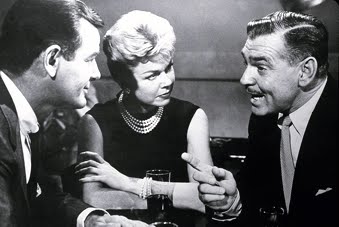
Teacher's Pet (George Seaton, 1958) is a romantic comedy on an interesting theme: real-world experience versus higher education. Clark Gable is the appallingly chauvinistic city editor (only some of his myriad flaws evident to the writers) who enlists in a journalism course to mock pert blonde teacher Doris Day, only to fall for her - and her message. It's quite well-written and played, with a strong presentation of newsroom life (it's not much like a Harrogate weekly in 2011) and a notable supporting turn from Gig Young as Day's sure-sighted intellectual collaborator. (3)

***


Mr. Jealousy (Noah Baumbach, 1997) – Substitute teacher Eric Stoltz starts a relationship with art gallery tour guide Annabella Sciorra, but is swallowed up by the green-eyed monster, becoming increasingly jealous of her past lovers - and then himself. This singularly unpromising premise is quite well-developed, with excellent turns from Carlos Jacott as Stoltz's complex pal and Chris Eigeman playing his arch nemesis, celebrated writer Dashiell Frank. The scenes in group therapy are very funny and a long-promised unmasking is hysterical, though the film still has some dull stretches and an extended ending that seems tacked-on. It's worth a look, but not in the same league as Baumbach's Kicking and Screaming. Or The Squid and the Whale, for that matter. (2.5)

***


Lady Be Good (Norman Z. McLeod, 1941) is the only musical I've seen with a framing sequence set in a divorce court*. The story about bickering married couple Ann Sothern and Robert Young isn't great (added to which, he's an absolute idiot) and the early numbers just consist of them singing round a piano, but the musical interludes get better and better as the film progresses, with the acrobatic African-American trio the Berry Brothers making a couple of appearances (they were rivals to the extraordinary Nicholas Brothers and engaged in a famous dance-off in 1938) and tap queen Eleanor Powell performing two routines. The first is a neat dance with a dog, but the second - with her in a glittery suit, hoofing to Gershwin's Fascinating Rhythm - is nothing short of astonishing. It was devised by Busby Berkeley, as you might expect, and is filmed in a palette of which silvery cinematographer Gregg Toland would have been proud. To see how it was staged and shot, check out That's Entertainment! III. Red Skelton's impression of Chinese people is a little bit racist. (2.5)

*Though Dancer in the Dark ventures into the criminal court.

***


Sylvia Scarlett (George Cukor, 1935) - Katharine Hepburn and Cary Grant made four films together. This is the other one, made a full three years before the commencement of that unmissable run incorporating Holiday, Bringing Up Baby and The Philadelphia Story. Before Grant debuted the persona that would define an entire era of America movie-making, in The Awful Truth. Here, Cary's a Cockney con man, Kate's a motherless waif posing as a boy and Brian Aherne is an artist of unclear morality, trying to give her a life lesson or two. The plotting is all over the shop, beginning with a parade of over-emoting that plays like a parody and recalls the worst excesses of silent melodrama, then going from knockabout comedy to improbable tragedy and back again in the blink of an eye. Several times. But it's rarely dull, Hepburn is mostly very good and the ending is nicely realised. (2.5)

***


Knight and Day (James Mangold, 2010) is a great trailer in search of a decent film. I've finally gotten around to seeing it and I still feel like I haven't. It's OK froth, beginning well with tongue firmly in cheek, but soon going awry in its gently incoherent, globe-trotting way. Tom Cruise is good fun in his ambiguous role; Cameron Diaz can't do comedy, drama, or anything else really, and looks weird and melted. (2.5)

***


Never Wave at a WAC (Norman Z. McLeod, 1953) - Pathetic addition to the "in the Army now" comedy ranks, with Rosalind Russell going from hideous socialite to hideous private. The story and script are unbearable and Russell - one of the most revered comediennes in the history of the movies, and of course His Girl Friday's Hildy Johnson - is just dreadful. The only bright spots come from Marie Wilson, doing her usual dumb blonde schtick. Bizarrely, this mess was directed by genre veteran McLeod, who was no stranger to manic masterpieces, having helmed the Marx Bros' 1932 classic Horse Feathers. (1.5)