Showing posts with label Martin Scorsese. Show all posts

Monday, 9 January 2017

Jane Austen, Pride, and Martin Scorsese pandering to my every whim – Reviews #254

I've only watched two films since 22 December (what the hell?), as I have been Broadening My Horizons*.

Thanks to everyone who read and shared my blogs last year. It topped 9,000 views in a month for the first time ever in December, which might not sound like a great deal, but meant a lot to me.


Pride (Matthew Warchus, 2014)

"Our lives shall not be sweated,
From birth until life closes,
Hearts starve as well as bodies,
Give us bread, but give us roses."

The best British film I've seen since Attack the Block, taking a premise that seems merely like a liberal wet dream and fashioning an astonishingly erudite, funny and intensely moving movie, which works as an examination of our shared humanity, a startling recreation of the last stand of our country's working class, and a much-needed rallying cry at a time when the left has never seemed weaker or more irrelevant.

Ben Schnetzer plays Mark Ashton, a gay rights activist who persuades his friends to protest on behalf of the miners engaged in the longest and bloodiest strike of the post-war era; like the gay community, they've been smeared and attacked by the government, the police and the right-wing press. There's division on both sides − his colleagues have been persecuted by alpha males their whole lives; the miners think the poofs will turn them into a laughing stock − but their uneasy alliance grows in sincerity and power as it progresses.

Pride is of a piece with those popular and critical British successes of a previous generation − Brassed Off, The Full Monty, Little Voice and Billy Elliot − which effectively juxtaposed artistic or social endeavour (a key tenet of British working class life since time immemorial, just watch Humphrey Jennings' Spare Time from 1939) with the plight of community, as Thatcher systematically decimated the country's industrial heartlands. But I found it more persuasive than those films, mixing Brassed Off's intellectual rigour and daring with The Full Monty's box office crowdpleasing, and Little Voice's embracing of the outsider hero.

A lot of that is in Stephen Beresford's script, which has a very clear voice, right from the off, full of distinctive, imaginative and beautifully balanced dialogue. I particularly enjoyed this exchange:

"I've never met a lesbian before."
"I've never met anyone who irons their jeans before."

There's also one instantly classic bit of dialogue that perfectly epitomises the collision between two worlds, as veteran mining committee secretary Gwen (Menna Trusler) alerts her colleagues to the presence of their visitors with the immortal words: "Dai, your gays have arrived."

It's in the film's emotional moments, though, that I found it most effective, and altogether unforgettable. Many of these are from Andrew Scott's tormented Gethin, given a lifeline by the venture, and from Schnetzer, astonishingly good as the driven, prepossessing and amiable Mark, whose flipside is a pained, alienated despondency. I had no idea he was a native New Yorker until googling him afterwards. There's also one of the best single-scene bits in aeons from Russell Tovey as Mark's friend Tim.

Occasionally the film becomes too cartoonish, usually when Dominic West's flamboyant gay actor, Jonathan, is permitted centre-stage, or Lisa Palfrey peddles her one-dimensional villainy, and my main quibble on seeing the cast − that perhaps drama-school-educated, middle-class Londoners aren't the best choices to play working-class Welsh people − was validated somewhat by Imelda Staunton's slightly synthetic performance, though Bill Nighy is often very good as sympathetic committee member, Cliff. One of the script's real virtues is its rich tapestry of human life: there are at least six brilliantly-drawn characters − what's the last film you could say that about? And the rest of the casting is superb: Paddy Considine perfect as the gays' first friend amongst the miners − a measured, compassionate man − Joseph Gilgun as funny and lacking in vanity as ever, George MacKay attractively callow and genuine as a fledgling gay, and Faye Marsay as the spiky, angsty lesbian who said that thing about jeans above.

The two scenes that utterly floored me, though, were the 'Bread and Roses' set-piece − built around as perfect an evocation of working class pride and dignity (and feminism) as was ever written, and augmented with tearjerking visual grace-notes from Scott and Liz White − and a note in the credits that resolves that age-old question: can a brief statement about block voting at a political conference ever make you cry? Director Matthew Warchus's building up of momentum during those final scenes just couldn't be better, finding solace and inspiration in what was a crushing and humiliating defeat.

This is on iPlayer for a few more weeks, and I would urge you to watch it. It's uplifting, mature, intelligent, entertaining and important: a valuable corrective to modern myths about people and politics, relentlessly peddled by a hypocritical media and a political establishment who continue to con millions of people into voting against their own interests, and then to blame those who have even less for their straitened circumstances. (4)

See also: Matthew Warchus went on to direct my favourite play of 2016, so well done him. I wouldn't be doing my job if I omitted to mention that we'll be joined by Mike and Jonathan from the LGSM for a special screening of Pride at the Royal Albert Hall next month.

***


CINEMA: Pandora and the Flying Dutchman (Albert Lewin, 1951) − A Hollywood art film, and as such one of the most interesting American films of its era: a metaphysical love story in which a poet (Marius Goring), a racing driver (Nigel Patrick), a matador and the Flying Dutchman himself (James Mason) risk death or worse in their pursuit of former nightclub singer Ava Gardner, and who can blame them?

I've wanted to see this somewhat notorious curio since reading Lee Server's biography of Gardner more than five years ago, which painted the actress as a voracious, hedonistic auto-didact who left behind her dirt-poor Southern upbringing to become a muse to some of the era's greatest men (including Hemingway), before depressingly if flamboyantly self-destructing. Server was at pains to highlight the unorthodoxy, originality and vision of this film (if not always the execution), and I finished the book wanting to see it more than any other.

It took an intervention by Martin Scorsese (a deus ex machina if ever there was one) to determine that not only would that be possible, but to ensure that it'd be on the big screen, thanks to his curation of a special season at the BFI featuring various oddities that have inspired him over the years. And seeing this farcically ambitious film as it was intended allowed me to luxuriate in its Spanish coastal locales, its incomparably sensuous leading lady, and writer, director and co-producer Albert Lewin's decidedly odd approach to just about everything, from shot framing to the rules of narrative (no, Albert, to the best of my knowledge, no-one has ever done a dream sequence within a flashback within a flashback before; even The Locket didn't try, and that had flashbackitis).

It's a bold, serious-minded and, yes, dreamlike film – though not without humour – that asks us to believe in faith, in fate, in legends, as Mason's sailor is doomed to sail the earth unless he can atone for his sins by, erm, making a woman die for him (bit sexist). He's good, though it's Gardner, as a cruel beauty transfigured by love, who dominates – she was often derided as an actress, especially during this period, but her untaught naturalism has aged extremely well, immune to changing modes of performance.

She is also the flat-out sexiest, most erotic actress there has ever been on screen: not the prettiest, not even necessarily the most well-proportioned or of a type still considered fashionable, but she has what Billy Wilder once called 'flesh appeal', appearing in 3D when everyone else is in two, her visceral appearance allied to a knowingness, a mixture of the ruthless and the vulnerable, and an ease in her skin that is intoxicating. Especially on the big screen.

Her conviction and attractiveness are as much a key to making this film work as Lewin's impassioned writing and his and Jack Cardiff's remarkable visual sense: notably exemplified by that shot of Gardner's face almost as a landscape, Patrick some vague cipher approaching her eternal beauty (a shot that seems to me to be echoed by Vilmos Zsigmond in The Argument); or her scarf on a headless statue that points out to the sea that will ultimately take her (that's not a spoiler, it's revealed in the first scene). I don't doubt that it was Cardiff's photography that drew, Scorsese, a massive Michael Powell buff, to the movie. Cardiff shot several of Powell's most celebrated films, including The Red Shoes and Black Narcissus.

The film is a little long-winded, at times simply too po-faced, relies overly on voiceover, and occasionally tips over into pretension or silliness, but it's also a genuinely ambitious, literate and artistic film, full of imaginative language, camera angles and ideas, and with just the right actress to play the beautiful, sensuous and thoroughly doomed Pandora. In fact, the only actress who could have done it. (3)

See also: There's a little about One Touch of Venus, Gardner's 1948 vehicle, in this thing here.

***

A BOOK:


*A FEW SPOILERS*
Northanger Abbey by Jane Austen (published 1917)
– Jane Austen’s first completed novel, only published posthumously, is often cited as simply a parody of Gothic literature, but it’s immeasurably more: a witheringly sarcastic romantic comedy of manners, with precisely no intrusions from the supernatural or melodramatic, vastly more accessible and universal than I ever expected. Its spoofing, when it comes, is simply another comic device: Austen toying with the over-the-top expectations of her impressionable heroine, and suggesting that perhaps popular culture isn’t always the best guide to behaviour in the real world, a remarkably contemporary observation. You don’t even need to be a literature buff to get the Gothicism jokes, as Austen gently, deftly introduces the genre tropes in amusing discussions between the hero and heroine, before meticulously layering them one upon the other, then puncturing the bloated illusion with a sharp, incisive revelation.

The story has 17-year-old Catherine Morland, Austen’s most naïve heroine, going to Bath – where she finds love and friendship – and then on to Northanger Abbey, where she is assailed by intrigue of her own imagination. It’s faster and arguably funnier than any other Austen book, with a truly bruising wit – particularly when angled at braggadocious bore John Thorpe, who has Catherine in his sights – and some breathtakingly modern, absurdist observations from love interest Henry Tilney, whose satirical, laborious constructing of false positions is basically my entire sense of humour. There are also piquant, pungent passages dealing with superficiality, duplicitousness and greed, and startlingly clear-eyed, refreshing characterisation that seeks to rescue the novel from the clutches of the unbelievable. Having a character who starts to pay attention to a woman only because she clearly fancies him is a refreshing change from the hyperbole of many romantic novels.

About three-quarters of the way through the book, Austen arguably pushes Catherine too far, the heroine’s fanciful conspiracy theorising transgressing from the appealing to the appallingly insensitive, but even this potential (and indeed apparent) misstep is merely waiting for a suitable pay-off, and gets one in a denouement that has enormous, escapist fun in tying up loose ends with glee and elan – her callback to the notes in the ‘japan’ bureau is particularly and exceptionally charming.

In the Christmas Radio Times, a Bronte fan was sneering at Jane Austen for the primness of her heroines, but it’s both a misreading of those characters, and lacks insight into the differences between an author’s viewpoint and that of her creations. Catherine Morland becomes a woman over the course of these pages, but even before that she makes judgements chiefly about herself, and is shocked by cruelty and hypocrisy as opposed to a breach of accepted manners. Austen too, more than in any other book until Persuasion, showcases a contemporary sensibility that’s remarkably fair-handed, wise and good-natured, her blistering sardonism a formidable weapon turned only on the most deserving causes. She’s so fierce and funny, so strikingly modern, that painting Austen (or one of her heroines) as an endlessly shockable shrinking violet does her a ridiculous disservice, and seems to miss what it is that fans respond to so keenly in her work. (4)

Next up is Stephen King's 11/22/63, which I'm halfway through.

***

Thanks for reading.

*newcomers: this is an homage to my beloved A. A. Milne, I do know how to use capital letters

Tuesday, 4 February 2014

Tom Hiddleston, The Wolf of Wall Street and the first of Fonda - Reviews #183

Here are the things I've been watching lately. Wow as I get a bit bored of Scorsese's latest. Thrill as I watch a Janet Gaynor film. Coo appreciatively as you read a potted biography of John Barrymore.


CINEMA: The Wolf of Wall Street (Martin Scorsese, 2013) - So what's all this then? Basically Banks of New York, with Leonardo DiCaprio as hedonistic stockbroker Jordan Belfort, the kind of guy who caused the global recession.

Here he is having an awesome time. Look at his wife. Look at his car. Look at the size of his house. Here he is snorting cocaine off a hooker's boobs. Here he is doing it another eighteen times. Here he is making money. He has lots of money.

Scorsese's admirers will tell you that the director's presenting the facts about Belfort without comment or embellishment, and letting us make up our own minds. I don't buy it. Look at the final shot of the agent assigned to Belfort's case (Kyle Chandler), then try to tell me we're supposed to be energised on his behalf, rather than gloating on his adversary's. I'm not saying Scorsese is on the side of rapacious financiers, more that the film's gleeful tone is a botch job.

The film is troubling and immoral, then, but is it any good? Not really, no. There's an unshakeable confidence about it, DiCaprio gives an assured star turn in the Catch Me If You Can mould, and there are some big laughs and good scenes, particularly near the beginning: Leo having lunch with his mentor - weird, unrepentant über-Gecko, Matthew McConaughey - aceing a penny-share sale, quizzing Jonah Hill about marrying his own cousin, and sparring with FBI agent Kyle Chandler on the deck of his gargantuan yacht. But while I chuckled a bit at DiCaprio's monstrous arrogance, there's a point where I stopped caring what was happening, or deriving any pleasure from the story. I think it was the 408th orgy.

I've seen the film compared endlessly to Goodfellas, but it's more like DePalma's wretched remake of Scarface. It's just deadeningly debauched: a three-hour, one-note exercise in coke-fuelled, fleshy excess with almost no narrative impetus, virtually nothing to say, and even a certain desperation in its supposed strong suit of comedy. Isn't it funny to chuck a dwarf around? Lol when he's on drugs DiCaprio says it's like having cerebral palsy. Now he's effectively raping a woman on a plane. What a card.

Given the critical bouquets being flung in its direction, I was expecting something special. But if you want a film that embraces con artistry, examines the American Dream, and delivers nuanced characterisation to go with its razor-sharp comedy, try Barry Levinson's eternally overlooked Tin Men, one of the great films of recent decades. Scorsese's best since Goodfellas? This is barely his best since his last film. (2)

***


National Theatre Live: Coriolanus (Josie Rourke 2014)

Coriolanus: "I had rather have one scratch my head i' the sun.
When the alarum were struck, than idly sit
To hear my nothings monster'd."

I want to monster Tom Hiddleston's nothings. (3)

***


Sightseers (Ben Wheatley, 2012)

"Bye, Mum."
"You'll be back."
"I will, Mum, in a week."

Badlands. In the English countryside. With jokes.

I missed Down Terrace and found Kill List a major disappointment - albeit an intriguing one - but A Field in England, one of the most fun film events of last year thanks to its simultaneous multi-platform release, suggested Wheatley was clicking into gear impressively, another slightly iffy story given superlative, (then somewhat pretentious, long-winded) treatment. Sightseers, his third film, looked better yet, with a fun trailer spotlighting an ace premise and some sly gags - and so indeed it was.

The story sees Tina (Alice Lowe), an ordinary girl from the Midlands, leaving her impossible mum behind to go caravanning with her new boyfriend, Chris (Steve Oram). They're hoping to take in some historical ruins, the Keswick pencil museum, and a fair amount of in-caravan boffing, only for his anger issues to fatally intrude.

The best thing about the film is its tone: aside from Tina occasionally being too dense and one radio broadcast that goes too broad, it creates an affectionate, believable adult relationship - very British in a way rarely seen on screen - within a credible environment of camp stoves, macs and rainy walks, then proceeds to chuck shards of black comedy and bloody violence excitedly into the mix.

While the story is fairly simplistic, though with one particularly clever development, the script is absolutely exceptional, and both leads are superb: Lowe perfectly articulating a certain sort of lovelorn but upbeat, unambitious 30-something Brit, and Oram personifying an outwardly avuncular but troubled man held hostage by his creative impulses, which aren't necessarily matched by his talents (oh dear, that sounds like me).

Wheatley's direction is mostly quite restrained, but with a few agreeably unusual shots (the door closing on Lowe's mum is inventively done) and a handful of extremely effective, intensely edited montages, rich in symbolism and with great use of music, including Donovan's Season of the Witch.

I'm in two minds about the ending. Wheatley seems to be obsessed with these abrupt finishes, where you can almost see him sitting back in his chair, going: "How about that, then?", and thinking that what he's just done is jawdropping, rather than mildly unexpected. On the other hand, this one is broadly in keeping with the story, and works fairly well.

All in all, Sightseers zips by. There's no real message or depth, but it does offer some amusingly askew philosophy, a little suspense - generally alleviated only as and when someone is dead - and a lot of good jokes, including Lowe's memorable putdown of her boyfriend's writing career. (3.5)

***


When the Wind Blows (Jimmy T. Murakami, 1986) - Hell. A devastating animated feature about the Atomic Age from the writer and director of The Snowman, which takes Peter Watkins' seminal drama-doc The War Game as its jumping off point, showing an archetypal, retired English couple as they prepare for an approaching nuclear strike.

Voiced by a perfectly cast Johnny Mills and Peggy Ashcroft, with a Roger Waters score that oscillates between wistful tranquility and doom-laden industrial mayhem, it's also a technical wonder, juxtaposing cartoons and strikingly grim photography as it juggles fantasy, reality and reflection to consistently remarkable ends, its gentle tone evaporating as the bomb approaches.

The World War II and wedding photo sequences - the latter surely an influence on Up's "Married Life" segment - are as moving and exalting as anything you'll ever see, depicting a world that at least, to these people, made some sort of sense.

By contrast, the film's long, slow and unremitting descent into ugly, pock-marked death is utterly horrifying. All this in a world that makes no sense at all. As much as Mills tries to reassure his wife, and himself, that there's some Government plan, that some help is on the way, he - and we - know that there's nothing. (4)

***

Alfred Hitchcock triple-bill:


Dial M for Murder (Alfred Hitchcock, 1954) - One of Hitchcock's most straightforward and entertaining films, with little visual innovation, just a meticulous, involving story about urbane psychopath Ray Milland plotting the murder of his wealthy wife (Grace Kelly), after learning of her affair with a mystery writer (Robert Cummings).

Taking place largely in a single London flat, it has just one notable set piece, and even that could have been done by a dozen other directors. But freed of the need to craft and then tie together those ambitious, show-stopping sequences, Hitch is instead able to throw his energies into making the clever, intriguing but stagy material cinematic and alive. And he's helped by a decent cast, with Milland in good form as the former tennis pro investigating a new and lucrative career in sociopathy.

A scene featuring Kelly's persecuted head is bafflingly rendered and the ending to this thriller could do without so much Basil Exposition, but those are minor quibbles with a first-rate film. (3.5)


Rope (Alfred Hitchcock, 1948) - Hitchcock loved an experiment. In 1954 he would shoot (almost) an entire movie, Rear Window, from a single vantage point. Six years earlier he presented this popular stage play as a "single take" feature - with one cut and some rather obvious cheating.

The effect is of being permitted on stage during a play with no scenery changes, and having Hitchcock push you around the set, occasionally grabbing the back of your neck to show you what you should be looking at. It's arguably negated by zooming in and out of someone's back every 10 minutes (Hitch's somewhat artless way of obscuring the joins between takes), and there's probably a reason why the exercise has only been repeated once or twice, but it's an interesting approach and one that really suits the material.

Rope used to be regarded as a lesser work, but is now ritually listed among his classics, perhaps because its technical showboating is more appreciated; perhaps because its cynicism is easy for a modern audience to embrace (while I've lost count of the number of times someone has praised a film noir for its nastiness, I'm yet to hear anyone laud an old rom-com for its consummate niceness).

Or perhaps its critical standing is simply because it's very good indeed: the gripping story of two murderers (John Dall and Farley Granger), patterned after Leopold and Loeb, who hide the body in a chest, throw a tablecloth over the top and invite the victim's friends and family over for the evening.

The first and last five minutes are rather weak, but the rest is first-rate, full of clever touches and lashes of black humour, with Dall and Jimmy Stewart very well matched: the former a superficially charming Nietzschean superman, the latter his erudite, endlessly joshing former mentor, and the one guest who smells a rat. (3.5)


*SPOILERS*
The Man Who Knew Too Much (Alfred Hitchcock, 1956)
- Forget the story and feel the suspense, as Hitch uses that old kid-in-danger set-up to serve up a succession of virtuosic set pieces.

A dead man walking through a Marrakech market place.

Jimmy Stewart trying to make a critical phone call as he's interrupted by some luvvies, and heading to a secret rendezvous tracked by noisy footsteps.

The mesmeric, pulsating Albert Hall climax, which builds from a concert performance to one of the tautest sequences in the Master's oeuvre, as Bernard Herrmann conducts, a statesman watches, and a gaunt gunman lurks.

And Doris Day belting out Que Sera, Sera at the top of her lungs, hoping it will rouse her kidnapped kid, and bring him back to her.

(There's also that usual bit where Hitchcock gets really excited by a staircase.)

Hitch's loose remake of his own 1934 effort, concerning an innocent couple mixed up in an assassination attempt, is a film with many great things in it, rather than a great film. The script feels slight, padded and lacking in panache, Day and Stewart exhibit little chemistry, and the kid would like wildly out of his depth in a school nativity (look, I'm cool, I picked on a little boy). And then there are those hideous process shots that blight a lot of Hitch's '50s work (some unbearable critics have suggested he's purposefully introducing a theatrical unreality to his work; yeah, he's not, he just didn't realise how crap they looked).

But while the leads never quite click with one another, they both offer a great deal individually. Championing Stewart is, of course, as uncontroversial as thinking the effects in T2 were quite impressive for their time, but being a Day fanboy is resolutely uncool today. That's perhaps due to her wholesome image and the clunkers she was later forced into by her agent husband, but she was a remarkably talented woman with a singular voice. While her performance is best remembered for her Oscar-winning rendition of Que Sera, Sera, she also gives the film the undercurrent of love and humanity that it needs, lending the disorientating, brilliantly-filmed Albert Hall sequence an added feeling of maternal desperation.

It's those imaginative, self-contained and perfectly paced set-pieces that are the film's raison d'être, and those - as well as a certain slickness of production - that lift it out of the class of the original, even without Peter Lorre's delicious presence. (3.5)

***

John Barrymore double-bill:


*MINOR SPOILERS*
The Beloved Rogue (Alan Crosland, 1927)
- John Barrymore was one of the greatest actors of the 20th century. That's simply a fact. His performances as Richard III and Hamlet on the stage in the 1920s revolutionised Shakespearean acting and inspired the likes of Gielgud, Olivier and Orson Welles. But it's often hard to make out his undoubted genius in his screen work, which was erratic to say the least.

That was down not only to the different demands of film acting when he was at his peak - less physical and at that stage soundless - but also his general disdain for the medium, and for the roles he found there. He went into movie acting because he was easily bored, abhorred repetition and liked money. And so although he is brilliant in the mental health drama A Bill of Divorcement and in parts of Wyler's punchy Pre-Code legal melodrama, Counsellor-at-Law, although he lit up Twentieth Century when perfectly set up to chew all the scenery he liked, although he provided brief flashes of brilliance across a half-dozen other roles, from Don Juan to Topaze to Midnight, it's often hard to reconcile the two Jacks.

On the one hand there is the consummate artist, a dizzyingly talented, ambitious thespian who reinvented himself from a light comedian to a mesmerising tragedian across less than five years during the Jazz Age. And then there is the increasingly hammy, increasingly dissipated "Great Profile", playing every role for a laugh, with a raised eyebrow in place of a performance.

So it was with some excitement that I came across The Beloved Rogue, an extravagantly mounted silent version of the story later made as If I Were King (script by Preston Sturges), in which Barrymore - if not approaching his scintillating Shakespearean apex - is at least astonishingly good. There are moments when that eyebrow makes its dreaded appearance, when he skips around merrily like a pointy-bearded pixie, but then he does something like the scene by the snow-capped monument, removing his Fools Day disguise as his heart quietly breaks, and all is forgiven. That passage is so touching and so beautifully restrained, the whole effect created solely with his eyes. There are lush love scenes too, rousing speeches, and several stunning sequences where his poet goes tête-a-tête with his king (an extravagantly weird, intensely good Conrad Veidt), and this vision of Barrymore, the greatest actor of his age, hoves quite unexpectedly and gloriously into view.

For those not familiar with the story from the respectful, lushly-mounted Ronald Colman version, Francois Villon (Barrymore) is a pickpocket and carouser who also doubles as France's national poet. He loves "France earnestly, Frenchwomen excessively, French wine exclusively" - not true of Barrymore, of course, who had no great feeling for patriotism, loved all women excessively and drank anything. Some people think he's a ledge, I think he's a tragic alcoholic who followed in his father's footsteps by throwing his God-given gift down the toilet. But not before doing things like this. Anyway, back to the story, in which Villon finds himself at loggerheads with the scheming Duke of Burgundy (Henry Victor) and so with the superstitious, weak-minded King Louis XI (Veidt), while vying for the hand of the monarch's hot ward (Marceline Day).

There are four credits that stand out. Director Alan Crosland essentially sounded the tinny, Jolson-y death knell for silent cinema the same year by making that abysmal first talkie, The Jazz Singer, but fills this one with lovely, stunningly-lit imagery, assisted by future John Ford cinematographer Joe August. William Cameron Menzies was a magnificent art director who worked on the likes of The Thief of Bagdad (the silent version) and Gone with the Wind, as well as directing Things to Come (great sets, boring film), and produces a grubbily opulent Paris, complete with a massive great tower for the climax. And Paul Bern, remembered today - if at all - for his marriage to Jean Harlow and tragic, mysterious demise, was a first-rate screenwriter who penned The Marriage Circle for Lubitsch, and wrote MGM's all-star film Grand Hotel five years after this one. His script here is dramatically imperfect, with a few sequences that stall the film's momentum - most notably the reunion between the hero and his friends at the palace, and his later torture - but it's full of rich characterisation, cleverly-conceived action sequences, and remarkably deft dialogue in its title cards, including plenty of witty verse for Villon.

Given over to Colman, Villon was an engaging if rather safe, smug speechmaker. In Barrymore's hands, he's quicksilver: a mercurial man driven to extremes by all-consuming passions: love, lust, righteousness, patriotism and drink. Though the film frames him as a swashbuckler in the Douglas Fairbanks mould, Barrymore is far too sensual to play an everyman, or transmit a straight-up heroic quality, and that makes the film, and his ultimate, fascinating conversion into this Christ-like figure, all the more intriguing. It is, to all intents and purpose, a piece of escapism, as Fairbanks' historical pictures were, and a slightly flawed one at that. But when Barrymore hits the heights, he's a far better actor than Fairbanks - or just about anyone else - ever was, taking Villon, and us, to new and incredible places. (3.5)

Trivia note: That's unmistakably Dickie Moore as the baby Barrymore, in his first screen appearance. Moore went on to feature in more than a hundred films, including Peter Ibbetson, Lubitsch's Heaven Can Wait and Out of the Past. He's still knocking around today, and is married to fellow former child star Jane Powell.


Dr. Jekyll and Mr. Hyde (John S. Robertson, 1920) - Did Mr Hyde have such comically oversized hands in the book? He looks like Miley Cyrus at the VMAs. This is a reasonable silent version of the oft-told tale, with John Barrymore having fun in the dual role of the idealistic doctor and the monstrous, big-handed alter-ego into whom he pours his moral failings. The film is pictorially static and dodgily adapted, with as many dry spells as great moments, but it's definitely worth seeing for Barrymore's performance(s), even if his troubled, nuanced, rather gorgeous Jekyll is more substantial than his off-the-scale Hyde. Incidentally, director Robertson was the figure immortalised in one of The Byrds' greatest songs, Old John Robertson. In his dotage, the Stetson-wearing eccentric was a figure of fun to Chris Hillman and the other neighbourhood kids. (2.5)

***


The Farmer Takes a Wife (Victor Fleming, 1935) - I don't like it, Mummy. Henry Fonda looks too young. This was the first film of Fonda's 56-year screen career, as he brought his breakout Broadway role to the screen, playing the titular farmer, who romances a feisty cook (Janet Gaynor) whilst working on the Erie Canal. And very smooth-faced and bushy-tailed he is too.

Its stage origins are obvious, but it is opened up well in places into something like Americana, evoking an under-represented area of U.S. history - the east just prior to the mid-19th century railroad boom - and throwing in a few references to the likes of Lincoln and Booth, wagon trains and government treaties with the Native Americans, which places it in context as well as just being good, eerie fun. It's also nicely photographed by Ernest Palmer, who shot many of Fox's best late silents, including 7th Heaven, Street Angel and The River for Borzage, and Murnau's City Girl.

There's plenty of character business featuring Slim Summerville, Andy Devine, Margaret Hamilton, Sig Ruman and John Qualen, though the film is at its best when either evoking a pastoral idyll or focusing on Fonda and Gaynor. The source of their trouble, for there's always trouble, is not unlike that in the Tom Waits song Fish & Bird ("He said, 'You cannot live in the ocean', And she said to him, 'You never can live in the sky'"): she won't leave the canal and he wants a farm. To be honest, it's rather an uninteresting dynamic - and the subplot about Fonda's "cowardice", featuring annoying Charles Bickford, is retrograde nonsense - so their earlier scenes are the best, but they're both such talented actors that they can make anything look good.

Fonda's technique is a little stagy in places, but it's surprising how quickly he adapted to the requirements of screen acting (and his adorable habit of prefixing any word starting with "w" with "huh" is present and correct: "Like huh-what?"). And Gaynor is just fantastic, cast in an unusually fiery part that recalls her early scenes in Lucky Star. It's a pity that the only existing print is missing a few frames here and there, making their first meeting choppy and sometimes difficult to follow.

The film is inconsistent to say the least, both dramatically and stylistically, and there's a character from "Yorkshire" whose accent is frankly very Welsh, but it has a few lovely moments as well as a pair of very attractive star turns. (2.5)

***

Thanks for reading.

Wednesday, 28 December 2011

Scorsese scores, Gervais bores - Reviews #94

I've got to go back to my holiday in a moment, but here are a couple of reviews:


Hugo (Martin Scorsese, 2011) - Little Martin Scorsese (Asa Butterworth) rescues the reputation - and happiness - of neglected, balding film titan Michael Powell (Ben Kingsley) in this heartwarming, Truffaut-ish love letter to the early days of cinema, set around Montparnasse train station. The film is unapologetically episodic, plays by its own rules (breaking off for oodles of back-story more than once) and hits the target most of the time, thanks to the fascinating subject matter, Scorsese's vivid direction - incorporating spectacular use of 3D - and a cast that does broad in a way that works. It's easily the best thing Scorsese has done since Goodfellas - excepting No Direction Home, of course, on the grounds that it doesn't really count. (3.5)

This would probably have made #10 in my Top 10 of the Year.

***


*REVIEW CONTAINS ONE INSTANCE OF ANGRY SWEARING*
Life's Too Short (S1, 2011)
- Shortly after making the first series of The Office, Ricky Gervais was asked about his favourite sitcoms of all time and, waxing lyrical about Cheers, said the most impressive thing was not pushing boundaries of taste, but making shows that - while inoffensive and of the mainstream - were of exceptional quality. Unfortunately he seems to have forgotten that, as this over-familiar mockumentary, mining the comedy of embarrassment via reheated stock situations and populated with boring celeb cameos, is full of tedious, laboured taboo-tickling shit, even if its treatment of dwarfism is generally quite sensitive)*. Warwick Davis is good value in the lead, playing a hideous spin on himself, but the supporting cast is mystifyingly poor (with the honourable exception of the excellent Rosamund Hanson) and the material, while containing moments of genuine inspiration (the sight of our hero pretending to be the Lord of the Dance in a hotel room will live long in the memory), is terribly spotty: predictable, obvious and frequently unfunny, particularly in the underwhelming final two episodes. I'm a conventional, sentimental sort, and my favourite comedies generally leave me feeling uplifted and fulfilled. After a fun start, this one made me angry, deflated and disappointed - especially on behalf of Davis, who gives his best and is clearly a decent comic performer. Apparently the series is coming back in 2013, but I don't think I'll be rejoining it. After all, life's too short. Arf. Somebody probably already did that one. (2)

*I'm not saying that there isn't a place for that kind of comedy, done well - of course there is. It's just bizarre that Gervais seems determined to carve a niche there, as he's really not very good at it.

Sunday, 27 November 2011

The Fighter, Natalie Portman and a man repeatedly saying "Ravi" - Reviews #89


The Fighter (David O. Russell, 2010) - Conventional, sometimes muddled, but very entertaining and well-acted boxing drama about fighter Micky Ward (Mark Wahlberg) taking a last crack at the big time, as his brother (Christian Bale) just takes a load of crack. I'm a big fan of Wahlberg, but here he's blown off the screen by a trio of supporting players who are given far more interesting roles: Amy Adams, as the tough college dropout with whom he falls in love, Melissa Leo as his ferocious chain-smoking mother and - best of all - Bale as the self-destructive dreamer who once knocked down Sugar Ray Leonard. It's not up there with remarkable boxing movies like Body and Soul and Raging Bull - or even Champion - but it's the right mix of slick and gritty: the powerful mockumentary inserts underlining the most remarkable fact of all - that it's all based on a true story. (3)

***


*MINOR SPOILERS*
Black Swan (Darren Aronofsky, 2010)
- A ballerina, caught in a love triangle, loses her mind as she takes on an impossible role. Yes, it's The Red Shoes II, with Aronofsky spinning the dance film into psychological thriller and body horror territory, as Natalie Portman's driven, frigid perfectionist begins to fall apart, both mentally and around the fingernails. Portman is excellent in the lead, Barbara Hershey works wonders with a cliched part as her mother and the whole piece is a triumph of directorial invention - vivid visuals and eerie soundscapes combining to chilling effect in fragments of black fantasy - but it's all to service a story that's a bit old hat and difficult to engage with. Mila Kunis and Vincent Cassel (who can only act in French) offer a whole lot of nothing in support. Having seen many '30s musicals, I'm sure putting on a show used to be a lot more fun. (3)

***


The Distinguished Gentleman (Jonathan Lynn, 1992) - Underrated comedy that drops Murphy's familiar, wonderful, on-the-make persona into that old chestnut about a first-time congressman inspired by a sexy wumon to expose corruption, a story first filmed in 1932 as Washington Merry-Go-Round and popularised seven years later in Mr Smith Goes to Washington. It's predictable, then - and not nearly as biting as it could be - but great fun, with a handful of laugh-out-loud moments: the speech to the poultry moguls, the "she got her shoe back" gag and a scene where Murphy poses as a member of the NAACP. Indeed, most of his impressions get a run out at one stage or another. Lynn, who directed and shared writing duties here, was the co-creator of Yes, Minister, but had by this stage undergone a subtlety bypass, as evidenced by his revelling in the name 'Dick' and allowing Murphy to spout off about "homos" and keep threatening to kick people's ass. And, yes, while the impressive-looking supporting cast does include a nice bit from James Garner as a randy congressman, the star is really the whole show. But that's fine by me; at this stage Murphy was still firing on most cylinders - even if he's not quite another Jimmy Stewart. Or a Lee Tracy. (3)

***


*BIG SPOILERS*
Meek's Cutoff (Kelly Reichardt, 2010)
- Michelle Williams, Moaning Myrtle and Nina from Bored to Death head off the beaten track in this incredibly ambitious, halfway-successful attempt to make an uber-realistic wagon train Western, which then compromises that raison d'etre with a weird, ambiguous ending. The photography is full of wonderfully-composed images: scorched earth, white skies and muddied faces. The land itself is the most striking character, which is a good thing, as only a couple of the others are really fleshed out. The ever-exciting Michelle Williams is good as an individualistic, compassionate frontierswoman, and Bruce Greenwood does quite well as the grizzled old racist of the title, who could be heading for a lynching if he can't lead the gang to water. Paul Dano is oddly crap in support - he's done very little of note since that astonishing turn in There Will Be Blood. This genre effort, shot in the Academy ratio of pre-1953 oaters, is too distinctive and original to dismiss completely, but too muted - and sometimes too tedious - to be fully embraced. John Ford did a similar thing a whole lot better with the peerless Wagon Master. (2.5)

***


*MORE BIG SPOILERS*
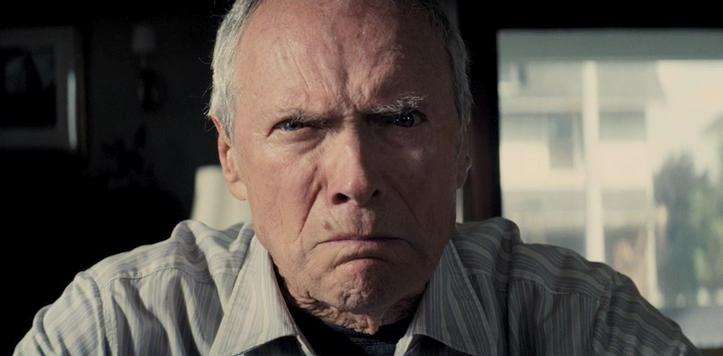
Gran Torino (Clint Eastwood, 2008)
- "Aaaauuuuuunnnnnnggggggh." Clint gets in a lot of good-quality growling in this simplistic but effective message movie about a bitter, bigoted old widower - whose worldview was shaped by the Korean War - bonding with the Hmong-folk next door. The ending cleverly and attractively inverts the Dirty Harry/Unforgiven fascist bloodbath pay-off, though the supporting cast is pretty wooden. (2.5)

***


*ONE INSTANCE OF SWEARING*
George Harrison: Living in the Material World (Martin Scorsese, 2010)
- Oddly repetitive, annoying documentary about the Pretentious Beatle, who seems to have only written three great songs, all of them in 1968-9. Dishearteningly, Scorsese appears to have forgotten how to assemble a musical biopic in the five years since the remarkable No Direction Home, chasing passing leads with the enthusiasm and negligible attention span of a toddler: the Beatles are in Hamburg, then they're doing Sgt Pepper, then they've split up. If you don't already know the back-story, you're going to be stumped. The rest of it is all "Ravi" ... "mantra" ... "spiritualism" and Shankar twatting about on a sitar, which quickly palls. (2)

Tuesday, 6 July 2010

How does it feel/To be on your own

The review of Bob at Hop Farm has attracted quite a bit of attention, so I thought I'd tack up the following for you. I'm usually to be found writing about movies rather than music. This review of Scorcese's celebrated Dylan doc has a bit of both; I penned it as part of the old Films on Friday column.


Bob Dylan - wouldn't even show you his right hand. Oh wait, there it is.

No Direction Home: Bob Dylan (Martin Scorsese, 2005)

Bob Dylan polarises music fans like no other artist. There are those who regard him as the great musical force of the second half of the 20th century - a poet, a pioneer, a genius. And then there are those who say he's overrated; his lyrics are pretentious, his voice is nasal. "Wrong", we call them.

No Direction Home is a portrait of the artist as a young man: described variously as "a sponge", "a shaman" and - yes - "a genius". Focusing on the period 1961-66 (with a little flashing back to his childhood), the three-and-a-half hour film presents his transformation from hero to outcast, as he defined, then rejected, the socially-conscious "folk revival" scene of the period.

The first thing to say is that the concert footage is spectacular. There are various outtakes from the notorious Eat the Document - a 1966 documentary shot by D.A. Pennebaker and never really finished by would-be editor Dylan (though bootleg copies exist), alongside rare material from civil rights events of 1963 and his three, explosive sets at the Newport Folk Festival, culminating with his going electric in '65. Best of all is (incomplete) film of the concert at Manchester's Free Trade Hall in which Dylan responded to cries of "Judas" with a blistering, snarling take on Like a Rolling Stone that remains one of the most extraordinary things I've ever heard.

There's great music from a selection of key influences too, including Odetta's Water Boy and an immensely moving version of If I Had a Hammer, in which Pete Seeger's voice is drowned out by his audience of black workers, singing along.

Then there are the interviews, with contributors ranging from Greenwich Village folkies to beat poets and journalists. Allen Ginsberg offers an appraisal rooted in free association, saying that Dylan had become "a column of air" by 1966, everything concentrated on his breath - and the words pouring out of him. Joan Baez is likeable and self-effacing, while Dave Von Ronk - a key influence on Dylan in 1961 New York - is affable and thoughtful, whilst possessing the greatest laugh in the world. Bob Johnston, who produced Highway 61 Revisited and Blonde on Blonde is a sweary, bear-like man who proclaims, guffawing: "I think that God instead of touching (Dylan) on the shoulder, he kicked him in the ass."

Interviews with Dylan, conducted in 2000 by his manager, Jeff Rosen, are used throughout the film. On first watch I found his contributions somewhat unilluminating, but on second watch - and having read 'Chronicles' - they seem revealing and honest. That's more than you could say for his answers to the barrage of stupid questions fired at him throughout the mid-'60s footage. "How many of the people who labour in the same musical vineyard in which you toil are protest singers?" one reporter asks. "I think there's about 136," Dylan says. Could he please suck his glasses for the camera? "Suck 'em?" Dylan replies. "Do you want to suck 'em?" The man declines. Dylan turns to the press gang. "Does anybody want to suck my glasses?" Another journalist asks to look at his left fingertips, imagining they've been toughened by playing electric. "I wouldn't even show you my right hand," Dylan fires back.

Booed at every concert by folkies appalled by his new direction, he appears to relent. "This is a folk song. I want to sing a folk song now," he says. There is rapturous applause. "I knew that would make you happy," Dylan says. "This is called 'Yes, I See You've Got Your Brand New Leopard Skin Pill Box Hat'." He is, frankly, hilarious. But the fun is evaporating fast, as Dylan is hailed repeatedly, against his protestations, as the spokesman of his generation, the conscience of Young America. He looks miserable, exhausted, trapped.

And still the spirit rages through him, face pinched beneath that mop of curly hair, wailing into the mic as the boos ring in his ears, until at last he can take no more.

This definitive Dylan doc is an exhilarating ride - insightful, gripping and electrifying. (4)
----------------------------------------------------------------------------------
No Direction Home is available on DVD for around £5.

Fans may also want to check out Dont Look Back (a somewhat unedifying portrait), The Other Side of the Mirror and Eat the Document.

The Free Trade Hall show (known colloquially as "The 'Royal Albert Hall' Concert") is my favourite record. Make your life immeasurably better by picking up a copy. We don't usually do orders, just recommendations, but I'm afraid this is an exception.