Showing posts with label Buster Keaton. Show all posts

Thursday, 21 July 2016

Sam Fuller, Maggie's Plan, and Buster Keaton on the skids - Reviews #235

And nothing else.


The Big Red One: The Reconstruction (Samuel Fuller 1980/2004)

What doesn't this war movie have?

- Big speeches
- Monologues about 'back home'
- Emotional death scenes
- Acts of heroism
- Anyone with special skills besides a few words of German or Italian

Sam Fuller's masterpiece, released in butchered form in 1980 then 'reconstructed' 24 years later according to his original shooting script, is a war movie like no other: the episodic, wryly fatalistic story of four dogfaces, dubbed 'the four horsemen of the apocalypse' who fight the battles that the writer-director had in World War Two: in North Africa, France, Belgium, Germany and Czechslovakia, under the wing of a taciturn, decent and unsentimental sergeant (Lee Marvin, himself a veteran of the conflict). Fuller himself is immortalised as 'Zab' (played by Robert Carradine), a cigar-chomping wannabe writer with a smart mouth, though his daughter Samantha says she could see him in all four of the horsemen, including the initially cowardly Griff, the most notable non-Luke part that Mark Hamill played during the first Star Wars run.

The Big Red One, named after the 1st Infantry Division of the American army, is a series of brilliant suspense sequences, alternated with poetic, poignant vignettes bearing the mark of memory, that seems to reach an essential truth about war that almost no other film has managed: it's just about survival. There are a couple of incidental flaws − foreigners talking English to one another with foreign accents (a now outdated device) as well as a scene in a castle near the close, which I just don't see the point of − but I found the experience completely and utterly overwhelming, in turn bloody, brutal and enrapturingly beautiful, with moments of tabloid ghoulishness and yet passages of almost Bresson-like humanism. It places you in the centre of battle like nothing else, but has no interest in glorifying its country, characters or the conflict in which they find themselves. It's simply the best war movie I've ever seen. (4)

***


CINEMA: Maggie's Plan (Rebecca Miller, 2015) - The only previous film I've seen from Rebecca Miller was Personal Velocity: Three Portraits, an extremely earnest slice of arthouse feminism that didn't quite come off. This film could hardly be more different: light, funny and accessible, a bit like a Lubitsch movie (it's thematically similar to both Angel and his classic, still contemporary comedy, That Uncertain Feeling) transplanted to the literate middle-class world of Woody Allen and Noah Baumbach.

The story concerns Maggie (Greta Gerwig), who works in arts marketing, sidelines as a complete control freak, and falls in love with a self-obsessed anthropologist and wannabe novelist (Ethan Hawke), bringing her into conflict with his terrifying wife (Julianne Moore). It's an odd combination of competing and probably contradictory ideas, but what it does really well initially is treating these characters as real, really flawed people, and allowing that − rather than Hollywood convention − to determine what happens next.

It also takes them seriously: Hawke nicely plays on his established persona as a sensitive intellectual, Moore seems too broad at first, playing Danish and with a soft 'r', but it's actually a really rounded performance, merely with a couple of quirks, while Gerwig is just magnificent. Again. She reminds me a bit of Jean Arthur, one of my favourite actresses, in that she has a screwball sensibility but roots it in the real. There's a vulnerability, an appealing hesitancy and a melancholia in her heroines, always just beneath the surface, that brings pathos to her comedy. But also her timing is impeccable. Over the past five years, the roles she's been given have mostly been within certain clearly-defined parameters (even stylistically: their outfits are broadly identical), but she never repeats herself: you could put her characters from Frances Ha, Mistress America, >Damsels in Distress, While We're Young (a rare misfire) and Maggie's Plan on screen together, and pick out each one in an instant. Finally, there's one of the best kids' performances I've seen in an age: so natural and unaffected that they must have simply left little Ida Rohatyn to it.

My problem with this movie, though, is highlighted by the ending. I really enjoyed watching Maggie's Plan: it made me laugh, and feel, and even think a little, despite a little flabbiness in the script and the occasional bum note, but the pay-off is just too conventional and convenient; so much so, that it feels like an affront to the rest of the movie. Then I realised that actually that didn't come out of the blue, I just hadn't picked up on the film's thematic failings because I was having too much fun, and because its narrative keeps you guessing through a succession of little twists. While it's dressed in the clothes of contemporary feminism, with a couple of strong female characters and a general disgust at the idea of Gerwig having to support her husband as the breadwinner, its message (if there is one) is actually pretty muddled, while it's very happy to employ worn old rom-com scenarios, including the snowed-in-lovers fallback used in innumerable '30s and '40s romances (especially comedies), from And So They Were Married and Sun Valley Serenade to My Reputation and the Garbo career apocalypse that was Two-Faced Woman, even if it does them very well.

What I love about Frances Ha isn't just its sumptuous monochrome photography and off-kilter humour, it's that it's about something: a relatable portrait of late 20s aimlessness. I'm not really sure what Maggie's Plan is about, beyond its immediate story, and when you think it's about to go somewhere exciting and novel in its final reel, it serves up a piece of wish-fulfilment that really disappointed me. So I'm in an odd position: as a film this is vastly superior to Personal Velocity, which often bored the pants off me as well as leaning on stylistic clichés like freeze-frames, but yet it doesn't feel an authentic statement of any kind, just a highly entertaining, extremely well-acted film that'll keep you laughing and interested for close to two hours. That's plenty, it's often what I feel like, but next to Gerwig's big artistic statements, and from a writer like Miller, I expected something different, and possibly something more. (3)

***

Buster Keaton shorts:


Keaton's heyday was the 1920s, an astonishing period of creativity largely unmatched in the annals of American film, with every single movie he made extraordinary in one way or another. He made the biggest mistake of his year in 1928, signing with MGM, who robbed him off his autonomy, stunted his creativity and then kicked him out the door in '34, by which time he'd become a hopeless alcoholic. Attempting to get back his mojo, he made 16 films at a so-called Poverty Row studio (a film factory with miniscule budgets), Educational Pictures. They're an incredibly mixed mag: some of them are utterly and irredeemably dreadful - embarrassing, depressing dirge bereft of imagination - but there's one genuine classic, Grand Slam Opera, which I reviewed here, and a handful of the others are really good fun. The problem is that it's almost impossible to guess which film will fit into which bracket, so I watched the lot. The final 10 are here:


The E-Flat Man (Charles Lamont, 1935) - This gentle spoof of Frank Capra's massively successful It Happened One Night - which sees Buster eloping incompetently with regular co-star Dorothea Kent - might not have cheered me before I started my Educational expedition, but viewed alongside some of the most upsetting comedy shorts I've ever seen, it's a welcome interpolation. The film starts badly but picks up, with a few strong gags and stunts that hark back to his silent classics Cops (that horizontal escape from the frame), Neighbours (as he's lifted onto a rooftop), The Scarecrow (a famous bit directly lifted from the 1920 movie) and The General (as he sits on the outside of a train before it unexpectedly sets off). Buster's persona in these shorts isn't very attractive: he's clumsy, finickity and frightened, light years from the energetic, era-defining young man who streaked like a comet across the sky of twenties cinema, and is now saggy, glum and more interested in slightly re-arranging items he's dislodged, like a proto-Hulot. He's also offered no thought into how you translate silent comedy to the sound era: so there's merely action without dialogue or the rhythmic, mood-enhancing narration of a score. In that damaging, alienating context, at least here there are some proper jokes, delivered with a hint of the elan that made him a superstar. (2)

The Timid Young Man (Mack Sennett, 1935) - Dire Keaton short incorporating the talents of washed-up Keystone Kops director Mack Sennett and former Laurel and Hardy heavy Tiny Sandford to absolutely no effect. Buster is Milton, the timid young man of the title, who flees a prospective wedding to bad-tempered Kitty McHugh (sister of then ubiquitous character actors Frank and Matt), picks up man-hating hitchhiker Lona Andre and gets into a spat with hulking bully boy Sandford, after inexplicably ramming his car off a cliff. Andre is appealing, the final shot is great and there are a couple of halfway-decent ideas somewhere in there, but they're drowned out by atrocious writing, painful running jokes and a succession of large continuity errors. (1)

Three on a Limb (Charles Lamont, 1936) - Buster romances a woman with two tough boyfriends in this weak short. A couple of the gags are funny - particularly the hero volunteering to a traffic cop that he also went through a red light - and womanising hard nut Grant Withers (later Ike Clanton in Ford's My Darling Clementine) gives the film a shot in the arm when he arrives, leading to an agreeably frenetic if rather botched ending, but most of it's just incredibly obvious and uninspired, the star's reunion with his nemesis from College and The Cameraman, Harold Goodwin, another pale shadow of past glories. (1.5)

Tars and Stripes (Charles Lamont, 1935) - Keaton's "in the Navy now" short is incredibly embarrassing and completely demoralising: painfully unfunny garbage with barely an ounce of ingenuity (and what there is restricted to the final two minutes). He's a hapless sailor perpetually in trouble with a superior (Vernon Dent) who keeps falling in the sea. Seeing Buster playing with a cannon calls to mind his Civil War masterpiece - The General - made eight years (and an entire lifetime) earlier, which serves only to make it even more upsetting. It looks like the studio, Educational, was so excited about the chance to film at a naval base that they rushed in without actually coming up with any material. The results are horrid. (1)


Blue Blazes (Raymond Kane, 1936) - Keaton's follow-up to Grand Slam Opera is a funny short with the star as a fireman, following that successful old formula in which he goes from patronised zero to celebrated hero. This one starts inauspiciously but the second half is great value, with three huge laughs. Buster's makeshift fire engine is such a great gag. (2.5)

The Chemist (Al Christie, 1936) - Another one that starts slowly but is really motoring by the end. Here he's a scientist working on various revolutionary powders, which make creatures multiply in size, women fall in love or things go bang. When he's illustrating these during a laughless sequence in the first reel, all you can think is: at this time, Chaplin was working on Modern Times. But by 1936 Keaton had got over his drink problem and got his confidence back, and from the time he's abducted by gangster Donald McBride (later a ubiquitous character comic, who looks a lot like Butch from Tom and Jerry) the good gags come thick and fast, leading to an un-PC closer that I really didn't see coming. (2.5)

Mixed Magic (Raymond Kane, 1936) - A good idea that really doesn't work, with Keaton as a hapless assistant to a tyrannical magician. There's barely a snicker, though you learn how a few magic tricks work and the star's Arabian outfit is cool. (1.5)


Jail Bait (Charles Lamont, 1937) - A fun little film, with Buster framing himself for murder, so his best mate can investigate the real crime. Again, the establishing of the plot is tedious, but the sequence in which he's trying to get arrested by a disinterested cop is genuinely hilarious, and there are some great ideas in here, including an outfit that's half convict-half guard, so his character can survive a prison break (Buster re-used the joke as a gag-writer on A Southern Yankee, a remake of The General starring the abominable Red Skelton), as well as a basic premise essentially reworked in the Fritz Lang thriller, Beyond a Reasonable Doubt. The sign in the window of the jeweller's, incidentally, is a lift from Keaton's early silent classic, The Goat. (2.5)

Ditto (Charles Lamont, 1937) - An incredibly tired farce, with unfortunate echoes of Keaton's gobsmacking technical achievement, The Play House, which also concerned itself with twins − while taking the premise rather further! The opening gag is poignant, the rest is just shit. (1)

Love Nest on Wheels (Charles Lamont, 1937) - The last of Buster's 16 films at Educational is a lousy, predictable short that lifts most of its better moments from The Bell Boy, which he'd made with Fatty Arbuckle, 19 years earlier. It's fun to see his family acting alongside him, especially his mum Myra chewing on a corn pipe, but the material is very weak. (1.5)

Here's the overall ranking for the series (with links to the other six reviews):


Grand Slam Opera (3.5)
Hayseed Romance (3)
Jail Bait (2.5)
The Gold Ghost
Blue Blazes
One Run Elmer
The Chemist
The E-Flat Man (2)
Allez-Oop
Three on a Limb (1.5)
Mixed Magic
Love Nest on Wheels
The Timid Young Man (1)
Tars and Stripes
Ditto
Palooka from Paducah

My conclusion is that Buster simply hadn't devised a coherent way of translating the essence of his silent successes to the sound era. Even when his imagination is firing and there are brief passages of brilliance, you know that his vision will be thwarted by a lack of money or a lack of clarity, that his momentum is liable to be stopped dead by a stilted, awkward dialogue scene at any moment, and that whatever rare genius was crackling through him in his heyday has now departed. After a similarly problematic period at Columbia Pictures, the star abandoned attempts to revive his solo film career and settled into character parts. Occasionally these were poignant and beautiful (as in the barely-seen San Diego, I Love You, Billy Wilder's sensational Sunset Blvd. and Chaplin's Limelight), but more often they showed a man betrayed by the studio system and his own demons, carrying on as best he could, because there was nothing else to do. There was a happy ending, though: as he went back to his stage roots, dried out and inspired anew by his third wife, he became a hit in Paris. Then the critical and popular renaissance of his 1920s work (tied to the rehabilitation of silent movies as a respected artform, rather than a laughing stock) saw him lauded across the globe as a cinematic pioneer and a true original. Finally, in 1965 (a year before his death), he returned to silent film itself, travelling across Canada for the gentle, self-homaging film, The Railrodder, a fitting finale with nods to many of his early classics.


If you want to see the Educational films and make your own mind up, they're on this DVD, 'Lost Keaton'.

The movie stills are from busterkeaton.com.

***

Thanks for reading.

Wednesday, 11 May 2016

Jerome Kern, The Boys from Brazil and Wilder's worst film - Reviews #236

Éric Rohmer has now made the best movie I've seen this year, as well as the worst. Also featuring this time around: Buster Keaton, D. W. Griffith and all that other stuff I won't shut up about.

FILMS:

After Le signe du lion, I'm back in love with Rohmer, courtesy of this double-bill:


The Bakery Girl of Monceau (1963) - A mesmerising, intoxicating Rohmer short that's as close to a personal manifesto as you'll ever see on screen. His enduring preoccupation was where eroticism touches romance, and his view of both was heady, wise, ironic. After the false start that was the director's abysmal debut feature, the tedious, neorealist Signe du Lion, this story of a law student (Barbet Schroeder) flirting with a counter girl at a Parisian bakery (Claudine Soubrier) as he waits for his true love (Michèle Girardon) to walk past is extraordinarily affecting, honest and insightful: grubbily conspiratorial as we're asked to see everything from his jaundiced viewpoint (it's a 'moral tale' in so much as it's about personal morality), a little eerie as it ponders fate and chance, and gloriously sensual when they duck into an alleyway to talk and he starts stroking her neck.

The first of Rohmer's Six Moral Tales, and – at 23 minutes – the best film I've seen this year. (4)


Suzanne’s Career (1963) - The second of Rohmer's Six Moral Tales, with quiet, judgemental Bertrand (Philippe Beuzen) observing the relationship between his cruel best friend, Guillaume (Christian Charrière) and the put-upon, unglamorous Suzanne (Catherine Sée), who seems lost and beset by cripplingly low self-worth. The characters are tough to like – or even to spend time with – but Rohmer knows exactly what he’s doing, as he drags us towards a brilliant and completely unexpected climax radiating a peculiar warmth and empathy. A very unusual and interesting movie. (3.5)

***


Ben Affleck doing some acting.

Argo (Ben Affleck, 2012) - '70s-style thriller meets against-the-clock blockbuster in Affleck's Oscar-winning movie, which is best when cranking up the tension unbearably or playing it agreeably scuzzy, less appealing when it gets an attack of the smugs (all that "Argo fuck yourself" stuff is too smirkily Oceans 11-like for my taste, complete with cartoonish performances from John Goodman and Alan Arkin). Ben Affleck is a CIA operative (in the film, not in real life) who attempts to get six American diplomats out of Iran under the guise of a phony film entitled 'Argo'. There's a touch of Dog Day Afternoon about its short time-frame and docu-realism, more of an attempt to place international events in context than you usually get from Hollywood (though protesting Iranians are still portrayed as the 'other') and a really good supporting performance from Bryan Cranston as Affleck's boss, whose reaction to the fate of the mission is beautifully judged. Imperfect but impressive. (3)

***


SHORT: Hayseed Romance (Charles Lamont, 1935) - A funny Buster short from his fallow mid-'30s period, as his hapless handyman gets a job at a farmhouse and comes close to destroying the place. It opens with a tired gag stolen from his 1922 film, My Wife's Relations, but quickly picks up, with more than enough laughs and even some unexpected ingenuity, courtesy of that double-exposure trick he introduced so memorably in Sherlock, Jr (and which here brings his conscience into the picture). It's all fairly minor, but the star's timing is exquisite, whether trying - and failing - to wash dishes, mend a leaky roof or escape from the house via an upstairs window. Well above-par for one of his Educational vehicles. (3)

***


A Nazi smile, if ever I saw one.

The Boys from Brazil (Franklin J. Schaffner, 1978) - Completely stupid movie about Nazi eugenicist Josef Mengele (Gregory Peck) trying to breed a new master race, to the understandable alarm of Ezra Lieberman (Laurence Olivier), a high-pitched, shambling and brilliant ‘Nazi hunter’ patterned after Simon Wiesenthal. It’s complete trash, but there are some very effective moments – especially involving the kids – and Olivier is absolutely excellent in a performance that seems at first to be alarmingly wide of the mark. The stunt casting of Peck works neatly too, though sadly James Mason is given almost nothing to do as his aristocratic confederate. (2.5)

***


Till the Clouds Roll By (Richard Whorf, 1946) - Sometimes you just have to go with the consensus: bad story, good songs. This is a middling musical from MGM about the life of Showboat and Swing Time composer, Jerome Kern, who told the writers that his life had frankly been too boring to adapt into a film, at which time they came up with a largely fictional narrative surely even more tedious than the real thing.

The script is just completely idiotic: a series of individually effective clichés stitched together to form a risible whole in which none of the characters’ actions making any sense. The second half concerns Kern’s entirely uninteresting (fatherly) relationship with his mentor’s daughter, Lucille Bremer – a regular in these musicals primarily because she was having sex with powerful producer Arthur Freed.

The composer’s played, incidentally, by Robert Walker, a reasonable, greatly troubled actor best remembered as Strangers on a Train’s Bruno, where Hitchcock used his essential callowness so chillingly (he is also very good opposite his then-wife, Jennifer Jones, in the Home Front masterpiece, Since You Went Away); here he’s adequate, doing what he can with such poor material. And it is poor: you know you’re in trouble when the amazing Van Heflin can’t make something look good.

I’m not going to say “thankfully Kern died during production”, but thankfully Kern’s tragic death – during production – led to the studio kicking this one into the A bracket, and stuffing it with stars, as well as incorporating a weird coda where he turns up at the studio to watch a gigantic production number medley, in which the ugly backdrop is exactly the same shade of red as singer Tony Martin.

There are quite a few good numbers, including a couple of appearances from June Allyson – who stole the studio’s next big composer biopic, Words and Music – a goofy I Won’t Dance featuring Bremer and Van Johnson, and a snippet of pre-fame Cyd Charisse dancing with Gower Champion to Smoke Gets in Your Eyes, but the film is dominated by three others.

There’s Lena Horne’s plaintive, erotic Can’t Help Lovin’ Dat Man – from the compressed Showboat production that opens the movie (she wanted to reprise the role of Julie La Verne in the studio’s 1951 adaptation, but was overlooked in favour of Ava Gardner) – an incredible version of Look for the Silver Lining sung by Judy Garland and directed by husband Vincente Minnelli, who throws in a superlative tracking shot following her from dressing room to stage that underlines the hopeless, static camerawork elsewhere in the film, and Frank Sinatra’s Ol’ Man River.

The latter is so synonymous with black performers (and particularly Paul Robeson) that this version almost feels like cultural appropriation, but it’s long been one of my favourite things in movies: a breathtaking vocalisation by a complete arsehole at the peak of his unbelievable powers; I could write a thousand words about his breathing technique alone.

So yes, the consensus is right: not a great movie, but a movie with great things in it, and as such a fair tribute to a fine songwriter, even if it’s missing both his best song – The Way You Look Tonight – and the best Kern story, which is when he got stuck in a big glass jar outside Myrna Loy’s house, completely naked. (2.5)

***


The film is approximately this good.

The Emperor Waltz (Billy Wilder, 1948) - Chronically unfunny Wilder film, with a brash, irritating Bing Crosby going to Austria to sell gramophones and falling in love with a horrible, stuck-up countess (Joan Fontaine). It's ugly, dislikeable and boring, with banal dialogue and dreadful songs. Every plot development is to do with dogs. (1)

***


More like bleurgh-glar, am-I-right?

SHORT: The Burglar’s Dilemma (D. W. Griffith, 1912) - I can’t believe that this film only lasts 15 minutes, as I could have sworn that Robert Harron spent literally two hours shaking his head at the police while they took it in turns to shout at him. There are some real gems in director D. W. Griffith’s earliest work – particularly the gangster blueprint, Musketeers of Pig Alley, released just six weeks before – but this isn’t one of them. Henry B. Walthall (the Little Colonel in Griffith’s notorious Birth of a Nation) is a feckless, drunken lout who thinks he’s killed his brother (Lionel Barrymore) and pins the crime on a cowardly crook (Harron) terrorised by his underworld boss (Harry Carey). Despite the presence of those big names, it’s totally drab and uninteresting, with Griffith at his most pious, patronising and long-winded. It’s interesting to see Barrymore and Lillian Gish on screen together, though (she turns up to wish him a happy birthday, which is what sets Walthall off drinking), 34 years before they played husband and wife in the post-war box-office sensation, Duel in the Sun. (1)

***

Thanks for reading.

Friday, 1 November 2013

Friday, 14 September 2012

John Barrymore, Buster Keaton, and the Playboy Mansion - Reviews #129

In this latest reviews update: a scintillating, sad biography of a theatrical great, the Isle of Man, and the continued adventures of the young Fairuza Balk.

BOOKS:


Damned in Paradise – The Life of John Barrymore (John Kobler, 1977) – I like a good actor biography and this is one of the best: a brilliantly researched, superbly written tear through the life of John Barrymore, the charming stage comedian who became the most celebrated Hamlet of his generation, before selling out the stage for the movies, and descending into an alcoholic abyss. Kobler is a fond but even-handed chronicler, and lays out some convincing mitigation for both Barrymore's consummate misogny ("I’ve fucked her. She’s nothing but a whore," he says of his brother's second wife) – he was seduced by his stepmother at the age of 14 – and his drink problems, which flow through the family. Still, the last hundred pages are almost unbearably sad, as Barrymore is consumed by his demons, with some help from his fourth wife, and winds up playing a caricature of himself, boozy and bloated, in low-rent Hollywood potboilers. By contrast, the chapters dealing with Jack’s nine years of theatrical triumph, from John Galsworth’s Justice to Peter Ibbetson, Richard III and Hamlet, are absolutely thrilling, crackling with life and atmosphere as they chart the meteoric ascent of a singular talent in a vibrant, masterfully-evoked Broadway. Though Barrymore’s take on Hamlet was a greater success in the US than in the UK, it was seen by both Olivier and Gielgud in London and formed the basis of their celebrated interpretations.

Throughout, the narrative is peppered with cameos from the likes of John Wilkes Booth, Winston Churchill and George Bernard Shaw, and a succession of stinging one-liners. My favourite is either Jack losing his temper with warbling opera star Jeanette MacDonald – “If you wave that loathsome chiffon rag you call a kerchief once more while I'm speaking, I shall ram it down your gargling throat” – or his father, Maurice, snapping out of a growing paresis to deliver a withering putdown to a Shakespearean actor. When Jack's dad appears in outlandish garb, a decision attributed to his illness, the ham asks if he's wearing it for a bet. “Yes, I am,” he replies. “You must have given the man long odds, Barry,” the actor says. “I did,” answers Maurice, “I wagered him that you were not the most mediocre reader of blank verse alive on the globe, and he proved me wrong and won.” Zing.

According to those who saw him tread the boards at the peak of his powers, Barrymore’s films don’t seem to have quite captured his gifts – or indeed stoked his imagination – and Kobler isn’t overly concerned with them. He does praise the Pre-Code drama Counsellor at Law, which features arguably Barrymore’s best dramatic performance, but, while acknowledging that Twentieth Century was Jack’s “funniest” work, the author doesn't give that screwball classic the praise it really deserves, and his implicit dismissal of the superb romantic comedy Midnight, which boasts a colourful supporting performance from Jack at a time when he was accepting all offers of work, suggests it might not have been an easy one to find when the book was written in 1977.

There is the odd minor lull across the book’s 400 pages – the sections dealing with Barrymore’s crackpot spiritualism occasionally drag and I don’t think we needed the unabridged, slightly racist honeymoon diary – but it’s nevertheless a gripping, exhilarating read that takes you to the very heart of its subject: in other words, definitive. (4)

***


Buster Keaton: Tempest in a Flat Hat (Edward McPherson, 2007) – McPherson is a skilful, amusing writer, but his Buster book is largely just a rehash of second-hand material – and the odd newspaper cutting – a recap of the star’s silent films, with some trivia from other sources thrown in. I learnt a few new things – like the fact that Buster added the boulder climax to Seven Chances after the second preview audience laughed at something he’d done by mistake – but a lot of it is merely elegantly-phrased synopsising. His summary of the difference between Buster’s greatest film and his most successful (The Navigator) is wonderful, though: “To love Sherlock, Jr., you have to love movies, anyone can laugh at a guy falling of a boat." (2.5)

***

MOVIES:


The Bride Wore Red (Dorothy Arzner, 1937) – Joan Crawford grandstands, mopes and plays alternately gooey and unattractively fierce in this tailor-made MGM melodrama, apparently about Spaniards, where her down-and-out cabaret performer is given the chance to masquerade as a lady, then to choose between smug gentleman Robert Young (who treats his fiancée notably shabbily) and poetic, working class postman Franchot Tone. The first scene is a gem, promising plenty, as cynical aristocrat George Zucco sets the wheels in motion by becoming Crawford’s sponsor, but then he disappears and it becomes a conventional story of love vs security, with a notably overwritten script that takes rather too long to wind itself up. There’s the typical MGM gloss, though – Crawford’s white dress with the veiled hood wouldn’t have been seen anywhere else on the planet – Tone is good in a part suited to his talents, and little Dickie Moore turns up as a telegram-delivering blackberry fiend. (2.5)

See also: Crawford and then husband Tone also appeared in Love on the Run, with Clark Gable.

***


The Street with No Name (William Keighley, 1948) – After the sensational success of Fox’s The House on 92nd Street, the studio produced a series of films in the same semi-documentary manner, shot memorably on location and featuring scrupulously-detailed voiceovers that hammer home the authenticity of what you’re seeing but – much like the FBI officers woodenly playing themselves – aren’t necessarily very cinematic. This one, which sees Lloyd Nolan reprising his 92nd Street role as FBI Inspector Briggs, isn’t as good as Call Northside 777, but it’s slicker, more confident and faster-paced than either its predecessor or Elia Kazan’s Boomerang! and benefits from a dynamic Richard Widmark performance – he was something special in those early days. Mark Stevens plays a G-Man sent in by Nolan to pose as a lowlife and infiltrate a robbery gang. After a pounding in the boxing ring and a spell in the cells, he’s taken on by Widmark’s local kingpin, and the two generate an apparently accidental homoerotic charge, due to the peculiar, flirtatious way that Widmark commands his subordinates, particularly this new one. It’s well-photographed in the chiaroscuro style, high in suspense and has a nice supporting bit from Ed Begley as Stevens’ grubby shadow, and while the pro-FBI tub-thumping and glimpses into the bureau’s operations do sometimes break the film’s momentum, they’re more coherent and sensible than before. (3)

***


Keeping Mum (Niall Johnson, 2005) – A vicar’s family appears on the brink of collapse, until a homicidal housekeeper (Maggie Smith) arrives on the scene. After a fun prologue with Emilia Fox as the young Smith, this black comedy proceeds to immediately trample over any hopes you might be holding for it: it’s set in a village called Little Wallop, it features that guy who looks like Rowan Atkinson but can’t possibly be because Rowan Atkinson used to be funny, and there’s a Carry On-style scene in which Patrick Swayze teaches Kristin Scott Thomas to play golf and says he’s going to keep his eye on her hole. Then, somewhere along the way, perhaps halfway through, I realised I was starting to rather enjoy it. That’s partly down to some familiar, lovely Isle of Man locales, but also an emotional attractiveness which emerges from beneath the lazy English stereotyping and Arsenic and Old Lace-style shenanigans, and the introduction of some jokes that were actually funny, to go along with all the rubbish ones. Swayze’s performance is a bit of a write-off, but Atkinson really grew on me, and I’ve a perpetual weakness for both Scott Thomas and Smith, the latter clearly relishing the chance to play this murderous Mary Poppins. (2.5)

***


Imaginary Crimes (Anthony Drazan, 1994) – Touching coming-of-age story set in the ‘50s and sparked by a typically fine performance from the young Fairuza Balk. She plays a teenage writer, recalling her mother’s passing in flashback, who strives to make something of her life – and her younger sister’s – despite feckless father Harvey Keitel, a pipe dreamer always a technicality away from fame and fortune. Like James Dunn in A Tree Grows in Brooklyn, or Tom Hulce in Parenthood. There’s nothing new here, the script tends towards cliché and the production values seem closer to a TV movie than a feature film, but Balk’s assured, appealing and unglamorous characterisation carries it right through to a very satisfying conclusion, which is beautifully filmed and played. I’m not a big fan of Keitel, but he’s quite good, particularly in the later scenes, and there’s very strong work from Kelly Lynch (as his late wife), Elisabeth Moss – as the other sibling – and Vincent D’Onofrio, playing Balk’s inspirational teacher. (3)

***


CINEMA: Brave 3D (Mark Andrews and Brenda Chapman, 2012) – Little Rebekah Brooks fights for her freedom against the evil, demon bear Leveson, and the clans of the Executive, Legislature and Judiciary, in this pungent media satire. I think that’s what was happening, anyway. On one level, Pixar’s latest – concerning a flame-haired princess learning the meaning of responsibility and courage as she tries to avoid getting married, spends some quality time with her mum, and raises the ire of the aforementioned bear – is difficult to fault, with the same clever visual gags, anarchic tendencies and involving plotting as before, but it’s somehow lacking the magic of Up, WALL-E and the studio’s other classics, feeling a touch too mechanical, a little uneven (there’s a 20-minute stretch that seems to dispense with jokes entirely) and, well, a bit too Disney, with an over-baked sentimentality that the studio usually keeps well at bay. It’s still a fun ride, blessed with some thrilling action sequences, plenty of good jokes, and those hilarious – though underused – red-headed triplets; but from the mighty Pixar, that’s not quite enough. (3)

It was screened with this brand new one-reeler:


*SPOILERS*
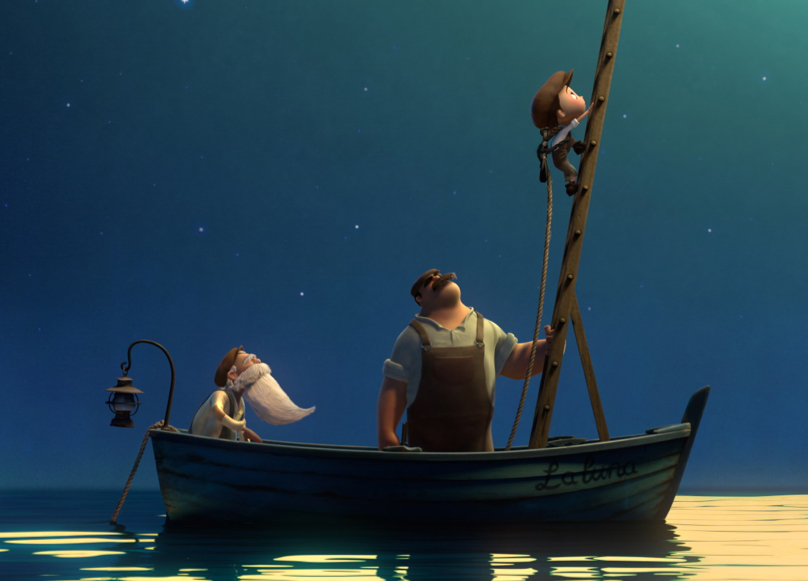
SHORT: La Luna (Enrico Casarosa, 2012)
– Typically wonderful Pixar short about an Italian boy learning the secrets of the moon from two crusty old-timers. It’s strikingly imaginative and original, with a brilliant pay-off, though I wonder if the backwards cap is perhaps a little too American. Still, magical. (4)

***


Passenger Side (Matt Bissonette, 2009) – Exceptional indie about wry, downbeat writer Adam Scott ferrying around his junkie brother (Joel Bissonette) for a day, all to serve some mysterious mission. There’s little in the way of conventional plotting, and a couple of the later excursions into absurdism feel forced (particularly the sweary, bestial garage attendant), but the characterisation is rich and original, the dialogue is absolutely extraordinary - eloquent, witty and genuinely offbeat - and the whole thing plays to a suitable, striking soundtrack. (4)

***


*SPOILERS*
Agatha (Michael Apted, 1979)
– Interminable, fictionalised nonsense about Agatha Christie’s mysterious 1926 disappearance, which eventually saw her discovered in Harrogate. A similar thing happened to me in 2007, and I still haven't been found. This was originally meant to focus on the relationship between the mystery writer and her husband’s mistress, until the producers decided to crowbar in a (made-up) American journalist, played by Dustin Hoffman, to sell the film across the Atlantic. Not to worry, both narrative threads are equally terrible, while the film itself is poorly directed, dreadfully photographed (everyone seems to be either in shadow or standing in front of a window) and has some of the worst dialogue I’ve ever heard. The performances from Vanessa Redgrave and Hoffman aren’t much better. The film was shot partly in Harrogate – yeah, Harrogate! – though there are some brilliant anachronisms for anyone familiar with Yorkshire. York railway station doubles for both Harrogate and London King’s Cross, while Hoffman’s mercy mission sees him sprinting to save Redgrave by going from his hotel room in Harrogate to the nearby spa, via the city of Bath. (1)

***


The House Bunny (Fred Wolf, 2008) – Don't judge me. I know it's hard not to. Confused, offensive comedy, produced by Adam Sandler, about centrefold wannabe Anna Faris being booted out of the Playboy Mansion when she hits 27, and ending up as house mother to a fraternity of nerds. Faris and Emma Stone are both quite good, particularly given the material, which contains a couple of laughs but is - overwhelmingly - both insultingly weak and muddled beyond belief. (1)

Wednesday, 4 July 2012

Buster, Bogart and idolising New York City out of all proportion - Festival blurbs

The World's Smallest Film Festival took place at Rudding Park, near Harrogate, on Sunday. Myself and Harrogate International Festival programme co-ordinator Graham Chalmers picked the six black-and-white movies: Sherlock, Jr was my choice, The Artist was his, and the other four emerged from a 10-minute discussion in the work canteen. For the programme, he penned blurbs about The Thin Man, Les Quatre cents coups and The Artist, while I wrote the other three, which I thought I might as well peg up here.


Sherlock, Jr. (Buster Keaton, 1924, 45 min) - A cinema projectionist (Buster Keaton) falls asleep on the job and dreams of being a brilliant detective – entering the screen itself to solve a jewel theft – in this groundbreaking comedy. Having served an apprenticeship under "Fatty" Arbuckle, Buster branched out on his own in 1920, unleashing a succession of dizzyingly inventive shorts that blended technical wizardry (The Playhouse saw him play no fewer than 25 parts) with devilishly clever incidental gags and astonishing stuntwork. He made his first feature in 1923 and reached his creative zenith the following year with Sherlock, Jr, a 45-minute comic masterwork that begins with whimsy and wonder, toys with the very nature of cinema and climaxes with some of the most extraordinary physical feats ever attempted on screen. Having been tossed around a vaudeville stage by his parents from the age of three, Buster was – in the modern parlance – as hard as nails, and when the water tower opens on him, you are watching a man having his neck broken. He didn't notice until the 1930s. Sherlock, Jr influenced the surrealists and formed the template for Woody Allen's classic 1984 film, The Purple Rose of Cairo, but, more importantly, it's a rollicking good ride, and still feels remarkably fresh and modern almost 90 years on.

(PS: When @Silent_London recently asked followers to nominate their favourite silent comedy, I sent this tweet, which, to my delight, they read out on this superlative podcast.)


Casablanca (Michael Curtiz, 1942, 102 min) - Casablanca is a great advert for chaos. Its script was still being written as it was filmed, it came in $100,000 over budget and Warner belatedly decided to re-shoot all the scenes featuring As Time Goes By, only to find that they couldn't, as Ingrid Bergman had cut her hair. Now regarded as the definitive screen romance, it's a vivid, unforgettable and lushly-shot film (think of the tears shining in the leading lady's eyes) that sees bar owner Humphrey Bogart, ethereal Norwegian Bergman and resistance leader Paul Henreid play out a love triangle in the titular city - which is increasingly overrun by Nazi forces. The leads are sublime, just about every line of the wise and witty script has echoed down the years and there's perhaps the finest supporting cast ever assembled for a film, from Claude Rains and silent movie legend Conrad Veidt to Peter Lorre, Sydney Greenstreet, John Qualen, Dooley Wilson and S.Z. Sakall. All together now: "You must remember this..."


Manhattan (Woody Allen, 1979, 96 min) - There are some sublime moments in Annie Hall, but really it's a bit of a mess. It was from 1979 that Woody Allen began firing on all cylinders, making a successful transition from those "early, funny films" (his words) to more thoughtful, affecting fare, and embarking on a devastating purple patch largely unrivalled in the history of American writer-directors. Surely only Buster Keaton or Preston Sturges have ever close to matching Allen's 13 years of unbroken brilliance, taking in films like The Purple Rose of Cairo, Hannah and Her Sisters and Crimes and Misdemeanours. Manhattan, with its gorgeous black-and-white cinematography (spotlighted in that classic planetarium set-piece), wonderful Gershwin score and climactic concession to subtle sentimentality, is one of his most distinctive and appealing movies, tracking the romantic entanglements of a group of New York intellectuals (surely not!) in characteristically sure-footed and amusing style. There's a knockout of a supporting performance from Mariel Hemingway – playing Woody's 17-year-old girlfriend – and it all builds to a typically inspired pay-off. Just lovely.

Wednesday, 11 April 2012

Buster Keaton odds 'n' ends - Reviews #109

... in which I grab a few of the Buster DVDs on the floor of my room, watch them and then write about them. Featuring a lesser early short, two cheapo efforts, a TV drama and what would have been a perfect swansong, had he not then done a few other things.

FRAGMENTS OF AN EARLY SHORT


The Frozen North (Buster Keaton and Eddie Cline, 1922) - The least of Buster's early shorts, I suppose, if only because around six minutes of the film are missing - apparently the six minutes needed to understand what on earth is going on. There are good moments (particularly the two-men-fishing bit) and some amusing spoofery - of Nanook of the North, of Erich von Stroheim and apparently of William S. Hart, though I've never seen more than snippets of his work - while the nice closing gag prefigures Sherlock, Jr., but it's hard to get a handle on the story, while Buster's brutish, selfish character is at odds with the put-upon, stoic little guy we all know and love. (2.5)

***

IT'S BEEN EDUCATIONAL...

... in which Buster pitches up at Poverty Row studio Educational Pictures, having been sacked by MGM. I've reviewed his personal favourite of his 16 films there already - Grand Slam Opera. Coming up are reviews of his first two shorts at the studio:


Phwoarr.

The Gold Ghost (Charles Lamont, 1934) – Buster pitches up in a ghost town – becoming a Ghost Buster? – where he proves himself as a man by taking on some claim jumpers. His first short at Educational is a lively Western spoof. There’s too much of him walking into things and then holding the afflicted body part, but he has fun trying out a lolloping Western walk, there’s a wonderful bit with a fantasy shoot-out and the action climax is nice, even if you’re willing him to do something truly Buster-ish. The closest we get is a neat, two-footed jump on a seesaw, to disarm a gunman. But my favourite bit is a reference to Buster's most famous stunt: a neat, tiny double-take he does when it looks for a second like the front of a building may be about to fall on top of him. (2.5)

Buster's second outing, Allez-Oop (Charles Lamont, 1934), is strangely melodramatic and a little threadbare, as his watch-repairer tries to woo customer Dorothy Sebastian – his sometime real-life girlfriend and the star of his last silent feature, Spite Marriage. There’s a super gag at the start where Sebastian’s face is distorted by an eyeglass, and the last minute is good (does anyone know if that’s Buster on the trapeze?), but what’s in between doesn’t quite cut it. When it becomes clear that Buster Keaton – yes, that Buster Keaton – is off to the circus, you expect more than him just asking the guy next to him to pass some refreshments and a cushion. And as unexpectedly nifty as the tenement climax is, it unfortunately calls to mind his 1921 short Neighbors, to which most things would pale in comparison. (2)

***

BUSTER AS BUSTER. SORT OF


One of those passable flashbacks.

TV: The Silent Partner (George Marshall, 1955) - A forgotten silent comic (Buster Keaton) has a quiet beer in a Hollywood bar, while next door at the Oscars a legendary movie producer (Joe E. Brown) dedicates a lifetime achievement award to the absent stoneface with whom he made his name. The Silent Partner is a moving, fascinating TV drama from the Screen Directors Playhouse series - made by Hal Roach Studios, a key player in pre-talkie days - with an amazing dramatic performance from Buster, interspersed with reasonable comic moments, and a cast that includes Greed grasper ZaSu Pitts, fellow silent players 'Snub' Pollard, Heinie Conklin and Spec O'Donnell, Western regular Jack Elam and regular Oscars host Bob Hope, whose sequences were shot especially. It does a slight disservice to the brilliance of silent comedians - there are none of Buster's surreal leanings, meticulous set-ups or dazzling stunts in the flashbacks, it's all ladders, pratfalls and being kicked up the arse - and he isn't portraying a genius in slap shoes, but an unwitting clown a la Marion Davies's character in Show People. (It's also worth pointing out, if this is supposed to be a thinly-veiled account of the star's own demise, that it wasn't really the talkies that put the skids on Buster's career, it was MGM and alcoholism.) But this 25-minute drama is a lovely piece of work, with fantastic framing scenes where his middling delivery contrasts with a facial expressiveness that's a thing of utter wonder and beauty. The moment where he silently, almost imperceptibly, raises a glass to his old comrade is a real choker. (3)

***

... AND A NOSTALGIC TREAT (WITH ADDED CANADA)


SHORT: The Railrodder (Gerald Potterton, 1965) - Buster's warm, funny tribute to his own silent films of the '20s was funded by the National Film Board of Canada in a bid to attract more moviemakers to the country. It's a charming little colour comedy - dialogue-free, but with cartoonish sound effects - that sees our hero zipping around the country's railroads on a little orange contraption, seeing the splendid panoramas and the shipyards, cooking lunch aboard and trying vainly to shoot geese after covering his 'train' in leaves. There are at least three big laughs - the absurd opening, in which he decides on a whim to visit Canada, jumping off a bridge and swimming there, and a couple of cleverly-timed tunnel gags - along with many amusing comic touches, and nods to The General (the premise), Sherlock, Jr. (some near-misses with vehicles and a water-tower), My Wife's Relations (the old-time camera) and The High Sign (Buster being overwhelmed by an improbably large sheet of folded paper). This is a man in touch with his own mythology, as evidenced by the glorious moment in which he fishes a porkpie hat out a bottomless compartment, pops it on his head and sits back (see above). There's little stuntwork, of course, and some of the material is a little samey, but it's a valuable and welcome nostalgic treat, with ample evidence that Buster's comic imagination was still firing, a year before his death. (3)

***

Still yearning for more?


For some reason I haven't reviewed Buster's features for the blog (aside from a bit on The Cameraman here as well as The Goat and The Boat), but there's a piece about some of his early shorts here, some things about his even earlier shorts here, and reviews of Cops, My Wife's Relations, Grand Slam Opera via those different coloured words there.

Friday, 17 February 2012

The Wrestler, the Talmadges, and Troy and Abed in the morning - Reviews #101

A film, a short and a TV series, because I am lovely.


The Wrestler (Darren Aronofsky, 2008) reminded me a little of Anvil, in its portrait of likeable, long-haired '80s relics playing to passionate but dwindling audiences. It's a heavy-handed, obvious but well-acted study of ageing pro-wrestler Mickey Rourke, who tries to connect with a lap dancer (Marisa Tomei) and his daughter (Evan Rachel Wood) after a stark reminder of his mortality. Aronofsky seems to have little faith in his audience's ability to understand even the simplest analogies, initially hinting at the fact that Rourke and Tomei are both past-it pieces of meat before deciding to clobber us over the head with it, and soundtracking our hero's walk to a new job at the deli with crowd noises - as if the way it's filmed doesn't make the connection obvious enough. OH RIGHT DARREN THANK YOU FOR EXPLAINING IT. I also suspect that if Aronofsky could direct an entire film as a tracking shot from just behind someone's head then he definitely would. The story is engrossing, building in power as it progresses, though the dialogue is variable and the self-satisfied gags about in-the-ring villains being absolutely lovely off-stage wear thin after a while. Rourke's performance is good rather than great, aside from the scene by the water, which is superb in every way and presumably what got him the Oscar nom. That and his leathery skin. Tomei, also nominated, was arguably more interesting when she was a sensitive mainstream lead* rather than a challenging, perma-naked wreck-specialist, but she does a decent job with a cliched part. I'm not sure about Wood's performance: she was excellent at the start, but by the end she was just shouting her trite dialogue whilst staring at the floor. I don't think this is the masterpiece others do, though it's still worth seeing, if only for that superlative monologue: "You're my girl. You're my little girl. And now, I'm an old broken down piece of meat... and I'm alone. And I deserve to be all alone. I just don't want you to hate me." The Nintendo game was also cool. The Wrestler was remade by Aronofsky in 2010 as Black Swan. (3)

See also: Marisa Tomei also appeared in Only You, doing her sweet-girl-abroad routine, and Before the Devil Knows You're Dead, not.

*This not apply to her performance in My Cousin Vinny.

***


SHORT: My Wife's Relations (Buster Keaton, 1922) - One of Buster's most underrated films, with a great through-line, several hysterically funny little set-pieces and a performance by its star that is essentially a series of priceless reaction shots. Accidentally married to a hefty woman with a massive dad and three big brothers, our hero navigates a family meal, a night's sleep, a photo-shoot and a posh party, displaying an impressive mix of patience, persistence and almost perpetual confusion. It's modest, with just a brief burst of dazzling stuntwork at the close (the 'carpet roll' is incredible), but the standard of throwaway gags is absolutely extraordinary, elevated by perhaps the cleverest, subtlest performance of the star's pre-features career. There's the bit where he pours the coffee into the sugar bowl to (sarcastically?) impress an in-law, the sequence with the collapsing bed and the indescribably brilliant moment in which everyone droops to the floor in unison with the photographer's slumping tripod. And how Buster can transmit such a variety of emotion whilst essentially keeping a Stoneface I don't know. The star's marital difficulties with Norma Talmadge do seem to have affected the way he portrayed love on-screen - and that's before we even get onto the subject of her relations - but where the subject matter is less tender, the films do tend to be irreverent and sardonic, rather than bleak or cynical. This one's a minor classic. (3.5)

See also: Many of Buster's other great early solo shorts are reviewed here.

***


"WANTED - GAY AND ALIVE"
TV: Community (Season 2, 2010-11)
is alternately better and lesser than the first series, with a few sincere scenes that are its finest moments to date, but far more genre episodes; pastiches in the Spaced mould. Though fine in themselves, they're not really what Community used to be about. There's a great ensemble - even if Jeff, Pierce, Annie, Troy and Abed are significantly funnier and more interesting than Shirley, Britta and the one-note Chang - and barely an episode goes by without three or four massive laughs and a dozen smaller ones. The weakest episode is probably #22, set around an anthropology exam. The best is #10, with Troy's 21st birthday party: the scene at the end with him and Annie is wonderful. Overall, it's probably a shade below the debut season, but it's still a real treat. (4)

Wednesday, 15 February 2012

Silent film. And Buster Keaton singing - Reviews #100

For our 100th reviews round-up, we present The Artist, The Circus and Buster Keaton's spoof of '30s musicals. To mark the centenary, I also seem to have taken up swearing, for which I can only blinking apologise.


CINEMA: The Artist (Michel Hanavicius, 2011) - George Valentin has a problem. The swashbuckling, perma-twinkling charmer is a matinee idol, but he is a silent one, and it is 1927. Within two years, his kind will be obsolete, as the movies learn to talk. On the front-line of this revolution is Peppy Miller, a fresh-faced ingénue whose star is about to go stratospheric. They meet and fall in love, but seem destined to be forever apart. The Artist is really a simple melding of A Star Is Born, Singin’ in the Rain and Sunset Blvd. (all movies of the 1950s), but the stroke of genius was to shoot it as a silent film – the finest since Chaplin hung up his Little Tramp costume in 1936. Often, when you see a spoof of early cinema, the overriding feeling is that the people who made it have never seen a silent film. With The Artist, the impression is that the writer, director and stars are immersed in the mythos of the medium, and that of studio system movies as a whole. But while this homage is a spot-on pastiche, it is also a whole lot more than that. The Artist reclaims the mantle of silent film as popular art, while adding a new classic to the canon. There are nods to stars Greta Garbo and Douglas Fairbanks, directors F. W. Murnau and Fritz Lang, and exuberant, Hollywood-on-film efforts of the ‘20s, like Show People.

It mixes sweet set-pieces – particularly the “tuxedo cuddle”, which wouldn’t be out of place in one of Harold Lloyd’s silent masterpieces – with stylised montages, experimental, expressionistic fantasy sequences and segments of black drama. Jean Dujardin’s heightened performance as the boozy star on the skids is wonderful, while Bérénice Bejo is suitably taken and toothy as the peppy Peppy, and the film features what is comfortably one of cinema’s best five dogs. If there is a flaw, it’s that the pacing of the less visually inventive scenes is sometimes a little off, as if writer-director Michel Hazanavicius hasn’t quite got to grips with handling talky moments in a silent film. Perhaps that’s why The Artist isn’t ultimately as heartwrenchingly powerful as wordless wonders like The Crowd, The Wind or City Lights. But for all that, it’s still the best silent film for 75 years. (3.5)

***


*SPOILERS*
The Circus (Charles Chaplin, 1928)
– Lovely Chaplin comedy – placing him in an eminently suitable setting – in which the Little Tramp accidentally becomes a star of the Big Top, while having his heart broken by a sweet, abused stunt-rider (Merna Kennedy). Not everything here gels, but it’s full of clever set pieces and hilarious running jokes, and there’s a beautiful love story at its centre. (3.5)

***


*SOME SPOILERS*
SHORT: Grand Slam Opera (Buster Keaton and Charles Lamont, 1936)
- After being sacked by MGM in 1933, Buster Keaton pitched up at Educational Pictures, a Poverty Row studio that had switched from shooting films for schools to making comedy two-reelers, billing itself as "the spice of the program". He regarded the 16 films he made there, across three years, as a creative low point, but remained proud of two of them: the baseball-themed One Run Elmer, and Grand Slam Opera, universally regarded as the pick of the bunch. It is a delightful shot of musical-comedy silliness in which Buster sings, dances and destroys a bed. The film begins with him on the back of a train - a leitmotif in his work - crooning along to So Long, Elmer (a spoof of the George M. Cohan song, So Long, Mary), as he leaves Arizona to try for stardom in New York. Once there, he attempts to land a break via a radio talent show, and romances pancake chef Diana Lewis by repeatedly asking her, "How about dinner and a show?". The low budget means that a couple of scenes are slightly stilted, while Lewis (later the wife of the great William Powell) is extremely wooden, and the star no longer draws on his famed gracefulness and athleticism. But, and this is one of the biggest buts I've ever had to write, Grand Slam Opera is an exceptionally good film. There's a lovely bit of business in which Buster dances to an ever-changing medley of international dances, a slapstick duel (borrowed from his vaudeville days) where he and a conductor exchange wallops in time to an orchestra, and a fine collection of incidental gags: the object of his affections disappearing on a passing bus, his attempts to hitch a ride on a parked car and the climactic pratfall. The pièce de résistance is a superlative spoof of Fred Astaire's No Strings number from Top Hat. Fred kept Ginger awake with a spectacular tap routine utilising his whole hotel room, before lulling her to sleep via a delicate sand dance. By contrast, Buster clumps around excitably, clambers messily over the furniture - obliterating his bed - and then, while trying to make amends, does quite the opposite. It is one of the great set-pieces of his career, the high point of one of his most improbable triumphs. (3.5)

NB: I watched Grand Slam Opera on the excellent Kino DVD pictured above, but it is available on YouTube, beginning here.

See also: Several of Buster's finest early solo shorts are reviewed here.

***


Bolt (Byron Howard and Chris Williams, 2008) – Impressive Disney animation about a superhero dog whose life isn’t all it seems. It opens with a bang and fills in the character drama later, with a Pixar-ish sensibility and a welcome lack of cloying sentiment. The hamster’s funny too. (3)

***


*SOME SPOILERS*
The Public Menace (Erle C. Kenton, 1935)
- Zippy, entertaining Columbia crime comedy about cocky journo George Murphy enjoying an on-off relationship with screwballish manicurist Jean Arthur while trying to get the scoop on crime kingpin Douglass Dumbrille. It's no His Girl Friday, but Arthur is as lovely as ever, Murphy's rival reporters are funny and I like the fact that our hero's plays for the big time are essentially quite rubbish. Especially the one about delivering a heavily-armed gangster to your boss. (3)

***


Apa (István Szabó, 1966) aka Father – A young boy who lost his father in the Second World War concocts fantasies that the old man was a resistance leader – and an action hero. A potentially brilliant idea is somewhat mangled in the translation. There are poetic stretches – not least the ‘three memories’ – but the film is a little hard to follow and has no real emotional pull, despite its semi-autobiographical material. (2.5)

***


The Client (Joel Schumacher, 1994) – I have a soft spot for Grisham adaptations, but Schumacher’s tend to be a bit trashy. This one is also saddled with a slightly confusing story, in that the viewer isn’t quite sure what they’re supposed to want to happen. It’s fast-moving and fairly entertaining, with a strong cast, but somewhat lacking in thrills. (2.5)

See also: Schumacher's A Time to Kill, also from a Grisham novel, is reviewed here.

***


Ocean’s Twelve (Steven Soderberg, 2004) is like a big, long in-joke to which you’re not party. At one point, Julia Roberts’s character has to pretend to be Julia Roberts – oh, the complete opposite of hilarity! It’s rare to come across a film that’s so utterly inept and yet so extraordinarily pleased with itself, with its atrocious plotting, babbling, inane overlapping dialogue and expensive swooping shots of each big name actor’s preening fizzog. Having said that, it is quite a lot less objectionable than A Touch of Class (see below), the 'laser dance' is nifty and I do rather like Matt Damon. (1.5)

***


The Three Caballeros (Norman Ferguson, 1944) – Bafflingly bad Disney feature in which inveterate pussy hound Donald Duck becomes acquainted with some of the most tedious aspects of Latin American culture. The title number is a wow and there’s some clever integration of live-action and animated footage, but long stretches of the film are just interminably boring. (1.5)

***


Mr. Woodcock (Craig Gillespie, 2007) – Unfunny, unpleasant ‘comedy’ about self-help guru Seann William Scott having a breakdown when his vindictive old gym teacher (Billy Bob Thornton) starts slamming/porking/boning his mum (Susan Sarandon) - and that varied repetition is the only laugh in the film. This premise was dealt with superbly in Freaks and Geeks; Mr. Woodcock is just a catastrophe. Amy Poehler’s character is an alcoholic, lol. (1)

***


Glenda Jackson, putting her considerable talents to dubious use.

A Touch of Class (Melvin Frank, 1973) – Can detestably smug adulterer George Segal keep saucy divorcee Glenda Jackson as a mere side dish? Who gives a shit? Appalling romantic comedy-drama in which love blossoms after she says she wishes he’d raped her. (1)

***

TV


Sherlock: Series 2 (2012) - Ridiculously, almost obscenely good, at least in the first and last episodes, which boasted a couple of the best scripts you're ever likely to find. The middle chapter was the weak link again, with a silly plot and Russell Tovey overacting in a key supporting part. Regardless, this second series is a remarkable achievement, with exceptional direction, performances - particularly by Freeman, Cumberbatch and Andrew Scott - and music. Final episode, The Reichenbach Fall, just raised the bar in terms of British TV drama. (4)

***


Community (Season 1, 2009-10) – Exceptional post-modern comedy about a self-styled “loveable gang of misfits” who band together at community college after each hitting a crisis in their lives. It begins in a Bilko vein, focusing on selfish, grandstanding former lawyer Joel McHale, but opens up impressively to spotlight a gallery of brilliantly-etched subversive archetypes, including pop culture-obsessed Asperger’s sufferer Danny Pudi, “decent person” Alison Brie, and vacant jock and secret modern dancer Donald Glover. There are a handful of episodes that don’t quite work in this initial batch of 25, but at its best it is as funny as anything I’ve seen on American TV. The most surprising thing of all? Its secret weapon is Chevy Chase, as the racist, gay-obsessed Pierce, who has probably the best two lines of the series in the final episode. (4)

***


30 Rock: Season 1 (2007-8) - In spots, dangerously funny, though it's not very consistent and has a tendency towards caricature. The cast is excellent, particularly Tracy Morgan, Judah Friedlander and Scott Adsit. (3)

***


Charlie Brooker's 2011 Wipe (2010) - A bit erratic. Doug Stanhope was atrocious, but the sequence about Freddie Flintoff's Christmas advert made me cry with laughter. (3)

***


TVM: Hawking (2004) - A portrait of the scientist as a young man, as Steve-O (Benedict Cumberbum) tries to find his place in the world, while dealing with romantic distractions and the onset of his illness. The framing device is absolutely atrocious - another transparent attempt to sell our dramas to the States - the story is unfocused and some of the dialogue sucks so much it creates a black hole... but it's worth it for Cumberbum's excellent central performance, and that stunning scene at the train station. Lisa Dillon, who doesn't get out much, is decent, if somewhat underused, as his beau. (2.5)