Showing posts with label biography. Show all posts

Friday, 11 August 2017

So long, farewell, auf wiedersehen, adieu – Reviews #272

This will be the last update for the time being. I want to take a break from the blog to focus more on my fiction (I've written a kids' book and am trying to get it published), and after 10 years I'm not sure what more I have to say about movies, gigs, books and plays. I may post updates now and then: I enjoy doing the reviews of the year, so I imagine I'll put those up in December.

In the meantime, thanks to each of you who's read, commented on or plugged the blog over the past seven-and-a-half years (and for the three years before that, when it was Films on Friday). Bye then.

BOOKS


A Tree Grows in Brooklyn by Betty Smith (1943) – Betty Smith’s novel about growing up in poverty in Brooklyn at the turn of the century begins with such an accumulation of detail that you feel as if perhaps she can’t distinguish between the mundane and the memorable. But then you realise she’s merely setting the scene, immersing you in the minutiae and the singular atmosphere of this atypical household in this dirt-poor, drably colourful place, so the stories – anecdotal, funny, heartbreaking – have a place to lay their roots. Her heroine Francie Nolan is the bookish, sensitive and poetic daughter of a mother turned hard by penury – just as her hands are cracked and weathered by work – and a father who is too dreamy, deluded and drunk for this world, and will be out of here by 35.

Kazan’s sensational 1945 film condenses the key events to a single year, but this book follows Francies from 10 to 18, flashing back to her infancy, and seeing her grow from a dirty-faced junk hoarder to a confident, intelligent, sexually-aware young woman finding her way in the world, negotiating the pain of betrayal and finally leaving that home in Brooklyn with its improbable, incongruously beautiful, neverendingly resilient tree in the yard. The film has been a precious thing to me for years, and this book has the same tone of yearning, of wisdom learned too young, and character being forged in the furnace of hardship, while offering dozens of deleted scenes with their new insights, moments of deft levity and piercing heartaches. I don’t think it’ll ever leave me, not least those details, like the one about her keeping the old house's carpet for the new one. (4)

***


Winchell: Gossip, Power, and the Culture of Celebrity by Neal Gabler (1994) – Walter Winchell is one of those cultural figures so of his time that they simply evaporate from history. That time was the 1920s to the 1950s, when the former second-rate Vaudevillian turned from a gossip columnist into a political commentator, from a Rooseveltian Democrat into a McCarthyite Republican, and from a slangy if self-obsessed man of the people into a vicious bully forever sidetracked by meaningless, one-sided beefs. At the peak of his fame and influence, he was read or listened to by two-thirds of Americans each week.

It’s hard to write a biography of a man who was so unknowable and aloof – Winchell had few friends and almost no interests beside his career – but this book gets as close as it can through contemporary articles, secondary sources and interviews with his colleagues and near-confidantes, while doubling as a truly exceptional social history of America: an America for whom Winchell democratised but trivialised and sensationalised news, treating gossip, tragedy or politics with the same screaming, shallow reverence, and increasingly – like his protégé Roy Cohn, later the mentor of one Donald Trump – seeing life as a war between an Eastern intellectual elite and the common, simple and simply patriotic American. If you wondered too where Trump got his tweet style, then look at a ‘50s Winchell item, ending with an accentuated, hyperbolic blast like “Seven subpoenas!” or “Party card!”.

Gabler has a superb vocabulary and a grabby but cerebral style, while littering the narrative with mini-profiles of contemporaries, and short essays on the changing America – and how Winchell first powered that change, and then was powerless to resist it, eventually being destroyed by hubris, his association with McCarthy, his personal unpopularity and his utter irrelevance to the world of the 1960s. The author’s set-pieces are dynamic – including a brilliant chronicle of the Hauptmann trial of the 1930s, and Winchell’s initially understandable but then unbearably overbearing hatchet job on Josephine Baker – and so is his deep, thoughtful and truthful analysis, most memorably of his subject’s political conversion, which he attributes to Winchell’s fear of being investigated himself, his genuine, fervent and long-standing anti-Communism, and the opportunity it gave him to lambast James Wechsler, the editor of the New York Post and a former Young Communist League member, whose paper had just written a series dismantling Winchell’s mythos and reputation.

Gabler argues brilliantly that communism was “the weapon, not the object” and that Winchell’s decisions were often more political than personal. He had become a worshipper of Roosevelt only after being charmed personally by the new president, while – like McCarthy and Cohn, both of whom he liked personally – Winchell was earthy, bitter, working-class and attracted to power. Even in the ‘50s he didn’t see himself as a Republican – telling a party functionary who welcomed him to the GOP at Eisenhower’s election party, “I'm not a Republican, you're a Republican” – and never abandoned his one saving grace, the ‘premature anti-fascism’ (as the HUAC would dub it) of the early ‘30s, in which his uncanny antenna for anti-Semitism saw him repeatedly and passionately denounce the Nazis some five years before most of his contemporaries, and root out fascists and Nazi sympathisers throughout the United States (this role inspired Philip Roth to use Winchell as the defender of the people in his brilliant alternate history, The Plot Against America, in which the hero of the air – and of America First – the fascist Charles Lindbergh becomes president).

In the end, Winchell did as much harm as good: opening up the press to working class voices, challenging outdated mores and unquestionably enlivening the medium, but then using his platform to settle scores and wage vindictive vendettas, accumulating more and more wealth (a reaction to his Dickensian childhood), and – in a broader cultural sense – turning news into entertainment, with the accompanying callousness and collateral damage that engendered. He fought fewer and fewer justified or even coherent battles, was a lousy friend, and was an even worse father, but – for better or worse – he was also among the most significant cultural voices of the 20th century, whose life must be understood in order to understand the present. Without ever over-stretching or being caught up in academic-ese, Gabler’s incredibly entertaining book does as good a job as can be imagined of making that possible. (4)

***

FILMS


Grand Hotel (Edmund Goudling, 1932) – It looks like a relic compared to even similar contemporary films like Union Depot, Dinner at Eight and Skyscraper Souls: too static, melodramatic and light on, y’know, story. And yet once you adjust to its size and tempo, and the characters begin to cross into one another’s lives (always a joy of such all-star shenanigans), it becomes damn near unmissable.

John Barrymore is noble (and wearing way too much eye-shadow), Lionel turns from a trivial one-note annoyance into a hero, Crawford discovers an attractively tender humanity, and Garbo is just so damn Garbo: warm, sensual, tragic, and apparently in a different film to everyone else, as she dances badly and her silent film eyebrow works overtime. The moment where she discovers Barrymore’s true character, purring “Norrrr”, is such a transportative treat: dumping you right back into 1932. A mention too for Lewis Stone, playing an omniscient medic who got blown up in the war and is now Two-Face from Batman.

If you show it to someone who thinks black-and-white films are dated, clunky and even a little silly, they’ll laugh you right out of the room, but if you’re receptive to this era of cinema, it’s kind of amazing. (3.5)

***


Tagline clearly influenced by Annie Hall's 'A nervous romance'.

CINEMA: The Big Sick (Michael Showalter, 2017) – American stand-up is just crap, isn’t it*. The rest of the film’s great, though: funny, tender and coming at the rom-com from a different angle to normal, with what’s surely a star-making part for Kumail Nanjiani (who co-wrote the script, based on his own life). In support, Holly Hunter is ACTING and Ray Romano is playing for laughs, and yet what underpins their performances seems real, and so they really work. I liked it a lot. (3.5)
*not Louis C.K.

***


CINEMA: Cría Cuervos 1976 – A miraculous film, quite unlike anything else I’ve seen, that plays out on the face of its young heroine (Ana Torrent from Spirit of the Beehive) and exists in that strange place between memory, reality and fantasy, as scenes bleed one into the next, and Torrent recalls her authoritarian, adulterous father, conjures the gentle spirit of her neurotic mother (Geraldine Chaplin) and cautiously negotiates a new, lonelier life in the bosom of her strict aunt’s family.

Torrent is simply wonderful, as is Chaplin – who also plays the older Ana – and the film’s unpredictable storytelling, offbeat comedy and sumptuous camerawork is allied to a pained understanding of human cruelty – but also a firm conviction in human resilience. For all the political analysis made of the movie (it seems that every Spanish film, even if it’s a comedy about an ice-skating dog, is read as an allegory of the Spanish Civil War), it’s really a film about loss, its unique worldview encapsulated by the inspired use of a contemporary pop song that has the jauntiest tune and the most desolate lyrics, and seems to be the only record Ana owns. (4)

***


"I wrote it."
"I gave you the title."
"Okay, so when they have awards for titles, you can go to that."

CINEMA: Prick Up Your Ears (Stephen Frears, 1987) – Near-perfect biopic of gay '60s playwright Joe Orton (Gary Oldman), focusing on his volatile relationship with live-in lover, Kenneth Halliwell (Alfred Molina), powered by a superb Alan Bennett script, and Oldman's best performance. It has the same appealing, distinctive, slightly washed-out look as almost every good British film of the period and, if it's perhaps a little light on Orton's writing, and its Morocco sequence drags, the film is just as bawdy, erudite, entertaining, non-judgemental and tragic as it should be. A film so fine, in fact, that Vanessa Redgrave is good in it.

Oldman has given so many mannered, lacklustre or just plain bad performances since the early '90s, but in his first few years he must have seemed a revelation, his star soaring as he subsumed himself in a succession of unforgettable, coruscating characterisations. Playful, reckless and morphing from a rough, nervy Midlands youth to a swaggering, dapper jack-the-lad toast-of-London, his Orton is the best of the lot. The relationship he evokes with sister Leoni (Frances Barber) too is wonderfully attractive and real.

'Synthesisers by Hans Zimmer'! (4)

***


CINEMA: The Swimmer (Frank Perry, 1968) – An American tragedy, impeccably constructed, with charming, toothy and toned Burt Lancaster resolving to 'swim home' through his gated Connecticut community via his wealthy friends' sapphire, sun-dappled pools. It's a film about innocence, idealism and moral rot: bombastic, melodramatic and surrealistic, but also human, profound and intensely moving as it depicts a body, a mind and a society running to ruin. There's also a scene in which Lancaster runs around a horse enclosure in slow-motion, leaping over hurdles, which is emblematic of the film's sometimes heavy-handed symbolism, and really very silly indeed. (4)

***


Fixer Dugan (Lew Landers, 1939) – Fast-talking Lee Tracy played reporters, promoters and carnival barkers in a career that saw him rise meteorically during the pre-Code era, then plummet to earth after he allegedly urinated on the Mexican Army whilst shooting on location in November 1933, was booted out of the country, and then sacked by MGM. (I wrote about it here.) Tracy was sensational when given a good script (his turn in Blessed Event, patterned after the life of national sensation Walter Winchell, is one of the great comic performances), but he seemed rather lost without one, and his performances lost much of their zip and vigour as he filled out and toured the cheaper studios in search of his lost career.

He made four films set around carnivals and circuses, where his characters’ conniving, finagling and, well, lying seemed right at home. The first and best of these was The Half-Naked Truth, a spectacular, lightning-paced comedy made while he was on the way up, and pairing him with the ‘Mexican Spitfire’, Lupe Velez. The other three – You Belong to Me, Carnival and this one – are sentimental yarns that offset his scurrilous, take-no-prisoners persona by making him care for an orphan. Here that orphan is Virginia Weidler, one of the better child stars of the era and a key part of the classic B-movie, The Lone Wolf Spy Hunt, the same year, but sadly Fixer Dugan doesn’t amount to much: it’s rather functional and laboured, and its tiny budget sticks out all over the place.

The film reunites Tracy with Peggy Shannon six years after Turn Back the Clock, the brilliant Depression-era fantasy about a tobacconist returning to his youth and reinventing himself as a crusading politician. Here he’s a carnival ‘fixer’, she’s a lion tamer and together they’re trying to do the best for Weidler while keeping hold of Shannon’s big cats (which she accidentally sold to a scheming rival), but neither of them seem to have their heart in it. The scenes of the star sparring with William Edmunds and a funny Ed Gargan are enjoyable enough, and there’s a fair part for Irene Franklin as a has-been, but it’s slightly dispiriting seeing Tracy – formerly a human firecracker – slog his way through the B-movie mire, and the story’s outcome is readily apparent from the 10-minute mark. (2)

Many thanks to Owen for the loan. (I always feel ungrateful giving two stars to something someone’s kindly posted to me, but you’ve got to be honest I think, or what’s the point of reviewing? Spectre of the Rose next!)

See also: I wrote about some of Tracy's key early films in this piece on the American political cinema of 1932-33.

***


Big City Blues (Mervyn LeRoy, 1932) – A bad pre-Code potboiler with a good cast, as Callow Woodenness Personified (Eric Linden) travels from Indiana to New York, where he meets crooked uncle Walter Catlett and brassy showgirl Joan Blondell, before clunky melodrama intervenes.

It's extremely 1932, with some fast-paced dialogue and an impressive-sounding supporting cast (Bogart, Lyle Talbot, Tom Dugan, Ned Sparks being aggressively deadpan, Guy Kibbee playing his usual drink-sodden lech), but the story is silly, muddled and joyless, alternating between hard-boiled posturing and mawkish hand-wringing, and much of the cast is given nothing to do.

The film's only real virtues are some snappy stylistics – including the epitome of old movie in-the-big-city montages, and that great shot of Blondell at the station near the end – Clarence Muse's nightclub numbers, and a pair of good performances: the big-eyed Blondell peddling a typically nice line in worldly-wise empathy, and Jobyna Howland stealing the film as a lonely, kindly socialite looking for a young gigolo. (1.5)

***

Thanks for reading.

Friday, 14 April 2017

Ways of looking at America – Reviews #262


Stars and Stripes by Emma Amos (1992)

Yesterday it was my birthday. I went to the American Dream exhibition at the British Museum – which looks at modern America through screen printing, the consistency of the form illuminating the variations in theme – and to see Get Out, a horror movie that uses genre tropes to investigate the African-American experience. Several of these reviews touch on American identity, from Kurt Vonnegut's last 'novel' – which challenges the fear and intellectual bankruptcy of his country – to Evan Thomas's Robert Kennedy biography, a portrait of a decent, compromised man trying to stay true to his ideals, and sometimes merely to discover what they are, in the super-charged, dangerous and conflicted atmosphere of Cold War America. Vonnegut returns time and again to the subject of Native Americans, and they were one of Kennedy's causes too: on the last night of his life, he kept asking reporters, "Did you hear about the Indians?" Over 98% of Native American voters in California had cast their ballot for him.

Tunnel of Love, a supposedly inoffensive 1958 comedy that I watched for light relief, is fascinating in a variety of ways, eerily anticipating an American tragedy with links to the counterculture, and depicting a violently unequal, sexist US society both on-screen and off. Elsewhere, I've written about low culture trying to document high culture in '40s Hollywood, how Kurosawa took American pulp fiction and turned it into a study of Japanese society, and how one of America's finest imports, Billy Wilder, lost control of his talents after two decades at the top. By taking the action to Paris, he was aping his great hero – and fellow German emigre – Ernst Lubitsch, and yet his presentation was becoming crudely American, an unbecoming pastiche of Frank Tashlin, who a year before Tunnel of Love managed to smuggle the subversive masterpiece, Will Success Spoil Rock Hunter? past the censors, his characters' powerless, bawdy ogling of Jayne Mansfield a joke on the sexist, consumerist society that was '50s America. Mansfield, of course, was a Marilyn Monroe substitute, and Andy Warhol's famous screen prints of her hang in the first room of American Dream.

BOOKS:


Timequake by Kurt Vonnegut (1997) – Vonnegut’s last ‘novel’ isn’t quite a novel: it’s ‘choice cuts from the carcass’ of a book he was dissatisfied with (at least if the arch post-modernist isn’t having us on), mixed with reminiscences, reflections and bitter, hysterically funny wisdom earned in a life well but often painfully lived. The fictional portions deal with recurring character (and multi-eyed hack writer) Kilgore Trout, a mouthpiece for Vonnegut’s inspired short stories, and one of the luckless planetary citizens forced to endure a ‘rerun’ of the past decade following the ‘timequake’ of the title, in which they go through every moment of every day of every year in exactly the same way, the only novelty being that they are aware this is happening. The rest shoots off from this story at tangents, and just about every one is inspired. The book shakes with pain in its early passages, as Vonnegut details his crippling writer’s block and rails at the innate cruelty of the world, appearing almost defeated by it. After all, he says, “No-one asks to be born”. Soon, though, he’s brimming with brilliance both comic and humane, picking himself – and us – off the floor and arming us with compassion, insight and practical ideas for combating the societal plagues of poverty, loneliness and despair. It’s like a self-help book for sarcastic socialists. I thought I’d share a few favourite bits.

On socialism:


On his favourite movies and Kate Hepburn:


On wealth redistribution:


On humanism and religion:


While this is just one of the best passages I've ever read:


Me too, Kurt. Me too.

Not quite a novel, then, rather a handbook for life. Give copies to people you love. (4)

***


Robert Kennedy by Evan Thomas (2000) – This superb biography does a fine job of interrogating an extraordinary life, rejecting the lionisation and demonisation of RFK for something more complex and credible: a psychologically insightful portrait of a decent but deeply-flawed subject who felt deeply, erred frequently and grew through tragedy to become a great man. Thomas manages to explain how Kennedy could work for Joseph McCarthy, try to assassinate Castro, tap Martin Luther King's phone, and then emerge as a voice for the weak, the vulnerable and the forgotten − before being gunned down in his prime.

Across 400 pages (and acres of notes), Thomas shows us a man who was a hothead, a bully and a philosophical auto-didact, who loved children, his country and his doomed family, who hated his reputation for ruthlessness but frequently deserved it, and who wrote just one speech in his life, the greatest he ever gave, announcing the death of Martin Luther King to a black audience in inner-city Indianapolis, and speaking the words of his favourite poet, Aeschylus, to offer some shred of comfort.

The author doesn't bother with backstory, launching us into the book proper with Kennedy a teenager (and barely flashing back), and he has a tendency to be episodic − perhaps inevitable when you're dealing with a life dominated by set-pieces: the pursuit of Jimmy Hoffa, the Cuban Missile Crisis, the death of JFK − but he's also intuitive, even-handed and, though he sometimes deals with complexity of character by laying out a scattering of anecdotal, contradictory evidence − when he's dealing with complex matters of fact, he will always drill down in search of the truth.

If you go in expecting a hatchet job or a hagiography, you'll be disappointed. Thomas follows up the Indianapolis speech by having RFK mouthing off backstage about Dr King (and this time doesn't attribute it to wisecracking as a defence mechanism), while the famous story about Kennedy demanding the civil rights champion's release from jail is explained in terms of realpolitik, as well as principle, but appreciating the subject as a man forced to operate in the shady, pragmatic and morally murky world of politics makes his achievements and principled outspokenness all the more remarkable.

Kennedy was not the lily-white paragon of virtue of popular myth, his electoral hopes in 1968 − and he was by no means a cinch to win − had been raised by an unprecedented spending spree, and it's difficult to believe that he would have the same impact on the popular imagination without the tragic glamour bestowed by his brother's demise. His intense emotional connection with the downtrodden, though, was genuine, and while RFK was central in cementing the 'Camelot' myth of JFK's presidency, he was by far the more liberal, idealistic and ambitious of the two.

He was also a man of great bravery, not just in his obsession with proving his physical courage − a preoccupation forged as an effeminate young member of the Kennedy clan, sidelined by his older brothers − but in his resolute lack of fear towards the end of his short life. One of the great tragedies of a sudden death isn't just the violence and the unfulfilled promise, but the shock of it: the absence of warning, the inability of the person to prepare. This book made me realise just how fatalistic and undaunted Kennedy was: he suspected the end was coming, and he didn't care. He'd wave away his bodyguards, ignore their advice about not driving in convertibles, and even refused to draw his hotel curtains after seeing a gunman on a roof. After he was shot, he spoke just two lines. The second was a cry of pain. The first was: "Is everybody else all right." Now that is the mark of a man. (3.5)

I thought I'd share his speech upon the death of Martin Luther King with you: it's here. And this is the Great Lives episode that first made me aware of Kennedy's life and legacy, back in 2009. I remembered that Matthew Parris said the episode had done a rare thing in changing his mind about a subject, as he'd always thought RFK was a countercultural figure. I'd forgotten that it was Ken Livingstone who nominated Kennedy as his Great Life, before all he could talk about was Hitler.

***


CINEMA: Get Out (Jordan Peele, 2017) – I don't watch many modern horror movies: they're just not really for me. While I actively dislike slasher films − watching attractive women in their underwear being stabbed to death strikes me as a curious way to spend your spare time − my aversion to other horror sub-genres is less rooted in moral queasiness, it's more that I'm a big wuss. Mark Kermode once said that he loves being scared. I don't. Being scared is really bad. I like being calm and in control.

Every so often, though, a horror film will pique my interest and I'll trot dutifully along to my local cineplex and try bravely to appreciate it over the sound of dickheads talking and eating crisps. That's how I experienced Get Out, as a race relations horror about the African-American experience sounded like the kind of wanky liberal thing I'd enjoy.

Chris (Daniel Kaluuya) is a black college student who goes with his white girlfriend (Allison Williams) to visit her family in deep suburbia, where he's unquestioningly welcomed in a manner rife with complacent white guilt, but the spectre of African-American servitude still seems to linger, catching his eye in increasingly bizarre and jarring ways.

Writer-director Jordan Peele does a great job of balancing sardonic satire with social comment, while delivering a succession of knockout jump scares (aided by superb sound design) and passages of fantastical disorientation that keep you trapped in your seat. To an outsider, at least, he seems to articulate the immobility and impotence of self-determination that typified the African-American experience − and sometimes still do − by rendering them literal.

With very rare exceptions, black actors in the 1930s through the 1950s were only allowed to speak the words of white writers, and play characters acceptable to white audiences, as black citizens were forced to do the bidding of white masters. In juxtaposing a knowing, confident 21st century black man with these Uncle Toms and Mammys − twisted into eerie ciphers, dead behind the eyes − Peele shows how far we have come, but then how far we still have to travel. Today's racism may lurk beneath a respectable veneer, he appears to be arguing (presumably having written this before the ascent of Trump), but it's there all the same.

Whether he quite finishes that thought, or manages to properly punch it across, I'm not sure. Perhaps his point is that we'll only accept black people by controlling them in a new way − i.e. by forcing them to co-opt white norms − or it's an assault on liberal hypocrisy, but, if it's either, then the message is muddled and diluted in the telling.

Like another subversive comedy-horror that I really took to, Tucker & Dale vs Evil − the film falls down a little in the final act, becoming more horror-by-numbers, and failing to draw its thematic threads together, despite odd moments of brilliance. For the most part, though, it's a sharp and pointed and funny film, commandeering genre tropes to its own ends, while remembering to scare you shitless at the same time. And no-one was stabbed while wearing just a bra and pants. Though I wanted something even better, if they continue making horror movies this interesting, I may start watching more. (3)

***


Deception (Irving Rapper, 1946) – An absolutely awful Warner film about megalomaniac composer Claude Rains making life hell for his old flame (Bette Davis) and her new husband (Paul Henreid), who's just back from a PoW camp, and is like Victor Laszlo if he was a wife-beating twat.

The script and story are absolute shit, full of clunking, laboriously explained dialogue and bad characterisation, with Rains attempting to do his patented 'well-spoken psycho' bit using some of the least promising material in existence, and Henreid a sullen, jealous, domestic abuser whom we're supposed to root for.

Elsewhere it's all crunching plot gears, badly-mimed cello-playing and unearned sentiment − when even a committed Bette Davis and a Korngold score can't help, you know you're in trouble (though the way Erich Wolfgang holds that long note at a point of tragedy, damn). Of all the Golden Age melodramas about classical musicians, I think the only one that's halfway worthwhile is Humoresque. This one manages to be nasty, boring and stupid. (1.5)

***


The Tunnel of Love (Gene Kelly, 1958) – A very watchable '60s sitcom about the sexual peccadilloes of couple Richard Widmark and Doris Day, who are looking to adopt their first child. It's blandly shot and directed, but Gig Young is funny, Day has a couple of songs ('Run Away, Skidaddle, Skidoo' is great fun) and Scouse actress Gia Scala is stunningly attractive as the adoption board investigator who catches Widmark's eye, the cast making the most of material that's never inspired but rarely dull. There's also a bit where Young and Widmark both mugging wildly with the *exact* same face that Gene Kelly liked to pull on screen when being cheekily amorous. He directed this one.

In broader cinematic and social terms, though, there are four things that make the film troubling, some trivial and others less so:

1) Richard Widmark isn't good at playing normal characters. His great performances were all as villains or anti-heroes (even in Panic in the Streets, he's hardly straight-forwardly sympathetic). The Hollywood power structure dictated that when you became a big enough star, you played conventional leading men roles. That's why after a blistering beginning, his career tailed off so dramatically.

2) It's a fascinating snapshot of the period, but it's extremely sexist. Even when it tries to challenge its male characters' rampant, complacent misogyny, it only does so half-heartedly.

3) Martin Melcher's name is on the credits. Over the next 10 years, he would run his wife Doris Day's career into the ground, casting her in unsuitable projects and losing her fortune through bad investments.

4) There's a running joke about Gig Young's character being in therapy. In the 1970s, having been under the 'care' of Brian Wilson's psychologist, Eugene Landy, he killed himself and his young wife.

If you can put all that to one side, it's a diverting film, perfect for a lazy afternoon. Good luck. (2.5)

***


High and Low (Akira Kurosawa, 1963) – Or 'Heaven and Hell' in its original Japanese: the first half of Kurosawa's superb film a moral thriller set in the rarified atmosphere of businessman Toshiro Mifune's hilltop home − where he must decide whether to ruin himself by paying the ransom for his chauffeur's son − and the second a trawl through the depths, taking in a speeding train, police HQ and the sweaty, dirty, morally dissolute streets of Yokohama, through which a kidnapper with terrific sunglasses (Tsutomu Yamazaki) is pursued by the full force of the law.

Adapting from an Ed McBain novel, the director fashioned a story about contemporary Japan, indicting not just the rigid, unforgiving class structure that dictates the relationship between Mifune and his chauffeur, and the cops' preconceptions of both victim and criminal, but also the increasing shallowness of Japanese society. That's elucidated by the shoe company so central to the businessman's existence (shades of the leather gloves in Philip Roth's American Pastoral), caught between the durability and reliability of its dull products, and the cheap, flashy models now in vogue.

High and Low is a masterfully-made film, its claustrophobic first hour, rife with circular debate, that gives way to something else entirely: Kurosawa ripping the film open as it becomes a meticulous, credible and far-reaching procedural, without losing sight of its raison d'etre. The script isn't perfect, at times it spoonfeeds, at others it's long-winded or relies on coincidence, but as it evokes the collision of high and low society, as the cops search high and low for a kidnapper, it's taut, thrilling and yet substantial, with a final scene of virtuosic and pungent brilliance. (3.5)

***


Irma la Douce (Billy Wilder, 1963) – Wilder's worst film since The Emperor Waltz back in 1948, sunk by an approach that's more 'Frank Tashlin's crap brother' than Lubitsch in his prime, and sharply heralding a career decline where these shortcomings became more like old friends than the rude awakening they are here.

Jack Lemmon is a gendarme in the belly of Paris who falls in love with hooker Irma la Douce (Shirley MacLaine). He tries to reform her, but after finding himself reformed into her pimp, opts for Plan B, reinventing himself as a raffish English lord who becomes her sole client. The catch: he has to work every other hour in backbreaking manual labour in order to fund his scheme.

The first 30 is nice and the last half-hour isn't bad, but the 77 minutes in between are unbearable, with Lemmon off the leash and so at his most unbelievably irritating. There's no subtlety of specificity to his characterisation, it is just every moment in Wilder's sub-par script played as big and broad and loud as possible. He was an actor of some skill and sensitivity, but − like Mickey Rooney − he could only do comedy if he was reined in very tightly. Here Wilder is apparently aiming for cartoonish, and he certainly manages that, but to what end?

MacLaine, in green stockings, flashing her cleavage at every opportunity, strikes just the right note of casual, slightly worn sexiness, but her work is lost in this mess of a film. You could just watch The Apartment instead, and have 12 minutes free to spend how you like. (2)

***

Thanks for reading. Next time: Philip Roth's The Ghost Writer, Doris Day in April in Paris, and Bette Davis in All This and Heaven Too. Plus: other stuff to be determined.

Thursday, 1 December 2016

Amy Adams, The Big Short and a biography of rare brilliance – Reviews #249

Here's what I've been consuming of late:

BOOK


Huey Long by T. Harry Williams (1969)
– This is a political biography of rare brilliance: a heavyweight chronicle of the life of Huey P. Long, one of the most extraordinary figures of the American century. A humble-born native of Louisiana, Long found work as a travelling salesman and a lawyer before entering politics and proceeding to dominate the state like no-one has ever dominated a state. By the time of his assassination in 1935, the senator for Louisiana was one of the most popular – and reviled – figures in America, and preparing to run for president on a radical platform of wealth redistribution.

Williams’ epic, Pulitzer-winning biography, two decades in the writing and clocking in at 900 pages, is a work of uncommon clarity, insight and poetry, drawing on 275 interviews, archive memos, newspapers and private letters, and painting a rich, vivid portrait of the man. Williams dismantles claims of fascism, despotism and racketeering, but his clear-sighted analysis does acknowledge Long’s egomania, vindictiveness and increasingly erratic decision-making, while illustrating at length the brilliance of his subject’s mind, the quality of his oratory and the sincerity with which he went about changing the lives of the state's – and the country’s – poorest and most vulnerable people. It’s also a work of stunning breadth, detailing the unique character of Louisiana, establishing its political scene and examining the context that made Long’s rise to prominence possible, while leaning on the ‘great man’ theory and maintaining that while someone would have come along to grasp this mantle, it did not have to be a Huey P. Long.

Beyond that, it’s also an extremely funny and entertaining work, not only in its recounting of the innumerable colourful stories involving Long – from greeting foreign dignitaries in his pyjamas to threatening a rail company with exorbitant taxes unless it gave all LSU students cheap passage to a football game and his fabled stump speech about ‘High Popalorum and Low Popahirum’ – but also thanks to Williams’ wonderfully dry sense of humour, his prose peppered with ironic commentary on the hypocrisy of both Long’s supporters and his nemeses. The overall effect is astonishing and enveloping, placing you at the scene of some of the most remarkable political happenings of the 20th century, from filibusters on the floor of the Senate to deals in smoke-filled rooms and the devastating assassination that naturally closes the book. By the time it comes, you’re so invested in Long, and in his programme for change, that you can barely turn the pages.

There’s no question that Long was a great man, but what surprised me is that he also comes across as a good man. There are times when he oversteps the mark – threatening a newspaper editor with blackmail, trying to utterly destroy (rather than just beat) his rivals and leaning occasionally on race prejudice (though Williams makes it clear that he did less of this than any of his Southern contemporaries) – but it’s also true that he’s one of the few left-wing leaders in the Western world who, when faced with the pitiless onslaught that faces anyone trying to change things for the better, fought his foes with everything at his disposal, until they were nothing but dust. There are times in 1934-5 when his local power-grabs and recourses to martial law are utterly contrary to democracy, and I found that disillusioning and difficult to swallow, but Long really was trying to change the lives of poor people for the better, he was just greedy for every bit of credit that went with it. His story is astonishing, inspiring and also critical to understanding the Roosevelt years, for without him, FDR would never have been dragged so far to the left, and become – for many, myself included – America's greatest president. (4)


Expect that to figure prominently in my books of the year round-up, one of three review collections coming up, as ever, at the end of December (the other focus on films and live events).

***

FILMS


CINEMA: Nocturnal Animals (Tom Ford, 2016)
– A film about emotional violence, cruelty and revenge, as disquieting and unpleasant as any mainstream Hollywood movie I can remember, and for that reason both an experience that I can’t recommend and that I must. It’s a collision of three stories, three universes: an antiseptic art world, where curator Amy Adams and her Tom Ford glasses live a cool, detached life contorted by compromise; a headily romantic Hollywood film in which her younger self flirts with old acquaintance Jake Gyllenhaal and then flirts with giving him up; and a horrifying slab of Southern gothic – rendered by the current day Gyllenhaal, in which his ‘weak’ husband is run off a Texas road by mutton-chopped psychopath writ large, Aaron Taylor Johnson.

The start of its horror thread – long, unflinching and uninterrupted – is particularly arresting: hypnotically, seductively awful; a harrowing, caricatured journey into man’s dark heart, a panic attack in film form. But this strand isn’t new. None of them are. Where this dazzling, dizzyingly surefooted movie astounds is in its outlandish, hugely ambitious juxtapositions: an ingenious, incisive structure; a combination of the cerebral, sentimental and utterly visceral that tosses you about the theatre like a ragdoll. At first you wonder if Ford can tie these threads together properly, if the knot will be tight enough without pulling the individual stories out of shape. He can: the cumulative effect is far greater than the parts, three stories of one dimension adding up to a whole that’s in three.

Where the film does fall down is in hitting its emotional and dramatic zenith a half-hour from the end – while its final five minutes are haunting, certainly the gothic part plods onwards for some time after it’s become submerged in lacklustre familiarity – but it’s an extremely unusual and refreshing reworking of genre clichés, novelistic but also invigoratingly cinematic. It’s a model of how to utilise cinematic grammar (particularly abrupt, busy but restrained editing) to tell a story, and to layer that story so densely and virtuosically that it embeds itself in you. The performances are great too, with Johnson fine in a big performance that doesn’t slip from showy dynamism into hamminess, and Shannon absolutely superb as the intense, taciturn and unsmiling sheriff called into action by Gylenhaal’s tale of terror.

Don’t miss it, and don’t come crying to me after you've been. (3.5)

***


The Big Short (Adam McKay, 2015) – An audacious, counter-intuitive and richly entertaining polemic about the financial crisis, its raw anger cooked up into a fun old caper movie, studded with vividly sketched characters, sourly profane dialogue and a heap of meta gags: a few of them overdone, but most melting in the mouth before leaving an aftertaste akin to charred vomit. McKay knows what he’s doing, and even if he’s sometimes doing it too loudly or just with tits, it’s ultimately worth it.

It’s the story of a one-eyed maths whiz (Christian Bale, superb), a smarmy, roguish narrator (Ryan Gosling), a bereaved, self-loathing fund manager (Steve Carell, never better) and two naïve kids trying to get onto Wall Street with the help of a gloomy neighbour (Brad Pitt) – all of whom see the financial crash coming, and start betting against the market.

A few left-leaning critics have questioned its morality, but that’s such a blinkered, reductionist view. If you make a film about a poor guy losing his house or a morality play condemning bankers, you might win an award, but you won’t find a mass audience. The Big Short made over $133m (Inside Job, the brilliant, Oscar-winning documentary dealing with the same story grossed under $8m) – and in that context it’s pure dynamite. The punters may be so wowed by the shiny, Ryan Gosling-patterned paper they won’t realise they’re holding a textbook, but the film is nimble enough to make its viewpoint clear. It’s like The Wolf of Wall Street if it wasn’t a nasty, incoherent shambles.

More than that, though, it’s intellectually daring. Like Reitman’s Thank You for Smoking and Up in the Air, it trades not in heroes or spoonfeeding, but in ideas and shades of grey. Oddly, this is actually McKay’s second stab at a financial crisis comedy. While The Other Guys is my favourite Ferrell film and probably the funniest mainstream comedy since Team America, its attempts at social comment were hapless, with only the end credits PowerPoint landing any blows at all.

The Big Short may be playful but it’s pointed enough to draw real blood, asking you to question your preconceptions and priorities – while being ferociously funny and quite ludicrously fun. (3.5)

***


*SOME SPOILERS*
West of Memphis (Amy Berg, 2012)
– A powerful, polemical documentary about a notorious miscarriage of justice, in which three eight-year-olds were murdered, turtles nipped at the bodies, and ambitious, blinkered public officials ill-equipped to deal with the case decided that these injuries could only have been caused by satanists, robbing 14 years from the lives of three teenage outsiders: damaged Damien Echols, softly-spoken Jason Baldwin and Jessie Misskelley, a mentally handicapped young man whose ‘confession’ formed a key part of the case.

For anyone gripped by Making a Murderer, this is more of the same, but ahead of the fact and without the same doubt in your mind: these three were knowingly fitted up by the state, and that should chill your blood. Unlike Making a Murderer – and indeed the first two Paradise Lost documentaries previously dealing with this case – it’s all told in retrospect, so it becomes a clear-sighted indictment of the American legal system, rather than the campaigning piece needed so desperately in previous years.

As a film, Amy Berg’s condensed account is fast-moving and often forensic, though with an eye for an entertaining aside or celebrity angle – among the campaigners interviewed are Peter Jackson, Eddie Vedder and Henry Rollins – as it paints a complete picture of the case, and posits a highly credible theory of its own (though if you think about it, that's pretty hypocritical!). It’s also, ultimately, an oddly uplifting film, as well as a gruelling and horrific one, as it depicts the selflessness of the West Memphis Three’s champions: including the girlfriend of Damien Echols, Lorri Davis, who took up his case after watching Paradise Lost.

Some people still think these three dunit, but when their evidence is things like “known history of mental illness”, it makes you wonder what the fuck. I have a known history of mental illness and have never murdered any children.

A chilling postscript is that Echols later had to meet Piers Morgan, surely more awful than any experience he endured in prison. (3)

***


My Scientology Movie (John Dower, 2015) – This is an amusing but infuriating documentary, in which Louis Theroux fails to speak to any Scientologists, except to explain that he has a filming permit and doesn’t see why he should leave. That’s the problem with making a film about an incredibly powerful, secretive cult. Sorry, religion. Sorry, obviously cult. If you don’t know anything about the subject, I suppose it’s mildly insightful – with various reenactions, interviews with ex-Scientologists and archive clips of Tom Cruise being weird and frightening – while Theroux’s façade of amiable bumbling makes for some funny encounters, but like his fellow posh, shambling English documentary-maker, Nick Broomfield, he thinks that being asked to leave somewhere is investigative journalism in itself. (2)

***


Brothers in Law (Roy Boulting, 1957) – A below-par legal satire from the Boulting Brothers that starts promisingly but gets sidetracked by broad, lazy set-pieces and bits of ‘business’ that surely someone must find hysterical, though I’ve no idea who. If you’re the kind of person who finds a nervous Ian Carmichael bumping into people funny, then get ready for the greatest night of your life. He’s a recent graduate of the bar trying to find his feet in the legal world of London, who finds an unlikely ally in selfish Dickie Attenborough, a powerful sponsor in Miles Malleson and a girlfriend in the charming Jill Adams, but bumbles haplessly through his first few cases and – in one interminable, laughless sequence – incurs the wrath of judge John Le Mesurier while playing golf.

Carmichael’s relationship with his parents, particularly his warm, proud father (Henry B. Longhurst) is delightful and touching, Malleson is quite amusing, and now and then there are some intelligent sideswipes at the law – particularly when Attenborough tries to avoid leading questions and cocky criminal Terry-Thomas enlists Carmichael’s assistance – but it’s too often unfocused and unfunny, without the teeth of the Boultings’ best comedies (the more I see of their later work, the more I wish it was all like Heavens Above!), and replete with irrelevant story threads that exist only for their unsatisfying and obvious pay-offs. (2)


***

SHORT: Come Together (Wes Anderson, 2016) – Anderson’s H&M advert (sorry, ‘new short film’) is droll, tender and really rather magical, with that undertug of disconnected, Keatonesque melancholia blossoming into selfless humanity that makes his films so deceptively substantial. It’s otherwise extremely straightforward and almost self-parodically designed, harking back to The Darjeeling Limited in its setting – a stylised, late-running train dominated by sad-eyed conductor Adrien Brody – and telling a Christmas story of impeccable (and arguably insulting) simplicity. One complaint, though – and I know my class warfare may be showing – must the kids in his films always look so preppy and spoilt? I appreciate that all children deserve a nice Christmas, and money isn’t necessarily a signifier of a life easily lived, but on the whole I can think of worthier subjects than some prep school Tarquin in his designer blazer. It’s still affecting, though, and one to pop on the list of brief festive films worth visiting and then revisiting: not a patch on The Snowman, Jolly Snow or Star in the Night – that miraculous Tex-Mex Nativity story directed by a young Don Siegel! – but blessed with a certain seasonal something. (3)

***

THEATRE


King Lear (The Old Vic, 19/11/16)
– Glenda Jackson makes a triumphant return to the stage in this sparsely-staged version of one of Shakespeare’s most long-winded and inaccessible plays. The set is all white screens and functional tables, the effects done with lighting and a proliferation of bin bags, and across it Jackson rampages or creeps, dynamic and desperate as the king “more sinned against than sinning” as he loses his authority and his mind. There are great moments, and the acting is a treat – with a surprisingly effective Rhys Ifans as the Fool, and Sargon Yelda, Simon Manyonda and Karl Johnson putting bigger names Jane Horrocks and Celia Imrie to shame with nuanced, sometimes hilarious performances – allied to an energetic and bawdy reading of the text, but so much of it is just mad people shouting nonsense: if I wanted that, I’d just open my Twitter notifications. (3)

***

Thanks for reading.

Friday, 14 September 2012

John Barrymore, Buster Keaton, and the Playboy Mansion - Reviews #129

In this latest reviews update: a scintillating, sad biography of a theatrical great, the Isle of Man, and the continued adventures of the young Fairuza Balk.

BOOKS:


Damned in Paradise – The Life of John Barrymore (John Kobler, 1977) – I like a good actor biography and this is one of the best: a brilliantly researched, superbly written tear through the life of John Barrymore, the charming stage comedian who became the most celebrated Hamlet of his generation, before selling out the stage for the movies, and descending into an alcoholic abyss. Kobler is a fond but even-handed chronicler, and lays out some convincing mitigation for both Barrymore's consummate misogny ("I’ve fucked her. She’s nothing but a whore," he says of his brother's second wife) – he was seduced by his stepmother at the age of 14 – and his drink problems, which flow through the family. Still, the last hundred pages are almost unbearably sad, as Barrymore is consumed by his demons, with some help from his fourth wife, and winds up playing a caricature of himself, boozy and bloated, in low-rent Hollywood potboilers. By contrast, the chapters dealing with Jack’s nine years of theatrical triumph, from John Galsworth’s Justice to Peter Ibbetson, Richard III and Hamlet, are absolutely thrilling, crackling with life and atmosphere as they chart the meteoric ascent of a singular talent in a vibrant, masterfully-evoked Broadway. Though Barrymore’s take on Hamlet was a greater success in the US than in the UK, it was seen by both Olivier and Gielgud in London and formed the basis of their celebrated interpretations.

Throughout, the narrative is peppered with cameos from the likes of John Wilkes Booth, Winston Churchill and George Bernard Shaw, and a succession of stinging one-liners. My favourite is either Jack losing his temper with warbling opera star Jeanette MacDonald – “If you wave that loathsome chiffon rag you call a kerchief once more while I'm speaking, I shall ram it down your gargling throat” – or his father, Maurice, snapping out of a growing paresis to deliver a withering putdown to a Shakespearean actor. When Jack's dad appears in outlandish garb, a decision attributed to his illness, the ham asks if he's wearing it for a bet. “Yes, I am,” he replies. “You must have given the man long odds, Barry,” the actor says. “I did,” answers Maurice, “I wagered him that you were not the most mediocre reader of blank verse alive on the globe, and he proved me wrong and won.” Zing.

According to those who saw him tread the boards at the peak of his powers, Barrymore’s films don’t seem to have quite captured his gifts – or indeed stoked his imagination – and Kobler isn’t overly concerned with them. He does praise the Pre-Code drama Counsellor at Law, which features arguably Barrymore’s best dramatic performance, but, while acknowledging that Twentieth Century was Jack’s “funniest” work, the author doesn't give that screwball classic the praise it really deserves, and his implicit dismissal of the superb romantic comedy Midnight, which boasts a colourful supporting performance from Jack at a time when he was accepting all offers of work, suggests it might not have been an easy one to find when the book was written in 1977.

There is the odd minor lull across the book’s 400 pages – the sections dealing with Barrymore’s crackpot spiritualism occasionally drag and I don’t think we needed the unabridged, slightly racist honeymoon diary – but it’s nevertheless a gripping, exhilarating read that takes you to the very heart of its subject: in other words, definitive. (4)

***


Buster Keaton: Tempest in a Flat Hat (Edward McPherson, 2007) – McPherson is a skilful, amusing writer, but his Buster book is largely just a rehash of second-hand material – and the odd newspaper cutting – a recap of the star’s silent films, with some trivia from other sources thrown in. I learnt a few new things – like the fact that Buster added the boulder climax to Seven Chances after the second preview audience laughed at something he’d done by mistake – but a lot of it is merely elegantly-phrased synopsising. His summary of the difference between Buster’s greatest film and his most successful (The Navigator) is wonderful, though: “To love Sherlock, Jr., you have to love movies, anyone can laugh at a guy falling of a boat." (2.5)

***

MOVIES:


The Bride Wore Red (Dorothy Arzner, 1937) – Joan Crawford grandstands, mopes and plays alternately gooey and unattractively fierce in this tailor-made MGM melodrama, apparently about Spaniards, where her down-and-out cabaret performer is given the chance to masquerade as a lady, then to choose between smug gentleman Robert Young (who treats his fiancée notably shabbily) and poetic, working class postman Franchot Tone. The first scene is a gem, promising plenty, as cynical aristocrat George Zucco sets the wheels in motion by becoming Crawford’s sponsor, but then he disappears and it becomes a conventional story of love vs security, with a notably overwritten script that takes rather too long to wind itself up. There’s the typical MGM gloss, though – Crawford’s white dress with the veiled hood wouldn’t have been seen anywhere else on the planet – Tone is good in a part suited to his talents, and little Dickie Moore turns up as a telegram-delivering blackberry fiend. (2.5)

See also: Crawford and then husband Tone also appeared in Love on the Run, with Clark Gable.

***


The Street with No Name (William Keighley, 1948) – After the sensational success of Fox’s The House on 92nd Street, the studio produced a series of films in the same semi-documentary manner, shot memorably on location and featuring scrupulously-detailed voiceovers that hammer home the authenticity of what you’re seeing but – much like the FBI officers woodenly playing themselves – aren’t necessarily very cinematic. This one, which sees Lloyd Nolan reprising his 92nd Street role as FBI Inspector Briggs, isn’t as good as Call Northside 777, but it’s slicker, more confident and faster-paced than either its predecessor or Elia Kazan’s Boomerang! and benefits from a dynamic Richard Widmark performance – he was something special in those early days. Mark Stevens plays a G-Man sent in by Nolan to pose as a lowlife and infiltrate a robbery gang. After a pounding in the boxing ring and a spell in the cells, he’s taken on by Widmark’s local kingpin, and the two generate an apparently accidental homoerotic charge, due to the peculiar, flirtatious way that Widmark commands his subordinates, particularly this new one. It’s well-photographed in the chiaroscuro style, high in suspense and has a nice supporting bit from Ed Begley as Stevens’ grubby shadow, and while the pro-FBI tub-thumping and glimpses into the bureau’s operations do sometimes break the film’s momentum, they’re more coherent and sensible than before. (3)

***


Keeping Mum (Niall Johnson, 2005) – A vicar’s family appears on the brink of collapse, until a homicidal housekeeper (Maggie Smith) arrives on the scene. After a fun prologue with Emilia Fox as the young Smith, this black comedy proceeds to immediately trample over any hopes you might be holding for it: it’s set in a village called Little Wallop, it features that guy who looks like Rowan Atkinson but can’t possibly be because Rowan Atkinson used to be funny, and there’s a Carry On-style scene in which Patrick Swayze teaches Kristin Scott Thomas to play golf and says he’s going to keep his eye on her hole. Then, somewhere along the way, perhaps halfway through, I realised I was starting to rather enjoy it. That’s partly down to some familiar, lovely Isle of Man locales, but also an emotional attractiveness which emerges from beneath the lazy English stereotyping and Arsenic and Old Lace-style shenanigans, and the introduction of some jokes that were actually funny, to go along with all the rubbish ones. Swayze’s performance is a bit of a write-off, but Atkinson really grew on me, and I’ve a perpetual weakness for both Scott Thomas and Smith, the latter clearly relishing the chance to play this murderous Mary Poppins. (2.5)

***


Imaginary Crimes (Anthony Drazan, 1994) – Touching coming-of-age story set in the ‘50s and sparked by a typically fine performance from the young Fairuza Balk. She plays a teenage writer, recalling her mother’s passing in flashback, who strives to make something of her life – and her younger sister’s – despite feckless father Harvey Keitel, a pipe dreamer always a technicality away from fame and fortune. Like James Dunn in A Tree Grows in Brooklyn, or Tom Hulce in Parenthood. There’s nothing new here, the script tends towards cliché and the production values seem closer to a TV movie than a feature film, but Balk’s assured, appealing and unglamorous characterisation carries it right through to a very satisfying conclusion, which is beautifully filmed and played. I’m not a big fan of Keitel, but he’s quite good, particularly in the later scenes, and there’s very strong work from Kelly Lynch (as his late wife), Elisabeth Moss – as the other sibling – and Vincent D’Onofrio, playing Balk’s inspirational teacher. (3)

***


CINEMA: Brave 3D (Mark Andrews and Brenda Chapman, 2012) – Little Rebekah Brooks fights for her freedom against the evil, demon bear Leveson, and the clans of the Executive, Legislature and Judiciary, in this pungent media satire. I think that’s what was happening, anyway. On one level, Pixar’s latest – concerning a flame-haired princess learning the meaning of responsibility and courage as she tries to avoid getting married, spends some quality time with her mum, and raises the ire of the aforementioned bear – is difficult to fault, with the same clever visual gags, anarchic tendencies and involving plotting as before, but it’s somehow lacking the magic of Up, WALL-E and the studio’s other classics, feeling a touch too mechanical, a little uneven (there’s a 20-minute stretch that seems to dispense with jokes entirely) and, well, a bit too Disney, with an over-baked sentimentality that the studio usually keeps well at bay. It’s still a fun ride, blessed with some thrilling action sequences, plenty of good jokes, and those hilarious – though underused – red-headed triplets; but from the mighty Pixar, that’s not quite enough. (3)

It was screened with this brand new one-reeler:


*SPOILERS*
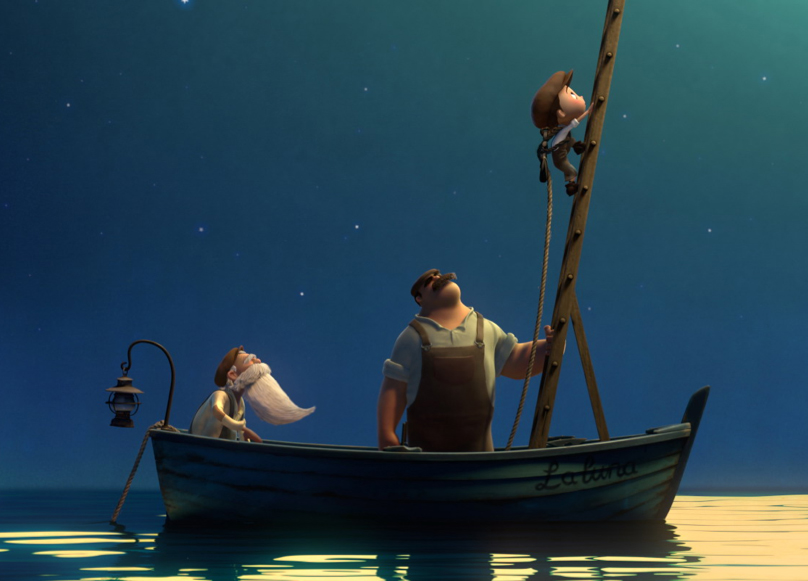
SHORT: La Luna (Enrico Casarosa, 2012)
– Typically wonderful Pixar short about an Italian boy learning the secrets of the moon from two crusty old-timers. It’s strikingly imaginative and original, with a brilliant pay-off, though I wonder if the backwards cap is perhaps a little too American. Still, magical. (4)

***


Passenger Side (Matt Bissonette, 2009) – Exceptional indie about wry, downbeat writer Adam Scott ferrying around his junkie brother (Joel Bissonette) for a day, all to serve some mysterious mission. There’s little in the way of conventional plotting, and a couple of the later excursions into absurdism feel forced (particularly the sweary, bestial garage attendant), but the characterisation is rich and original, the dialogue is absolutely extraordinary - eloquent, witty and genuinely offbeat - and the whole thing plays to a suitable, striking soundtrack. (4)

***


*SPOILERS*
Agatha (Michael Apted, 1979)
– Interminable, fictionalised nonsense about Agatha Christie’s mysterious 1926 disappearance, which eventually saw her discovered in Harrogate. A similar thing happened to me in 2007, and I still haven't been found. This was originally meant to focus on the relationship between the mystery writer and her husband’s mistress, until the producers decided to crowbar in a (made-up) American journalist, played by Dustin Hoffman, to sell the film across the Atlantic. Not to worry, both narrative threads are equally terrible, while the film itself is poorly directed, dreadfully photographed (everyone seems to be either in shadow or standing in front of a window) and has some of the worst dialogue I’ve ever heard. The performances from Vanessa Redgrave and Hoffman aren’t much better. The film was shot partly in Harrogate – yeah, Harrogate! – though there are some brilliant anachronisms for anyone familiar with Yorkshire. York railway station doubles for both Harrogate and London King’s Cross, while Hoffman’s mercy mission sees him sprinting to save Redgrave by going from his hotel room in Harrogate to the nearby spa, via the city of Bath. (1)

***


The House Bunny (Fred Wolf, 2008) – Don't judge me. I know it's hard not to. Confused, offensive comedy, produced by Adam Sandler, about centrefold wannabe Anna Faris being booted out of the Playboy Mansion when she hits 27, and ending up as house mother to a fraternity of nerds. Faris and Emma Stone are both quite good, particularly given the material, which contains a couple of laughs but is - overwhelmingly - both insultingly weak and muddled beyond belief. (1)