Showing posts with label Fairuza Balk. Show all posts

Thursday, 30 March 2017

Ten things I learned about Gas, Food Lodging

The latest in my now-almost-regular series. Recent articles include The Crying Game, Peter Lorre and Lillian Gish.


Yes, I do have excellent seats, thank you for noticing.

Allison Anders’ 1992 indie has been a favourite of mine for years. I’ve lost count of the number of times I’ve watched my battered, pan-and-scan VHS copy, taped off Channel 4 a few years later. I love Anders’ unique viewpoint – empathetic, unsensationalised, real – her film’s delicate balancing of emotions, and its aesthetic and emotional treats: J Mascis’s spare, evocative guitar score, Dean Lent’s decolourised, subtly beautiful cinematography, and Fairuza Balk’s performance, the greatest of a sporadically spectacular career in which she has been unfailingly fine, but in films only sometimes befitting her transcendent gifts.

She’s the teenage, introspective Shade, who lives with her sister Trudie (Ione Skye) and their single mom (Brooke Adams) in a New Mexico trailer. Like River Phoenix’s hero in Idaho, Shade is also searching for a family, but in an inert, haphazard way that keeps her within the boundaries of a drab, colourless small town. Ione, the town slut, has regular shouting matches with her witty, loyal, self-pitying mother, but both are masking a desperate pain, scrolling through romantic misadventures much like Shade’s heroes, those characters depicted by glamorous Spanish movie star Elvia Rivero in the local fleapit.


It’s a series of glorious vignettes – held together within an ingenious, elasticated structure – from those gloriously-realised films-within-a-film, a romantic encounter in a cave lit by violet light, and Adams’ charmingly weird ‘first date’ with an old flame, to Balk’s hilariously incompetent, profoundly moving seduction of Darius (Donovan Leitch, Jr.), and her gradual discovery of a soulmate in the shape of cherubic ‘cholo’ Javier (Jacob Vargas). Balk dominates throughout, with a performance of startling depth and beguiling sensitivity, though I don’t see it as the whole show, as I think I used to. Skye and Adams are both terrific (despite the odd wooden line-reading), James Brolin is superb as a benevolent stranger and, seeing the film as it should be – on a big screen, in a sumptuous new digital print – one is struck by the clarity of Anders’ artistic vision, her lack of judgmentalism, and her consummating shepherding of her creative collaborators, their talents drawn out and drawn together in the service of the story.

That story seems fresh now, was ahead of its time even in 1998, and must have been positively revolutionary six years earlier. Just watch Trudie’s departure for Dallas, a sequence that Kelly Reichardt would be proud of in 2017, and see how Anders deals with these female characters frankly and honestly, employing a deft, humanist poetry born of mutual dependence, pragmatism and real love, in place of the trite sentimentalism that dominates so much of cinema. And watch Balk trailing off into the brush, her ferocious loyalty and protectiveness of her spiky, abrasive older sister paying off not with a Hollywood ending, but with one that’s ultimately more satisfying, because it’s honest.

It's a great film. One of the great films. And, like Idaho, it's not flawless, but it's more important than films which arguably are.


That absolutely American DVD cover (it's never been released over here), with a misleading photo and a dreadful tagline: "When Shade's good, she's very good. But when Trudi's bad, she's better."

On Tuesday, the BFI held a special 25th anniversary screening. Here are 10 things I learnt from writer-director Allison Anders’ post-film Q&A:


1. Learning on a Wim
Anders was mentored by arthouse giant Wim Wenders, after a sustained campaign to win his favour that include writing him letters up to 30 pages long, and – with two of her friends – winning grants to study with him on the set of Paris, Texas, without asking him if it would be OK. When she did, Wenders looked into the distance, and said: “Oh well, you better come along then.” Dean Lent, who went on to shoot Gas, Food Lodging, studied cinematographer Robby Müller obsessively on the set of Paris, Texas. Her second mentor was Martin Scorsese. His Universal deal in the mid-1990s included the capacity to produce five smaller-budget features. His then-girlfriend, Ileana Douglas, asked for a meeting with Anders, they got on well, and decided to make Grace of My Heart (Anders’ 1996 movie, set in the Brill Building). Scorsese had planned a Lieber and Stoller biopic himself, but couldn’t get the knots out of his story. When Anders was briefly away from the Grace set, star Matt Dillon found himself working under Scorsese. “I can’t believe you left me with this hack,” he told her.


2. Chicago fired
Anders’ Belgian producer, Carl Colpaert, picked up Gas, Food Lodging’s source novel – Don’t Look and It Won’t Hurt by Richard Peck – at a thrift store for 10 cents, and optioned the rights. Anders wrote two drafts of the script, in the process scrapping the Chicago setting, streamlining Trudie’s character – “you can’t be both the town slut and the most popular girl in school”, adding a sex life for the mum (“a tired woman who just worked and raised the kids”) – and removing a third kid “because to be honest, [the mum] had enough to do”. By the time filming commenced, almost all of the material was her own.


3. ‘I’m never gonna cease to roam’
The film was set in New Mexico “because the producers wanted to go to New Mexico”. Anders was determined not to shoot somewhere too beautiful, like Santa Fe, as the basic drabness of the setting was integral to her vision, which coupled the mundane and the magical. The scenes set inside the trailer were filmed in a trailer home, put in a warehouse for absolute control over the setting.


4. Caving in
Nick Cave was the original choice for Robert Knepper’s character, an English rock-collector, which would have been ideal, as he spends most of his time in caves. An unnamed, high-profile English actor was then cast, but then dropped out at the last minute. Anders apologised for Knepper’s accent, but it’s actually pretty good.


5. Balking at Barrymore
Anders tested "every actor of that age who is now famous" for the part of Shade, including Drew Barrymore and Reese Witherspoon. She wanted the character to have a range and complexity that was beyond the capabilities of everyone aside from Balk. "All the actors were either bubbly or dark, but Fairuza had that lightness and depth." In my question, I'd said that Balk was "so good" in the film. "Isn't she?!" enthused Anders, adding that she is "great in everything". (I've discussed Fairuza's erratic career here.) She singled out the scene in the hospital room (perhaps the greatest thing the actress does in the picture), joking that she was "incredibly grateful to Milos Forman, as he had taught her to cry effortlessly on demand" while filming Valmont. Anders said Balk's performance resonated so much because "she was quite like that character, and she had been raised by a single mum", as had Skye, while Anders and Adams were both single parents themselves.


6. Darius' vassal
Is Darius, the object of Shade's initial affections, gay? Anders and her editor, Tracy Granger decided in the edit that it should be unresolved. And Leitch, in his performance, had done the same thing. "He's camp, and he's probably gay, but maybe he's just a New Romantic," Anders said.


7. Up to scratch
Granger 'aged' the Elvia Rivero footage by scratching it with her stepdad's Victrola. He was Richard Brooks, and it was the one he had used on the set of In Cold Blood. Her parents, incidentally, were two greats of the British screen: the ethereal Jean Simmons, and matinee idol Stewart Granger.


8. Lost in translation
Anders' one regret with the finished film is that she didn't subtitle the Spanish dialogue (though the Rivera sequences were subtitled when it screened on Channel 4, and I have the beaten-up pan-and-scan video to prove it). The reason, apparently, was money, and Anders' concern that audiences weren't used to watching subtitled films. Mascis was particularly disappointed when he saw the completed version, saying that it spoiled the climactic scene between Shade and Javier.


9. Allison's starting to happen
Having studied the French New Wave, German New Cinema and British Free Cinema at UCLA, Anders (top of frame) wanted to be part of a movement "and then I was": the American arthouse scene of the early '90s. She's directed seven features in total, as well as three TV movies, and has directed episodes of The Mentalist, Orange Is the New Black and a certain vapid show about four single women exploring Manhattan's dating scene. Though Anders isn't a big fan of TV, those four Sex and the City episodes keep the money rolling in even now, and have presumably helped her to realise other, more personal, projects.


10. Terrence's stamp
An essential 10th insight courtesy of the Telegraph's Tim Robey, who asked Anders about the apparent influence of Terrence Malick's breathtaking Days of Heaven, perhaps the most beautiful colour film ever made, which he'd spotted in Shade's voiceover and the final shot. You're right, said Anders, and it was intentional.

... and finally...


Those are not typos above. After all these years, we FINALLY have an answer on the title. It is not 'Gas Food Lodging' (as in the BFI's programme) or 'Gas, Food, Lodging' as it's frequently written but, erm, 'Gas, Food Lodging' (kudos to IMDb, who have it correct). "We couldn't afford a second comma in the credits," according to Anders, which is NOT an explanation and renders the above poster INACCURATE.

***

Thanks for reading.

Friday, 14 September 2012

John Barrymore, Buster Keaton, and the Playboy Mansion - Reviews #129

In this latest reviews update: a scintillating, sad biography of a theatrical great, the Isle of Man, and the continued adventures of the young Fairuza Balk.

BOOKS:


Damned in Paradise – The Life of John Barrymore (John Kobler, 1977) – I like a good actor biography and this is one of the best: a brilliantly researched, superbly written tear through the life of John Barrymore, the charming stage comedian who became the most celebrated Hamlet of his generation, before selling out the stage for the movies, and descending into an alcoholic abyss. Kobler is a fond but even-handed chronicler, and lays out some convincing mitigation for both Barrymore's consummate misogny ("I’ve fucked her. She’s nothing but a whore," he says of his brother's second wife) – he was seduced by his stepmother at the age of 14 – and his drink problems, which flow through the family. Still, the last hundred pages are almost unbearably sad, as Barrymore is consumed by his demons, with some help from his fourth wife, and winds up playing a caricature of himself, boozy and bloated, in low-rent Hollywood potboilers. By contrast, the chapters dealing with Jack’s nine years of theatrical triumph, from John Galsworth’s Justice to Peter Ibbetson, Richard III and Hamlet, are absolutely thrilling, crackling with life and atmosphere as they chart the meteoric ascent of a singular talent in a vibrant, masterfully-evoked Broadway. Though Barrymore’s take on Hamlet was a greater success in the US than in the UK, it was seen by both Olivier and Gielgud in London and formed the basis of their celebrated interpretations.

Throughout, the narrative is peppered with cameos from the likes of John Wilkes Booth, Winston Churchill and George Bernard Shaw, and a succession of stinging one-liners. My favourite is either Jack losing his temper with warbling opera star Jeanette MacDonald – “If you wave that loathsome chiffon rag you call a kerchief once more while I'm speaking, I shall ram it down your gargling throat” – or his father, Maurice, snapping out of a growing paresis to deliver a withering putdown to a Shakespearean actor. When Jack's dad appears in outlandish garb, a decision attributed to his illness, the ham asks if he's wearing it for a bet. “Yes, I am,” he replies. “You must have given the man long odds, Barry,” the actor says. “I did,” answers Maurice, “I wagered him that you were not the most mediocre reader of blank verse alive on the globe, and he proved me wrong and won.” Zing.

According to those who saw him tread the boards at the peak of his powers, Barrymore’s films don’t seem to have quite captured his gifts – or indeed stoked his imagination – and Kobler isn’t overly concerned with them. He does praise the Pre-Code drama Counsellor at Law, which features arguably Barrymore’s best dramatic performance, but, while acknowledging that Twentieth Century was Jack’s “funniest” work, the author doesn't give that screwball classic the praise it really deserves, and his implicit dismissal of the superb romantic comedy Midnight, which boasts a colourful supporting performance from Jack at a time when he was accepting all offers of work, suggests it might not have been an easy one to find when the book was written in 1977.

There is the odd minor lull across the book’s 400 pages – the sections dealing with Barrymore’s crackpot spiritualism occasionally drag and I don’t think we needed the unabridged, slightly racist honeymoon diary – but it’s nevertheless a gripping, exhilarating read that takes you to the very heart of its subject: in other words, definitive. (4)

***


Buster Keaton: Tempest in a Flat Hat (Edward McPherson, 2007) – McPherson is a skilful, amusing writer, but his Buster book is largely just a rehash of second-hand material – and the odd newspaper cutting – a recap of the star’s silent films, with some trivia from other sources thrown in. I learnt a few new things – like the fact that Buster added the boulder climax to Seven Chances after the second preview audience laughed at something he’d done by mistake – but a lot of it is merely elegantly-phrased synopsising. His summary of the difference between Buster’s greatest film and his most successful (The Navigator) is wonderful, though: “To love Sherlock, Jr., you have to love movies, anyone can laugh at a guy falling of a boat." (2.5)

***

MOVIES:


The Bride Wore Red (Dorothy Arzner, 1937) – Joan Crawford grandstands, mopes and plays alternately gooey and unattractively fierce in this tailor-made MGM melodrama, apparently about Spaniards, where her down-and-out cabaret performer is given the chance to masquerade as a lady, then to choose between smug gentleman Robert Young (who treats his fiancée notably shabbily) and poetic, working class postman Franchot Tone. The first scene is a gem, promising plenty, as cynical aristocrat George Zucco sets the wheels in motion by becoming Crawford’s sponsor, but then he disappears and it becomes a conventional story of love vs security, with a notably overwritten script that takes rather too long to wind itself up. There’s the typical MGM gloss, though – Crawford’s white dress with the veiled hood wouldn’t have been seen anywhere else on the planet – Tone is good in a part suited to his talents, and little Dickie Moore turns up as a telegram-delivering blackberry fiend. (2.5)

See also: Crawford and then husband Tone also appeared in Love on the Run, with Clark Gable.

***


The Street with No Name (William Keighley, 1948) – After the sensational success of Fox’s The House on 92nd Street, the studio produced a series of films in the same semi-documentary manner, shot memorably on location and featuring scrupulously-detailed voiceovers that hammer home the authenticity of what you’re seeing but – much like the FBI officers woodenly playing themselves – aren’t necessarily very cinematic. This one, which sees Lloyd Nolan reprising his 92nd Street role as FBI Inspector Briggs, isn’t as good as Call Northside 777, but it’s slicker, more confident and faster-paced than either its predecessor or Elia Kazan’s Boomerang! and benefits from a dynamic Richard Widmark performance – he was something special in those early days. Mark Stevens plays a G-Man sent in by Nolan to pose as a lowlife and infiltrate a robbery gang. After a pounding in the boxing ring and a spell in the cells, he’s taken on by Widmark’s local kingpin, and the two generate an apparently accidental homoerotic charge, due to the peculiar, flirtatious way that Widmark commands his subordinates, particularly this new one. It’s well-photographed in the chiaroscuro style, high in suspense and has a nice supporting bit from Ed Begley as Stevens’ grubby shadow, and while the pro-FBI tub-thumping and glimpses into the bureau’s operations do sometimes break the film’s momentum, they’re more coherent and sensible than before. (3)

***


Keeping Mum (Niall Johnson, 2005) – A vicar’s family appears on the brink of collapse, until a homicidal housekeeper (Maggie Smith) arrives on the scene. After a fun prologue with Emilia Fox as the young Smith, this black comedy proceeds to immediately trample over any hopes you might be holding for it: it’s set in a village called Little Wallop, it features that guy who looks like Rowan Atkinson but can’t possibly be because Rowan Atkinson used to be funny, and there’s a Carry On-style scene in which Patrick Swayze teaches Kristin Scott Thomas to play golf and says he’s going to keep his eye on her hole. Then, somewhere along the way, perhaps halfway through, I realised I was starting to rather enjoy it. That’s partly down to some familiar, lovely Isle of Man locales, but also an emotional attractiveness which emerges from beneath the lazy English stereotyping and Arsenic and Old Lace-style shenanigans, and the introduction of some jokes that were actually funny, to go along with all the rubbish ones. Swayze’s performance is a bit of a write-off, but Atkinson really grew on me, and I’ve a perpetual weakness for both Scott Thomas and Smith, the latter clearly relishing the chance to play this murderous Mary Poppins. (2.5)

***


Imaginary Crimes (Anthony Drazan, 1994) – Touching coming-of-age story set in the ‘50s and sparked by a typically fine performance from the young Fairuza Balk. She plays a teenage writer, recalling her mother’s passing in flashback, who strives to make something of her life – and her younger sister’s – despite feckless father Harvey Keitel, a pipe dreamer always a technicality away from fame and fortune. Like James Dunn in A Tree Grows in Brooklyn, or Tom Hulce in Parenthood. There’s nothing new here, the script tends towards cliché and the production values seem closer to a TV movie than a feature film, but Balk’s assured, appealing and unglamorous characterisation carries it right through to a very satisfying conclusion, which is beautifully filmed and played. I’m not a big fan of Keitel, but he’s quite good, particularly in the later scenes, and there’s very strong work from Kelly Lynch (as his late wife), Elisabeth Moss – as the other sibling – and Vincent D’Onofrio, playing Balk’s inspirational teacher. (3)

***


CINEMA: Brave 3D (Mark Andrews and Brenda Chapman, 2012) – Little Rebekah Brooks fights for her freedom against the evil, demon bear Leveson, and the clans of the Executive, Legislature and Judiciary, in this pungent media satire. I think that’s what was happening, anyway. On one level, Pixar’s latest – concerning a flame-haired princess learning the meaning of responsibility and courage as she tries to avoid getting married, spends some quality time with her mum, and raises the ire of the aforementioned bear – is difficult to fault, with the same clever visual gags, anarchic tendencies and involving plotting as before, but it’s somehow lacking the magic of Up, WALL-E and the studio’s other classics, feeling a touch too mechanical, a little uneven (there’s a 20-minute stretch that seems to dispense with jokes entirely) and, well, a bit too Disney, with an over-baked sentimentality that the studio usually keeps well at bay. It’s still a fun ride, blessed with some thrilling action sequences, plenty of good jokes, and those hilarious – though underused – red-headed triplets; but from the mighty Pixar, that’s not quite enough. (3)

It was screened with this brand new one-reeler:


*SPOILERS*
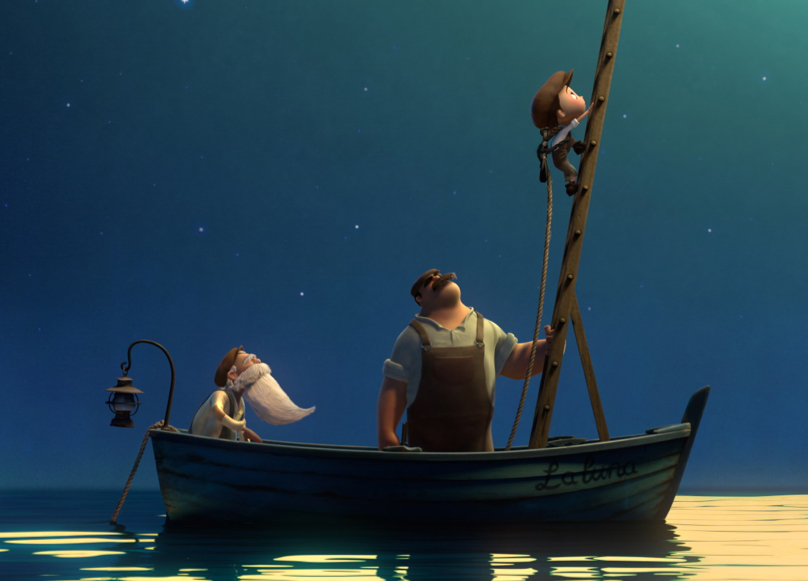
SHORT: La Luna (Enrico Casarosa, 2012)
– Typically wonderful Pixar short about an Italian boy learning the secrets of the moon from two crusty old-timers. It’s strikingly imaginative and original, with a brilliant pay-off, though I wonder if the backwards cap is perhaps a little too American. Still, magical. (4)

***


Passenger Side (Matt Bissonette, 2009) – Exceptional indie about wry, downbeat writer Adam Scott ferrying around his junkie brother (Joel Bissonette) for a day, all to serve some mysterious mission. There’s little in the way of conventional plotting, and a couple of the later excursions into absurdism feel forced (particularly the sweary, bestial garage attendant), but the characterisation is rich and original, the dialogue is absolutely extraordinary - eloquent, witty and genuinely offbeat - and the whole thing plays to a suitable, striking soundtrack. (4)

***


*SPOILERS*
Agatha (Michael Apted, 1979)
– Interminable, fictionalised nonsense about Agatha Christie’s mysterious 1926 disappearance, which eventually saw her discovered in Harrogate. A similar thing happened to me in 2007, and I still haven't been found. This was originally meant to focus on the relationship between the mystery writer and her husband’s mistress, until the producers decided to crowbar in a (made-up) American journalist, played by Dustin Hoffman, to sell the film across the Atlantic. Not to worry, both narrative threads are equally terrible, while the film itself is poorly directed, dreadfully photographed (everyone seems to be either in shadow or standing in front of a window) and has some of the worst dialogue I’ve ever heard. The performances from Vanessa Redgrave and Hoffman aren’t much better. The film was shot partly in Harrogate – yeah, Harrogate! – though there are some brilliant anachronisms for anyone familiar with Yorkshire. York railway station doubles for both Harrogate and London King’s Cross, while Hoffman’s mercy mission sees him sprinting to save Redgrave by going from his hotel room in Harrogate to the nearby spa, via the city of Bath. (1)

***


The House Bunny (Fred Wolf, 2008) – Don't judge me. I know it's hard not to. Confused, offensive comedy, produced by Adam Sandler, about centrefold wannabe Anna Faris being booted out of the Playboy Mansion when she hits 27, and ending up as house mother to a fraternity of nerds. Faris and Emma Stone are both quite good, particularly given the material, which contains a couple of laughs but is - overwhelmingly - both insultingly weak and muddled beyond belief. (1)

Sunday, 6 March 2011

Fairuza Balk - A celebration

By Rick Burin


There she is on the right, surveying the blog in her own inimitable fashion, as she has since the day it started. Fairuza Balk. My favourite turqoise-eyed ingenue turned sassy-but-vulnerable goth-punk. And, for many years now, one of the few actors I'll watch in absolutely anything.

A teenage crush started it, but we've all had a lot of call centre jobs since then. Inspired by a chance viewing of Things to Do in Denver, I quickly consumed every Fairuza film I could get my grubby mitts on and no matter how glorious (Return to Oz), incisive (American History X) or Adam Sandler-ish (The Waterboy) the results, she was always the best thing on screen. By turns subtle, explosive and beguiling, she was one of those artists with whom you feel an immediate and important affinity. The most exciting screen presence of her generation. An actress of extraordinary potency. And did I mention that Valmont is actually amazing? It's the film where Balk wears ruby slippers and Colin Firth emerges from a lake with in a sopping wet white shirt. Put that in yer pub quiz.

The only mystery, on the basis of Balk's mesmerising turn in Gas Food Lodging, is how a performer of her unabashed talent and gobsmacking emotional sensitivity failed to go on to conquer the world. It's churlish to view through sad eyes a career that's involved working for Milos Forman, Wim Wenders and Werner Herzog, but at the same time, I always felt frustrated that there seemed to have been a paucity of Fairuza films - and roles - truly worthy of her gifts. I figured this was down to poor luck, the wrong choices or Hollywood's unfortunate propensity to pigeon-hole a performer on the basis of one hit film. Now I'm not so sure. Her new website and associated Facebook and Twitter feeds, suggest that she's actually very happy as she is: making records, drinking tea, writing kids' books and appearing in a couple of pretty interesting films a year. So that shows what I know - very little, as per usual.

Anyway, for those of you who, like me, see just about everything in terms of cold, hard films, here's a quick run through Fairuza's career highlights...


1. Return to Oz (Walter Murch, 1985) - A belated, superior sequel to MGM's splashy sing-along that was unleashed on an unsuspecting world in 1985 - and promptly made all the children burst into tears. Balk is Dorothy Gale, back in Kansas and embarrassing her folks. She keeps going on about her mates – one of whom's made out of straw, another out of tin, and a third who seems to be some sort of camp lion – so Aunt Em decides to give her electro-shock treatment. Yes, really. Luckily she escapes and, finally arriving back in Oz, finds the Emerald City in ruins and her former companions turned to stone. With a new gaggle of rebels, Dorothy tries to right these terrible wrongs, but soon enough dismembered heads start yakking and our heroes have to escape on a talking sofa with the head of a moose. Then it gets really weird. I'd say it was the greatest kids' film ever made, if I was sure it's suitable for kids. Whatever, it's utterly brilliant: a stunning fusion of horror and childhood fantasy that gleefully subverts the iconography of the original whilst providing a wealth of whizz-bang thrills. The director, Walter Murch, had been the sound mixer on Coppola's The Conversation and Apocalypse Now. He never helmed another movie. In her first theatrical feature, Balk is truly superb; the definitive Dorothy. (4)


2. Valmont (Milos Forman, 1987) is an uproariously entertaining period romp that slips into perilous darkness in its second half. The script is well weighted, laced with pungent one-liners without going overboard, but it's the cast that's the real draw: caddish Firth, omniscient, plotting Bening and sweet, virginal Balk, two years on from her Oz heroics. If you've ever wanted to see the goths' representative on film sing a folk song, accompanying herself on the harp, this would appear to be your chance. (3.5)


I'm not sure who cropped this picture, but I don't respect the way they've done it.

3. If Return to Oz is Fairuza's best film (and it transparently is), then Gas Food Lodging (Allison Anders, 1992) features far and away her finest performance; one of the best in '90s cinema. I find it hard to put into words just how much I like it, and its utter honesty. The movie isn't perfect, its rich atmosphere, thoughtful dialogue and exquisite film-within-a-film segments offset by the odd wooden gesture or duff line, but it's appealingly original and in her transitional role Balk is simply transcendent: her Shade travelling untainted through a succession of defining moments as she searches for romance and for her father. (3.5)


4. Things to Do in Denver When You're Dead (Gary Fleder, 1995) is a spotty but extremely memorable thriller, one of a slew of offbeat American crime pics made in the mid-90s. Andy Garcia (the punchy trainee cop from The Untouchables) is an ex-con with a new venture: filming terminally ill people so they can speak to friends and family from beyond the grave. In debt to bankroller Christopher Walken, he plans a heist, enlisting the help of several other actors who've escaped from the 1980s, among them Treat Williams – brilliant in Lumet's Prince of the City – Christopher Lloyd (Doc from Back to the Future) and William Forsythe (Once Upon a Time in America). Garcia spars romantically with Gabrielle Anwar, while keeping an eye out for troubled Fairuza, and trying to stay one step ahead of Steve Buscemi's slick hitman, Mr Shhh (so called because he "don't say much"). This stylish, intriguing picture has too many lulls and inconsistencies to trouble anyone's top films list, but Balk is absolutely arresting in her supporting part, and there's a melancholy, nostalgic undercurrent reinforced by Garcia's backward-looking catchphrase: "Back in the day". (3)


5. American History X (Tony Kaye, 1998) - Well, this is something different, anyway. Fairuza as a neo-Nazi, chiding intense Edward Norton for giving up on the old race hate. She's great in it, as is Norton, and it's powerful stuff, despite the sound of plot gears crunching towards the end. (3)


6. Don't Come Knocking (Wim Wenders, 2005) - Wim Wenders and Sam Shepard re-teamed 21 years on from their peerless Paris, Texas for this off-kilter road movie. Shepard, a leading man in the '70s (he's one of the central trio in Terence Malick's Days of Heaven), plays a broken down old Western actor who heads back home to see his ma (Eva Marie Saint), then off in search of the son he never knew he had. The storyline is a bit jagged, but Shepard's dialogue is, as always, on a higher plane. Fairuza is a joy in a primarily comic role, her ding-dong with Gabriel Mann as they stalk down the street being an obvious highlight. (3)

... and here's a round-up of some of the others:


Personal Velocity: Three Portraits (Rebecca Miller, 2002) - She might not have her father Arthur's genius, but writer-director Miller certainly knows her way around the rudest word in the English language. Does that make up for it? I'm not sure. The film is split into three chapters. The last has Fairuza wandering around in shock and she's phenomenally good. The Worst Witch (Robert Young, 1986) is a super little TV movie for kids, The Craft (Andrew Fleming, 1996) - in which she plays a far worse witch - I can pretty much leave, despite Balk's trademark pyrotechnics as a baddie, while The Waterboy (Frank Coraci, 1998) is just a stale rehash of Harold Lloyd's The Freshman. Starring Adam Sandler. I'm a big admirer of Fairuza's work in American Perfekt (Paul Chart, 1997), but you'd struggle to argue that it's a good film. Again, Almost Famous (Cameron Crowe, 2000), where she's cast as one of Kate Hudson's legion of "band aides", has a fervent following, and I usually take to Crowe's brand of sentimentality, but it didn't really do it for me.

So there we are. What's next? Well, she's mentioned a possible collaboration with Quentin Dupieux (director of Rubber and the guy responsible for Flat Beat), but despite Fairuza's clear contentment, sheer selfishness on my part dictates that I'd be fascinated to see what a few more of modern cinema's true greats - von Trier, Wes Anderson, Lasse Hallström, Gus Van Sant - could achieve alongside her. And in the meantime I'll stop being so churlish.