Showing posts with label Harrogate. Show all posts

Friday, 14 September 2012

John Barrymore, Buster Keaton, and the Playboy Mansion - Reviews #129

In this latest reviews update: a scintillating, sad biography of a theatrical great, the Isle of Man, and the continued adventures of the young Fairuza Balk.

BOOKS:


Damned in Paradise – The Life of John Barrymore (John Kobler, 1977) – I like a good actor biography and this is one of the best: a brilliantly researched, superbly written tear through the life of John Barrymore, the charming stage comedian who became the most celebrated Hamlet of his generation, before selling out the stage for the movies, and descending into an alcoholic abyss. Kobler is a fond but even-handed chronicler, and lays out some convincing mitigation for both Barrymore's consummate misogny ("I’ve fucked her. She’s nothing but a whore," he says of his brother's second wife) – he was seduced by his stepmother at the age of 14 – and his drink problems, which flow through the family. Still, the last hundred pages are almost unbearably sad, as Barrymore is consumed by his demons, with some help from his fourth wife, and winds up playing a caricature of himself, boozy and bloated, in low-rent Hollywood potboilers. By contrast, the chapters dealing with Jack’s nine years of theatrical triumph, from John Galsworth’s Justice to Peter Ibbetson, Richard III and Hamlet, are absolutely thrilling, crackling with life and atmosphere as they chart the meteoric ascent of a singular talent in a vibrant, masterfully-evoked Broadway. Though Barrymore’s take on Hamlet was a greater success in the US than in the UK, it was seen by both Olivier and Gielgud in London and formed the basis of their celebrated interpretations.

Throughout, the narrative is peppered with cameos from the likes of John Wilkes Booth, Winston Churchill and George Bernard Shaw, and a succession of stinging one-liners. My favourite is either Jack losing his temper with warbling opera star Jeanette MacDonald – “If you wave that loathsome chiffon rag you call a kerchief once more while I'm speaking, I shall ram it down your gargling throat” – or his father, Maurice, snapping out of a growing paresis to deliver a withering putdown to a Shakespearean actor. When Jack's dad appears in outlandish garb, a decision attributed to his illness, the ham asks if he's wearing it for a bet. “Yes, I am,” he replies. “You must have given the man long odds, Barry,” the actor says. “I did,” answers Maurice, “I wagered him that you were not the most mediocre reader of blank verse alive on the globe, and he proved me wrong and won.” Zing.

According to those who saw him tread the boards at the peak of his powers, Barrymore’s films don’t seem to have quite captured his gifts – or indeed stoked his imagination – and Kobler isn’t overly concerned with them. He does praise the Pre-Code drama Counsellor at Law, which features arguably Barrymore’s best dramatic performance, but, while acknowledging that Twentieth Century was Jack’s “funniest” work, the author doesn't give that screwball classic the praise it really deserves, and his implicit dismissal of the superb romantic comedy Midnight, which boasts a colourful supporting performance from Jack at a time when he was accepting all offers of work, suggests it might not have been an easy one to find when the book was written in 1977.

There is the odd minor lull across the book’s 400 pages – the sections dealing with Barrymore’s crackpot spiritualism occasionally drag and I don’t think we needed the unabridged, slightly racist honeymoon diary – but it’s nevertheless a gripping, exhilarating read that takes you to the very heart of its subject: in other words, definitive. (4)

***


Buster Keaton: Tempest in a Flat Hat (Edward McPherson, 2007) – McPherson is a skilful, amusing writer, but his Buster book is largely just a rehash of second-hand material – and the odd newspaper cutting – a recap of the star’s silent films, with some trivia from other sources thrown in. I learnt a few new things – like the fact that Buster added the boulder climax to Seven Chances after the second preview audience laughed at something he’d done by mistake – but a lot of it is merely elegantly-phrased synopsising. His summary of the difference between Buster’s greatest film and his most successful (The Navigator) is wonderful, though: “To love Sherlock, Jr., you have to love movies, anyone can laugh at a guy falling of a boat." (2.5)

***

MOVIES:


The Bride Wore Red (Dorothy Arzner, 1937) – Joan Crawford grandstands, mopes and plays alternately gooey and unattractively fierce in this tailor-made MGM melodrama, apparently about Spaniards, where her down-and-out cabaret performer is given the chance to masquerade as a lady, then to choose between smug gentleman Robert Young (who treats his fiancée notably shabbily) and poetic, working class postman Franchot Tone. The first scene is a gem, promising plenty, as cynical aristocrat George Zucco sets the wheels in motion by becoming Crawford’s sponsor, but then he disappears and it becomes a conventional story of love vs security, with a notably overwritten script that takes rather too long to wind itself up. There’s the typical MGM gloss, though – Crawford’s white dress with the veiled hood wouldn’t have been seen anywhere else on the planet – Tone is good in a part suited to his talents, and little Dickie Moore turns up as a telegram-delivering blackberry fiend. (2.5)

See also: Crawford and then husband Tone also appeared in Love on the Run, with Clark Gable.

***


The Street with No Name (William Keighley, 1948) – After the sensational success of Fox’s The House on 92nd Street, the studio produced a series of films in the same semi-documentary manner, shot memorably on location and featuring scrupulously-detailed voiceovers that hammer home the authenticity of what you’re seeing but – much like the FBI officers woodenly playing themselves – aren’t necessarily very cinematic. This one, which sees Lloyd Nolan reprising his 92nd Street role as FBI Inspector Briggs, isn’t as good as Call Northside 777, but it’s slicker, more confident and faster-paced than either its predecessor or Elia Kazan’s Boomerang! and benefits from a dynamic Richard Widmark performance – he was something special in those early days. Mark Stevens plays a G-Man sent in by Nolan to pose as a lowlife and infiltrate a robbery gang. After a pounding in the boxing ring and a spell in the cells, he’s taken on by Widmark’s local kingpin, and the two generate an apparently accidental homoerotic charge, due to the peculiar, flirtatious way that Widmark commands his subordinates, particularly this new one. It’s well-photographed in the chiaroscuro style, high in suspense and has a nice supporting bit from Ed Begley as Stevens’ grubby shadow, and while the pro-FBI tub-thumping and glimpses into the bureau’s operations do sometimes break the film’s momentum, they’re more coherent and sensible than before. (3)

***


Keeping Mum (Niall Johnson, 2005) – A vicar’s family appears on the brink of collapse, until a homicidal housekeeper (Maggie Smith) arrives on the scene. After a fun prologue with Emilia Fox as the young Smith, this black comedy proceeds to immediately trample over any hopes you might be holding for it: it’s set in a village called Little Wallop, it features that guy who looks like Rowan Atkinson but can’t possibly be because Rowan Atkinson used to be funny, and there’s a Carry On-style scene in which Patrick Swayze teaches Kristin Scott Thomas to play golf and says he’s going to keep his eye on her hole. Then, somewhere along the way, perhaps halfway through, I realised I was starting to rather enjoy it. That’s partly down to some familiar, lovely Isle of Man locales, but also an emotional attractiveness which emerges from beneath the lazy English stereotyping and Arsenic and Old Lace-style shenanigans, and the introduction of some jokes that were actually funny, to go along with all the rubbish ones. Swayze’s performance is a bit of a write-off, but Atkinson really grew on me, and I’ve a perpetual weakness for both Scott Thomas and Smith, the latter clearly relishing the chance to play this murderous Mary Poppins. (2.5)

***


Imaginary Crimes (Anthony Drazan, 1994) – Touching coming-of-age story set in the ‘50s and sparked by a typically fine performance from the young Fairuza Balk. She plays a teenage writer, recalling her mother’s passing in flashback, who strives to make something of her life – and her younger sister’s – despite feckless father Harvey Keitel, a pipe dreamer always a technicality away from fame and fortune. Like James Dunn in A Tree Grows in Brooklyn, or Tom Hulce in Parenthood. There’s nothing new here, the script tends towards cliché and the production values seem closer to a TV movie than a feature film, but Balk’s assured, appealing and unglamorous characterisation carries it right through to a very satisfying conclusion, which is beautifully filmed and played. I’m not a big fan of Keitel, but he’s quite good, particularly in the later scenes, and there’s very strong work from Kelly Lynch (as his late wife), Elisabeth Moss – as the other sibling – and Vincent D’Onofrio, playing Balk’s inspirational teacher. (3)

***


CINEMA: Brave 3D (Mark Andrews and Brenda Chapman, 2012) – Little Rebekah Brooks fights for her freedom against the evil, demon bear Leveson, and the clans of the Executive, Legislature and Judiciary, in this pungent media satire. I think that’s what was happening, anyway. On one level, Pixar’s latest – concerning a flame-haired princess learning the meaning of responsibility and courage as she tries to avoid getting married, spends some quality time with her mum, and raises the ire of the aforementioned bear – is difficult to fault, with the same clever visual gags, anarchic tendencies and involving plotting as before, but it’s somehow lacking the magic of Up, WALL-E and the studio’s other classics, feeling a touch too mechanical, a little uneven (there’s a 20-minute stretch that seems to dispense with jokes entirely) and, well, a bit too Disney, with an over-baked sentimentality that the studio usually keeps well at bay. It’s still a fun ride, blessed with some thrilling action sequences, plenty of good jokes, and those hilarious – though underused – red-headed triplets; but from the mighty Pixar, that’s not quite enough. (3)

It was screened with this brand new one-reeler:
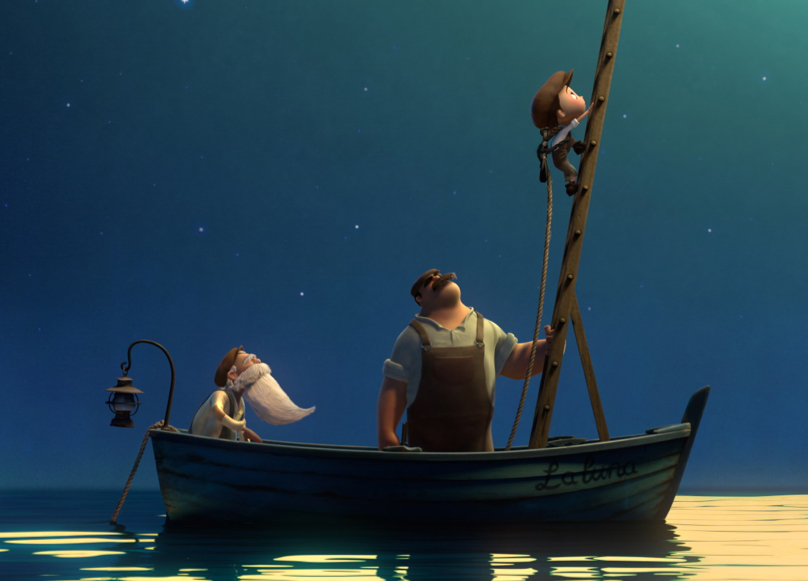


*SPOILERS*
SHORT: La Luna (Enrico Casarosa, 2012)
– Typically wonderful Pixar short about an Italian boy learning the secrets of the moon from two crusty old-timers. It’s strikingly imaginative and original, with a brilliant pay-off, though I wonder if the backwards cap is perhaps a little too American. Still, magical. (4)

***


Passenger Side (Matt Bissonette, 2009) – Exceptional indie about wry, downbeat writer Adam Scott ferrying around his junkie brother (Joel Bissonette) for a day, all to serve some mysterious mission. There’s little in the way of conventional plotting, and a couple of the later excursions into absurdism feel forced (particularly the sweary, bestial garage attendant), but the characterisation is rich and original, the dialogue is absolutely extraordinary - eloquent, witty and genuinely offbeat - and the whole thing plays to a suitable, striking soundtrack. (4)

***


*SPOILERS*
Agatha (Michael Apted, 1979)
– Interminable, fictionalised nonsense about Agatha Christie’s mysterious 1926 disappearance, which eventually saw her discovered in Harrogate. A similar thing happened to me in 2007, and I still haven't been found. This was originally meant to focus on the relationship between the mystery writer and her husband’s mistress, until the producers decided to crowbar in a (made-up) American journalist, played by Dustin Hoffman, to sell the film across the Atlantic. Not to worry, both narrative threads are equally terrible, while the film itself is poorly directed, dreadfully photographed (everyone seems to be either in shadow or standing in front of a window) and has some of the worst dialogue I’ve ever heard. The performances from Vanessa Redgrave and Hoffman aren’t much better. The film was shot partly in Harrogate – yeah, Harrogate! – though there are some brilliant anachronisms for anyone familiar with Yorkshire. York railway station doubles for both Harrogate and London King’s Cross, while Hoffman’s mercy mission sees him sprinting to save Redgrave by going from his hotel room in Harrogate to the nearby spa, via the city of Bath. (1)

***


The House Bunny (Fred Wolf, 2008) – Don't judge me. I know it's hard not to. Confused, offensive comedy, produced by Adam Sandler, about centrefold wannabe Anna Faris being booted out of the Playboy Mansion when she hits 27, and ending up as house mother to a fraternity of nerds. Faris and Emma Stone are both quite good, particularly given the material, which contains a couple of laughs but is - overwhelmingly - both insultingly weak and muddled beyond belief. (1)

Wednesday, 4 July 2012

Buster, Bogart and idolising New York City out of all proportion - Festival blurbs

The World's Smallest Film Festival took place at Rudding Park, near Harrogate, on Sunday. Myself and Harrogate International Festival programme co-ordinator Graham Chalmers picked the six black-and-white movies: Sherlock, Jr was my choice, The Artist was his, and the other four emerged from a 10-minute discussion in the work canteen. For the programme, he penned blurbs about The Thin Man, Les Quatre cents coups and The Artist, while I wrote the other three, which I thought I might as well peg up here.


Sherlock, Jr. (Buster Keaton, 1924, 45 min) - A cinema projectionist (Buster Keaton) falls asleep on the job and dreams of being a brilliant detective – entering the screen itself to solve a jewel theft – in this groundbreaking comedy. Having served an apprenticeship under "Fatty" Arbuckle, Buster branched out on his own in 1920, unleashing a succession of dizzyingly inventive shorts that blended technical wizardry (The Playhouse saw him play no fewer than 25 parts) with devilishly clever incidental gags and astonishing stuntwork. He made his first feature in 1923 and reached his creative zenith the following year with Sherlock, Jr, a 45-minute comic masterwork that begins with whimsy and wonder, toys with the very nature of cinema and climaxes with some of the most extraordinary physical feats ever attempted on screen. Having been tossed around a vaudeville stage by his parents from the age of three, Buster was – in the modern parlance – as hard as nails, and when the water tower opens on him, you are watching a man having his neck broken. He didn't notice until the 1930s. Sherlock, Jr influenced the surrealists and formed the template for Woody Allen's classic 1984 film, The Purple Rose of Cairo, but, more importantly, it's a rollicking good ride, and still feels remarkably fresh and modern almost 90 years on.

(PS: When @Silent_London recently asked followers to nominate their favourite silent comedy, I sent this tweet, which, to my delight, they read out on this superlative podcast.)


Casablanca (Michael Curtiz, 1942, 102 min) - Casablanca is a great advert for chaos. Its script was still being written as it was filmed, it came in $100,000 over budget and Warner belatedly decided to re-shoot all the scenes featuring As Time Goes By, only to find that they couldn't, as Ingrid Bergman had cut her hair. Now regarded as the definitive screen romance, it's a vivid, unforgettable and lushly-shot film (think of the tears shining in the leading lady's eyes) that sees bar owner Humphrey Bogart, ethereal Norwegian Bergman and resistance leader Paul Henreid play out a love triangle in the titular city - which is increasingly overrun by Nazi forces. The leads are sublime, just about every line of the wise and witty script has echoed down the years and there's perhaps the finest supporting cast ever assembled for a film, from Claude Rains and silent movie legend Conrad Veidt to Peter Lorre, Sydney Greenstreet, John Qualen, Dooley Wilson and S.Z. Sakall. All together now: "You must remember this..."


Manhattan (Woody Allen, 1979, 96 min) - There are some sublime moments in Annie Hall, but really it's a bit of a mess. It was from 1979 that Woody Allen began firing on all cylinders, making a successful transition from those "early, funny films" (his words) to more thoughtful, affecting fare, and embarking on a devastating purple patch largely unrivalled in the history of American writer-directors. Surely only Buster Keaton or Preston Sturges have ever close to matching Allen's 13 years of unbroken brilliance, taking in films like The Purple Rose of Cairo, Hannah and Her Sisters and Crimes and Misdemeanours. Manhattan, with its gorgeous black-and-white cinematography (spotlighted in that classic planetarium set-piece), wonderful Gershwin score and climactic concession to subtle sentimentality, is one of his most distinctive and appealing movies, tracking the romantic entanglements of a group of New York intellectuals (surely not!) in characteristically sure-footed and amusing style. There's a knockout of a supporting performance from Mariel Hemingway – playing Woody's 17-year-old girlfriend – and it all builds to a typically inspired pay-off. Just lovely.

Thursday, 21 June 2012

Banking on the Olympic dream


What is the official bank of the London 2012 Olympics?

Oh yes, I remember, because they drove a little musical van past us repeatedly as we were waiting patiently and expectantly for the torch parade. And then the sponsors sent in the big guns: an open-top bus with a shouty MC and a 10ft Beckham Head smoothing out at us from a video screen.

Even the impressively bendy woman wowing the crowds by walking like a crab was dressed in the official colours of the official bank, except for a patriotic wig. And it seemed a shame.

Because Harrogate had never seen anything like it: thousands upon thousands lining the streets to welcome the flame in a show of community spirit and unbridled enthusiasm about the possibilities of the summer games.

Yes there was free cola, but the Olympic dream seemed to be struggling to clamber out from under some hideous corporate nightmare and the crass Americanisms that threaten to invade every public event.

“Put your hands in the air!” No, shut up and go away.

And then the flame arrived: an awestruck, unaffected kid grinning from ear to ear, clutching the outsized golden torch as he jogged along West Park, his smile growing ever larger as the deafening ovation rippled through the crowd.

And all the cynicism melted away.
----------------------------------------------------------------------------------
This column was written by Rick Burin and appeared on Page 2 of the Harrogate Advertiser, June 21, 2012.

I don't usually put news-y stuff on the blog, as most of the readers obviously aren't from Harrogate, but this seemed more universal, and I was quite pleased with it.

Sunday, 5 February 2012

Ken Russell - Reviews #96

I met Ken Russell once. For about 15 seconds. In that time he signed a piece of card and a friend's book, working out at a cool 7.5 seconds a signature. He was gruff but friendly and had a big red face.


Russell - who took Billy Wilder's first commandment of moviemaking ("thou shalt not bore") to extremes - made his name with rapturously-received arts documentaries for the BBC. Among the most acclaimed was TVM: Elgar: Portrait of a Composer (Ken Russell, 1962, 3) is one of Russell's famed docu-dramas for the BBC. Seen today, it's a fairly effective biography, with several very potent passages - especially the WWI footage cut to Land of Hope and Glory - but a stiff, strangely-written third-person narration that leaps from one event to another, often makes no sense (the "turning point" in Elgar's life turns out to be nothing of the sort) and undermines its sense of authority by inexplicably inserting the word "apparently" at regular intervals. Still, the monochrome photography is ravishing and the use of music is suitably thrilling. Particularly Elgar's exquisite cello concerto, which makes me cry.


His great success was Women in Love (Ken Russell, 1969, 3), for which Glenda Jackson won the 1969 Best Actess Oscar. It's a messy but magnificently-acted adaptation of the D.H. Lawrence novel, with Alan Bates as a bearded, gabbling amateur philosopher obsessed with manly love, Jennie Linden his clingy beau, Oliver Reed his best friend - rocking a fearsome moustache and permanent 10-yard stare - and Glenda Jackson as Reed's spiky, free-spirited bit of posh. Bates and Jackson are astonishingly good, Reed and Linden a touch below, with Eleanor Bron (of Bedazzled and BT recorded messages renown) suitably annoying in support. The script isn't always quite on-the-money, Vladek Sheybal seems oddly cast, but it's always interesting - I liked the stylistic shifts underscoring the film's changing moods - and packs a latent emotional thwack.


After the notorious 1971 movie, The Devils - cited by Mark Kermode and Alex Cox as a masterpiece, but pilloried by many and now long out of circulation (a DVD is imminent) - he opted for a change of tack, and made a backstage musical, The Boy Friend (Ken Russell, 1972, 4). It's an inspired melange of The Entertainer and 42nd Street, as a seedy seaside revue is visited by a Hollywood producer, and all concerned indulge in Busby Berkeley fantasies. Twiggy is excellent in the lead – playing an ingénue who takes over when the star (Glenda Jackson in a delicious extended cameo) breaks her ankle – and there are several spectacular songs and production numbers, amidst the campy backstage squabbling and Barbara Windsor’s boob-jiggling and caterwauling. With Bugsy Malone and All That Jazz, Russell’s typically extravagant, confrontational musical is one of the most striking and original of its decade. It's also the best film I've seen so far this year.


Even great directors get it wrong, though, and as with Orson Welles's The Stranger, proving you're a safe pair of hands with your backers' money often results in a dull film. Such was the case with The Rainbow (Ken Russell, 1989, 2) a pervy tedious prequel to Women in Love, about the sexual awakening of a school leaver (Sammi Davis; though not, alas, Sammy Davis, Jr.). It's well-directed, with some stunning cuts, and there's a wonderful score by the great Carl Davis, but the story just isn't very interesting. Davis's mannered, slightly wooden performance does grow on you. Glenda Jackson appears as the mother of her character in Women in Love, but has almost nothing to do.

Russell passed away in November, 20 years after his last major film, the nattily-titled Whore.

Friday, 17 June 2011

O2 Media Awards 2011


I'm a-freight this isn't the award I'm in the running for. (Sorry.)

Hello there. This is a short missive to let you know that I've been nominated for a couple of O2 Media Awards. I'm up for the Feature Writer of the Year and Digital Journalist of the Year gongs at the Yorkshire and the Humber ceremony on July 14.

Last year I was shortlisted as both a Young Journalist and Digital Reporter and invited to eat veggie sausage sandwiches at The Loft in Leeds. This year's event will take place at York Racecourse.

This very blog formed part of my digital portfolio, so thank you for reading, commenting and generally being awesome over the past year. Without your support (and I do mean YOU), there wouldn't be much point to me doing it.

I'll report back to you on July 15 with all the gossip from the evening. And by gossip, I mean what we had to eat.

Friday, 25 March 2011

Review: Pretending to Be Me at Harrogate Theatre - Sunday, March 20, 2011


Sir Tom Courtenay’s eyes close. His voice raises. His hands raise and shake.

He’s midway through Philip Larkin’s seminal Audabe, and building up a head of steam.

“This is a special way of being afraid,” he says.
“No trick dispels. Religion used to try,
That vast, moth-eaten musical brocade
Created to pretend we never die.”

Pretending to Be Me, commissioned by the Larkin Society and first performed in Leeds in 2002, is a remarkable show that brings to life the late poet and Hull University librarian through a 90-minute, in-character monologue drawn from poems, articles and letters.

It offers hot jazz, an obscene anecdote about W. H. Auden and rules you can really live your life by, like: “Distrust any enterprise requiring new clothes.”

“It’s difficult to keep life at arm’s length, isn’t it?” it begins.

Courtenay’s Larkin is thoughtful, acerbic and twinklingly misanthropic, with a fondness for withering, throwaway one-liners aimed at revered institutions, rival poets and himself.

He says that getting married “is like agreeing to stand on one leg for the rest of your life”, dismisses “Ted ‘The Incredible Hulk’ Hughes” with his swaggering masculinity and leather jacket, and then turns his attention to America. Friends told him to only visit the east and west coasts.

“The rest is a desert full of bigots,” he wryly observes.

“I think that’s the part I would like.”

It’s Larkin’s reaction to the prospect of being a poet-in-resident at a US
university that lends the show its name. “I don’t want to go around pretending to be me,” he laments.

Legend

Courtenay, the stage and screen legend of Billy Liar, The Loneliness of the Long Distance Runner and The Dresser, and a fellow son of Hull, makes no effort to look like Larkin and uses a minimum of props; just the odd drink.

But he’s utterly magnetic.

He talks about his childhood stammer, his family and his first forays into verse, then becomes more reflective, considering his ailing productivity, his public persona and - most movingly - his own mortality.

“Just imagine we’re sitting round in a condemned cell,” he says.

“Would we talk about the SDP and the price of fish?”

He concludes that we probably would.

But it’s when Courtenay performs the poems, seamlessly woven into the narrative, that he ups the ante, changing to a more flamboyant style of expression.

It’s as if it’s only when he’s writing that Larkin comes alive - and we see right into his soul.

Bolstering some of the myths around his life (“Deprivation is to me what daffodils were to Wordsworth”) and obliterating others, the show is illuminating, intriguing and ultimately captivating.

It reaches a climax with the poet’s declaration that the one line that sums up his oeuvre is not the potty-mouthed one about his parents, but the final sentiment of An Arundel Tomb: “What will survive of us is love.”

And it’s anchored by a performance of rare intensity and virtuosity from one of Britain’s finest actors.
----------------------------------------------------------------------------------
This article was written by Rick Burin and appeared on Page 31 of the Harrogate Advertiser, March 25, 2011.

Sunday, 2 January 2011

Review: Kate Rusby at the Royal Hall, Harrogate

Friday, December 10, 2010


Surrounded by Christmas trees, fairy lights and a gaggle of cheery musicians, the “Barnsley Nightingale” brought an early festive treat to Harrogate.

“It’s very good to be in Yorkshire,” announces Penistone-born Kate Rusby as she strolls on stage at the Royal Hall, dressed all in black, save for a white necklace and bangle.

The county’s the only place on earth you can get a good cup of tea, she says.

For the next two hours she dazzles a three quarters-full hall with a catalogue of carols and a smattering of songs from her new album, Make the Light.

And while her vocals are plaintive and pure, her personality is playful - and as big as the Royal Hall.

She regales the audience with stories about her daughter and her dog, recalls some peculiar complaints about her performances - “Someone was very offended that I was singing songs about Jesus,” she recalls, while a BBC viewer balked at the sight of her knees - and accuses her multi-instrumentalist husband of being a cross-dresser.

Many of her festive tunes are drawn from the tradition of pub sing-alongs in South Yorkshire and Derbyshire pubs. While some were “thrown out by the Victorians for being too raucous”, there’s room for more reflective fare delivered in Rusby’s inimitable fashion: eyes closed, head cocked to one side, hands clutching the mic stand, her voice as crisp and clear as fresh snow.

The highlights include Here We Come A-Wassailing - even more joyous and knockabout than on the 2008 Christmas record from which eight of the songs are taken - The Holly and the Ivy, slowed down in a manner that makes it sound utterly new, and The Mocking Bird, a glorious cut from Make the Light that’s at once powerful and delicate, the soaring vocal sparsely backed by guitar and bass.

Even the decision to let husband and collaborator Damien O’Kane play the title track from his debut album Summer Hill pays off. Such concessions to a headliner’s partner are usually unwelcome, but O’Kane, from Coleraine, Northern Ireland, has a fascinating voice and Rusby’s harmonising on this lovely song is first-rate.

She rips through Sweet Bells - “an absolute favourite” - and offers a transcendent take on the elliptical Poor Old Horse, before closing with O Little Town of Bethlehem, an effective bit of staging placing the focus on the brass band.

Rusby’s announcement that it would be the last song had drawn groans from the audience. “Well, if you clap loudly, I’ll come back on,” she had added with a wicked grin.

And so she does, quipping: “It just so happens that we do know two more. That’s lucky.”

If Hark, Hark, What News is pleasant if unremarkable, Rusby pulls out all the stops with The Wren, the juxtaposition between her appealing, cheery banter and heart-stopping, often heartbreaking, singing never more pronounced.

Summarising the song’s roots in children’s Christmas tradition - “Look, we’ve got a bird in a box - some treats and money, please” - she recalls her own confusion at the lyrics, “We have cannon and ball to conquer them all”, which as a young girl she took to refer to the ‘80s comedians, then promptly launches into a spellbinding vocal that sends a shiver down the spine.

My dad, who was up in the dress circle, said it brought back memories of seeing Sandy Denny in her prime, which is as high praise as I can think of.

“I love Christmas,” Rusby had told us. Her Harrogate gig was a captivating evening that for a few hundred of us heralded the real start of the festive season.
----------------------------------------------------------------------------------
This article was written by Rick Burin and appeared on Page 27 of the Harrogate Advertiser, December 24, 2010.

Thursday, 28 October 2010

Review: Josie Long at Harrogate Theatre

Tuesday, October 12, 2010


IT’S good to live in a world with Josie Long.

The daft, cheery and now politically-energised Kent-born stand-up is great company, and has the jokes to match her delightful stage presence.

High-fiving herself, shooting out her familiar catchphrase of “Am I right?” - and a new one, “Buckle me in” - she’s a bundle of energy, and her fresh, funny material has acquired an added bite.

As her touring show reaches its 16th date in the lovely surroundings of a Studio Theatre decked out like a ‘70s living-room, the audience is treated to no fewer than three cracking sets, courtesy of Long, potential star James Acaster and musician The Pictish Trail, a former pupil at St John Fisher in Harrogate.

Long describes her opening spiel as “admin”, saying “if it’s funny, you’re doing it wrong”, but she’s soon reeling off jokes, saying six unoccupied chairs are “the devil’s seats”.

Having walked on with a mug of tea, she duly distorts the cosiness of the image.

“I’ve brought my tea on. I put crack in it. But you’re supposed to smoke crack, so it has no effect. If anything, it’s just gritty tea.”

She promises extreme language, but assures the audience: “I have a big chubby face like a baby - so how can it count?”

And anyway, the show is going better than her date in Trowbridge. “I thought they were going to set us alight, ” she recalls.

James Acaster

Her first support act bounds onto the stage: gangly, curly-haired James Acaster, whose schtick is essentially ‘the funniest guy you knew at uni’.

Whizzing through material about skydiving - with memorable audience participation - safari parks and homies called Simon, he improvises wildly, and the effect is nothing short of sensational.

The lightning-witted comedian further engages the crowd with a chat about bands they’ve been in, before an inspired routine about a terrible gig in Stockport during his musical days.

Finding his audience consisted of two girls in pink puffa jackets, he attempted to back out, only for an ageing rocker on the bill to decide the show must go on, uttering the immortal words: “What if Paul Weller walks in?”

“Does he live in Stockport?” Acaster enquired.

“He lives wherever the hell he wants to live, ” the man replied.

The Pictish Trail appears scowling, with his hood up, before firing up a techno track with aggressively puerile lyrics. Suddenly it cuts out. “None of my songs are like that, ” he says jovially, breaking into some folk music with more than a whiff of ‘90s duo Arab Strap.

Talented, versatile and charmingly nervous, the Scottish-accented singer makes a mockery of his difficult position on the bill with an engaging set that’s stuffed with his trademark 30-second songs.

Astronaut

Then it’s over to headliner Josie Long, who starts the second half in character.

“Thank you for clubbing together to organise this chance for me to talk about my career as an astronaut, ” she says, explaining that she’ll be answering seven questions put on the NASA website “as part of their comedy festival”.

Handily recapping for stragglers, she reveals that she “first decided to go up space after having looked at the stars”.

It turns out the routine is based on a belligerent acquaintance.

“It’s essentially a protracted impression of my sister’s friend. And she’s not even an astronaut.”

The show proper is a hotchpotch of disparate routines - covering Conservatism, dream parents and the paparazzi - loosely tied together by the idea that until lately Long hadn’t been doing good in any meaningful way.

“Going to Glastonbury Festival is not in itself a political act, ” she wryly observes.

There’s also quite a lot of stuff about breakfast.

Long used to be a sceptic (“Oh OK, I’ll eat breakfast and later I’ll learn to drive... SQUARE, ” she exclaims), but has recently become a believer.

She devotes a sizeable portion of the show (pun very much intended) to Walter Ezell, a gay American who posted a photo of his intimidating morning meal on the internet every day for a year - “everything that’s good and everything that’s unacceptable about America... before nine in the morning”.

Nye Bevan

After fantasising about having Ezell, Billy Bragg or Nye Bevan as a father, Long begins to reminisce about life under Labour, which was “like hanging out with a dear old friend who you suspected had betrayed you”.

As the set develops, it becomes clear that she has become newly engaged with politics, finally having something to rail against.

Her response is a mixture of surrealistic fancy (suggesting George Osborne has taken the shape of a bird to attack her), four-letter words and genuine rhetoric, as she attacks the people who look like her, dress like her, but voted in the Tories.

The sublime punchline fuses history, silliness and righteous anger: “Et tu hipsters.”

It’s an arresting direction for a comedian whose ready wit and DIY sensibility - stretching to a photocopied programme and a pad of hand-drawn illustrative aids - have largely been targeted at more trivial subjects.

The slice-of-life gags are still intact (“Not everyone who talks to you wants to have sex with you. Women: be less paranoid. Men: stop it.”) and so are the ridiculous one-liners: she prefaces a joke about the Tube, a bugbear of non-London audiences, by describing it as “like an underground spaceworm”.

But Long now has loftier targets in the crosshairs. I can’t wait to see what she does next.
----------------------------------------------------------------------------------
This article was written by Rick Burin and appeared on Page 23 of the Harrogate Advertiser, October 22, 2010.

Sunday, 1 August 2010

Theatre review: Alan Bennett at the Royal Hall, Harrogate

Sunday, July 25, 2010


There's something entirely winning about Alan Bennett’s familiar, unassuming persona.

He might be among the most talented, versatile and influential writers of his generation. He might be one of the top draws at this year’s Harrogate International Festival. And he might have just sold out the Royal Hall.

But, shuffling onto the stage in a tweed suit and green tie, he’s not giving his show the big sell.

“I’m going to read bits of plays and things from my career - such as it is,” he says.

And for the next hour-and-a-quarter, seated meekly in a black leather armchair, he does just that, providing a whirlwind tour of a singular back catalogue that encompasses novels, theatre, TV and films - all stamped with that trademark blend of pathos and wry humour.

The resulting show is breathlessly funny, but also remarkably candid, down-to-earth and even outspoken, incorporating a heartfelt defence of “two institutions we are going to have to fight for”: the NHS and the BBC.

After a few teething problems with the microphone (“You’ll have to talk among yourselves,” he says), Bennett starts with a gem from 1968’s Forty Years On, an uproarious account of T.E. Lawrence’s life supposedly written by a fradulent confidant.

A man called Graham

Next up is an excerpt from Getting On, with its genuine - if knowing - tribute to the welfare state. It segues seamlessly into a new piece, written in his dressing room before coming on, that earnestly and passionately pleads for the audience to safeguard its institutions.

He speaks of the state as “nurturer” and “saviour”, saying: “For my generation, brought up in the ‘40s and ‘50s, the state educated us, so that everything I have I owe to the state.”

Habeas Corpus merits a brief diversion, before we’re treated to the evening’s highlight, an extended reading from A Chip in the Sugar, the memorable Talking Heads episode narrated by Bennett’s Graham, a damaged soul whose relationship with his mother is shattered by a figure from her past.

“If there’s one thing mother and I agree on, it’s that red is a common colour, and the whole place is done up in red,” he says, as the audience considers the impossibly ornate interior of the Royal Hall - much of it in red - and bursts out laughing.

After selections from Telling Tales and his 2004 play The History Boys, there’s a 15-minute Q&A, taking in technology (“I don’t see how you can take a screen to bed with you”), the Queen (“She’s magnetic”) and regional accents (“The accent that’s still slightly a joke is Wolverhampton, the others all get by”).

Bennett reveals that he wouldn’t have attended university were today’s funding system in place and recalls his father’s pride as he watched other members of the audience laughing at Habeas Corpus, though he says the reaction to his later work would have been mixed - “He didn’t like anything he called ‘cheeky’.”

He closes with a reading from Untold Stories about his battle with colon cancer in the late ‘90s that’s rich in melancholic humour.

'Greatest hits'

It ends a wonderful night’s entertainment: a ‘greatest hits’ package mixing the familiar and the new; both painfully frank and painfully funny.

Bennett’s peerless ear for dialogue and his gift for articulating his audience’s feelings are perhaps summed up by a passage he reads from The History Boys.

“The best moments in reading are when you come across something - a thought, a feeling, a way of looking at things - which you had thought special and particular to you,” he says.

“And now, here it is, set down by someone else, a person you have never met, someone even who is long dead.

“And it is as if a hand has come out, and taken yours."

With a set that comprised the first half of the evening, pianist Alessandro Taverna gave an ecstatically-received performance.

Apparently having just as good a time as the audience, he played selections from Beethoven, Rachmaninov and Moszkowski, with highlights including a delicate take on Chopin’s Nocturne in B major, Op. 62 and an exuberant “Carmen Fantasy” by Busoni.

He concluded with several uptempo pieces by Viennese pianist Friedrich Gulda, which brought down the house.
----------------------------------------------------------------------------------
This article was written by Rick Burin and appeared on Page 33 of the Harrogate Advertiser, July 30, 2010.