Showing posts with label Robert Rodriguez. Show all posts

Thursday, 27 February 2014

Laughton, the Lanes, and Woody does Lang - Reviews #185

The latest reviews update, in which I watch a couple of good things and then nearly drown in dreck.


The Hunchback of Notre Dame (William Dieterle, 1939) - "Everybody thought he was a genius," Rex Harrison once said of Charles Laughton. "I didn't. I thought he was more of a show-off, really."

This spellbinding film, from Hollywood's greatest year, is the most forceful rebuke to Sexy Rexy's silly, green-eyed contention you're ever likely to find, offering considerable evidence as to why Harrison found himself in a minority of one.

The mighty Laughton is Victor Hugo's tragic hero, Quasimodo, the deaf, childlike bell-ringer of Notre Dame Cathedral, whose passions are awakened by the arrival of the beautiful gypsy girl, Esmeralda (Maureen O'Hara), in Paris to seek clemency for her people from the King. His head isn't the only one that's turned, though, as she unwittingly attracts the attention of three other men: a poet (Edmond O'Brien), a soldier (Alan Marshal) and a sexually repressed clergyman who believes she's been sent to drag him to Hell (Cedric Hardwicke, in delicious form). Cue potential tragedy, and enter Quasimodo.

Filmed on an enormous, astonishingly detailed set, Dieterle's film evokes an almost unparalleled atmosphere, presenting 15th-century Paris as a place of social oppression, fervent spirituality and crippling superstition, its streets teeming with life, violence and hatred, the whole city at a turning point in its history. At the centre of this maelstrom, as the printing press spreads dissent and the ruling class spread discord, is a true innocent, brought to stunning life by Laughton in a remarkably restrained, nuanced and enduringly affecting performance. He's sparingly used until the film's final third, but it's his presence that dominates throughout, as he wins our pity, our sympathy and then our affection, while essentially allowed to act with just half his face, the remainder covered in remarkable prosthetics.

There are stunning passages studded throughout the film, like the Fools' Day parade and the trial of Esmeralda (which ends with the indelible line: "... together with your accomplice, the goat"), but towering above all is the unforgettable "Sanctuary! Sanctuary!" set-piece, which remains simply one of the greatest, most spine-tingling sequences ever put on film. And who else but Laughton could have pulled it off? Probably not Rex Harrison. (3.5)

This review was written for MovieMail.

***


WOODFEST '14: Shadows and Fog (Woody Allen, 1991) - Woody Allen's homage to Expressionism - particularly Kafka and Fritz Lang's M - never quite gels, but it's unusual and amusing all the same.

Allen is in full Bob Hope mode as a nervous nebbish sent out by his vigilante mob to trap a strangler in the shadow-shrouded nocturnal streets. Unfortunately no-one's shared the actual plan with him, and so he just wanders around, incorporating a gallery of grotesques and lost souls, including a circus sword swallower (Mia Farrow) who dreams of a family but has ended up at a whorehouse.

Blending ruminations on mortality and a strange subplot about anti-semitism in a Third Reich-like state with absurdism and Woodyish one-liners could conceivably have worked, but here the elements just sort of sit alongside one another, rather than congealing into a satisfying whole.

It looks fantastic, though, with Carlo DiPalma's cinematography ladling on plenty of the eponymous elements, and while there are some scenes that don't work - largely those featuring the killer - there are also some great ones, in which Farrow explores her desires or Allen tries to comprehend the spiralling situation. Watching him weasel up to his boss, try to satisfy warring vigilante factions and childishly gloat at the murderer via a magic mirror is an absolute delight.

The film also has one of the director's most peculiar and eclectic ensembles, with the excellent Farrow sharing a love triangle with Malkovich and Madonna, while Jodie Foster and Lily Tomlin play prostitutes, John Cusack is one of their clients, a young John C. Reilly turns up as a cop, and Donald Pleasance appears as a very creepy doctor.

After a devastating purple patch between 1984 and '89, Allen dipped a little on Alice and this one, before roaring back with Husbands and Wives, as his life and reputation fell to pieces. (3)

***


"You can be such a -"
"What?"
"Pretty cool human being when you're not being a first class, Grade A bitch."
The Faculty (Robert Rodriguez, 1998) - Pod people take over an archetypal American high school in this typically sharp comedy-horror from the pen of Kevin Williamson.

That smart set-up allows for some astute commentary on the potential benefits of blank-minded assimilation, as well as Williamson's usual amusing inventions - it seems aliens can be killed by chucking drugs at them - and superior dialogue, laced with post-modern genre references, a few overt, a few not.

It isn't as consistently great as it might be, with some dodgy CGI, wish-fulfilment for geeks and nonsensical plotting, but there's lots to enjoy, with a steady stream of shocks and surprises, and a cracking cast.

Bebe Neuwirth is particularly fun as the headteacher, and there are turns from budding stars Elijah Wood and Josh Hartnett, supported by a gallery of familiar faces (Robert Patrick, Famke Janssen, Salma Hayek, Piper Laurie and Jon Stewart) playing the faculty. There's also Harry Knowles, which I suppose is one way of ensuring your film gets a good write-up.

Perhaps ironically, given Williamson's considerable flair, my favourite scene is entirely wordless, an apparent homage to The Birds in which our band of misfits stride out of the school building in slow-motion, observed by a mass of gormless alien fizzogs. Rodriguez has proved a wildly unreliable filmmaker, but he handles this one quite nicely, and that sequence is both obscenely exciting and hysterically hip. (3)

See also: I wrote about Rodriguez's Mexico Trilogy here.

***


This is the best pitch ever for a film.

Varsity Show (William Keighley, 1937) - A pleasant but completely nondescript "campus musical" - back from when that was a thing - right up until a big, bold Busby Berkeley finale.

Dick Powell plays a failing Broadway producer petitioned by (apparently overage) students at his old college to come in and save their annual show from clueless, meddling headmaster Walter Catlett. Powell turns up with grouchy Ted Healy in tow, is mistaken for a fresher by a dominatrix - sorry, sophomore - who insists he call her "ma'am" and be spanked on the bottom, then proceeds to get off with her, which is frankly inappropriate. She's played by Rosemary Lane, incidentally, who along with her better-known (and more talented) sister Priscilla was making her debut here.

The script, cast and numbers are bland as can be, until Buzz intervenes in typically bombastic fashion. First John Bubbles does a flamboyant tap routine in front of some giant sheet music, then it's twirling batons galore and synchronised hoofing, before Berkeley takes to flinging pigskins at 3D flags of various US colleges, each one created by a hundred or so dancers, as the soundtrack hollers their anthems. Not his best by a long shot, but middling Berkeley is still something to behold.

Apparently some 40 minutes of the film were snipped by Warner for its re-release, and no longer exist. On the strength of what remains, we didn't lose another Ambersons, though a couple of numbers in the trailer look better than most of those that remain. (2)

***


Pretty Woman (Garry Marshall, 1990) - This has been a recruitment video on behalf of the prostitution industry. (2)

***


Kindergarten Cop (Ivan Reitman, 1990) - Oh early-1990s, you guys crack me up. And with this high-concept action-comedy you must have created about the highest and most lowbrow concept ever: Arnie, playgroup, let's go!

Beyond the premise, it's just screenwriting by numbers, with every development signposted in advance, and every tick-box checked, from mawkish motivation to the requisite action climax. And in the foreground are a bunch of kids who can't act, but in the presence of Arnie "doing comedy" look like a RADA reunion. Then there are those parts, erm, "borrowed" from crime classics White Heat and The Narrow Margin, and what seems like five solid minutes of a car repeatedly pulling over so someone can be sick.

The best you can say for the film is that Penelope Ann Miller is quite good as the love interest, it has undisputably the greatest title card of all time, and there's a sign outside a shop saying "Owl drugs", which I hope is what it sells, rather than its name.

I'd always remembered this as being fun. But it's not fun. How could a film called Kindergarten Cop not be fun? (1.5)

***

... and an early contender for this year's This Film Is the Worst award:


Enchanted April (Harry Beaumont, 1935) - Yikes. I'm not a very cynical person, but this artificial, unconvincing drama is a bit twee, even for me. It's also quite outrageously uninteresting. "I don't know why San Salvatore makes me so drowsy," ponders one of the characters. Me neither, but the feeling's mutual. I could sense myself growing increasingly jaundiced, grumpy and ever so sleepy under the film's malignly benign influence.

Ann Harding and Katharine Alexander are the unhappy American housewives given a new lease of life by their stay at an Italian villa. The script is profoundly irritating - mixing weak comedy, self-pitying drama and inexplicable subplots - and the film completely fails to evoke Italy through a mixture of second-unit footage and back projection.

Harding was a really good actress, but she's unbearably bright-eyed and unfunny here, aside from in the climactic scene. She and screen husband Frank Morgan fared much better in the excellent 1933 film. When Ladies Meet. In support, Reginald Owen tackles the material with all the subtlety of a knee to the face, as we head towards one of the worst endings I've ever seen.

Apparently the 1991 version is rather wonderful. I'll have to watch it, after I've destroyed all copies of this one. (1)

***

Thanks for reading.

Sunday, 29 May 2011

Machete, Bill Douglas and two men fighting over a mill - Reviews #72


My Childhood (Bill Douglas, 1972) just blew me away. Douglas made only three short features and the socio-political epic Comrades before his untimely death at the age of 57. This, his debut, is a grainy, uncompromising slice of neorealism – the closest British cinema has come to a Bicycle Thieves or Pather Panchali – shot through with sincerity, compassion and a unique eye for poetic detail. The performances from the two kids (who both died tragically young) are breathtaking and the scene in which the elder, Hughie Restorick, spins and dances atop a bridge in swirling, billowing train smoke is a shot of pure joy in a film dominated by monochrome sadness. (4)


My Ain Folk (Bill Douglas, 1973) isn’t quite as good – it’s a bit too plotty and relies excessively on interiors – but then what is? Douglas’s second film remains a wrenchingly powerful portrait of financial and emotional poverty, amidst the coal mines and crumbling families of rural Scotland. As the director’s on-screen alter-ego, Stephen Archibald gives another superb performance: the troubled youngster had a naturalism and subtlety you rarely come across in juvenile acting. And the film's opening – juxtaposing the cosy, Hollywood sentimentality of MGM’s Lassie Come Home (set in Yorkshire) with the grim reality of post-war Britain – is an absolute knockout. It presumably informed near-contemporary Terence Davies’ subsequent forays into film. (3.5)

***


Machete (Robert Rodriguez, 2010) grew out of a fake trailer made as part of Rodriguez and Quentin Tarantino's Grindhouse project. There was a huge clamour to see this stylised, uber-violent, non-existent high-concept flick; so now here it is. Unfortunately, in fleshing out the concept, Rodriguez has somewhat overstretched. In 2003, the director seemed to tire of making pure entertainment in the vein of El Mariachi and From Dusk Till Dawn and began to use his privileged position to bang the drum for democracy, decency and Mexico. An admirable goal; he's just not very good at it. And it means his revenge thrillers - whether glossy (Once Upon a Time in Mexico) or trashy (this one) - are painted on far too broad a canvas, replete with uninspiring speechifying and saddled with countless extraneous subplots, which frequently veer towards melodrama.

So while the central story of machete-wielding Danny Trejo going on the rampage is very fun, the parallel thread about immigrant-killing senator Robert De Niro and his devious aide is embarrassingly silly. And Jessica Alba's narrative is like Traffic remade by CBBC. On the plus side, there are a heap of explosive action sequences with grisly pay-offs (the opener is a stunner, while another sees Trejo using a man's intestines as a rope) and the ensemble is impressive, with Rodriguez drawing on his stock company of Trejo, Cheech Marin, Daryl Sabana, Tom Savini and Jessica Alba, and attracting De Niro, Don Johnson (complete with a jokey "and introducing..." tag), Jeff Fahey, Lindsay Lohan, the ever-excellent Michelle Rodriguez and the never-excellent Steven Seagal. All in all, it's an enjoyable film - with a few truly triumphant moments - though the coupling of exploitation-style mayhem and heavyhanded liberalism remains an incongruous one. And the huge action climax is as deadening as the one in Desperado. (2.5)

Trivia notes: Trejo also played a character called Machete Cortez in the Spy Kids series. No-one's quite sure if this is a spin-off. My guess is that it isn't. The end credits here promise two sequels, entitled Machete Kills and Machete Kills Again. Apparently this is serious. Awesome. Let's just have a small-scale thriller next time, shall we? Please?

***


Spoofy sequel Gremlins 2: The New Batch (Joe Dante, 1990) has little story to speak of, instead offering a string of comic scenes as those little green bullies run amok in a futuristic office block, raiding Christopher Lee's genetics lab and emerging with bat wings, eight legs or a plummy voice and a doctorate. It's not a patch on the first film and Gizmo's story thread is a bit hard to take, but there are some funny and imaginative moments, and a couple of great lines. "We could have had three shrinks and a plastic surgeon in that space," says building owner John Glover of the genetics centre. "But no..." (2.5)

Trivia notes: When Gizmo is asked about his grandfather's death, he responds by bleating: "Keye Luke", the name of the screen legend playing the old man. I thought that was nice.


The ‘burbs (Joe Dante, 1989) – Are those guys down the street really murderous Satanists? They certainly seem a bit, well, German. There are a few pointed observations about small-town American life here, but this horror-comedy is a bit light on both jokes and thrills. I laughed three times; at a pratfall, Corey Feldman stalling the police and Tom Hanks’ bemused one-liner: “I've never seen that. I've never seen anybody drive their garbage down to the street and bang the hell out of it with a stick. I... I've never seen that.” Carrie Fisher provides an engaging characterisation as Hanks’ matter-of-fact suburban wife. But while The ‘burbs is pleasant enough, it never really gets going. Also, Bruce Dern is rubbish in it. (2.5)

***


The Shadow (Russell Mulcahy, 1994) – This big-screen version of the old radio show, previously done as a serial in 1940, has a lot going for it: the spectacular ‘30s art deco production design, a fascinating presentation of a complex hero (Alec Baldwin) and a smart romance, which sets up our reformed warlord with a fragile, telepathic girl who could prove his undoing. Sadly it’s hamstrung by a ridiculous adversary – a psychotic descendant of Genghis Khan who kills a taxi driver for knowing his whereabouts, then guffaws about it at deafening volume, in full body armour, in the middle of the street – along with a bafflingly inconsistent script that breaks into wisecrackery at the worst possible moments. That's massively disappointing, as this could have been something genuinely special. Still, Peter Boyle is fun in support as Baldwin’s trusted chauffeur and the runaway bomb was a nice touch. (2.5)

***


Mr. Nice (Bernard Rose, 2010) is a straightforward biopic of Welsh drug smuggler Howard Marks (Rhys Ifans), with a good cast and the odd memorable scene, including a potential kneecapping at a farmhouse and a couple of nice courtroom fib-athons. Ifans is quite effective carrying the piece – he’s in virtually every scene – though the best work comes from David Thewlis as a Provisional IRA member with a bit of a temper and Christian McKay (one of my favourites), in a small role as a MI6 operative. The film generally avoids the dreaded weed-is-cool posturing (to which the only possible response is a great big yawn), limiting it to just the opening and closing reels. Marks' cameo as a Dutch coffee shop owner ended up on the cutting room floor, before someone picked it up and put it on the DVD. (2.5)

***


What's happened here is that she's accidentally taken magic mushrooms. No, that isn't very funny and, yes, it is fairly typical of the script, but enemy-of-the-tabloids Hugh Grant makes me laugh.

Bridget Jones: The Edge of Reason (Beeban Kidron, 2004) is a step up from the original (stay with me here), as at least it’s fairly funny. Well, sometimes. Caddish Hugh Grant and uptight Colin Firth provide all the laughs, though Zellweger acquits herself well, considering she hasn’t an amusing bone in her perpetually perky persona. (2)

***


It's approximately as fun as it looks.

Big Business (Jim Abrahams, 1988) is an amiable but laughless would-be comedy about two sets of twins, separated and mixed up at birth, who are on opposing sides of a business deal that threatens a rural community. Bette Midler and Lily Tomlin do their best in dual roles – the latter sharing an affecting romantic scene with rough-hewn Fred Ward – but the material is very thin, as the look-alikes take to simply wandering around the Plaza hotel, getting mistaken for one another. (2)

***


TVM: The Mill on the Floss (Graham Theakston, 1997) is a disappointing BBC period drama, worth seeing only for Emily Watson's brilliant performance. This was the teleplay she made shortly after von Trier's Breaking the Waves, the devastating drama of faith and sexual degradation that catapulted her to fame. She plays Maggie Tulliver, a young woman whose existence is dominated by love for her changeable brother and a booming conscience that won't let her find happiness at the expense of others. Watson's depth and clarity of expression is like nothing else I've ever seen and whenever she's on screen the piece sparks into life. But the story is essentially uninteresting - concerning the rivalry between a mill owner and his neighbour - most of the other performances are weak and the script is particularly poor, with little dramatic coherence and chunks of sloppy exposition. (2)

Wednesday, 11 May 2011

Robert Rodriguez's Mexico Trilogy - Reviews #68


In 1992, Mexican director Robert Rodriguez burst onto the scene with a low-budget, Spanish-language thriller about a musician hiding out in a small town having been mistaken for a deadly criminal. El Mariachi was followed three years later by Desperado, a glossy Hollywood actioner where the title role was taken up by Antonio Banderas. A conclusion to the trilogy arrived in 2003, on which Rodriguez spanked $29m - more than 4,000 times what the first film cost - as he looked to emulate part three of Sergio Leone's slightly overrated Dollars Trilogy, The Good, the Bad and the Ugly. What I've done is, I've watched the films and then written reviews of them.


*SOME SPOILERS*
El Mariachi (Robert Rodriguez, 1992)
- Rodriguez's debut feature, shot in two weeks for $7,000, is a heady mix of grisliness, wry humour and charm, as a travelling guitarist (Carlos Gallardo) is mistaken for a ruthless killer, turning him from lightning-fingered balladeer to lightning-fingered desperado. It's an excitingly rough and ready mission statement, with bloody action scenes, a touching romance and a great use of voiceover, as our hero harks back to the mariachis of old, lending the film a timelessness and cultural relevance. Rodriguez allows some cheesiness to creep in when slimy '80s-style villain Peter Marquardt is on screen, but it's a minor shortcoming in this excellent little film, which milks the mistaken-identity plot for all its worth, aided by Gallardo's considerable charisma and likeability. There's even time in its 82 minutes for us all to stop and listen to a nice song. (3.5)


The first sequel, Desperado (Robert Rodriguez, 1995), kicks off in spectacular fashion, with Steve Buscemi regaling barman Cheech Marin and his pals with the story of a near-mythic gunman, "the biggest Mexican I have ever seen". His tall tale is intercut with exaggerated footage of El Mariachi (now played by Antonio Banderas) wiping out a bar-full of real lowlifes. "I think he's headed this way," Buscemi adds helpfully. For 50 minutes, the film maintains that momentum, setting up its Leone-ish story through a series of deft set-pieces as Banderas blasts up a second saloon, gets acquainted with leggy book-store owner Salma Hayek and encounters a knife-throwing mystery man (Danny Trejo). But then the story gets away from Rodriguez, becoming repetitive and uninteresting as it sets up a run of increasingly desperate action sequences. Banderas is good in the lead, but the film's concessions to conventional "cool" are pretty tiresome compared to the individuality, wisdom and bracing bleakness of the first instalment. (2.5)

Trivia note: That's the original El Mariachi, Carlos Gallardo, as Banderas' buddy Campa - the chap with the rocket-launcher guitar case.


Once Upon a Time in Mexico (Robert Rodriguez, 2003) - So this is how the trilogy ends. Not with a bang, but with a succession of massive bangs. The first sign that Rodriguez might be getting a little carried away is in the credits sequence, where Banderas strolls to the top of a cathedral and we pull away to an obscenely, self-consciously grandiose helicopter shot that must have cost more than his entire debut film, the music swelling in mock-Morricone style. Then our hero watches a blameless pensioner get shot for protecting his identity and you begin to think: 'Perhaps a little more time could have been spent on the story.' It's a confused, portentous film that weaves its many narrative strands with the casual grace of a dead rhino, as CIA agent Johnny Depp tries to engineer a revolution to his ends, Banderas hunts the man who killed his wife and daughter, and Eva Mendes wears a succession of very tight-fitting tops. There are individual sequences that work well, particularly another flashy opening that's rich in mythology and a flashback that sees Banderas and Hayek escape from a fifth-storey flat whilst handcuffed to one another, but the overall effect is deadening. Rodriguez certainly knows how to mess up the end of a trilogy, doesn't he? (2)

Friday, 6 May 2011

Spy Kids, baseball and the worst film I've seen in years - Reviews #66


Spy Kids (Robert Rodriguez, 2001) – This is a wonderful children's movie: intelligent, wildly imaginative and with plenty of heart. Daryl Sabara and Alexa Vega are appealing as the troubled kids whose tedious suburban life is turned upside down by the revelation that those bedtime stories were real, and their parents (Carla Gugino and the excellent Antonio Banderas) really are super-agents. Now all they have to do is travel to the remote island castle of an eccentric kids TV presenter (Alan Cumming) who's imprisoned their mum and dad, fight some henchman made of giant thumbs and defeat an army of robot children. Rodriguez, who also scripted, edited and co-scored, perfectly juggles the diverse elements, creating a movie that's as funny, entertaining and original as any live-action kids' film of the last 20 years. From the super-stylised pre-credits sequence - showing Gugino and Banderas gettin' it on - to the heartfelt post-action pay-off, this is something very special indeed. (4)

***


Spy Kids 2: The Island of Lost Dreams (Robert Rodriguez, 2002) is an absolutely exceptional sequel that takes all the best elements of the first film - humour, warmth and pencil-moustaches - and throws in some giant hybrid animals and Steve Buscemi as a mad scientist, with predictably awesome results. Sabara and Vega return, this time battling a shadowy power-crazed villain, while trying to out-do a pair of rival, showboating spy kids. As you might expect, their quest involves camping out on an island populated by oversized beasts, like a 20ft half-spider/half-gorilla. Not to mention several Harryhausen-homaging sword-fighting skellingtons. Rodriguez expands his scope, adding romance and another generation of super agents (Ricardo Montalban and Holland Taylor as Gugino's parents), without diluting the sense of wonder, excitement or emotional clarity. My favourite gag is the little toddler weighing into the fight at the awards dinner. In the spirit of full disclosure, I should add that the musical end-credits sequence is rubbish. (4)

***


Yes, it really is this rubbish.

*SPOILERS*
Spy Kids 3: Game Over (Robert Rodriguez, 2003)
is an inexplicably dire third outing that takes place largely in a virtual-reality universe, flinging things audience-wards in a way that apparently realises the full benefits of 3D, while ignoring all of cinema's other possibilities. Juni (Daryl Sabara), now an ex-super-agent, is forced to return to the fold after his sister is frozen in a video game by slurring megalomaniac Sylvester Stallone, cueing a series of terrible CGI set-pieces. There are a couple of laughs, including the appearance - and then swift demise - of The Guy (a surprise cameo), but the film is full of superficial sentimentality and entirely devoid of magic or invention, trading idly on the goodwill from the first two movies. Disappointingly, Sabara plays Juni as if he were a different character: self-consciously cool, and lacking in the nerdy appeal essential for the part, while the sequences with Stallone and his unfunny alter-egos are beyond parody. This is like watching someone else play a video game for 80 minutes. (1.5)

***


At no point does this, or anything like this, happen.

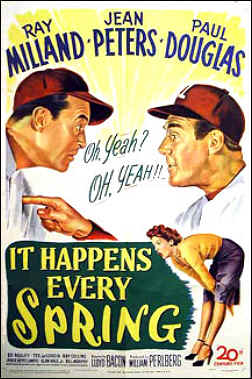
It Happens Every Spring (Lloyd Bacon, 1949) is a sporting comedy that takes a fun premise and knocks it out of the park. Ray Milland plays a professor who inadvertently discovers that his new solution can keep baseballs away from bats, launching him on a wildly successful pitching career. It's clever, atmospheric, amusing and sometimes very tense, with some thoughtful things to say about hero-worship and America’s obsession with its national game, an excellent supporting performance from Paul Douglas and a particularly satisfying ending. (4)

See also: To read about The Doctor Takes a Wife, a screwball comedy starring Ray Milland, go here.

***


Oh shut up. Your character makes no sense.

Mamma Mia! (Phyllida Lloyd, 2008) - This has put me off Abba. And Julie Walters. And possibly cinema itself. I couldn't stand anything about it, from Meryl Steep's grating singing and "look at me, I can be fun" characterisation to the teeth-achingly dreadful script - which crowbars the numbers in with staggering artlessness - witless staging and uniformly annoying performances. Except Colin Firth, he was kind of OK. Without hyperbole, the worst film I've seen for two years. (1)