Showing posts with label DVD. Show all posts

Monday, 16 October 2017

Next year's best films: London Film Festival 2017 round-up − Part 1


If you see this man, do not approach him or he will bore you about films.

Well, you asked for it. Or at least partially dictated the format. So here's all 20 movies I saw at this year's London Film Festival, from worst to best.

Part 1 includes films by the likes of Todd Haynes, Dee Rees and Martin McDonagh, as well as a Chilean documentary on the world's worst aunt, a pulsating French drama about AIDS activists, and Aubrey Plaza being amazing (again). Plus at least two crushing disappointments.

It seems a little odd to make you read an article about the 10 worst films I saw at a festival, but not as odd as publishing a 6,000-word blog, which is why I've split this in two. Also, films #11-14 are really worth s

eeing, and hopefully the reviews of the others are more entertaining than the movies themselves, which isn't the highest bar. Now join me in saying the official catchphrase of the festival, spoken at least four times during every Q&A by a festival programmer: "Congratulations on what I think is an extraordinary movie."

***

20. Wonderstruck


"Make her look a bit cross-eyed with warty eyelids. There we go: old. Done."

Director: Todd Haynes
Cast: Millicent Simmonds, Julianne Moore, Cory Michael Smith, James Urbaniak, Damian Young
Country: USA
Rating: 1.5/4
UK release date: mid-November 2017

How is a Todd Haynes film with a character based on Lillian Gish this bad? And why is this his follow-up to Carol?!

This YA mystery – adapted by its author – has an intriguing dual-time structure, a nice Carter Burwell score and some neat nods to silents, but it's also cloying, not very mysterious, and incredibly longwinded: not trusting its audience to understand anything, and struggling with some laborious translation problems reminiscent of Le mèpris, in which a lot of the dialogue has to be written down and held up. It doesn't help that the central kid seems to have wandered in from a school play. Or that it ends up looking like an extended advertorial for some museums.

It's sort of like Hugo, if everything that Scorsese's film had done had gone a bit wrong.

(The Gish films being homaged, incidentally, are primarily The Wind (the poster of the film-within-a-film starring 'Lillian Mayhew' is based directly on a publicity image for this 1928 masterpiece) and Orphans of the Storm, though she played mothers in few of her starring vehicles and Wonderstruck diverts considerably from her real life.)

***

19. Zama


Director: Lucrecia Martel
Cast: Daniel Giménez Cacho, Lola Dueñas, Matheus Nachtergaele, Juan Minujín, Nahuel Cano
Country: Numerous
UK release date: No release confirmed
Rating: 2/4

"Think of the film as a whiskey... Sometimes you might get drunk and fall asleep. For me that's a good thing. There are some films I love that I've seen five times, and I fell asleep five times." – writer-director Lucrecia Martel

Yeah, I don't feel the same, though that does explain why your film is quite boring.

Zama is about a colonial magistrate who just wants to go home, but forever finds one more obstacle in his way. There's some glorious imagery, and the odd interesting scene – with Lola Dueñas great as a prostitute elevated to society life, and a neat mini-twist near the end – but the characters aren't for the most part well-drawn, and the film's lack of context and air of aloof pretentiousness got on my wick. With a half hour to go, I just couldn't wait for it to end.

The Q&A, as you can tell, managed to be even more annoying than the film (yeah, I shouldn't have stayed). At one point she said that hens have greater attention to detail than humans.

***

... and the award for The Biggest Disappointment of LFF 2017 goes to...

18. The Florida Project


Director: Sean Baker
Cast: Willem Dafoe, Brooklynn Prince, Valeria Cotto, Bria Vinaite, Christopher Rivera
Country: USA
UK release date: 10 November 2017
Rating: 2/4

An Our Gang movie set among the 'hidden homeless' in run-down motels around Disneyworld sounds brilliant, but this tone-deaf film is too horrible and muddled to be anything but a trial.

As it moves from a film about resourceful, anarchic children to one about the world they're forced to inhabit, it forgets that in order to root for a character, they have to not be just the most appalling dickhead. Because of my background, I tend to feel a great affinity towards damaged working-class characters, and subscribe to the lefty notion that there are few bad people, we're shaped more than we might ever like to admit by our privileges and opportunities, rather than by innate attributes. I'm sure, too, that the mum here loves her daughter, as that sweet scene in the rain attests. But she's still a selfish, ungrateful arsehole.

You don't have to love a film's characters to love a film, but from the way Sean Baker has set up this movie, and used it to try to open up a debate about homelessness, you're clearly supposed to feel something, if only pity. For a masterclass, see the Dardennes' The Kid with the Bike, which gave us a self-centred, troublesome protagonist incinerating his second chances and made us want to save his life. Here you see characters like Willem Dafoe's motel manager exhibiting a gentle human kindness towards Bria Vinaite's character, and her treating them repeatedly like shit.

Nor does the kid stuff come off much better. All the child actors are good, especially Brooklynn Prince as Moonee, but most of the jokes grow simply from kids behaving inappropriately like adults: a situation used solely for cheap (but undeniable) laughs, without ever really addressing its essential sadness. I'm as much of a fan as the next person of a kid not really knowing how to swear and just shouting: "You are shit!" at a neighbour, but there's an inmate tragedy there that the film never approaches in its reluctance to acknowledge that while Moonee is slowly waking to a nightmare caused by the callous lie that is capitalism, her mum is also a dick.

It's only when the film slips into an improvisatory mode, allowing its kids to be kids, and a gentle, insular almost surreal silliness to intrude, that it manages to truly evoke childhood, and so achieve the juxtaposition essential to making its premise work. The ending calls to mind Les 400 Coups, surely not accidentally, and it's beautifully done, but it's hardly enough.

The hilarious Q&A with the kids was way better than this unpleasant, inexplicably lauded film.


***

17. Mudbound


Director: Dee Rees
Cast: Carey Mulligan, Garrett Hedlund, Jonathan Banks, Jason Clarke, Jason Mitchell
Country: USA
Rating: 2/4
UK release date: 17 November 2017 (Netflix and simultaneous theatrical release)

Ronsel quick-drying mud stain: it does exactly what it says on the tin – attempts to create a weighty, socially-conscious art movie from Hillary Jordan's plotty, slightly trashy but well-meaning page-turner.

Dee Rees's film spends more time in battle, fleshes out the Ronsel-Jamie relationship, and dwells on the minutiae of African-American life in the Deep South, but in a choppily uninvolving way, and at the expense of Laura's intriguing story of love, repression, sexual and racial guilt.

Critically, it never summons the book's sense of inexorable, fatalistic dread, nor knows what to do as it reaches its climax, which is first silly, then rushed and finally pointlessly and unconvincingly rose-tinted.

Mudbound has a few painterly images, good performances from Jason Mitchell and Carey Mulligan (who has one fantastic scene largely disconnected from the narrative and the worst pregnancy prop in decades) and an unvarnished understanding of the unglamorous, subservient pragmatism needed to survive as a black man in '40s Mississippi, but it isn't very compelling or convincing.

I say this as a middle-class white bloke, but... what promised to be a timely exploration of the African-American experience from an urgent and valuable contemporary voice is instead just a standard book adaptation: a mediocre melodrama that deals with big themes in a handsome but hackneyed way. Plus lots of Mary J. Blige staring out of windows.


***

16. Downsizing


Director: Alexander Payne
Cast: Matt Damon, Hong Chau, Christoph Waltz, Kristen Wiig, Rolf Lassgård
Country: USA
UK release date: 19 January 2018
Rating: 2.5/4

Payne's latest is a funny, sometimes affecting but also confused and rambling satire about everyman Matt Damon joining the growing number of humans 'downsizing' to about 0.035% of their previous body mass, in order to save the environment (and get a better house).

Many of the familiar Payne themes and tropes are here – the search for meaning, economics becoming personal, a climactic moment of supposed quiet catharsis – but the film is all over the shop, mixing neat sight gags, piercing one-liners and heavyhanded comment with variable effects, disastrous diversions and Christoph Waltz being pretty funny but in a different film to everyone else.

Between a broad beginning and an earnest, incoherent end – and seriously, after this, Only Cowgirls Get the Blues (Van Sant), Wanderlust (Wain), keep good American directors away from hippy communes – it does find a sweet spot and a real rhythm for what must be 45 minutes, with Hong Chau absolutely terrific as a bossy Vietnamese dissident (I await the terrible thinkpieces about whether her character is racist). And I loved the fact, perhaps minor to many, that it preached tolerance but took faith seriously: a balance that remains unusual, since evangelical America has rightly revolted anyone with a sense of decency.

But where Election was compact and deadly, and The Descendants elegantly elongated and profound, this feels like about five films cobbled together – and the last couple aren't really any good.

***

15. The Venerable W.


Director: Barbet Schroeder
Country: France/Switzerland
UK release date: TBC
Rating: 2.5/4
A pretty good documentary from Barbet Schroeder − a former Éric Rohmer collaborator who now makes factual films about awful people − dealing with Ashin Wirathu, the world's naughtiest baby. Oh, OK, he's a Buddhist hate preacher. Who's eaten quite enough alms, by the looks of him. It's more a potted history of the path to genocide − with a bit of access and some intelligently-compiled raw footage shot by others − than an in-depth portrait of its subject, though it's an important story and a timely primer on an urgent humanitarian crisis.

As a film, it might be more effective if it had taken the route of its trailer, which makes the Errol Morris-like decision to unveil The Venerable W's toxic Islamophobia at the midway point, rather than leading with it. In the screening, a woman behind me tutted at everything from fascist rhetoric to burning bodies, as if otherwise we'd think that she was endorsing the behaviour in the film.

***

... and the award for The Most Objectionable Audience of LFF 2017 goes to...

14. Three Billboards Outside Ebbing, Missouri (Are McDonagh's films increasingly just an arsehole magnet? Discuss.)


Director: Martin McDonagh
Cast: Frances McDormand, Woody Harrelson, Sam Rockwell, Abbie Cornish, Peter Dinklage
Country: UK/USA
UK release date: 12 January 2018
Rating: 3/4

Martin McDonagh's third film may lack the effortless grace of his stunning debut, In Bruges, but it’s more coherent and confident than his follow-up, Seven Psychopaths, getting its humanistic points across covered by the usual maelstrom of swearing, violence and taboo-punching.

Frances McDormand plays a plain-talking cracker mom who hires three defunct billboards in a bid to attract the attention of a police force that has spent seven months failing to find the man who raped and killed her daughter.

Those cops are led by Chief Willoughby (Woody Harrelson), a family man dying of pancreatic cancer, and the slow-witted, hair-triggered Officer Dixon (Sam Rockwell, brilliant again), one of the most intelligently, interestingly developed characters I’ve seen in a while.

It doesn’t always delve into its serious themes in enough depth – McDonagh’s recent stage hit, Hangmen, dealt with justice and bloodlust in a more intriguing yet incisive way – and the writer-director’s unfortunate predilection for midget gags continues, suggesting a comic imagination that’s as committed to cheap laughs on any terms as it is to shocking us out of apathy (I’ll let him off on the profusion of ‘retard’s, as it makes sense for that to be in these characters’ vernacular).

But his sarcastic, pedantic humour is still great fun to indulge, even when he has to file off the cultural specificity for a mass audience, and there are stunning scenes here: a one-take act of brutality, a breakdown, letters from beyond the grave, and a fiery callback to In Bruges’ Raglan Road set-piece.

I don’t think the movie quite manages to make you feel McDormand’s grief and sorrow, only really her helplessness and exasperation, but this typically outrageous, confrontational and well-acted film is full of surprises, appealingly nuanced characterisation and moments of quiet emotion, and if it feels too disjointed and too detached from the more urgent themes at which it hints, it does have a little to say about the abandoned in America, the seductive symmetry of eye-for-an-eye retribution, and the reasons why tub-thumping calls to arms from a literal moron might currently have the capital that they do.

I might try to see this again when I'm not so tired, as it was my 20th big-screen film in 11 days, and it started really late.

Incidentally, is Lucas Hedges the most morosely uninteresting actor working today?

***

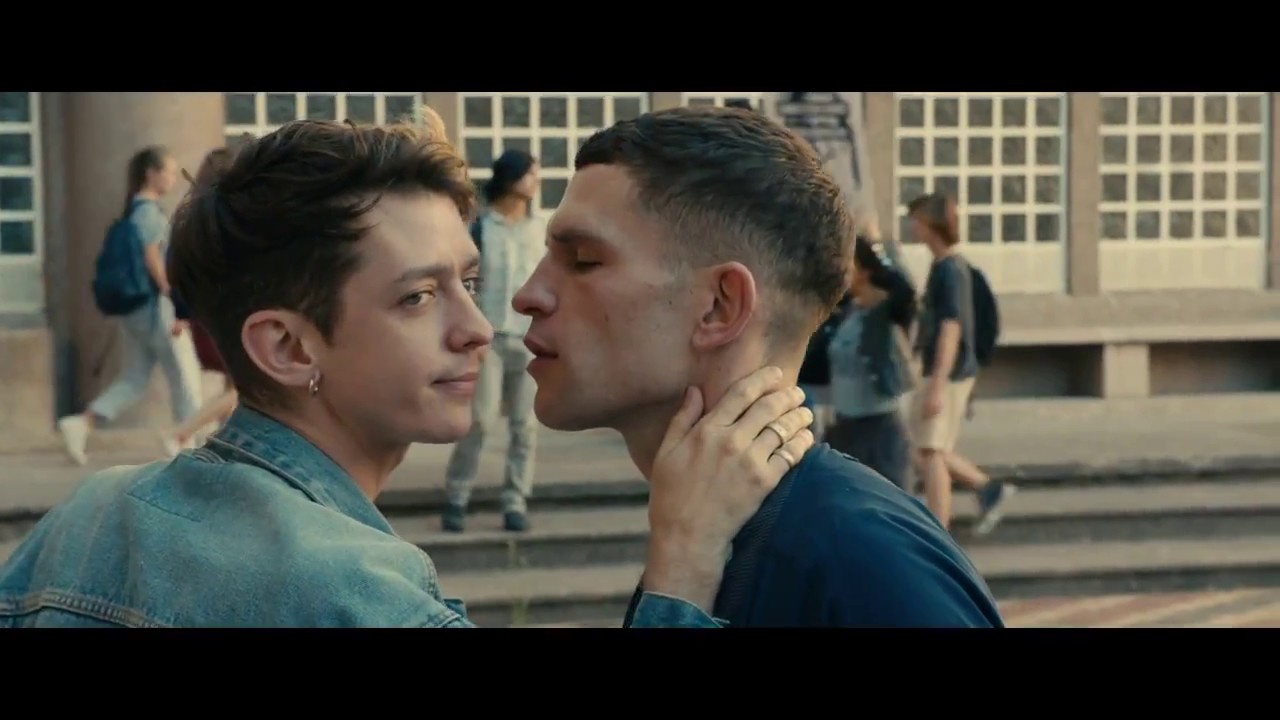
13. 120 Beats per Minute


Director: Robin Campillo
Cast: Nahuel Pérez Biscayart, Arnaud Valois, Adèle Haenel, Antoine Reinartz, Félix Maritaud
Country: France
UK release date: 6 April 2018
Rating: 3/4

An intelligent yet visceral film about the gay community in '80s Paris, which starts brilliantly – focusing on the protests and meetings of Act Up, a group of guerrilla AIDS activists – before turning into a film about a man dying of the illness.

No matter how compassionately, credibly and intimately it does that, segueing from a film about ideas to one about the individual, contrasting the character's dynamism and beauty with his pain-ravaged impotence, and showing the body – not the city – as the battleground, it's ground we've covered countless times before, and (at the risk of sounding awful) it made the movie increasingly tedious.

At its best, this confrontational, unsentimental but humanistic film has unexpected echoes of Melville's Army in the Shadows, which looked at action, division and necessity within the French Resistance, and I understand why it included so many sequences of illness and fucking, but those elements don't seem as interesting as the story it started to tell. When it returns to it in those final moments, loaded with the suffering and sadness of what's gone before, the results are admittedly astounding.

Nahuel Pérez Biscayart is absolutely terrific as Sean, a founding member, Mesut Őzil-alike and all-round complex human being, first introduced to us justifying the fact that he and his mates have handcuffed a government official to a post during his team's PowerPoint presentation.

***

12. Adriana's Pact


Director: Lissette Orozco
Country: Chile
UK release date: TBC, but it's been picked up by Articial Eye
Rating: 3/4

A riveting documentary about a young Chilean filmmaker, Lissette Orozco, who discovers that her beloved aunt was a member of Pinochet's notorious secret police.

As a (debut) film, its balancing of the disparate elements is perhaps a little off – too much unrelated footage of other family members, too much of the director talking about her feelings – and it does become slightly repetitive towards the end, but its story and levels of access are incredible, and it's one of those few films deserving of that most overused of adjectives: brave.

Also Orozco has a lovely pretty face. Her next film, brilliantly, is about an uncle!

***

11. Ingrid Goes West


Director: Matt Spicer
Cast: Aubrey Plaza, Elizabeth Olsen, O'Shea Jackson Jr., Wyatt Russell, Billy Magnussen
Country: USA
UK release date: 17 November 2017
Rating: 3/4

A genre-blurring indie starring Aubrey Plaza (I will watch anything starring Aubrey Plaza) as the lost, damaged and impressionable Ingrid, who gets out of the psychiatric hospital after one of the great opening scenes, takes the insurance money she got from her mum's death and hot-foots it to LA in the hope of befriending Insta superstar Taylor Sloane (Elizabeth Olsen).

Matt Spicer's film isn't always as piercingly, exaltingly dark as it might be, but it treats Ingrid with just the right balance of interest, empathy and fear, and Plaza − who also produced − is absolutely superb in the lead, bringing a great depth, sadness and humanity to a character who can be the most appalling, manipulative monster, but somehow still isn't that big on Instagram.

There are elements that don't quite come off (Billy Magnussen's Nick is an interesting second act catalyst, but it's such a big performance that he unbalances the film; the love interest's Batman fixation is funny but pushed beyond the bounds of credibility), but it's a very interesting, enjoyable film that works as a black comedy, horror, psychological thriller, character study and satire on the skewed and unhealthy forced perspective of social media, in which everything is 'the best' and everything is put through a filter until it's perfect.

That's not perhaps the most profound observation, but the unexpected human fragility beneath Ingrid's monstrousness gives the film a real resonance, and makes it something slightly different to the razor-sharp, take-no-prisoners movie being sold to us.

#iamingrid


At the screening: It was interesting to hear Plaza (above, with Spicer (second from left) and Magnussen (right) say that her own preference is for an ending with at least a little hope in it, a sentiment hinting at the warmth beneath the nihilistic bravado, which it's tempting to compare with that of April Ludgate, her character in all-time classic sitcom, Parks and Recreation. "In essence, we're all fucked," she said at another point during the Q&A, asked to pontificate on the future of the world.

***

Thanks for reading. Part 2 will be up shortly.

Saturday, 22 July 2017

Warren William, The Girl From the North Country, and peaceful protest – Reviews #271

It's not all profiles of people from the 1930s, occasionally I review things that have just happened. But only if they're set in the 1930s.

THEATRE


Girl From the North Country (The Old Vic)
Saturday 22 July 2017 (matinee, final preview)

This new Old Vic production is a jukebox musical of Bob Dylan album tracks, allied to a Depression-era melodrama, and nearly as good as that sounds. Written by Conor McPherson, it takes place in a guest house in Dylan's home town of Duluth, Minnesota in 1934, where owner Nick Laine (Ciarán Hinds) cares for his wife Elizabeth (Shirley Henderson), who's animated by dementia, while trying to pair off their pregnant daughter (Sheila Atim), navigate an affair with a long-term tenant (Debbie Kurup) and cater for two strange man who arrive in the dead of night: bible salesman Michael Shaeffer and ex-boxing champ Arinzé Kene. All of them are waiting for their ship to come in.

The numbers are brilliantly chosen, adapted, staged and sung, ranging from a yearning duet on 'I Want You' (slowed down as it always should have been, and performed by parting couple Sam Reid and Claudia Jolly) to a dynamic, ensemble 'Slow Train Coming' and a climactic medley of 'Duquesne Whistle', 'Make You Feel My Love' and 'Is Your Love in Vain?', all accompanied by a period-appropriate Bluegrass ensemble. Even some of the more peculiar ideas, like commandeering that ode to gloriously malignant petulance, 'Idiot Wind', as a Dustbowl lament, leaning on 'Seňor' or making 'Like a Rolling Stone' a ballad, come off really nicely, with 'Jokerman' effectively reprised and 'Forever Young' finally where it belongs: as a West End weepie. (Other songs utilised include 'True Love Tends to Forget', 'Tight Connection to the Heart' and 'You Ain't Goin' Nowhere', not perhaps the most obvious Dylan tracks, but more the welcome for it; the eponymous track, from The Freewheelin' doesn't get an airing.)

At times the scenes around the music can be too vague or muted, but there are moments of resonance − and bits of tension created from thin air − before the narratives coalesce satisfyingly (but not too conveniently) in two moving final scenes. There perhaps isn't enough at stake, or at least enough that's truly tangible in the script, but perhaps future viewings would reveal hidden depths or further truths. I enjoyed Kene's performance, and the voices of Atim, Reid and Kurup (whose stately grace and absence of self-pity still lingers), though I struggled to take my eyes off Henderson whenever she was on stage.

I've never been that taken with her, seeing her in films, but she has such a presence and physicality, flitting between pitiful and sensual, rabid and comatose, that I was transfixed. Though I tend to have a problem with portraits of mental disintegration which are big and tic-laden (as the journalist Tim Lott once wrote, a realistic piece of fiction about mental illness would just be very boring), this one managed to be funny, intelligently allegorical, moving and somewhat unpleasant, without traversing into unbelievability or hysteria, while her moments of lucidity unveiled an unexpectedly beautiful voice, shot through a Scandi-Minnesotan lilt. It's her, the songs and the atmosphere of quiet desperation which I think will stay with me. (3.5)

See also: I've written about a few other Old Vic plays, including Clarence Darrow, The Master Builder, The Caretaker (which I didn't care for), Groundhog Day (my favourite theatrical experience of last year), and King Lear.

***

EXHIBITION


People Power: Fighting for Peace (Imperial War Museum) is impressive, multi-faceted and a little unfortunate in having to follow the V&A's Disobedient Objects, which is one of the best exhibitions I've seen since moving to London, and dealt with a similar theme: public protest. Here that's scaled down to protests for peace, and zones in on four big British protest movements, those of conscientious objectors in World Wars One and Two, the CND campaign that ran throughout the Cold War (with a little on Vietnam), and the Stop the War coalition which protested Tony Blair's invasion of Iraq.

That's both its strength and its weakness: it has a formidable mixture of exhibits: striking banners, poignant paintings, and arresting posters, trinkets and oddities (from CND pin badges reading 'Guardian Readers Concerned About the Bomb' and 'Clouseau Fans Against the Beumb' to a protestor's accordion), alongside audio snippets also transcribed on a display screen, and fascinating archive videos: one shown via a dozen faux-placards forming an irregular whole, others sharing snippets of news reels, news reports and public information films.


One of those, offering advice on how to survive a nuclear blast, is comically, depressingly and appositely juxtaposed with Peter Watkins' chilling film, The War Game, which showed British unpreparedness and was subsequently banned by the BBC, which had commissioned it. The flip-side is that the exhibition doesn't necessarily have a sufficient through-line explaining or investigating the continuity of pacifism, while its personal case studies − including one of Paul Eddington, a CO during WWII because of his Quakerism − are sometimes too brief and slight to really hit home. Having said that, one inspired inclusion is that of hate mail sent to successive generations of those who excused themselves from war, written by ordinary men and women whipped into a patriotic, judgemental fever by politicians and press.

In that way, People Power allows us to appreciate that where British current affairs are concerned, there is nothing new under the sun. It also offers a huge amount to see, and has plenty to say on the iconography, idealism and discomfort of pacifism, though I found Disobedient Objects somehow more inspiring, perhaps because of its internationalism and diversity of activist art, or perhaps simply because it celebrated causes that are simply more easy to embrace, several of which actually won. The final room here tries to send out on an upbeat note, saying that another British war was less likely after Iraq, but all I could think was that Corbyn only stood a chance in the election because he vowed to keep Trident, and that I don't necessarily disagree with that. (3.5)


I liked this poster, which highlighted the hypocrisy of America at a time when anti-war posters (like the 'Fuck the draft' one above) were being seized under obscenity laws. Not much has changed.

See also: I wrote about the IWM's 'Real to Reel' exhibition last year. ***

GIG


Robin and Bina Williamson (The Half Moon, Putney)
– An evening with 'the mystical one' from '60s psychedelic folk heroes The Incredible String Band, Robin Williamson, who's long since stopped singing his old stuff, and now sings much older stuff: Celtic and pioneer songs, accompanying them on the harp and guitar. He's joined by his wife Bina, who seems lovely, but is a bit of a Yoko: while her voice works OK in harmony, it can't sustain songs by itself, and her psaltery-playing seems to require such concentration that there's no room for expression or timing.


Williamson still has it, though: that distinctive voice, topped by a slight clicking lisp, and the same mesmerising gift for fretwork and fingerpicking, poured into a dozen songs, each either contextualised or prefaced by a story or gag. Who knew that the mystical one would have such a weakness for delightfully terrible puns. Seeing a musical visionary, still performing a half-century on, was a rarefied and special experience, especially doing so in the back of a London pub along with just 30 other people. It might have been even better if he'd had the spotlight all to himself, but they're clearly in love and he's clearly in thrall to her talents, so good luck to them. (3)

***

FILMS


CINEMA: Amélie (Jean-Pierre Jeunet, 2001) – This film is so personal to me that writing about it honestly would be like posting my diary, so I'll just say that while one could harp on endlessly about its shots, its structure, its score and Tautou's mesmeric central performance – and although those elements are almost without equal – it's the film's intensely beautiful heart that takes my breath away every time. I can't believe I just got to see it on the big screen. (4)

***


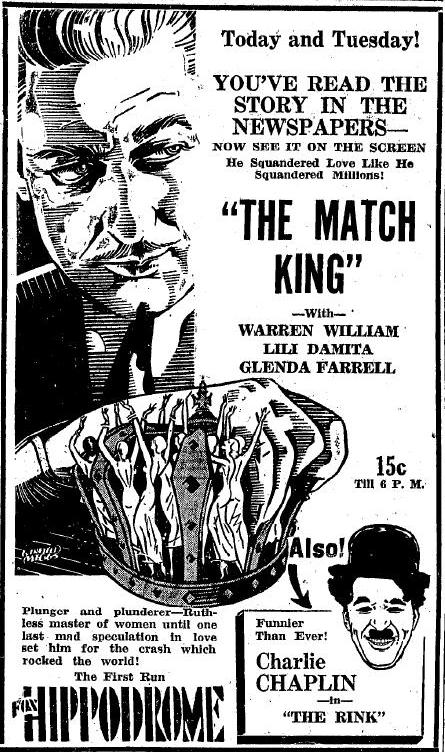
The Match King (Howard Bretherton and William Keighley, 1932) – I bow to no-one in my appreciation of pre-Code Warren William vehicles, but this one's a bit of a mess. It's quite fun, though. The film kicks off with a pre-credit sequence (surprising, since the earliest pre-credit scene is generally cited to be Crime Without Passion, which came out two years later), showing how important and ubiquitous matches are. Then we're into the story proper: a thinly-veiled biopic of Ivar Kreuger ('Paul Kroll', as he is here), the Swedish-born conman who had died earlier that year (and was immediately immortalised in a novel), having cornered the world market in matches.

It begins uproariously in the amoral Warren William tradition, the star selling out friends, pimping out girlfriends and swindling bankers on his way up the ladder. But then it turns into a romance featuring Lili Damita, a business drama full of laughably bad expository dialogue, and finally a morality tale that exposes the star's limitations. He was always a dynamic scoundrel, but just opening your eyes very wide isn't enough for the serious bits. If you like pre-Code cinema, it's worth a look, with some scurrilous plotting, saucily suggestive near-nudity, and bits for Glenda Farrell and Claire Dodd, while its neat final line anticipates the capper to The Roaring Twenties' rise-and-fall narrative, but it seems to have been written, shot and put out in a tearing hurry, with flubs left in the finished film, haphazard editing and an increasingly crap screenplay. Plus Harold Huber pretending to be Portuguese. (2)

See also: I wrote about The Mouthpiece, a better Warren William film, also found on the Forbidden Hollywood, Vol. 10 box-set here. His two defining films, Skyscraper Souls and Employees' Entrance are on Vol. 7, which I wrote about at length here.

***

DVD


Stewart Lee: If You Prefer a Milder Comedian, Please Ask for One (2010)
– I'll give it to you straight, like a cider that's made from 100% pear.

This is perhaps Lee's best show, with a pair of inspired, extended set-pieces about Top Gear and Magners Cider that take unnerring aim at casual racism, manufactured outrage, and the corporate co-opting of the art, history and communal experiences that we treasure. The interview with Kevin Eldon on the DVD is a real bonus too, a fascinating insight into Lee's psyche, character and work, which reached some kind of apogee with this daring, thematically and formally original, consistently hilarious act: part deconstruction, part tightrope-walk, part epic fantasy about Richard Hammond being decapitated. (4)

***

Thanks for reading.

Friday, 21 July 2017

And introducing… #3. Lee Tracy

Here's part three of the series. Previous instalments were about John Ford and Wendy Hiller. Some of the films dealt with below also feature in my two-part 'FDR's Hollywood' feature, looking at political cinema of the 1930s and '40s.

#3. Lee Tracy


Who?
The electrifying, motormouthed comedian whose career came to a sudden and dramatic halt in the mid-1930s.

How so?
He pissed on the Mexican Army.

He what now?
He (allegedly) relieved himself nakedly on a passing military parade during the location filming of MGM’s Viva Villa! in November 1933, and was thrown out of Mexico.

Well, if you’ve got to go...
Indeed – though for Tracy’s part, he denied it all. He was sacked by the studio anyway and spent the rest of his career at lesser studios, before a brief, remarkable comeback in the 1960s.


Was he any good?
The best. Tracy was an explosive, compelling performer: the living embodiment of the “pre-Code” movie – those do-anything, say-anything films that packed out cinemas in the early ‘30s, before the Hays Office went and spoiled everyone’s fun. The impending censorship clampdown of 1934 effectively put Tracy’s kind of movie out of business, which might have been why MGM weren’t too sorry to see him go.

Any trademarks?
Plenty. A wild-eyed delight at his amoral manoeuvring getting him on top once more. A twirling forefinger, a selection of distinctive vocal trills (“You’re thrrrrrough”) and an arsenal of singular gestures, from the way he appeared to be literally seizing control of a scene – bending forward, arms wide apart – to his deft, farewell flick of the hand.


Where do I start?
With Blessed Event, the 1932 Warner Bros comedy about an unscrupulous gossip columnist, which may just be the funniest movie ever made (watch the trailer here). Tracy’s Alvin Roberts, “that kid from advertising”, is allowed to look after the paper’s social section while the regular author is away, and proceeds to turn it into the most popular – and unpopular – column in the country, incurring the wrath of a gangster, and engaging in a gleeful tit-for-tat rivalry with eternally upbeat crooner Bunny Harmon (Dick Powell). Playing a character loosely based on Walter Winchell – then one of the most influential men in America, and the subject of a half-dozen semi-fictional films – Tracy is hysterically funny, spewing a constant stream of wisecracks, though the film’s centrepiece is a terrifying, perilously dark set-piece in which he talks mobster Allen Jenkins through a trip to the electric chair. He shoves a picture of noted victim Ruth Snyder in Jenkins’ face, before navigating the henchman through a florid, impossibly graphic description of state-sanctioned death, every part of his body seeming to contort as he dominates the screen. You would die with one finger twitching upwards, Tracy concludes with a shaking voice, “to where you’re... not... going”.

That sounds, err, fun?
It doesn’t, but somehow it’s exhilarating, because you’ve never seen anyone act like that before: it’s neither conventional, nor stagy, nor necessarily naturalistic, it’s just dynamic.


What else did Tracy do?
Having originated the role of Hildy Johnson in the legendary stage play, The Front Page (above), he had come to Hollywood in ’29. He appeared as a low-level criminal in Frank Borzage’s abysmal translation of Liliom (later musicalised as Carousel), and had a bit in John Ford's gangster flick, Born Reckless, but came to real prominence with three supporting roles in 1932: The Strange Love of Molly Louvain – a nasty, compelling Pre-Coder that spotlighted his singular, rapidly-quickening style of delivery – Love Is a Racket (a film he would have starred in just months later) and the near-legendary two-strip Technicolor horror-comedy, Doctor X, playing an endlessly quipping reporter – a market he had quickly cornered. After Blessed Event, he starred in a succession of tailor-made vehicles making use of the go-getter persona so beloved of Depression-era audiences, beginning with The Half-Naked Truth (which cast him as a promoter), Clear All Wires! (sending his journalist to Communist Russia), the classic romantic comedy The Nuisance (with Tracy as the last word in amoral shysters) and the fantasy masterpiece, Turn Back the Clock, in which his unsatisfied grocer has the chance to live his adulthood over. The final two were made at MGM, the world's biggest and most prestigious movie studio, which could scarcely miss the impact he had been having over at Warner Bros, and didn't hesitate in offering him a fat long-term contract.

Is that all?
Of course not! This was the early '30s, when actors were treated abysmally, so there are always tons of films to enjoy. Tracy had also appeared in Washington Merry-Go-Round, which anticipated Mr Smith Goes to Washington, and went on to deliver an unforgettable supporting performance as the agent to alcoholic actor John Barrymore in Dinner at Eight (perhaps the most prestigious MGM film of 1933), run rings round Jean Harlow’s diva in the superlative, lightning-paced comedy, Bombshell, and star in a bastardised version of Nathanael West’s 'Miss Lonelyhearts' called Advice to the Lovelorn (sound familiar?), designed to cash in on the success of Blessed Event. It was his 14th film in just two years. After that came Mexico. And the rest, as they say, is history.


I’m not sure it is. Please fill me in.
Tracy did the rounds, pitching up at Columbia, RKO and even the Poverty Row studio PRC, where – looking a bit more jowly than 10 years before – he rolled back the years, recapturing some of that old Blessed Event magic in a zingy film called The Pay-Off. His other post-MGM films are a mixed bag, though the mid-‘30s comedy-thrillers Wanted: Jane Turner and Behind the Headlines are pretty great for what they are, while I’ll Tell the World – which cast him opposite Old Rose from Titanic (Gloria Stuart) – is a charming movie in which his dogged, dynamic reporter falls in love with a European princess, without losing his passion for skulduggery and sarcasm.


Tell us about the ones that didn’t work.
It’s not that they don’t work, it’s that they don’t work fully, sometimes leaving Tracy high and dry as the films run out of momentum, or trade sardonism for sanctimony. He’s always worth watching, though, and endearing oddities during this period include a boxing comedy alongside Roscoe Karns (Two-Fisted), a weird comedy-weepie co-starring Jimmy Durante (Carnival), the Hollywood-on-film shenanigans of Crashing Hollywood, 1940’s gimmicky Millionaires in Prison (inevitably featuring Raymond Walburn as one such moneyman), and a variety of vehicles with Tracy in crooked attorney parts, such as Criminal Lawyer – uneven but great fun – and The Spellbinder, which like 1934’s You Belong to Me cast him as a dad, before degenerating quickly into soap operatics.

That doesn’t sound very good. His worst?
No, his worst is definitely The Power of the Press (1943), a hopeless, excruciating collision of small-town patriotic wisdom and WWII propaganda flick – based on a Sam Fuller story, wtf?! – in which folksy newspaper editor Guy Kibbee takes over a New York paper infested with fascist fifth columnists, including Hearst-like businessman Otto Kruger, who's in preposterous form. Tracy’s OK as a snappy but spineless, circulation-chasing editor, but it’s a profoundly depressing experience. He made three more films over the next four years, each more obscure than the last, and then disappeared from the big screen.


So what’s all this about a comeback?
Having made his way slowly down the ladder, and then crossed over to TV, Tracy returned to the stage in the early ‘60s, playing a former President – patterned after Harry Truman – in Gore Vidal’s vital, vivid political play, The Best Man. When it transferred to the screen, Tracy played the role again: a glorious, measured, nostalgic characterisation that showed a range largely untapped by a Hollywood system forever trading off familiar persona, finally allowed him to swear (he swears superbly), and landed him a well-deserved Oscar nomination. Sadly, talk of a comeback was scuppered by his faltering health – he died four years later – but as swansongs go, it was one of the finest.

A case of what might have been, perhaps, had he not made that ill-fated trip to a Mexican hotel balcony. He did, right?
Who knows? In his book, cinematographer Charles G. Clarke said he was standing outside during the parade, and the incident never happened. In his version of events, Tracy had responded to an obscene gesture on the street by making one of his own, but that after the papers got wind of his supposed insult to the nation, MGM had sacrificed Tracy in order to be allowed to continue filming there. Director Howard Hawks was also kicked off the picture for siding with Tracy.


What to say: “Blessed Event is the epitome of pre-Code filmmaking: daring, lightning-paced and furiously funny.”

What not to say: “Blessed Event is so good it makes me want to wee on soldiers.”

***

Thanks for reading.

Wednesday, 17 May 2017

Folk music, The Apartment, and the other Elizabeth Taylor – Reviews #265

Behold such riches as have rarely been seen on Advice to the Lovelorn: one of my favourite 20 movies, two fantastic books, and the amazing psychedelic folk records that one of them has turned me onto. I also enjoyed a phenomenally intense Yasmine Hamdan performance at London's sweaty, sensational Scala, and saw the Moomin exhibition at the Southbank and the sensational butterflies at the Natural History Museum. Those sojourns will turn up in my review of the year, but for now let's talk films, books and music:


*MINOR SPOILERS*
The Apartment (Billy Wilder, 1960)
– I will never get over how much I love this movie: a film about unrequited love, with Jack Lemmon taking a verbal and physical pummeling to protect the elevator girl he loves, the beautiful Miss Kubelik (Shirley MacLaine).

She's the one left holding the sleeping pills after his spineless corporate climbing – achieved by leasing the titular abode to horny company executives – and her naïve romanticism bring them into the circle of all-time business shitweasel, Mr Sheldrake (Fred MacMurray, cast brilliantly against type). Recovering in Lemmon's apartment, MacLaine begins to fall for the poor fool, but damn it if he can't quite untangle himself from acquiescence, subversience and the hollow, ill-gotten glories of corporate success, and become a mensch.

The greatest of Wilder's many masterpieces (I'd say he made nine), it's a perfect marriage of cynicism and innocence, with Lemmon perfectly balancing his character's myriad complexities, making us feel sorry for a fawning, amoral and (admittedly) piteous schmuck for 20 minutes, transmitting his character's innate sensitivity and subsequent moral awakening – inspired by his beautifully unselfish love for the bob-cutted, pixie-ish Miss Kubelik – and negotiating the frustration of a hero who'll try to set up the love of his life with his arsehole boss out of pure selflessness, then enjoy the societal and financial rewards. I've said it before and I'll say it again: Lemmon needed a tight rein on him or it was all overbearing humming and unbearable mugging. Here he does a little of that, but it's part of the densely-packed mesh of a believable, human character.

MacMurray too is superb as the evil, ageing twin of his character in Remember the Night (my favourite film), who abandons his suicidal mistress on Christmas Day and tries to fuck her on New Year's Eve. Best of all is MacLaine's performance, which she has never come close to approaching, despite decades of fine work. Her haircut might be pure MPDG, but she's a real woman, with real difficulties, delusions and selfish impulses, real pain and anger shining from those eyes, and a real, rewarding sweetness, tenderness and humanity.

In its gorgeous widescreen, monochrome, city-based cinematography and perfectly-timed blasts of melodic jazz, it anticipates Woody Allen's Manhattan, and its ending has the same joyous dash towards romance, the same profoundly understated, compassionate, off-kilter pay-off. (It's in a constant conversation with cinema too, being inspired by an incidental element of Brief Encounter and explicitly referencing MGM's all-star 1932 movie, Grand Hotel and the westerns of John Ford.) This whole film feels like perfection, but its last 10 minutes especially so, as every seed that Wilder has sown throughout the past 115 bursts into bloom, as MacLaine sprints through the streets, a crown on her head, the camera shaking as it struggles to keep up. A mention too for the scene with Lemmon, MacLaine and the broken mirror, in which every element is so perfectly integrated, from language to image to performance. I'd die happy if I could ever write something just a tenth as good.

It's a film about gentlessness, stoicism and the need to tell power to take a running jump. My film. And as good as it gets, cinema-wise. (4)

This was #19 on that all-time top 100 I put together last year.

***


Awakenings (Penny Marshall, 1990) – An effective, sentimental story about awkward, passionate doctor Robin Williams getting a job in a chronic hospital in the Bronx, and realising that the supposed vegetables peopling the ward – including former encephalitis patient Robert De Niro – might be alive in there after all.

For more than an hour it's like a lighter, extremely entertaining variation on One Flew Over, as Williams fights the authorities for the right to administer untested medication in an attempt to “awaken” these trapped souls, and modern-day miracles begin to happen. Then the movie becomes darker and more troubling, making it a richer, more human and more profound film, but notably less comfortable viewing.

Williams' closing speech is the kind of vague, wooly, catch-all bollocks I can't stand (who, precisely, has forgotten “work, play, friendship, family”?! Even Hitler was a fan of all four), but the rest of the film is extremely well done, with strong performances, a familiar but slick script, and some thoughtful direction, Marshall's Hollywood instincts and visual shadowing of moods augmented by some artistic touches, including fine, subtle use of handheld camera.

Its overall presentation is none-more-1990, with some of the broad strokes (and subsequent distancing) you’d expect, but also the attendant entertainment value, as the film’s edge, basic commitment to the facts and underlying sincerity begins to work away at you. (3.5)

(This viewing was in the annual pre-Eurovision slot, with my friend Vicky, following last year's acclaimed screening of We Bought a Zoo.)

***


CINEMA: Adam & Paul (Lenny Abrahamson, 2004) – Michael Smiley introduced this at the BFI, saying it was a film that gave him a funny feeling inside, and a movie he’d shared with friends, always asking them to pass the DVD on, rather than giving it back. Justin Johnson, chief programmer at the BFI, said people could regard it as the most hilarious film ever made, or the most heartbreaking. For me it’s not quite either, though it does have a special something about it.

It’s essentially Waiting for Godot relocated to junkie Dublin, as two addicts who’ve been missing for a month wander the streets looking for their next hit. They are gentle, meek, apologetic Paul (Tom Murphy) and the taller, quieter, grumpier Paul (Mark O'Halloran, who wrote it), and the day we spend with them is poignant and troubling and sometimes hysterically funny. The leads aren’t unfailingly convincing, but they have just the right mix of sensitivity and selfishness, as O’Halloran’s script traverses comfortable ground, then expects us to navigate abrupt, discomforting developments, like the pitiful, pitiless mugging of a kid with Down syndrome). Adam and Paul are loveable in their innocent, Laurel and Hardy-ish way, but that scene reveals a cruelty born of desperation just beneath the surface.

The film was directed by Lenny Abrahamson, who’s since gone on to big things with Frank and Room, and while you’d never mistake it for a film with a big budget, its low-rent look and the drab Dublin it presents suit the subject matter. When there is a need to slip into something more cinematic, he really delivers: the mini-flashback (or flash-forward?) in the baby sequence is a jolt of auteuristic brilliance.

Adam & Paul is a little shabby and at times too much a melange of styles (the comic scene at the gas station is superbly done, but out of step with the rest of the picture), but there’s a great feel to it: sad and humanist and quietly absurd, with a cleverly contrarian treatment of tropes: we want these characters to be happy, but their goal is the worst possible thing for them; we want them to have friends, but if they reconnect with Janine (Louise Lewis), the new mum is likely to get hooked on heroin again. That uneasiness, our complicity in it, and the touching (if not entirely original) unspoken bond between Adam and Paul – deep, unconditional, unspoken – may well account for that funny feeling, as I got it too. I suppose I'm one of Smiley's people. (3.5)

I'd also like to mention here that my tweet about the film (and Tim Farron) got RTs from Smiley and O'Halloran. But I won't, that would be both insufferable and pathetic.

***


CINEMA: Chinese Roulette (Rainer Werner Fassbinder, 1976) – All the elements are here for another fine Fassbinder film – an intriguing set-up, an amusingly subversive villain, Anna Karina looking hot in a cool black bandana – but it never quite gets there, and in the meantime it’s all v-e-r-y s—l—o—w.

A married couple (Alexander Allerson and Margit Carstensen) each take a lover to their country estate, where they’re joined by their malevolent ‘crippled’ daughter, her governess, the housekeeper (Brigitte Mira) and the housekeeper’s son (Volker Spengler), an aspiring author. It sounds fascinating, but it flails impotently for an age, with Fassbinder abandoning his usual precise, methodical approach, taking a stab at a kind of cerebral Godardianism, his portentous, nebulous script directed at a halting face suffused with pregnant pauses.

Its characters are mysterious and craftily unexpected enough for it to gather momentum at times, but its intriguing dynamics and occasional surprises (a brief but brilliant off-the-wall dance sequence underlining its strong use of music; an unforgettable close up on a beaded hair net after an explosive tragedy) are bogged down by a laissez faire approach that obfuscates when it should elucidate, expecting us to basically make up both the story and what all of it means. This is typified by the titular, climactic game, which reaches a fairly worthwhile crescendo but takes an interminable amount of time to get there, forcing us to slog through synthetic dialogue, snail-paced delivery and endless silences.

It is fascinating and eerie to watch Mira standing there as Fassbinder invokes Nazi collaboration, though. The half-Jewish actress was a key performer in Goebbels’ state propaganda series, Liese und Miese, as the ‘bad’ citizen whose behaviour was a cautionary tale for German audiences.

From what I’d read, I was expecting something twisted and refreshing, with the best kid villain since Bonita Granville’s malicious gossip in These Three. What I got was less elusive than illusive, a slip of a film that you can read a lot into, much of it perhaps not really there. (2)

***

BOOKS


Electric Eden by Rob Young (2010)
– This is a rare gem of a book: a beautifully-written, passionately-argued history – and defence – of British folk music from its origins in the pastoral socialism of William Morris and classical composers Holst, Vaughan Williams and Delius, through to Kate Bush, Julian Cope and Talk Talk in the 1980s. The meat of the book, though, is a conversational, amusing and astute evocation of the British folk boom of 1965-74, with vivid, condensed portraits of the likes of Pentangle, Fairport Convention, John Martyn and the Incredible String Band, their origins, obsessions and place in the canon impeccably but accessibly explained and elucidated, alongside that of an abundance of odd, often forgotten contemporaries, from the bleak and furious art rock of Comus to, erm, a moonlighting Playaway presenter involved in naked pagan rituals (these sequences are occasionally laborious or tenuously linked, but far more often utterly fascinating).

Young does a simply extraordinary job of stripping away decades of murkiness and myth, tracing an elegant through-line from 1890 to the 1980s, and confronting and considering many of the questions and controversies that dog the genre, tackling supposed middle-class hijacking – and Victorian sanitisation – of working class song preserved in the oral tradition, dismantling the associated notions of ‘authenticity’ that dominated folk in the 1960s, and repeatedly defending Morris dancing (he’s a braver man than I). He writes brilliantly about music too. There are a few too many 'tendril's and 'brew's, but his ingenious use of the pastoral vernacular, and his creating of neologisms and metaphors by riffing on album titles, is a joy to read: colourful and ambitious but precise, without the meaningless pretension of, say, '80s NME, or the drab, dryly factual contextualisation which seems to serve as music journalism today. He also takes an enormous gamble (in non-fiction terms) by slipping into allegorical fiction during the Rocket Cottage chapter, a stylistic quirk that is, if not a total success, extremely memorable.

Though a few furious pedants have found errors in the book, I’d argue that it’s better to write a passionate, revelatory book casting extraordinary light on British culture than to not bother because some bores might get cross. And while – due to the subjective nature of music – it inevitably becomes at times a personal history (Young omits June Tabor, has little time for Sandy Denny’s extraordinary second album, and neglects to even mention Fotheringay’s ‘Banks of the Nile’, perhaps the towering achievement of the era), its forays into the wider cultural context are extraordinarily invigorating, with the inclusion of A Canterbury Tale, Bagpuss and the films of Humphrey Jennings – allied to the genre’s root in socialism and a pastoral, nostalgic vision of Albion – suggests that everything I like is in some way related to British folk music.

The greatest joy of this book is the wealth of wonderful music it has inspired me to investigate. Best of the lot is the Incredible String Band, whose outrageously original psychedelic folk is illuminating each walk to and from work. Here's your four-step guide to becoming a fan:

a) Put on 5,000 Spirits or the Layers of the Onion
b) Do not turn it off
c) Do it again
d) You are now a fan
(4)

***


Angel by Elizabeth Taylor (1957) – This impeccably restrained, richly ironic novel is the story of Angel Deverell, a 15-year-old liar and aspirant author who seeks to transcend the pathetic life of servitude mapped out for her, through sheer, incandescent genius. Her genius, though, isn’t for art but for matching the taste of the public, which greets her epic, florid, ‘risqué’, wildly inaccurate tour-de-force, The Lady Irania, with little short of hysteria, catapulting the waspish, selfish and humourless egomaniac into a life of which she has merely dreamt, and yet has dreamt relentlessly.

Taylor’s writing is intoxicatingly crisp and precise, allowing her to define character, invoke laughter or evoke tragedy with a minimum of language or apparent effort, as she traces Angel’s path from the deprivations of working-class Volunteer Street to the peak of renown and ridicule, and then on, towards desire, rot and ruin in a landscape blanched by snow, as lives fester beneath delusion, but compassion flowers from the muck.

In Angel’s world, horrors are envisaged then never arrived upon, as others emerge from the shadows; no passage goes where you expect it to, or elicits the emotion you anticipated; and Taylor creates not so much a cautionary tale as a devastating character study: the writer as a monster, chained to her art, anti-social and self-obsessed, in communion with herself, and fashioning the world as it should be, not as it is, both on the page and beyond.

It’s exquisitely beautiful, piercingly funny, and segues from brutish to elegiac quite seamlessly, Angel’s story peopled by vividly-realised supporting characters: her protective editor, Theo, with his perfectly-manufactured kid gloves; Nora, whose blinkers are replaced by perpetual martyrdom; lazy, deceptively doting Marvell; and that callow, listless and dissipated prettyboy, Ésme. In tone, style and subject, it’s like nothing else I’ve read. (4)

***

Thanks for reading.

Tuesday, 4 April 2017

Patti Smith, Music for Chameleons, and Ghibli being all weird again – #Reviews 261

Here's a blog I wrote about getting to go behind-the-scenes at Brian Pern: A Tribute, one of this year's televisual triumphs.

And here are reviews of the other cultural things I've ingested recently: three books, a movie and a couple of TV series.

BOOKS


Just Kids by Patti Smith (2010)
– At its best, Smith’s beautifully-titled memoir of her life with idiosyncratic, doomed artist Robert Mapplethorpe is uncommonly insightful, raw and moving, as a trio of fateful encounters blossom into romance, which in time becomes an epic love that endures even as their lives begin to diverge: Smith graduating from artist to poet to pioneering rock ‘n’ roll frontwoman, Mapplethorpe admitting his homosexuality to himself as he turns from a collagist and painter into one of the era’s defining photographers. The passages detailing his death and then flashing back to their early acquaintanceship and their construction and then abandonment of a self-contained world are extraordinarily powerful, shining a light into the corners of Smith’s soul and revealing the importance that her upbringing, her faith and her commitment to creativity and visionary artistry have played in dictating her life’s course.

And yet the book becomes decreasingly revelatory and compelling as it progresses, Smith traversing into pretension with increasing frequency and intensity, as well as boringly listing which thrift shops she visited, which trinkets people gave one another, which outfits she wore every day and what she had to eat. As a fashion icon, it seems obvious in retrospect that she must have spent time and energy crafting her visual identities, but it doesn’t make for great reading, that blissful middle-ground of relatability, frank emotion and economic but literate prose vacated entirely for long stretches, as we oscillate between posturing and pointlessness.

Even then, though, Smith has a way of snapping back to a truthfulness and precision that's immediately and startlingly effective, and while reading between the lines we can deduce that perhaps Robert wasn’t the saintly, selfless figure that his great defender contends, you would have to be a psychopath not to be moved by the pair’s deep, mutual and unstinting dependence, at times breathtakingly evoked by this flawed but distinctive and heartbreaking elegy – not just for an artist, but for a man, and for the heyday of the grungy, bohemian, dangerous, filthy, accepting, unforgiving and enrapturing New York City that was his. (3)

***


Scandals of Classic Hollywood by Anne Helen Peterson (2014) – I don’t want you to develop any preconceptions about this book’s contents, based on this image: if only there were a saying that succinctly crystallised this thought.

Anne Helen Petersen’s book isn’t the tawdry, sensationalist rehashing of age-old scandals it appears from the cover, rather it seems that this is the only way you can get a book like hers published. Instead, it’s a collection of blogs from this ‘doctor of gossip’ (she has a PhD in the history of the industry, from the University of Texas) which examines Hollywood scandals or tragedies, how they were managed (or not) by the studios, and what the events, their handling and the fall-out tell us about American society. Each chapter is around 13 pages long (a couple are much longer), beginning with Mary Pickford’s affair with Douglas Fairbanks, closing with the hysteria around James Dean’s death, and in between looking at everything from the tragic lives of screen sex sirens Clara Bow and Jean Harlow to Bogie and Bacall’s romance, and Montgomery Clift’s ‘long suicide’.

The quoted sources are almost all gossip and fan magazines, a fascinating prism through which to view this history, but also somewhat limiting, if the sections on Bow and Harlow are representative of the whole. Though Petersen alludes to David Stenn’s book on Harlow, she either misinterprets or deviates from his impeccably well-sourced, well-argued narratives of both lives, with an alternate vision that seems myopic and incomplete, with no understanding of (or even reference to) Bow’s tortured upbringing. The contrary assertions it does make aren’t attributed to any sources and so seem more like supposition. Though most of the other essays crackle with energy, as we get a witty, accessible and cleverly contextualised whistle-stop tour of a star’s life, usually zoning in on a controversial, widely-covered scandal (Fatty Arbuckle) or tragedy (Carole Lombard), or – more often than not – the ongoing ‘scandal’ that was their self-destruction (in the case of Judy Garland, Montgomery Clift, Marlon Brando), or their side-lining by censorship (Mae West) or racism (Dorothy Dandridge), as a result I began to question their veracity of completeness. Doubtless some elements are difficult to fact-check through the fog of time and the smoke and mirrors of Hollywood publicity, but her constant get-out of “the accuracy of this claim matters less than…” is frustrating, and there are quite a few typos and errors (Carole Lombard dies in 1941, then signs up to do war work in 1942). That’s a shame, as the Arbuckle section is spot on, the Clift one is a decent effort, and the chapters on West, Dandridge and heroin-addicted silent star Wallace Reid are – at least on the surface – gripping and eye-opening pieces about stars I’ve seen a bit of, but knew little about beyond the headlines.

There’s also certainly no doubt that Peterson is an expert on fan magazines and studio publicity, and it’s a fascinating angle from which to approach these stories. Now and then she'll even turn something you thought you knew about – like Kazan's On the Waterfront, one of the first films I ever loved – so you see it as if for the first time, appreciating how Eva Marie Saint's transformation in the film is fundamentally achieved through Brando's reactions to her. On the other hand, Petersen is writing for an audience with little to no knowledge of these stars and their work, which means that if you’ve read Patricia Bosworth’s book on Clift, Stenn’s definitive works on Bow and Harlow, or even seen – say – Paul Merton’s documentary on Arbuckle, you’re having to sit through an awful lot of familiar (but simplified) material in order to get a little more insight. She’s also somewhat curbed the waspish, sweary tone of her earlier Hairpin articles, which is understandable (I sometimes soften my own writing depending on the audience), but a little disappointing.

It's not that I didn’t enjoy the book. It’s a lot of fun, and I learned quite a bit, but it left me a little unsatisfied. Perhaps I’m just spoiled by Karina Longworth’s superb You Must Remember This podcast, which covers these sorts of stories with such skill, insight and journalistic rigour – and at such length – that she leaves most other film historians trailing in her wake. (2.5)

With enduring thanks (and sincere apologies for my usual ungratefulness) to my friend Soph for sending me this one.

***


Music for Chameleons by Truman Capote (1980) – A book of extraordinary grace, incisiveness and honesty which further bolsters my impression that Capote remains one of the most important, original and underestimated writers of his era. Fuck his artificial image as a catty, trivial, morbid starfucker, and study the work: dark, devastating, morally decent work shot through with his actual character, the shadows of an encroaching darkness creeping across the sun-dappled idyll of his New Orleans childhood. Even fans tend to lean on a popular narrative – pushed in last decade’s cinematic biopics – that sees him in terminal decline after the trial of In Cold Blood, but while it’s true that he degenerated into substance abuse (an affliction dealt with in breathtaking fashion in the last of these 14 pieces), and that with it his work-rate slowed, this book may well be his creative zenith.

In Bob Dylan’s Chronicles, he explains (entirely preposterously) that in the late ‘80s he found a new way to sing: a mathematical formula that has enabled his voice to endure his Never Ending Tour (please post your punchlines below). Here, Capote does much the same, denigrating his entire back catalogue as he seeks to articulate exactly why, and how, he’s developed the new style premiered in this book. Unlike Dylan, who is talking through his silly cowboy hat, Capote is sincere. His style here is so clean, precise and economical, yet to formally inventive, that it takes the breath away. Every decision he makes, from delayed gratification, to leading with dialogue, to drifting into remembrance and reminiscence, seems right, and his evocation of emotion, of nature, and of character is remarkably specific and so uniquely powerful.

There are six short stories and seven conversational portraits, alongside a non-fiction (?) centrepiece about a serial killer, and each is remarkable in one way or another. Perhaps my favourite piece is Dazzle, a multi-layered story with a time-shifting perspective that’s about love, fear and guilt, as Capote relives the story of his paternal grandfather, a fortune teller and two terrible secrets: one comic, the other tragic. It is flecked with wonder, touched by horror, and redolent with an unstudied compassion for his younger self, before a climactic sucker-punch that knocked me sideways. But it’s just one masterpiece among many. The other short stories are rich in irony, but unwaveringly sincere, as they deal with self-loathing, denial and the secrets (or unspoken truths) that dominate the book, while his egalitarian ‘portraits’ take in a weed-smoking cleaner, Marilyn Monroe, pastoral novelist Willa Cather and amoral Manson acolyte Bobby Beausoleil: though you could class the first of those as ‘hilarious’ and the last as ‘chilling’, that’s to reduce them from the multi-faceted, playful, probing, touching, humane and sad works that they are. The only piece that doesn't quite work for me, at least not unequivocally, is Handcarved Coffins, the lengthy true crime chapter at the book's centre. It has passages of great insight – on sexuality, obsession, delusion – but at times its language is oddly forced, and ultimately I'm not sure exactly what the point is that Capote is constantly circling and yet never quite landing upon.

It makes sense, perhaps, that when the book does malfunction, it's in both style and content, for it's the balancing of form, viewpoint and revelation, both overt and within the reader, that is the book's great strength. Music for Chameleons is beautifully-written, but even Capote’s admirers often stop right there, and it’s much more than that. His swaggering, elegant, stylistic brilliance – even as a supposed has-been, with a pickled liver and a nose stuffed with coke – is really a way of packing as much wit, pathos and meaning into each line as possible. His style is not an end in itself, it's the way he carries truth to the reader. (4)

See also: I wrote about In Cold Blood here, and some earlier Capote works here.

***

FILM


Spirited Away (Hayao Miyazaki, 2001)
– It only took me 16 years to see Spirited Away, and what a wondrous, spectacularly odd film it is: Ghibli on an epic yet intimate scale, as a little girl named Chihiro gets waylaid while moving house, and Hayao Miyazaki’s imagination goes into overdrive.

We meet Chihiro just minutes after an emotional farewell to her old friends: she’s sitting in the backseat of her parents’ car, as they trail a moving van to their new home. The family stop to investigate what seems to be an abandoned theme park, and soon the parents have been turned into pigs, Chihiro’s life has been saved by a boy who it turns out is a dragon and also a god, and she’s been forced to find employment in a fully-functioning bathhouse populated by ghosts, assisted by a multi-armed man who lives by a furnace with his friends – sentient bits of soot – and under the cosh of giant-headed Thatcher-a-like Yubaba, whose beloved germaphobe baby is bigger than she is. That’s the first 20 minutes. It carries on in a similar vein from there, as you can see from this short paragraph lifted from Wikipedia:
While visiting her parents' pigpen, Sen finds a goodbye card addressed to Chihiro and realizes that she has already forgotten her name. Haku warns her that Yubaba controls people by taking their names and that if she forgets hers like he has forgotten his, she will not be able to leave the spirit world. While working, Sen invites a silent masked creature named No-Face inside, believing him to be a customer. A 'stink spirit' arrives as Sen's first customer. She discovers he is the spirit of a polluted river. In gratitude for cleaning him, he gives Sen a magic emetic dumpling. Meanwhile, No-Face tempts a worker with gold, then swallows him. He demands food and begins tipping extensively. As the workers swarm him hoping to be tipped, he swallows yet another two greedy workers.
The film takes a little while to begin to weave its magic, but without warning you find yourself enraptured, lost in its peerlessly weird universe, spellbound by its animation – by turns serene, frenetic, opulent, disorientating, immersive and repulsive – and touched by its understated but profound emotional core. Its characters are notable for their complexity, duality and depth – often achieved with minimal exertion – as well as for their malleability. Whether by witchcraft or kindness, they can be corrupted or reformed – these are not the one-trait ciphers often fed to animation audiences – and yet there’s a simplicity in the emotional exchanges that’s completely beguiling, and surprising for a film with such a complicated story, and such a wealth of subtext. Miyazaki’s nostalgic vision acts as a commentary on a modern Japan that has lost its way, betraying its national identity and its environmental responsibility with a greed that’s evoked with both subtlety and a crude, in-your-face literalism. This, it says, it what happens when you only have a yen for yen. On a surface level, it's also great to have this coming-of-age tale led by such a brave, forthright, decent, ass-kicking girl. There should be one in every story.

The film isn’t perfect: while transfixed and impressed by its balls-out, apparently authentic weirdness, I found it initially distancing, and there were times when the movie’s proliferation of oddball supporting characters, the scenes necessary to accommodate them and its general noisiness (compared to my favourites thus far, Totoro and Porco Rosso) began to tire. It always, though, came back to itself: to Miyazaki’s singular if somewhat unregulated imagination, to the sincerity and simplicity of the Chihiro-Haku relationship, and to the aesthetic analogue that is Spirited Away’s exquisite animation. (3.5)

The music's lovely too.

***

TV


The Nazis: A Warning from History (1997)
– A topical rerun of this seminal series, 20 years on. It’s history as investigative journalism, shorn of all sensationalism and ghoulishness, which changes much of what you thought you knew about the Nazis, such as their bizarre, deeply dangerous power structure – competing, antagonistic department heads seeking to turn Hitler’s psychopathic monologues into policy – the role of voluntary, informal informants in making the Gestapo appear omniscient, and the self-justification of ‘ordinary’ Germans who enabled them to commit unprecedented horrors. From its striking credits to Samuel West’s crisp, authoritative voiceover, its unearthing (and understanding) of revelatory documents to its astonishing interviews with perpetrators and victims alike, it’s a class act, which manages to answer (or at least posit a compelling answer) to that eternal, chilling question: how could it happen? (4)

***


Spiral: Season 5 (2014) – For five episodes, this erratic but often exquisite French crime series appears to have given up the ghost. It’s tired, disjointed and – yes – even boring, as Laure Berthaud (Caroline Proust), Gilou (Thierry Godard) and the rest return to solve a slow-moving murder case, a series of ATM ram raids and the mystery of what the hell’s happened to Spiral. Then suddenly, and almost without warning, it explodes into brilliance, its stories dovetailing – and then artfully unfolding – its human subplots becoming uncommonly compelling, and Proust, Godard and Audrey Fleurot (as complex, flamehaired, bad-ass shyster Josephine Karlsson) hitting devastating peak form. It turns out that it’s all about mothers and daughters, and that neither we nor Laure are allowed to have anything nice happen to us ever. It’s back later this year, apparently. I’m going to record them all and then binge. (3)

***

Thanks for reading.