Showing posts with label D. W. Griffith. Show all posts

Tuesday, 1 September 2015

16 more things I learned about Lillian Gish


Last month, I read the autobiography of famed silent star Lillian Gish, and suggested that it smelt a little like someone curating their own legacy. Charles Affron's 2001 biography, Lillian Gish: Her Legend, Her Life, essentially attempts to unpick the meticulous framework of untruths that Gish constructed around her existence, whilst giving the actress the due that was very much hers. At first, Affron's exertions are frankly annoying − the early parts of the book are needlessly pernickety and sometimes weirdly nasty − but the further we get into it, the more he draws on varied extracts from her personal papers and the more he examines Gish's peerless art, the dizzying highs, declining fortunes and minor later triumphs, presenting a fine portrait of her as a performer, if a rather incomplete one of her as a woman. The major problem with the book, compared to the best of its type, is that Affron hasn't bothered to interview anyone, which given that Gish was still alive, well, fully compos mentis and happy to talk to everyone who asked until 1993, is something of an incredibly large oversight. It is, however, the best book yet written on her work, and taught me exactly 16 fascinating new things about the greatest screen actress who ever lived:


1. When Gish's mentor, D. W. Griffith, was making Hearts of the World, a WWI propaganda film bankrolled by the British government, Prime Minister David Lloyd George tried to get him to use scenes written by Winston Churchill. The credited scriptwriters, their names designed to endow the film with credibility, were Gaston de Tolignac and Captain Victor Marier. Neither man existed, both being pseudonyms for Griffith. Tolignac was revived for the director's 1921 film, Orphans of the Storm, which dealt with the French Revolution.

2. Broken Blossoms was Gish's favourite of her films. The anecdote about passers-by outside the studio thinking she was being attacked (which I speculated might be nonsense) stems from that shoot, and is apparently from Kevin Brownlow's book, The Parade's Gone By, so is almost certainly true.


3. A pioneering proto-feminist, Gish was heavily involved in every aspect of Griffith's filmmaking. After she left him, she and director Henry King wrote, cast and assembled her 1923 vehicle, The White Sister, together. The final cut was edited single-handedly by Gish. She was also a director, filming Remodeling Her Husband (starring her sister Dorothy) in 1920. Despite such progressive virtuosity, she wasn't as forthright about gender roles as she might have been, saying: "I doubt if any woman is strong enough [to direct films]", though adding as a caveat, "what is more, there are very few men that have the vigour and imagination to be directors."

4. A workaholic, she said that when being absorbed in shooting one of Griffith's pictures "I underwent a period of creative fervour that to me was intense happiness. At the time, I hadn't enough insight to know that I was using hard work as a smoke screen to cover my almost complete retreat from my life."

5. After breaking with Gish and replacing her with the unloved Carol Dempster, director Griffith lamented to reporter Adela Rogers St. Johns that he had "chucked her out for that mediocre girl... She was my luck, she was my light − I never had either after I lost her. Oh God − man can be his own worst enemy, can he not?"


6. She became an "honorary member of the Fascisti" in 1923, joining the repugnant ranks of Mussolini's blackshirts while shooting The White Sister near Rome. I'm more of a fan of Gish's acting than her politics.

7. When Gish signed with Nicholas Schenck at MGM in 1925, it wasn't her first dealing with his family: Nick and his brother Joe (chairman of United Artists) had, like many other movie moguls, come up from the amusement park game, running Fort George in Upper Manhattan, where Gish's mother Mary had managed a candy stand and Lillian had learned to ride a horse.

8. Gish's first choice project upon joining MGM, Romeo and Juliet, was vetoed by theatre owners, more than half of whom said they'd refuse to buy a Shakespeare adaptation. Her second, Joan of Arc, was kiboshed due to expense. Other suggestions included Jane Eyre, Bernard Shaw's Major Barbara (which would have been wondrous to behold), and works by Goethe, Euripides, Thomas Hardy and Gabriele D'Annunzio.


9. Lillian claimed that her mother's ill-health had been caused by shellshock sustained during a trip to London in WWI. Actually, a careless gynaecologist had accidentally forgotten to retrieve his sponge.

10. The only MGM film that lost more money during the 1927-8 season than Gish's Annie Laurie (an attempt to sex up her image) was Lubitsch's silent masterwork, The Student Prince of Old Heidelberg.


11. This is the big one: there was no alternate ending to Gish's greatest film, the incomparable silent Western, The Wind. According to the star in her oft-screened introduction to the film, preview audiences were shocked by a tragic finale in which Gish's Letty wandered off into the desert to die, and studio bean-counters decided that she'd met her maker too often on screen lately, and ought to survive. (I fell for this myself: look.) In fact, the ending that we see was in the fourth draft of the script − completed two months before shooting began − with the exception that the original climax included some additional business for the abysmal comic character, 'Sourdough'! Her mythmaking was designed to cast her in the role of a crusading artist sold out by greedy studio heads: a convenient fiction to explain her unhappy departure from MGM. Bad Gish.

12. The hostility towards Gish from Photoplay Magazine, which launched an almost unstinting vendetta against the star from 1924 onwards, appears to have resulted from her polite refusal to be included on a set of collectible movie star spoons that the publication launched shortly beforehand.

13. After the failure of The Wind, Gish spent months working on an unrealised project called The Miracle Woman, with German theatrical maestro, Max Reinhardt, for much of that time even living in his house, the Schloss Leopoldskron. After reading the story, Joe Schenck gave Gish his hilariously blunt assessment of what would happen if they made the film: "I will lose my money and you will lose your last chance to become popular again." Her next role would have been Nina in Eugene O'Neill's Strange Interlude, but United Artists pulled out after the playwright was sued for plagiarism (a claim later dismissed at trial).


14. Gish would have played the role of Birdie in William Wyler's breathtaking version of Lillian Hellman's The Little Foxes (review of that film in my next post), had she not been held to her contract for the play, Life with Father, another of the major 'what if's in her career. The answer to all of them: it would have been amazing. In later years, she was pitched to John Ford for his swansong, Seven Women, and to Hitchcock for Family Plot, while John Gielgud − to whose Hamlet she had been Ophelia in 1936 − was originally cast in the Vincent Price role in Gish's last film, The Whales of August.

15. Among the famous stage roles written for Gish, but never played by her, were Lavinia in O'Neill's Mourning Becomes Elektra and the young prostitute in William Saroyan's Time of Your Life. She did finally get to play another part penned with her in mind, the rough draft of Blanche DuBois in Tennessee Williams' Portrait of a Madonna (the play that became A Streetcar Named Desire), at a one-off event in Berlin in 1957.

16. In 1991, she turned down the chance to play her first nude scene, aged 98.

... and here's the last word from Affron on Gish's consummate artistry, discussing Orphans of the Storm (spoilers):

Thursday, 20 August 2015

Gish and Stanwyck - Reviews #213

Assorted bits and pieces from the careers of two of my favourite actresses, Lillian Gish and Barbara Stanwyck. You can click on those links for a bit of background.

GISH:


*MINOR SPOILERS*
Broken Blossoms (D. W. Griffith, 1919)
- This slow, bleak D. W. Griffith melodrama has achieved classic status, but I find it so completely over the top, in both its material and Donald Crisp's ludicrous villainy, that it's hard to get into.

Richard Barthelmess is a Chinese pacifist who travels to London to share the Buddha's teachings, but winds up a lonely opium addict instead. When he falls in love with a 15-year-old girl (Lillian Gish) who's terrorised by her father (Crisp) - a malevolent, embittered boxer living in squalor on the waterfront - you get the idea that it probably won't end well.

Crisp is farcical - constantly facing the camera and frequently mugging - and it all feels very aloof and detached compared to Griffith's usual work. Having said that, Barthelmess does a good job of inhabiting his part - if tending to display very little emotion or rather too much, and walking with a stoop that I hope he doesn't think is characteristically Chinese - while Gish is absolutely excellent, playing young yet world-weary, abused yet enduringly innocent in some essential way, and masterfully articulating everything from the flowering of self-worth to a cacophony of head-spinning terror. The 'finger smile' she does here - improvised on the set - quickly became iconic, and it's a flash of genius.

Broken Blossoms is also quite a progressive movie for its time, especially considering it was made by Griffith, is subtitled 'The Yellow Man and the Girl', and stars a white man as a Chinese guy. (2.5)


*MINOR SPOILERS*
Way Down East (D. W. Griffith, 1920)
- When I was a newspaper reporter, there was a local woman in her 90s who used to sometimes ring me up on newsdesk on a Friday (I think she was lonely), and it turned out that her earliest memory was chasing Maltesers down the aisle of Harrogate's Royal Hall as a toddler, while this film played in the background.

She seemed slightly confused when I told her it was one of my favourite movies, perhaps not realising that, at heart, I'm 103. "You can't mean the same film," she said. "It's very old."

It is.

It's also something of a miracle: a hoary Victorian stage melodrama transformed into enrapturing screen art by the skill of the father of film, D. W. Griffith, and the genius of his leading lady, the incomparable Lillian Gish.

The movie is a lengthier variation on Griffith's pastoral poems of the previous year - A Romance of Happy Valley and True Heart Susie - and a fitting vehicle for Gish, in her definitive role as the embodiment of womanhood, a virginal waif who's tricked into sleeping with caddish Lowell Sherman, and can't start anew with boy-next-door Richard Barthelmess (ideally cast), due to the secret forever hanging over her.

Griffith's title cards are hysterically preachy and the supporting slapstick is moronic, but the rhapsodic, beautifully photographed central story remains utterly mesmerising, with Gish evoking every emotion under the sun, before drifting away on the ice floes, her hair and hand trailing in the freezing water as she heads for a waterfall.

That dazzling climactic set-piece, which has transcended the film to become one of the passages most associated with silent cinema, was filmed essentially for real across three weeks in Arctic temperatures, and left Gish with permanent nerve damage. A tour-de-force of iconic imagery, bravura editing, and stunning stuntwork by the leads themselves, it's the capper to a quite wondrous movie.

The only thing I can think of that's more enjoyable would be chasing Maltesers through a theatre. (4)


The White Sister (Henry King, 1923) was silent screen phenomenon Gish's first film away from the auspices of D. W. Griffith, the pioneering director who had cast her initially in The Unseen Enemy (1912) - a daft short that's a little bit like Panic Room - elicited her first truly great performance in The Mothering Heart (1913), and then collaborated with her on epic smashes like The Birth of a Nation (1915) and Intolerance (1916), before finding vehicles tailored particularly to Gish's incomparable talents in movies such as True Heart Susie (1919), Way Down East (1920) and finally Orphans of the Storm (1921).

Breaking away with his blessing, Gish then signed with the independent company, Inspiration Pictures, excited by the chance to work with the director (Henry King) and producers of the stunning pastoral drama, Tol'able David (1921), which had been one of the biggest box-office hits of its year, and starred Gish's Way Down East and Broken Blossoms co-lead, Richard Barthelmess. And so she, King, a relative newcomer by the name of Ronald Colman and the rest of the company decamped to Italy to shoot their new film on location, discovering when they got there that there were only two klieg lights in the entire country, though they did at least have both of them.

The story Gish had chosen for her mission statement was The White Sister, dealing with a young woman who believes her soldier lover has been killed, and renounces the outside world to become a nun - only for him to reappear. In typical proto-feminist fashion, the star fought with distribution companies who pooh-poohed the project, scouted all the locations for the film and attended innumerable religious ceremonies by way of research, while fostering an unfailingly, appropriately "spiritual" atmosphere.

"How is it on the set between scenes?" Gish asked Helen Hayes a decade later, when her friend was shooting a talkie remake. "Oh, you know, the usual stories and jokes," Hayes replied. "Then you're not going to get it," Gish told her. "You cannot set up a camera and take a picture of faith."

It's that commitment to the project, and her instinctive genius, that makes the film work, when it does work. There are moments of visual and actorly poetry here as good as anything that the cinema has ever produced: the moment where Gish, hearing of her lover's death, shudders in the breeze of an open window; her heartbreaking encounter with his portrait in a hospital ward; her transfiguration when he later calls on her to recant her vows. It's a performance of extraordinary power and nuance: in the early reels boasting a sensuality very rare in her characterisations - which have been derided for their sexlessness - and in the later ones, so shot through with pious eloquence that you seem to be staring into the face of God through the eyes of Gish.

The rest of the film, somewhat unfortunately, is a bit of a hodgepodge, never quite gelling. There are scenes that go on too long or are cut oddly short, other bits of 'business' (as silent directors termed character colour) that have no real right to be here - so a boy tied a girl's hair to her chair, is that really relevant right now? - passages that are awfully talky for a silent, and an action climax that seems to exist only because of faddish convention and narrative convenience, dragging its feet as it serves up, at best, a feeling of mild peril. And though Colman is fairly effective in a tricky part, we also have to endure a highly silly villainess (sillainess) and a convenient subplot about an ailing scientist notable only for the fact that when a volcano eruption is on the way, he has some thermometers that light up the word "TIIIIIT" on his wall. Sorry, this is a film about nuns, I do apologise.

As a movie, then, it isn't altogether the seamless, ceaselessly credible experience that one truly desires, but as a piece of art about faith and love, it can be both wrenchingly powerful and truly profound, thanks almost entirely to the talents and exertions of Lillian Gish, perhaps the best screen actress we've ever seen. (3)


The Wind (Victor Sjöström, 1928) - A spectacularly uncommercial silent melodrama, with Lillian Gish driven mad by chauvinism and the desert wind. There's some incongruous comedy and a divisive re-shot ending, but the rest is gobsmacking, with peerless atmospherics and Gish's biggest, arguably best performance. (4)


One Romantic Night (Paul L. Stein, 1930) - This stilted, very talky early talkie is notable only as Gish's first excursion into the nascent medium, cast somewhat against type as a snappily dressed princess caught between two very different men, Rod La Rocque (an actor memorably name-checked in Singin' in the Rain) and Conrad Nagel.

Adapted from a Ferenc Molnár play called The Swan, it possesses dated mores that are difficult to follow today, and creaks like hell, everybody speaking with that weird just-learning-to-use-these-crap-new-microphones intonation, though some of Gish's facial acting is characteristically excellent, and that first kiss is a good moment.

The star made just one more movie in the next 12 years - the no-budget New York-shot film, His Double Life (1933) - tired of and dismissed by Hollywood, before her triumphant return as a character actress in the 1940s. (1.5)


Portrait of Jennie (William Dieterle, 1948) - An ethereal, inspiring fantasy-romance in the vein of The Ghost and Mrs Muir, Somewhere in Time and The Time Traveller's Wife, with listless artist Joseph Cotten finding a muse in the shape of a mysterious girl named Jennie (Jennifer Jones), who seems to belong to another era, and is growing up too fast.

Its feel is transcendent, with seductive visuals, a relentless, lushly magical Dimitri Tiomkin score (with a debt to Debussy), and persuasive performances from one of the casts of the decade, including memorable supporting roles for Lillian Gish, David Wayne and especially Ethel Barrymore.

The only parts that didn't work for me on first viewing were the confusingly conceived 'taking of the veil' sequence, and the waterlogged ending, which is impressively staged but thematically unsatisfying. It's still an extremely evocative and affecting film, and one I'll doubtless return to, time and again. Maybe next time those elements will strike me differently.

Incidentally, that's Nancy Reagan making her screen debut in the final scene - she's the teenage girl on the left, viewing the eponymous artwork. (3.5)


*SOME SPOILERS*
Follow Me, Boys! (Norman Tokar, 1966)
- Erratic but engaging small-town Americana starring three of my favourite actors, Fred MacMurray, Vera Miles and silent screen legend Lillian Gish, about a touring musician (MacMurray) who jacks it in to put down roots, becoming a beloved scoutmaster.

After that delightful opening, the first half follows the Boys Town template - or The Parable of the Lost Sheep, if we're going further back - with the stern but loving MacMurray becoming father figure to a bunch of boys, only to end up spending more time on one problem case (the young, freckled Snake Plissken) than the rest of them put together.

The remainder of the film is rather odd: shapeless and episodic, with an extended war games set-piece set in 1944, some courtroom drama, and a finale that could never be accused of subtlety, as it hammers home the idea that only a sense of civic duty can lead to true happiness, and that you get a parade and everything.

One can rail against the film's Disneyfied, Republican view of the world - where a white community solves its problems through temperance and Christian values - mock its tending of mile-high corn, and quibble with the stealing wholesale of a memorable moment from Goodbye, Mr Chips, but I think the film caught me in the right mood, as I rather enjoyed it.

I watched it chiefly because I'm continuing to explore the career of Lillian Gish. For the most part, her performance as a wealthy, benevolent widow is suitable but unexceptional, until one very good scene near the end, where she opens up about her past. The rest of the movie is sincere and competently done, without ever pulling up trees, and MacMurray and Miles work really nicely together. (Though the beginning of their courtship reminds me a *little* of Travis and Betsy at the start of Taxi Driver.)

Also, for fans of unimportant facts about movies - 'trivia', if you will - Up wasn't, as is often claimed, the first Disney film to feature a character who can't have children, as that's the case with Vera Miles here.

Follow Me, Boys! is likely to be Hell on Earth for any unremitting cynics out there, but for everyone else, it's all pretty pleasant. If you were only going to ever watch one Disney drama from the 1960s, though, go for Pollyanna, as that's an exceptional piece of work which throws this film's more everyday shortcomings into sharp relief. (2.5)

***

STANWYCK:


This is My Affair (William A. Seiter, 1937) - President McKinley sends naval officer Robert Taylor deep undercover to foil a bunch of bank robbers and expose their inside source, in this handsome but lumpy thriller. It’s a great premise, but Allen Rivkin and Lamar Trotti – the latter the writer of Ford’s seminal Young Mr Lincoln soon afterwards – skimp on the psychology, jumping right into Taylor’s quest, without the need for him to shed his attachments or sink from the service, a dynamic of public disgracement that worked so well in Batman Begins. Instead, he drops us straight into a suspense-free period crime drama – intended to cash in on the success of San Francisco and In Old Chicago, the second of these written by Trotti – as Taylor spars with criminals Brian Donlevy and Victor McLaglen, each of whom has a claim on songstress Barbara Stanwyck.

There are passages of pure Americana, allied to some lush love scenes (Stanwyck and Taylor simply can’t stop kissing, and married in 1939, though their courtship here begins with some charmless rom-com stalking), and a succession of painstakingly-recreated dance hall numbers from 1901 – several unfortunately enunciated by the leading lady. Stanwyck’s speaking voice – at least before she smoked her one millionth cigarette – was an instrument of rare beauty. Remember the Night and Ball of Fire are all about her voice, but even lesser films like My Reputation (below) and this one hinge upon it. The way she'd drop it out, crack it or throw in a kind of blue note. It’s exalting to listen to. Her singing was dreadful, though, no matter how much training she had, nor how sensitive the arrangement, and that’s never going to stop being true.

There’s a more central problem here, though, and it’s in the writing, which is too often cartoonish, flat and simplistic: words one would hardly associate with Trotti’s work on Judge Priest and that polemical classic, The Ox-Bow Incident. There’s a risible bit of ‘business’ about McLaglen being an inveterate practical joker, which is poorly conceived and idiotically executed, a comfortable shorthand for the film’s narrative failings.

Then, about an hour in, Taylor tries something outlandish in a bid to catch the traitor supplying safe codes to the robbers, and the film turns into something else entirely: a shadowy thriller complete with psychological torture, a nifty twist and some race-against-the-clock shenanigans: again enjoyable enough to watch, but not especially novel, nor evoking the requisite emotional response – partly because Taylor is so wooden, always operating at the same simplistic level, which broadly translates as “wait one sec, I’m just going to do an act”.

A few more weeks spent on the script, and this movie could have been something special. As it is, it’s a good-looking mash-up of various disparate genres that never quite gels or hits the heights it might, but consistently entertains, providing moments of beauty amidst its peddling of affable mediocrity. (2.5)


My Reputation (Curtis Bernhardt, 1946) - Decent, handsome 'woman's picture' about widow Barbara Stanwyck falling in love with patronising know-it-all George Brent, their romance upsetting her mother (Lucile Watson, so purposefully annoying she's unwatchable) and setting local tongues wagging.

It works better as a mature drama than when trying to be a rom-com, but it's really about Stanwyck's excellent performance, James Wong Howe's photography and Max Steiner's score, the three combining to particularly powerful effect in the early scene where she reads a letter from her late husband, and during that moving climactic monologue. The ending proper is sadly a double cop-out representing unreconstructed Hollywood at its worst, but those last 15 seconds are stylised perfection. (Incidentally, if Stanwyck looks unexpectedly young, and you're flummoxed by the unnecessary wartime setting, that's because this one was shot in 1943 then caught up in the Mass WWII Backlog.) (2.5)


The Bride Wore Boots (Irving Pichel, 1946) - Mean-spirited, astonishly unfunny comedy about horse-mad Barbara Stanwyck and historian Robert Cummings having marital troubles, probably because they're both so utterly unbearable. There's one touching scene near the start, but it's mostly shrill, hateful rubbish, and in the end I just gave up. You know a movie's in trouble when even a horny Diana Lynn isn't helping. (1)


*MINOR SPOILERS*
The Lady Gambles (Michael Gordon, 1949)
- A gruelling, laudable film about married photographer Barbara Stanwyck becoming addicted to gambling, turning from an affable careerwoman to a two-bit criminal lying bruised on a hospital bed.

The makers were allowed to shoot on location in Vegas, so there's no indictment of organised gambling, with the hoteliers and pawnbrokers proving absolutely delightful, but for the period this is an unusually heartfelt and perceptive examination of mental illness, with Stanwyck playing her problem as if it were a drug addiction, which it absolutely is. You get the sense that she cared more about this role than most of those she got in the late '40s: there's a fragility, a hopelessness, a perpetual vulnerability that she didn't often go for, and it inspires pity, uncertainty and unhappiness in the viewer - not the ingredients for a cracking night in with a DVD, but fitting for this type of film.

Frank Skinner's score is rather patronising. the flashback structure has Robert Preston's character recalling details he wouldn't really know about and the story moves somewhat in judders, with an unnecessary subplot about horse-racing and a weak ending utilising Stanwyck's incredibly neurotic older sister (Gothic horror regular, Edith Barrett), but it's a largely solid 'problem picture' with a fatalistic, ever-present atmosphere of gnawing dread, and a strong central performance that sees Stanwyck doing something a little different from her norm.

Incidentally, I do genuinely wonder if there was something in her contract saying that at least once a film someone had to comment on how ravishing she was. Either that or the studios were just trying to brainwash us. (2.5)


East Side, West Side (Mervyn LeRoy, 1949) - Glossy, unbelievably entertaining Hollywood meller set in New York, with Stanwyck as a wronged wife, Charisse the girl-next-door, Heflin's effortlessly modern performance, Gardner's feline sensuality, Mason's voice, colourful bits for William Conrad, Beverly Michaels and Gale Sondergaard - her last film before being blacklisted. For what it is, close to perfect. (4)


The Furies (Anthony Mann, 1950) - A disappointing adaptation of Niven Busch's novel (which comes in the Criterion set): not as clever, atmospheric or claustrophobically, Freudianly bonkers, and missing the book's most deliriously dark character, the mute, merciless, yellow-eyed blood-lusting 70-year-old psychopath gunman, Quintinella, who should clearly be played by J. Carrol Naish.

43-year-old Barbara Stanwyck is Vance Jeffries - at the start of the book, 19 years of age - who takes after but lives in the shadow of her tycoon father, T. C. (Walter Huston), owner of the titular ranch. Their intense relationship is fractured but not destroyed by two romances: the first her affair with a gaunt gambler (Wendell Corey), the second his visit from gold-digger Judith Anderson, and soon they're trading in increasingly bitter revenge.

That famous scene with the shears is great and there are some strikingly composed shots, but neither those nor the talents of Stanwyck and director Mann can compensate for Charles Schnee's pale, toneless, often brainless script. A couple of his changes are for censorship or commercial reasons, but most of the others are just stupid: Anderson's character is now a villain rather than a charming victim of circumstance, Quintinella is replaced by a generic fat Mexican guy called El Tigre (Thomas Gomez), IOUs are legal tender known as 'TCs', and The Furies is the endlessly-repeated name of the ranch, not a clutch of demons gathering poetically in the sky.

What remains of Busch's story is sufficiently original to explain some of the film's reputation, Stanwyck is good in one of her late-period 'strong woman' roles and Beulah Bondi - her co-star from my favourite movie, Remember the Night - turns up briefly to predictably excellent effect, but it is an extremely flawed movie, equipped not only with narrative shortcomings, but four principal males who are either overrated if commanding (Huston), off-form (Gomez) or just rubbish (Corey and the ever execrable Gilbert Roland).

Mann made a few of my favourite Westerns, particularly Man of the West and The Naked Spur.

This isn't in the same league, though perhaps when the book has faded from my mind I can take it on its own terms and enjoy it more, luxuriating in that chiaroscuro photography. I'm not sure, though. Gilbert Bloody Roland, ffs. (2)


To Please a Lady (Clarence Brown, 1950) - This hilariously-titled movie is the motor-racing film that Gizmo likes watching in Gremlins: a stale star vehicle about speedway, with as much badly back-projected footage of Clark Gable in goggles and a little hat as you'd expect.

The story's the usual sexist Gable rubbish, rather late in the day, with a jumped-up dame (Barbara Stanwyck) causing him trouble until he slaps and kisses her, after which she immediately falls in love with him.

The stars' hearts clearly aren't in it, there's a disconcerting scene where they have phone sex with him watching her in the mirror and then he pretends she's his aunt, and though the film's harnessing of sporting clichés – incorporating some unexpectedly involving race sequences – keeps it moving for a while, it all runs out of gas a long way before the finish.

That speedway episode of Malcolm in the Middle is much better, especially the sight gag with the lap numbers. (1.5)


Jeopardy (John Sturges, 1953) - Nasty little thriller about an all-American family on holiday in Mexico: Barry Sullivan gets trapped under a pier, wife Barbara Stanwyck goes for help, only to get waylaid by complete psycho Ralph Meeker. Starts slowly, picks up when Meeker appears and Sullivan gives his son a moving pep talk about coffee, then ends rather strangely.

The best thing about the film is that Sullivan smells his wife's perfume and then says "Mmm, sexish", which I shall be doing from now on. (2)


All I Desire (Douglas Sirk, 1953) - An affecting drama in Douglas Sirk's familiar style, with Barbara Stanwyck given one of her best later roles - and so giving one of her best later performances.

As in the pair's other film together, 1956's There's Always Tomorrow (below), she's a woman returning to a town she left years before, complicating the lives of the married man she once loved (Richard Carlson), his son and his two daughters. This time, though, the kids are hers and the man was once her husband.

It's not quite as effective, unusual or stylistically striking as that later film, which made vivid use of the wide screen then de rigueur, with compositions rich in symbolism (hello Rex, the Walkie Talkie Robot Man), but it largely succeeds, Sirk again leaning on archetypes - the cowardly cuckold, the surrogate mother, the stage-struck kid and the sexually voracious single man - but usually finding real emotions between the lines.

At times the film tips over into unconvincing melodrama and overbearing sentiment, the supporting comedy is as laboured as ever and the score gets very ominous and silly whenever ex-lover Lyle Bettger turns up, but the film's very Sirkian themes - that good people tossed around by their emotions can do bad things, that gossips should shut up and go away - are very persuasive, and articulated by Stanwyck with a conviction and nuance she rarely managed later on.

During the early '40s, she was absolutely on fire: in 1941 alone, she got three parts showcasing both her beguiling emotional sensitivity (cased in cynicism) and her sexual smarts, and aced them all. Then movies changed, she got old, she got an awful new haircut, all that smoking wrecked her voice, and nothing worked so much any more. Some superficiality on my part perhaps, but that spark, that energy seemed to have sapped away, the star so removed in her Hollywood bubble from her tough upbringing in Brooklyn that it was like she no longer knew how to play ordinary people. All I Desire isn't in the same league as those earlier films, and neither is her performance, but there are moments of genuine clarity and beauty - the start of the conversation with her confused, distraught son; the "I'd love you to come with me" that she utters to herself after purposefully wrecking her daughter's image of her; bits of the Browning poem she reads - and that's far more than we usually get.

And as it's set in the past, even her hair is OK. The slang of the period is better than OK: "He's a regular Lemon, from Lemontown," a student warns a girl he likes. "Ah, 23 skidoo," replies his rival.

All I Desire isn't an unassailable classic, but as a vehicle for a truly great actress it works better than most, helped by a solid script, Carl E. Guthrie's thoughtful lighting and an unusually convincing supporting cast - these aren't exceptional performers, but for the most part they fit their roles well and so never distract from a woman who is.

I find it enduringly fascinating, however, that Sirk and his writers so consistently fetishised the importance of small town family life to an almost hysterical degree, whilst wallowing in the unhappiness of its stifling nature and eyeing the attractions of the alternatives. It's a dichotomy deserving of a book that would perhaps contain no definitive conclusions.


Witness to Murder (Roy Rowland, 1954) - A minor annoyance (Barbara Stanwyck) looks out of her window, sees a homicidal ex-Nazi (George Sanders) commit a murder, and helpfully informs the police. They don’t believe her, but he does. This unpleasant sleeper has a good premise, well-matched stars – with Sanders hamming it up enjoyably if lazily – and some handsome shots by pioneering noir cinematographer John Alton, but it gets more and more illogical as it progresses, leading to an absolutely farcical climax. It also has a sensationalist approach to mental illness that leaves a bad taste in the mouth.

The Window - that 1949 classic about a boy who cried murder - did this sort of thing a whole lot better. As did Rear Window, actually, rather unfortunately released the same year as Witness to Murder.

On a minor note, this is another later Stanwyck film in which someone says completely incongruously how hot she is. It’s now my life’s ambition to find out if this was actually written into her contracts, as it’s getting a little ridiculous. (2.5)


There’s Always Tomorrow (Douglas Sirk, 1956) - Douglas Sirk tries to dissuade us from having children, #37.

An incisive, if not exactly subtle study of conformity and the American Dream - the director's pet theme - with successful, married father-of-three Fred MacMurray growing tired of his stifling life, and seeking escape with old flame Barbara Stanwyck.

It's brilliantly directed and sensitively played: the ultimate showdown between MacMurray's eldest kids and his mistress providing both dramatic fireworks and rhetorical resonance. His other child, Frankie, is basically the worst person in the world.

This may be the last and least of the three Stanwyck-MacMurray collaborations that I've seen (they made four films together), but since the others are my all-time favourite film (Remember the Night) and Billy Wilder's sublime film noir, Double Indemnity, I think we can let it off. (3.5)

***

Thanks for reading.

Monday, 6 July 2015

Ten things I learned about Lillian Gish


She was not just the first great screen actor, but arguably the greatest screen actor of all, with a devastating emotional sensitivity and a thousand ways of differentiating between and delving beneath the layers of often superficially similar characters. Her name was Lillian Gish and her genius lives on in silent movies like The Wind, True Heart Susie and the enduringly controversial Ku Klux Klanfic, The Birth of a Nation (or just ‘The Birth’, as she called it), which invented the grammar of modern cinema whilst giving the formerly ailing KKK a second wind, inspiring thousands to join the white supremacist organisation, with chilling consequences.

Miss Gish, as she insisted on being called, returned to the stage in the early ‘30s after the advent of sound cinema – perhaps because she had little time for the new medium, perhaps because Hollywood no longer wanted a woman as assured of her worth and her myriad gifts as she was – playing Ophelia opposite Gielgud amongst other triumphs, but began to appear on screen again from 1942, and featured in irregular character parts until 1987, delivering memorable performances in the sex-Western, Duel in the Sun, Charles Laughton’s hypnotic Night of the Hunter, and – finally – Lindsay Anderson’s Whales of August, a suitable swansong despite its many deficiencies.


Her autobiography, The Movies, Mr Griffith and Me, is insightful in ways both intentional – as she discusses her art and the way in which she crafted characters – and not, since her lack of a personal life, any external interests or a good sense of humour mean that when she isn’t talking about film, the results are usually extraordinarily dull. She’s great on “Mr Griffith”, though: that’s Birth of a Nation director D. W. Griffith, for whom she was a muse, sounding board, actor, writer, story buyer, location scout, editor and even publicity brain. She met Griffith in 1912, working with him for a decade, and the passages about their short films at Biograph and the subsequent war epics and rural poems on which they collaborated are utterly fascinating, if emanating the definite sense of someone meticulously curating their own legacy. (Amongst other stories, she claims to have discovered Ronald Colman and Rudolph Valentino, predicted to a disbelieving King Vidor that The Big Parade would be a massive success, and launched Garbo on the path to success.)

Giving her the benefit of the doubt, here are 10 things I learned…


1. The only actress she was jealous of was fellow Griffith regular, Mae Marsh. “She had a quality of pathos in her acting that has never been equalled… Not only did she play the parts I thought I could play, but she was better in them than I could have been. And that hurt.”

2. She didn’t regard The Birth of a Nation as racist. She cites author Thomas Dixon’s (very racist) defence of the film as proof, as well as Griffith’s own argument: “Of whatever excesses or outrages the blacks may be guilty, these they commit as blind and misguided, if violent, pawns of their satanic new white masters from the North.” She adds: “Mr Griffith was incapable of prejudice against any group.”

3. She and Griffith subsequently planned ‘a film of affirmation about the Negro’. They talked about this shortly before Griffith’s death in 1948. “He believed that the Negro had made great strides since the end of slavery… that no other race in the history of mankind had advanced so far so quickly.”

4. The Birth of a Nation was shot on a relative shoestring. It cost just $61,000 to make, and grossed $3.75m in 1915 in New York alone. Though Griffith claimed to have employed up to 18,000 extras at a time, he actually never used more than 500, instead relying on his considerable ingenuity to achieve the film’s stunning sense of scope.


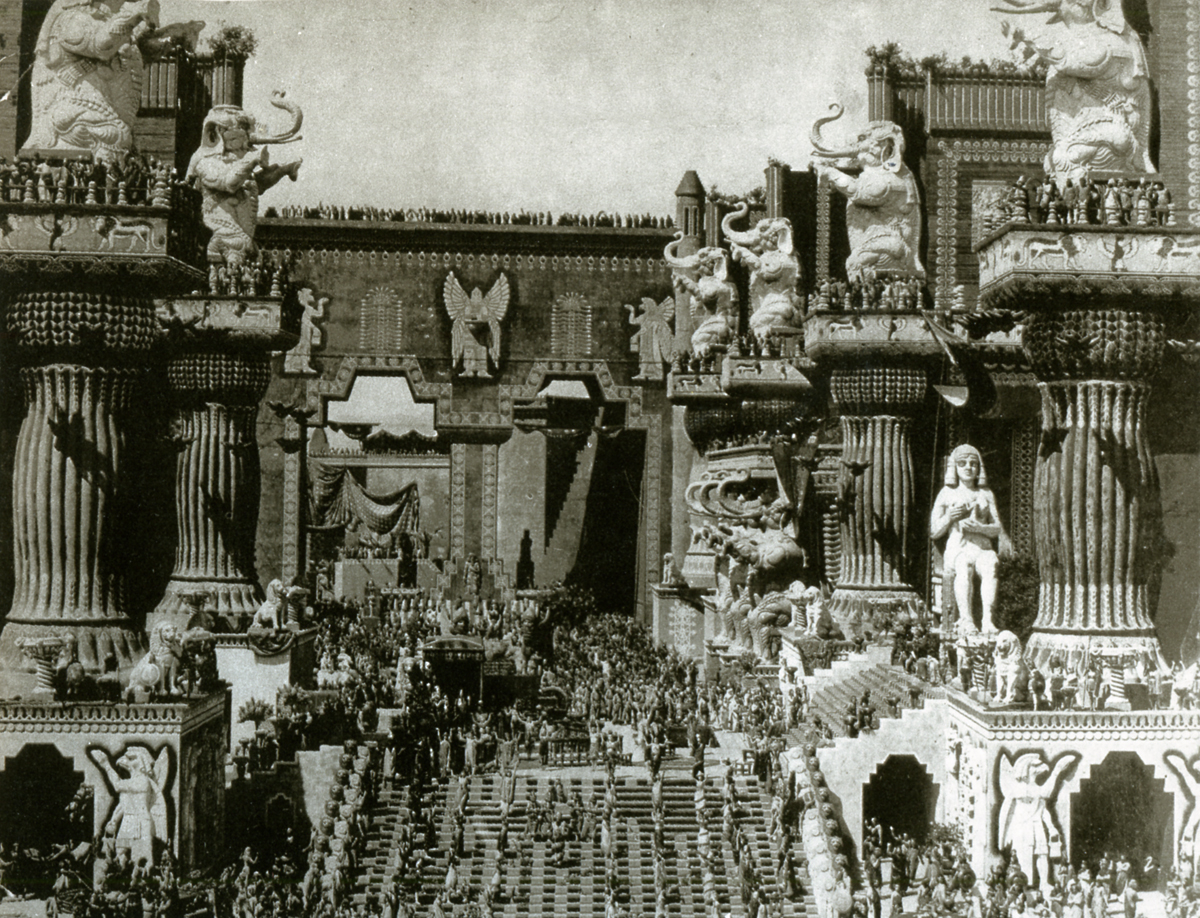
5. Intolerance was not. His subsequent film, Intolerance, required no such penny-pinching, and came in at $1.9m due in no small measure to its sets, which were up to 200ft high and more than a mile long. The film flopped upon release. Griffith’s initial cut ran eight hours long and was to be shown across two nights; it was later snipped to 210 minutes. Though her scenes in the film took just an hour to film, Gish felt “that there was more of me in this picture than in any other I had ever played in”. She talked over scenes with Griffith before he shot them, viewed all the rushes and suggested ways to improve them, and picked the best takes, before helping Jimmy Smith with the cutting. Though you get the sense that Griffith recognised Gish’s singular genius, this kind of partnership was only possible because of the egalitarian nature of moviemaking at the time.

6. Hearts of the World was filmed on location in a warzone. For this WWI propaganda piece, funded by the British and French governments, Gish, her sister Dorothy and Griffith filmed at the front. Their first location was a village that had been destroyed when the Germans were advancing on Paris. Later they were hit by a creeping barrage: two of their guides were killed, before the soldiers they had been hoping to film were obliterated by shellfire.

7. Lillian was ceaselessly melancholy; her sister wasn’t. In 1919, Gish and her younger sister Dorothy – also a major star – penned profiles of one another for Stage magazine. The pieces remain fascinating, not least for what they say about the writer. Lillian writes: “She is a criticism of all the things I am not. When I look at her, I always miss in myself the qualities that I was born without and that, I daresay, I should have been much happier with. She is laughter… nothing bothers her or saddens her or concerns her lastingly… I am not unhappy. I simply am not gay. It must have rained on the evening I was born, and it seems arbitrarily to have kept on raining in my heart ever since.” Dorothy says Lillian has a steeliness quite at odds with her popular image, like “a hat [that] lies upon the sidewalk; some person kicks it enthusiastically and finds to his astonishment and pain that there is hidden inside it a brick of flatiron”. She adds that “nothing really matters to her except her work and her career. She has little patience for anything or anybody unrelated to her work.”


8. She REALLY prepared – and did all her own stunts. Griffith would usually do just one take of a scene, but would rehearse his entire films from start to finish several times, his cast acting out the scenes on prop-free sets. He asked them to augment their characterisations through endless research. Gish took this to heart more than anyone, and continued her painstaking preparations even after her break from him. For The White Sister, she obsessively studied nuns whilst scouting 30 cloistered orders, watched taking-of-the-veil ceremonies before dawn and fostered a ‘spiritual’ atmosphere on set. Her devotion to her movies went further, though. The finale of Way Down East required her to lie on a slab of ice twenty times a day for three weeks. Her inspired idea that she should drag one hand ethereally in the freezing water permanently damaged her nerve endings. For The Wind, sand was blown at her by eight aeroplane propellers, while sulphur pots were used to simulate a sandstorm, burning her hair and almost blinding her.

9. Her first argument with Griffith was during the filming of Way Down East. After that legendary ‘ice floes’ climax, he told her to get ready. “I’m ready,” she said. “Yes, but the climax is over,” he told her. “The audience will want to see you look beautiful again. Go put on fresh make-up, and comb your hair.” Gish says it was the first time in her memory that Griffith had “settled for less than the truth… I obeyed. But in the scene it is evident to those who know me that I was awfully mad at someone.” In his defence, he was massively in debt, and in dire need of a hit. He got one.

10. She was great friends with F. Scott Fitzgerald. The author of The Great Gatsby gave her a copy of his novel, Tender Is the Night, inscribed: “For Lillian Gish, My Favourite Actress. On the occasion of her 1st visit to New York of which this book is a practical guide. From Her Chattel, F. Scott Fitzgerald.”


***

Thanks for reading.

My recent reviews of Griffith and Gish films - some of them screened at London's BFI Southbank - are right here.

You can read Louise Brooks' thoughts on Lillian Gish here.

Thursday, 25 June 2015

Gish and Griffith: pockmarked with greatness


You know D. W. Griffith - he made the most racist film of all time, The Birth of a Nation, which rather inconveniently also created cinema as we know it. You may notice that a Klansman appears to be the hero.

I've been watching a lot of Griffith's films lately, partly because the BFI in London has had a special season on, and partly because I'm enduringly and indelibly obsessed with the actress who starred in so many of his films, the immortal (not actually immortal, she died in 1993) Lillian Gish.

Depending on your mood, and his, Griffith's films can be either unbearably corny or rather moving in their sincerity, but while he was unquestionably a shamelessly sentimental bigot with a yen for preposterous third-act melodrama, he was also the most important and influential filmmaker of his generation. Here's a whizz through all the Gish-led Griffith I've got my mucky little mitts on lately:


An Unseen Enemy (D. W. Griffith, 1912) - Panic Room, 1912-style. It's all a bit silly, but worth it for the debuts of the Gish sisters, with Lillian compulsively watchable throughout.

Title cards include:


Oh, D. W., you are giving silent films a silly name. (2.5)

***


The Musketeers of Pig Alley (D. W. Griffith, 1912) - The 'first gangster movie' still looks decent a century on, with a hokey but atmospheric opening, a slightly static middle where people mostly walk in and out of a saloon, and then an absolutely spectacular denouement, featuring one eye-popping close-up, a tense shootout in an alleyway and an irreverent ending that makes the most of star Elmer Booth's dazzling charisma.

Lillian Gish is 'The Little Lady', whose patronising nickname masks the fact that she's an asskicking feminist who clobbers an amorous assailant, chooses whichever man she likes, and unwittingly starts a gang war by being hot at a party. Walter Miller plays her boyfriend, a musician who may as well just have 'mug me' tattooed on his face, while Booth is The Snapper Kid, a swaggering gunman who's like a sexy, funny, easy-going Al Capone, though the film came out when Al Capone was 13.

Underworld, Little Caesar and The Godfather all redrafted the genre rules across subsequent decades, but this is the film that wrote them, in 16 brisk, bruising minutes, with Booth something like the cinema's first anti-hero: a likeable guy swaggering around the wrong side of the law, far removed from the tedious, moustache-twirling villainy that blighted many films of the period. Tragically, he died just three years later, on the cusp of superstardom, in a car accident caused by future Dracula director Tod Browning. He had been about to start filming Griffith's epic, Intolerance. (3.5)

***


CINEMA: A Romance of Happy Valley (D. W. Griffith, 1919) - The hero in this film is a lot like me, a young man who sits at his desk, in his flat, in the unforgiving city, thinking about Lillian Gish.

A Romance of Happy Valley was made by D. W. Griffith during his white-hot streak between the enduringly controversial Birth of a Nation (1915) and his epic of the French Revolution, Orphans of the Storm(1921) , a period that also took in Intolerance (1916), Broken Blossoms (1919) and Way Down East (1920), and essentially laid the template for cinema as we know it.

Set in the Kentucky where he grew up, it's notably less ambitious than almost all of those films (Broken Blossoms is the only one on a similar scale): a gentle, pastoral comedy-drama about a farm labourer (Robert Harron) who goes off to seek his fortune in New York, leaving behind the lovestruck, pure-hearted and relentlessly stoic Jennie (Lillian Gish), his childhood sweetheart.

It's corny in places, predictably racist in a couple of others (uh-oh, a white guy in blackface who's greedy and feckless), and saddled with an overlong, melodramatic and improbable climax, but it's also extremely involving and often very moving, with an unexpectedly wry, even occasionally subversive sense of humour.

Harron provides plenty of those virtues in a committed, appealing performance, while Gish is as transcendent as ever, whether bidding him an awkward, adoring goodbye, seeing off 'a descendant of Judas Iscariot' who fancies getting off with her, or romancing a scarecrow that's dressed as her lover, a touching, understated sequence that influenced 7th Heaven and then The Artist.

Her singular artistry and Griffith's trendsetting direction - rich in close-ups, including an unforgettable flourish featuring the lovers' hands, and still yet to be emulated let alone overhauled by his European rivals - make this a little gem, despite a bit of his signature silliness. (3.5)

This screened at the BFI along with Griffith's 1909 short, The Cricket on the Hearth (D. W. Griffith, 1909). My only comment on that one is that I had absolutely no idea what was going on. (1.5)

***


True Heart Susie (D. W. Griffith, 1919) - Maybe my favourite ever Lillian Gish performance, with everyone's favourite tiny-mouthed acting titan playing the "simple, plain" Susie, an angelic, motherless farmer who sells her cow to fund sweetheart Robert Harron's college career, then watches, powerless as he falls for a tight-skirted, powder-faced party animal (Clarine Seymour).

Yes, that is the best premise for a movie ever, thank you for asking.

True Heart Susie is old-fashioned, rose-tinted and heavy-handed in its depiction of the afflictions besetting America (adultery, dancing, lipstick), with a lurch towards melodrama in the final quarter that's more convenient than credible, but it's also utterly beguiling: beautifully directed by a filmmaker who could do Americana with the best of them, when he wasn't doing racism with the worst of them. At one point he uses a hedgerow to split the screen into two: ecstasy on the left, despair on the right.

And yet it's only when Gish is on screen that it hits those heights. Without her, it's a standard, slightly overripe drama with a touch of visual poetry. But when she steps in front of the camera - her heroine too pained to watch as her love is snatched away, hiding her tears behind a fan, or collapsing in agony as soon as the ill-suited pair depart from sight - it becomes something else entirely. You sense that Griffith knows it too: in those scenes his lense is softer but his eye is sharper, and every detail his camera catches seems profound and vivid and alive, every muscle of Gish's genius twitching and sparking.

It's not a flawless film, but as a snapshot of two pioneers pockmarked with greatness, it can scarcely be beat. (3.5)

***

Thanks for reading.

Wednesday, 27 May 2015

Let's re-appraise Lillian Gish

Thoughts on:
Annie Laurie (John S. Roberton, 1927) - Tue, 28 April
La Bohème (King Vidor, 1926) - Sun, 17 May


The Lillian Gish reappraisal starts here – who’s with me?

You wouldn’t have thought that Lillian Gish needed re-appraising. After all, she did virtually invent modern screen acting, in collaboration with noted bigot and revolutionary filmmaker D. W. Griffith, starring in his notorious Birth of a Nation, and the follow-up, Intolerance (contrary to popular rumour, that film wasn’t a mea culpa for the racist sentiment of his earlier film, but a response to people he thought were being intolerant of his worldview. Lol).

She does, though.

The mighty Gish wasn’t name-checked at all in Paul Merton’s most recent series on the history of silent film, appearing just once as he made a facile point about over-acting. In the book I’m reading at the moment, William J. Mann’s Wisecracker, the author gleefully notes that Gish had been excluded from a contemporary list of people with a commodity known as ‘It’ (broadly sex appeal), writing that she “was widely presumed to have no sex drive at all”. Even in the introduction to Annie Laurie at London’s Barbican Centre on Sunday, the marketing person from the Hippodrome Festival who presented the film had just three things to say about Gish: that she had made Annie Laurie to try to change her screen image to something sexier, that she was one of the hardest working actresses in silent cinema, and that when she emoted, people outside the studio walls often came running to see if she was OK, as she was so loud they thought she was in genuine distress. Aside from the fact I’m calling bullshit on that, since post-1920 soundstages were almost all indoors, and encased in massive studio lots, there’s a more important point at stake here – the reputation of arguably the greatest actress who ever lived.

Louise Brooks, who was no-one in terms of popularity in the heyday of silent film but is now an iconic figure across the Western world, wrote a superb essay on Gish in the 1970s, where she cast the actress as a proto-feminist who bought and adapted her own stories, chose her directors, starred in them and even handled the publicity. She argued, very persuasively, that Gish’s career as a leading actress was wrecked not by changing tastes but by sexist studio heads who resented her power and her pay packet. (Incidentally, it’s worth noting that the ass-kicking, non-conformist Gish was also a staunch Republican who was vehemently opposed to child labour laws, having gone on the stage as a kid to support her family!)

Beyond the trendsetting, though, there’s something just as important: the sheer acting talent of the woman. There are only a handful of artists in the field of acting whose mastery of the medium is so complete that they seem to be doing something utterly new: Jason Robards, Emily Watson, Wendy Hiller – it doesn’t happen very often. Gish is one of those. You can see it in Annie Laurie. Everything that works here does so because of her.

The plotting is perfunctory – some fictionialised, Hollywoodised rubbish based broadly around the Glencoe Massacre, as Gish’s aristocrat falls in love with the world’s burliest man (Norman Kerry) and finds herself caught between warring Scottish clans – and the first half is frankly quite boring, but the second has some magical moments, including tremendous use of the titular song, and two action scenes in which Gish loses her shit. The idea that she was melodramatic simply isn’t true: hysteria was just a card she could play, and play beautifully. Here she does it for, what, 15 seconds, then 20, across two hours? It’s in keeping with the plot, and artfully done, creating two of the best sequences in the movie.

The second is one of the few times that director John S. Robertson actually does anything half decent: a thrilling, high-octane chase, with a wide-eyed Gish legging it up a mountainside, pursued by a dude with a gun, the camera scurrying ahead of her, framed on her face and frame. An interesting footnote, though: Robertson was later the local, Stetson-wearing eccentric in the small Los Angeles town where Byrds songwriter Chris Hillman grew up, and the band’s song Old John Robertson (from their classic Notorious Byrd Brothers record) is about how he was ridiculed by the local kids, who knew nothing of his past as a Hollywood director. Here, the music accompanying his film came from Shona Mooney’s folk trio, playing their specially commissioned score for just the second time, which was both inventive and familiar, in all the right places.

And throughout, Gish – while plagued by personal problems that meant she saw this one as simply a job of work – is transcendent. Take the moment where the plot promotes that pernicious myth that, whatever they say, women do want you to kiss them. A load of dangerous, sexist bollocks, but her character’s conflicted emotions: fear of him, fear of herself, anger, confusion, arousal and joy, are beautifully conveyed in just a few flickers of a moment. It’s not sexless, she’s not over-acting, and there’s no-one rushing from outside a studio wall to check she’s OK. It’s art, pure and simple.

And no-one rocks a Tam o'Shanter like Lillian Gish.

***


The main ethical problem with La Bohème - based on the same stories as Puccini's opera - is that it's a romance in which the hero (John Gilbert) is a violent, suspicious and abusive bully who spends the first hour gaslighting his girlfriend.

Its main technical problems are that the script is alternately melodramatic or lacking in incident, that the sets are largely dull, and that most of the cast is mediocre.

Lillian Gish, though, is absolutely mesmerising, as another of her gentle, selfless heroines tortured by an unkind world, exhibiting a range of complex emotion, rendered both subtly and explosively, that's pretty much off-the-scale in terms of artistic genius.

And King Vidor, while never approaching the lyrical, ironic brilliance he displays in something like The Crowd, does stud this sometimes clunky-looking film with a handful of gorgeous shots, most utilising windows, railings or Gish's beautiful, matchlessly expressive visage.

Gilbert's performance, by contrast, is pretty big and unfulfilling: like a parody of silent movie acting by someone who's only seen two of them.

But in the end the film's myriad flaws won't be what stay in the mind. It won't even be Edward Everett Horton looking terrifyingly young as one of Gilbert's bohemian cohorts. Instead it'll be Gish telling her lover that he's foolish to be jealous, a look of fond, intense compassion on her funny little 1920s face.

Annie Laurie: (2.5)
La Bohème: (3)


***

Thanks for reading. #GishFest15 continues with A Romance of Happy Valley and True Heart Susie (both screening as part of BFI Southbank's D. W. Griffith season) over the next couple of weeks.

Monday, 14 March 2011

Paul, D.W. Griffith and Hancock's 46 minutes of magic - Reviews #56


CINEMA: Paul (Greg Mottola, 2011) - As Simon Pegg and Nick Frost said on Radio 5 Live recently: if you're spending $50m of someone else's money, you've got to make a certain kind of film. So gone are the offbeat sensibility and obscure pop culture references of the show that made their name - Spaced - and the genre movies that followed, Shaun of the Dead and Hot Fuzz. The nods to E.T. and The X-Files here are more like headbutts. Gone too is the razor-sharp sense of humour. There are plenty of laughs, but the humour is so broad you could park a spaceship on it. This one's as straight-down-the-line as a movie about a foul-mouthed, chain-smoking alien is going to get. Pegg and Frost play a couple of nerds who plan to follow their visit to San Francisco's comic convention with a tour of the Deep South's UFO hotspots. They've barely gotten started before a car flips over in front of their camper van and - examining the wreckage - they come across Paul. He's an alien. A peaceful but rude alien. And he needs to get home. But before that the mismatched gang are going to have to do battle with an FBI agent (Jason Bateman), two childish cops, a couple of good ol' boys, a shadowy megalomaniac and a gun-totin' father. Yes, I think they probably have seen The Blues Brothers. One can lament the absence of Edgar Wright, the stylish director who co-wrote Shaun and Hot Fuzz with Pegg and was single-handedly responsible for their frenetic visual style. And it's easy to pick holes in a film that jettisons its creators' distinctiveness in search of a bigger audience - though there is at least one blessing: Pegg said he wanted to make more of the creationism subplot, the most smug and misguided bit of the film. But at the same time, it seems churlish to be too down on a film this solidly entertaining, with its likeable performances, strong supporting cast and a dozen genuine laughs. (2.5)

***


Sally of the Sawdust (D. W. Griffith, 1925)
is a nice film from the director of The Birth of a Nation, with nary a heroic Klansman in sight. The engrossing storyline, adapted from a hit stage musical, sees carnival barker W. C. Fields looking to restore orphaned waif Carol Dempster to her rightful place in society. The much-maligned Dempster is actually very good here (save for a bit of over-acting among the rushes as the police close in on her), backed by a couple of unimpeachable heavyweights: Fields and Effie Shannon. There are flaws. We could probably have done without the knockabout comedy for a start. The slapstick interludes aren't as jarring as in Way Down East, where the wrenchingly powerful narrative is offset by some of the most inscrutable alleged comic relief ever slapped onto the screen. For one thing, it's quite funny. But it does jar a little with the dramatic elements, particularly when we see Dempster striving desperately to avoid capture and ruin, intercut with Fields bouncing down a hill in an old banger. And there's also the sense of a missed opportunity. For a film that's not afraid to be melodramatic, the climactic reveal doesn't really carry an emotional punch at all, let alone the assault on the tear ducts I was anticipating. But I liked the film on the whole: interesting story, strong performances and - once you adapt to Griffith's style, revolutionary in 1915, a touch staid 10 years on - very watchable indeed. (3)

Trivia notes: Alfred Lunt, who plays Dempster's love interest, was Monty Clift's mentor and acting tutor. The film was remade as the talkie Poppy, also starring Fields, in 1936.

***


Hancock (Peter Berg, 2008) - If the credits had rolled after 46 minutes, I'd be raving about this as one of the best films I've seen in years. Hilarious, profane and bracingly original, with a killer performance from Will Smith and a deliciously dry one from Jason Bateman. Unfortunately it completely falls apart after that, morphing into a metaphysical love story of rare incoherence and tedium. Rarely have I come across a film - or a book, or a record, or a meal - with such a gaping gulf between the quality of its first half and its second. Gaah. The script was in development for 10 years, being fundamentally re-written with no input from the original author. Could that by any chance be something to do with it? (2.5)

***


Working Girl (Mike Nichols, 1988) is the second most '80s movie of all time (The Secret of My Success, obviously) - a hymn to business (urgh, business) with a sweet performance from Melanie Griffith, a fun one from Sigourney Weaver (boo, hiss) and a slightly lacklustre turn from Harrison Ford, making a then rare foray into romantic comedy. The story is formulaic in the extreme and there aren't many jokes, but it's entertaining and Griffith is an appealing presence. (2.5)

***


Out of Sight (Steven Soderbergh, 1998) is an enjoyable comic thriller, scripted by Scott Frank, though patently not one of the best films of its decade, as it's regularly described. The leads are good - I've never seen Clooney and Lopez as attractive or amusing as they are here - the labyrinthine, time-shifting script is mostly pretty neat and there are some strong scenes, including an opening bank robbery that's the ultimate in lo-fi insouciance. But the movie also drags in places, with an abundance of uninteresting subplots, and it's never quite as clever, smart or sexy as it seems to think. (3)

***


Anne of Green Gables (George Nichols, Jr., 1934) - This is a short, sentimental highlights package that turned out to be RKO's sleeper hit of 1934. Anne Shirley is Anne Shirley (she used her character's name for the rest of her screen career), the cheery, melodramatic, eternally appealing redhead created by L. M. Montgomery. Mistakenly placed with adoptive parents who were rather hoping for the boy they'd requested, her hot temper proceeds to get her into scrapes with friends, neighbours and that cheeky, good-looking boy in her class. There are production and pacing issues. The first hour is a little lacking in atmosphere, then - upon finding loads of the stuff - the film proceeds to race through the rest of the narrative at breakneck speed, with a succession of short scenes that cover five years in about five seconds. It also omits the most memorable bit of the book: Anne dyeing her hair green. For all that, this is a really gentle and rewarding movie, with absolutely charming performances, particularly from Shirley and O. P. Heggie, best-known for his turn as the blind hermit in Universal's seminal Bride of Frankenstein the following year. (3)

***


Bee Movie (Steve Hickner and Simon J. Smith, 2007) - The story doesn't always work, but the script's very funny and the animation's good. Not Pixar-good. But good. Apparently it got a bit of a kicking on release, which is a shame. Unless the critics were suggesting that a relationship between a bee and a woman constitutes quite an inappropriate romantic subplot, in which case they would be correct. (3)