Tuesday, 3 April 2012

Senna, Anna Friel's accent, and the dude going West - Reviews #106

Cars going vroom-vroom, Brendan Gleeson swearing and Rainn Wilson wielding a wrench, in our latest round-up of reviews. I say "our", I mean "my".


The Guard (John Michael McDonagh, 2011) – Fun comedy about a sweary, pill-popping, apparently racist provincial Irish cop (Brendan Gleeson) with his own code of ethics, and what happens when he’s asked to help an FBI agent (Don Cheadle) bust a drug-smuggling ring. The film has an irreverent if sometimes predictably contrary sense of humour – I particularly liked the taunts in the briefing and Gleeson’s “milkshake headache” – an excellent performance from its star and the odd, oddly-moving moment, even if those concessions to sentiment seem somewhat shoehorned in. It also treats its crime plot lightly, not allowing it to unbalance the film, and – having seen the various scenes that ended up on the cutting room floor – knows when to quit. It isn’t in the same league as the dazzling In Bruges, to which it’s constantly compared, but it’s a charming and amusing film, and an enjoyable way to spend an hour-and-a-half. (3)

***


The Dude Goes West (Kurt Neumann, 1948) – Thoroughly likeable Western spoof, similar in tone to the Gary Cooper classic Along Came Jones, about a bookish gunsmith (Eddie Albert) who tangles with Indians, gunmen and an endlessly-suspicious hottie (Gale Storm) after swapping Brooklyn for Arsenic City. Albert, best remembered today for his part as Gregory Peck’s mate Irving in Roman Holiday, is good value in the lead, the script is full of sly, affectionate digs at the genre – the audience discovering this alternate West alongside its hero – and there’s a superb supporting cast, including Binnie Barnes as a nefarious saloon-keeper, Gilbert Roland playing her fast-drawing henchman and, best of all, Barton MacLane – spectacular as Albert’s guardian angel, a heavy-set murderer with a price on his head. The only shortcoming is the heavy-handed score, which flags up every big gag or ominous development with unnecessary bombast. (3)

***


*SPOILERS*
Super (James Gunn, 2010)
– A massive loser (Rainn Wilson) loses his wife (Liv Tyler) to a badass drug dealer (Kevin Bacon, obviously), then loses the plot, reinventing himself as a wrench-wielding superhero called The Crimson Bolt. This DIY spin on comic book mythos is truer, darker and more subversive than Kick-Ass, boosted by Wilson’s surprisingly deep, complex characterisation as a man at the end of his tether. It’s also very funny for the most part, though harmed somewhat by a troubling scene in which the excellent Ellen Page, as Wilson’s slightly unhinged kid sidekick, effectively rapes him. I’m not sure if it’s supposed to be funny or sexy, but it’s neither, it’s just illegal. A shame, as the murals with tiny hands, Wilson’s hilarious catchphrases (“Shut up, crime”) and Page’s acerbic, excitable jabbering (“Unless you’re laughing at how gay it is...”) show a sharp and silly wit at work. That mystifying misstep aside, it’s a good film, with a genuine heart beating beneath all of its hilariously excessive violence. Great credits sequence too. (3)

***


*SPOILERS*
Senna (Asif Kapadia, 2010)
– I was a big Senna fan as a kid and I was devastated when he died. I actually had two Senna matchbox cars in his McLaren days, because I didn’t realise that they all had his name on one side and Alain Prost’s on the other – and I thought I’d bought the Prost one by mistake, so my mum got me another (thanks Mum). Anyway, that meant they could race each other on the window-sill, so that was cool. This hagiography is exciting, engrossing and affecting, if slightly slim in scope and painting the somewhat controversial Senna as little less than a saint. I particularly liked the sequence set around his first Brazilian Grand Prix win, an extraordinary feat of endurance that sent much of his upper body into impotent spasm. We learn little of Senna’s childhood or private life and the spoken contributions are largely from journalists (the rare insights from insiders like Sid Watkins are generally far more interesting), but there’s a wealth of classic racing footage and some revealing behind-the-scenes film of the hero sticking it to that prize-one-dick-of-an-FIA-boss, Jean-Marie Balestre. Alain Prost, portrayed here as a snooty, boring and calculating hypocrite, also makes for a great villain. The final 20 minutes, dealing with Senna’s untimely death on the track at Imola, are virtually unwatchable, taking me back to that awful Sunday and walking onto the field behind our house to tell my dad that Senna was dead. (3)

***


The MatchMaker (Mark Joffe, 1997) – This much-maligned comedy is actually quite appealing in its brainless way. It’s another in the seemingly endless line of “uptight city slicker decamps to the country, is won over by its quirky charms and falls in love” movies. That classic set-up has given us I Know Where I’m Going, Local Hero and Seducing Dr. Lewis, but its increasingly formulaic sub-genre also houses all manner of mediocre and slapdash efforts. Here, filling in the blanks, it’s Boston political assistant Janeane Garofalo (in her short career as a mainstream romantic lead) who decamps to Ireland and falls in love with bartender and former journalist David O’Hara. Conflict is presented in the shape of pouty Saffron Burrows, Garofalo’s thankless task of digging up Irish roots to help win her senator an election, and her colleague Denis Leary, who looks and acts like Alastair Campbell. The title figure is Milo O’Shea, who hosts an annual match-making festival, and bets £100 that he can get Garofalo and O’Hara together.

The plotting is muddled, with contrivances so clumsily foreshadowed it's like all the characters have Donnie Darko-style tubes coming out of them, and so many threads left untied it’s difficult to keep count, while the jokes range from the genuinely offbeat and amusing to the grindingly obvious. In terms of atmosphere, there really is a crane shot of Garofalo running along by the coast, whooping and waving her arms about as the strings soar. And the film’s knowledge of traditional Celtic song is based almost entirely on Van Morrison’s album Irish Heartbeat. But I thought The MatchMaker was nice: easy to take in its meandering, sloppy way, that hoary old set-up still as winning as it ever was, the lovely scenery, gentle pace and constant, pleasant diversions compensating for a script that’s essentially a bit of a mess – perhaps because it was comprehensively re-tooled by a second writer before shooting. Garofalo is alright – I usually really enjoy her schtick, but I think she’s slightly miscast here, or else struggling with inconsistent characterisation – though it's O’Hara, O’Shea and David Kelly (who only turns up for a minute or two) who lift the spotty material. It's... cosy. (2.5)

***


Land of the Lost (Brad Silberling, 2009) – Binge-eating scientific genius Will Ferrell, leggy assistant Anna Friel and vest-wearing fireworks salesman Danny McBride find a porthole to a parallel world filled with dinosaurs, monkey men and lizard people in this resounding box-office flop. Another comic reboot of a straight ‘70s TV show, it features bizarrely amateurish special effects for a film that cost $100m, but it’s fairly funny – especially Ferrell’s delivery of dialogue – and lacks the mean-spiritedness present in too many of his collaborations with Adam McKay. I also like Friel’s voice – it’s nice to hear a Rochdale accent in a Hollywood film, even if there’s no such thing as Manchester Zoo. Rounding out the trio, McBride is less irritating than usual: I still think he’s completely talentless, but at least he tones it down a bit. It’s quite a lazy film, and there’s not much story to speak of, but as a Sunday afternoon watch it’s kind of fun. (2.5)

***


30 Rock (Season 2, 2007-8) - Mediocre second season of the somewhat overrated hit sitcom. It's not a bad show, but it isn't in the same league as Parks and Rec, Community or Party Down - perhaps because it's constantly eyeing those big ratings. The main problem is a complete lack of character development, at least until they try to cram loads of the stuff into the last episode. These are just cartoons who learn nothing. Season 2 offers nothing more than further adventures from the lives of TV show writer Tina Fey, corporate slickster Alec Baldwin, troublesome stars Tracy Morgan and Jane Krakowski, page Jack McBrayer - a toothy, deferential yes-man from the sticks - and arch nerd Judah Friedlander. There are a couple of big laughs in most episodes, and a handful of smaller ones, but there's little heart or depth, and a surprisingly amount of pointless nastiness begins to creep in by the close. The worst episode is still the first one, which Jerry Seinfeld clearly agreed to do in exchange for them letting him relentlessly promote Bee Movie. It's pretty embarrassing and I didn't come back to 30 Rock for about three weeks afterwards. Ultimately, there are no genuinely classic half-hours here, though the best moments belong to guest star Will Arnett (G.O.B. from Arrested Development), as Baldwin's gay, conniving nemesis. Matthew Broderick also has a hilarious part in the season finale, while Friedlander and Morgan are always good value - the latter consistently breathing comic life into his vain, preening, ludicrous megastar. All in all, a bit disappointing, really. (2.5)

Sunday, 25 March 2012

The International Hayley Mills Festival...


... isn't a real thing, sadly, so I've been hosting one in my room. We (I) didn't show her finest film, Whistle Down the Wind (#19 in the performances list), #45 in the all-time films list), as I've seen it quite a lot lately. If you're disappointed by that (not sure why you would be), you can watch this amazing video. Hayley's not actually in that clip, but it does feature perhaps the finest line of dialogue ever uttered on screen.

I just really like Hayley Mills. She's an actress of rare gifts, and was one of the greatest child stars of all time. Here's the round-up:

HAYLEY'S DEBUT


Tiger Bay (J. Lee Thompson, 1959) – A mischievous, tomboyish loner (Hayley Mills) finds kinship with the murderer who takes her hostage (Horst Buccholz) in this unusual, brilliantly-photographed drama, dominated by Mills' staggering debut turn. Johnny Mills (her real-life dad) also shines, as the cop who would quite like her to stop lying. With a rich, intelligent screenplay, flavourful semi-documentary exteriors shot on location around Cardiff (and Bristol Harbour) and a wealth of vivid, painterly set-pieces – including a superb face-to-face in a darkened church attic – it’s suspenseful, funny and extremely affecting. (4)

Here's an interesting reminiscence from someone who was aboard the big ship during filming.

***

HAYLEY'S SIGNATURE ROLE(S)


The Parent Trap (David Swift, 1961) – I didn’t cry four times during The Parent Trap, shut up. You cried four times during The Parent Trap. This is a largely wonderful, seriously sentimental family comedy about twins Hayley Mills and Hayley Mills, separated in infancy, who meet by chance at a summer camp and scheme to bring their estranged parents Brian Keith and Maureen O’Hara back together. The special effects are decent (well, except for the bit where Pretend Hayley has to hold an enormous sleeping mat next to her head), the supporting cast of Charlie Ruggles, Una Merkel and Leo G. Carroll is absolutely first-rate and Hayley is just a joy. Only downsides: it runs out of steam with 20 minutes to go, and the ‘Let's Get Together’ song is faddy rubbish. (3.5) I really like the remake as well.

***

DISNEY FUN WITH HAYLEY


*SPOILERS, BUT THE PLOTTING IS QUITE OBVIOUS ANYWAY*
Summer Magic (James Neilson, 1963)
– This Disneyfied slice of Americana shouldn’t really work. For a start, there’s no real story to speak of, beyond a rough paraphrasing of The Railway Children, minus the trains. That’s not to say there aren’t bits of plot, but they’re gathered together in clusters, to be fought with for a couple of minutes every half-hour or so. A family moves to a new yellow home in the country, does it up nicely and has a few minor adventures – some of them romantic – but there’s always the chance that the chap who really owns the house will come and reclaim it, only we know that he won’t because it’s a Disney film. There are some songs by the Sherman Brothers, the quickest, weirdest volte face by a character in cinema history, and a confusing message about how girls should pretend to be coquettish and stupid if they want people to like them. Show your daughter this and Grease and they will be expelled, pregnant or dead within a week. There’s also the problem of Dorothy McGuire. The film features three of my favourite, disparate actresses: the wonderfully gifted child star Hayley Mills, sassy, ironic ‘30s leading lady Una Merkel, and McGuire – certainly the most sensitive American screen actress of her generation, and probably the best. It’s rare you happen upon a performance as good, complex or multi-layered as her harsh, loving, old-before-her-time mother in Elia Kazan’s A Tree Grows in Brooklyn. Or her astonishing turn as a mute targeted by a murderer in A Spiral Staircase (soundless screaming - wtf?!). Or, indeed, her (not actually very) ugly duckling transformed by love in An Enchanted Cottage. She made those three films in a single year. But she may as well not be in Summer Magic, as she doesn’t actually bother to do any acting. She has lines. And potentially poignant scenes. But she barely moves her (suspiciously?) unlined face, which is fixed in a supposedly heartening ‘motherly’ smile throughout. It makes her look like a chipmunk in an apron.

For all that, though, I rather like the film. It is a mess, but its various elements are all pleasant in themselves – and it kept me entertained and cheery across a couple of hours. Mills is very good as a teenager graduating from tall-tale-telling to adulthood and the possibility of lurve, and she has three particularly special moments. The first is one of those passages in the John Ford manner, with soft backing music (this time played on-screen by Burl Ives) and a troubled character just looking on as the camera fixes on them. It’s heartbreaking, and beautifully played. The others occur after her row with massive bitch Deborah Walley, where Mills spills the shameful beans (the worst kind of beans) about Walley’s past. “Oh Julia, I’m-I’m sorry, I...” she says desperately, before chasing her nemesis into the other room. There, her mum demands an explanation. “Oh mother, you know what I said,” says Mills forlornly. And it's desperately moving. I did that thing where you very-almost cry, but don't quite. It’s at this point that Walley turns from the antichrist into an angel, transformed by the power of love and poor screenwriting. The supporting cast is interesting. Unexpectedly, Burl Ives is the pick of the bunch as a tubby optimist with a pleasant singing voice. His popular children’s song ‘Ugly Bug Ball’ is on the soundtrack, though my favourite numbers were ‘On the Front Porch’ (complete with Mills’s sad staring) and ‘Flitterin’’, sung by the family before their move to the country. Una Merkel is virtually unrecognisable – even from the previous decade – as Ives’s pessimistic wife, with a great big head, and a phony (?) 60-a-day growl that obscures her familiar and delightful squeak. Of the other kids, Michael J. Pollard (who gave Michael J. Fox his phony ‘J’) is good and Jimmy Mathers is cute, though Eddie Hodges can’t really act.

Summer Magic is a strange movie. A remake of a 1938 RKO film, based on a 1917 play, based on a book, what fragments of plot it retains also seem to have found their way into the second Nanny McPhee outing (though the use of the word "poo" that I so much enjoyed in that film isn't present here). There’s no dramatic impetus, Disney’s emotional heavyhandedness detracts from the picture's power and the most exciting name on the cast-list doesn’t turn up. But I still like it a great deal: for the fun numbers, the consistent entertainment value, and Mills’s commanding performance, which touches true brilliance in a trio of moments. (3)

***

HAYLEY, WITH ADDED CAT-THEMED SILLINESS


That Darn Cat! (Robert Stevenson, 1965) - An FBI agent (Dean Jones) has to track a cat on its nightly prowls, after its owner (the lovely Hayley Mills) claims the puss can lead them to the gruesome twosome behind a bank job and kidnapping. But get this - the Fed is allergic to cats, and keeps sneezing! And people keep falling over. This witless, cartoonish Disney romp - full of garish visuals and tiresome mugging, and wasting a promising cast that includes old-timers Elsa Lanchester and William Demarest (his hair a curious shade of orange) - is the least of Hayley's vehicles for The Evil Mouse, but just about worth it for her appealing, amusing performance. It's not as bad as the remake, anyway. (2)

***

HAYLEY'S FIRST ADULT ROLE


The Family Way (Roy Boulting, 1966) is like Sons and Lovers re-imagined as a breezy sex comedy, as arty Hywel Bennett – living in the shadow of his gruff father (Johnny Mills) – somehow fails to consummate his marriage with the 20-year-old Hayley Mills. This being the north in the 1960s, soon housewives in headscarves start gossiping, which doesn’t help Bennett’s mood – or his mojo. Hayley is lovely in her first adult role, while her pops is simply exceptional as a boozy, sad blowhard who understands nothing, not even the disappearance of his best friend some 30 years ago. His rapport with screen wife Marjorie Rhodes strikes just the right balance of tough and tender. The film has a stagy three-act structure, but it’s opened up nicely with some shots of the principals wandering around Bolton, there are a few big laughs and the whole thing builds to a particularly satisfying, erm, climax. (3)

... so there you have it. An offbeat British masterpiece, three Disney vehicles and a knockout sex comedy. And because you've been very good this year, here's a bonus write-up of a certified Hayley Mills classic, from the archive:

THE GLAD HAYLEY


Pollyanna (David Swift, 1960) is an enchanting family film based on an enduringly popular novel. The last Disney production overseen by Walt, it takes numerous liberties with the source – and even makes up an Abraham Lincoln quote to give Pollyanna’s musings some gravitas – but it’s utterly charming. The “glad girl” of the title (Hayley Mills) moves in with her aunt, uptight town matriarch Jane Wyman, and her boundless optimism begins to work its magic on Wyman, hypochondriac Agnes Moorhead, embittered loner Adolphe Menjou and intolerant, weak-minded priest Karl Malden. Disney called off the search for his Pollyanna after seeing Mills in Tiger Bay, while her father (celebrated British screen star Johnny) famously sparked her into life with on-set coaching. Her natural performance, and pinpoint characterisations from the on-form veterans, create many lovely vignettes in this episodic, excellent movie. Lovely cinematography too. (4)

Monday, 19 March 2012

The Prestige, Élodie Bouchez, and RKO's breeding ground - Reviews #105

In the latest reviews round-up, I swear twice (sorry), get swept away by a modern French masterpiece and wander the streets of London clutching a naked cut-out of Jane Asher. Oh no, that wasn't me, that was John Moulder Brown.


La vie rêvée des anges (Erick Zonca, 1998) aka The Dreamlife of Angels – Profound, poignant film about the friendship that develops – and then unravels – between two young women who meet at a factory in Lille. Ila (Élodie Bouchez) is friendly, compassionate and happy to ask for help; self-centred Maria (Natacha Régnier) throws her pride and practicality to the wind as she embarks on a self-destructive affair with an utter shit. A wise, insightful and immersive study of human relationships, and the nature of friendship, with exceptional performances from the two leads – especially the big-eyed, expressive Bouchez. This one’s going right to the top of the 2012 list. (4)

***


Deep End (Jerzy Skolimowski, 1970) is a fascinating, virtuosic study of romantic and sexual obsession set around a London bath house gone entirely to seed. John Moulder Brown plays a 15-year-old school leaver who finds work there and becomes besotted with the free-and-easy redhead (Jane Asher) who shares his duties. Their innocent flirtations escalate until he's chasing her around the London Underground with a monochrome cut-out of her naked body, shouting: "Is this you?!" It begins as a playful, absurdist and almost bawdy comedy - the only film I've seen that shares the feel of My Own Private Idaho, as Diana Dors shouts about George Best whilst rubbing a teenager's head against her boobs - then becomes darker and odder by the minute, as Skolimowski brings an outsider's eye, and an Eastern European sensibility, to bear on the complex, mutating material, on its way to the only ending these films ever have. Moulder Brown's accent is a pity - as with A Kid for Two Farthings, cockernee would have been preferable to estuary - but Asher's pitch-perfect performance, the inventive, well-paced narrative and Skolimowski's vivid visual sense, tying the intro to the ending with intelligent glee, make it a cast-iron classic. (4)

***


*SPOILERS*
The Prestige (Christopher Nolan, 2006)
- Wow. That was great: one long magic trick, in which turn-of-the-18th-century magicians Christian Bale and Hugh Jackman indulge in an obsessive rivalry, their secrets revealed through a series of delicious, rug-pulling twists. Two of Nolan's most highly-praised films - The Dark Knight and Memento - leave me a little cold (he probably doesn't care), but this one's a wow: somehow sheer escapism, despite a narrative that takes in existential despair, suicide and death-by-drowning. Like Nolan's later Inception, his non-linear structure juggles three stories (or in this case, three time-frames), as Bale-reads-about-Jackman-reading-about-Bale's-life. Phew. There's the odd bad line ("You deserve each other"? Really?) or slip into domestic melodrama, and the film suffers from a serious case of Scarlett Johansson, but it's just a ripping good ride, with a spectacular denouement that made my brain ache. Someone is probably going to tell me that the pay-off doesn't make sense, but I don't care. So nerr. (4)

***


The Moon Is Blue (Otto Preminger, 1953) - Stagy, unusually frank sex comedy - written by playwright and '30s character actor Hugh Herbert of the "woo hoo!" catchphrase - about a professional virgin (Maggie McNamara), the newly-free bachelor (William Holden) who picks her up up the Empire State Building, and the caddish elder gent (David Niven) who later muscles in. It starts off very slowly - with a deeply boring wordless opening - but picks up greatly for a fresh, funny second half that recalls Bluebeard's Eighth Wife (Ernst Lubitsch's most underrated comedy), and is dominated by Niven's hilariously immoral characterisation. He really was a sensational light comedian - right up there with Cary Grant and William Powell. Wordy farce wasn't Holden's forte, but he's OK, while McNamara equips herself well - once you get used to the fact that she looks and sounds like the five-year-old Margaret O'Brien. Dated, sure, but for all its flaws, a fun way to spend an evening. (3)

***


The Assassination of Richard Nixon (Niels Mueller, 2004) - This functional portrait of a beaten-down loser who finally snaps - and proceeds to mount the most hilariously shit assassination attempt of all time - owes no small debt to Taxi Driver and the classic Edward Dmytryk B-movie The Sniper. But it's just not in the same league. Sean Penn, surely the most overrated person in the entire world, isn't "acting" as much as usual - a welcome relief - but despite that atypically nuanced performance, a reasonable, unsensationalised script and Mueller's sporadically intelligent handling, it's all been done a whole lot better before. (2.5)

***


Inglourious Basterds (Quentin Tarantino, 2009) - Bizarrely lacklustre Tarantino film about various pockets of resistance fighters and secret agents planning to off the Nazi brass during a film premiere. It's watchable throughout and there's a taut, tense, tight-as-a-drum suspense sequence set in a bar - as a Gestapo officer begins to suspect undercover British soldier Michael Fassbender isn't all he seems - but the film is largely lacking the excitement and raw energy one usually associates with the director, or at least used to. Christoph Waltz is exceptional as a cultured Jew-hunter, but he's also the only character Tarantino bothers to flesh out, a mystifying decision in a film that bills itself as a Jewish revenge fantasy. When one considers the car-wreck that was Death Proof - comfortably one of the worst 10 films I have ever seen - you can view this as something of a return-to-form but, compared to Reservoir Dogs, it lacks distinctiveness, quality and heart. (2.5)

***


The Ploughman’s Lunch (Richard Eyre, 1983) – Incredibly cynical satire, written by Ian McEwan, about a BBC radio producer (Jonathan Pryce) and his relationships with fellow right-wing media types (including camp, mulleted Tim Curry), his working class parents and a Socialist historian. It’s more a series of polemics on British history and Thatcherite Britain than it is a coherent drama, which means that while individual scenes are often striking and interesting, the overall effect is rather muted. I also found it quite hard work spending 100 minutes in the company of such a hateful human being, so bereft of redeeming qualities, as Pryce’s selfish, duplicitous journo, even in the name of satire. I do get quite turned on by newsreels of the Suez Crisis, though, so we have that in common. (2.5)

***


*INCLUDES A FACT-HEAVY GUIDE TO THE CHARMS OF THE FALCON SERIES*
The Falcon in San Francisco (Joseph H. Lewis, 1945)
– This was the eighth of Tom Conway’s 10 outings as the eponymous crime-solver and adventurer, a role he took over from his real-life brother, George Sanders, in 1942. The series is notable for that trivia point, and as a breeding and dumping ground for studio RKO. The Falcon in Mexico is said to contain footage shot by Orson Welles for his never-completed film It’s All True. Music that features prominently in Falcon films turns up in other RKO pictures: San Francisco uses 'My Shining Hour' from the Fred Astaire musical The Sky's the Limit as background music, while the sumptuous theme for the classic noir Out of the Past was featured as an on-screen nightclub number in The Falcon Takes Over. That same film was the first adapted from Raymond Chandler’s Farewell, My Lovely, a huge hit for the studio two years later when it was filmed more faithfully as Murder, My Sweet. The series also includes bit parts for stars on the rise and on the skids. Alibi features up-and-coming Lawrence Tierney (later Joe Cabot in Reservoir Dogs) and future Out of the Past femme fatale Jane Greer - who later fell out of favour with Howard Hughes by not boffing him - while that idiot who brought King Kong to New York, Robert Armstrong, turns up in San Francisco 12 years on. People like Allen Jenkins, Cliff "Ukelele Ike" Edwards (the voice of Jiminy Cricket), Edward Brophy (the voice of Timothy the Mouse), Esther Howard, near-legendary character actor Elisha Cook, Jr. (the gunsel from The Maltese Falcon), Barbara Hale and Fox's favourite "other woman", Lynn Bari, appear in other outings.

Two key directors of the ‘40s and ‘50s also got their big break in Falcons: Edward Dmytryk – the noir specialist and notorious Hollywood Ten-ner who gave series highpoint Strikes Back such a punchy style – and Joseph H. Lewis, the B-movie legend who went on to make Gun Crazy and The Big Combo. Lewis isn’t given much of a free rein with the low-budget San Francisco, but he does contribute one fantastic little set-piece, in which Conway wakes up from being slugged, sees various blurry figures hoving into view, gets smacked around a bit and then falls to the floor, photographed artfully through a wooden chair – recalling Lewis’s predilection for shooting-action-through-inanimate-objects that got him the nickname “Wagon Wheel Joe” in his Western days. Otherwise, it’s a pretty pedestrian affair by the series’ standards, pleasant enough, but with a thin, somewhat unconvincing story and a predictable reveal, though if you want to see Edward Brophy being insulted by a lot of women, this is definitely the film for you. It was Conway’s last Falcon based on an original story; the final pair were remakes of the first two Sanders films. (2.5), just about.

***


The Long Gray Line (John Ford, 1959) - One of Ford's worst films, a long, shapeless biopic of West Point trainer Marty Mahan (Tyrone Power) that's something like his version of Goodbye, Mr. Chips. It's seriously light on plot, beginning with tons of broad, witless comedy, before segueing into an hour of overwraught sentimentality, with no coherent viewpoint or - indeed - any point at all. There are some moving moments along the way, especially the scenes set around Mahan's son's birth, and Maureen O'Hara is very good in support, but it's one of the director's rare misfires. (2)

See also: Ford's 1956 Western, The Searchers, isn't half bad, though...

Sunday, 4 March 2012

Ellen Page, The Hour and Howard Hughes's ode to cleavage - Reviews #104

... plus Edward Brophy's moment in the sun, Gene Kelly shooting Hitler, and Doris Day and Rock Hudson riding again. Sort of.


*SPOILERS*
Hard Candy (David Slade, 2005)
- Sensational (in both senses of the word) black-comedy-turned-revenge-fantasy about a boyish, 14-year-old psychopath (Ellen Page) holding a suspected paedophile hostage in his flat, and threatening to cut off his balls. Page is jaw-dropping in her star-making turn, Patrick Wilson fine as her quivering quarry, this talky two-hander avoiding staginess through stunning acting, digital effects that shadow its changing moods, and kinetic bursts of frantic action. Troubling, confrontational and throbbing with anger, it's tabloidy in the Sam Fuller fashion, and oddly appealing in its self-conscious, modish references to MP3s, Amazon reviews and Goldfrapp, though the film's deliciously wry sense of humour evaporates in a po-faced, conventional, disappointing final 15. It's still the best new watch of the year, if only for its, err, balls. (4)

***


Larceny, Inc. (Lloyd Bacon, 1942) – Very funny little Warner crime comedy about a petty criminal with the gift-of-the-gab (Edward G. Robinson) who gets out of the clink and starts plotting a heist. With his idiotic goons, Broderick Crawford and Edward Brophy, he takes over the luggage store next door to a bank – planning to tunnel in – but finds his plans, and his life, plagued by a moralising adopted daughter (Jane Wyman), an overenthusiastic salesman (Jack Carson) and an entire street-full of fellow traders who think he’s wonderful. The climactic swing towards melodrama is perhaps a bit too strong, and a few of Robinson’s one-liners are more nasty than amusing, but for the most part this is absolutely first-rate, with the star on top form, a particularly funny performance from Brophy – the scene where he’s talked into buying masses of stock by Carson is brilliant – and a supporting cast littered with familiar faces, from Anthony Quinn to Harry Davenport, John Qualen, Charles Arnt, Harry Hayden, Grant Mitchell, Chester Clute, Joe Downing and Jackie Gleason, in an early role as a nosey soda jerk. (3.5)

***


Fire in Babylon (Stevan Riley, 2010) – Entertaining documentary about the West Indies cricket team of the 1970s and ‘80s, with snippets of dazzling footage, informative talking-head interviews and the historical context needed to make sense of the action’s greater significance. (Incidentally, as he says he doesn’t understand the difference, I will be happy to explain to Colin Croft the difference between playing in an unsanctioned triangular series in Australia, and taking a pay cheque to play in Apartheid-era South Africa.) The film is true to its story by creating an interesting, flavourful atmosphere rife with the culture of the islands, but does this by enlisting the help of an annoying, weed-addled Wailer who won’t shut up, a sometimes pretentious broadcaster with a big beard, and some enthusiastic but actually quite terrible cricket-themed music, played on-screen. Including more film of the actual matches and scoring those with the songs would surely have made better use of the slender running time, since sequences like the montage of Malcolm Marshall destroying the England team during the blackwash of 1984 are simply exhilarating. Ultimately it’s merely a good film about a truly fascinating subject. (3)

***


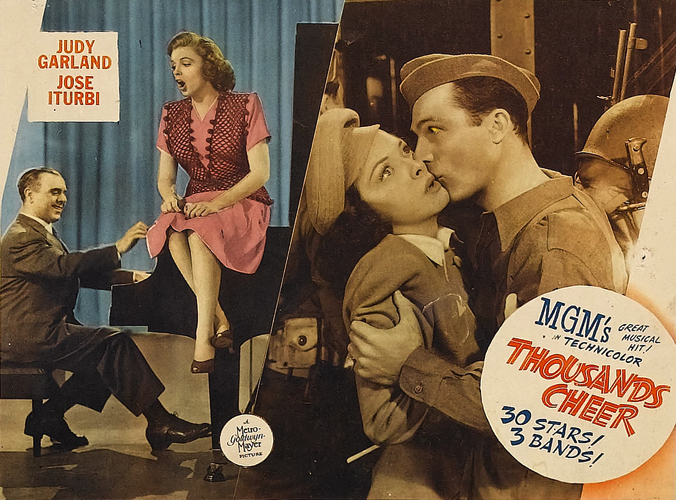
Thousands Cheer (George Sidney, 1943) was MGM’s entry in the ‘all-star WWII flagwaver’ stakes, the spirited everything-and-the-kitchen-sink sub-genre that produced a couple of musical-comedy classics – Warner’s Thank Your Lucky Stars and Paramount’s Star Spangled Rhythm – and a bunch of half-baked but enjoyable films like Hollywood Canteen (Warner again), Stage Door Canteen (RKO) and Follow the Boys (Universal). The story has Kathryn Grayson staying with her colonel father and being romanced by soldier – and former aerialist! – Gene Kelly, who needs to learn the value of discipline if he’s going to make something of himself. As you might expect, Grayson puts on a show to raise morale, resulting in 40 minutes of wall-to-wall sketches and songs featuring MGM’s finest, and compèred by Mickey Rooney. The highlights of that star-fest are Lena Horne’s seductive ‘Honeysuckle Rose’, Eleanor Powell doing a funky tap in front of a badly back-projected curtain, Judy making the most of a daft song featuring Jose Iturbi on boogie-woogie piano, and Rooney’s impressions of Gable and Lionel Barrymore. But they’re arguably upstaged by two earlier numbers from the film’s leads: Kelly’s solo dance with a mop to ‘Let Me Call You Sweetheart’ (which includes him shooting Hitler) and Grayson’s simply lovely ‘Daybreak’ – an absolute gem. Grayson, whose mentor Joe Pasternak produced the film, is terribly affecting and has a marvellous voice, lifting the often humdrum, silly material at every turn. Thousands Cheer isn’t another delight in the Thank Your Lucky Stars mould, but it’s still good fun, particularly for inveterate star-gazers. (And I haven’t even mentioned Frank Morgan’s skit about an amorous barber. Or the Mexican ballet. Or Margaret O’Brien demanding some ice-cream.) (2.5)

See also: For a brief history of all-star Hollywood films, clicky on here.

***


The Tall Stranger (Thomas Carr, 1957) - Typically enjoyable Joel McCrea B-Western, with our wise, tanned, greying hero (no I don't fancy him, you're getting me confused with Maureen Stapleton) caught - as is customary - between a shouty land-owner, unscrupulous gunmen and a wagon train full of women, children and incredibly stupid men. The scene where the crowd is repeatedly won over by whomever happens to be speaking is hysterically funny. Unintentionally, of course. The plot is cleverly drawn, though it shows its hand too early, but the main draw is McCrea, asked to carry a film once more, and transforming every hack line into a thing of naturalistic brilliance. Virginia Mayo, regarded as one of the great beauties of the Golden Age, is OK as a love interest with an uninteresting back-story, while Barry Kelley manages to be both imposing and clunky as the blustering land baron. The action scenes are either flat or confusing, though the exuberance of the stuntmen in the climactic set-piece makes up for the fact that it's a bit difficult to work out exactly what's going on. At least Hans Salter's score hits the target. That and McCrea's performance, a masterclass in turning oatery into gold. (2.5)

***


Down with Love (Peyton Reed, 2003) gets a bit of a raw deal. It’s an enthusiastic tribute to the Doris Day/Rock Hudson comedies of the ‘50s and ‘60s – which comprised two agreeably fluffy romances and an iffy black comedy – with a decent feel for the era, incorporating pop culture staples like What’s My Line and Ed Sullivan, and a very funny supporting performance from David Hyde-Pierce in the Tony Randall role. Curiously, Randall himself also appears, though in a disastrously underwritten part. The film isn’t terribly sophisticated, with its innuendo quickly wearing, while the attempt to inject some feminism into the proceedings near the end just makes everything very confusing, but it’s still quite a fun watch. Renee Zellweger – pouting as usual as if her life depended on it – is alternately impressive and annoying in the Doris role; Ewan McGregor makes a reasonable Rock-ish cad. I wish Thelma Ritter and Allen Jenkins were still around. (2.5)

***


Bull Durham (Ron Shelton, 1988) - A doggedly mediocre baseball comedy-drama - set in the minor leagues and somewhat pleased with itself - about a saucy older woman (Susan Sarandon) who chooses a dim-witted, big-time-bound pitcher (Tim Robbins) as that season's project, but is drawn to the wise old catcher (Kevin Costner) enjoying one last season. Robbins is introduced as little more than a cartoon - perhaps appropriate, since he looks just like a cartoon - so when we're asked to care about him, we can't. Costner, meanwhile, is strangely wooden, while I'm not even sure what the point of Sarandon is. Is she ever good? (Well, I suppose there was Atlantic City.) Is there anyone who fancies her aside from Hollywood casting directors? The film is fairly entertaining, at least until the soft-core fumblings of its final 20, and I particularly liked the small comic scene where Robbins sings the wrong words to 'Try a Little Tenderness', but compared to A League of Their Own, Eight Men Out and especially Field of Dreams, it's strictly minor league. (2.5)

***


*SPOILERS*
The French Line (Lloyd Bacon, 1953)
– Howard Hughes’s ode to cleavage has Jane Russell as an oil millionairess who goes incognito to find her ideal man – and ends up with wrinkly Gilbert Roland. Every woman in the film – though especially Russell – is forever arching their back, bending down to pick something up, or getting out of a chair, the camera lasciviously gawping down their top. It was originally in 3D. I’m surprised they didn’t have someone’s eyes out. The plotting is terrible, the acting little better and the songs largely forgettable, though the number pairing Russell and Mary McMarty, 'Any Gal From Texas', is a lot of fun if you can stomach the amateurish dancing. Roland also has a pleasant voice and his Comment Allez Vous is initially quite charming, before overstaying its welcome. One of the funniest things about Hughes’s films of this period is how many superfluous roles there are for women under the age of 30. Such was his harem of wannabe actresses that he was ultimately forced to create an entire film, Son of Sinbad, just to give them something to do. The French Line, damaged as usual by his interference and seen now in a washed-out print, is a tired, thin, often laughable musical-comedy. (1.5)

***

TV:


The Hour (S1, 2011)
– Abi Morgan’s drama-cum-thriller swings between greatness and mediocrity, chronicling the launch of a groundbreaking BBC news show, as the Suez Crisis hums away in the background, getting ready to explode. The central affair between producer Romola Garai and anchor Dominic West (who acts with his teeth) is spectacularly uninteresting, the political content is both under and over-explained until the last episode, and the programme itself is too often ignored. But The Hour builds as it progresses and there are wonderful moments all over the place, particularly from Ben Whishaw as the resentful, brilliant Freddie. The bit where he finds out that Garai and West have been shagging away is an absolutely stunning piece of acting and his intense, fascinating characterisation is reason enough to tune in. The supporting cast is led by Anton Lesser – excellent – and Julian Rhind-Tutt, who does a fine job with a somewhat one-dimensional part. I also took to the thriller elements; that side of it was pretty engrossing. The Hour starts too slowly, meanders too often and doesn’t always know what its strong suit is, but at its best it is special, and the final hour is a tour-de-force. If only they’d stop saying “Moneypenny”. (3)

Tuesday, 28 February 2012

Major Barbara - Reviews #103

This is probably the most personal review I've ever put on here. Uh-oh.


"Drunkenness and murder! My God: why hast thou forsaken me?"
*SPOILERS*
Major Barbara (Gabriel Pascal, 1941)
- There are some performances that bypass your critical faculties altogether, connecting not with your brain but with your soul. They are desperately few, those characterisations of such heightened sensitivity, such emotional resonance that the effect is both exalting and suffocating. You might chance upon one every three of four years, if you're lucky. I don't know why, or how, but every time Wendy Hiller utters a line or holds the frame in Major Barbara, I am on the verge of tears. It's just such a beautiful, enrapturing performance, the perfect, compassionate, warm and beating heart of a satirical, often cynical Bernard Shaw gabfest that cocks a snook at temperance, the Sally Army and those who see nobility in poverty. The first time round, I found it difficult to grasp the polemic beyond Shaw's bombast - and his alter-ego's bomb blasts. On a second viewing, it's much clearer: poverty is the real enemy; don't bother thinking about the soul until you've saved the body.

Hiller is the title figure, whose faith in the noble work of her Salvation Army is shattered when her bosses accept a donation from her father, a supercilious, devilish, ominously-twinkling arms dealer (Robert Morley) who looks and acts like a mix of Shaw and Satan. Hiller has entranced professor Rex Harrison in a spellbinding prologue added especially for the film - I'd have the audio of either that speech or the climactic one in my eight Desert Island Discs - and destroyed loutish Robert Newton through softly-spoken rectitude, but has her life torn asunder by the compromise of all she holds dear, before rising again, eyes shining, voice lifting as she enters a brave new world. "Transfigured", as Shaw intended. Much is made by acting buffs of Hiller's supposed staginess in her early films. They say she's stiff, overly technical, soon to be overtaken by a more naturalistic mode of performance. What a load of shit. Great acting isn't what you see, it's what you feel, and Hiller's characterisation - through whatever method - cuts right to the bone.

Shaw's wise, profound, wilfully contrarian (though somewhat abridged) script is all kinds of magic, even if very occasionally - as with another fine Irish playwright, Oscar Wilde - you want to slap him in the face and shout: "I knew you were going to fashion an epigram by reversing the previous line, now stop being so fucking pleased with yourself!" Perhaps that's just a personal thing. Helping out Gabriel Pascal, who also helmed the Shaw/Hiller collaboration Pygmalion, are assistant director David Lean, cinematographer Ronald Neame (who made Tunes of Glory), production designer Vincent Korda, and Cecil Beaton, sorting out the costumes. Cast-wise, Morley is terrific in a big, broad part, while Rex Harrison is at his most looking-like-a-dog-ish in a curious role that's neither one thing or another. It's a solid performance, reaching an admirable crescendo at Morley's factory, but lacking the potency or white hot comic smarts of Pygmalion lead Leslie Howard. The supporting cast is largely superb, particularly Marie Lohr as the self-pitying aristo married to Morley, Walter Hudd - hysterical as their feeble, pompous son - and David Tree being inappropriate at all the best times. Deborah Kerr is touching in her first film (she later shared the screen with Hiller in the brilliant Separate Tables), while Newton is dynamic and compelling - if perhaps a little over-ripe - as the rotten apple hurling himself at the Sally Army.

It's Hiller's film, though, an extraordinary showcase for a rare and remarkable talent, her greatest creation a living, breathing, wonderful woman of Shavian rhetorical powers, uplifting faith and arresting, all-consuming empathy. "Oh, did you think my courage would never come back?" she asks Harrison in a transcendent closing monologue. "Did you believe that I was a deserter? That I, who have stood in the streets, and taken my people to my heart, and talked of the holiest and greatest things with them, could ever turn back and chatter foolishly to fashionable people about nothing in a drawing room?" It absolutely floors me. (4)

See also: I had Hiller's turn at #2 in my best female performances list - I'm starting to think I might have underrated it.

Wednesday, 22 February 2012

Nothing Lasts Forever, Woody at his best and Douglas Sirk in the noughties - Reviews #102

"I like a Gershwin tune/How about you?" Yeah, loads, and there are plenty in Woody Allen's Manhattan, which wowed me for the umpteenth time last weekend. Also in this batch of reviews: further artful use of black-and-white in the hard-to-find '80s cult item Nothing Lasts Forever, The Academy of the Overrated's Michael Mann in atypically fine form, and The Gruffalo crashing a lesbian household.


*SPOILERS*
“I had a mad impulse to throw you down on the lunar surface and commit interstellar perversion.”
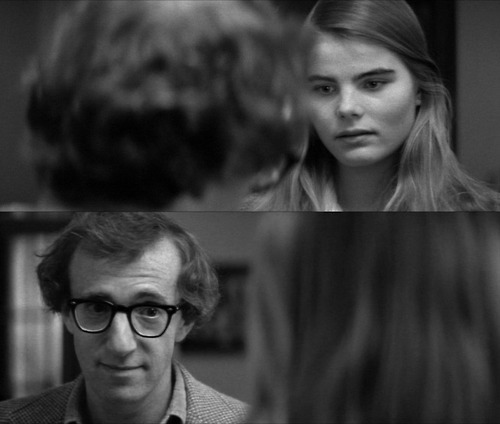
Manhattan (Woody Allen, 1979) – This brilliantly-written study of relationships in modern-day New York was Woody’s first truly great film. He plays a neurotic TV comedy writer – surely not! – who’s dating a high-school student (Mariel Hemingway), but lusts after opinionated journalist Diane Keaton, the mistress of his best friend (Michael Murphy). The scene in the planetarium is a particular wonder, and Allen and Murphy's climactic showdown is a comic masterpiece ("'I liked her first'? What are you, six years old?"). But it's superb all round: wonderfully-photographed in black-and-white, scored by peerless Gershwin tunes and boasting a brilliant supporting performance from Hemingway, all building to a typically-inspired Woody pay-off: “You have to have a little faith in people.” (Smile.) Sob. (4)

See also: There's more stuff about Woody here.

***


Nothing Lasts Forever (Tom Schiller, 1984) – One-of-a-kind fantasy-comedy set in an alternate past (bizarre future?) and shot in the style of a ‘30s studio movie, albeit with vivid snippets of newsreel and stock footage, Bunuel, Griffith and Eisenstein. Zach Galligan is an artist (medium undecided) who returns from Europe to make his name and finds Manhattan locked-down by the port authority, in the midst of a 100-day strike. Cue adventures in Dada, highways management and moon travel, appearances from Dan Aykroyd and Bill Murray, and a musical number set in a lunar greenhouse. Friend-of-Gizmo, Gilligan, can be a little callow as a lead, but here his slightly uneasy quality is put to fine use. This is a true original – albeit with nods to both Kafka and classic sci-fi movies – with a superb score from Howard Shore and a look and feel that’s all its own. (3.5)

***


*MINOR SPOILERS*
Zodiac (David Fincher, 2007)
- This is perhaps Fincher's best to date (it's a toss-up with Seven): a riveting, meticulously-detailed procedural, with a few early excursions into slasher territory, that charts the investigation into a still-unsolved murder spree that took at least seven lives and consumed three others: those of an obsessive cartoonist-cum-author (Jake Gyllenhaal), an alcoholic journo (Robert Downey, Jnr.) and a hard-working cop (The Gruffalo). The script wears its rigorous research lightly, the direction is virtuosic and The Gruffalo stands out in an ensemble that doesn't put a foot wrong, though if the film has a failing, it's that the character drama isn't always as pronounced as it should be and does occasionally lapse into cliche. Still, it's utterly gripping, immersing you in the thankless, plodding world of police work - alive with minor victories - even if I find it hard to believe that a Joel McCrea fan and silent film cheerleader called Rick could possibly be considered a suspect in a crime. (3.5)

***


Al Pacino and W.C. Fields.

The Insider (Michael Mann, 1999) is a superb drama about pasty Big Tobacco exec Russell Crowe and how his life unravels after he tries to turn whistleblower for 60 Minutes producer Al Pacino. I’m largely immune to Mann’s movies – Heat and Ali are two of the most boring, badly-directed films I’ve ever seen – but here his domestic fixation and penchant for lonely saxes and scenes of people wandering on the beach at night fit the material perfectly, and his pacing and skilful handling of the narrative are reminiscent of Sidney Lumet at his considerable best, aside from the needless repetition of footage from the doc-within-the-film, which is a minor complaint. He’s aided by an exceptional cast – the hammy Michael Gambon aside – with Crowe unquestionably the standout in a complex part. Mann’s script, co-written with Eric Roth, is eloquent and cleverly heightened, though the alleged zingers they feed Pacino are a bit of a misstep – they seem out of place and they’re not funny. What is funny is the scene after the deposition, where Crowe is standing on a lawn in the half-light and he looks like W.C. Fields. He should have just run all the Big Tobacco bigwigs off the road and into a ditch, tooting his horn. Still, The Insider is an important, impassioned and very entertaining film: its engrossing story lit by fine performances. (3.5)

***


Far From Heaven (Todd Haynes, 2002) is an expert pastiche of Douglas Sirk melodramas of the 1950s - particularly All That Heaven Allows and Imitation of Life - that also stands on its own two feet. The gimmick, and there is always one where homages are concerned, is that Haynes deals with themes that were resolutely off-limits for moviemakers during the Eisenhower era, like homosexuality and inter-racial love. Julianne Moore is the smiling housewife whose apparently perfect existence is shattered by the revelation that her husband (Dennis Quaid) is gay. She seeks solace in the company of her black gardener (Dennis Haysbert), but it turns out that small-town housewives of the 1950s will talk... Haynes's florid recreation of the style of classic-era "women's pictures" is meticulous, the cast is uniformly fine and there's a terrific, backwards-looking score from Elmer Bernstein that captures the essence of the genre. The director's script is literate but admirably straightforward: particularly the matter-of-fact way it deals with the process of "curing" homosexuality, which is both insightful and genuinely shocking. Significantly, Far From Heaven makes a welcome break from the popular presentation of the '50s as a time of optimism, swinging hips and tailfins, showing it instead as a period of emotional repression and stifling conformity: the projected image defended at all costs against the stark reality. To get the full effect - and appreciate the dark humour of the opening reels - a crash-course in Sirk would definitely help, but I think you can appreciate the film regardless, as a deliciously mannered portrait of an ideal crashing quietly to the floor. (3.5)

***


The Kids Are All Right (Lisa Cholodenko, 2010) – Entertaining comedy-drama in the Jason Reitman/Tom McCarthy vein - though from a female perspective - the lightness of the approach belying the amount going on under the surface, as lonely sperm donor Mark Ruffalo becomes acquainted with lesbian couple Annette Bening and Julianne Moore, and the two teenage offspring he never know about. The performances are excellent, particularly from Ruffalo and daughter Mia Wasikowska, but while the film certainly has its moments, it doesn’t always achieve the emotional resonance you might hope for, or expect. The way the inevitable appearance of Joni Mitchell’s Blue is crowbarred into the storyline, late-era Woody Allen-style, is also a bit crap - though the pay-off isn’t bad- while the whole film climaxes with a fucking group hug. Still, the performances make it, and it’s nice to find another mainstream-ish Hollywood film dealing with grown-up subjects like female sexuality in an intelligent way (you get to see one of Julianne Moore’s boobs at one point!). If you like it, the 1992 indie Gas, Food, Lodging has a somewhat similar angle on life, as well as one of the greatest performances I've ever seen, from a 17-year-old Fairuza Balk. (3)

***


*SOME SPOILERS*
The Sweet Hereafter (Atom Egoyan, 1997)
– Freezing, powerful Egoyan drama about lawyer Ian Holm trying to persuade the folks of a small Canadian town to file a negligence claim, after the bus crash that killed most of their children. Holm is absolutely terrific and the sequences portraying his travails with his drug addict daughter are sledgehammer stuff, but the small town scenes are a little less consistent – helped by vivid direction and a spellbinding musical score, but alternately too vague or too obvious in the scripting. Sarah Polley, who memorably stuck it to Disney back in the day, is quite good in a crucial supporting role, though Tom McCamus doesn’t really cut it as her abusive father. And he looks a lot like Tommy Wiseau. (3)

***


Topaz (Alfred Hitchcock, 1969) – Hitch’s powers were waning when he helmed this overly static espionage film, centring on the Cuban Missile Crisis, but it is notable for one excellent set-piece, in which intelligence service pawn Roscoe Lee Browne liberates some top secret plans from a hotel crawling with Cubans. Elsewhere, some nice directorial touches can’t really enliven lots of scenes of people just sitting around talking, at least until Philippe Noiret turns up a half hour from the end and the plot goes all Tinker, Tailor. I did enjoy Frederick Stafford’s leading man routine, but the rest of the international cast is a little nondescript. The scenes on the roads around Gard du Nord feature some of the ugliest process shots I’ve ever seen. (2.5)

NB: Hitch's cameo pre-dates Little Britain by a good three decades. He's a fella in a wheelchair at the airport who rises to his feet to shake hands.

***


*MAJOR SPOILERS*
The Piano (Jane Campion, 1993)
– Interesting, lushly-made drama about a mute Scottish woman (Holly Hunter) who is to marry a man she has never met (Sam Neill), and so moves to New Zealand with her daughter (Anna Paquin) and her piano, but finds herself flung around by her unpredictable will. Bribed into sexy-time with the badly miscast Harvey Keitel, she unleashes a torrent of jealousy, finger mutilation and piano music. It’s a good film, with a setting amongst the Maoris that’s rarely seen on screen and an involving story, but it never quite hits the emotional high notes, lacking real resonance even as Michael Nyman’s superlative score booms and tinkles. Perhaps Keitel’s weird, unconvincing performance is partly to blame, snapping you out of the story just as soon as you’re becoming immersed in it. Hunter is fine in a demanding part, though the really stellar performance is by Paquin – particularly good as her conflicted, confused, constantly-singing little girl. (3)

***


The Cat and the Canary (Radley Metzger, 1978) - Ten millionth version of the creaky old stage play, in which family members gather for the reading of a will, but are picked off one-by-one by the cat-obsessed psychopath roaming their ancestral home. The film is awash with problems: it's far too talky, the plotting often makes no sense (always best to go off on your own to the cellar when there's a murderer loose, I find), the frequent wisecracks mean literally nothing and the younger cast members are terribly bland. But it is salvaged somewhat by the welcome presence of three old-timers. Wendy Hiller is good-natured and effortlessly charismatic as the knowing executor, stage legend Beatrix Lehmann gives a masterclass in absent wandering - playing the creepy housekeeper - and Wilfrid Hyde-White has an amusing bit as the benefactor, appearing from beyond the grave via film footage - a plot point borrowed from the George Arliss vehicle, The Last Gentleman. There are also a handful of nice, old-school horror shots. We see the killer looming large behind his unwitting victims, and, best-of-all, lurking by a bed to grasp at a diamond-studded necklace, like some magpie Nosferatu. For Hiller completists, it's worth a look; others should just check out the 1939 version - a fine horror-comedy that made a star out of Bob Hope. (2)

***


Chisum (Andrew V. McLaglen, 1970) is a lacklustre John Wayne vehicle, from the tail-end of his career, about real-life land baron John Chisum, who joined forces with Pat Garrett and shiny-faced hotshot Billy the Kid (Geoffrey Deuel) in the summer of 1869, to see off unscrupulous tycoon Lawrence Murphy. It’s well-shot and excitably directed, with a strong cast of Golden Age veterans (Forrest Tucker, Bruce Cabot, Patric Knowles), but it suffers from a weak story and script, and action sequences that are frankly just very confusing. Added to that, Wayne is phoning it in in the lead and Ben Johnson’s character is a joke for someone of his ability. You can derive some enjoyment from the fact that every time someone says Chisum’s name, it sounds like they’re saying “jism” (the theme song goes “Jism! John Jism!” and when he appears at the, um, climax, they shout "It's jism!"), but it’s slim pickings really. (1.5)

SHORT: John Wayne and Chisum (Elliot Geisinger and Ronald Saland, 1970) – Sycophantic documentary about the making of the film. It’s usually fun seeing scenes shot from different angles – and some behind-the-scenes shorts even show different takes or deleted material – but as the film isn’t very good, it’s not so exciting. (1.5)

Friday, 17 February 2012

The Wrestler, the Talmadges, and Troy and Abed in the morning - Reviews #101

A film, a short and a TV series, because I am lovely.


The Wrestler (Darren Aronofsky, 2008) reminded me a little of Anvil, in its portrait of likeable, long-haired '80s relics playing to passionate but dwindling audiences. It's a heavy-handed, obvious but well-acted study of ageing pro-wrestler Mickey Rourke, who tries to connect with a lap dancer (Marisa Tomei) and his daughter (Evan Rachel Wood) after a stark reminder of his mortality. Aronofsky seems to have little faith in his audience's ability to understand even the simplest analogies, initially hinting at the fact that Rourke and Tomei are both past-it pieces of meat before deciding to clobber us over the head with it, and soundtracking our hero's walk to a new job at the deli with crowd noises - as if the way it's filmed doesn't make the connection obvious enough. OH RIGHT DARREN THANK YOU FOR EXPLAINING IT. I also suspect that if Aronofsky could direct an entire film as a tracking shot from just behind someone's head then he definitely would. The story is engrossing, building in power as it progresses, though the dialogue is variable and the self-satisfied gags about in-the-ring villains being absolutely lovely off-stage wear thin after a while. Rourke's performance is good rather than great, aside from the scene by the water, which is superb in every way and presumably what got him the Oscar nom. That and his leathery skin. Tomei, also nominated, was arguably more interesting when she was a sensitive mainstream lead* rather than a challenging, perma-naked wreck-specialist, but she does a decent job with a cliched part. I'm not sure about Wood's performance: she was excellent at the start, but by the end she was just shouting her trite dialogue whilst staring at the floor. I don't think this is the masterpiece others do, though it's still worth seeing, if only for that superlative monologue: "You're my girl. You're my little girl. And now, I'm an old broken down piece of meat... and I'm alone. And I deserve to be all alone. I just don't want you to hate me." The Nintendo game was also cool. The Wrestler was remade by Aronofsky in 2010 as Black Swan. (3)

See also: Marisa Tomei also appeared in Only You, doing her sweet-girl-abroad routine, and Before the Devil Knows You're Dead, not.

*This not apply to her performance in My Cousin Vinny.

***


SHORT: My Wife's Relations (Buster Keaton, 1922) - One of Buster's most underrated films, with a great through-line, several hysterically funny little set-pieces and a performance by its star that is essentially a series of priceless reaction shots. Accidentally married to a hefty woman with a massive dad and three big brothers, our hero navigates a family meal, a night's sleep, a photo-shoot and a posh party, displaying an impressive mix of patience, persistence and almost perpetual confusion. It's modest, with just a brief burst of dazzling stuntwork at the close (the 'carpet roll' is incredible), but the standard of throwaway gags is absolutely extraordinary, elevated by perhaps the cleverest, subtlest performance of the star's pre-features career. There's the bit where he pours the coffee into the sugar bowl to (sarcastically?) impress an in-law, the sequence with the collapsing bed and the indescribably brilliant moment in which everyone droops to the floor in unison with the photographer's slumping tripod. And how Buster can transmit such a variety of emotion whilst essentially keeping a Stoneface I don't know. The star's marital difficulties with Norma Talmadge do seem to have affected the way he portrayed love on-screen - and that's before we even get onto the subject of her relations - but where the subject matter is less tender, the films do tend to be irreverent and sardonic, rather than bleak or cynical. This one's a minor classic. (3.5)

See also: Many of Buster's other great early solo shorts are reviewed here.

***


"WANTED - GAY AND ALIVE"
TV: Community (Season 2, 2010-11)
is alternately better and lesser than the first series, with a few sincere scenes that are its finest moments to date, but far more genre episodes; pastiches in the Spaced mould. Though fine in themselves, they're not really what Community used to be about. There's a great ensemble - even if Jeff, Pierce, Annie, Troy and Abed are significantly funnier and more interesting than Shirley, Britta and the one-note Chang - and barely an episode goes by without three or four massive laughs and a dozen smaller ones. The weakest episode is probably #22, set around an anthropology exam. The best is #10, with Troy's 21st birthday party: the scene at the end with him and Annie is wonderful. Overall, it's probably a shade below the debut season, but it's still a real treat. (4)