Showing posts with label MGM. Show all posts

Monday, 21 October 2013

Myrna Loy, Gaslight, and Toronto's premier downtown mall - Reviews #173

SOME REVIEWS! Also featuring: MGM showing off, Alan Ladd being cool, and Anton Walbrook being mean. Very mean. Evil, even.


Test Pilot (Victor Fleming, 1938) is the epitome, if not the apogee, of Old Hollywood excellence, a slick but weighty entertainment with several remarkable facets, and the full weight of the MGM dream factory behind it.

First, consider its pedigree: its scriptwriters included Howard Hawks and former aviator Frank "Spig" Wead, the personable stars - Clark Gable and Myrna Loy - had just been voted the King and Queen of Hollywood in the biggest poll of its kind ever conducted, there was a meaty role for dramatic heavyweight Spencer Tracy, about to land his second consecutive Oscar, and the direction came from skilled filmmaker and unequivocal "man's man" Victor Fleming - who specialised in rough, tough pictures, but would shoot most of The Wizard of Oz and Gone with the Wind the following year. Seventy-five years on, it still looks like what it was: a proper prestige production, shot on location as well as in the studio, and full of impressive flight footage (which I'll acknowledge isn't always perfectly integrated with the close-up work).

Gable is the test pilot of the title, pushing new planes to the limit at risk of his life. Tracy is his fatalistic, constantly chewing mechanic, Loy the university-educated farm girl on whose parents' land he downs, setting up a romance that moves from blissful exploration to bitter desperation, as drunkenness and death intervene.

This was among Loy's favourites of all her films, and, she said, the last movie in which her seven-time co-star Gable dared to emote, before the need to protect his macho image rendered him dramatically immobile. He was a formidable star, if not much of an actor, and Test Pilot finds him at the top of his game. Loy herself is out of this world: she was never more affecting or amusing - eliciting bona fide lolz and heartbreak in equal measure with a rich, multi-layered characterisation brimming with confidence. Usually happy to merely complement her co-star, here she just acts him off the screen. Tracy is also at the peak of his gargantuan powers, exhibiting a wondrous naturalism that's sustained throughout every moment he's on screen, whether centre-stage or not.

There are a few extraneous scenes, a couple of lurches in mood and perhaps an overly folsky wrap-up utilising Lionel Barrymore's popular persona, but it's largely a proper movie with proper characters, and little of the superficiality or convolution that marred many of Gable's MGM vehicles. It's also a film of great moments: Loy's first meeting with Gable, her breathtaking heart-to-heart with Tracy, a noted precursor to the classic "Who's Joe?" scene from Hawks' own Only Angels Have Wings, and that gutting instant that consists of nothing more than the mechanic tossing some chewing gum on the ground. (Unless my ears deceive me, it's additionally one of the only Breen-era movies to contain blasphemy, in the scene where Gable goes to visit Gloria Holden.)

In her book, Loy says the film "really stands as an example of what big-studio filmmaking could be", and who am I disagree? (3.5)

See also: Tracy and Gable's next, and final collaboration, Boom Town, is reviewed below.

***


The Glass Key (Stuart Heisler, 1942) - For all its flaws, this is one of my favourite noirs, and a movie I return to time and again. There isn't much plot, and what there is doesn't always make sense, but it's pure joy from start to finish, with Ladd and Lake's usual fireworks, Brian Donlevy and William Bendix in career-best form, and a spectacular script crackling with menace, innuendo and pitch black humour. Putting the malnourished story aside, it's everything film noir should be: violent, sexy and funny. And homoerotic. It's very homoerotic. (3.5)

See also: I reviewed Sullivan's Travels, also starring Veronica Lake, here.

***


The Silent Partner (Daryl Duke, 1978) - A very good thriller in a very '70s style, with a languid style of storytelling punctuated by scintillating genre set pieces, a shambling, handsome-ugly hero, and lots of women without any clothes on.

Elliott Gould is a Toronto bank clerk, in love with co-worker Susannah York, who realises he's about to be stuck up by a department store Santa (Christopher Plummer) and decides to turn the situation to his advantage. Unfortunately his adversary turns out to be an absolute psychopath – shades of Charley Varrick – but Gould's dalliance with illegality seems to have woken him from his stupor, and sharpened his wits.

In plot terms it's reminiscent of Wait Until Dark and the later Hopscotch, it's thematically and stylistically akin to Michael Cimino's Thunderbolt and Lightfoot, and the atmosphere of growing dread and danger within a sanitised, bloodless corporate environment makes it an interesting companion piece to the same year's Dawn of the Dead, but this Curtis Hanson-scripted movie also treads its own path, thanks to consistently surprising plotting, delicious performances from Gould and Plummer, and an incredible score by jazz legend Oscar Peterson, his only one for a feature film, which fills those bank vault sequences with an irresistible, pounding tension.

It's Gould's sporadically assured anti-hero, though - nervous one minute, nerveless the next - who gives the film its apparently contradictory gamut of virtues: it's cool and gripping, fatalistic but unpredictable, escapist but sometimes plain old terrifying. In fact, my only complaint with this offbeat, frequently magnificent movie is the misogynistic nastiness that sometimes intrudes, revelling in Plummer's sexualised deviancy as it pretends to condemn it. (3.5)

Trivia note: The film is set at Toronto's Eaton Centre. I went there once. It wasn't as tense as this.

***


When Ladies Meet (Harry Beaumont and Robert Z. Leonard, 1933) - AKA "The one where Myrna Loy is hot for The Wizard of Oz". This is one of the most grown-up films to come out of Hollywood in the '30s (in stark contrast to the opening of my review): a fiercely intelligent and sexually candid drama about a "good woman" (Myrna Loy) who falls in love with a married man (err, Frank Morgan, in a departure from his popular persona), then winds up spending an unwitting evening with his wife (Ann Harding) thanks to the machinations of the sarcastic, good-hearted journalist (Robert Montgomery) who's stuck on Loy.

It's talky in the extreme, and the character comedy from Alice Brady, Luis Alberni and Sterling Holloway is abysmal, but it's also equipped with a fascinating, astonishingly incisive take on gender politics, with none of the stifling conformity enforced by the Hays Office in future years (or by MGM normally). Though it starts slowly, it builds superbly, and the climactic conversation between the two women is a powerhouse. Harding, who specialised in smart, adult dramas during the Pre-Code era - also appearing in Double Harness with William Powell - is extremely good, particularly in the later scenes, and Montgomery handles a tricky part with some style, but it's Loy's show all the way. She's nothing short of sensational as the modern woman who just might be heading for a fall. With The Rains Came, it's the best dramatic performance she ever gave. (3.5)

***


Truly Madly Deeply (Anthony Minghella the Merciless, 1990) - Juliet Stevenson's performance in this fantasy romance is comfortably in my top 10 of all time, her grieving widow contorting with anger, confusion and unhappiness at the untimely death of her husband (Alan Rickman). Her pleasant, measured and good-humoured demeanour crumples and cracks, revealing a raging sea of anguish, tears and snot, but after the return of Rickman - in ghost form - there's joy there too (Walker Brothers!), and wonder, and then more confusion. When I interviewed Terence Davies a few years back (yes, still harping on about that), he insisted on referring to this film as "Truly Madly Boringly". Far be it from me to contradict the best British filmmaker of his generation, but a) That's not a pun, and b) The film's not boring. It is often quite annoying, though, not to mention thematically muddled, tonally baffling, frequently unfunny, saddled with a weak supporting cast, and equipped with a love interest sporting legitimately the worst hairstyle of all time. How do you rate a film like that? Generously, I think, for Stevenson's intense, jaw-dropping, utterly real performance, and for Minghella's work in securing it, whatever the film's other innumerable shortcomings. (3)

***


"Don't call me 'shorty'."
Boom Town (Jack Conway, 1940) - MGM wasn't in bad shape in 1940. This familiar but ludicrously entertaining mix of comedy, drama and romance – set in the world of wildcat oil drilling – was made on a vast canvas, has the usual polished production values and features no fewer than four massive stars: Clark Gable, Spencer Tracy, Claudette Colbert and Hedi Lamarr, whose names scroll across the screen in gargantuan capitals. It was the last (and probably least) of three collaborations between screen titans Gable and Tracy, whose mutual jealousy added to their on-screen sparring. As Myrna Loy notes in her book, Tracy was envious of Gable's sexual magnetism and his popularity with the public, while Gable yearned to be taken seriously by the critics and his fellow actors in the way that Tracy was.

The story sees Big John (Gable) and Straight Jon (Tracy) variously making and losing vast fortunes in the oil game, while fighting over Tracy's childhood sweetheart (Colbert), Gable's interest in a single-minded glamour puss (Lamarr), and the fact that the taller guy keeps calling the smaller one "shorty". The first 30 and last 30 minutes are both very well done; the rest is bitty, fast-moving fun, full of abrupt plot developments and excitable montages portraying the passing of time. Tracy and Colbert are superb, Gable – who had worked in the fields with his oil-driller dad – is very charismatic, and there are some wonderful flourishes, both artistic and dramatic: the smoke from a steam train buffeting a banner, a drunk Tracy's parting line to showgirl Marion Martin, and his heart-to-heart with a bedridden Colbert, which moves from faux-poetic predictability to tearjerking brilliance in the blink of an eye.

John Lee Mahin's script is unquestionably erratic, with an unfortunate, jarring propensity to threaten women with violence, but there are lots of enjoyable scenes in it, and it's never boring (just horribly sexist). There's also a first-rate supporting cast, led by Lamarr (whose billing is a little confusing), legendary weirdo Lionel Atwill and Frank Morgan, his riotous performance interrupted by a single moment of overwhelming sincerity. Boom Town isn't as deep or thrilling as George Stevens' later oil-fuelled epic, Giant, but for fans of Golden Age movies, it's a must. (3)

***


We've all been through this.

36 Hours (George Seaton, 1965) - As you'd expect, this is only three-quarters as good as 48 Hrs. It's a disappointing spy story, set on the brink of the Normandy landings, in which the Nazis devise an elaborate way to get American diplomat James Garner to spill the beans about the D-Day plans. An ingenious first half gives way to a conventional, convenient second that mixes reheated cliches with artificial attempts to deal with big issues, and a litany of far-fetched developments, several concerning a particularly improbable "good German" in the shape of doctor Rod Taylor. Garner's hero must also be about the most stupid in movies, and among the least pro-active: a square-jawed moron buffeted around by chance, German office politics, and his own confusion as to which day it is. It's a shame that after a disorientating, deftly-devised first hour that promises plenty, all the film can deliver is a daft, dull and formulaic final 50 preoccupied with German incompetence, and augmented by a little suspenseless pursuit. (2.5)

***

And here's a review of a recent DVD release that I wrote for MovieMail:


Gaslight (Thorold Dickinson, 1940) - There can surely be no higher compliment than the world's most famous movie studio trying to destroy the negative of your film because it's a bit too good. That's the fate that befell Thorold Dickinson's Gaslight in 1944, as it dawned on MGM that their remake of the British film - released four years earlier - didn't really measure up.

Dickinson's original is a scintillating, richly atmospheric and sickeningly tense suspenser set in Edwardian London, in which sadistic maniac Anton Walbrook returns to the house where his aunt was once strangled, and methodically and insidiously drives his blameless wife (Diana Wynyard) to the brink of madness.

The director fairly revels in Walbrook's dapper deviance, and proves himself every bit as meticulous as his villain, stuffing his gas-lit movie with vivid montages, ingenious juxtapositions and nerve-shredding set pieces. The sequence in which Walbrook stage-manages his wife's breakdown at a charity concert is one of the most harrowing in movie history, Dickinson masterfully dragging his heels as we move towards the inevitable, and Wynyard sits blissfully unaware, listening to the tinkling of ivories. Later, he cuts restlessly between a crucial conversation and a rambunctious music hall show, briefly stemming the undercurrent of mounting dread via a sea of can-can dancers, only to unleash it in a veritable torrent.

Although the vicious, grey-templed Walbrook steals the picture in familiar fashion, as he would in Dickinson's cult classic The Queen of Spades nine years later, Gaslight wouldn't work without the basic human goodness at its centre. It's a film that finds time to properly humanise its heroine, whose intense fragility is instantly recognisable and whose true character only truly emerges in the presence of some boisterous street urchins, and equips her with a pair of selfless allies: a rotund retired detective (Frank Pettingell) who smells a Walbrook-shaped rat, and her affable cousin Vincent, played by a young Robert Newton.

Stark, suspenseful and sexually frank, essentially good-hearted and yet dripping with the menace and malevolence of its errant villain, Gaslight remains a must for fans of classic British cinema. Just be sure to lock your copy in your desk, Walbrook-style, in case MGM come calling. (3)

Thursday, 6 June 2013

RIP Esther Williams - The Million Dollar Mermaid


Esther Williams, who has passed away aged 91, was the legendary star of MGM musicals, a wartime pin-up and former swimming champion whose wet-through routines in movies like Bathing Beauty, Million Dollar Mermaid and Dangerous When Wet (opposite Tom & Jerry) essentially created the Olympic sport of synchronised swimming. It's not often you can say that an actress did something quite unlike anything that came before or since, but Williams did: she created an entire genre of which she was the only proponent. She was a limited actress, but a magnificent star, whose stunning, startling water ballets - which she co-choreographed - created many of the defining moments of '40s and '50s cinema.

She also wrote one of the great books about Hollywood at its height.

So what would you imagine that the autobiography of Esther Williams, MGM’s beloved musical swimming sensation, would be like? Well, the middle section of the nattily-titled Million Dollar Mermaid (2000) is like that: fun, splashy, gossipy, though with an unexpected feminist edge. We learn that producer Joe Pasternak ate spaghetti with his hands, Stanley Donen liked to eavesdrop on conversations about himself from behind a curtain, and Joan Crawford wasn’t averse to wandering around a deserted MGM at night, dressed as a bird. And then there are her tales of Johnny Weissmuller, superbly debunked by Cheeta the Chimp in the index of his autobiography.

But the book isn't just froth: it's tough, bleak and sometimes just plain old weird.

It begins, bizarrely, with a chapter in which Williams and ghostwriter Digby Diehl recall the time she scored LSD with the help of Cary Grant, and then hallucinated that she’d consumed the identity of her brother – who died tragically young – and was turning into a hermaphrodite. I can imagine the hordes of American movie fans at their local bookshop, protesting: “When I bought the autobiography of beloved MGM musical swimming sensation Esther Williams, I didn’t expect that the first chapter would include her saying: ‘I felt my penis stirring’.”

The next chapter, detailing her abuse at the hands of her adopted brother, is simply horrific – desperately sad – before the book proceeds to morph almost instantly into the light, undemanding read you might have anticipated. Well, until her second husband gambles away all her money.

I’ve read a fair few Golden Age autobiographies and Million Dollar Mermaid is one of the best, full of the kind of delightful detail that colours your perceptions from then on. The first thing I think when I see director Mervyn LeRoy's name on screen nowadays is that he apparently gave a single piece of advice before every camera-roll: “Let’s have a nice little scene”.

Williams has a slightly self-serving writing style and doesn't come out of the book as the saint she envisages: one can query her heartlessness in the treatment of a boyfriend's wife, the way she hangs poor old Jeff Chandler out to dry with tales of his cross-dressing, and the fact that she hung around with Franco's mates in Spain, but for all that it's a hell of a good book and she's an engaging, amusing companion: one who lived a full, fascinating and often fearlessly feminist life.

***


Esther Williams on...

... her LSD trip:
"When I looked in the mirror again, I was startled by a split image: One half of my face, the right half, was me; the other half was the face of a sixteen-year-old boy. The left side of my upper body was flat and muscular, like the chest of a boy. I reached up with my boy's large, clumsy hand to touch my right breast and felt my penis stirring. It was a hermaphroditic phantasm that held me entranced as I discovered my divided body. I don't know how long I stood there touching and exploring, but I was not afraid. Finally, I understood completely: when Stanton had died, I had taken him into my life so completely that he became a part of me."

... her movies, and those of Judy Garland, and Tracy and Hepburn: "People stood in line to see these films not because of the title or the plot, but because we were in them, and the revenue from these 'predictable' movies financed the production of a lot of turgid dramas and bad comedies that nobody stood in line for."

... Jeff Chandler: "'Jeff, are you getting help? Are you seeing a therapist?'
'Yes, of course.'
I felt a strong intuition and blurted it out: 'Your therapist is a cross-dresser too, isn't he?'"

... Joan Crawford: "Joan Crawford, feeding off the adoration of sycophants and decked out in her turqoise bird outfit, begging an imaginary public not to abandon her, is just one of many stars who became almost pathologically unable to deal with growing older." Ouch.

***

And here's a quick guide to her best movies:

A Guy Named Joe (Victor Fleming, 1943) - Williams made a good early impression with a dramatic role in this transcendent WWII fantasy, later remade by Spielberg as Always, starring Spencer Tracy and Irene Dunne.

Bathing Beauty (George Sidney, 1944) - Her breakout success began life as a Red Skelton comedy called Mr Coed. MGM's third floor brains were no mugs, and changed the title when they saw who was sprinting away with the movie.

Ziegfeld Follies (Merrill Pye - uncredited, 1945) - Williams' smiley, water-lily heavy ballet is one of the highlights of this all-star compendium.

On an Island with You (Richard Thorpe, 1948) - Cheery Hawaii-set fun with a good cast and some great numbers: Williams in the water and Cyd Charisse hoofing on dry land.


Neptune's Daughter (Edward Buzzell, 1949) - This standard Williams vehicle is best remembered for foreshadowing her move into swimsuit design (after her career dried out, she became a hard-nosed businesswoman), and for her passable, Oscar-winning take on the classic Baby It's Cold Outside.

Take Me Out to the Ball Game (Busby Berkeley, 1949) - On the Town, but with baseball, with Williams crowbarred into the movie at short notice. She was miserable throughout filming; it doesn't show.

The Million Dollar Mermaid (Mervyn LeRoy, 1952) - Williams gave her best dramatic performance in this biopic, playing Australian swimmer Annette Kellerman. She was cast opposite Victor Mature, with whom she promptly began an intense affair.

Dangerous When Wet (Charles Walters, 1953) - Charming story about a Channel-swimmer (Williams), lit by that classic dream sequence in which she swims with Tom & Jerry, and the draining action climax.

Tuesday, 15 May 2012

Edison, explosions and Deanna Durbin - Reviews #115

Presenting MGM's two-part Thomas Edison biopic, Douglas Fairbanks' silent swansong and Aziz Ansari helping his mate rob a bank, in the latest reviews round-up.


Young Tom Edison (Norman Taurog, 1940) - Captivating Americana based on the boyhood of the famed inventor, played here by Mickey Rooney, who is kicked out of school for his intense inquisitiveness - and his habit of staring out the window, and that big explosion - is branded "addle-pated" by the townsfolk, but ultimately comes good. Rooney's stock persona was as a brash, cartoonish know-it-all who gets a lesson in humility (at which point he starts crying and saying sorry), but his best performances came when he was asked to calm down and actually act, doing extraordinary work in The Human Comedy and National Velvet. He's superb here - using slightly broader strokes than in those seminal later performances - and surrounded by a cast of top character actors, including Virginia Weidler as his affectionate sister, Fay Bainter as his protective mother and George Bancroft as a stern patriarch with impressive sideburns but an unfortunate propensity to ignore his son's protestations of innocence. It's a wonderfully-mounted production, with a literate script that mixes things that actually happened, things you wish had happened and MGM staples like the family sing-along. And it climaxes with two extraordinary, unbearably tense suspense sequences. If you're a cynic, just don't bother. For everyone else, this is a rosy primer on Edison's early years and a poignant, exciting and flavourful example of MGM at its absolute best. (4)


Edison, the Man (Clarence Brown, 1940) - The second part of MGM's Ed-stravaganza, prepared by the same producers, was released two months later but featured an all-new cast, with the story picking up a good decade later. It's a more conventional biopic, with an unnecessary framing device and the needless fabrication of a villain (though if they were going to insist on a chubby, selfish financier standing in the way of progress, at least they had the decency to make it Gene Lockhart), but the story is engrossing, MGM's top production values are still much in evidence and there's a good central performance from Spencer Tracy - if not one of his very best. Incidentally, he was so affronted that the film didn't get nominated for a Best Picture Oscar that he never attended the event again. (3)

***


The Long Kiss Goodnight (Renny Harlin, 1996) - Amnesiac Geena Davis delves into her past with the help of a low-rent PI (Samuel L. Jackson) and discovers that she used to be a deadly assassin. Meanwhile, her psychotic old adversaries find out she's still alive. This Shane Black concoction is shlocky, ridiculous and morally confused, but also incredibly entertaining, with a great performance from Jackson, dozens of brilliant jokes and a knowingly over-the-top climax that is one of the funniest, silliest and best things I've seen so far this year. (3.5)

***


*SPOILERS*
It Happened Here (Kevin Brownlow and Andrew Mollo, 1966)
- Brownlow and Mollo's film has some bad acting and confusing plotting, but achieves something truly remarkable in convincing you that the Nazis really did occupy Britain during World War Two, and that Our Finest Hour was shortly followed by Our Collapse and Our Shameful Period of Collaboration, with Jewish areas ghettoised, resistance fighters betrayed and sick men euthanised. It's also remarkable in failing to provide any moral heroics - or moments of catharsis - while articulating with invigorating intelligence and a clear understanding of history and rhetoric exactly how collaboration would have been justified. A shame, then, that it starts so poorly and that the documentary levels of realism are undermined by the non-professional cast. (3)

***


The Big Year (David Frankel, 2011) - "Birders" Jack Black, Owen Wilson and Steve Martin compete to spot the largest number of species in a calendar year, in this sweet-natured comedy-drama. Gratifyingly - given the presence of Black and Martin - it leans towards realism rather than zaniness, and while there are no real belly laughs or revelations, it's all very pleasant. (2.5)

***


*SPOILERS*
The Iron Mask (Allan Dwan, 1929)
- Douglas Fairbanks' farewell to silent swashbucklers has one of the greatest openings to a film I have ever seen - including D'Artagnan's exquisite, playful courtship of Constance - and climaxes with an utterly staggering final scene. What comes between is often excellent, but sometimes undermined by serving Dumas' story too slavishly, with dense plotting at the expense of action and character drama. It's still a great movie, better in fact than The Three Musketeers, with many wonderful vignettes and a fittingly heavy human cost that is rare in Fairbanks' films. (3.5)

See also: I've written reviews of Fairbanks' classic films Robin Hood and The Black Pirate right here.

***


*SPOILERS*
Pretty in Pink (John Hughes, 1986)
- Hughes's best film is an affecting teen drama about lovers from literally the opposite side of the tracks. Molly Ringwald is all homemade clothes and vaguely subversive socio-political leanings, while Andrew McCarthy is a "richie". Their budding romance is threatened, ahead of the prom, by their suspicious friends, including Ringwald's obsessive suitor (Jon Cryer) - who likes round shades, fast patter and leaping around a record store miming to Otis Redding - and McCarthy's horny bleach-blonde buddy James Spader, who's a dick. The leads are very likeable - well, except for when he bails on her, and when she calls her acolyte a "retarded little dwarf" - but the really great performances come from Cryer, who's moving, funny and most importantly credible in a potentially cartoonish part, and Harry Dean Stanton, as Ringwald's depressive father. In some ways it's a typical Hughes movie - full of rock music, teen angst and drunken parties, everything dripping with '80sness - but it's more incisive, mellow and heartfelt, without concessions to either idiotic humour (hello, Sixteen Candles) or heavy-handed speechifying (The Breakfast Club, I'm looking at you). A little gem. (4)

***


It's a Date (William A. Seiter, 1940) - Deanna Durbin wants to be an actress like her famous mum (Kay Francis). So when she lands the role of a lifetime, she's understandably chuffed. Unfortunately, her mum thought she was going to get the part. And they both want to get off with the same guy (Walter Pidgeon). This transitional vehicle for former child star Durbin has its fair share of cliches and contrivances, but it's appealing, particularly well-photographed and seems to have a genuine understanding of acting and the theatre, courtesy of screenwriter (and playwright) Norman Krasna. As for Deanna, her character isn't as obviously sympathetic as usual - she's a bit of a drama queen - but her songs are mesmerising (including Loch Lomond, Love Is All, Ave Maria and an aria from La Boheme) and that "smitten" routine with the glazed eyes and steady voice that she does in the penultimate scene is absolutely hilarious. She had everything. The excellent supporting cast includes Cecilia Loftus, Eugene Pallette, Henry Stephenson, S. Z. Sakall and Samuel S. Hinds. (3) This was the last of Durbin's 21 features I got around to, and one of two still unavailable on DVD in the UK or US.

***


30 Minutes or Less (Ruben Fleischer, 2011) - Pizza delivery driver Jesse Eisenberg is having a bad day. He's just fallen out with his best friend (Aziz Ansari) when an annoyance with a goatee (Danny McBride) straps a bomb to his chest and tells him to rob a bank. This lively comedy-thriller boasts a hilarious performance from Ansari ("'Do you think Lisa will go out with me?' I don't think so - she's laughing in your face!"), great chemistry between the leads and an entertaining, twisty-turny narrative, but relies too much on unfunny sex gags in its first half hour and stops dead every time McBride turns up. I don't know why all those talented people on the DVD documentary are falling over themselves to praise him - he's a no-trick pony. (3)

Sunday, 4 March 2012

Ellen Page, The Hour and Howard Hughes's ode to cleavage - Reviews #104

... plus Edward Brophy's moment in the sun, Gene Kelly shooting Hitler, and Doris Day and Rock Hudson riding again. Sort of.


*SPOILERS*
Hard Candy (David Slade, 2005)
- Sensational (in both senses of the word) black-comedy-turned-revenge-fantasy about a boyish, 14-year-old psychopath (Ellen Page) holding a suspected paedophile hostage in his flat, and threatening to cut off his balls. Page is jaw-dropping in her star-making turn, Patrick Wilson fine as her quivering quarry, this talky two-hander avoiding staginess through stunning acting, digital effects that shadow its changing moods, and kinetic bursts of frantic action. Troubling, confrontational and throbbing with anger, it's tabloidy in the Sam Fuller fashion, and oddly appealing in its self-conscious, modish references to MP3s, Amazon reviews and Goldfrapp, though the film's deliciously wry sense of humour evaporates in a po-faced, conventional, disappointing final 15. It's still the best new watch of the year, if only for its, err, balls. (4)

***


Larceny, Inc. (Lloyd Bacon, 1942) – Very funny little Warner crime comedy about a petty criminal with the gift-of-the-gab (Edward G. Robinson) who gets out of the clink and starts plotting a heist. With his idiotic goons, Broderick Crawford and Edward Brophy, he takes over the luggage store next door to a bank – planning to tunnel in – but finds his plans, and his life, plagued by a moralising adopted daughter (Jane Wyman), an overenthusiastic salesman (Jack Carson) and an entire street-full of fellow traders who think he’s wonderful. The climactic swing towards melodrama is perhaps a bit too strong, and a few of Robinson’s one-liners are more nasty than amusing, but for the most part this is absolutely first-rate, with the star on top form, a particularly funny performance from Brophy – the scene where he’s talked into buying masses of stock by Carson is brilliant – and a supporting cast littered with familiar faces, from Anthony Quinn to Harry Davenport, John Qualen, Charles Arnt, Harry Hayden, Grant Mitchell, Chester Clute, Joe Downing and Jackie Gleason, in an early role as a nosey soda jerk. (3.5)

***


Fire in Babylon (Stevan Riley, 2010) – Entertaining documentary about the West Indies cricket team of the 1970s and ‘80s, with snippets of dazzling footage, informative talking-head interviews and the historical context needed to make sense of the action’s greater significance. (Incidentally, as he says he doesn’t understand the difference, I will be happy to explain to Colin Croft the difference between playing in an unsanctioned triangular series in Australia, and taking a pay cheque to play in Apartheid-era South Africa.) The film is true to its story by creating an interesting, flavourful atmosphere rife with the culture of the islands, but does this by enlisting the help of an annoying, weed-addled Wailer who won’t shut up, a sometimes pretentious broadcaster with a big beard, and some enthusiastic but actually quite terrible cricket-themed music, played on-screen. Including more film of the actual matches and scoring those with the songs would surely have made better use of the slender running time, since sequences like the montage of Malcolm Marshall destroying the England team during the blackwash of 1984 are simply exhilarating. Ultimately it’s merely a good film about a truly fascinating subject. (3)

***


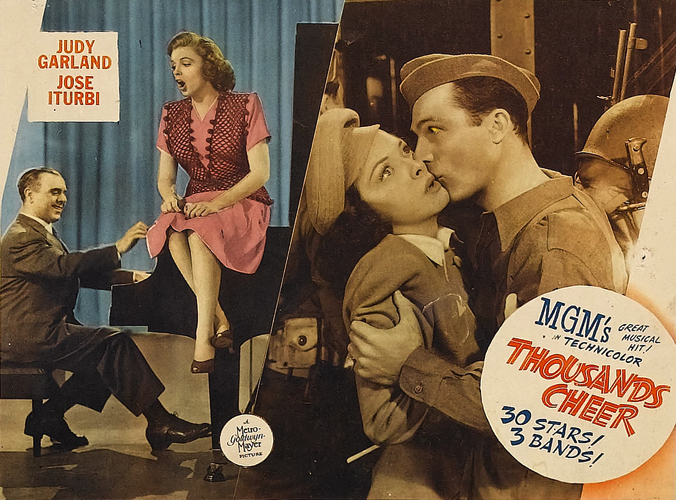
Thousands Cheer (George Sidney, 1943) was MGM’s entry in the ‘all-star WWII flagwaver’ stakes, the spirited everything-and-the-kitchen-sink sub-genre that produced a couple of musical-comedy classics – Warner’s Thank Your Lucky Stars and Paramount’s Star Spangled Rhythm – and a bunch of half-baked but enjoyable films like Hollywood Canteen (Warner again), Stage Door Canteen (RKO) and Follow the Boys (Universal). The story has Kathryn Grayson staying with her colonel father and being romanced by soldier – and former aerialist! – Gene Kelly, who needs to learn the value of discipline if he’s going to make something of himself. As you might expect, Grayson puts on a show to raise morale, resulting in 40 minutes of wall-to-wall sketches and songs featuring MGM’s finest, and compèred by Mickey Rooney. The highlights of that star-fest are Lena Horne’s seductive ‘Honeysuckle Rose’, Eleanor Powell doing a funky tap in front of a badly back-projected curtain, Judy making the most of a daft song featuring Jose Iturbi on boogie-woogie piano, and Rooney’s impressions of Gable and Lionel Barrymore. But they’re arguably upstaged by two earlier numbers from the film’s leads: Kelly’s solo dance with a mop to ‘Let Me Call You Sweetheart’ (which includes him shooting Hitler) and Grayson’s simply lovely ‘Daybreak’ – an absolute gem. Grayson, whose mentor Joe Pasternak produced the film, is terribly affecting and has a marvellous voice, lifting the often humdrum, silly material at every turn. Thousands Cheer isn’t another delight in the Thank Your Lucky Stars mould, but it’s still good fun, particularly for inveterate star-gazers. (And I haven’t even mentioned Frank Morgan’s skit about an amorous barber. Or the Mexican ballet. Or Margaret O’Brien demanding some ice-cream.) (2.5)

See also: For a brief history of all-star Hollywood films, clicky on here.

***


The Tall Stranger (Thomas Carr, 1957) - Typically enjoyable Joel McCrea B-Western, with our wise, tanned, greying hero (no I don't fancy him, you're getting me confused with Maureen Stapleton) caught - as is customary - between a shouty land-owner, unscrupulous gunmen and a wagon train full of women, children and incredibly stupid men. The scene where the crowd is repeatedly won over by whomever happens to be speaking is hysterically funny. Unintentionally, of course. The plot is cleverly drawn, though it shows its hand too early, but the main draw is McCrea, asked to carry a film once more, and transforming every hack line into a thing of naturalistic brilliance. Virginia Mayo, regarded as one of the great beauties of the Golden Age, is OK as a love interest with an uninteresting back-story, while Barry Kelley manages to be both imposing and clunky as the blustering land baron. The action scenes are either flat or confusing, though the exuberance of the stuntmen in the climactic set-piece makes up for the fact that it's a bit difficult to work out exactly what's going on. At least Hans Salter's score hits the target. That and McCrea's performance, a masterclass in turning oatery into gold. (2.5)

***


Down with Love (Peyton Reed, 2003) gets a bit of a raw deal. It’s an enthusiastic tribute to the Doris Day/Rock Hudson comedies of the ‘50s and ‘60s – which comprised two agreeably fluffy romances and an iffy black comedy – with a decent feel for the era, incorporating pop culture staples like What’s My Line and Ed Sullivan, and a very funny supporting performance from David Hyde-Pierce in the Tony Randall role. Curiously, Randall himself also appears, though in a disastrously underwritten part. The film isn’t terribly sophisticated, with its innuendo quickly wearing, while the attempt to inject some feminism into the proceedings near the end just makes everything very confusing, but it’s still quite a fun watch. Renee Zellweger – pouting as usual as if her life depended on it – is alternately impressive and annoying in the Doris role; Ewan McGregor makes a reasonable Rock-ish cad. I wish Thelma Ritter and Allen Jenkins were still around. (2.5)

***


Bull Durham (Ron Shelton, 1988) - A doggedly mediocre baseball comedy-drama - set in the minor leagues and somewhat pleased with itself - about a saucy older woman (Susan Sarandon) who chooses a dim-witted, big-time-bound pitcher (Tim Robbins) as that season's project, but is drawn to the wise old catcher (Kevin Costner) enjoying one last season. Robbins is introduced as little more than a cartoon - perhaps appropriate, since he looks just like a cartoon - so when we're asked to care about him, we can't. Costner, meanwhile, is strangely wooden, while I'm not even sure what the point of Sarandon is. Is she ever good? (Well, I suppose there was Atlantic City.) Is there anyone who fancies her aside from Hollywood casting directors? The film is fairly entertaining, at least until the soft-core fumblings of its final 20, and I particularly liked the small comic scene where Robbins sings the wrong words to 'Try a Little Tenderness', but compared to A League of Their Own, Eight Men Out and especially Field of Dreams, it's strictly minor league. (2.5)

***


*SPOILERS*
The French Line (Lloyd Bacon, 1953)
– Howard Hughes’s ode to cleavage has Jane Russell as an oil millionairess who goes incognito to find her ideal man – and ends up with wrinkly Gilbert Roland. Every woman in the film – though especially Russell – is forever arching their back, bending down to pick something up, or getting out of a chair, the camera lasciviously gawping down their top. It was originally in 3D. I’m surprised they didn’t have someone’s eyes out. The plotting is terrible, the acting little better and the songs largely forgettable, though the number pairing Russell and Mary McMarty, 'Any Gal From Texas', is a lot of fun if you can stomach the amateurish dancing. Roland also has a pleasant voice and his Comment Allez Vous is initially quite charming, before overstaying its welcome. One of the funniest things about Hughes’s films of this period is how many superfluous roles there are for women under the age of 30. Such was his harem of wannabe actresses that he was ultimately forced to create an entire film, Son of Sinbad, just to give them something to do. The French Line, damaged as usual by his interference and seen now in a washed-out print, is a tired, thin, often laughable musical-comedy. (1.5)

***

TV:


The Hour (S1, 2011)
– Abi Morgan’s drama-cum-thriller swings between greatness and mediocrity, chronicling the launch of a groundbreaking BBC news show, as the Suez Crisis hums away in the background, getting ready to explode. The central affair between producer Romola Garai and anchor Dominic West (who acts with his teeth) is spectacularly uninteresting, the political content is both under and over-explained until the last episode, and the programme itself is too often ignored. But The Hour builds as it progresses and there are wonderful moments all over the place, particularly from Ben Whishaw as the resentful, brilliant Freddie. The bit where he finds out that Garai and West have been shagging away is an absolutely stunning piece of acting and his intense, fascinating characterisation is reason enough to tune in. The supporting cast is led by Anton Lesser – excellent – and Julian Rhind-Tutt, who does a fine job with a somewhat one-dimensional part. I also took to the thriller elements; that side of it was pretty engrossing. The Hour starts too slowly, meanders too often and doesn’t always know what its strong suit is, but at its best it is special, and the final hour is a tour-de-force. If only they’d stop saying “Moneypenny”. (3)