Hello again. Thanks to those of you who read
the first part of my review of the year, it means a lot to me, genuinely. And thanks especially to those who shared it on Twitter and Facebook.
Part 1 was about movies, which is when you go into a darkened room and watch a filmed record of people pretending to be other people for about two hours at a time. This second part will cover gigs, exhibitions and the theatre, the last two of which have become an increasing part of my life since I moved to That London, which for all of its many flaws – and the unacceptability of this being the case – dwarfs the rest of Britain when it comes to cultural opportunities. Unless you would care for some more ado, here it is:
THEATRE
5. Sunset Blvd. (London Coliseum)

I
saw this whilst in the midst of personal trauma and, despite a few flaws, it enraptured and obsessed me. It's an Andrew Lloyd Webber adaptation of Billy Wilder's Hollywood nightmare, brought to the home of the English National Opera with a bare set, a 48-piece orchestra and Glenn Close in the lead (on the rare occasions when she wasn't indisposed). I ended up seeing it twice, and
the second time was a more arresting experience, thanks to a front row seat and a stirring, moving performance from Close's big-voiced understudy, Ria Jones, whose performance I much preferred. Oddly, the things I liked most about it, though, were elements that wouldn't necessarily come to mind when you uttered the title: the lush melody of Too Much in Love to Care, the explosions of inventively choreographed dance, and the pairing of Michael Xavier as cynical screenwriter Joe Gillis, and Siobhan Dillon playing his possible lifeline: bright-eyed studio scribe Betty Schaefer. Their irresistible chemistry made Joe's story as much of a tragedy as that of Close and Jones' character – deluded former screen queen, Norma Desmond – lending an undertug of humanity to this story of stifling desperation, laced with bitter, bullet-ridden, waterlogged wisdom.
4. Letters Live (Freemasons' Hall)

A must-see event, if you're a human and in London: letters from history, both well-known and unknown, read by some of the leading lights in the arts, including the likes of Benedict Cumberbatch, Jude Law and Meera Syal.
The most profound of these was written, and read, by Caitlin Moran, and immediately and fundamentally transformed my conception of her. It has moments of self-aggrandisement, but it affected me very deeply, and I've looked to it time and again this year when things seemed a little too great to bear.
"Here is a promise, and a fact: you will never, in your life, ever have to deal with anything more than the next minute. However much it feels like you are approaching an event – an exam, a conversation, a decision, a kiss – where, if you screw it up, the entire future will just burn to hell in front of you and you will end, you are not.
That will never happen. That is not what happens.
The minutes always come one at a time, inside hours that come one at a time, inside days that come one at a time – all orderly strung, like pearls on a necklace, suspended in a graceful line. You will never, ever have to deal with more than the next 60 seconds.
Do the calm, right thing that needs to be done in that minute. The work, or the breathing, or the smile. You can do that, for just one minute. And if you can do a minute, you can do the next.
Pretend you are your own baby. You would never cut that baby, or starve it, or overfeed it until it cried in pain, or tell it it was worthless. Sometimes, girls have to be mothers to themselves. Your body wants to live – that’s all and everything it was born to do. Let it do that, in the safety you provide it. Protect it. That is your biggest job. To protect your skin, and heart."
3. The Threepenny Opera (National Theatre)

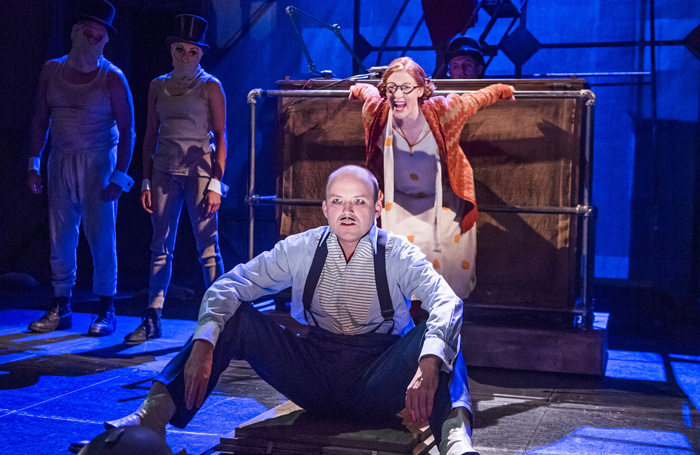
A lewd, sharp and sordid version of Brecht and Weill’s classic musical that provides deliciously amoral fun while doubling as a critique of establishment hypocrisy – and perhaps humanity itself. Seeing the play the day after Jo Cox’s murder, the brooding, putrid patriotism that infests the characters – sprawled beneath a gargantuan St George’s flag – cast a pall over the theatre: one of those moments when great art captures the national mood almost through chance.
Full review.
2. Ellen Terry with Eileen Atkins (Sam Wanamaker Playhouse, The Globe)

A monumental achievement on an intimate scale, with Atkins recreating a lecture on Shakespeare's women by 19th century actress Ellen Terry. Staged in the Globe's sumptuous smaller room, it was educational, enrapturing and exhilarating, with Atkins/Terry discoursing on gender politics, sketching deft portraits of characters and breaking into dazzling performances of apposite Shakespearean scenes. A quietly breathtaking night.
1. Groundhog Day (The Old Vic)

It's incredibly rare that an actor takes a role indelibly associated with someone else and makes it completely, and perhaps irrevocably, their own. But that's what's happened with Groundhog Day's Phil Connors in this musical adaptation of Harold Ramis's 1993 film. As realised by Broadway star Andy Karl, Connors is a comic whirlwind, powering a jawdropping production that's both a technical and an artistic triumph, using a rotating stage and several travelators, a song style fusing Lorenz Hart with hip hop, and an inspired broadening of its focus to wring every laugh, gasp and tear from the source material, and from its audience. A complete triumph.
Full review.
 Round-up:
 Glenda Jackson returned to the stage in a genderblind King Lear at The Old Vic:
a mixture of the terrific and the tedious. Romeo and Juliet at the Garrick was interesting and enjoyable, but hampered by an understudy ill-equipped to deal with a framing of the play as a study of sexual obsession. Kinks musical
Sunny Afternoon had great moments and laboured griping,
The Entertainer recovered from serious inertia to provide a vivid portrait of a past (and present?) Britain, and Day Job at the Bread and Roses Theatre showed that some of the most interesting and dynamic work is done in small rooms by people who aren't on telly. The cast was superb. This year's worst were
Show Boat, a play that may need to be either re-tooled or retired, and
an unbearable take on The Caretaker at The Old Vic, featuring the lesser-spotted Bad Timothy Spall Performance (above).
***
GIGS
Oddly for me, almost everything I've seen this year has been
at work, perhaps because the line-up at the Hall this year was quite ridiculously good.
7. Brian Wilson performs Pet Sounds (Royal Albert Hall)

A deeply moving celebration of one of the 20th century’s greatest artists, but it’s more than that: it’s a show that’s vivid, alive and invigoratingly enjoyable: an exploration and reinvention of some of the finest songs ever written, with Wilson its centre and its beating heart, even if a part of him is still lost somewhere in the 1960s.
Full review.
6. Radio 2 Folk Awards (Royal Albert Hall)

A truly magical evening, not least because I spent much of it with Georgia Lucas, the daughter of my great hero, Sandy Denny, as well as meeting people I'd grown up listening to, including Norma Waterson, Linda Thompson and Ralph McTell. The show itself was a wonder, including a tribute to Sandy,
Sam Lee singing 'Lovely Molly' and The Unthanks doing a clog dance.
I wrote a feature about Sandy's shows at the Hall here.
5. John Grant (Royal Albert Hall)

Not the loud, sweaty, hyper-intensive show we got at Hammersmith Apollo in November, but no less memorable a night, with Grant in balladic, hypnotic and rhapsodic mood. I still haven't recovered from that heartstopping version of Mary MacGregor’s 'Torn Between Two Lovers', featuring Welsh singer-songwriter Cate Le Bon on lead vocals.
Full review.
4. CHVRCHES (Royal Albert Hall)

A dancy, high-octane show from Scottish electronica heroes, CHVRCHES. 'Leave a Trace' damn near blew the roof off the building (
it's not actually attached, it merely rests on the Hall). The most fun I've had without laughing, as Woody Allen once said.
Review.
3. Björk (Royal Albert Hall)

A mesmerising night in the company of one of our time's truly great artists, centred largely on her tortured last album, Vulnicura, the most harrowing break-up record I’ve heard in years. Before a sell-out crowd of over 5,000, backed purely by the strings of the Aurora Orchestra and wearing a flamboyant mask that lights up midway through the first half (obviously), she gives a mesmerising performance that’s utterly raw: flaying her wounds till they’re tender, then cauterising them till they’re healed.
Full review.
2. Paul Simon (Royal Albert Hall)

A stunning, moving, exultant tour of one of the finest back catalogues in popular music. Dylan is a contrarian and McCartney a crowdpleaser, but Simon's something else: a man at peace with his legacy who'll give you the hits in a new way, and knows you'll love it. The show brought us to our feet and dancing countless times, prompted four standing ovations and included both the best ('Stranger to Stranger') and worst ('Wristband') of his current record, but it was his haunting hymn to serenity and sorrow, 'The Sound of Silence', that really took my breath away.
Full review.
1. Basia Bulat (Hoxton Square Kitchen)

She
topped last year's list too, but nothing prepared for me this, though: the whispery, wispy, baby-faced Bulat reincarnated as a power-pop diva in a gold cape, charisma bursting from her, as she belted out crowd-pleasers from behind a keyboard, like some improbable, magnificent union between Janis Joplin and Carly Simon. She also had an adorable smear of lipstick on her cheek for the entire show.
Full review. And
I saw her in Hackney in September too.
 Round-up:
 Other highlights include
Belle and Sebastian's 20th anniversary 'If You're Feeling Sinister' show,
Guy Barker's warming Big Band Christmas (graphic above), and
the Manics doing Everything Must Go. I saw a couple of Proms too, including one in a car park.
***
EXHIBITIONS
7. States of Mind : Tracing the Edges of Consciousness (Wellcome Collection)

This study of the fringes of the mind began simply enough, with paintings representing synaesthesia and photos attempting to capture dreams, then became increasingly unsettling as it journeyed through somnambulism, resistance to anaesthesia, temporary paralysis and memory disorders, augmented by eerie soundscapes and alarming, atmospheric installations. Isn't reality terrifying?
6. Real to Reel (Imperial War Museum)

A handsome, scholarly and accessible exhibition about war and its fictional representation on screen, curiously rather better on movie artefacts than those from genuine battles, but I wasn't complaining. The highlight was right at the end: IDs, the letters of transit and a bona fide cafe chair from Warner Bros' really rather good 1942 movie,
Casablanca.
Full review. (That's Steve McQueen's bike from
The Great Escape in the photo.)
5. Annie Leibovitz – WOMEN: New Portraits (Wapping Hydraulic Power Station)

An interesting exhibition in a startling location of bare, weathered brick and standing striplights. The photos (all of women) alternated vapid society worship and striking, distinctive work, and while seeing that volume, largely projected, created some semantic saturation, it largely engendered admiration for a sure style that avoids self-plagiarism. Leibovitz also captures character quite well, exhibiting a valuable, unexpected humility for a widely proclaimed superstar of the medium. The pub across the road did nice pies too.
4. Abstract Expressionism (Royal Academy)

A heavy-hitting overview that did a fair job of making this material accessible to a beginner like me, showing Pollock's versatility, range and the muscularity of his art, expanding my understanding of Rothko beyond his status as a creator of moods, and introducing me to a selection of (apparently well-known) contemporaries. Robert Motherwell's endless evoking of the Spanish Civil War sounded promising but left me cold, but Still's ever-climbing verticals and the "violent marks" of Kline – stark black lines conjuring noirish city scapes – took my breath away, and I found the fleshy eroticism of de Kooning's 'women' period beguiling. The Pollock and Rothko pieces were utterly overpowering, in both scale and content, and a room of drawings and photos included a lovely shot of the former 'disappearing in light' as he dripped onto a vast canvas. For the most part, this was a really interesting, rewarding exhibition, though with the usual moments of nagging unease I get from modern art exhibitions, as some pictures and painters leave me with the distinct feeling that either I'm stupid or they're shit.
3. Björk Digital (Somerset House)

There’s something endlessly fascinating, dizzyingly esoteric and yet gloriously specific about the shape-shifting, now 50-year-old Björk, for whom music is emotional expression and visual art is avant garde experimentation. This exhibition, tied into her big one-off show at the Royal Albert Hall, was led by four VR experiences, which possessed an enrapturing, all-encompassing embracing of immersion. It was artistically dazzling, its architect’s intrepid, idiosyncratic pursuit of new worlds to conquer enabled by technology that’s amazing to experience, even if it’s not quite there yet.
Full review.
2. Warhol (Ashmolean Museum)

A small, brilliant celebration of Warhol's work, from striking but superficial tracings of socialites and celebrities to loops of experimental films and bold, brilliant, perfectly contextualised prints, the best of which finds him sticking great big honking portraits of his friend and polar opposite Joseph Beuys on a cheap laundry bag. From this vantage point, he seems more like a conflicted commentator on his times - bemoaning the unthinking acquisitiveness of art collectors while being commissioned to draw titled millionaires - than a hypocrite, pushing the boundaries of both imagery and popular culture, and exploring his own obsessions and failings, as he cuts a singular swathe through counter-culture and then mainstream America.
... and the winner is...
1. Ragnar Kjartansson (Barbican Centre)

All I knew about Ragnar Kjartansson before this glorious exhibition was that he once got American indie heroes The National to play their song Sorrow over and over again for six hours. Feats of endurance were a recurring theme during the Kjartansson retrospective at the Barbican, but these aren’t just stunts, they’re part of a body of work that treats popular culture with both reverence and scorn (often simultaneously), deals with deadly serious subjects like familial strife and mortality with a beguiling playfulness, and manages to tread that line between being dully prescriptive about what we take from the work and seeming to be about nothing much at all. The piece de resistance (or "stykki de viðnám" in Icelandic), though, was The Visitors, a gorgeous meditation on music, communality and individuality, as eight musicians in separate rooms of a historic building some miles from New York perform a song together, build once more around a single mantra, this time heartbreakingly beautiful: "Once again, I fall into my feminine ways.” I experienced it walking round and round, as in turn each screen came to life, and then each performer began to make music, accentuated as you reached them, from the professionalism of the drummer to the pianist’s classical flourishes, the artist himself crooningly in a bubble bath (a slightly glib gesture) and, best of all, the accordion player singing in an unaffected, Joanne Newsom-ish squeak. It’s an absolutely devastating, exultant and euphoric piece of work: a manifesto, memoir and concert film that you experience in a new way each time, and in a completely unique way based simply on where you stand and where you walk.
Full review.
Round-up: I enjoyed Endless Endeavours, a one-room exhibition at the LSE Library
celebrating suffragism and described by this reviewer as 'sexy'.
Exhibitionism at the Saatchi Gallery was both impressive and infuriating (I took my dad for his birthday), while the Science Museum's Our Lives in Data served up both insight and imagination, right up until the point that it stopped very abruptly.
***
MISCELLANY
 Paul Verhoeven and Isabelle Huppert apparently not finding the need to justify the repulsive
 Elle
at LFF2016.
As always, I saw a fair bit of stand-up, enjoying (though not unreservedly)
Stewart Lee's Southbank marathon and
new Leicester Square show, catching
a disappointing but nevertheless entertaining Bridget Christie performance dealing with Brexit, and experiencing
David Cross's rather laboured contributions to the medium.
Film-wise,
I watched Love and Friendship in the company of Kate Beckinsale and the incredible Whit Stillman (meeting him was a great thrill), saw the likes of Ryan Gosling, Michelle Williams and Kenneth Lonergan at the London Film Festival, and was fortunate enough to both catch
Aliens Live at work, and be invited by
Neil Brand to
the premiere of his score for Allan Dwan's Robin Hood (which I seem to have forgotten to add to my blog), still the best take on that thieving git from Nottingham.
An improbable event teaming
Ray Davies and Mark Hamill was one of those once-in-a-lifetime shows you're compelled to go to, regardless of penury or the fact it's in Hornsey, though somehow finer than all of these things was the live reunion of
Adam and Joe at BFI Southbank this month, which brought tidings of comfort, joy and delirious silliness at a time when they've scarcely been more needed.
***
Thanks for reading. The final part will be on books and TV, but virtually none of them came out this year, so it probably won't be that interesting for anyone except me.