Showing posts with label John Grant. Show all posts

Wednesday, 20 December 2017

Review of 2017: Part 2 – Live


I'm not blasé about how lucky I am to have the job I do, to live in London, and to have just enough money to go to some incredible events (provided I don't go on holiday, and shop at Aldi quite a bit). In 2017, I've strolled around the Royal Albert Hall auditorium laying out Santa hats as Chrissie Hynde sang '2,000 Miles', gone for an extended drink with the Pern team after a day of filming with Christopher Eccleston, Paul Whitehouse and Nigel Havers, met Billy Bragg (straight in at #1 on the Nicest Celebs spreadsheet) and been to a celebration of Joe Orton featuring his sister Leonie, Kenneth Cranham and John Lahr. I've seen Allison Anders talk about Gas, Food Lodging, Bruce Robinson and Richard E. Grant discuss Withnail & I, and Kazuo Ishiguro reveal a deep love of screwball comedy. And through jobligations and a fast finger on the F5 button, I've been fortunate enough to go to the BAFTAs, Oliviers, the London Film Festival and the athletics world championships, and to see John Grant interview Elizabeth Fraser. It's been a bit daft.

That's everything that doesn't fit into my rigorously regimented Part 2 of the Review of the Year, which is split into Gigs, Shows and Exhibitions:

Gigs


12. The Best of Elmer Bernstein (June, Royal Albert Hall) – A fantastic concert showcasing Bernstein's pioneering work in everything from epics to comedies, Westerns to romances, and nature documentaries to sweaty, cynical, claustrophobic fag-end noirs. It was cosy, conversational and emotionally overwhelming in turn. Bernstein’s rhapsodic homage to/pastiche of classic Hollywood music – evoking the very history of Hollywood and composed for a ‘60s TV show called Hollywood and the Stars – was a revelation, captivating me with its sweeping, Steiner-esque beauty. Full review.


11. Martha Wainwright and Ed Harcourt (February, The Roundhouse) – An often brilliant evening in the company of one of the 21st century’s most compelling performers. Her new record is patchy, but she is such a mesmerising performer that she can wring brilliance from almost anything, her hips rotating sensually, her foot coming off the floor and her knee up towards her chest again and again in a mannerism that seems both inexplicable and inevitable, as much a part of her act as her easy humour, constant between-songs swearing and that unapproachable voice, racing over the octaves, blasting the roof off the Roundhouse or staying husky, deep and disgruntled somewhere in her larynx. Leonard Cohen’s 'Chelsea Hotel #2' is the highlight: among the most remarkable things I’ve ever seen or heard, at a gig or anywhere else (even after a false start in which she leaps straight into the second verse). At one point she’s crouched on the floor, her voice somewhere in the rafters, her heart somewhere in Hell. There are versions of it on YouTube, one from 10 years ago, another when she started doing it again live in December – clutching a lyric sheet, skitting around the tune – but nothing will ever come close to the way she sang it that night in February. It was revelatory. Full review.


10. The National (September, Hammersmith Apollo) – The best band since Suede (it's true, check your paperwork), and one of the most viscerally exciting live acts around. After three solid years of touring Trouble Will Find Me, they seemed keen to get away from it, delving further back into their catalogue and playing nearly everything from their new record, Sleep Well Beast. Highlights were a blistering 'The System Only Dreams in Total Darkness', a hushed, harmonised 'Dark Side of the Gym' featuring support act This The Kit, and a brass-backed take on that stuttering, syncopated hymn to escapism in a hellhole, 'Fake Empire'. My only quibble is that Matt Berninger, one of the most gifted lyricists of his generation and a dynamic stage presence, can't sing in tune live. It's not that hard.


9. Jens Lekman (March, Oval Space) – Glorious. Imagine how good he is when he doesn't have the flu. Full review.


8. David Ford's Milk and Cookies (December, Bush Hall) – Every Christmas, the protest-singing multi-instrumentalist puts down the economics textbook and plays a covers show for charity. Milk and cookies are on sale from a table at the back. This was the first time I'd been (though I've seen Ford live twice before), and it was a total joy, Ford effortlessly judging the mood as kicked off with 'Free Fallin' ', put his heart into a Whitney cover ('Didn't We Almost Have It All'), and played a joshing bromantic duet with Tom McRae (John Waite's 'Missing You'), between self-penned classics and randomly generated 'requests'. At one point, he asked the audience to sing a succession of notes, then used them as the synths for an inspired take on 10cc's 'I'm Not in Love'. What a treat. See you next year. I've put up a setlist (from memory) here.


7. Mike Heron and Trembling Bells (August, Cafe Oto) – As I said in the books review, my summer was commandeered by a burgeoning infatuation with the Incredible String Band. Robin Williamson's show at a Putney pub was distinctive and enjoyable, but ISB-free and dragged down by his wife's tuneless vocals. That felt in keeping with his character, and so did Mike Heron's hits set, backed by Glasgow folk-rock outfit, Trembling Bells. After support by a bad poet and a good young folkie, they took the stage for eight Incredible String Band numbers, including mesmeric versions of 'Douglas Traherne Harding' and 'A Very Cellular Song', probably the best thing Heron ever wrote. Pushing 75, he couldn't take a lead on all the numbers, so a backing singer unconvincingly deputised on 'Maya', but his voice has held up pretty well, and there's no questioning the enduring, singular quality of the material, nor the talent of his polished but flexible ensemble. He ended the show by duetting on the ISB rarity, 'Bright Morning Stars', with his daughter. Immediate reaction.


6. Yasmine Hamdan (March, Scala) – Every time I see her live, Lebanese electro-grunge pioneer Yasmine Hamdan features in this list. She topped it in 2014. The crowd was full of people farting and petting, but the performance itself was packed full of Hamdan's easy sensuality, instinctive creativity and megawatt charisma. The aftermath was somewhat spoiled by Yasmine not remembering me (we once hung out for like three hours) and then proceeding to offer me a fist-bump, which I misjudged and shook hands with. I can hear you cringing from here. Full review.


5. Susanne Sundfør (October, Union Chapel) – For me, one of this year's happiest musical discoveries, along with my numbers 10, 7 and 1. I saw her at the Scott Walker Prom in July (more of which later), and quickly became besotted. Y'know, musically. This show at London's most tranquil, atmospheric and welcoming venue (though the pews aren't ideal if you're a handsome 33-year-old press executive with a bad back) leant heavily on her new record, Music for People in Trouble, and its stylistic siblings: songs like 'Walls' and 'The Brothel', introspective, teasingly extroverted synth-folk ballads a world away from the stomping electro-pop of 2015's irresistible Ten Love Songs. Occasionally the show dipped into plonky nothingness, but there were stand-out moments from 'Reincarnation' to Paul Simon's 'American Tune', and when Sundfor rips the lid off that extraordinary voice for 'Trust Me' (a heart-stopping version) and the year's best song, 'Undercover', there's simply no feeling comparable.


4. John Grant (May, Union Chapel) – My first ever visit to Union Chapel was to see Review-of-the-Year stalwart John Grant, staying true to his reputation as rock's nicest genius with a charity show (to fund a kidney transplant for his friend Oleg) full of rarely-aired fan favourites ('Global Warming', 'You Don't Have To') and definitive versions. His 'Glacier' was the greatest I've ever heard, and I've seen him duet on it with Kylie. Full review.


3. Seu Jorge (May, Royal Albert Hall) – I loved The Life Aquatic from first sight, and one of its great joys is the Seu Jorge soundtrack: Portuguese-language covers of Bowie songs that give it so much of its poignant, perfect atmosphere. This year he toured those songs for the first time, pitching up at My Office for an intimate, conversational show. It was uplifting, unique, but deeply moving too: speaking very personally to the sell-out crowd, many of them sporting those iconic red beanies. “I am glad to see so many members of Zissou Team here,” says Seu. (A Team Zissou member calling Team Zissou 'Zissou Team” is the most Team Zissou thing ever). When a hidden screen comes down and his backdrop is The Life Aquatic and you realise that though it’s only 13 years, it’s already 13 years, and that the passing of time set to music is a rhapsodically poignant thing. Full review.


2. Prom 15: The Songs of Scott Walker: 1967-70 (July, Royal Albert Hall) – Perhaps the best show I've ever seen at work, a stunning reinterpretation of Scott Walker's early solo work from four of the most distinctive musical voices of later generations. Backed by Jules Buckley's impeccable Heritage Orchestra, each brought something different to the show, representing a different facet of Walker's mercurial persona: John Grant power and eloquence, Richard Hawley an urgent, tuneful melancholy, Jarvis Cocker a stage presence in place of the voice required to do Walker's songs justice, and Susanne Sundfør the insolent sensuality and super soaraway top notes. I'd come for Walker and Grant, but left as a Sundfør superfan. I first saw her in the soundcheck, doing something strange to 'The Amorous Humphrey Plugg'. By the end of the song I couldn't wait to hear more, and when she stepped out to sing it in Bond-theme style that night, I was just a foot away. It damn near lifted me to the ceiling. You can watch it here.


1. Father John Misty (November, Hammersmith Apollo) – In which the psychically tortured confessional artist puts on the most joyous pop concert of the year. Full review.

Would you like some more? I've written about plenty of other shows, from Jackson Browne being pretty damn great to Angel Olsen being pretty damn poor, and Richard Thompson not really being arsed.

Extra bits: Here are the best three pieces I wrote for the Royal Albert Hall blog this year: - My best pun of the year headlines this piece about Elmer Bernstein's greatest hits - Go behind the scenes at the filming of Brian Pern: A Tribute - And, after the untimely passing of the great Tom Petty, I wrote about seeing him live in 2012

***

Theatre


Yes, I like this sort of thing, what exactly is your point.

7. The John Wilson Orchestra presents Oklahoma! (August, Royal Albert Hall) – This counts, right? A semi-staged performance of Rodgers and Hammerstein's morally incomprehensible 1943 musical, in which the hero decides that a mentally ill love rival who owns pornography doesn't deserve to exist, and tries to convince him to commit suicide. Helluva show, though, powered by John Wilson's tight, exuberant orchestra, as a first-rate ensemble conjured Oklahoma from thin air with the help of a washing line, a couple of chairs, and impeccable song-and-dance smarts. Robert Fairchild was unquestionably the stand-out, but a mention too for Marcus Brigstocke. When I heard he was in it, I thought that was funny. It wasn't, but he was. I'd forgotten too how much great music there is in Oklahoma! I'll always prefer Rodgers and Hart to Rodgers and Hammerstein, but I prefer Rodgers and Hart to most things.


6. An American in Paris (March, Dominion Theatre) – An explosive, intelligent stage version of MGM’s 1951 masterpiece, direct from Broadway, which sags now and then in its book, but offers unmissable entertainment of a type rarely seen in the West End. It was the first night too, so Leslie Caron turned up to take a bow. Full review.


5. Girl From the North Country (July, The Old Vic) – A jukebox musical of Bob Dylan album tracks, allied to a Depression-era melodrama, and nearly as good as that sounds. Its greatest virtue was Shirley Henderson's performance. I've never been that taken with her, seeing her in films, but she had such a presence and physicality, flitting between pitiful and sensual, rabid and comatose, that I was transfixed. Though I tend to have a problem with portraits of mental disintegration which are big and tic-laden (as the journalist Tim Lott once wrote, a realistic piece of fiction about mental illness would just be very boring), this one managed to be funny, intelligently allegorical, moving and somewhat unpleasant, without traversing into unbelievability or hysteria, while her moments of lucidity unveiled an unexpectedly beautiful voice, shot through a Scandi-Minnesotan lilt. It was her, the songs and the atmosphere of quiet desperation that stayed with me, but mostly her. Full review.


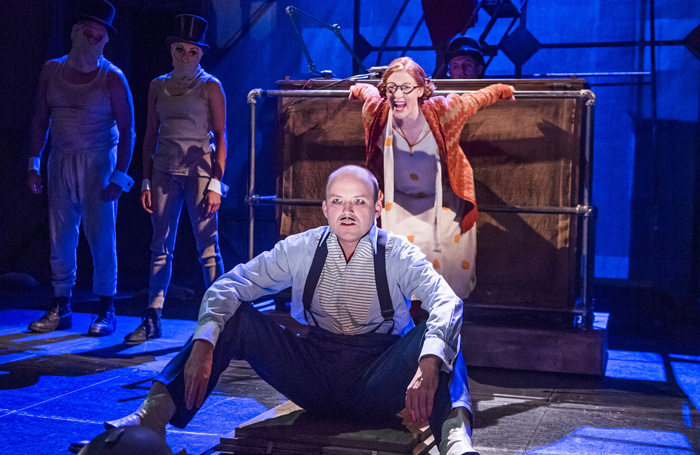
Pennycooke as the dandyish Francophile, Thomas Jefferson.

4. Hamilton (December, Victoria Palace Theatre) – The top four could be in any order, really: I've been incredibly lucky to see four shows so thrilling and affecting in a single year. Lin-Manuel Miranda's Broadway sensation makes it to the West End in considerable style, delivering for an audience so hyped that they were whooping with barely-contained delirium when the lights went down. The writing is magnificent – two small moments that just blow me away are Lafayette's appearance in 'Guns and Ships' and "... we dream in the dark for the most time", a wail of impotence in the stand-out number, 'The Room Where It Happens' – and the staging and playing aren't far off. Rachel John (as Angelica) and Giles Terera (as Aaron Burr) are both incredibly classy performers, and there's explosive, pint-sized support from Jason Pennycooke. The West End audience seemed to retain its comfortable fondness for warbly show tunes (the cheesy if unquestionably effective 'One Last Time') over lightning-paced wordplay, but the atmosphere was something special all the same.


3. Angels in America (July/Aug, National Theatre) – The first half, Millennium Approaches, was astonishing: a clear-headed, literate and ambitious piece of art, lit by the NT's masterly, expansive stagecraft and a stunning ensemble. Part two, Perestroika, wasn't quite in my sweet spot, its abstract and metaphysical elements sometimes more confusing than compelling, but taken as a whole it was a vivid presentation of an extraordinarily ambitious, eight-hour play, with a sprawling focus but an enduring, unblinkered humanity. The performances from Nathan Lane (as Trump's mentor, McCarthyite lawyer Roy Cohn), Denise Gough and the relatively unknown James McArdle were absolutely terrific.


2. The Ferryman (August, The Gielgud Theatre) – What I always imagined theatre might be, and yet rarely is: both political and personal, with a specificity that gives it its universality, and a crackling, super-charged atmosphere that here buzzes with desperation, danger and the particular energy of unspoken love. Written by Jez Butterworth and directed by Sam Mendes, it stars Paddy Considine as a former IRA heavy whose tranquil farm life remains in the shadow of his brother's unresolved disappearance, setting up your expectations only to subvert them or – in the case of a moment of lucidity amidst the fog of dementia – time and heighten cliche with such effortlessness that it works just the same, before a descent into inevitable, ironic violence. Everything about the play is first-rate, but especially Laura Donnelly as the missing brother's wife. The play was based on Donnelly's own experiences, and her knife-edge performance is warm, tortured and erotic – sometimes all three at once.


1. Hamlet (April, Almeida Theatre) – Andrew Scott's Hamlet is the best I've seen − probing, philosophical, introspective and bitterly witty − and this intimate, innovative, cleanly modern production rises to meet him, keeping your attention rapt and your emotions engaged. He's also the first to whom I've felt a natural and personal connection, and it runs deep. He's groping in the dark, beset with an impotence of action from which he's trying to rip himself free, questing for self-knowledge, while praying for a relief from it. He's an existential Hamlet: thoughtful, melancholy, feeling deeply, a decent, anguished, emotionally tender Prince with an adolescent's loathing of hypocrisy and duplicity, a child's guilelessness, and a self-loathing born of immobility in the face of dishonour. In pegged black trousers and a collarless shirt, barefoot or in shiny black shoes, stripped to a vest highlighting his voluminous biceps, or dressed in cream and white for the graveyard scene, the wiry, wild-eyed Scott commands the stage, and all of your attention. Full review.

***

Exhibitions


"The bees are getting suspicious." My favourite exhibition of the year is on until April: the V&A's wonderful Winnie the Pooh: Exploring a Classic, which approaches its topic from the angle of E. H. Shepard's perfect illustrations. That was presumably through necessity, as Shepard's drawings are part of the museum's collection whereas the smaller number of Milne items are borrowed, but it offers a fascinating new perspective on the works, examining Shepard's preparation (sketches from life in the rural locations), his subtle tricks (lengthening Piglet's snout to bury it in a balloon, showing his ears streaming back in the force of a gale) and his genius, while celebrating a creative marriage of two forceful, remarkable talents that extended to the artistic layout of the text, which echoed and so enhanced the stories they were telling. Don't miss the little side-room which takes that one step further! The rooms are full of life-size recreations of the drawings, including a Poohsticks bridge with an electronic river, and of remarkable insights and artefacts. The best are the alternate, unused Shepard sketches, among 270 drawings that he donated the museum in 1973. What I also found fascinating, looking at a gallery of later Pooh editions illustrated by Shepard, is that it was only in his dotage that his colour portraits began to work. His watercolour paintings, at least in these reproductions, seem blocky and charmless, but when he returned to the subject in his eighties, his eyesight failing, he opted instead for simple washes over his old ink drawings, and it's those indelible editions (making Pooh's jackets red, where sometimes they'd been blue) which have become definitive – and rightly so. There are a few references to the abhorrent D*sney bastardisation of the books in the opening room, but otherwise we're fine.


Grayson Perry's small-scale offering at the Serpentine Galleries, The Most Popular Art Exhibition Ever!, made me very happy: a sly, self-referential and extremely funny collection, from a vase decorated with delicately hideous cartoons of the Brexit mob to a tooled up motorbike for his teddy bear and (my favourite), a pastiche of miners' gala banners that contrasts the vilified 'archetypes' of the contemporary working class with the hazy image of their forefathers' macho monochrome nobility.


I saw two great exhibitions at the British Library, as well as their enjoyable Harry Potter one: a collection of Jane Austen's teenage writings in the Treasures gallery, and a fine study of the failed communist experiment – already in tatters by 1920 – in Russian Revolution: Hope, Tragedy, Myths. The Imperial War Museum's People Power exhibition was impressive, multi-faceted and a little unfortunate in having to follow the V&A's Disobedient Objects, which is one of the best exhibitions I've seen since moving to London, and dealt with a similar theme: public protest.

If you like the idea of going into a warm hut and trying not to stand on some butterflies, then I'd really recommend the Natural History Museum's ever-popular Sensational Butterflies (seriously, it's terrific).


My favourite of the art exhibitions was Tate Modern's Soul of A Nation: Art in the Age of Black Power, which had its philosophically impenetrable collections of twigs, but also works like Benny Andrews' provocative, 'Did the Bear Sit Under a Tree' – with its challenging, tactile 3D created partially by using an everyday zip for a mouth – and Betye Saar's 'Sambo's Banjo', its gaudy exterior covered in the infantilising, dehumanising racism of a blackface caricature, while its inside contains a black figure strung up for a lynching. Saar said, though, that the plight of the black man in America was not hopeless, destiny was in his hands, and so a sniper rifle lies within reach, waiting for him to free himself. I was less enamoured of the Rauschenberg exhibition, though it contained the greatest factual description of an artwork ever written, though American Dream at the British Museum got me thinking about the ways we see America, and the ways it sees itself.

***

Thanks for reading.

Thursday, 18 May 2017

REVIEWS: Yasmine Hamdan at Scala; John Grant at Union Chapel

Sometimes my life is really nice.


Yasmine Hamdan at Scala
Monday 15 May, 2017

One of the world's most singular, sensual and explosive performers is back in London, turning the sweaty, claustrophobic Scala near King's Cross from a dive into a dive faintly reminiscent of a bazaar, as she performs before a backdrop of white linen, and shifts between Lebanese metal, suggestive, seductive and erotic bedouin songs, and the kind of spellbinding electronica with which she made her name in cult band SoapKills, taking in both pulse-driven dance music and wails of futuristic despond.

Yasmine's presence – and sound – simply grabbed me by the throat when I first saw her live in 2014, though she delivered a different sort of show the following year: more muted and relaxed, the last of her lengthy Ya Nass tour. Here she's rediscovered her range – a range that simply doesn't transmit on her records, which are exotic and evocative but hardly arresting – the grungier sections rising into a cacophonous racket topped by her overpowering, startlingly committed vocals. At other times she's flirtatious, plaintive, erotic. "You didn't tell me she was sexy," challenged my friend Jess, when Yasmine walked on barefoot and launched into the first number, breaking into a slow grind.

Most of the dozen or so songs (she doesn't play long shows) are from her new record, Al Jamirat, which isn't the departure from Ya Nass she had promised or envisaged, at least musically (as she sings in Arabic, doesn't publish her lyrics and has dispensed with contextualising her songs live at all, themes are harder to discern), but then I don't think it needs to be. She has already cut out a unique place for herself, and exploring it gradually: brushing away the sand and gently splitting the concrete, sounds as worthwhile as just wandering off elsewhere. She does do two numbers from that 2013 record, though: 'Hal' (her best-known song in the West, due to its appearance in Jim Jarmusch's risible vampire film, Only Lovers Left Alive) and the beautiful 'Beirut', that breathtaking paean to her home city. The other old track is one I can't find on any record, but which she's done live each time I've seen her: Hamdan toying with the audience, and her own persona, as she plays both a lustful scoundrel and the nervous young virgin he's trying to bring back to his tent.

The night wasn't a total success, Yasmine has forgotten who I am, an annoying adorable new couple kept getting in the way, and we suffered the worst audience farts since the Manics at the Roundhouse in 2014, but Hamdan can't be held accountable for any of that (except the first bit, which is dreadful – I am highly memorable, if only memorably irritating), and in this spellbinding show she showed why she's one of the best live acts on the planet, intoxicating us with her mega-watt charisma, and drowning us in that extraordinary sound. (4)

***


John Grant at Union Chapel
Tuesday 2 May, 2017

A mesmeric evening in the company of electro-balladeer John Grant, who staged this one-off show in one of Britain’s most distinctive, beautiful venues to raise money for his Russian mate Oleg’s kidney transplant.

It was a proper fans’ gig, with no sign of his signature tune, 'GMF', but rare airings of 'Magma Arrives' (the first since 2015) and a pair of my favourites: the elegantly foul-mouthed, cataclysmic slump into depression that is 'You Don’t Have To' – with Grant delivering a vocal that rendered him lost and bewildered, offset by sonic squalls and squelches via the synth – and 'Global Warming', a piece of subtly, seductively rhythmic self-mockery that moves like a rap record, its passages of blissful audial catharsis at odds with the alarm of approaching Armageddon papered over with lust and vanity.

Other highlights included the title track of his most recent album – 'Grey Tickles, Black Pressure' – now a reliable blast of baritone misery – a thawing then roaring 'Where Dreams Go to Die' (of the 16 songs he plays, half are from his first solo record), and the greatest 'Glacier' I’ve ever heard (and I’ve now heard it live three times, and perhaps a dozen times elsewhere), Grant swaggering with intent, coalescing and convalescing with saw-player Mara Carlyle, and then ripping the lid of that unmatchable voice. It is, simply, great. (4)

See also: I saw John Grant at Hammersmith Apollo in 2015 (my second favourite show of the year), then at my office in 2016.

***

Thanks for reading.

Wednesday, 28 December 2016

Review of 2016: Part 2 – Live

Hello again. Thanks to those of you who read the first part of my review of the year, it means a lot to me, genuinely. And thanks especially to those who shared it on Twitter and Facebook.

Part 1 was about movies, which is when you go into a darkened room and watch a filmed record of people pretending to be other people for about two hours at a time. This second part will cover gigs, exhibitions and the theatre, the last two of which have become an increasing part of my life since I moved to That London, which for all of its many flaws – and the unacceptability of this being the case – dwarfs the rest of Britain when it comes to cultural opportunities. Unless you would care for some more ado, here it is:

THEATRE

5. Sunset Blvd. (London Coliseum)

I saw this whilst in the midst of personal trauma and, despite a few flaws, it enraptured and obsessed me. It's an Andrew Lloyd Webber adaptation of Billy Wilder's Hollywood nightmare, brought to the home of the English National Opera with a bare set, a 48-piece orchestra and Glenn Close in the lead (on the rare occasions when she wasn't indisposed). I ended up seeing it twice, and the second time was a more arresting experience, thanks to a front row seat and a stirring, moving performance from Close's big-voiced understudy, Ria Jones, whose performance I much preferred. Oddly, the things I liked most about it, though, were elements that wouldn't necessarily come to mind when you uttered the title: the lush melody of Too Much in Love to Care, the explosions of inventively choreographed dance, and the pairing of Michael Xavier as cynical screenwriter Joe Gillis, and Siobhan Dillon playing his possible lifeline: bright-eyed studio scribe Betty Schaefer. Their irresistible chemistry made Joe's story as much of a tragedy as that of Close and Jones' character – deluded former screen queen, Norma Desmond – lending an undertug of humanity to this story of stifling desperation, laced with bitter, bullet-ridden, waterlogged wisdom.

4. Letters Live (Freemasons' Hall)

A must-see event, if you're a human and in London: letters from history, both well-known and unknown, read by some of the leading lights in the arts, including the likes of Benedict Cumberbatch, Jude Law and Meera Syal. The most profound of these was written, and read, by Caitlin Moran, and immediately and fundamentally transformed my conception of her. It has moments of self-aggrandisement, but it affected me very deeply, and I've looked to it time and again this year when things seemed a little too great to bear.

"Here is a promise, and a fact: you will never, in your life, ever have to deal with anything more than the next minute. However much it feels like you are approaching an event – an exam, a conversation, a decision, a kiss – where, if you screw it up, the entire future will just burn to hell in front of you and you will end, you are not.

That will never happen. That is not what happens.

The minutes always come one at a time, inside hours that come one at a time, inside days that come one at a time – all orderly strung, like pearls on a necklace, suspended in a graceful line. You will never, ever have to deal with more than the next 60 seconds.

Do the calm, right thing that needs to be done in that minute. The work, or the breathing, or the smile. You can do that, for just one minute. And if you can do a minute, you can do the next.

Pretend you are your own baby. You would never cut that baby, or starve it, or overfeed it until it cried in pain, or tell it it was worthless. Sometimes, girls have to be mothers to themselves. Your body wants to live – that’s all and everything it was born to do. Let it do that, in the safety you provide it. Protect it. That is your biggest job. To protect your skin, and heart."


3. The Threepenny Opera (National Theatre)

A lewd, sharp and sordid version of Brecht and Weill’s classic musical that provides deliciously amoral fun while doubling as a critique of establishment hypocrisy – and perhaps humanity itself. Seeing the play the day after Jo Cox’s murder, the brooding, putrid patriotism that infests the characters – sprawled beneath a gargantuan St George’s flag – cast a pall over the theatre: one of those moments when great art captures the national mood almost through chance. Full review.

2. Ellen Terry with Eileen Atkins (Sam Wanamaker Playhouse, The Globe)

A monumental achievement on an intimate scale, with Atkins recreating a lecture on Shakespeare's women by 19th century actress Ellen Terry. Staged in the Globe's sumptuous smaller room, it was educational, enrapturing and exhilarating, with Atkins/Terry discoursing on gender politics, sketching deft portraits of characters and breaking into dazzling performances of apposite Shakespearean scenes. A quietly breathtaking night.

1. Groundhog Day (The Old Vic)

It's incredibly rare that an actor takes a role indelibly associated with someone else and makes it completely, and perhaps irrevocably, their own. But that's what's happened with Groundhog Day's Phil Connors in this musical adaptation of Harold Ramis's 1993 film. As realised by Broadway star Andy Karl, Connors is a comic whirlwind, powering a jawdropping production that's both a technical and an artistic triumph, using a rotating stage and several travelators, a song style fusing Lorenz Hart with hip hop, and an inspired broadening of its focus to wring every laugh, gasp and tear from the source material, and from its audience. A complete triumph. Full review.


Round-up: Glenda Jackson returned to the stage in a genderblind King Lear at The Old Vic: a mixture of the terrific and the tedious. Romeo and Juliet at the Garrick was interesting and enjoyable, but hampered by an understudy ill-equipped to deal with a framing of the play as a study of sexual obsession. Kinks musical Sunny Afternoon had great moments and laboured griping, The Entertainer recovered from serious inertia to provide a vivid portrait of a past (and present?) Britain, and Day Job at the Bread and Roses Theatre showed that some of the most interesting and dynamic work is done in small rooms by people who aren't on telly. The cast was superb. This year's worst were Show Boat, a play that may need to be either re-tooled or retired, and an unbearable take on The Caretaker at The Old Vic, featuring the lesser-spotted Bad Timothy Spall Performance (above).

***

GIGS

Oddly for me, almost everything I've seen this year has been at work, perhaps because the line-up at the Hall this year was quite ridiculously good.

7. Brian Wilson performs Pet Sounds (Royal Albert Hall)

A deeply moving celebration of one of the 20th century’s greatest artists, but it’s more than that: it’s a show that’s vivid, alive and invigoratingly enjoyable: an exploration and reinvention of some of the finest songs ever written, with Wilson its centre and its beating heart, even if a part of him is still lost somewhere in the 1960s. Full review.

6. Radio 2 Folk Awards (Royal Albert Hall)

A truly magical evening, not least because I spent much of it with Georgia Lucas, the daughter of my great hero, Sandy Denny, as well as meeting people I'd grown up listening to, including Norma Waterson, Linda Thompson and Ralph McTell. The show itself was a wonder, including a tribute to Sandy, Sam Lee singing 'Lovely Molly' and The Unthanks doing a clog dance. I wrote a feature about Sandy's shows at the Hall here.

5. John Grant (Royal Albert Hall)

Not the loud, sweaty, hyper-intensive show we got at Hammersmith Apollo in November, but no less memorable a night, with Grant in balladic, hypnotic and rhapsodic mood. I still haven't recovered from that heartstopping version of Mary MacGregor’s 'Torn Between Two Lovers', featuring Welsh singer-songwriter Cate Le Bon on lead vocals. Full review.

4. CHVRCHES (Royal Albert Hall)

A dancy, high-octane show from Scottish electronica heroes, CHVRCHES. 'Leave a Trace' damn near blew the roof off the building (it's not actually attached, it merely rests on the Hall). The most fun I've had without laughing, as Woody Allen once said. Review.

3. Björk (Royal Albert Hall)

A mesmerising night in the company of one of our time's truly great artists, centred largely on her tortured last album, Vulnicura, the most harrowing break-up record I’ve heard in years. Before a sell-out crowd of over 5,000, backed purely by the strings of the Aurora Orchestra and wearing a flamboyant mask that lights up midway through the first half (obviously), she gives a mesmerising performance that’s utterly raw: flaying her wounds till they’re tender, then cauterising them till they’re healed. Full review.

2. Paul Simon (Royal Albert Hall)

A stunning, moving, exultant tour of one of the finest back catalogues in popular music. Dylan is a contrarian and McCartney a crowdpleaser, but Simon's something else: a man at peace with his legacy who'll give you the hits in a new way, and knows you'll love it. The show brought us to our feet and dancing countless times, prompted four standing ovations and included both the best ('Stranger to Stranger') and worst ('Wristband') of his current record, but it was his haunting hymn to serenity and sorrow, 'The Sound of Silence', that really took my breath away. Full review.

1. Basia Bulat (Hoxton Square Kitchen)

She topped last year's list too, but nothing prepared for me this, though: the whispery, wispy, baby-faced Bulat reincarnated as a power-pop diva in a gold cape, charisma bursting from her, as she belted out crowd-pleasers from behind a keyboard, like some improbable, magnificent union between Janis Joplin and Carly Simon. She also had an adorable smear of lipstick on her cheek for the entire show. Full review. And I saw her in Hackney in September too.


Round-up: Other highlights include Belle and Sebastian's 20th anniversary 'If You're Feeling Sinister' show, Guy Barker's warming Big Band Christmas (graphic above), and the Manics doing Everything Must Go. I saw a couple of Proms too, including one in a car park.

***

EXHIBITIONS

7. States of Mind : Tracing the Edges of Consciousness (Wellcome Collection)

This study of the fringes of the mind began simply enough, with paintings representing synaesthesia and photos attempting to capture dreams, then became increasingly unsettling as it journeyed through somnambulism, resistance to anaesthesia, temporary paralysis and memory disorders, augmented by eerie soundscapes and alarming, atmospheric installations. Isn't reality terrifying?

6. Real to Reel (Imperial War Museum)


A handsome, scholarly and accessible exhibition about war and its fictional representation on screen, curiously rather better on movie artefacts than those from genuine battles, but I wasn't complaining. The highlight was right at the end: IDs, the letters of transit and a bona fide cafe chair from Warner Bros' really rather good 1942 movie, Casablanca. Full review. (That's Steve McQueen's bike from The Great Escape in the photo.)

5. Annie Leibovitz – WOMEN: New Portraits (Wapping Hydraulic Power Station)

An interesting exhibition in a startling location of bare, weathered brick and standing striplights. The photos (all of women) alternated vapid society worship and striking, distinctive work, and while seeing that volume, largely projected, created some semantic saturation, it largely engendered admiration for a sure style that avoids self-plagiarism. Leibovitz also captures character quite well, exhibiting a valuable, unexpected humility for a widely proclaimed superstar of the medium. The pub across the road did nice pies too.

4. Abstract Expressionism (Royal Academy)

A heavy-hitting overview that did a fair job of making this material accessible to a beginner like me, showing Pollock's versatility, range and the muscularity of his art, expanding my understanding of Rothko beyond his status as a creator of moods, and introducing me to a selection of (apparently well-known) contemporaries. Robert Motherwell's endless evoking of the Spanish Civil War sounded promising but left me cold, but Still's ever-climbing verticals and the "violent marks" of Kline – stark black lines conjuring noirish city scapes – took my breath away, and I found the fleshy eroticism of de Kooning's 'women' period beguiling. The Pollock and Rothko pieces were utterly overpowering, in both scale and content, and a room of drawings and photos included a lovely shot of the former 'disappearing in light' as he dripped onto a vast canvas. For the most part, this was a really interesting, rewarding exhibition, though with the usual moments of nagging unease I get from modern art exhibitions, as some pictures and painters leave me with the distinct feeling that either I'm stupid or they're shit.

3. Björk Digital (Somerset House)

There’s something endlessly fascinating, dizzyingly esoteric and yet gloriously specific about the shape-shifting, now 50-year-old Björk, for whom music is emotional expression and visual art is avant garde experimentation. This exhibition, tied into her big one-off show at the Royal Albert Hall, was led by four VR experiences, which possessed an enrapturing, all-encompassing embracing of immersion. It was artistically dazzling, its architect’s intrepid, idiosyncratic pursuit of new worlds to conquer enabled by technology that’s amazing to experience, even if it’s not quite there yet. Full review.

2. Warhol (Ashmolean Museum)

A small, brilliant celebration of Warhol's work, from striking but superficial tracings of socialites and celebrities to loops of experimental films and bold, brilliant, perfectly contextualised prints, the best of which finds him sticking great big honking portraits of his friend and polar opposite Joseph Beuys on a cheap laundry bag. From this vantage point, he seems more like a conflicted commentator on his times - bemoaning the unthinking acquisitiveness of art collectors while being commissioned to draw titled millionaires - than a hypocrite, pushing the boundaries of both imagery and popular culture, and exploring his own obsessions and failings, as he cuts a singular swathe through counter-culture and then mainstream America.

... and the winner is...

1. Ragnar Kjartansson (Barbican Centre)


All I knew about Ragnar Kjartansson before this glorious exhibition was that he once got American indie heroes The National to play their song Sorrow over and over again for six hours. Feats of endurance were a recurring theme during the Kjartansson retrospective at the Barbican, but these aren’t just stunts, they’re part of a body of work that treats popular culture with both reverence and scorn (often simultaneously), deals with deadly serious subjects like familial strife and mortality with a beguiling playfulness, and manages to tread that line between being dully prescriptive about what we take from the work and seeming to be about nothing much at all. The piece de resistance (or "stykki de viðnám" in Icelandic), though, was The Visitors, a gorgeous meditation on music, communality and individuality, as eight musicians in separate rooms of a historic building some miles from New York perform a song together, build once more around a single mantra, this time heartbreakingly beautiful: "Once again, I fall into my feminine ways.” I experienced it walking round and round, as in turn each screen came to life, and then each performer began to make music, accentuated as you reached them, from the professionalism of the drummer to the pianist’s classical flourishes, the artist himself crooningly in a bubble bath (a slightly glib gesture) and, best of all, the accordion player singing in an unaffected, Joanne Newsom-ish squeak. It’s an absolutely devastating, exultant and euphoric piece of work: a manifesto, memoir and concert film that you experience in a new way each time, and in a completely unique way based simply on where you stand and where you walk. Full review.

Round-up: I enjoyed Endless Endeavours, a one-room exhibition at the LSE Library celebrating suffragism and described by this reviewer as 'sexy'. Exhibitionism at the Saatchi Gallery was both impressive and infuriating (I took my dad for his birthday), while the Science Museum's Our Lives in Data served up both insight and imagination, right up until the point that it stopped very abruptly.

***

MISCELLANY


Paul Verhoeven and Isabelle Huppert apparently not finding the need to justify the repulsive Elle at LFF2016.

As always, I saw a fair bit of stand-up, enjoying (though not unreservedly) Stewart Lee's Southbank marathon and new Leicester Square show, catching a disappointing but nevertheless entertaining Bridget Christie performance dealing with Brexit, and experiencing David Cross's rather laboured contributions to the medium.

Film-wise, I watched Love and Friendship in the company of Kate Beckinsale and the incredible Whit Stillman (meeting him was a great thrill), saw the likes of Ryan Gosling, Michelle Williams and Kenneth Lonergan at the London Film Festival, and was fortunate enough to both catch Aliens Live at work, and be invited by Neil Brand to the premiere of his score for Allan Dwan's Robin Hood (which I seem to have forgotten to add to my blog), still the best take on that thieving git from Nottingham.

An improbable event teaming Ray Davies and Mark Hamill was one of those once-in-a-lifetime shows you're compelled to go to, regardless of penury or the fact it's in Hornsey, though somehow finer than all of these things was the live reunion of Adam and Joe at BFI Southbank this month, which brought tidings of comfort, joy and delirious silliness at a time when they've scarcely been more needed.

***

Thanks for reading. The final part will be on books and TV, but virtually none of them came out this year, so it probably won't be that interesting for anyone except me.

Thursday, 23 June 2016

John Grant, French Cancan, and Making America Great Again not being that good – Reviews #242

LIVE


Pic from here.

John Grant at the Royal Albert Hall (15 June 2016) – Not the loud, sweaty, hyper-intensive show we got at Hammersmith Apollo in November, but no less memorable a night, with Grant in balladic, hypnotic and rhapsodic mood. He kicked off with a breathtakingly cathartic 'Geraldine' – “We’re not like them, we’re not that strong/At least that’s what they’ve been telling us all along – and invited Kylie on for a breathtaking, triumphant 'Glacier' duet that should perhaps have closed the show (but was merely the first of five songs in an extended encore), and in between offered a gallery of highlights drawn from each of his three stunning solo records – and then far beyond.

There was a surely definitive new arrangement of his most recent title track, 'Grey Tickles, Black Pressure', a heartstopping version of Mary MacGregor’s 'Torn Between Two Lovers' (co-written by Peter Yarrow), featuring Welsh singer-songwriter Cate Le Bon on lead vocals, and outings for just about every song of real note that he’s recorded: a blistering, euphoric 'No More Tangles' for which he knocked the lid of his sensational baritone voice, recent single 'Disappointing' – with wah-wah guitar from Richard Hawley – and an uber-cool 'Black Belt', a track that showcasing every bit of his wit, sardonism and impeccable rhythm, but never quite moved like this.

There was the simple, simply wonderful love song, Outer Space; the discordant beast of a freak-out that his near-legendary 'Queen of Denmark' has now become (like Dylan doing Hendrix’s 'All Along the Watchtower', it’s closer to Sinead O’Connor cover than Grant’s original); the timely 'Jesus Hates Faggots' – now back on his regular setlist – and of course his anthemic GMF, introduced in his typically knowing, offhand manner, which can’t quite disguise that the song is about how motherfucking great he is. Throw out the risible 'Snug Slacks' (a hymn to seeing men’s penises in their tracksuit bottoms) and bring in 'You Don’t Have To', and we’d have had something like the definitive Grant show: overwhelming ‘70s-style balladeering and challenging but danceable contemporary electronica, all apparently adapted for the venue so that it all chimed with the opulence of the arena, rather than blasting the roof off the place. On any terms, though, an incredible evening. (4)

I also met him, as we were doing some filming for a work project, look.


This is a different gig. You can't see his surprisingly muscular arms.

COMEDY: David Cross: Making America Great Again at the O2 Forum (Sun 19 June) – I’m not sure quite the point of this was: an evening of Arrested Development star David Cross telling a bunch of liberal Londoners about the evils of Donald Trump, gun ownership and Catholicism. With a big grey beard and wearing an eye-grabbing Stars-and-Stripes cap that blazed in the lights, he delivered a set that kept threatening to go somewhere important, but ultimately settled for preaching to the converted, while occasionally shocking them with rape jokes. There are a few nice bits – routines about a shop boasting of its “get what you get” tattoo, the logic behind selling suitcases in an airport, and a guy who thought the notorious phrase was “Hi Hitler” – but he doesn’t seem to have the equipment to take these somewhere painfully, breathlessly funny: too many jokes are either blindingly obvious or fall well short of where they should land.

A new bit about Jo Cox’s alleged murderer finds the essential absurdity of the name he provided in court, then uses it for a lame Starbucks gag. And more often than not he simply went for the lazy shock option, with innumerable jokes about raping or killing children. He threw in one about cartoons of the Prophet Muhammad too, perhaps to balance the scales before a prolonged routine about transubstantiation that could have been written 600 years ago, suggesting that it would be fine to get a tattoo of him if it was on a milk carton, followed by a sequence in which he tried to explain the joke whilst being murdered. It kind of summed up the evening: a provocative theme, a flash of intelligence, then a cartoonish, unsatisfying denouement. (2)


THEATRE: The Threepenny Opera (National Theatre) – By far the best thing I’ve seen at the National since coming to London: a lewd, sharp and sordid version of Brecht and Weill’s classic musical that provides deliciously amoral fun while doubling as a critique of establishment hypocrisy – and perhaps humanity itself. Rory Kinnear is Mack the Knife, the womanising career criminal whose fucking and fighting may be coming to an end after he alienates his confidantes, his lovers and his police protector, then goes to a brothel when he’s supposed to be fleeing town.

The songs, the ensemble, the post-modern staging on a revolving stage – everything works. In order for it to do so, Kinnear has both to vocalise persuasively and radiate a brusque, sensual charisma that I didn’t imagine him capable of, and he does with ease, while there’s superb work in support from Rosalie Craig, Hayden Gwynne and particularly Nick Holder as Mack’s roly-poly nemesis, Peachum, a fey, flabby, curiously refined villain in the Sydney Greenstreet/Robert Morley/Francis Sullivan mold. It’s vividly, bawdily and joyously done, and yet underneath it all there’s malevolence and malaise.

While the barbs at bankers throb with malice, and the violent misogny makes you nauseous, it’s Scene 7 that knocked me sideways. Seeing the play the day after Jo Cox’s murder, the brooding, putrid patriotism that infests the characters – sprawled beneath a gargantuan St George’s flag – cast a pall over the theatre: one of those moments when great art captures the national mood almost through chance. (4)

***

TV


Life on Mars (Series 1, 2006)
– I finally caught up with this, a decade on. It’s a remarkable piece of television that plays into my own nostalgia, complicated relationship with the passing of time, and predilection for picking holes in our sincere but synthetic liberality – there’s something guiltily pleasurable about seeing a copper just thumping an apparent criminal, then alarm bells go off and you realise that you’re adrift in a moral morass and that whatever the temptation is to whack seven bells out of someone, it’s humanity, due process and a certain hand-wringing that represent the best of us, if not always the best chance of a conviction. Somewhere in my subconscious, I always think I’ll go back to a time before things went wrong. A Britain of easier choices and starker lines, of football as a working-class sport (as it was when my dad first took me in 1990), a country that looked like it did in those photo albums in the front room, from the billboards to the faces to the cars on the street.

Life on Mars pushes all those buttons, and though the dialogue sometimes slips into the obvious or the cartoonish, the programme’s essential eerieness, its dislocating iconography (special mention for the Test Card Girl) and mind-bending time-bending makes it a show like no other: not necessarily enjoyable a lot of the time, but unmissable and vital, dragging you into its vividly-realised world: part social experiment, part cop show, part flashback and part dizzying head-fuck.

As you’ll know because you saw it a decade ago, John Simm is Sam Tyler, a 21st century cop who gets hits by a car and wakes up in 1973, where he clashes heads with boozy, violent, chauvinistic alpha male Gene Hunt (Philip Glenister), while dealing with the fact that he appears to be in a coma, sounds from the real world bleeding into this one, in the shape of wild, terrifying hallucinations and ultimata. Each hour delivers a self-contained mystery – dealing with themes like football hooliganism, police brutality and pimping – before an absolute knockout of a final episode that ups the ante in every way imaginable, though particularly emotionally.

The details are just right (as in that gem of a sequence where Sam wonders how he could be imagining something this complete), Glenister is perfectly cast – and mostly convincing – and Simm delivers arguably the best performance of a career that began a little inauspiciously (erm, Human Traffic), vibrating with angst, confusion, compassion and a certain arrogance as he’s tipped into a never-ending nightmare that most of the time he seems to be quite enjoying. There’s a really nice turn too from Liz White as Simm’s confidante and potential girlfriend, a WPC with a philosophy degree, while Dean Andrews makes for a pitch-perfect heavy and adversary.

Sometimes the show goes for the easy gag or the predictable twist ending, but taken as a whole it’s a remarkable, ground-breaking piece of television that discombobulates, confounds and enthralls, especially when drawing us into Simm’s childhood, a seductive proposition symbolised by Joanne Froggatt’s heartbreaking characterisation as his strong, proud and independent mother, a character I’ve met a dozen times before, and who reminds me a great deal of my late nanna. (4)

See also: Simm and Glenister had previously appeared together in State of Play.

***

FILMS


No, honestly, this is a great film.

CINEMA: French Cancan (Jean Renoir, 1954) – Renoir's whimsical, beautiful film about the birth of the Moulin Rouge is handled largely with the lightest of touches, reaching eternal truths along the way, before exploding into an ecstasy of music, dance and colour.

Jean Gabin - more often seen as a laconic fall guy in poetic realist pictures - is a silver fox with ineffable charm but no money, who hatches upon an idea for a new club selling slick, sexy slumming to millionaires. He also finds the girl to put it across (Françoise Arnaul): a laundry worker with the talent and drive to lead the line in the new 'French Cancan'.

There's some questionable melodrama in the story, and a bit of weak slapstick, but Renoir evokes a remarkable, singular atmosphere, through sumptuous Montmartre studio sets, Arnaul's beguiling but completely unsentimental characterisation, and a stunning sense of composition: like a broken-hearted loner stuck unmoving in a chair, as the bright, tactile bustle of a chorus line snakes around and away from him, leaving him utterly alone.

There's glorious music too - some from the rehearsals, some from thin air, some from a montaged medley featuring Edith Piaf! - before a climactic show featuring a fast-talking cabaret performer, a mellifulous whistler, chanteuse Jean Raymond's beguiling 'La sérénade du pavé', and a sort of belly-dancing Janis Paige substitute (Arnaul's chief antagonist, María Félix). Nothing, though, quite prepares you for that completely overwhelming feel-good finale: the immersive, wordless and flawlessly edited "pure cinema" of which Truffaut often spoke.

Taken minute-by-minute, it's not a faultless film, but it's a heart-melting, uniquely textured and utterly rousing experience, with just the right undertug of melancholy and sacrifice, as Renoir suggests that a great creative life means no other life at all, but that the ultimate creation makes everything else pale into nothing. On this evidence, you can see his point. (4)

(I saw this at the BFI as part of their Big Screen Classics strand.)


*MINOR SPOILERS*
The Woman Next Door (Francois Truffaut, 1981)
– A completely effortless Truffaut movie: easily the best of his later films, playfully told yet with the stifling feel of a '40s Hollywood melodrama, as married man Gerard Depardieu discovers that his new neighbour is ex-lover Fanny Ardant – and that the flame never really went out.

It’s beset with an unconvincing fatalism that Truffaut fairly crowbarred into his heavier dramas, as if tragedy and its foreshadowing lent a credibility that less incongruously tragic, violent stories lacked, but it's also brilliantly-directed from that opening fourth-wall-break onwards, with a restless, endlessly inquisitive camera, and a peerless understanding of the grammar of cinema that allows him to give every scene its due (with scarcely a wasted moment), and conjure up suspense from thin air, as well as including fun visual nods to landmarks in American golden age cinema, like Double Indemnity and The Searchers.

The characterisation is also superb, with outwardly arbitrary swings into action that we – as the characters’ co-conspirators – understand implicitly, and which enliven a potentially over-familiar story, as do a deftly-judged subplot concerning the narrator, and some glorious grace notes with the children, which you could watch by themselves and still know who directed them. Truffaut never quite matched his first two films, Les 400 Coups and Shoot the Pianist, getting sidetracked by gloomy adaptations of old novels and unambitious comedies about sex, but The Woman Next Door shows a filmmaker in complete control of his genius, even if the material he’s bringing to screen isn’t quite as good – or as sustained – as it might be. (3)


Spy (Paul Feig, 2015) – Director Paul Feig and star Melissa McCarthy followed up Bridesmaids and their superb cop-comedy, The Heat, with this rather over-cooked offering. She’s a desk-bound CIA agent, but if you thought that this was going to be a great, cleverly moderated change-of-pace, a la Will Ferrell in The Other Guys, I’m afraid you’re wrong – she’s quickly back to doing exactly the same thing as normal (mostly yelling), pitched into the field after superspy Bradley Fine (Jude Law) unfortunately gets extremely shot.

McCarthy’s schtick is fine in small doses, or opposite a collaborative comedian as good as Sandra Bullock, but not so effective when she’s mostly with Rose Byrne – even if Byrne is a little less crushingly banal than usual. There are some really great jokes in here – the microphone gag, the Face/Off bit, McCarthy looking like a “homophobic aunt” – and a somewhat underused Jason Statham delivers in a specially-written part, but Miranda Hart is poor as McCarthy’s best friend, the non-sequitur sequences fall flat (hello 50 Cent) and the film ultimately runs out of steam with a good half hour to go.

It’s worth seeing once, for Feig’s usual offbeat comic sensibility, but those expecting something to rival The Heat should probably adjust their expectations. It’s also weirdly, gruesomely and excessively violent. (2.5)

***

Thanks for reading.