Showing posts with label Spencer Tracy. Show all posts

Monday, 21 October 2013

Myrna Loy, Gaslight, and Toronto's premier downtown mall - Reviews #173

SOME REVIEWS! Also featuring: MGM showing off, Alan Ladd being cool, and Anton Walbrook being mean. Very mean. Evil, even.


Test Pilot (Victor Fleming, 1938) is the epitome, if not the apogee, of Old Hollywood excellence, a slick but weighty entertainment with several remarkable facets, and the full weight of the MGM dream factory behind it.

First, consider its pedigree: its scriptwriters included Howard Hawks and former aviator Frank "Spig" Wead, the personable stars - Clark Gable and Myrna Loy - had just been voted the King and Queen of Hollywood in the biggest poll of its kind ever conducted, there was a meaty role for dramatic heavyweight Spencer Tracy, about to land his second consecutive Oscar, and the direction came from skilled filmmaker and unequivocal "man's man" Victor Fleming - who specialised in rough, tough pictures, but would shoot most of The Wizard of Oz and Gone with the Wind the following year. Seventy-five years on, it still looks like what it was: a proper prestige production, shot on location as well as in the studio, and full of impressive flight footage (which I'll acknowledge isn't always perfectly integrated with the close-up work).

Gable is the test pilot of the title, pushing new planes to the limit at risk of his life. Tracy is his fatalistic, constantly chewing mechanic, Loy the university-educated farm girl on whose parents' land he downs, setting up a romance that moves from blissful exploration to bitter desperation, as drunkenness and death intervene.

This was among Loy's favourites of all her films, and, she said, the last movie in which her seven-time co-star Gable dared to emote, before the need to protect his macho image rendered him dramatically immobile. He was a formidable star, if not much of an actor, and Test Pilot finds him at the top of his game. Loy herself is out of this world: she was never more affecting or amusing - eliciting bona fide lolz and heartbreak in equal measure with a rich, multi-layered characterisation brimming with confidence. Usually happy to merely complement her co-star, here she just acts him off the screen. Tracy is also at the peak of his gargantuan powers, exhibiting a wondrous naturalism that's sustained throughout every moment he's on screen, whether centre-stage or not.

There are a few extraneous scenes, a couple of lurches in mood and perhaps an overly folsky wrap-up utilising Lionel Barrymore's popular persona, but it's largely a proper movie with proper characters, and little of the superficiality or convolution that marred many of Gable's MGM vehicles. It's also a film of great moments: Loy's first meeting with Gable, her breathtaking heart-to-heart with Tracy, a noted precursor to the classic "Who's Joe?" scene from Hawks' own Only Angels Have Wings, and that gutting instant that consists of nothing more than the mechanic tossing some chewing gum on the ground. (Unless my ears deceive me, it's additionally one of the only Breen-era movies to contain blasphemy, in the scene where Gable goes to visit Gloria Holden.)

In her book, Loy says the film "really stands as an example of what big-studio filmmaking could be", and who am I disagree? (3.5)

See also: Tracy and Gable's next, and final collaboration, Boom Town, is reviewed below.

***


The Glass Key (Stuart Heisler, 1942) - For all its flaws, this is one of my favourite noirs, and a movie I return to time and again. There isn't much plot, and what there is doesn't always make sense, but it's pure joy from start to finish, with Ladd and Lake's usual fireworks, Brian Donlevy and William Bendix in career-best form, and a spectacular script crackling with menace, innuendo and pitch black humour. Putting the malnourished story aside, it's everything film noir should be: violent, sexy and funny. And homoerotic. It's very homoerotic. (3.5)

See also: I reviewed Sullivan's Travels, also starring Veronica Lake, here.

***


The Silent Partner (Daryl Duke, 1978) - A very good thriller in a very '70s style, with a languid style of storytelling punctuated by scintillating genre set pieces, a shambling, handsome-ugly hero, and lots of women without any clothes on.

Elliott Gould is a Toronto bank clerk, in love with co-worker Susannah York, who realises he's about to be stuck up by a department store Santa (Christopher Plummer) and decides to turn the situation to his advantage. Unfortunately his adversary turns out to be an absolute psychopath – shades of Charley Varrick – but Gould's dalliance with illegality seems to have woken him from his stupor, and sharpened his wits.

In plot terms it's reminiscent of Wait Until Dark and the later Hopscotch, it's thematically and stylistically akin to Michael Cimino's Thunderbolt and Lightfoot, and the atmosphere of growing dread and danger within a sanitised, bloodless corporate environment makes it an interesting companion piece to the same year's Dawn of the Dead, but this Curtis Hanson-scripted movie also treads its own path, thanks to consistently surprising plotting, delicious performances from Gould and Plummer, and an incredible score by jazz legend Oscar Peterson, his only one for a feature film, which fills those bank vault sequences with an irresistible, pounding tension.

It's Gould's sporadically assured anti-hero, though - nervous one minute, nerveless the next - who gives the film its apparently contradictory gamut of virtues: it's cool and gripping, fatalistic but unpredictable, escapist but sometimes plain old terrifying. In fact, my only complaint with this offbeat, frequently magnificent movie is the misogynistic nastiness that sometimes intrudes, revelling in Plummer's sexualised deviancy as it pretends to condemn it. (3.5)

Trivia note: The film is set at Toronto's Eaton Centre. I went there once. It wasn't as tense as this.

***


When Ladies Meet (Harry Beaumont and Robert Z. Leonard, 1933) - AKA "The one where Myrna Loy is hot for The Wizard of Oz". This is one of the most grown-up films to come out of Hollywood in the '30s (in stark contrast to the opening of my review): a fiercely intelligent and sexually candid drama about a "good woman" (Myrna Loy) who falls in love with a married man (err, Frank Morgan, in a departure from his popular persona), then winds up spending an unwitting evening with his wife (Ann Harding) thanks to the machinations of the sarcastic, good-hearted journalist (Robert Montgomery) who's stuck on Loy.

It's talky in the extreme, and the character comedy from Alice Brady, Luis Alberni and Sterling Holloway is abysmal, but it's also equipped with a fascinating, astonishingly incisive take on gender politics, with none of the stifling conformity enforced by the Hays Office in future years (or by MGM normally). Though it starts slowly, it builds superbly, and the climactic conversation between the two women is a powerhouse. Harding, who specialised in smart, adult dramas during the Pre-Code era - also appearing in Double Harness with William Powell - is extremely good, particularly in the later scenes, and Montgomery handles a tricky part with some style, but it's Loy's show all the way. She's nothing short of sensational as the modern woman who just might be heading for a fall. With The Rains Came, it's the best dramatic performance she ever gave. (3.5)

***


Truly Madly Deeply (Anthony Minghella the Merciless, 1990) - Juliet Stevenson's performance in this fantasy romance is comfortably in my top 10 of all time, her grieving widow contorting with anger, confusion and unhappiness at the untimely death of her husband (Alan Rickman). Her pleasant, measured and good-humoured demeanour crumples and cracks, revealing a raging sea of anguish, tears and snot, but after the return of Rickman - in ghost form - there's joy there too (Walker Brothers!), and wonder, and then more confusion. When I interviewed Terence Davies a few years back (yes, still harping on about that), he insisted on referring to this film as "Truly Madly Boringly". Far be it from me to contradict the best British filmmaker of his generation, but a) That's not a pun, and b) The film's not boring. It is often quite annoying, though, not to mention thematically muddled, tonally baffling, frequently unfunny, saddled with a weak supporting cast, and equipped with a love interest sporting legitimately the worst hairstyle of all time. How do you rate a film like that? Generously, I think, for Stevenson's intense, jaw-dropping, utterly real performance, and for Minghella's work in securing it, whatever the film's other innumerable shortcomings. (3)

***


"Don't call me 'shorty'."
Boom Town (Jack Conway, 1940) - MGM wasn't in bad shape in 1940. This familiar but ludicrously entertaining mix of comedy, drama and romance – set in the world of wildcat oil drilling – was made on a vast canvas, has the usual polished production values and features no fewer than four massive stars: Clark Gable, Spencer Tracy, Claudette Colbert and Hedi Lamarr, whose names scroll across the screen in gargantuan capitals. It was the last (and probably least) of three collaborations between screen titans Gable and Tracy, whose mutual jealousy added to their on-screen sparring. As Myrna Loy notes in her book, Tracy was envious of Gable's sexual magnetism and his popularity with the public, while Gable yearned to be taken seriously by the critics and his fellow actors in the way that Tracy was.

The story sees Big John (Gable) and Straight Jon (Tracy) variously making and losing vast fortunes in the oil game, while fighting over Tracy's childhood sweetheart (Colbert), Gable's interest in a single-minded glamour puss (Lamarr), and the fact that the taller guy keeps calling the smaller one "shorty". The first 30 and last 30 minutes are both very well done; the rest is bitty, fast-moving fun, full of abrupt plot developments and excitable montages portraying the passing of time. Tracy and Colbert are superb, Gable – who had worked in the fields with his oil-driller dad – is very charismatic, and there are some wonderful flourishes, both artistic and dramatic: the smoke from a steam train buffeting a banner, a drunk Tracy's parting line to showgirl Marion Martin, and his heart-to-heart with a bedridden Colbert, which moves from faux-poetic predictability to tearjerking brilliance in the blink of an eye.

John Lee Mahin's script is unquestionably erratic, with an unfortunate, jarring propensity to threaten women with violence, but there are lots of enjoyable scenes in it, and it's never boring (just horribly sexist). There's also a first-rate supporting cast, led by Lamarr (whose billing is a little confusing), legendary weirdo Lionel Atwill and Frank Morgan, his riotous performance interrupted by a single moment of overwhelming sincerity. Boom Town isn't as deep or thrilling as George Stevens' later oil-fuelled epic, Giant, but for fans of Golden Age movies, it's a must. (3)

***


We've all been through this.

36 Hours (George Seaton, 1965) - As you'd expect, this is only three-quarters as good as 48 Hrs. It's a disappointing spy story, set on the brink of the Normandy landings, in which the Nazis devise an elaborate way to get American diplomat James Garner to spill the beans about the D-Day plans. An ingenious first half gives way to a conventional, convenient second that mixes reheated cliches with artificial attempts to deal with big issues, and a litany of far-fetched developments, several concerning a particularly improbable "good German" in the shape of doctor Rod Taylor. Garner's hero must also be about the most stupid in movies, and among the least pro-active: a square-jawed moron buffeted around by chance, German office politics, and his own confusion as to which day it is. It's a shame that after a disorientating, deftly-devised first hour that promises plenty, all the film can deliver is a daft, dull and formulaic final 50 preoccupied with German incompetence, and augmented by a little suspenseless pursuit. (2.5)

***

And here's a review of a recent DVD release that I wrote for MovieMail:


Gaslight (Thorold Dickinson, 1940) - There can surely be no higher compliment than the world's most famous movie studio trying to destroy the negative of your film because it's a bit too good. That's the fate that befell Thorold Dickinson's Gaslight in 1944, as it dawned on MGM that their remake of the British film - released four years earlier - didn't really measure up.

Dickinson's original is a scintillating, richly atmospheric and sickeningly tense suspenser set in Edwardian London, in which sadistic maniac Anton Walbrook returns to the house where his aunt was once strangled, and methodically and insidiously drives his blameless wife (Diana Wynyard) to the brink of madness.

The director fairly revels in Walbrook's dapper deviance, and proves himself every bit as meticulous as his villain, stuffing his gas-lit movie with vivid montages, ingenious juxtapositions and nerve-shredding set pieces. The sequence in which Walbrook stage-manages his wife's breakdown at a charity concert is one of the most harrowing in movie history, Dickinson masterfully dragging his heels as we move towards the inevitable, and Wynyard sits blissfully unaware, listening to the tinkling of ivories. Later, he cuts restlessly between a crucial conversation and a rambunctious music hall show, briefly stemming the undercurrent of mounting dread via a sea of can-can dancers, only to unleash it in a veritable torrent.

Although the vicious, grey-templed Walbrook steals the picture in familiar fashion, as he would in Dickinson's cult classic The Queen of Spades nine years later, Gaslight wouldn't work without the basic human goodness at its centre. It's a film that finds time to properly humanise its heroine, whose intense fragility is instantly recognisable and whose true character only truly emerges in the presence of some boisterous street urchins, and equips her with a pair of selfless allies: a rotund retired detective (Frank Pettingell) who smells a Walbrook-shaped rat, and her affable cousin Vincent, played by a young Robert Newton.

Stark, suspenseful and sexually frank, essentially good-hearted and yet dripping with the menace and malevolence of its errant villain, Gaslight remains a must for fans of classic British cinema. Just be sure to lock your copy in your desk, Walbrook-style, in case MGM come calling. (3)

Monday, 20 May 2013

Robert Mitchum, To Rome with Love, and Gollum moonwalking - Reviews #160

Last time I forgot to include any films where you can hear what the people are saying. Sorry! #pre1927fail. This time around I've made no such mistake.


The Friends of Eddie Coyle (Robert Mitchum, 1973)

"Count your fuckin' knuckles."
"All of 'em?"
"Count as many as you want. As many as you got, I got four more."

So goes my favourite exchange in this uniquely flavourful, downbeat crime classic, which topped my "to see" list for a good five years from 2003 onwards, and even then exceeded my expectations when a copy dropped in my lap. Second time around - and on Criterion! - it's even better.

Bob Mitchum, that cobra-lidded titan of the screen, who more than anyone personified the laconic anti-hero of the film noir, is Eddie "Fingers" Coyle. He's a low-life, he knows it, and with friends like his, who needs enemies? Some of them are bank robbers, one of them's an arms dealer and another is a permanent fink (Peter Boyle), peddling information to an ambitious young cop.

George V. Higgins' source novel received instant acclaim for the authenticity of its dialogue, steeped in the vernacular of the '70s underworld, and attuned to its lazy rhythms and repetitions, but with perhaps a dash more poetry. Those in the know say he took the praise so much to heart that he proceeded to flood his subsequent novels with extraneous chatter, causing them to sink without trace. Here, the balance between story and yakking is spot on: there are five great suspense sequences and, around them, a wealth of rich characterisation, much of it devoted to the mighty Mitch.

Bob was one of David Lean's favourite two actors (the other was William Holden) and for me he's the outstanding male screen star of the 20th century. Though he's best known today for one of his worst performances - offering only pantomime theatrics in the otherwise transcendent Night of the Hunter - he gave dozens of great performances across five decades: like his philosophical fall guy in Out of the Past, his jaded ex-rodeo champ in The Lusty Men (pervy title by Howard Hughes!) and a trio of great performances during a mid-'70s renaissance. This was the first of the three, and it's the best of the three as well, the finest crystallisation of his world-weary persona, because this time he's got plenty to be weary about. He's no honourable ex-detective looking for redemption in Japan (The Yakuza) nor an aged, smart-aleck Philip Marlowe (Farewell, My Lovely). He's just a two-bit con who gets around so much, "you'd think he was some fuckin' stray dog", who "works about as much as Santa Claus", and who's thinking of climbing into bed with the cops, now he's facing three-to-five. (And if you're wondering about his knuckles, someone slammed his hand in a drawer.)

Mitchum's only on screen for around half the running time, but he couldn't dominate the movie more completely if it was a direct-to-camera monologue. His every utterance and gesture rings true, whether twinkling with Irish charm, throbbing with menace or stinking of pure desperation. It's a testament to Yates' sure-footed direction and that spirited ensemble that the other set-pieces stand up around such bitter majesty. Mitchum is so good, his dialogue so bleakly, swearily lyrical, that it takes something special to stop you from just wishing he were back on screen. Perhaps there's a smidgen of that - I just can't help myself - but the rest of it is extraordinarily original, unsentimental and apparently realistic, full of ingenious details about the minutiae of law-breaking, coloured by an unrelenting gloominess, and - since it's the 1970s - populated by grubby men with big sideburns wearing brown, and meeting in vivid, sometimes hideous Boston locales. The best of the supporting bunch is surely Boyle. I won't say I've never seen him give a bad performance, because he was in Everybody Loves Raymond, but he was certainly among the best character actors of his age.

The '70s produced a slew of great crime movies. This one doesn't seek to mythologise its characters like The Godfather, bathe your eyes in blood and beauty like Badlands, or gleefully obliterate genre archetypes like Chinatown and The Long Goodbye. Instead, it shows the criminal world at its most grasping, desperate and dishonourable. There's no code of ethics here, no sentiment and no heroes: even Coyle drops the n-word in the first five minutes, shops a contact and is tempted to sell out his best mate. This is real life. But with better dialogue. (4)

***


State of the Union (Frank Capra, 1948) - Idealistic industrialist Spencer Tracy runs for president, though can you really trust a man who's married to Kate Hepburn but wants to boff Angela Lansbury? Capra's adaptation of the Pulitzer Prize-winning play hasn't been dulled by decades of similar fare. Even aside from its staginess, it has its flaws: some incongruous comic relief, Van Johnson's irritating wisecracks (though the scene in which he gives Hepburn a peck on the forehead is lovely) and a tiresome aviation scene full of broad visual humour, but it's powerful, savvy and chock-full of snappy dialogue, while much of the acting is first-rate. Spence is impressive, if not quite at the peak of his powers, as the politico selling out his ideals for a shot at the White House, while Adolphe Menjou makes for an agreeably slimy kingmaker, and Lansbury is icily imposing in a less than nuanced role. It's Hepburn who steals the show, though: she's simply mesmerising, as she so often was in those early days. Few actresses could match her when it came to quick-fire badinage, and fewer have ever possessed such rich emotional articulacy in either delivery or facial expression. To be honest, she bypasses my critical faculties altogether, and goes right for the tear-ducts: not just here, but always. Her speech at the end of Stage Door absolutely destroys me, every single time.

For those familiar with the Tracy-Hepburn story, there's also an added feeling of melancholy to the scenes of marital strife. The pair began a long-term relationship in 1942, while filming Woman of the Year, but never married, as Tracy's Catholic beliefs prevented him from getting a divorce. It's not for me to say who was right, but knowing that all that is bubbling under the surface gives it an added kick: they were a couple who could only ever play at being married, on a movie-set. The film is also, of course, a fascinating companion piece to that landmark of American political cinema, Capra's Mr Smith Goes to Washington. This one's less iconic, perhaps less optimistic, and makes you wait just as long before releasing the pressure valve, but it's up there with the best of the Hepburn-Tracy collaborations, fuelled by that cocktail of idealism and cynicism upon which all great political dramas run. It has a couple of lulls across its two hours, but incredible high-spots too: that night-time heart-to-heart, the bitter scene on the plane, and the knock-out ending, in which Tracy takes centre-stage for a "fireside chat" with the electorate. Ultimately it's a film in which the forcefully articulated message will always ring true, that parties should appeal to the best, not the worst in people. And obviously Raymond Walburn is in it, because he is in every film about crooked politicians. (3.5)

***


Zombieland (Ruben Fleishcer, 2009) - An excellent horror-comedy, a bit light on plot, but with a couple of good performances and a hysterically funny script that finds time for romance, pathos and an awful lot of zombie-killing. Jesse Eisenberg is brilliant as an anxious nerd and zombie apocalypse survivor who joins forces with gun-totin' warrior-of-vengeance Woody From Cheers (in fine form), before stumbling across foxy Emma Stone and her sister (Abigail Breslin), who are in all sorts of trouble. Stone isn't as great as usual - and has had an inexpicable image overhaul - Breslin is disappointing, and the movie isn't very scary (not that I like scary movies) until its cleverly-conceived finale, but it's a fun, pacy ride with some neat directorial flourishes and a multitude of big laughs, many from a slyly post-modern slant. My favourite gags are Eisenberg's line: "Someone's ear is in danger of having hair brushed over it", his attempt to ride to the rescue, and Harrelson's amazing farewell speech, probably the hardest I've laughed at a film this year. And then there's that cameo. (3.5)

***


This picture is tiny, but it's also brilliant.

13 Going on 30 (Gary Winick, 2004) - What a lovely film. I'm a sucker for these sorts of body-swap movies, and if it's not quite the equal of 17 Again, this one's still great fun. A 13-year-old girl hides in a closet during her disastrous birthday party and, thanks to some wishing dust (I'm not sure whether this is a real thing), wakes up to find that it's 17 years later - and she's 17 years older; in fact, she's Jennifer Garner, a magazine editor and a bit of a bastard. Sometimes the film calls to mind Diana Lynn's withering line to Ginger Rogers' child impersonator in The Major and the Minor - "You're 12, you're not six" - by overplaying the central character's naivety, and occasionally it trips up on girly fantasy or excessive triviality, but for the most part it works, helped no end by Garner's unusually charismatic, appealing performance, an injection of pure class from The Gruffalo as the (rather dreamy) best friend she hasn't seen in years, and a story that has a few surprises, some positive things to say about female role models and the way we treat other people, and an atypically mature appreciation of life's missed opportunities and disappointments. There's a great soundtrack too, which inspires a memorable recreation of the Thriller dance - including The Gruffalo hoofing and Gollum moonwalking - and a John Hughes-ish framing device that works an absolute treat. (3)

See also: All of Me and Big are a pair of '80s body-swap movies.

***


To Rome with Love (Woody Allen, 2012) - Is this a Woody Allen film? Yes it is. Is the main story about a nervy, neurotic Jewish chap becoming smitten with his steady girlfriend's best mate, a flirty, neurotic culture vulture? Yes it is. And does this latest European excursion resume the torrent of cinematic disappointment momentarily stilled by the rather excellent Midnight in Paris? Incredibly not.

For while it starts poorly, suffers through its fair share of dud lines and developments, and remains a long way from vintage Woody, To Rome with Love is nonetheless a decent entertainment, with three story strands of varying interest and amusement, and a little beauty featuring Roberto Benigni as a middle-class clerk who becomes an instant celebrity for no apparent reason, much to his perpetual confusion.

The stories, which are told alternately but never interweave, are these:

- In the most typically Woody-ish segment, Jesse Eisenberg falls for girlfriend Greta Gerwig's flighty friend Ellen Page, while cynical observer Alec Baldwin - returning to Rome after 30 years - sits in on their scenes, offering his jaded, suspicious, post-modern commentary on proceedings. I don't really care for Baldwin (who in his earlier incarnation as a thin, sleepy-looking young man had a very effective bit in Woody's 1990 movie, Alice), but he's pretty good here. Page, who I like very much, struggles to walk the line between intriguing and irritatingly capricious, cast in the recurring role of the attractive woman in her 20s who has to spend her time essentially saying, "I fancy men who are like Woody Allen", while Eisenberg is a fair if uninspiring surrogate Woody. It's all been done a lot of times before - usually by Allen - but it's OK.

- A retired opera director (Woody Allen), come to Rome with his acerbic wife (Judy Davis), finds that a prospective in-law has the greatest voice of his generation. But only in the shower. It's a one-joke bit, and that joke is rather pilfered from Chuck Jones's One Froggy Evening, but it's mildly amusing, and the back-scrubbing gag works every time. Woody, on screen for the first time in a decade, is less agreeable. He has one very funny bit in which he keeps saying that he won't mention the singing again, then does, but the overriding impression is that he either hates his own dialogue (and much of the time here, who can blame him), or has been out of acting for so long that he's forgotten how to speak properly. He also creates a first: negative chemistry, his interactions with the usually excellent Judy Davis so awkward that you suspect one of them may have been green-screened in. It's the weakest of the four narratives.

- The most ambitious and interesting storyline follows a pair of newlyweds from a small Italian village, who arrive in Rome, where they'll meet his wealthy family and try to get a foothold in the business world. Instead, she wanders off to get her hair done and ends up in a movie star's bed, while he introduces a prostitute (Penelope Cruz) to his wife. The influence of Fellini is felt throughout - the seduction performed by the actor recalls Masina's meeting with Amedeo Nazzari in Nights of Cabiria, while finding oneself in a movie set is pure 8 1/2 - though the segment also recalls Lubitsch, particularly The Marriage Circle (musicalised as One Hour with You), and there's a laid-back sexiness about the pay-off that really reminds me of Rohmer. Hardly original, then, and filled with contrivance, but also light, appealing and with a sense of place that's sorely missing from the rest of the film, aside from its brief bookends.

- The best chapter, and the one given least screentime, deals with the obvious (people who are famous for being famous) in inspired fashion, as Robert Benigni's everyman suddenly finds himself a phenomenon, whose choice of breakfast and underwear is the stuff of news programmes and talk shows. I'm not sure that we need the heavy-handed wrap-up - which follows a delightful explosion of desperation - or that the moralising really makes sense (being a celebrity is better than not being a celebrity? How... profound?), but it's a minor gripe about a rather wonderful little diversion that recalls Woody's "early, funny" films. Lots of people hate Benigni. I don't, I think he's great.

Woody is arguably the greatest writer-director in the history of American cinema (surely only Preston Sturges and Buster Keaton come close), but his powers began to fade in the mid-'90s, then fail in the next decade, resulting in absolute toss like Cassandra's Dream and You Will Meet a Tall Dark Stranger. To Rome with Love doesn't rank with the classics he could churn out in his sleep in the 1980s, but it's better than most of his films since his last truly great one (Sweet and Lowdown).

He has a tin ear for other cultures and generations (Italians refer to "blocks" as if they were Americans, Page utters the immortally dreadful line, "There's something attractive about a man who's sensitive to the agonies of existence"), but Woody seems to have regained his zest for filmmaking. Yes he still wants to work with any pretty young woman who happens to wander past, and remake Annie Hall with them as the star, but compared to what we've had to endure over the past 10 years, To Rome with Love is a light, lively affair. Its tone is frequently sunny and carefree, its sense of humour doesn't rely solely on bad aphorisms (though there are a few), and then there's Benigni, yelling "white and baggy" in the middle of the street as he shows everybody his boxer shorts. That would have enhanced Cassandra's Dream no end.

***


Phantom Lady (Robert Siodmak, 1944) - "Mitchum was film noir," Martin Scorsese once said of a certain sleepy-eyed leading man. But for other fans of the genre, the star has competition from a namesake: Robert Siodmak, the director who devoted most of the '40s to making vividly-shot, expressionistic crime flicks. When they worked - like The Killers, Cry of the City and Criss Cross - they were simply extraordinary. And when they didn't quite, they still had their compensations: like seeing Gene Kelly as a murderer and Deanna Durbin as a prostitute in the bizarre Christmas Holiday.

Siodmak's first excursion into the genre came in '44, the year that produced such cynical, shadow-drenched fare as Double Indemnity and Murder, My Sweet, and, at its best, Phantom Lady is a match for either, with two sequences as distinctive and arresting as noir ever produced. In the first, steely Ella Raines sits, unmoving, on a bar-stool, like some furious, one-person flashmob, as the world whirls around her. Then she starts to shadow her prey - a balding bartender - haunting him like his conscience, only for the tables to turn at a deserted railway station. The second is the film's infamous "sex" scene, in which lascivious drummer Elisha Cook, Jr bashes out a jazz number in a dingy basement, with the most alarming look on his face.

Raines is unequivocally fantastic as a secretary who sees her boss - and prospective partner - wind up on death row, after he's accused of strangling his wife and can only offer a flimsy alibi about a woman in a funny hat who's disappeared into thin air. What follows is a crackling thriller: a sour, sweaty suspenser with all those Siodmak trademarks. There's the stripping away of the heroine's safety net that we see in The Spiral Staircase, the same seedy milieu as The Dark Corner, and that habit of drawing fine performances from overlooked actresses which enhanced the work of Durbin, Ava Gardner and the naturalistic leads of his astonishing debut, People on Sunday.

The plotting's not perfect and Franchot Tone rather overdoes it as the villain, but, shot by Woody Bredell and replete with hard-boiled dialogue in the best genre tradition, it's an atmospheric, nerve-shredding noir that offers still more proof of its director's singular gifts. Now who's going to tell Scorsese? (3)

***

Thanks for reading.

Wednesday, 17 October 2012

Zac Efron, lesbians and how to stop a riot - Reviews #133

Plus: Tina Fey not being very funny, house painting and Spencer Tracy's early Google.


17 Again (Burr Steers, 2009) - This might be the most entertaining film I've seen so far this year, an irresistible reverse-Big (or reverse, gender-swap 13 Going on 30; they chickened out of doing 17 Going on 70), in which unhappy father-of-two Matthew Perry – about to be divorced by Leslie Mann – gets the chance to be 17 again, the age that he got his girlfriend pregs, and so gave up his dreams of college. He also turns into Zac Efron, the lucky bastard. It's utterly charming, disarmingly affecting and unexpectedly funny, powered by a turbo-charged performance from Efron. For what it is, it could scarcely be better. Efron's hair was cooler at the start, though. (4)

***


The Interrupters: How to Stop a Riot (Steve James, 2011) – A film that’s at once horrifying and humane, upsetting and uplifting, as Hoop Dreams director Steve James traces a year in the lives of “The Interrupters” – a group of former gang members whose sole mission is to stop violence on the streets of Chicago. James focuses on three of the mediators: the daughter of a notorious gang lord, who renounced her former life after turning to Islam, a convicted drug trafficker transformed by the love of his step-sons, and a murderer forever haunted by his past. Even their boss has a criminal background: he was once a good-looking, low-level hustler who got by on the kindness of women. James’s film argues that absent fathers, a rancid, ingrained culture of masculinity – in which violence is always the first recourse – and a lack of understanding from wider society is to blame for Chicago’s woes, and smartly incorporates inflammatory news reports to contrast the complex reality with the popular media’s treatment of the same issues: a simplistic, right-wing demonisation of society’s victims. But while the deaths of young people, and the way many law-makers want to shoot the problem under the carpet, makes for chilling, heart-rending viewing, the Interrupters themselves are inspirational: brave, selfless souls who put a lie to the idea that human nature is unchangeable and bad things are only done by bad people, using their second chance to ensure that others – if only a few – don’t need a second chance at all. It’s an extraordinary, eye-opening, wrenchingly powerful film, brilliantly assembled by one of the best filmmakers working today. (4)

***


Kissing Jessica Stein (Charles Herman-Wurmfeld, 2002) - An uptight, 28-year-old Jewish woman (Jennifer Westfeldt), whose impossible standards have made her unlucky in love, begins a relationship with a clever, funny and erudite soulmate, who just happens to be a woman (Heather Juergensen). This intelligent, witty and affecting romcom, written by the stars and based on their play Lipschtick, is a breath of fresh air, with well-drawn characters, an incisive look at adult relationships and sexual attraction, and a strong NYC flavour, with Woody Allen-ish use of apposite old standards. My only two complaints: using the verb "to marinate" outside its food-y context isn't that impressive (it sounds like business speak) and the ending is rather contrived and unsatisfying. Kissing Jessica Stein is still a cut above. (3.5)

***


The Karate Kid (John G. Avildsen, 1984) – A wily old maintenance expert trains an unskilled teenager to become an accomplished car-waxer, floor-sander and house-painter, whilst supposedly preparing him for a karate competition. The archetypal ‘80s crowd-pleaser still holds up superbly today, with a terrific performance from “Pat” Morita – as the mystical Mr Miyagi – a lengthy running time that allows for plenty of character development, and a more realistic set-up than you might expect: Daniel-san (Ralph Macchio) brings some of the pain on himself by provoking a local hothead, to impress a girl (Elisabeth Shue), the second time in incomparably idiotic fashion. There’s also a clever, very well-directed scene in a diner where we can see what’s coming – but Daniel-san can’t. It’s very ‘80s (one of the fist-in-the-air moments involves someone getting a nice car) and a bit daft in places, but completely winning – a far superior underdog story to Avildsen’s most celebrated film, Rocky, which I think you’ll find is actually a bit rubbish. (3.5)

***


Desk Set (Walter Lang, 1957) - A broadcasting company brings in efficiency expert Spencer Tracy to see whether his new-fangled computer can do the same job as the reference department, headed by the lovelorn, fiercely intelligent Katharine Hepburn. The eighth of nine Tracy-Hepburn vehicles begins at a leaden pace, rambles rather and has too many concessions to silliness, but picks up for a spirited, sweet-natured second half that features three extended set pieces: the first funny, the second touching, and the third rather broad and overdone. The leads are excellent throughout, displaying an effortless, very real chemistry that extends to their overlapping dialogue and affectionate chiding. There's also a welcome appearance from Joan Blondell, who gave perhaps her best performance in Will Success Spoil Rock Hunter? the same year. No classic, but worth watching, and sticking with, particularly for fans of the stars. (2.5)

***


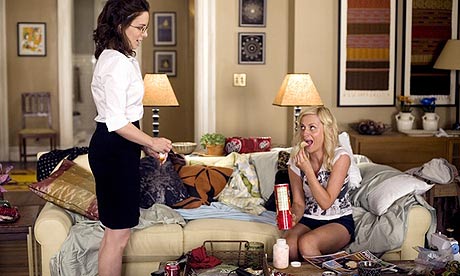
Baby Mama (Michael McCullers, 2008) - A mawkish, one-joke comedy - and the joke's not very good. Tina Fey is a career woman who recruits thick, white trash Amy Poehler as a surrogate. I find Fey incredibly overrated, the film's universe is tiresome and unappealing, and Sigourney Weaver is so bad at comedy it's painful. The film is also saddled with a horrible, overbearing score pointlessly hammering home the mood of almost every scene. Poehler and Dax Shepard provide a few laughs in support. (1.5)

***


Elektra (Rob Bowman, 2005) - There's quite a fun scene where Cleavage (Jennifer Garner) stops Goran Ivanisovic and his daughter from being murdered. The rest of it is either incredibly boring, completely incomprehensible or hilariously stupid (there's a henchman with tattoes that turn into animals and attack people, Boobs has flashbacks to quite a difficult swimming lesson, and Terence Stamp is in it looking like a sunburnt lion) and it has some of the worst dialogue I've ever heard. The baddie genuinely stops in the climactic fight to say: "There is nothing you can do - and so the balance tips to me." Ooh, zinger. (1)

***


The Office (US): Season 6 (2009-10) - Another extraordinarily good season. This is where everyone says it started going off the boil, but I don't see it. There are weaknesses: the once transcendent Jim-Pam relationship now contains too much bickering (as highlighted in the first clip show, always an underwhelming endeavour), Kathy Bates is a pain in the arse and there are three weak episodes (Mafia, in particular), but the show has one of the best ensembles out there, offers consistently top-grade entertainment and continues to evolve and develop - even while sacrificing realism in the name of laughs. I still love it. (3.5)

Tuesday, 5 April 2011

Puppets, Peggy Dow and Judy Holliday's tour-de-force - Reviews #59

Another reviews round-up. Three films I'd seen before, then a few I hadn't...


Born Yesterday (George Cukor, 1950) - Even without Judy Holliday's astonishing characterisation, this might have been something special, with Garson Kanin's brilliant script - intelligent, forceful and so witty the rest of us may as well just give up now - and note-perfect turns from William Holden, Broderick Crawford and Howard St. John. That it also contains one of the three or four best female performances in American cinema in the shape of Holliday's endearing, eye-wateringly hilarious Billie Dawn is something of a bonus. She's a former chorus girl ("I also spoke lines. Ask me how many. Five") who's become the moll of a hulking scruple-vacuum (Broderick Crawford) in Washington to promote his latest shady deal. Embarrassed by her general ignorance, he hires crusading freelance journo Holden to smarten her up, but isn't ready for what happens next. Adapted by Kanin from his celebrated play, which Holliday starred in on Broadway, it's a dazzling film: a flawless metaphor about the working classes and the emancipating power of knowledge posing as an utterly delightful romantic comedy. (4)

See also: Kanin, Cukor and Holliday reteamed four years later for another incisive look at modern America: It Should Happen to You. For Kanin and wife Ruth Gordon's slightly less wonderful Adam's Rib - also featuring Holliday in a showy supporting part - clicky on here.

***


Team America: World Police (Trey Parker, 2004) - Well, it's clearly not perfect. There are a couple of jokes that push too far for me (shall I explain why rape isn't funny?), at least two duff songs and a surfeit of tedious material about Hollywood liberals, but despite all that, this is a fantastic film: brilliantly funny (as much so as any film I've ever seen) and often devastatingly satirical. The quotable lines and inspired sight gags are legendary - and legion. The hammer, the walk-out, the bit where Chris says: 'That's Carson's replacement? A fucking actor?', the undercover distress signal, the corporation-y corporations, "I promise I will never die", the vomit geyser (the hardest I have ever laughed in a cinema) and Gary's climactic monologue. I've watched the film five or six times now. This time I had a bad back and every time I laughed it hurt a little more. By the end I was in absolute finger-biting agony. It's that good. (4)

***


Boys Town (Norman Taurog, 1938) - So Who Framed Roger Rabbit? was "groundbreaking", was it? Released a whole half-century before, Boys Town also features a mugging, gurning cartoon interacting with real-life humans. Mickey Rooney. His hysterical, one-man assault on the realism of the piece leads it somewhat astray. I'm a big fan of Rooney (particularly his work in The Human Comedy and National Velvet) and he excels in the straightforward emotional stuff here, but surrounded by naturalistic performers like Spencer Tracy and Bobs Watson he opts to play the rest of the film with a scenery-devouring style of acting that does away with much of the titular village. Tracy won a deserved Oscar as Father Flanagan, the real-life priest who established a home for lost boys, with Rooney playing Whitey Marsh, his toughest case, Watson as the diminutive, charming Pee Wee, who "likes everyone", Gene Reynolds (Ted Nickerson in the Bonnie Granville Nancy Drew series) as the current mayor, and Henry Hull as Tracy's friend and sponsor. There are dozens of wonderful scenes and deeply moving moments - the opening scene is an absolute knockout, and Pee Wee's toothbrush tale is another - it's just a shame that someone didn't rein in Rooney's excessive posturing. I still think it's a lovely film. Some deride it as corny or sentimental, but I think that's rather the point. (3.5)

See also: The fascinating Spencer Tracy-Katharine Hepburn vehicle Keeper of the Flame: fascism, fire and flabbiness.

***


Starlift (Roy Del Ruth, 1951) - A handful of superb musical numbers lift this propagandist musical, which is like a live action recruiting poster for the air force; and one which finds time to repeatedly plug Louella Parsons' Hollywood gossip column. The best see bear-like Baloo-voicer Phil Harris narrating a saloon story with Gary Cooper as a Texas Ranger, Day duetting with familiar foil Gordon McRae on 'You're Gonna Lose Your Gal', and Gene Nelson and Janice Rule doing 'It's Magic', complete with a succession of neat conjuring tricks and optical illusions. Del Ruth, who began his career at Warner helming Pre-Code comedies like Blessed Event - starring Lee Tracy - and Blonde Crazy shows little of his trademark razzle-dazzle and pacy panache, but the songs and some fun cameos (including Cagney being teased by a Cagney impersonator) make it. (2.5)

And another thing: Starlift is available as part of the TCM Spotlight: Doris Day Collection, which I got from my girlfriend for Christmas. It's a Great Feeling is also on there and is a must for Hollywood-on-film buffs, or indeed anyone else. It's a truly joyous mix of music, comedy and insider references, with a roll call of gag appearances that includes Coop, Patricia Neal, Edward G. Robinson, Eleanor Parker, Joan Crawford, Sydney Greenstreet, Danny Kaye, Ronald Reagan and Jane Wyman, along with directors David Butler, King Vidor and Raoul Walsh! There's also an AMAZING surprise cameo that I won't give away. That was among the best movies I saw last year (#38 on the list here).

***


This poster is beyond great.

*LOADS OF SPOILERS. HUNDREDS OF THEM, THOUGH I DON'T GIVE AWAY ANYTHING ABOUT THE LAST 15 MINUTES*
Woman in Hiding (Michael Gordon, 1950)
is an entertaining but heavily flawed crime melodrama. It mistakes repetition for relentlessness and has a plot that really doesn't stand up to scrutiny, but there are eye-catching performances from the iconic Ida Lupino and Peggy Dow, some nice stylistic touches and chase sequences and a pleasing mid-section that's lighter and brighter than the rest. London-born Lupino was a remarkable actress whose name became a by-word for eye-rolling intensity, thanks largely to her explosive supporting performance in They Drive by Night, the only film truly deserving of the title "trucker classic". She appeared in many of the best films of the '30s, '40s and '50s - being an assuredly classy presence in A movies like The Adventures of Sherlock Holmes (the pick of the Rathbone-Bruce pictures) and High Sierra and superb B films both comedic (The Lone Wolf Spy Hunt) and otherwise (Private Hell 36) - while embarking on a successful career as one of the business's few female directors.

Here she appears to depart this shadowy world in the opening sequence, as her car goes through a fence and over a cliff. As she tells us via voiceover, those folks blasting the river with an antique cannon are looking for her body. We get 20 minutes of flashback detailing her travails at the hands of stone cold psycho Stephen McNally - who totals her dad (Nancy Drew's father, John Litel), then cuts her brakes - before we catch up to the opening and find that she (wooh yeah!) totally escaped. Fleeing, her terrified bride ends up being pursued by a good-hearted, wrong-headed, love-struck drifter (Howard Duff), who thinks McNally's nice and Lupino's imagining things and should really go home. Their courtship, which has a slight whiff of It Happened One Night, is really nicely handled (and the chemistry is no illusion - Lupino and Duff were married soon afterwards), though the bizarre lurches in tone reach a head with the introduction of some drunk conventioneers, including Don Beddoe, who's billed as "Fat Salesman", which is just rude. There are two strong set-pieces. The best is the Hitchcock-esque stair chase, which is really cleverly directed, with great use of sound and shapes. The other is the more conventionally noirish train sequence, utilising such genre staples as the scary-face-in-the-mirror, the conk-on-the-head and the standing-with-your-back-to-the-wall-near-an-open-train-door-looking-frightened pose.

The film has in-built problems: a complete humourlessness in its first and final reels, lapses in logic that almost make you give up on it, and elements of dialogue and performance that seem terribly contrived. But it's still an interesting, watchable piece and it's a real treat to see Peggy Dow in one of her few film roles. Dow, who remains best-known as the entirely lovely Miss Kelly in Harvey, gave up her hugely promising film career when she got married the following year. Her turn here, flitting between drunken desperation, vulnerability and sensual villainy in the blink of an eye, is just yet more evidence of what a talent Hollywood lost when she resolved to devote herself to oil-drilling and charity work in Tulsa, Oklahoma. (2.5)

***

I also watched these two shorts on the Starlift disc:


SHORT: Sleepy Time Possum (Robert McKimson, 1951) – Strange Merrie Melodies cartoon in which a mild-mannered possum dresses up as a dog and tries to beat up his child, to stop him napping all day. A few cute bits with the sleepy kid, who's surprisingly quick, but that’s all. Voices by Mel Blanc. (1.5)

***


SHORT: So You Want to Be a Bachelor (Richard L. Bare, 1951) – An uncredited, trivial retelling of the old One Sunday Afternoon/The Strawberry Blonde story, this time done in one reel as part of the Joe McDoakes series. Seeing as we already have a classic version of this story, and another that's pretty good, the only way I can see anyone opting for this one is if they’re going to die in 10 minutes. (1.5)

Tuesday, 18 May 2010

Tracy and Hepburn do America - Reviews #36


Keeper of the Flame (George Cukor, 1942) - National hero Robert Forrest is dead. As America mourns, idealistic hack Stephen O'Malley (Spencer Tracy) arrives at the Forrest mansion, promising to do right by the heroic statesman with a comprehensive biog. That sounds reasonable, so why is Forrest's white-clad widow (Katharine Hepburn) acting so strangely? The film starts off fantastically, the first 30 bristling with energy and intrigue as sparks fly between reporter Tracy - just back from Berlin - and old flame Audrey Christie. There's some super interplay between the leads as well, and Tracy spouts spare, world-weary wisdom as only he can. But then Kate starts whispering behind closed doors to press agent Richard Whorf and it all falls apart. The blame really lies with Donald Ogden Stewart's script, which slips from wit, originality and humanism to cliche and blandness, though Cukor (Hepburn's favourite director) doesn't help matters by signposting all his plot twists.

There's a good idea at the heart of this film, but it's lost in the muddled production. The effect is as if Tracy and Hepburn were offered four disparate projects and decided to film them all at once. Beginning with a sort of inspired cross between Citizen Kane (see #88) and His Girl Friday (see #100), we traipse through tedious gothic melodrama (the mid-section playing like a flabby Jane Eyre as the meeting with Forrest's mother just goes on and on and on), and wind up in a heavy-handed, unconvincing thriller, Hepburn frantically incinerating her late husband's papers. To my eyes, few films are "unintentionally hilarious", but there's a bit in the climax where Whorf bounces off the front of a car that's really badly handled and did elicit a slight chuckle. Considering the film's opening, I have to chalk up Keeper of the Flame as a major disappointment. Revel in the opening third, with its scintillating badinage and Percy Kilbride's hilarious supporting turn, but don't expect that momentum to last. By the final reels, there's just the performances to take solace in, as the screenplay loses the plot. Perhaps that's what Hepburn was chucking in the fire. (2.5)

***

For our review of Hepburn and Tracy in Adam's Rib, why not clicky here.