Showing posts with label The Office. Show all posts

Wednesday, 17 October 2012

Zac Efron, lesbians and how to stop a riot - Reviews #133

Plus: Tina Fey not being very funny, house painting and Spencer Tracy's early Google.


17 Again (Burr Steers, 2009) - This might be the most entertaining film I've seen so far this year, an irresistible reverse-Big (or reverse, gender-swap 13 Going on 30; they chickened out of doing 17 Going on 70), in which unhappy father-of-two Matthew Perry – about to be divorced by Leslie Mann – gets the chance to be 17 again, the age that he got his girlfriend pregs, and so gave up his dreams of college. He also turns into Zac Efron, the lucky bastard. It's utterly charming, disarmingly affecting and unexpectedly funny, powered by a turbo-charged performance from Efron. For what it is, it could scarcely be better. Efron's hair was cooler at the start, though. (4)

***


The Interrupters: How to Stop a Riot (Steve James, 2011) – A film that’s at once horrifying and humane, upsetting and uplifting, as Hoop Dreams director Steve James traces a year in the lives of “The Interrupters” – a group of former gang members whose sole mission is to stop violence on the streets of Chicago. James focuses on three of the mediators: the daughter of a notorious gang lord, who renounced her former life after turning to Islam, a convicted drug trafficker transformed by the love of his step-sons, and a murderer forever haunted by his past. Even their boss has a criminal background: he was once a good-looking, low-level hustler who got by on the kindness of women. James’s film argues that absent fathers, a rancid, ingrained culture of masculinity – in which violence is always the first recourse – and a lack of understanding from wider society is to blame for Chicago’s woes, and smartly incorporates inflammatory news reports to contrast the complex reality with the popular media’s treatment of the same issues: a simplistic, right-wing demonisation of society’s victims. But while the deaths of young people, and the way many law-makers want to shoot the problem under the carpet, makes for chilling, heart-rending viewing, the Interrupters themselves are inspirational: brave, selfless souls who put a lie to the idea that human nature is unchangeable and bad things are only done by bad people, using their second chance to ensure that others – if only a few – don’t need a second chance at all. It’s an extraordinary, eye-opening, wrenchingly powerful film, brilliantly assembled by one of the best filmmakers working today. (4)

***


Kissing Jessica Stein (Charles Herman-Wurmfeld, 2002) - An uptight, 28-year-old Jewish woman (Jennifer Westfeldt), whose impossible standards have made her unlucky in love, begins a relationship with a clever, funny and erudite soulmate, who just happens to be a woman (Heather Juergensen). This intelligent, witty and affecting romcom, written by the stars and based on their play Lipschtick, is a breath of fresh air, with well-drawn characters, an incisive look at adult relationships and sexual attraction, and a strong NYC flavour, with Woody Allen-ish use of apposite old standards. My only two complaints: using the verb "to marinate" outside its food-y context isn't that impressive (it sounds like business speak) and the ending is rather contrived and unsatisfying. Kissing Jessica Stein is still a cut above. (3.5)

***


The Karate Kid (John G. Avildsen, 1984) – A wily old maintenance expert trains an unskilled teenager to become an accomplished car-waxer, floor-sander and house-painter, whilst supposedly preparing him for a karate competition. The archetypal ‘80s crowd-pleaser still holds up superbly today, with a terrific performance from “Pat” Morita – as the mystical Mr Miyagi – a lengthy running time that allows for plenty of character development, and a more realistic set-up than you might expect: Daniel-san (Ralph Macchio) brings some of the pain on himself by provoking a local hothead, to impress a girl (Elisabeth Shue), the second time in incomparably idiotic fashion. There’s also a clever, very well-directed scene in a diner where we can see what’s coming – but Daniel-san can’t. It’s very ‘80s (one of the fist-in-the-air moments involves someone getting a nice car) and a bit daft in places, but completely winning – a far superior underdog story to Avildsen’s most celebrated film, Rocky, which I think you’ll find is actually a bit rubbish. (3.5)

***


Desk Set (Walter Lang, 1957) - A broadcasting company brings in efficiency expert Spencer Tracy to see whether his new-fangled computer can do the same job as the reference department, headed by the lovelorn, fiercely intelligent Katharine Hepburn. The eighth of nine Tracy-Hepburn vehicles begins at a leaden pace, rambles rather and has too many concessions to silliness, but picks up for a spirited, sweet-natured second half that features three extended set pieces: the first funny, the second touching, and the third rather broad and overdone. The leads are excellent throughout, displaying an effortless, very real chemistry that extends to their overlapping dialogue and affectionate chiding. There's also a welcome appearance from Joan Blondell, who gave perhaps her best performance in Will Success Spoil Rock Hunter? the same year. No classic, but worth watching, and sticking with, particularly for fans of the stars. (2.5)

***
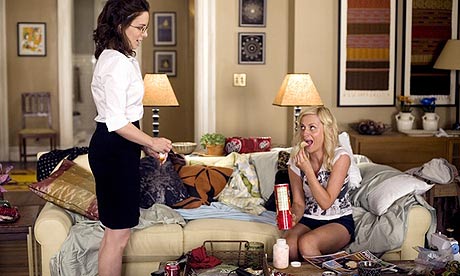


Baby Mama (Michael McCullers, 2008) - A mawkish, one-joke comedy - and the joke's not very good. Tina Fey is a career woman who recruits thick, white trash Amy Poehler as a surrogate. I find Fey incredibly overrated, the film's universe is tiresome and unappealing, and Sigourney Weaver is so bad at comedy it's painful. The film is also saddled with a horrible, overbearing score pointlessly hammering home the mood of almost every scene. Poehler and Dax Shepard provide a few laughs in support. (1.5)

***


Elektra (Rob Bowman, 2005) - There's quite a fun scene where Cleavage (Jennifer Garner) stops Goran Ivanisovic and his daughter from being murdered. The rest of it is either incredibly boring, completely incomprehensible or hilariously stupid (there's a henchman with tattoes that turn into animals and attack people, Boobs has flashbacks to quite a difficult swimming lesson, and Terence Stamp is in it looking like a sunburnt lion) and it has some of the worst dialogue I've ever heard. The baddie genuinely stops in the climactic fight to say: "There is nothing you can do - and so the balance tips to me." Ooh, zinger. (1)

***


The Office (US): Season 6 (2009-10) - Another extraordinarily good season. This is where everyone says it started going off the boil, but I don't see it. There are weaknesses: the once transcendent Jim-Pam relationship now contains too much bickering (as highlighted in the first clip show, always an underwhelming endeavour), Kathy Bates is a pain in the arse and there are three weak episodes (Mafia, in particular), but the show has one of the best ensembles out there, offers consistently top-grade entertainment and continues to evolve and develop - even while sacrificing realism in the name of laughs. I still love it. (3.5)

Sunday, 30 September 2012

Rita Hayworth, This Means War and tuna - Reviews #130

An indie triumph, Loki in a low-key drama, and three absolutely rubbish movies. Plus: The Office (US), Michael Cera and Carmen Miranda.


Who Loves the Sun (Matt Bissonette, 2006) is an exceptional debut from Matt Bissonette, who went on to make the tremendous two-hander Passenger Side. Lukas Haas is a taciturn, unhappy and mysterious 30-something who returns home after five years away, and reconnects - in less than reconciliatory fashion - with ex-wife Molly Parker and cocky former friend Adam Scott. Growing in confidence and resonance as it progresses, it's an eloquent, moving and funny film, traversing apparently well-worn ground, only to find new avenues of exploration, and new insights. Haas and Parker are both very good, though once again it's Scott who takes top honours. His comic abilities have been front and centre of late, in TV sitcoms like Party Down and Parks and Recreation, but he's a tremendously gifted dramatic actor, and displays a heartbreaking vulnerability beneath his white-suited character's smarmy exterior. It's a fantastic film: effective as a character study; even better as a treatment of universal themes, arguing that most people face disasters of some magnitude, and we can only move forward by making peace with the past. (4)

***


Archipelago (Joanna Hogg, 2010) - An unhappy middle-class family decamps to the Isles of Scilly, where its frailties and internal tensions simmer and leak out across one gloomy week. The mother (Kate Fahy) is falling apart, her daughter is a stuck-up, self-hating bitch (Lydia Leonard) and sensitive younger brother Edward (Tom Hiddleston) is beset by bourgeois guilt that sees him trying to make friends with the hired help, prior to setting off for an 11-month aid mission in Africa. There's a touch of Festen in there, a bit of Bergman, perhaps even some of Woody Allen's Alice, but its concerns - particularly its preoccupation with class - are overridingly British. Hogg's second feature is acutely well-observed, and filmed in a way that suggests a series of overheard conversations, but it's also wilfully undramatic: there are barely any close-ups, narrative peaks are invariably followed by long silences and the stylistic gimmick does sometimes give the impression that someone has accidentally left the camera in the other room. While the slow stretches are integral to the film's purposefully faltering rhythm, they're not that interesting to watch: the film is at its best when bursting into restrained conflict, as in its awful, brilliant centrepiece, in which Leonard decides to send back her guinea fowl. (3)

***


Youth in Revolt (Miguel Arteta, 2009) - Ineffectual teenager Nick Twist (Michael Cera) needs to get kicked out of his mum's house, so he can hook up with the girl of his dreams, idealistic Francophile, Portia Doubleday. Enter his Belmondo-esque alter-ego, Francois Dillinger (also Cera), a moustachoied, smart-shirted sociopath with a ciggie permanently on the go. This adaptation of an early-'90s novel plays like a less successful version of Richard Ayoade's Submarine. It has the same interesting pictoral sense, dry sense of humour and amusing, introverted, sometimes obnoxious hero, but lacks focus and wastes the talents of an exciting supporting cast, giving Steve Buscemi and Justin Long very little to do. Taken as a whole, then, it's frustrating, but it has wonderful moments: its hero gawping, lovestruck in the shower as French music swells, two fine animated sequences and a handful of belly laughs. Those familiar with Cera's work should take to it more than most, and fully appreciate the rather heavy-handed subversion of his persona. (3)

See also: Cera also appeared in Nick and Norah's Infinite Playlist, which got a bit tiresome after a while.

***


The Thief Lord (Richard Claus, 2006) - When protective, tousle-haired Prosper (Aaron Johnson) rescues his little brother, Boniface, from unfeeling relatives, the pair head for Venice, a place special to their late mother. Looking to elude their pursuers, including PI Victor Getz (Jim Carter), they fall in with the The Thief Lord, a masked teenager who gets by on his wits and acts as mentor to a group of orphans camping out in a derelict cinema. This by-the-numbers family film lacks the complexities and nuances of Cornelia Funke's source novel, leaning instead on cartoonish villainy and broad humour, but Johnson is a class act - particularly when asked to emote with face, not voice - and it's always nice to spend time in Venice, even if the locales could have been used more atmospherically. It's certainly nothing like the horrendous failure that was the adaptation of Anthony Horowitz's Stormbreaker, though it would certainly have benefited from more subtle and adventurous handling. The supporting cast includes Vanessa Redgrave and Alexei Sayle. (2.5)

***


That Night in Rio (Irving Cummings, 1941) - Fox's mainstream musicals were never in the same league as MGM's: the budgets weren't as large, the songs weren't as good and, crucially, the talent involved just couldn't compare. The Gang's All Here may have a cult following of Californian acid casualties due to its trippily garish visuals, but it's really no better than the rest: films like Down Argentine Way and Sun Valley Serenade, which only truly come to life when the incredible Nicholas Brothers make their typically brief appearances. (Ironically, Stormy Weather, an African-American musical which the studio didn't even deem worthy of Technicolor stock, is by far its most enduring and exciting outing.) This colourful but pedestrian remake of Folies Bergère de Paris - a near-classic Maurice Chevalier vehicle - has a typically charismatic Don Ameche taking on a dual role, as his American cabaret entertainer comes to the aid of his Brazilian baron, while almost nabbing the baroness (Alice Faye). Yes, you're right, quite a lot like The Prisoner of Zenda. It's actually a better farce than a musical (I swear Carmen Miranda does the same two songs in every film), though Faye's rendering of They Met in Rio is lovely - with some awesome blue notes. (2.5)

***


*SPOILERS*
Down to Earth (Alexander Hall, 1947)
– Silly semi-sequel to Columbia’s dazzling 1941 fantasy Here Comes Mr Jordan, which sees the goddess of song and dance, Terpsichore (Rita Hayworth), coming down from above to destroy a Broadway show that paints her as a horny everywoman. Larry Parks, fresh from his success in The Jolson Story, is the show’s producer, who falls head over heels for the scheming, hoofing psycho. Hayworth is good, and the film looks amazing, with vast, vivid sets and sumptuous, sensitive early Technicolor. But after a fun beginning featuring Jordan alumni James Gleason and Edward Everett Horton, the story slows to a crawl, and just sort of sits there as Parks flounders and a game cast tries to enliven a set of tunes ranging from the forgettable to the downright poor, and keep afloat a plot with a ridiculous third-act twist. It’s worth a look for old movie nerds, but it isn’t a fitting follow-up to one of the most unusual and memorable Hollywood movies of the decade. (2)

Trivia notes: Here Comes Mr Jordan was based on a play called Heaven Can Wait, and was remade under that name in the 1970s. There is an unrelated ‘40s film called Heaven Can Wait, directed by Ernst Lubitsch and starring Don Ameche. A third version of Here Comes Mr Jordan arrived in 2001, featuring Chris Rock in the Robert Montgomery role. That film was called... Down to Earth.

***


This Means War (McG, 2011) - This dire attempt at a date movie is a creepy, bombastic romantic-action-comedy, full of teeth-achingly awful dialogue, about CIA agents Chris Pine and Tom Hardy using their security clearance to stalk mutual girlfriend Reese Witherspoon. Speaking of agents, hers must be about the worst in the world. The script includes a joke about bipolar disorder, Hardy calling someone a "spaz" and an incredibly irritating supporting part for Chelsea Handler. Occasionally the film becomes halfway entertaining in a kind of pathetic, witless way, but most of the time it's just grating, offensive nonsense. The best bit is in the final scene, when Hardy has to shout above the noise of a plane, and briefly turns into Bane. Watch the unjustly maligned I-Spy instead. (1)

***


Mustang Country (John C. Champion, 1976) - Extraordinarily bad Western about milky-haired ex-rodeo champ Joel McCrea (in his last film) trying to catch a wild horse, avoid a bear, and bond with one of the worst child actors I have ever seen: Nika Rita, whose Native American foil redefines the concept of the wooden Indian. The film is shot in some pleasant locales, and McCrea does his best with what he's given, offering one nice moment of quiet grief, but the script, story and editing are atrocious. Hardly a fitting swansong for an icon of the genre, and of the American screen. (1)

***


*SPOILERS, BUT YOU'LL THANK ME. I ALSO SEEM TO HAVE STARTED SWEARING, BUT IN THE CIRCUMSTANCES THIS SEEMS ENTIRELY REASONABLE*
Weird Science (John Hughes, 1985)
- This might be the most '80s thing that has ever happened. And one of the worst. If you found the scene in Sixteen Candles where Dong gets stuck up a tree hilarious but a little highbrow, then you'll love this steaming pile of hairsprayed, incomprehensible shit, in which Bill Paxton does literally and incomprehensibly turn into a steaming pile of shit. The premise - which sees two horny teenage geeks conjure up a hot 23-year-old with their computer - is great, but what John Hughes does with it is the exact opposite of great. It's sexist, racist, homophobic, and has a completely different message to the one it claims to espouse. I'm a big fan of Hughes, but this one's impossible to defend. And Anthony Michael Hall's drunk scenes are the most annoying on film. (1)

***


SHORT: The Campus Vamp (Harry Edwards, 1928) – Embarrassingly awful Mack Sennett two-reeler about a college boy ignoring his frigid girlfriend to consort with an annoying flapper (a young, brunette Carole Lombard wearing a cloche hat, who gets groped by a lobster). The plot makes no sense, the jokes are rubbish (with the sole exception of a man looking for his wife in a chest of drawers) and the characters are really annoying, though film nerds might enjoy a couple of the sequences being in two-strip Technicolor: love those reds and greens. If you want to see it, my copy is now at a charity shop and also contains three Our Gang shorts and the racist Harold Lloyd film, Haunted Spooks. (1)

***

TV:

This is what I have been mostly doing lately:


The Office (US): Season 2 (2006-7) – The series at its zenith, with Michael becoming more human (and slightly less annoying), the Jim-Pam relationship developing in beautiful and poignant ways, and just one great episode after another. My favourite bit has to be either Jim flicking on his messages after a lousy day at work, or the scene in the road at the end of the final episode. (4)

The Office (US): Season 3 (2007-8) – The third season is less realistic and more sitcomish, causing the dramatic scenes to lose a little of their resonance, while Jim and Pam seem to be kept apart more through dramatic necessity than credible plot development, and there’s an inability to fully capitalise on some of the more promising premises, like the convention visit. For all that, it’s still top entertainment, with as many fine comic moments as Season 2 (my personal favourite is Dwight’s impression of Jim) and an absolutely irresistible pay-off. (3.5)

The Office (US): Season 4 (2008-9) – Only one of the opening four, double-length episodes really works (Launch Party), but after that it really kicks into gear. Kevin saying “toona toona toona” may be the funniest moment in the show’s history. Bizarrely, Carell’s inconsistent, irritating central character remains the weak link in what is a riotously enjoyable series. (3.5)

The Office (US): Season 5 (2009-10) – A step up from Season 4. At its centre is the most successful episode ever, and one of the best, Stress Relief, which compensates for a deeply unfunny film-within-a-show with two very involving narratives and one of the most amazing cold opens I have ever seen. The season as a whole serves up the usual mixture of escapism, invention and affecting sentiment, and just when you think the basic format may be getting tired, Schur and co shake it up again. John Krasinki's spectacular comic timing remains something to behold. (3.5)