Friday, 11 August 2017

So long, farewell, auf wiedersehen, adieu – Reviews #272

This will be the last update for the time being. I want to take a break from the blog to focus more on my fiction (I've written a kids' book and am trying to get it published), and after 10 years I'm not sure what more I have to say about movies, gigs, books and plays. I may post updates now and then: I enjoy doing the reviews of the year, so I imagine I'll put those up in December.

In the meantime, thanks to each of you who's read, commented on or plugged the blog over the past seven-and-a-half years (and for the three years before that, when it was Films on Friday). Bye then.

BOOKS


A Tree Grows in Brooklyn by Betty Smith (1943) – Betty Smith’s novel about growing up in poverty in Brooklyn at the turn of the century begins with such an accumulation of detail that you feel as if perhaps she can’t distinguish between the mundane and the memorable. But then you realise she’s merely setting the scene, immersing you in the minutiae and the singular atmosphere of this atypical household in this dirt-poor, drably colourful place, so the stories – anecdotal, funny, heartbreaking – have a place to lay their roots. Her heroine Francie Nolan is the bookish, sensitive and poetic daughter of a mother turned hard by penury – just as her hands are cracked and weathered by work – and a father who is too dreamy, deluded and drunk for this world, and will be out of here by 35.

Kazan’s sensational 1945 film condenses the key events to a single year, but this book follows Francies from 10 to 18, flashing back to her infancy, and seeing her grow from a dirty-faced junk hoarder to a confident, intelligent, sexually-aware young woman finding her way in the world, negotiating the pain of betrayal and finally leaving that home in Brooklyn with its improbable, incongruously beautiful, neverendingly resilient tree in the yard. The film has been a precious thing to me for years, and this book has the same tone of yearning, of wisdom learned too young, and character being forged in the furnace of hardship, while offering dozens of deleted scenes with their new insights, moments of deft levity and piercing heartaches. I don’t think it’ll ever leave me, not least those details, like the one about her keeping the old house's carpet for the new one. (4)

***


Winchell: Gossip, Power, and the Culture of Celebrity by Neal Gabler (1994) – Walter Winchell is one of those cultural figures so of his time that they simply evaporate from history. That time was the 1920s to the 1950s, when the former second-rate Vaudevillian turned from a gossip columnist into a political commentator, from a Rooseveltian Democrat into a McCarthyite Republican, and from a slangy if self-obsessed man of the people into a vicious bully forever sidetracked by meaningless, one-sided beefs. At the peak of his fame and influence, he was read or listened to by two-thirds of Americans each week.

It’s hard to write a biography of a man who was so unknowable and aloof – Winchell had few friends and almost no interests beside his career – but this book gets as close as it can through contemporary articles, secondary sources and interviews with his colleagues and near-confidantes, while doubling as a truly exceptional social history of America: an America for whom Winchell democratised but trivialised and sensationalised news, treating gossip, tragedy or politics with the same screaming, shallow reverence, and increasingly – like his protégé Roy Cohn, later the mentor of one Donald Trump – seeing life as a war between an Eastern intellectual elite and the common, simple and simply patriotic American. If you wondered too where Trump got his tweet style, then look at a ‘50s Winchell item, ending with an accentuated, hyperbolic blast like “Seven subpoenas!” or “Party card!”.

Gabler has a superb vocabulary and a grabby but cerebral style, while littering the narrative with mini-profiles of contemporaries, and short essays on the changing America – and how Winchell first powered that change, and then was powerless to resist it, eventually being destroyed by hubris, his association with McCarthy, his personal unpopularity and his utter irrelevance to the world of the 1960s. The author’s set-pieces are dynamic – including a brilliant chronicle of the Hauptmann trial of the 1930s, and Winchell’s initially understandable but then unbearably overbearing hatchet job on Josephine Baker – and so is his deep, thoughtful and truthful analysis, most memorably of his subject’s political conversion, which he attributes to Winchell’s fear of being investigated himself, his genuine, fervent and long-standing anti-Communism, and the opportunity it gave him to lambast James Wechsler, the editor of the New York Post and a former Young Communist League member, whose paper had just written a series dismantling Winchell’s mythos and reputation.

Gabler argues brilliantly that communism was “the weapon, not the object” and that Winchell’s decisions were often more political than personal. He had become a worshipper of Roosevelt only after being charmed personally by the new president, while – like McCarthy and Cohn, both of whom he liked personally – Winchell was earthy, bitter, working-class and attracted to power. Even in the ‘50s he didn’t see himself as a Republican – telling a party functionary who welcomed him to the GOP at Eisenhower’s election party, “I'm not a Republican, you're a Republican” – and never abandoned his one saving grace, the ‘premature anti-fascism’ (as the HUAC would dub it) of the early ‘30s, in which his uncanny antenna for anti-Semitism saw him repeatedly and passionately denounce the Nazis some five years before most of his contemporaries, and root out fascists and Nazi sympathisers throughout the United States (this role inspired Philip Roth to use Winchell as the defender of the people in his brilliant alternate history, The Plot Against America, in which the hero of the air – and of America First – the fascist Charles Lindbergh becomes president).

In the end, Winchell did as much harm as good: opening up the press to working class voices, challenging outdated mores and unquestionably enlivening the medium, but then using his platform to settle scores and wage vindictive vendettas, accumulating more and more wealth (a reaction to his Dickensian childhood), and – in a broader cultural sense – turning news into entertainment, with the accompanying callousness and collateral damage that engendered. He fought fewer and fewer justified or even coherent battles, was a lousy friend, and was an even worse father, but – for better or worse – he was also among the most significant cultural voices of the 20th century, whose life must be understood in order to understand the present. Without ever over-stretching or being caught up in academic-ese, Gabler’s incredibly entertaining book does as good a job as can be imagined of making that possible. (4)

***

FILMS


Grand Hotel (Edmund Goudling, 1932) – It looks like a relic compared to even similar contemporary films like Union Depot, Dinner at Eight and Skyscraper Souls: too static, melodramatic and light on, y’know, story. And yet once you adjust to its size and tempo, and the characters begin to cross into one another’s lives (always a joy of such all-star shenanigans), it becomes damn near unmissable.

John Barrymore is noble (and wearing way too much eye-shadow), Lionel turns from a trivial one-note annoyance into a hero, Crawford discovers an attractively tender humanity, and Garbo is just so damn Garbo: warm, sensual, tragic, and apparently in a different film to everyone else, as she dances badly and her silent film eyebrow works overtime. The moment where she discovers Barrymore’s true character, purring “Norrrr”, is such a transportative treat: dumping you right back into 1932. A mention too for Lewis Stone, playing an omniscient medic who got blown up in the war and is now Two-Face from Batman.

If you show it to someone who thinks black-and-white films are dated, clunky and even a little silly, they’ll laugh you right out of the room, but if you’re receptive to this era of cinema, it’s kind of amazing. (3.5)

***


Tagline clearly influenced by Annie Hall's 'A nervous romance'.

CINEMA: The Big Sick (Michael Showalter, 2017) – American stand-up is just crap, isn’t it*. The rest of the film’s great, though: funny, tender and coming at the rom-com from a different angle to normal, with what’s surely a star-making part for Kumail Nanjiani (who co-wrote the script, based on his own life). In support, Holly Hunter is ACTING and Ray Romano is playing for laughs, and yet what underpins their performances seems real, and so they really work. I liked it a lot. (3.5)
*not Louis C.K.

***


CINEMA: Cría Cuervos 1976 – A miraculous film, quite unlike anything else I’ve seen, that plays out on the face of its young heroine (Ana Torrent from Spirit of the Beehive) and exists in that strange place between memory, reality and fantasy, as scenes bleed one into the next, and Torrent recalls her authoritarian, adulterous father, conjures the gentle spirit of her neurotic mother (Geraldine Chaplin) and cautiously negotiates a new, lonelier life in the bosom of her strict aunt’s family.

Torrent is simply wonderful, as is Chaplin – who also plays the older Ana – and the film’s unpredictable storytelling, offbeat comedy and sumptuous camerawork is allied to a pained understanding of human cruelty – but also a firm conviction in human resilience. For all the political analysis made of the movie (it seems that every Spanish film, even if it’s a comedy about an ice-skating dog, is read as an allegory of the Spanish Civil War), it’s really a film about loss, its unique worldview encapsulated by the inspired use of a contemporary pop song that has the jauntiest tune and the most desolate lyrics, and seems to be the only record Ana owns. (4)

***


"I wrote it."
"I gave you the title."
"Okay, so when they have awards for titles, you can go to that."

CINEMA: Prick Up Your Ears (Stephen Frears, 1987) – Near-perfect biopic of gay '60s playwright Joe Orton (Gary Oldman), focusing on his volatile relationship with live-in lover, Kenneth Halliwell (Alfred Molina), powered by a superb Alan Bennett script, and Oldman's best performance. It has the same appealing, distinctive, slightly washed-out look as almost every good British film of the period and, if it's perhaps a little light on Orton's writing, and its Morocco sequence drags, the film is just as bawdy, erudite, entertaining, non-judgemental and tragic as it should be. A film so fine, in fact, that Vanessa Redgrave is good in it.

Oldman has given so many mannered, lacklustre or just plain bad performances since the early '90s, but in his first few years he must have seemed a revelation, his star soaring as he subsumed himself in a succession of unforgettable, coruscating characterisations. Playful, reckless and morphing from a rough, nervy Midlands youth to a swaggering, dapper jack-the-lad toast-of-London, his Orton is the best of the lot. The relationship he evokes with sister Leoni (Frances Barber) too is wonderfully attractive and real.

'Synthesisers by Hans Zimmer'! (4)

***


CINEMA: The Swimmer (Frank Perry, 1968) – An American tragedy, impeccably constructed, with charming, toothy and toned Burt Lancaster resolving to 'swim home' through his gated Connecticut community via his wealthy friends' sapphire, sun-dappled pools. It's a film about innocence, idealism and moral rot: bombastic, melodramatic and surrealistic, but also human, profound and intensely moving as it depicts a body, a mind and a society running to ruin. There's also a scene in which Lancaster runs around a horse enclosure in slow-motion, leaping over hurdles, which is emblematic of the film's sometimes heavy-handed symbolism, and really very silly indeed. (4)

***


Fixer Dugan (Lew Landers, 1939) – Fast-talking Lee Tracy played reporters, promoters and carnival barkers in a career that saw him rise meteorically during the pre-Code era, then plummet to earth after he allegedly urinated on the Mexican Army whilst shooting on location in November 1933, was booted out of the country, and then sacked by MGM. (I wrote about it here.) Tracy was sensational when given a good script (his turn in Blessed Event, patterned after the life of national sensation Walter Winchell, is one of the great comic performances), but he seemed rather lost without one, and his performances lost much of their zip and vigour as he filled out and toured the cheaper studios in search of his lost career.

He made four films set around carnivals and circuses, where his characters’ conniving, finagling and, well, lying seemed right at home. The first and best of these was The Half-Naked Truth, a spectacular, lightning-paced comedy made while he was on the way up, and pairing him with the ‘Mexican Spitfire’, Lupe Velez. The other three – You Belong to Me, Carnival and this one – are sentimental yarns that offset his scurrilous, take-no-prisoners persona by making him care for an orphan. Here that orphan is Virginia Weidler, one of the better child stars of the era and a key part of the classic B-movie, The Lone Wolf Spy Hunt, the same year, but sadly Fixer Dugan doesn’t amount to much: it’s rather functional and laboured, and its tiny budget sticks out all over the place.

The film reunites Tracy with Peggy Shannon six years after Turn Back the Clock, the brilliant Depression-era fantasy about a tobacconist returning to his youth and reinventing himself as a crusading politician. Here he’s a carnival ‘fixer’, she’s a lion tamer and together they’re trying to do the best for Weidler while keeping hold of Shannon’s big cats (which she accidentally sold to a scheming rival), but neither of them seem to have their heart in it. The scenes of the star sparring with William Edmunds and a funny Ed Gargan are enjoyable enough, and there’s a fair part for Irene Franklin as a has-been, but it’s slightly dispiriting seeing Tracy – formerly a human firecracker – slog his way through the B-movie mire, and the story’s outcome is readily apparent from the 10-minute mark. (2)

Many thanks to Owen for the loan. (I always feel ungrateful giving two stars to something someone’s kindly posted to me, but you’ve got to be honest I think, or what’s the point of reviewing? Spectre of the Rose next!)

See also: I wrote about some of Tracy's key early films in this piece on the American political cinema of 1932-33.

***


Big City Blues (Mervyn LeRoy, 1932) – A bad pre-Code potboiler with a good cast, as Callow Woodenness Personified (Eric Linden) travels from Indiana to New York, where he meets crooked uncle Walter Catlett and brassy showgirl Joan Blondell, before clunky melodrama intervenes.

It's extremely 1932, with some fast-paced dialogue and an impressive-sounding supporting cast (Bogart, Lyle Talbot, Tom Dugan, Ned Sparks being aggressively deadpan, Guy Kibbee playing his usual drink-sodden lech), but the story is silly, muddled and joyless, alternating between hard-boiled posturing and mawkish hand-wringing, and much of the cast is given nothing to do.

The film's only real virtues are some snappy stylistics – including the epitome of old movie in-the-big-city montages, and that great shot of Blondell at the station near the end – Clarence Muse's nightclub numbers, and a pair of good performances: the big-eyed Blondell peddling a typically nice line in worldly-wise empathy, and Jobyna Howland stealing the film as a lonely, kindly socialite looking for a young gigolo. (1.5)

***

Thanks for reading.

Saturday, 22 July 2017

Warren William, The Girl From the North Country, and peaceful protest – Reviews #271

It's not all profiles of people from the 1930s, occasionally I review things that have just happened. But only if they're set in the 1930s.

THEATRE


Girl From the North Country (The Old Vic)
Saturday 22 July 2017 (matinee, final preview)

This new Old Vic production is a jukebox musical of Bob Dylan album tracks, allied to a Depression-era melodrama, and nearly as good as that sounds. Written by Conor McPherson, it takes place in a guest house in Dylan's home town of Duluth, Minnesota in 1934, where owner Nick Laine (Ciarán Hinds) cares for his wife Elizabeth (Shirley Henderson), who's animated by dementia, while trying to pair off their pregnant daughter (Sheila Atim), navigate an affair with a long-term tenant (Debbie Kurup) and cater for two strange man who arrive in the dead of night: bible salesman Michael Shaeffer and ex-boxing champ Arinzé Kene. All of them are waiting for their ship to come in.

The numbers are brilliantly chosen, adapted, staged and sung, ranging from a yearning duet on 'I Want You' (slowed down as it always should have been, and performed by parting couple Sam Reid and Claudia Jolly) to a dynamic, ensemble 'Slow Train Coming' and a climactic medley of 'Duquesne Whistle', 'Make You Feel My Love' and 'Is Your Love in Vain?', all accompanied by a period-appropriate Bluegrass ensemble. Even some of the more peculiar ideas, like commandeering that ode to gloriously malignant petulance, 'Idiot Wind', as a Dustbowl lament, leaning on 'Seňor' or making 'Like a Rolling Stone' a ballad, come off really nicely, with 'Jokerman' effectively reprised and 'Forever Young' finally where it belongs: as a West End weepie. (Other songs utilised include 'True Love Tends to Forget', 'Tight Connection to the Heart' and 'You Ain't Goin' Nowhere', not perhaps the most obvious Dylan tracks, but more the welcome for it; the eponymous track, from The Freewheelin' doesn't get an airing.)

At times the scenes around the music can be too vague or muted, but there are moments of resonance − and bits of tension created from thin air − before the narratives coalesce satisfyingly (but not too conveniently) in two moving final scenes. There perhaps isn't enough at stake, or at least enough that's truly tangible in the script, but perhaps future viewings would reveal hidden depths or further truths. I enjoyed Kene's performance, and the voices of Atim, Reid and Kurup (whose stately grace and absence of self-pity still lingers), though I struggled to take my eyes off Henderson whenever she was on stage.

I've never been that taken with her, seeing her in films, but she has such a presence and physicality, flitting between pitiful and sensual, rabid and comatose, that I was transfixed. Though I tend to have a problem with portraits of mental disintegration which are big and tic-laden (as the journalist Tim Lott once wrote, a realistic piece of fiction about mental illness would just be very boring), this one managed to be funny, intelligently allegorical, moving and somewhat unpleasant, without traversing into unbelievability or hysteria, while her moments of lucidity unveiled an unexpectedly beautiful voice, shot through a Scandi-Minnesotan lilt. It's her, the songs and the atmosphere of quiet desperation which I think will stay with me. (3.5)

See also: I've written about a few other Old Vic plays, including Clarence Darrow, The Master Builder, The Caretaker (which I didn't care for), Groundhog Day (my favourite theatrical experience of last year), and King Lear.

***

EXHIBITION


People Power: Fighting for Peace (Imperial War Museum) is impressive, multi-faceted and a little unfortunate in having to follow the V&A's Disobedient Objects, which is one of the best exhibitions I've seen since moving to London, and dealt with a similar theme: public protest. Here that's scaled down to protests for peace, and zones in on four big British protest movements, those of conscientious objectors in World Wars One and Two, the CND campaign that ran throughout the Cold War (with a little on Vietnam), and the Stop the War coalition which protested Tony Blair's invasion of Iraq.

That's both its strength and its weakness: it has a formidable mixture of exhibits: striking banners, poignant paintings, and arresting posters, trinkets and oddities (from CND pin badges reading 'Guardian Readers Concerned About the Bomb' and 'Clouseau Fans Against the Beumb' to a protestor's accordion), alongside audio snippets also transcribed on a display screen, and fascinating archive videos: one shown via a dozen faux-placards forming an irregular whole, others sharing snippets of news reels, news reports and public information films.


One of those, offering advice on how to survive a nuclear blast, is comically, depressingly and appositely juxtaposed with Peter Watkins' chilling film, The War Game, which showed British unpreparedness and was subsequently banned by the BBC, which had commissioned it. The flip-side is that the exhibition doesn't necessarily have a sufficient through-line explaining or investigating the continuity of pacifism, while its personal case studies − including one of Paul Eddington, a CO during WWII because of his Quakerism − are sometimes too brief and slight to really hit home. Having said that, one inspired inclusion is that of hate mail sent to successive generations of those who excused themselves from war, written by ordinary men and women whipped into a patriotic, judgemental fever by politicians and press.

In that way, People Power allows us to appreciate that where British current affairs are concerned, there is nothing new under the sun. It also offers a huge amount to see, and has plenty to say on the iconography, idealism and discomfort of pacifism, though I found Disobedient Objects somehow more inspiring, perhaps because of its internationalism and diversity of activist art, or perhaps simply because it celebrated causes that are simply more easy to embrace, several of which actually won. The final room here tries to send out on an upbeat note, saying that another British war was less likely after Iraq, but all I could think was that Corbyn only stood a chance in the election because he vowed to keep Trident, and that I don't necessarily disagree with that. (3.5)


I liked this poster, which highlighted the hypocrisy of America at a time when anti-war posters (like the 'Fuck the draft' one above) were being seized under obscenity laws. Not much has changed.

See also: I wrote about the IWM's 'Real to Reel' exhibition last year. ***

GIG


Robin and Bina Williamson (The Half Moon, Putney)
– An evening with 'the mystical one' from '60s psychedelic folk heroes The Incredible String Band, Robin Williamson, who's long since stopped singing his old stuff, and now sings much older stuff: Celtic and pioneer songs, accompanying them on the harp and guitar. He's joined by his wife Bina, who seems lovely, but is a bit of a Yoko: while her voice works OK in harmony, it can't sustain songs by itself, and her psaltery-playing seems to require such concentration that there's no room for expression or timing.


Williamson still has it, though: that distinctive voice, topped by a slight clicking lisp, and the same mesmerising gift for fretwork and fingerpicking, poured into a dozen songs, each either contextualised or prefaced by a story or gag. Who knew that the mystical one would have such a weakness for delightfully terrible puns. Seeing a musical visionary, still performing a half-century on, was a rarefied and special experience, especially doing so in the back of a London pub along with just 30 other people. It might have been even better if he'd had the spotlight all to himself, but they're clearly in love and he's clearly in thrall to her talents, so good luck to them. (3)

***

FILMS


CINEMA: Amélie (Jean-Pierre Jeunet, 2001) – This film is so personal to me that writing about it honestly would be like posting my diary, so I'll just say that while one could harp on endlessly about its shots, its structure, its score and Tautou's mesmeric central performance – and although those elements are almost without equal – it's the film's intensely beautiful heart that takes my breath away every time. I can't believe I just got to see it on the big screen. (4)

***


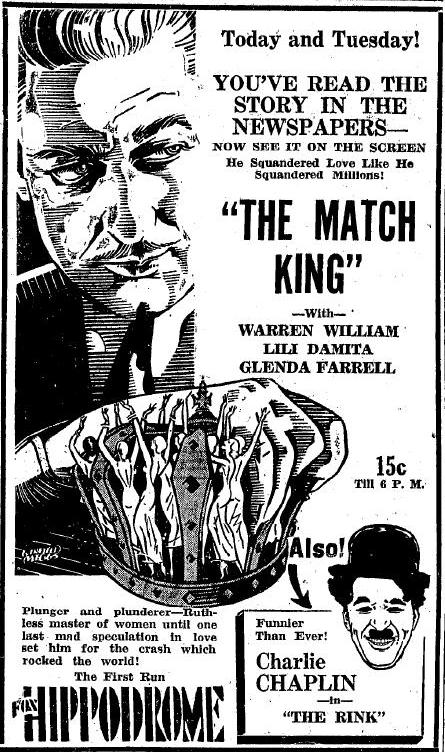
The Match King (Howard Bretherton and William Keighley, 1932) – I bow to no-one in my appreciation of pre-Code Warren William vehicles, but this one's a bit of a mess. It's quite fun, though. The film kicks off with a pre-credit sequence (surprising, since the earliest pre-credit scene is generally cited to be Crime Without Passion, which came out two years later), showing how important and ubiquitous matches are. Then we're into the story proper: a thinly-veiled biopic of Ivar Kreuger ('Paul Kroll', as he is here), the Swedish-born conman who had died earlier that year (and was immediately immortalised in a novel), having cornered the world market in matches.

It begins uproariously in the amoral Warren William tradition, the star selling out friends, pimping out girlfriends and swindling bankers on his way up the ladder. But then it turns into a romance featuring Lili Damita, a business drama full of laughably bad expository dialogue, and finally a morality tale that exposes the star's limitations. He was always a dynamic scoundrel, but just opening your eyes very wide isn't enough for the serious bits. If you like pre-Code cinema, it's worth a look, with some scurrilous plotting, saucily suggestive near-nudity, and bits for Glenda Farrell and Claire Dodd, while its neat final line anticipates the capper to The Roaring Twenties' rise-and-fall narrative, but it seems to have been written, shot and put out in a tearing hurry, with flubs left in the finished film, haphazard editing and an increasingly crap screenplay. Plus Harold Huber pretending to be Portuguese. (2)

See also: I wrote about The Mouthpiece, a better Warren William film, also found on the Forbidden Hollywood, Vol. 10 box-set here. His two defining films, Skyscraper Souls and Employees' Entrance are on Vol. 7, which I wrote about at length here.

***

DVD


Stewart Lee: If You Prefer a Milder Comedian, Please Ask for One (2010)
– I'll give it to you straight, like a cider that's made from 100% pear.

This is perhaps Lee's best show, with a pair of inspired, extended set-pieces about Top Gear and Magners Cider that take unnerring aim at casual racism, manufactured outrage, and the corporate co-opting of the art, history and communal experiences that we treasure. The interview with Kevin Eldon on the DVD is a real bonus too, a fascinating insight into Lee's psyche, character and work, which reached some kind of apogee with this daring, thematically and formally original, consistently hilarious act: part deconstruction, part tightrope-walk, part epic fantasy about Richard Hammond being decapitated. (4)

***

Thanks for reading.

Friday, 21 July 2017

And introducing… #3. Lee Tracy

Here's part three of the series. Previous instalments were about John Ford and Wendy Hiller. Some of the films dealt with below also feature in my two-part 'FDR's Hollywood' feature, looking at political cinema of the 1930s and '40s.

#3. Lee Tracy


Who?
The electrifying, motormouthed comedian whose career came to a sudden and dramatic halt in the mid-1930s.

How so?
He pissed on the Mexican Army.

He what now?
He (allegedly) relieved himself nakedly on a passing military parade during the location filming of MGM’s Viva Villa! in November 1933, and was thrown out of Mexico.

Well, if you’ve got to go...
Indeed – though for Tracy’s part, he denied it all. He was sacked by the studio anyway and spent the rest of his career at lesser studios, before a brief, remarkable comeback in the 1960s.


Was he any good?
The best. Tracy was an explosive, compelling performer: the living embodiment of the “pre-Code” movie – those do-anything, say-anything films that packed out cinemas in the early ‘30s, before the Hays Office went and spoiled everyone’s fun. The impending censorship clampdown of 1934 effectively put Tracy’s kind of movie out of business, which might have been why MGM weren’t too sorry to see him go.

Any trademarks?
Plenty. A wild-eyed delight at his amoral manoeuvring getting him on top once more. A twirling forefinger, a selection of distinctive vocal trills (“You’re thrrrrrough”) and an arsenal of singular gestures, from the way he appeared to be literally seizing control of a scene – bending forward, arms wide apart – to his deft, farewell flick of the hand.


Where do I start?
With Blessed Event, the 1932 Warner Bros comedy about an unscrupulous gossip columnist, which may just be the funniest movie ever made (watch the trailer here). Tracy’s Alvin Roberts, “that kid from advertising”, is allowed to look after the paper’s social section while the regular author is away, and proceeds to turn it into the most popular – and unpopular – column in the country, incurring the wrath of a gangster, and engaging in a gleeful tit-for-tat rivalry with eternally upbeat crooner Bunny Harmon (Dick Powell). Playing a character loosely based on Walter Winchell – then one of the most influential men in America, and the subject of a half-dozen semi-fictional films – Tracy is hysterically funny, spewing a constant stream of wisecracks, though the film’s centrepiece is a terrifying, perilously dark set-piece in which he talks mobster Allen Jenkins through a trip to the electric chair. He shoves a picture of noted victim Ruth Snyder in Jenkins’ face, before navigating the henchman through a florid, impossibly graphic description of state-sanctioned death, every part of his body seeming to contort as he dominates the screen. You would die with one finger twitching upwards, Tracy concludes with a shaking voice, “to where you’re... not... going”.

That sounds, err, fun?
It doesn’t, but somehow it’s exhilarating, because you’ve never seen anyone act like that before: it’s neither conventional, nor stagy, nor necessarily naturalistic, it’s just dynamic.


What else did Tracy do?
Having originated the role of Hildy Johnson in the legendary stage play, The Front Page (above), he had come to Hollywood in ’29. He appeared as a low-level criminal in Frank Borzage’s abysmal translation of Liliom (later musicalised as Carousel), and had a bit in John Ford's gangster flick, Born Reckless, but came to real prominence with three supporting roles in 1932: The Strange Love of Molly Louvain – a nasty, compelling Pre-Coder that spotlighted his singular, rapidly-quickening style of delivery – Love Is a Racket (a film he would have starred in just months later) and the near-legendary two-strip Technicolor horror-comedy, Doctor X, playing an endlessly quipping reporter – a market he had quickly cornered. After Blessed Event, he starred in a succession of tailor-made vehicles making use of the go-getter persona so beloved of Depression-era audiences, beginning with The Half-Naked Truth (which cast him as a promoter), Clear All Wires! (sending his journalist to Communist Russia), the classic romantic comedy The Nuisance (with Tracy as the last word in amoral shysters) and the fantasy masterpiece, Turn Back the Clock, in which his unsatisfied grocer has the chance to live his adulthood over. The final two were made at MGM, the world's biggest and most prestigious movie studio, which could scarcely miss the impact he had been having over at Warner Bros, and didn't hesitate in offering him a fat long-term contract.

Is that all?
Of course not! This was the early '30s, when actors were treated abysmally, so there are always tons of films to enjoy. Tracy had also appeared in Washington Merry-Go-Round, which anticipated Mr Smith Goes to Washington, and went on to deliver an unforgettable supporting performance as the agent to alcoholic actor John Barrymore in Dinner at Eight (perhaps the most prestigious MGM film of 1933), run rings round Jean Harlow’s diva in the superlative, lightning-paced comedy, Bombshell, and star in a bastardised version of Nathanael West’s 'Miss Lonelyhearts' called Advice to the Lovelorn (sound familiar?), designed to cash in on the success of Blessed Event. It was his 14th film in just two years. After that came Mexico. And the rest, as they say, is history.


I’m not sure it is. Please fill me in.
Tracy did the rounds, pitching up at Columbia, RKO and even the Poverty Row studio PRC, where – looking a bit more jowly than 10 years before – he rolled back the years, recapturing some of that old Blessed Event magic in a zingy film called The Pay-Off. His other post-MGM films are a mixed bag, though the mid-‘30s comedy-thrillers Wanted: Jane Turner and Behind the Headlines are pretty great for what they are, while I’ll Tell the World – which cast him opposite Old Rose from Titanic (Gloria Stuart) – is a charming movie in which his dogged, dynamic reporter falls in love with a European princess, without losing his passion for skulduggery and sarcasm.


Tell us about the ones that didn’t work.
It’s not that they don’t work, it’s that they don’t work fully, sometimes leaving Tracy high and dry as the films run out of momentum, or trade sardonism for sanctimony. He’s always worth watching, though, and endearing oddities during this period include a boxing comedy alongside Roscoe Karns (Two-Fisted), a weird comedy-weepie co-starring Jimmy Durante (Carnival), the Hollywood-on-film shenanigans of Crashing Hollywood, 1940’s gimmicky Millionaires in Prison (inevitably featuring Raymond Walburn as one such moneyman), and a variety of vehicles with Tracy in crooked attorney parts, such as Criminal Lawyer – uneven but great fun – and The Spellbinder, which like 1934’s You Belong to Me cast him as a dad, before degenerating quickly into soap operatics.

That doesn’t sound very good. His worst?
No, his worst is definitely The Power of the Press (1943), a hopeless, excruciating collision of small-town patriotic wisdom and WWII propaganda flick – based on a Sam Fuller story, wtf?! – in which folksy newspaper editor Guy Kibbee takes over a New York paper infested with fascist fifth columnists, including Hearst-like businessman Otto Kruger, who's in preposterous form. Tracy’s OK as a snappy but spineless, circulation-chasing editor, but it’s a profoundly depressing experience. He made three more films over the next four years, each more obscure than the last, and then disappeared from the big screen.


So what’s all this about a comeback?
Having made his way slowly down the ladder, and then crossed over to TV, Tracy returned to the stage in the early ‘60s, playing a former President – patterned after Harry Truman – in Gore Vidal’s vital, vivid political play, The Best Man. When it transferred to the screen, Tracy played the role again: a glorious, measured, nostalgic characterisation that showed a range largely untapped by a Hollywood system forever trading off familiar persona, finally allowed him to swear (he swears superbly), and landed him a well-deserved Oscar nomination. Sadly, talk of a comeback was scuppered by his faltering health – he died four years later – but as swansongs go, it was one of the finest.

A case of what might have been, perhaps, had he not made that ill-fated trip to a Mexican hotel balcony. He did, right?
Who knows? In his book, cinematographer Charles G. Clarke said he was standing outside during the parade, and the incident never happened. In his version of events, Tracy had responded to an obscene gesture on the street by making one of his own, but that after the papers got wind of his supposed insult to the nation, MGM had sacrificed Tracy in order to be allowed to continue filming there. Director Howard Hawks was also kicked off the picture for siding with Tracy.


What to say: “Blessed Event is the epitome of pre-Code filmmaking: daring, lightning-paced and furiously funny.”

What not to say: “Blessed Event is so good it makes me want to wee on soldiers.”

***

Thanks for reading.

Wednesday, 19 July 2017

And introducing... #2. Wendy Hiller

Following on from the surprisingly successful John Ford feature (650 hits, thank you very much), here's part two.

#2. Wendy Hiller


One of the most extraordinary things to happen to me in recent times was the discovery – quite by chance, aside from the fact that I’m generally talking about Wendy Hiller – that my dad’s new girlfriend’s mum grew up next door to Wendy Hiller, the only actress who truly vies for my affections alongside Miss Lillian Gish. This discovery has culminated with my cool new grandma giving me the signed photograph that Hiller gave her upon returning to her childhood home upon making it, a quite exquisite act of kindness and generosity. So for the second instalment of the ‘And introducing…’ series, we’re talking all things Wendy Hiller.

Who?
One of the most distinctive actresses of the 20th century, with her inimitable, tremulous voice, arrestingly unusual features and irresistible presence, guaranteed to wrench your attention away from everything else on screen.


She sounds good. Why haven’t I heard of her?
The Cheshire-born actress was primarily a stage star, but she lent her talents to 18 films across 50 years, as well as doing a bit of TV. Fans of British filmmaking legends Michael Powell and Emeric Pressburger will know her as the social climber scuppered by love in their Hebridean romantic drama, ‘I Know Where I’m Going!’ (above). She was also George Bernard Shaw’s favourite actress and appeared in definitive film versions of two of his finest plays: Pygmalion – later musicalised as My Fair Lady – and Major Barbara, giving perhaps my favourite performance of all time (here's the opening scene, it's an absolute wonder). Her later film work included lower billing in everything from an exhaustingly compromised colonial drama (Something of Value) to Southern Gothic (Toys in the Attic), soaring, searing religious drama (A Man for All Seasons), and David Lynch’s The Elephant Man.


That was some big talk about Major Barbara. Tell me more.
Hiller gives a beautiful, enrapturing performance as the title figure (above), whose faith in the noble work of her Salvation Army is shattered when her bosses accept a donation from her father, a supercilious, ominously-twinkling arms dealer (Robert Morley) who looks and acts like a mix of Shaw and Satan. She’s the perfect, compassionate, warm and beating heart of a satirical, often cynical Bernard Shaw gabfest that cocks a snook at temperance, the Sally Army and those who see nobility in poverty.

Go on.
It’s an extraordinary showcase for a rare and remarkable talent, Hiller’s greatest creation a living, breathing, wonderful woman of Shavian rhetorical powers, uplifting faith and arresting, all-consuming empathy. "Oh, did you think my courage would never come back?" she asks screen beau Rex Harrison in a transcendent closing monologue. "Did you believe that I was a deserter? That I, who have stood in the streets, and taken my people to my heart, and talked of the holiest and greatest things with them, could ever turn back and chatter foolishly to fashionable people about nothing in a drawing-room?" It absolutely floors me.

Whit-whoo. You love her.
Please. This is ridiculous.

You do.
I do a bit.


She’s your wife. So what else did your wife make that’s worth watching?
Pygmalion (above) is high-grade, surprisingly glamorous entertainment – featuring Leslie Howard’s white-hot comic smarts and Hiller’s definitive Eliza – and has a good deal to say about life, love and how to pretend you’re not a Cockney. There’s a committed group of cinephiles who hold ‘I Know Where I’m Going!’ as their favourite film ever, and you can well understand why. Hiller’s performance is a masterclass in thawing-out, her stuffy bride-to-be throwing caution to the wind – and a future of security in the bin – as she falls for penniless Scottish charmer Roger Livesey. Hiller is the best thing about both the batshit colonial melodrama Outcast of the Islands and the conventional war drama, Sailor of the King, though she disappears from the latter after the prologue.

Written out after the prologue? Sounds like she was in decline.
How dare you. Five years later she won the Best Supporting Actress Oscar – despite having most of her best scenes snipped – playing a stoically lovelorn hotelier in Separate Tables, opposite Burt Lancaster, Rita Hayworth, David Niven and her Major Barbara co-star Deborah Kerr. She delivered another of her sporadic, effortlessly devastating performances four years later in Sons and Lovers. It may be difficult to watch much of the film without thinking of Monty Python’s deft spoof, but Hiller is spectacular as a mother who retains her essential goodness despite the oppressive brutality of life. Her performance incorporates a couple of little breakdowns that make you whimper. Which other actress has ever made you feel – actually feel – something of the loss of a child, or the ruination of another? She went on to play Thomas More’s wife Alice in A Man for All Seasons, an exceptional characterisation that transcends its relative brevity, and formed part of an impeccable supporting cast assembled around The Elephant Man. Her final big screen role was opposite a rampaging, marauding, self-loathing Maggie Smith in the erratic 1987 film, The Lonely Passion of Judith Hearne – in which Hiller is afforded just one truly stirring scene, but what magic she weaves from it.


Hiller in Separate Tables.

Be honest, though, how did a Bramhall-born favourite of the British stage translate to a slice of Southern Gothic?
Incredibly well. I was surprised too. Toys in the Attic, written by Lillian Hellman, is a little ripe, a little familiar, but extremely well done. Geraldine Page and Hiller are cast as spinster sisters in New Orleans whose sheltered life is shaken by the return of ne'er-do-well brother, Dean Martin, suddenly flush with cash but somewhat reticent to say why. In his company is his neurotic young wife (Yvette Mimieux), whose harsh, strident mother (Gene Tierney) may have made the match. It's largely shot on one set, but future New Hollywood hero George Roy Hill directs it all extremely nicely, and much of the acting is an absolute treat, with Page and Hiller dominating in two mesmerising characterisations. Both play women who are blind and deluded, though in quite different ways, Page hitting a peak of quivering self-loathing, Hiller shuffling the moods as she did so superbly in these mid-career characterisations that she loved to (infrequently) take on: not the shimmering archetypes she had embodied in Bernard Shaw plays, but starkly real characters made beautiful by their flaws and contradictions. Though billed fourth, it's actually a rare instance during her postwar career that she was front and centre, and the results are simply sublime.


Surely she must have done something rubbish?
Well, she was in the all-star Murder on the Orient Express (above), one of the most tedious, overrated and silly films of the ‘70s, playing the pale, aloof Princess Dragomiroff – not her best work, but still the most watchable thing on show, opposite Albert Finney and his little moustache-hammock. The 1978 version of that hoary old horror, The Cat and the Canary, is also a bit of a stinker, though Hiller is both droll and appealing as the executor.

I might give those a miss. Was she in anything as weird as John Ford’s sex hygiene film?
Arguably. Outcast of the Islands is a kind of batshit colonial Third Man, with raffish thief Trevor Howard winding up at a trading outpost, where he falls for a female warrior (Kerima) and proceeds to betray his best friend (Ralph Richardson). It’s a strange, intense drama – complete with broad comic interludes – that lacks a consistency of tone, oscillates between profundity and pomposity and is too low-budget to realise its ambitions, leading to continuity problems and some iffy back-projection. But it has a whole deck of wild cards that make it a must-see for fans of classic British film. Where else would you get to watch Robert Morley trussed up in a cocoon-like hammock, swinging, whooping above a bonfire? Or Richardson – in full Captain Birdseye make-up – trudging up a mountain, unsure whether to shoot or lecture his protégé? Indeed, much of the acting has to be seen to be believed, with a masterclass in madness from Howard, a poignant part from Richardson, Morley’s bilious turn as a barking, greedy trader, and Hiller impossibly touching, in what could have been a hackneyed part, as the unhappily-married woman looking to trade in one bastard for another. It’s a film of rough edges and odd diversions, but it’s very interesting, and at its best, it’s just great. Something of Value is the film’s boring cousin: a sincere but muddled movie about the Mau Mau uprising in colonial Kenya, with Rock Hudson and Sidney Poitier as childhood friends caught on opposite sides of the conflict. It's a gruelling watch and its narrative flaws are legion, but Poitier is superb and Hiller steals the film (doesn't she always?) being variously sexy and transcendent and covered in blood and shooting a gun. Phwoarr.


I am glad you fancy your wife. Where does her TV work come on the Brideshead-to-Stranger-Things spectrum?
Do you mean, ‘Is it white flannelled English period drama or populist, internet-backed American sci-fi?’

No, I mean, ‘Is it amazing or terrible?’
Oh. Well I haven’t seen all of it, but there are dazzling highlights. Like All Passion Spent, a three-part adaptation of Vita Sackville-West's most popular novel, with Hiller as an 85-year-old widow – previously wedded to the establishment – who finally gets to show her innate non-conformity. It takes ages to get going (the first half of the mini-series is basically just her purchasing and redecorating a house), but the music's nice, the script is unusually classy and meditative, and the scenes between Hiller and her eccentric longtime admirer (Harry Andrews) are extraordinarily moving. This portrait of a stoical, accepting and non-judgemental woman, blessed with a gentle power that comes from deep within, is among the great achievements of her incomparable career. What surrounds it isn't generally in the same league, but it's worth seeing for the central performance alone.


I’m not going to watch 90 minutes of someone redecorating a house. What else?
How about her 1983 reunion with Rex Harrison, The Kingfisher (above)? This marvellously escapist drama, ab sees a lonely bachelor (Harrison), living with his gay old butler (Cyril Cusack), make a move for the one that that got away a half-century ago (Hiller), following the death of her husband. The material is good if imperfect – there's a touch of pointless slapstick and an ill-advised diversion about Harrison's fatal conquests that seems in rather bad taste given the actor's involvement in Carole Landis's suicide – while the direction is fairly standard and unimaginative, but the performances are an absolute joy, with Harrison and Hiller sparking as they had in Major Barbara 42 years earlier, and Cusack providing memorable though not exactly hilarious support. Sexy Rexy plays the unrepentant but genuine, wistful old cove you'd expect, dialogue still like honey on his lips, while Hiller creates another of those impeccable, distinct characterisations she could turn out at will: a twinkly-eyed, joshing, witty, knowing and self-aware woman who's happy to get sloshed but blessed with tremendous emotional intelligence (a pensioned-off, very English version of Myrna Loy's character in Libeled Lady, perhaps).

Warmer. Next!
OK, best of all is The Best of Friends, a remarkably thoughtful and mature TV movie based on the correspondence between legendary playwright George Bernard Shaw (Patrick McGoohan), esteemed museum curator Sydney Cockerell (John Gielgud) and Dame Laurentia McLachlan (Hiller), a Benedectine nun who was one of the world's leading authorities on church music. Quite how a play in which the characters simply wander in and out of one another's rooms and gardens, reciting their letters, can be this entertaining, immersive and affecting is rather beyond me, but Hugh Whitmore's script is remarkably incisive, insightful and inspiring − even curiously, enduringly comforting − in its ruminations on friendship, religion and death. That's especially true in the hands of these performers, with McGoohan a barnstorming but immensely likeable Shaw, and two of the finest actors of all time delivering late masterclasses: Gielgud's Cockerell understated, self-deprecating and self-aware, Hiller's Dame Laurentia radiating compassion, humanity and understanding: a fitting companion piece, in Hiller's penultimate appearance, to the greatest performance she ever gave, in Shaw's own Major Barbara.


Please can you summarise this blog for people in a hurry?
The filmed legacy of this renowned stage actress is a strange and spotty thing: she made just 18 movies, along with 40-odd TV appearances, during a career that spanned from 1937 to 1992, but what remains is of inestimable value for anyone who admires the artistry of acting. Through the nuanced control of her incomparable face, a stage-honed understanding of gesture that she adapted for the all-seeing camera, and that deep, modulated and inimitable voice, she thought out loud, and what she thought was usually extraordinarily beautiful. I really do think she's the greatest sound actress of all time. The world’s finest playwrights wrote roles for her, the world’s finest directors sought her out, and the world’s greatest performers were acted off the screen by her.

So where do I start?
With Pygmalion if you want something light but substantial, with Major Barbara if you want to have your very foundations shook.

Anything else to report?
If you ever come across a copy of her 1937 debut, Lancashire Luck, please alert me with extreme prejudice.

I bet she never expected to become a weird cult figure, if only in the head of an obsessive 33-year-old Press Executive.
On the contrary. Asked by the BBC how she would like to be remembered, if at all, the replied: “Oh, I think a little posterity must always be nice. After I'm dead I'll probably be a cult and they'll have entire seasons of me at the National Film Theatre. Thank God I won't have to watch them all." I've tweeted the NFT (now BFI Southbank), though, and they're ignoring me.

What to say: “Taking the bus to the video store to find out more about Wendy Hiller? Not bloody likely – I’m going in a taxi.”

What not to say: “I feel that she did her best work in the mid-to-late ‘70s.”

***

Thanks for reading. I didn't make any of the gifs, as I don't know how. You can find credits here.

Wednesday, 12 July 2017

REVIEW: Angels in America − Part One: Millennium Approaches at the National Theatre

Wednesday 12 July, 2017
*A FEW SPOILERS*

You can see the play at the National Theatre (a limited number of day tickets are available for every performance, on sale at 9:30am beforehand), or via NT Live.


I only knew this play from one scene, the highlight of NT50, a decidedly patchy nationally-broadcast celebration of half a century of the National Theatre, which proceeded to confirm to half the country that they really don't care for theatre. In it, Andrew Scott's fey, muscular, aloof Prior teases his lover Louis (Dominic Cooper) about becoming the butch "Lou" when he's around his own family, before revealing that he's dying, via the sudden exposure of the lesion on his arm. The way the scene shifts from catty camp to stoical sincerity, via linguistics, Judaism, death, seeming to cast its net so wide across the gay experience, marked it as a piece of urgent, intelligent, human writing, and confirmed what has been readily apparently to those more knowledgeable than me for years: Andrew Scott is quite something.

Now Tony Kushner's play is back at the National Theatre, where it premiered to UK audiences in 1992 a year after its American debut, with Andrew Garfield in the Scott role and James McArdle in Cooper's, as part of an ensemble featuring Russell Tovey, Denise Gough, Nathan Lane and Nathan Stewart-Jarrett.

It's billed as 'A Gay Fantasia on National Themes', and that's about the size of it: a waspish, tender and abstract state-of-the-union address, full of hallucinations, flights of philosophy, self-reproach and humour − it's far funnier than I expected − but completely sure-footed, never spinning into self-indulgence or triviality, and with such a variety of ideas, jokes and language that it reminded me of Truman Capote at his best. Set beneath the neon striplights of an unforgiving New York, a sort of Hell, haunted by the spectre of the AIDS pandemic as the Millennium Approaches, it follows a vivid assemblage of damaged souls, from Gough's valium-addicted housewife, hiding from an abusive childhood, to her closeted, straight-backed husband (Tovey) and his father figure, Roy Cohn (Nathan Lane), a genuine figure in 20th century American politics, who trained under Joseph McCarthy and mentored one Donald J. Trump.


Cohn, as envisaged by Kushner, is a brilliant character, and this is a simply brilliant characterisation. On one level he is so clear and commanding, so assured, so rendered in coal-black and Vanish-white, an unshakable monolith rooted in an immovable Americanism, and yet there are layers within layers, so many of them grey, and each lit up by the scene, and by what Lane seems to play between the lines. We see him first as a sort of barking barrel on little legs, roaring into his phone like a wackily irascible '30s screwball character. That blustering fury is part of his persona, but the blistering, hollering rage that comes later is part of his personality. Cohn seems at first full of contradictions, but they're not contradictions, they're contentions as firmly held as his believe in robust, right-wing America. He loathes traitors, but sees his disavowal of his orientation not as a betrayal of a community to which he doesn't believe he belongs; for him, betrayal would be accepting the lowly, put-upon place of the 'homo' in American life. And so, as he explains to his doctor (Susan Brown): "Roy Cohn is a heterosexual man, Henry, who fucks around with guys." The awesome power and nimble timing that Lane brings to this role is extraordinary but, like every element of this production, it's regimented and restrained, part of a whole that moves sleekly and sublimely.

McArdle is excellent too as Louis, a verbose, liberal Jew whose idealism is tempered by a pragmatic discovery of his own limitations that saturates him with self-loathing, and unbearable guilt. His chemistry with Garfield is tender, his deftness with quickening streams of political consciousness is a feat of admirable, involving plate-spinning, and his emotional connection with the audience allows us into a character conspicuously lacking in heroism.


Garfield's role is more obviously showy, and his performance attracts superlatives, but he refuses to play Prior as a straightforward martyr. His Prior is effete, sensitive and even profound, with a natural grace and an affected gentility. He's also this first half's great victim, transfigured but more often disfigured by his disease, by mental torment and physical degradation; a character defined by his beauty, with an illness that's ugly and unforgiving. Stricken, with lesions on his skin; pouting, dressed as Norma Desmond; barking wordplay on a bench; reclining like a dying Greek God on a hospital bed, his homosexuality or his illness make him irresistibly otherworldly, touched as if by some secret spell. But in this first half, Prior is also slightly silly: a shrieking, bitchy, tart, vain queen (played without an ounce of vanity), and Garfield never loses sight of that dichotomy.

By contrast, Tovey's Joe is a model of Reagan-era repression, a clean-cut, ambitious forceful 'nice' guy struggling to reconcile his sexuality, his morality and the sphere in which he operates. I was a bit of a Tovey agnostic before this (I believe he exists, I just wasn't sure if I was a fan), but he struck just the right tone, and continued striking it with just the right variations. As his tortured wife, Harper, slipping from her pained existence into the welcoming embrace of fantasy, Denise Gough matches him: we want to protect her character from this self-destructiveness, we want her to be happy, or content, or free, but we also want her to stop lying.

But while Louis spouts democratic rhetoric, Joe voted Republican and Belize (Stewart-Jarrett) listens − boiling − to Louis' description of a post-race America, these characters are not conduits or manifestations of political positions. They're people who have ideas, not people who represent ideas. That's why they feel real. I also loved the way that Kushner's language is attuned to his themes, and that those themes are so wide-ranging and yet so specific. Millennium Approaches cast its view across a broad scope of American history, takes in all areas of American society, and then goes broader still. Without labouring his points, the playwright can evoke the ethnic cleansing of Native Americans, the rooting out of communism, the endemic racism against African-Americans, the self-satisfied, unthinking, privileged, hostile 'niceness' of Reaganite Washington, and the hole in the Ozone layer that no-one but the emotionally damaged gives a shit about, without having to ever compare any of these, explicitly, to the plight of gay men during the AIDS pandemic.


Cohn and Trump

This revival is valuable too in reading present-day America. The people Cohn worked for (and namechecks) characters were − like Reagan −both political and pop cultural, celebrities who became celebrities because of their political power, and whose celebrity caused that power to increase exponentially: gossip columnist and commentator Walter Winchell, FBI chief J. Edgar Hoover, and red-blooded, red-hunting senator, Joseph McCarthy. All fine Americans, celebrated in their time for their strength, their weeding out of hypocrisy, and their obsession with the morality of private lives or of private political beliefs. Trump, though he's thick as shit, is a tub-thumping populist whose Americanism is similarly uncomplicated, and whose major calling card has been a ubiquitous celebrity, though he doesn't have the same concerns Cohn does about state officials being under Russian control. Nor is Trump's malevolence coated in the unwavering 'niceness' of Reaganism − who made people feel good about themselves, then looked the other way − it is sheer, toxic nationalism, which makes him more the heir to McCarthy and Cohn than Ronnie ever was. As much as anything, this is a play about both the ruinous effects of privilege − in which even a gay Jewish man whose lover is dying of AIDS cannot attempt to comprehend the African-American experience − and the blinkered guilt-saturated selfishness of '80s America ("All of us... falling through the cracks that separate what we owe to ourselves and... and what we owe to love," as Louis puts it). President Trump is both the scion and the defender of unthinking, uninvestigating privilege, while Reagan's America was the self-serving economic playground in which he began to pave his path to the White House.

As it contemplates these characters and draws those from history into its realm, its sprawling tentacles make the play feel like something in a hidden American tradition, the way Todd Haynes' Far From Heaven reinserted the nation's censored stories into '50s melodrama. It looks forward, back and around: absorbing the past (Jewish mothers carrying their world on their backs to the New World), staring dumbstruck at the present, and forecasting − via Cohn −a dominant Republican future, anticipating today's horror show, but little-knowing that the play's pop-culture savvy (with nods to Rosemary's Baby and The Exorcist) is probably going to be more valuable in understanding it than any knowledge of Washington history.


The play's stagecraft impeccably mirrors its subject matter. At first it's compartmentalised in three small sets (left, right and centre), its characters boxed off from one another, trapped in lives that are about to upended. Later the characters shout across one another: as they open up, so does the set, setting into motion the "connectedness" of which Louis speaks. Finally, the scenery moves back to make the most of a vast stage, as Garfield's descendants (a hilarious, Very Yorkshire Tovey, offset by Lane as a preening, powdered fusspot) pay him an unwelcome, hallucinatory visit, Gough retreats from her kitchen floor to see the Ozone layer up close, and Moon River pipes up from somewhere giving us a hint of a Hollywood ending as false as those always are.

I can gaze perplexed at some gay culture − when it's gaudily sleazy, I tend to feel either disinterested or uncomfortable; at others times I find its reductionism baffling, seeming to define gay people only by their gayness − but I suppose this is like how those who are LGBT might enjoy the album Liege and Lief but hate Transformers, the defining criteria of the art isn't the sexuality underpinning it, but whether it's really good or rubbish. You'd have thought a Corbyn voter would have known that.

One line in particular ("You're old enough to understand that your father didn't love you without being ridiculous about it") makes a dizzying comic leap that brings understanding and recognition in lapping waves of laughter, having audaciously vaulted over the expected exposition or consolation to land effortlessly on its feet.

I was blown away by Angels in America: this clear-headed, literate and ambitious piece of art; by the precision and variety of its ideas, the breadth of its imagination, the variety of its expression (in language alone, it moves from absurdity to knowingly long-winded verbosity, to wit, to caustic one-liners, to an unexpected bluntness that really works in such small doses), and by how unexpectedly enjoyable and funny and entertaining it was. Only a month to wait till Part Two. (4)

***

Thanks for reading.

Tuesday, 11 July 2017

Dorothy McGuire, The Battle of Algiers, and finally finishing His Dark Materials − Reviews #271

Following the frankly unnecessary exertion of writing 9,000 words about FDR and contemporaneous cinema over the past week, I hope you'll forgive this piddling effort, which covers three films and a solitary book.

FILMS


The Battle of Algiers (Gillo Pontecorvo, 1966)
− A pulsating, gripping, brilliantly-directed docu-drama about the Algerian revolution, which works as a history lesson, a thriller and a study of a handful of memorable characters on both sides of the battle, all augmented by Ennio Morricone's exceptional score.

It's an invigoratingly cinematic film – full of handheld action scenes, suspense sequences and tersely, grittily real exchanges – and just as intellectually stimulating, asking us to weigh the morality of political violence, of torture, and of the disconnect between state-sanctioned military action and terrorism.

Those are even bigger issues now than they were in 1966, and with its scenes of bombs in public places, vans mowing down civilians, and young men and women being radicalised by colonial aggression, the film chillingly foreshadows the current experience of Western city life.

I've heard for years how incredible this movie is, but it's not, it's way better than that. (4)

***


Babette's Feast (Gabriel Axel, 1987) − "Throughout the world sounds one long cry from the heart of the artist: 'Give me the chance to do my very best'."

And fuck me, Gabriel Axel's best is little short of astonishing.
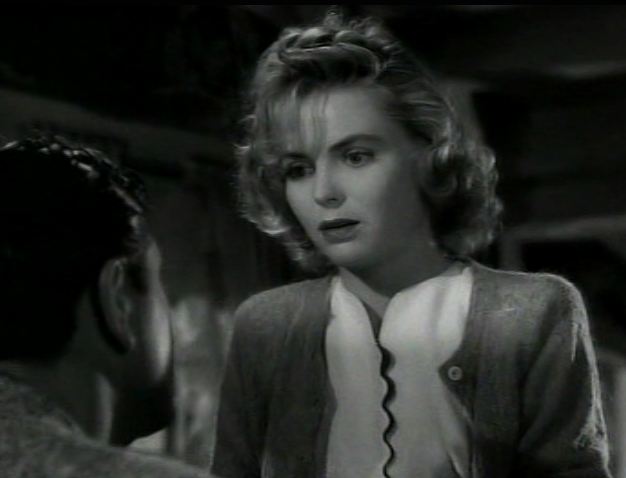
Babette's Feast has been on my watchlist for years. It's conspicuously beloved by people who adore my favourite films, so I was pretty sure I'd like it too. It's a Danish variation on James Joyce's The Dead (perfectly filmed by John Huston in 1987), though with more jokes, as friends and acquaintances gather to evoke the past, and their conversation turns to memory, loss, food and faith.

Here, those friends include ageing sisters Birgitte Federspiel and Bodil Kjer, who have lived in the shadow of their late father, a puritanical parson whose influence saw them shake off their two suitors: a devoted, formerly dissolute soldier, and a great star of the Parisian opera. The latter sent the pair a gift in the shape of French housekeeper Babette (Stéphane Audran), and the former (Jarl Kulle) is coming to her dinner, being held to commemorate their patriarch's centenary, though the debauched promise of which sends the sisters into paroxysms of panic.

The film works miraculously as a drama, if only fairly well as a comedy, but those lighter moments do make the film more fun than a Danish movie concerned with reflection and lost love might sound − especially when noted collaborators of Claude Chabrol, the notoriously austere Carl Theodor Dreyer and the not overly vivacious Ingmar Bergman are flooding the cast.

It's a film full of painterly imagery, complex truths and quiet wisdom that echoes long after the curtain has fallen, and the virtuosic storytelling − hopping between time-frames, mood and media − takes the breath away. Though it's often labelled simply as a 'foodie film', it's hardly that, or else I'd have been bored rigid, being a tiresome vegetarian who regards food largely as fuel. It is, ultimately, a picture about time, love, and the gift of art. (4)

***


Claudia (Edmund Goulding, 1943) − An unusual comedy-drama about a naïve young housewife (Dorothy McGuire) whose callowness − and obsessive reliance on her mother (Ina Claire) − threatens to undermine her marriage to charming farmer Robert Young. The overarching story was probably more relevant in 1940s America than it is now, and the film never transcends the three-acts and one location of its source play, but it's full of good things.

Morrie Ryskind's screenplay (adapting a John Golden treatment of the Rose Franken original, which was based on a book) has lurches in tone, but its scenes of fast-paced absurdism and reflective sincerity are very effective on their own terms, and its treatment of growing pains, of relationship troubles − and triumphs − and the exquisite pain of loss is thoughtful and original. The real joy, though, is in the performances. Young could be dislikeable and one-note, but after a lightweight start, and with decent material (H. M. Pulham, Esq., Crossfire), he was a fine actor, and he's terrific here: the pivotal phone call scene, acted − of course − on his own, requires poise, timing and a broad range of subtle emotion, and he's up to it. Though Olga Baclanova is absolutely unbearable in a cacophonous, tone-deaf part as a Russian opera star, there are strong supporting performances from Reginald Gardiner − the best of his 'objectionable cad' parts, with some lovely understated touches (putting on the glasses!) − and Claire, terrific in a well-written part that has no room for easy sentiment (even if her intensely close relationship with Young is a bit... odd).

The film is most notable, though, as McGuire's screen debut, as she arrived with the play from Broadway, and proceeded to blaze a trail through '40s Hollywood, giving three of the greatest performances I've ever seen in 1945 alone (the final one, The Enchanted Cottage, re-teamed her with Young). Claudia gives her a rare chance to play comedy for close to an hour, and with a gloriously off-hand delivery, and that funny lilt in her voice, she's a whirlwind of unabashed, opinionated, guileless innocence. I'm not sure that the character she's playing makes for an entirely convincing whole − like the screenplay, it's made up of brilliant sequences that don't necessarily gel − but she has some wonderful moments: not least the wordless passage in which she responds to tragedy by headbutting a wall, a gesture to which I've occasionally taken recourse. The climactic moment in which she comes of age is also wonderfully played, and shot with transfigurative beauty by Leon Shamroy, in a final 20 that finally discovers something cinematic in the material aside from close-ups.

Even if it doesn't all hang together, or speak to a 21st century audience in its basic premise, it's a fascinating film, and a fine record of several special actors close to their zenith. I'll never understand transformation scenes in movies, though: I always seem to fancy the 'before' more than the 'after'. Also, can I be very clear that I'm not talking about Transformers. (3)

Many thanks to Fint for the loan of this one. Follow him on the Twitter, he's brilliant.

See also: My review of The Spiral Staircase is here. I wrote about A Tree Grows in Brooklyn for MovieMail in 2014 (click to enlarge):


***


BOOK

The Amber Spyglass by Philip Pullman (2000) − This final part of Pullman’s triumphant His Dark Materials trilogy is uneven, repetitive, pretentious, daring, rewarding and emotionally devastating. One wonders if a more forceful editor might have stopped the author keeping his heroine asleep for the first 150 pages, removed the much-maligned cattle-on-wheels (sorry, 'Mulefa'), and told him that you can’t simply compare the size of everything to hands, and yet this extraordinary, imperfect book scales untold heights, the alienating, pretentious scope of its opening chapters giving way to an emotional intimacy that allows it to campaign for wisdom, for empathy, for noble sacrifice, for the sincerity of love, and the honour of rich, full lives, without having to spend too much time with a god figure called Metatron (it was that which stumped me first time out, leading me to leave this book on the shelf for the next seven years). The Amber Spyglass is an indictment of religion, but as a (decidedly moderate) Catholic it’s not necessarily one I disagree with, railing at the self-denial, hypocrisy, intolerance and viciousness that is organised religion at its worst – and the guilt that is, admittedly, an intrinsic and damaging by-product of my faith. Its war on God, though, certainly didn’t serve to cloud the majesty of much of Pullman’s vision, or the innate, intoxicating beauty of the Will and Lyra relationship, one of the great joys of modern literature. This book’s closing chapters will never leave me. (3.5)

***

Thanks for reading.