Showing posts with label play. Show all posts

Saturday, 22 July 2017

Warren William, The Girl From the North Country, and peaceful protest – Reviews #271

It's not all profiles of people from the 1930s, occasionally I review things that have just happened. But only if they're set in the 1930s.

THEATRE


Girl From the North Country (The Old Vic)
Saturday 22 July 2017 (matinee, final preview)

This new Old Vic production is a jukebox musical of Bob Dylan album tracks, allied to a Depression-era melodrama, and nearly as good as that sounds. Written by Conor McPherson, it takes place in a guest house in Dylan's home town of Duluth, Minnesota in 1934, where owner Nick Laine (Ciarán Hinds) cares for his wife Elizabeth (Shirley Henderson), who's animated by dementia, while trying to pair off their pregnant daughter (Sheila Atim), navigate an affair with a long-term tenant (Debbie Kurup) and cater for two strange man who arrive in the dead of night: bible salesman Michael Shaeffer and ex-boxing champ Arinzé Kene. All of them are waiting for their ship to come in.

The numbers are brilliantly chosen, adapted, staged and sung, ranging from a yearning duet on 'I Want You' (slowed down as it always should have been, and performed by parting couple Sam Reid and Claudia Jolly) to a dynamic, ensemble 'Slow Train Coming' and a climactic medley of 'Duquesne Whistle', 'Make You Feel My Love' and 'Is Your Love in Vain?', all accompanied by a period-appropriate Bluegrass ensemble. Even some of the more peculiar ideas, like commandeering that ode to gloriously malignant petulance, 'Idiot Wind', as a Dustbowl lament, leaning on 'Seňor' or making 'Like a Rolling Stone' a ballad, come off really nicely, with 'Jokerman' effectively reprised and 'Forever Young' finally where it belongs: as a West End weepie. (Other songs utilised include 'True Love Tends to Forget', 'Tight Connection to the Heart' and 'You Ain't Goin' Nowhere', not perhaps the most obvious Dylan tracks, but more the welcome for it; the eponymous track, from The Freewheelin' doesn't get an airing.)

At times the scenes around the music can be too vague or muted, but there are moments of resonance − and bits of tension created from thin air − before the narratives coalesce satisfyingly (but not too conveniently) in two moving final scenes. There perhaps isn't enough at stake, or at least enough that's truly tangible in the script, but perhaps future viewings would reveal hidden depths or further truths. I enjoyed Kene's performance, and the voices of Atim, Reid and Kurup (whose stately grace and absence of self-pity still lingers), though I struggled to take my eyes off Henderson whenever she was on stage.

I've never been that taken with her, seeing her in films, but she has such a presence and physicality, flitting between pitiful and sensual, rabid and comatose, that I was transfixed. Though I tend to have a problem with portraits of mental disintegration which are big and tic-laden (as the journalist Tim Lott once wrote, a realistic piece of fiction about mental illness would just be very boring), this one managed to be funny, intelligently allegorical, moving and somewhat unpleasant, without traversing into unbelievability or hysteria, while her moments of lucidity unveiled an unexpectedly beautiful voice, shot through a Scandi-Minnesotan lilt. It's her, the songs and the atmosphere of quiet desperation which I think will stay with me. (3.5)

See also: I've written about a few other Old Vic plays, including Clarence Darrow, The Master Builder, The Caretaker (which I didn't care for), Groundhog Day (my favourite theatrical experience of last year), and King Lear.

***

EXHIBITION


People Power: Fighting for Peace (Imperial War Museum) is impressive, multi-faceted and a little unfortunate in having to follow the V&A's Disobedient Objects, which is one of the best exhibitions I've seen since moving to London, and dealt with a similar theme: public protest. Here that's scaled down to protests for peace, and zones in on four big British protest movements, those of conscientious objectors in World Wars One and Two, the CND campaign that ran throughout the Cold War (with a little on Vietnam), and the Stop the War coalition which protested Tony Blair's invasion of Iraq.

That's both its strength and its weakness: it has a formidable mixture of exhibits: striking banners, poignant paintings, and arresting posters, trinkets and oddities (from CND pin badges reading 'Guardian Readers Concerned About the Bomb' and 'Clouseau Fans Against the Beumb' to a protestor's accordion), alongside audio snippets also transcribed on a display screen, and fascinating archive videos: one shown via a dozen faux-placards forming an irregular whole, others sharing snippets of news reels, news reports and public information films.


One of those, offering advice on how to survive a nuclear blast, is comically, depressingly and appositely juxtaposed with Peter Watkins' chilling film, The War Game, which showed British unpreparedness and was subsequently banned by the BBC, which had commissioned it. The flip-side is that the exhibition doesn't necessarily have a sufficient through-line explaining or investigating the continuity of pacifism, while its personal case studies − including one of Paul Eddington, a CO during WWII because of his Quakerism − are sometimes too brief and slight to really hit home. Having said that, one inspired inclusion is that of hate mail sent to successive generations of those who excused themselves from war, written by ordinary men and women whipped into a patriotic, judgemental fever by politicians and press.

In that way, People Power allows us to appreciate that where British current affairs are concerned, there is nothing new under the sun. It also offers a huge amount to see, and has plenty to say on the iconography, idealism and discomfort of pacifism, though I found Disobedient Objects somehow more inspiring, perhaps because of its internationalism and diversity of activist art, or perhaps simply because it celebrated causes that are simply more easy to embrace, several of which actually won. The final room here tries to send out on an upbeat note, saying that another British war was less likely after Iraq, but all I could think was that Corbyn only stood a chance in the election because he vowed to keep Trident, and that I don't necessarily disagree with that. (3.5)


I liked this poster, which highlighted the hypocrisy of America at a time when anti-war posters (like the 'Fuck the draft' one above) were being seized under obscenity laws. Not much has changed.

See also: I wrote about the IWM's 'Real to Reel' exhibition last year. ***

GIG


Robin and Bina Williamson (The Half Moon, Putney)
– An evening with 'the mystical one' from '60s psychedelic folk heroes The Incredible String Band, Robin Williamson, who's long since stopped singing his old stuff, and now sings much older stuff: Celtic and pioneer songs, accompanying them on the harp and guitar. He's joined by his wife Bina, who seems lovely, but is a bit of a Yoko: while her voice works OK in harmony, it can't sustain songs by itself, and her psaltery-playing seems to require such concentration that there's no room for expression or timing.


Williamson still has it, though: that distinctive voice, topped by a slight clicking lisp, and the same mesmerising gift for fretwork and fingerpicking, poured into a dozen songs, each either contextualised or prefaced by a story or gag. Who knew that the mystical one would have such a weakness for delightfully terrible puns. Seeing a musical visionary, still performing a half-century on, was a rarefied and special experience, especially doing so in the back of a London pub along with just 30 other people. It might have been even better if he'd had the spotlight all to himself, but they're clearly in love and he's clearly in thrall to her talents, so good luck to them. (3)

***

FILMS


CINEMA: Amélie (Jean-Pierre Jeunet, 2001) – This film is so personal to me that writing about it honestly would be like posting my diary, so I'll just say that while one could harp on endlessly about its shots, its structure, its score and Tautou's mesmeric central performance – and although those elements are almost without equal – it's the film's intensely beautiful heart that takes my breath away every time. I can't believe I just got to see it on the big screen. (4)

***
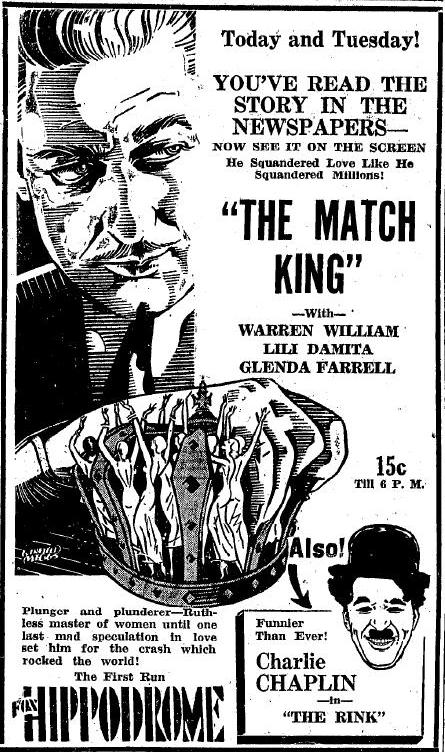


The Match King (Howard Bretherton and William Keighley, 1932) – I bow to no-one in my appreciation of pre-Code Warren William vehicles, but this one's a bit of a mess. It's quite fun, though. The film kicks off with a pre-credit sequence (surprising, since the earliest pre-credit scene is generally cited to be Crime Without Passion, which came out two years later), showing how important and ubiquitous matches are. Then we're into the story proper: a thinly-veiled biopic of Ivar Kreuger ('Paul Kroll', as he is here), the Swedish-born conman who had died earlier that year (and was immediately immortalised in a novel), having cornered the world market in matches.

It begins uproariously in the amoral Warren William tradition, the star selling out friends, pimping out girlfriends and swindling bankers on his way up the ladder. But then it turns into a romance featuring Lili Damita, a business drama full of laughably bad expository dialogue, and finally a morality tale that exposes the star's limitations. He was always a dynamic scoundrel, but just opening your eyes very wide isn't enough for the serious bits. If you like pre-Code cinema, it's worth a look, with some scurrilous plotting, saucily suggestive near-nudity, and bits for Glenda Farrell and Claire Dodd, while its neat final line anticipates the capper to The Roaring Twenties' rise-and-fall narrative, but it seems to have been written, shot and put out in a tearing hurry, with flubs left in the finished film, haphazard editing and an increasingly crap screenplay. Plus Harold Huber pretending to be Portuguese. (2)

See also: I wrote about The Mouthpiece, a better Warren William film, also found on the Forbidden Hollywood, Vol. 10 box-set here. His two defining films, Skyscraper Souls and Employees' Entrance are on Vol. 7, which I wrote about at length here.

***

DVD


Stewart Lee: If You Prefer a Milder Comedian, Please Ask for One (2010)
– I'll give it to you straight, like a cider that's made from 100% pear.

This is perhaps Lee's best show, with a pair of inspired, extended set-pieces about Top Gear and Magners Cider that take unnerring aim at casual racism, manufactured outrage, and the corporate co-opting of the art, history and communal experiences that we treasure. The interview with Kevin Eldon on the DVD is a real bonus too, a fascinating insight into Lee's psyche, character and work, which reached some kind of apogee with this daring, thematically and formally original, consistently hilarious act: part deconstruction, part tightrope-walk, part epic fantasy about Richard Hammond being decapitated. (4)

***

Thanks for reading.

Wednesday, 12 July 2017

REVIEW: Angels in America − Part One: Millennium Approaches at the National Theatre

Wednesday 12 July, 2017
*A FEW SPOILERS*

You can see the play at the National Theatre (a limited number of day tickets are available for every performance, on sale at 9:30am beforehand), or via NT Live.


I only knew this play from one scene, the highlight of NT50, a decidedly patchy nationally-broadcast celebration of half a century of the National Theatre, which proceeded to confirm to half the country that they really don't care for theatre. In it, Andrew Scott's fey, muscular, aloof Prior teases his lover Louis (Dominic Cooper) about becoming the butch "Lou" when he's around his own family, before revealing that he's dying, via the sudden exposure of the lesion on his arm. The way the scene shifts from catty camp to stoical sincerity, via linguistics, Judaism, death, seeming to cast its net so wide across the gay experience, marked it as a piece of urgent, intelligent, human writing, and confirmed what has been readily apparently to those more knowledgeable than me for years: Andrew Scott is quite something.

Now Tony Kushner's play is back at the National Theatre, where it premiered to UK audiences in 1992 a year after its American debut, with Andrew Garfield in the Scott role and James McArdle in Cooper's, as part of an ensemble featuring Russell Tovey, Denise Gough, Nathan Lane and Nathan Stewart-Jarrett.

It's billed as 'A Gay Fantasia on National Themes', and that's about the size of it: a waspish, tender and abstract state-of-the-union address, full of hallucinations, flights of philosophy, self-reproach and humour − it's far funnier than I expected − but completely sure-footed, never spinning into self-indulgence or triviality, and with such a variety of ideas, jokes and language that it reminded me of Truman Capote at his best. Set beneath the neon striplights of an unforgiving New York, a sort of Hell, haunted by the spectre of the AIDS pandemic as the Millennium Approaches, it follows a vivid assemblage of damaged souls, from Gough's valium-addicted housewife, hiding from an abusive childhood, to her closeted, straight-backed husband (Tovey) and his father figure, Roy Cohn (Nathan Lane), a genuine figure in 20th century American politics, who trained under Joseph McCarthy and mentored one Donald J. Trump.


Cohn, as envisaged by Kushner, is a brilliant character, and this is a simply brilliant characterisation. On one level he is so clear and commanding, so assured, so rendered in coal-black and Vanish-white, an unshakable monolith rooted in an immovable Americanism, and yet there are layers within layers, so many of them grey, and each lit up by the scene, and by what Lane seems to play between the lines. We see him first as a sort of barking barrel on little legs, roaring into his phone like a wackily irascible '30s screwball character. That blustering fury is part of his persona, but the blistering, hollering rage that comes later is part of his personality. Cohn seems at first full of contradictions, but they're not contradictions, they're contentions as firmly held as his believe in robust, right-wing America. He loathes traitors, but sees his disavowal of his orientation not as a betrayal of a community to which he doesn't believe he belongs; for him, betrayal would be accepting the lowly, put-upon place of the 'homo' in American life. And so, as he explains to his doctor (Susan Brown): "Roy Cohn is a heterosexual man, Henry, who fucks around with guys." The awesome power and nimble timing that Lane brings to this role is extraordinary but, like every element of this production, it's regimented and restrained, part of a whole that moves sleekly and sublimely.

McArdle is excellent too as Louis, a verbose, liberal Jew whose idealism is tempered by a pragmatic discovery of his own limitations that saturates him with self-loathing, and unbearable guilt. His chemistry with Garfield is tender, his deftness with quickening streams of political consciousness is a feat of admirable, involving plate-spinning, and his emotional connection with the audience allows us into a character conspicuously lacking in heroism.


Garfield's role is more obviously showy, and his performance attracts superlatives, but he refuses to play Prior as a straightforward martyr. His Prior is effete, sensitive and even profound, with a natural grace and an affected gentility. He's also this first half's great victim, transfigured but more often disfigured by his disease, by mental torment and physical degradation; a character defined by his beauty, with an illness that's ugly and unforgiving. Stricken, with lesions on his skin; pouting, dressed as Norma Desmond; barking wordplay on a bench; reclining like a dying Greek God on a hospital bed, his homosexuality or his illness make him irresistibly otherworldly, touched as if by some secret spell. But in this first half, Prior is also slightly silly: a shrieking, bitchy, tart, vain queen (played without an ounce of vanity), and Garfield never loses sight of that dichotomy.

By contrast, Tovey's Joe is a model of Reagan-era repression, a clean-cut, ambitious forceful 'nice' guy struggling to reconcile his sexuality, his morality and the sphere in which he operates. I was a bit of a Tovey agnostic before this (I believe he exists, I just wasn't sure if I was a fan), but he struck just the right tone, and continued striking it with just the right variations. As his tortured wife, Harper, slipping from her pained existence into the welcoming embrace of fantasy, Denise Gough matches him: we want to protect her character from this self-destructiveness, we want her to be happy, or content, or free, but we also want her to stop lying.

But while Louis spouts democratic rhetoric, Joe voted Republican and Belize (Stewart-Jarrett) listens − boiling − to Louis' description of a post-race America, these characters are not conduits or manifestations of political positions. They're people who have ideas, not people who represent ideas. That's why they feel real. I also loved the way that Kushner's language is attuned to his themes, and that those themes are so wide-ranging and yet so specific. Millennium Approaches cast its view across a broad scope of American history, takes in all areas of American society, and then goes broader still. Without labouring his points, the playwright can evoke the ethnic cleansing of Native Americans, the rooting out of communism, the endemic racism against African-Americans, the self-satisfied, unthinking, privileged, hostile 'niceness' of Reaganite Washington, and the hole in the Ozone layer that no-one but the emotionally damaged gives a shit about, without having to ever compare any of these, explicitly, to the plight of gay men during the AIDS pandemic.


Cohn and Trump

This revival is valuable too in reading present-day America. The people Cohn worked for (and namechecks) characters were − like Reagan −both political and pop cultural, celebrities who became celebrities because of their political power, and whose celebrity caused that power to increase exponentially: gossip columnist and commentator Walter Winchell, FBI chief J. Edgar Hoover, and red-blooded, red-hunting senator, Joseph McCarthy. All fine Americans, celebrated in their time for their strength, their weeding out of hypocrisy, and their obsession with the morality of private lives or of private political beliefs. Trump, though he's thick as shit, is a tub-thumping populist whose Americanism is similarly uncomplicated, and whose major calling card has been a ubiquitous celebrity, though he doesn't have the same concerns Cohn does about state officials being under Russian control. Nor is Trump's malevolence coated in the unwavering 'niceness' of Reaganism − who made people feel good about themselves, then looked the other way − it is sheer, toxic nationalism, which makes him more the heir to McCarthy and Cohn than Ronnie ever was. As much as anything, this is a play about both the ruinous effects of privilege − in which even a gay Jewish man whose lover is dying of AIDS cannot attempt to comprehend the African-American experience − and the blinkered guilt-saturated selfishness of '80s America ("All of us... falling through the cracks that separate what we owe to ourselves and... and what we owe to love," as Louis puts it). President Trump is both the scion and the defender of unthinking, uninvestigating privilege, while Reagan's America was the self-serving economic playground in which he began to pave his path to the White House.

As it contemplates these characters and draws those from history into its realm, its sprawling tentacles make the play feel like something in a hidden American tradition, the way Todd Haynes' Far From Heaven reinserted the nation's censored stories into '50s melodrama. It looks forward, back and around: absorbing the past (Jewish mothers carrying their world on their backs to the New World), staring dumbstruck at the present, and forecasting − via Cohn −a dominant Republican future, anticipating today's horror show, but little-knowing that the play's pop-culture savvy (with nods to Rosemary's Baby and The Exorcist) is probably going to be more valuable in understanding it than any knowledge of Washington history.


The play's stagecraft impeccably mirrors its subject matter. At first it's compartmentalised in three small sets (left, right and centre), its characters boxed off from one another, trapped in lives that are about to upended. Later the characters shout across one another: as they open up, so does the set, setting into motion the "connectedness" of which Louis speaks. Finally, the scenery moves back to make the most of a vast stage, as Garfield's descendants (a hilarious, Very Yorkshire Tovey, offset by Lane as a preening, powdered fusspot) pay him an unwelcome, hallucinatory visit, Gough retreats from her kitchen floor to see the Ozone layer up close, and Moon River pipes up from somewhere giving us a hint of a Hollywood ending as false as those always are.

I can gaze perplexed at some gay culture − when it's gaudily sleazy, I tend to feel either disinterested or uncomfortable; at others times I find its reductionism baffling, seeming to define gay people only by their gayness − but I suppose this is like how those who are LGBT might enjoy the album Liege and Lief but hate Transformers, the defining criteria of the art isn't the sexuality underpinning it, but whether it's really good or rubbish. You'd have thought a Corbyn voter would have known that.

One line in particular ("You're old enough to understand that your father didn't love you without being ridiculous about it") makes a dizzying comic leap that brings understanding and recognition in lapping waves of laughter, having audaciously vaulted over the expected exposition or consolation to land effortlessly on its feet.

I was blown away by Angels in America: this clear-headed, literate and ambitious piece of art; by the precision and variety of its ideas, the breadth of its imagination, the variety of its expression (in language alone, it moves from absurdity to knowingly long-winded verbosity, to wit, to caustic one-liners, to an unexpected bluntness that really works in such small doses), and by how unexpectedly enjoyable and funny and entertaining it was. Only a month to wait till Part Two. (4)

***

Thanks for reading.

Friday, 19 May 2017

REVIEW: An evening down the culture wars

The Girls (Phoenix Theatre)
Thursday 18 May, 2017


This is so, so Brexit. Gary Barlow’s musical version of Calendar Girls is fine-tuned to within an inch of its life, evoking a world and espousing a worldview that’s both seductive and abhorrent. It’s a hymn to a vanishing Britain – rural and nostalgic, where everyone knows everyone, and everyone is white – but it lacks the poetry or radicalism of the pastoral: it’s cloying and self-involved and almost context-free, lacking in proper principles beyond the ones you might find in the Conservative Party manifesto, and with a sense of community where there used to be a sense of society (cast member James Gaddas was a Tory PPC in 2005, so he should know all about it). The Girls is like Brassed Off for Leave voters: a safe, convivial, reassuring evening’s entertainment for people who look like the characters and think alcoholism is funny, and an ode to the crushing mediocrity rapidly consuming British culture, in both its music and its broad, blunt, saucy-seaside-postcard sense of humour. These characters aren’t really interested in politics, but they’ll vote Tory because they always have, and because you know where you stand with the Tories, and they’ve always done alright by us, and didn’t Corbyn say something about the IRA and wasn't that was dreadful, because I was around then and I remember what it was like. It’s a show of girl jobs and boy jobs, where hospitals should be paid for by charity, and the score is written by a tax avoider.

And yet, after 20 minutes of hating it, I began to come around, at least a little. From the moment that Claire Machin disappeared into her skirt for an exceptional piece of clowning on the knockout number ‘Who Wants a Silent Night?’, I started to forget that we’re in the middle of a culture war, and remembered that I was allowed to have a nice time, and a break from a hectic week at work. Having said that, the part of the show that really works is the hard part. The heartbreaking part. Torn from real life. Annie (Joanna Riding) loses her husband, Clarkey (Steve Giles) to cancer, and the play makes you feel the weight and the sorrow and the injustice of it. The way it's realised is very middle England, the lyrics evoking a world of duvets, margarine and Tesco trips that’s more Daily Mail than Ray Davies, but it's also moving and genuine and wonderfully played, with the two actors effortlessly stealing the show. That sincerity and emotion should, in principle, juxtapose perfectly with the humorous sequences that rub up alongside it. But they don’t. There are a handful of very funny moments, largely from Machin and young cast members Ben Hunter and Josh Benson, but most of the humour is really loud: inane, broad-brush joshing – the kind of thing you see on Loose Women or in an above-par Carry On… film, or when a hen party is on your train.


Chloe May Jackson, Ben Hunter and Josh Benson, the latter two providing many of the funny bits.

As you may know, Annie – encouraged by her free-spirited friend Chris (Claire Moore) – decides to make a nude calendar with her friends in the Women’s Institute, to raise money for a new sofa at the hospital where her husband died (I presume it hadn’t been replaced for several years due to 18 years of chronic underfunding of the health service by successive Tory governments). Along the way, they fight, squabble, banter and heal, while facing a cartoon baddie (Marion McLaughlin), assorted familial troubles and the personal demons of their WI friends. And we get a succession of Gary Barlow tunes – with pleasant if uninspired melodies, and wildly variable Tim Firth lyrics – before plot threads are tied and the cast take their clothes off behind pianos, flowers and currant buns, and the audience whoops and hollers, and a standing ovation breaks out. And in the end I kind of enjoyed it, because I like the theatre, and there were just about enough hummable songs and incidental funny bits, and Riding was very good, and her scenes with Clarkey stick in my mind because they brought a lump to my throat, and the second half was much more entertaining than the last act of King Lear at The Old Vic last year, which troubles me immensely. And though it’s set in a Paul Dacre wet dream of a small-town idyll, and the characters are cartoon Yorkshire people, and they’re the kind of cartoon Yorkshire people who actually exist, because they find the stereotype so alluring, and I’m going to have the burn the book to this show once the culture war hots up, it was a hell of a lot more enjoyable than I expected after those first, joyless 20 minutes, when I’d begun to question many of the life choices that had brought me to this point.

Having said all that, think how many hospital wings we could build if Gary Barlow just paid his taxes. (2.5)

***

Thanks for reading.

Tuesday, 26 April 2016

Review: Sunset Blvd at the London Coliseum

'This production did something to me'

Saturday 23 February 2016 (matinee)


Though I didn’t unequivocally laud the ENO’s production of Sunset Blvd, I did love it – or at least bits of it – intensely. I loved the melodies, the minor explosions of inventively choreographed dance, the pairing of Michael Xavier – playing cynical screenwriter Joe Gillis – and Siobhan Dillon, as his possible lifeline, bright-eyed studio scribe Betty Schaefer. So I went to see it again. The ticket was £105, but that’s exactly how much I’ve made recently from selling old DVDs and books, and one of the three remaining stalls seats was, erm, on the front row.

The one false note for me the first time out was Glenn Close’s former silent siren, Norma Desmond: her voice seemed to be a bit off – at times flat or thin – and her formerly Tony award-winning characterisation was fairly one-dimensional. From last Wednesday to Saturday, including the matinee show that I caught, she was replaced by understudy Ria Jones. And she was very good, with a big voice and an ability to pull a little pathos from the part (an opportunity that Close conspicuously missed), particularly during a scene in which Norma visits Paramount Pictures and an old crew member picks her out with a spotlight. It’s a potentially great moment, but it took Jones’s stoic, wordless and largely internalised emoting to put it across. There aren’t many moments like that in the show, though, as unlike Wilder’s poignant, pungent and ultimately profound satire, it tends to find tragedy in her situation, rather than her character. Here, Norma’s often seen to be acting, not truly suffering, which could make her subsequent nosedive powerfully abrupt or heightened through juxtaposition, but actually just makes it fairly unconvincing. There’s a broadness, a campness in the denouement, and in the play as a whole, that prevents you from truly engaging in her plight. (I also wondered if, as good as she was, the prolonged standing ovation that Jones received was as much about her status as an understudy, and of the audience trying to convince themselves that they had got value for money. There were no refunds offered, while an on-stage ENO functionary took the unusual step of saying that he was "delighted" Jones would be appearing: an ambitious gambit.)

Where it does score is in enveloping Gillis in an unfolding nightmare: a sad and seedy Hollywood evoked with minimal staging and blessed with a beguiling counterpoint: a handful of gloriously escapist scenes featuring Xavier and Gillis. As much as I enjoy the music as a whole, its high-points are unquestionably those two songs: the 'Girl Meets Boy' number that causes their love to bud and blossom, and captures it as it does; and the haunting, exceptionally moving 'Too Much in Love to Care': a soaring evocation of a futile love affair, and one of my favourite songs in musical theatre. The chatty, informal parts of Xavier’s delivery at times rob 'Girl Meets Boy' of some sonically sublime moments, but he has one hell of a voice, and Dillon’s exceptional balladeering carries to the back of the Upper Circle, matched to an utterly appealing performance that gives the play the moral centre it so desperately needs, before proceeding to smash your heart to pieces. When 'Too Much in Love to Care' is fleetingly reprised close to the death, it’s the characterisation here – Xavier’s self-loathing, Dillon’s transformative selflessness – that allows it to land with such devastating results.

The other numbers are good, and given oomph by a 48-piece on-stage orchestra, though I do find the two makeover scenes in Lloyd Webber’s version rather trite and artificial. Staged as they are here, they have no real place in Wilder’s world and come off merely as chick flick fluff, despite the uneasy subtext. Those songs – 'The Lady’s Paying' and 'Eternal Youth Is Worth a Little Suffering' – are also hampered by some weak and clunky couplets that sound like they were dashed off in a few minutes (the rhyming of ‘kosher’ and ‘brochure’ is particularly lousy), though they’re enjoyable enough in themselves, and there’s no faulting the composer’s melodies. The ballads dealing with Norma (from 'With One Look', vocalised by her, to 'The Greatest Star of All', sung by her butler Max) are fine, even show-stopping in their slow, windy, epic way, but they're not exactly my sort of thing.

All in all, though, it’s a fine play and this production – with its heady air of stifling desperation, of bitter, bullet-ridden, waterlogged wisdom, of redemptive love flailing in the face of fate – did something to me. I’ve never been back to see a show a second time, but with this the pull was too strong. Its wry sense of humour, sour celebration of Hollywood narcissicism and enrapturing songs got under my skin. And while it’s not perfect by any stretch, I doubt I’ll see another show this year that affects me so deeply.

***

Thanks for reading.

Saturday, 16 April 2016

Basia Bulat, Sunset Blvd: The Musical, and confessions of a completist - Reviews #233

I've been out of the flat a bit. See:

LIVE:


Photo by me, can you tell?


Basia Bulat (Hoxton Square Kitchen) - Since I last saw her properly a year ago, giving my favourite live performance of 2015, Polish-Canadian singer-songwriter Basia Bulat has undergone a quite startling transformation. There were hints of it in the Rough Trade mini-gig she did in February: a strident, rocky performance of songs from her new record, Good Advice, somewhat removed from that earlier folksy set played chiefly on the autoharp. Nothing prepared for me this, though: the whispery, wispy, baby-faced Bulat reincarnated as a power-pop diva in a gold cape, charisma bursting from her, as she belted out crowd-pleasers from behind a keyboard, like some improbable, magnificent union between Janis Joplin and Carly Simon.

Across the 90-minute show, and backed by her Canadian band (comprising support act The Weather Station and a bonus lead guitarist) she played six instruments on songs from the past 11 years, her voice everything from a sweet seduction to a tortured wail, including a stomping dance version of Let Me In (first heard as a Leonard Cohen-esque ballad last year), Fool - with its smooth falsetto replaced by a new arrangement that allows her to vocalise over a full band) - and, best of all, a Springsteen-like version of Five, Four, last heard as a faintly neurotic folk song. Between, there were autoharp versions of four beloved Bulat standards, including In the Night and Heart of My Own, the pop explosion that is Tall, Tall Shadow (title song of her 2013 record) and persuasive renderings of the hopeful Someday Soon and the furious, self-mocking La La Lie, two of the best songs from her current album.

The only track that didn't quite land was Good Advice, partly because of some sound problems at the venue, and partly because it's the least interesting song on her current LP. The encore - It Can't Be You played on a ukulele - was familiar, but little else about this show was, aside from its sheer mindblowing quality. With Yasmine Hamdan, she must be the best and friendliest live act around. (She also had an adorable smear of lipstick on her cheek for the entire show - marry me now, Basia.) (4)

SUPPORT: The Weather Station were happily in that 5% of support acts who are really good, particularly singer and guitarist Tamara Lindeman (who sang backing vocals for Basia). They sound like a compact Canadian Fairport, though the songs I liked best were the stripped-down ones using Linderman's ethereal voice to full effect. Their less conventional elements are, unusually, also the less successful. (3)

***


Sunset Blvd. (London Coliseum) - A good first half gives way to a sensational second in this headline-grabbing revival of Andrew Lloyd Webber's musical (based, of course, on Billy Wilder's seminal 1950 movie), which features Glenn Close in the role that won her a Tony and made her a musical star: Wilder's repulsive, tragic silent movie queen, Norma Desmond. Close is merely OK, struggling (literally) to hit the high notes or wring much of the implicit pathos from the role, but the 48-piece on-stage orchestra creates a sensational sound as it brings to life some of Lloyd Webber's most exquisite, affecting melodies, and both Michael Xavier (as Joe) and Siobhan Dillon (as Betty) are superb, Xavier articulating the character's inner conflict and broiling self-loathing in a way that I snobbishly thought might be beyond a West End musical star, while vocalising the numbers impeccably and looking terrific in a little pair of swimming shorts. There's a nice performance from Fred Johanson too, as Max, Desmond's imposing, unhappy butler.

Lonny Price's staging is imaginative, while relying on the imagination - consisting primarily of a metal gantry with two staircases and platforms - and I particularly liked both the use of archive LA footage (beamed onto a translucent screen) and, less obviously, the 'car chase' effect, which consisted of two people running down the steps in the semi-darkness, each holding torches in both hands (they never got around the second problem, though, which is that when they're 'parking' at the back of the stage, they just look like two men with their backs to the audience). A minor shortcoming of the musical adaptation is that Christopher Hampton's rhyming lyrics lack the bitter, sardonic poetry of Wilder's dialogue (some of which remains intact), while the recurring motif - while sumptuous - is perhaps ultimately overused. On the whole, though, I found the show hugely entertaining: a richly atmospheric evocation of Hollywood malaise, immersive, periodically exuberant and ultimately triumphant, if not quite for the reasons I expected. (3.5)

***


The Caretaker (The Old Vic) - I'm not a massive admirer of Harold Pinter's work: his way of writing (just start and you can figure out what it means later, or else not bother and just wait for critics to admiringly tell you) may have heralded a new type of theatre, but what if that type of theatre was a bit, you know, shit? Having said that, I can't watch The Servant - the 1962 Joseph Losey film written by Pinter - without being irredeemably sucked into its psycho-sexual confrontation of class politics, and much of that brilliance is to be found in the text, and between and underneath its abrasive lines.

I thought I'd see The Caretaker for my birthday though, as I like Timothy Spall, and his performance in Secrets & Lies (which I finally saw last year) has stayed with me like little else. Sadly this interminable production is one of the worst I've seen since I started regularly going to West End shows a couple of years ago. The second act provided its fair share of pathos and comic discomfort, thanks chiefly to George MacKay's barking, aggressive, leather-jacketed Pinter surrogate, though Daniel Mays' monologue at the close was extremely well received. Spall was dreadful, though, torpedoing the majority of the play with a single grating, borderline-unlistenable affectation of a line delivery that made me pray for the show to finish.

Three hours it lasts, including two intervals: that's a long time to be incredibly irritated. (1.5)

***

FILMS


What Ever Happened to Baby Jane? (Robert Aldrich, 1962) - Two of Hollywood's greatest actresses together at last: Bette Davis and Anna Lee. Joan Crawford's in it too.

Robert Aldrich's deliriously nasty Gothic thriller has Hollywood in its bones, and Hollywood stars in their element. As film historians have observed before, Davis's persona was as the great sadist, Crawford's the great masochist, and their roles here are tailored perfectly to their mismatched talents: Bette as ghost-faced former child star, Baby Jane Hudson, who has recently gone mad and taken to persecuting her sister, crippled Golden Age legend, Blanche (Crawford). Lee - who gave three of my favourite performances, in Ford's How Green Was My Valley, Lewton's Bedlam and Fuller's Crimson Kimono - is rather underutilised, though perfectly fine, as their solidly suburban neighbour, while big-boned Victor Buono plays Bette's new musical collaborator with an agreeably repellent, sickly charm, though also quite a bad English accent.

After a masterful prologue (magnificently utilising footage from Davis's most loathed studio potboiler, Parachute Jumper), Aldrich tips us into a rotting mansion, where Davis proceeds to isolate, starve and generally terrify her big-browed nemesis - and if that manifestation of the stars' mutual dislike is rather fanciful, the animosity itself was genuine. No two stars ever took bigger lumps out of another than these two (except perhaps for Tom Neal when he kicked Franchot Tone's head in), with the mercurial, sometimes monstrous Davis memorably dubbing her bed-hopping rival, "The original good time that was had by all."

I'm not sure that Aldrich's celebrated, trendsetting and meticulously well-directed film necessarily delivers on all of its early promise, as its story settles into a slightly repetitive rhythm, but it has many passages of nerve-shredding tension, some big dollops of pitch black comedy and two stars in fantastic form. I'm not generally a fan of Crawford, but there's no faulting her work here - she had, as the meme goes, one job, and did it very well - while Bette, that little black love heart on her blanched face, is in simply rampaging form, playing the last word in difficult siblings, though not one without an extremely latent sentimental side. (3.5)

***


La peau douce (François Truffaut, 1964) - Frustrated author Jean Desailly, bored with wife Nelly Benedetti, begins an affair with an air-hostess (Françoise Dorléac), and - worried about being unmasked - proceeds to make some foolish decisions.

It's Brief Encounter meets The Third Man, with nouvelle vague flourishes, fragments of Truffaut's own philosophy and some Hitchcockian suspense: note how the director immediately pitches us into a heart-stopping sequence that we really shouldn't care about, just as he'd envisaged when he spoke to Hitchcock about this very subject in 1962.

The film, Truffaut's fourth, was a critical and commercial failure upon release, with him lamenting that it had been too cold and unsentimental, with a protagonist no-one could care for, but it's full of great details (like Dorléac distractingly examining her reflection in a table knife), fine location flavour (a break-up on a Parisian rooftop!) and intuitive, intelligent female characters.

I'd class myself as a big fan of the director, but I don't think he actually made that many great films: acclaimed movies like Jules et Jim, Anne and Muriel, and The Last Metro leave me cold. This one, though, is mature, intriguing and quite brilliantly directed, if not exactly likeable.

Does the end fit the rest of it? I'm not sure. It's bloody good, though. (3)

***


Kiss and Make-Up (Harlan Thompson, 1934) - This plays almost like a parody of 1930s cinema, with white art deco sets, stylish wipes and an abundance of slightly stilted chorine types with fixed smiles, singsong voices and few clothes. Those bit parts are played by the entire roster of the 1934 WAMPAS Baby Stars, but unlike Clara Bow and Dorothy Mackaill (1924), Mary Astor, Mary Brian, Joan Crawford, Janet Gaynor and Fay Wray (1926), and Joan Blondell, Constance Cummings, Frances Dee, Rochelle Hudson and Karen Morley (1931), none of this bunch would go on to major stardom: 1934 was the most fallow crop, and the last.

Kiss and Make-Up is a bit sexist, a bit racist and a bit silly, concluding with an idiotic, pointless slapstick chase. But it's also surprisingly funny and full of novelties: slick, mobile direction, Edward Everett Horton and Helen Mack singing a duet about cabbage, and a neat POV opening where you get to be Cary Grant.

The story is that old chestnut - done best in Capra's Platinum Blonde - about a professional (beautician Grant) who loves a boring, shallow woman (his Galatea, Genevieve Tobin), not realising that he should be with his doting, lovelorn secretary. It would be a bit less disingenuous if Hollywood itself didn't routinely prize beauty over character, and the secretary was relatively unattractive, rather than a brunette Helen Mack.

Cary Grant only really became Cary Grant with Leo McCarey's hysterical 1937 film, The Awful Truth, one of the funniest movies ever made, but this is probably the closest he came before that, and it's definitely among his best early performances, with an easy charm, an aloof, offhand wryness even when the joke is very much on him, and even a couple of tuneful performances of the song, Love Divided by Two.

The best thing about the film, though, even acknowledging its attractive look and above-average dialogue, is Horton, who is at the peak of his powers: the scene between him and Grant in Tobin's room is genuinely hilarious. (3)

***


Sherlock Holmes (Albert Parker, 1922) - Here's a novelty: a Sherlock Holmes film without a mystery in it. It's based on a play by William Gillette - who popularised some of the iconography we associate with the character - but it's more true to the incidentals of the character than his essence, the detective portrayed as a romantic sentimentalist who'll go to the wall for the woman he loves.

An extraordinarily handsome John Barrymore - about to embark on his legendary stage triumph as Hamlet - is Holmes, who comes to the aid of a foreign prince and fellow Cambridge University student (Reginald Denny), bringing him into conflict with a nefarious, hairy Limehouse resident by the name of Moriarty - who seems to have been taking style tips from Barrymore's own Mr Hyde (unleashed on an unsuspecting public the previous year).

As a fan of film history, it's fun to see Barrymore as Holmes, to see a debuting Roland Young (as Watson) and William Powell (as a thief in the detective's employ), to see Moriarty introduced in the centre of a spider's web, and the likes of Denny, future gossip columnist Hedda Hopper and D. W. Griffith's mistress and leading lady, Carol Dempster, playing off one another. I'm glad the film was rediscovered in the '70s after being thought lost, and that Hugh Hefner stumped up the money for the restoration (!).

It's not actually very good, though. There are trick walls and secret passages (in my experience, a fail-safe indicator that I'm watching a shit film), the Holmes-Watson relationship - so integral to a successful adaptation - has but a single moment of genuine warmth, and the story is just really boring, because there's no mystery and not really any suspense: it's just people squabbling over some letters for 85 minutes. I think so, anyway: I'm not sure if there are frames missing from the existing print, but it all gets quite confusing towards the end, before a completely incomprehensible climax.

Barrymore was a truly great actor, but a lot of the time he couldn't really be arsed, and with Hamlet on the horizon, you get the feeling that his thoughts were over Elsinore rather than at 221b Baker Street. (2)

***


The Human Stain (Robert Benton, 2003) - Philip Roth's magnificent novel about a professor with a deep, dark secret, becomes an extravagantly bad film starring Anthony Hopkins, who does at least bother to do some acting, which I know he regards as something of a chore nowadays.

The scenes in the '40s about the professor's past are actually rather effective, but square-jawed, long-faced Wentworth Miller - though fine - looks and sounds nothing like Hopkins (who is orange and Welsh) and Nicole Kidman's irritatingly shallow performance sinks the rest, the portentous, overrated actress playing a one-dimensional stock character, rather than the fascinating one Roth wrote.

Compounding the misery is Sinise's Nathan Zuckerman (a recurring figure in the author's work), who must be about the most nondescript character I've ever seen in a film. The source novel may well be unfilmable, but it could be filmed quite a lot better than this. (1.5)

***

TV


The Kingfisher (James Cellan James, 1983)
- One of the loveliest things I've seen in ages: a magical, marvellously escapist made-for-TV drama with a cast of three and a tender score, as a lonely bachelor (Rex Harrison), living with his gay old butler (Cyril Cusack), who makes a move for the one that that got away a half-century ago (Wendy Hiller), following the death of her husband.

The material is good if imperfect - there's a touch of pointless slapstick and an ill-advised diversion about Harrison's fatal conquests that seems in rather bad taste given the actor's involvement in Carole Landis's suicide - while the direction is fairly standard and unimaginative, but the performances are an absolute joy, with Harrison and Hiller sparking as they had in Major Barbara (one of my favourite 10 films) 42 years earlier, and Cusack providing memorable though not exactly hilarious support.

Sexy Rexy plays the unrepentant but genuine, wistful old cove you'd expect, dialogue still like honey on his lips, while Hiller creates another of those impeccable, distinct characterisations she could turn out at will: a twinkly-eyed, joshing, witty, knowing and self-aware woman who's happy to get sloshed but blessed with tremendous emotional intelligence (a pensioned-off, very English version of Myrna Loy's character in Libeled Lady, perhaps).

The filmed legacy of this renowned stage actress is a strange and spotty thing: she made just 18 movies, along with 40-odd TV appearances, during a career that spanned from 1937 to 1992, but what remains is of inestimable value for anyone who admires the artistry of acting. Through the nuanced control of her incomparable face, a stage-honed understanding of gesture that she adapted for the all-seeing camera, and that deep, modulated and inimitable voice, she thought out loud, and what she thought was usually extraordinarily beautiful. I really do think she's the greatest sound actress of all time. And this TV drama that I supposed would be a mere footnote for this completist is a wonderful thing. (3.5)

***


All Passion Spent (Martyn Friend, 1986) - This three-part adaptation of Vita Sackville-West's most popular novel is quiet, contemplative and ultimately extremely rewarding: the story of an 85-year-old widow (Wendy Hiller) - previously wedded to the establishment - who finally gets to show her innate non-conformity.

It takes ages to get going (the first half of the mini-series is basically just her purchasing and redecorating a house), but the music's nice, the script is unusually classy and meditative, and the scenes between Hiller and her eccentric longtime admirer (Harry Andrews) are extraordinarily moving.

This portrait of a stoical, accepting and non-judgemental woman, blessed with a gentle power that comes from deep within, is among the great achievements of her incomparable career. What surrounds it isn't generally in the same league, but it's worth seeing for the central performance alone. (3)

***

BOOK


The Entertainer by Margaret Talbot (2012)
- The story of 20th century America, told through the prism of the author's father, Lyle Talbot, whose career mirrored the transition from localised to mass market entertainment, as he went from tent-show star, carny performer and stage actor to Pre-Code leading man, Ed Wood alumnus and TV sitcom favourite. His daughter Margaret is a New York staff writer, and the book does often feel more like an extended magazine feature than a weighty non-fiction tome - it's wide-ranging, thoughtful and interesting, whether documenting the early 20th century paradigm from character to personality, or dissecting the shortcomings that prevented Lyle from becoming the star that Warner Bros expected him to be - but sometimes rather slight (its anecdotes range from the memorable to the truly mundane), increasingly shows its working, and occasionally branches off into pretentious speculation (as in a simply dire passage imagining the later life of the actor's first girlfriend).

His biographer is broadly a good writer, though, her occasional weird, mannered, nature-themed metaphors compensated for by her ability to be witty, psychologically insightful and often subtly and deeply affecting (the final paragraph of her introduction is wonderfully realised). Sometimes she goes off on a mystifying tangent about a minor character in Lyle's life, and at times takes us into territory probably only interesting to her immediate family, but she writes movingly about both of her parents, knowledgeably about her father's minor Pre-Code triumphs, and perceptively -about everything from sexual attraction to Nebraska to the appeal of the sitcom Lyle appeared in, Ozzie and Harriet, and about the America it played to. Lyle himself had a remarkable life, rather than being a particularly interesting person, but in this ambitious, readable and slightly flawed book, he plays a new role: a man through whose long and diverse career we can better understand America, and the American century. The cover is absolutely beautiful too: a perfect pastiche of 1932 movie credits. (3.5)

***

Thanks for reading.

Thursday, 8 October 2015

Review: Benedict Cumberbatch in Hamlet

Friday, 2 October 2015
at the Barbican Centre


Hamlet was fairly good, but no better than that: a curious, tonally awkward production that accentuated the absurdism of the character's descent into madness, drawing attention to the play’s odd lurches in mood, which doesn’t always play well to a modern mind.

Benedict Cumberbatch, of course, is the sweet prince who becomes markedly less sweet upon learning of his father’s murder: as the king was poisoned, now his son’s mind is poisoned: flitting from revenge fantasies to abusive rants to (in this adaptation) playing in a toy castle. The show begins with him listening to Nat ‘King’ Cole’s Nature Boy on a gramophone, before the curtain rises to reveal a stunning set depicting a castle hall and centring on a banqueting table set at an angle, guests descending a stately, statuesque staircase along one wall. It’s a magnificent moment, but it soon becomes clear that the film has traded a basic, thrilling intimacy for these fleeting instances of theatrical splendour, as everyone is just rather far away. And for some reason that one could probably imaginatively justify at a stretch, but which I’m not going to, the table is littered with the antlers of recently deceased deer. In another curious bit of staging, the set also goes way, way back. It’s a design pregnant with possibilities, but it’s not generally used as imaginatively or intelligently as it might be: mostly for chase sequences or to suggest the size of the building. Indeed, the only moment when it really comes into its own is during Ophelia’s touching departure from this planet.

That’s also the only part of the play in which Ophelia works as a character, since Sian Brooke has apparently never encountered a mentally ill person before, or, indeed, a person. Her wretched, inane twitching is like every stylised approximation of madness you’ve ever seen, but somehow worse. The rest of the supporting cast struggles too (though not quite so much), aside from Ciarán Hinds’ dangerous, repentant, rather bluff Claudius, Karl Johnson – an effective ghost, particularly when appearing within the players’ stage – and Matthew Steer, an amusingly apprehensive, confused Rosencrantz. I don’t know why Kobna Holdbrook-Smith was cast as Laertes: there does seem to be a tendency in London theatre to incongruously bestow black actors with traditionally non-black roles to which they’re not very well-suited; and unless I’m missing something, it’s not done for purely artistic reasons.

At times, though, this adaptation really does work. “What a piece of work is a man” remains one of the most remarkable speeches ever written, with a vast scope and an overpowering emotional pull, and Cumberbatch draws out much of its haunting power. He’s good, throughout, actually: less drenched in spit-flecked venom than Maxine Peake’s recent genderblind characterisation and lacking her manic, vituperative if one-note comic energy, but committed to the legendary role, finding flashes of anger and shards of sorrow that illuminate the stage, and drawing the eye even when the action is elsewhere on that rather cavernous stage. Having said that, I’m not sure that what he offers us is Hamlet: it’s more a fusion of the character and his stock persona, which can be a little too knowing and in control to suggest true pain, true passion and true madness.

He’s also undermined by an oddly silly, adolescent touch in which people act in slow motion while he delivers his solliloquys, an approach that distracts from several of the play’s most important moments. That kind of am-dram silliness is one reason that this production is unlikely to satisfy Shakespeare buffs, but then neither is what I’m about to say, which is that a lot of Hamlet is quite silly. I wouldn’t actually mind some judicious cutting of the text and not just for reasons of length: keep the killer dialogue, but dump the signet ring, the poisoned blade and the comic longeuers in which Hamlet turns into a kind of wankerish clown. Doubtless some pseud will tell me that Shakespeare is subverting the very nature of plotting (just like he’s a feminist and not an anti-Semite), but I really think that if someone made a TV drama that hinged on these self-same elements, everyone would say it was shit.

The play probably will appeal to Cumberbatch fans, though, as it’s as close to a star vehicle as a Shakespeare play is ever going to be, and because he gives them what they want: charm, charisma, effort and Sherlock-ish comedy, dressed informally or in mocking, post-modern military garb, striding around a stage on which no expense has been spared – would that similar effort had been spent finding a cast – and interspersed with a handful of knockout moments. The most notable of all is a magnificent pièce de théâtre at the end of the second act, which informs the impractical but intriguing staging of the rest of the play. It’s an effect that I won’t spoil for those likely to see it: a very exciting, engaging bit of theatre in a schizophrenic, ultimately disappointing production. (2.5)

Monday, 1 June 2015

The Elephant Man at Theatre Royal Haymarket

Wednesday 27 May


The Elephant Man (Theatre Royal Haymarket) - This adaptation of Bernard Pomerance's play (also the basis for the exceptional 1980 film) is fantastic as far as it goes, but it doesn't go quite far enough.

The production feels too short by a good 20 minutes and has no real dramatic climax, though it's illuminated by a superlative, all-American cast, particularly screen star Bradley Cooper, who made it big in that abhorrent, detestable slice of Fratwank, The Hangover, before revealing he could actually act the pants of most people in Hollywood, and makes for a simply sublime John Merrick. Eschewing prosthetics, he instead walks on stage as the pin-up he is, before responding to a doctor's coldly clinical analysis of his character's physique by contorting his award-winning body (People Magazine's Sexiest Man of 2011) into the curious curves of the Elephant Man, just as his voice then leans on gasps and gulps, and his personality bends to draw out Merrick's good humour, irony and inherent tortured melancholia.

In what is more of an ensemble piece than you may expect, veteran indie darling Patricia Clarkson goes for some big American moments, angling for the loudest kind of quiet pathos imaginable, as she wields the silence between words like a sledgehammer, but she's certainly commanding playing a world-weary diva shaken to sentiment by her encounter with true goodness. The other really notable performance here, though - indeed, the only person on the Theatre Royal stage who can live with Cooper in this kind of form, in this kind of scene-nabbing role - is Alessandro Nivola, absolutely excellent as doctor Frederick Treves, a character whose descent from arrogant, ambitious physician to largely broken man wielding a few choice observations about the human race is chilling, if not dramatically complete.

The acting is complemented by inventive though not groundbreaking stagecraft, into which so much thought has clearly gone that at times the production slightly undermines itself (the odd if arresting scene in which Cooper contrasts the standard human form with Merrick's distorted body requires that he act from behind a curtain prior to that). It's a hot ticket, though, and it deserves to be, not just for the big names from the big screen - which have brought a crackling excitement to Haymarket - but for the quality of the acting, Pomerance's familiar, erratic but sometimes beautifully modulated observations, and a basic story that retains its ability to appal, amuse, confound and move.

If it has a problem, it's that it never quite comes to the boil. The problem, perhaps is that Pomerance's thesis - that Merrick was as damaged by his embedment in high society as by his experiences as a ritually abused freakshow attraction - doesn't really seem to ring true, at least not in this version of the story.

There's a huge amount to be drawn from it, though, and even a bit of gratuitous nudity for us all to enjoy. No, not Patricia Clarkson's waps (though those are also on show), I'm talking about that glimpse we get of the real John Merrick's penis, which is perfectly in proportion. Cool. (3.5)

Wednesday, 21 January 2015

King Charles III at Wyndham's Theatre

Tuesday, 20 January 2015.


King Charles III has been festooned with garlands and approving royalty-based puns by a succession of national reviewers, who’ve heralded it with phrases like “the play of the year” and “a crowning achievement”. Watching it during the final fortnight of its run at the West End’s Wyndham’s Theatre, I found myself unable to reconcile these plaudits with the entertaining, sentimental, tabloidish drama I was seeing: something like Macbeth + Henry IV + Yes, Minister + The Sun. Perhaps I'd been hoodwinked and all the right-wing papers really want is a cosy, deferential pageant in which every satirical swipe comes from a sabre with its safety cover firmly in place.

The play's gimmick is that it takes the template of the historical, monarchical drama touched with populism – think those classics of the ‘60s, from Jean Anouilh’s incomparable Becket to Bolt’s A Man for All Seasons and the campy excesses of James Goldman’s The Lion in Winter – sets it in the present day, and then loads it with Shakespearean tropes and blank verse, as the newly-crowned King Charles (Tim Pigott-Smith) takes a principled stand when asked to sign off his first bill, William (Oliver Chris) is pushed into the limelight by the Lady Macbeth-like Kate (Lydia Wilson), and his other son – Prince Hal-ly, if you will – falls in love with a socialist art student (Tafline Steen).

Pigott-Smith, whose turn as the sadistic imperialist Charles Merrick in ITV’s near-mythic Jewel in the Crown remains a high-watermark of recent British acting, is well-cast and highly watchable as a recognisable, resolute, emphatic but nonetheless conflicted Charles, who has waited so long for the top prize that he now wants to make his mark, if only by refusing to make his mark. And while Chris is flat and increasingly unconvincing, and both Margot Leicester (as Camilla) and Steen unbalance moments of pathos and humour with grating actorly intonation, Wilson works well as the smart, clever Kate – calling him “husband” like her Shakespearean forebear – and Richard Goulding is absolutely exceptional as Harry. Writer Mike Bartlett took a gamble in presenting the younger prince as a hedonist whose muddled, lost soul is invigorated by love, but it really works, largely because in Goulding’s hands this bumbling, jumbled, inwardly honourable man is both admirable and adorable. Whether it gels with the central narrative is another question.

I wonder if the play has attracted such raves because it’s accessible and broadly entertaining whilst appearing highbrow, satirical and insightful. It is all of those things in turn, but it’s also confused, shallow, unfocused, overlong and somewhat smug, especially given its slender achievement. It also isn’t especially timely – it hangs some of its plot on the question of press freedom, but the role of the royal family, the restrictions on monarchical power and the balance to be struck between an elected chamber and an anointed ruler are hardly pressing questions in 2014. And wouldn’t have been in 2004, or 1994, or really any time since about 1651.

Like Becket and A Man for All Seasons, it's also - at least superficially - a play about conscience. The issue there, I think, is credibility. Whereas those works traded on history, where the stakes were real and provable, here the joke is that we are heightening Charles and Kate to the level of Shakespearean drama. A whimsical conceit, but the play can't then dislodge its tongue from its cheek sufficiently well to make us care about what we're seeing, especially when the wider plot developments quickly become so preposterous.

It paints reasonable portraits of its principal players, filtered effectively if not intelligently through Shakespeare, but even at its best, the characterisation leans towards caricature, which, while amusing, rather undermines any serious points it’s purporting to make.

It doesn’t help that those points – that Britain itself is vanishing, slice by slice, that there is a balance to be struck on press censorship, that there exists an insoluble bond between ruler and people, and that Charles probably shouldn’t meddle if he ever gets the big gig – are neither coherent nor original enough to merit these rhapsodies from the critics. Likewise, Rupert Goold’s staging, while clever, economical and swiftly adaptable, is fairly unexceptional, eliciting nary a gasp from the audience, except for one very smart bit of theatre at the end of Act II.

It’s a fairly good play, with a couple of strong performances and an agreeable first half, but it’s not deep, incisive or believable enough to ultimately take the crown. I suppose you could say that it’s a succession of near misses and a great big ‘king disappointment. (2.5)

Sunday, 28 December 2014

Review of 2014

Reviews of 2011, 2012 and 2013.


Me standing around outside work, frowning.

In September 2013, I moved to 'that London' to pursue my new career as a class-traitor and absolute disgrace. Jettisoning those moving pictures I had once cherished so, I began a ceaseless and disgusting flirtation with their posh sister, West End theatre, whilst revelling in the perks of my job as Press Executive at the universe's premier music venue, the Royal Albert Hall. That's why this review of 2014 takes in not only my film viewing but also, for the first time, such things as plays, exhibitions and concerts. We'll start with the movies, though in time-honoured tradition...

***

FILMS

16 best discoveries of 2014, in descending order of utter, jawdropping brilliance:


Sommarnattens leende (Ingmar Bergman, 1955) aka Smiles of a Summer Night - Bergman does sex comedy - and the result is a deep, delicate, just about perfect movie, like the best of Lubitsch and Ophüls mixed with Partie de campagne.

Jeux interdits (René Clément, 1952) aka Forbidden Games - The children are both sensational, and the scenes concerning their obsessive friendship, their darkly comic quest and their wrestling with the biggest and most troubling questions in life are singularly and enduringly resonant, leading to a final scene that's as moving and powerful as cinema is ever going to get.


The Miracle Woman (Frank Capra, 1931) - By far the best of the five collaborations between future It’s a Wonderful Life director Frank Capra and the mercurially gifted Barbara Stanwyck: a blistering, beautiful Pre-Code masterpiece. Her final speech on the stage that may well be the best thing she ever did - at which point I should add that she stars in my favourite film of all time, Mitchell Leisen's Remember the Night.

Another Country (Marek Kanievska, 1984) - If you're interested in British history, class or sexual politics, it's completely fascinating, invigoratingly entertaining and extremely moving, with a hypnotically powerful, well-conceived pay-off.


Nightmare Alley (Edmund Goulding, 1947) - A stunning, staggeringly cynical melo-noir-ma about an amoral carnival huckster (Tyrone Power) using everyone he meets as he cuts a rapid path to the top. Gripping from first frame to last, it's simply one of the best of its decade: richly atmospheric, incisively intelligent and both fatalistic and unpredictable in the best tradition of the genre.

When the Wind Blows (Jimmy T. Murakami, 1986) - Hell. A devastating animated feature about the Atomic Age from the writer and director of The Snowman, which takes Peter Watkins' seminal drama-doc The War Game as its jumping off point, showing an archetypal, retired English couple as they prepare for an approaching nuclear strike.


Jodaí-e Nadér az Simín (Asghar Farhadi, 2011) aka A Separation - A searing examination of contemporary morality that offers no easy answers and passes no shallow judgements on its damaged characters, instead giving us something akin to real life, albeit in a world that often seems so very far removed from our own

Boyhood (Richard Linklater, 2014) - Its USP is far more than a gimmick; rather, it's what enables Boyhood to create such an indelible impact: visually, viscerally and deep down in your soul.


Mud (Jeff Nichols, 2012) - I told you that Matthew McConaughey was amazing. I spent 10 years saying it, while all he did was stand around on rom-com posters, leaning against things, but would you listen? No you would not. But I was right, I am the best.

The Grand Budapest Hotel (Wes Anderson, 2014) - A classic to rank alongside Tenenbaums and Rushmore, with two beautiful central performances - as well as fine ones from F. Murray Abraham and Tom Wilkinson - numerous comic high spots and a bewitching evocation of a mythical world not glimpsed on screen since the mighty Lubitsch passed on.


Flesh and the Devil (Clarence Brown, 1927) - It's narratively simplistic, erotically confused and perhaps a little erratically played, but it's a visual feast like little before or since, and a fitting showcase for one of cinema's most beguiling, singular performers.

Three Strangers (Jean Negulesco, 1946) - Allergic to formula, yet richly and enduringly fatalistic in the familiar manner of co-writer John Huston, it's one film you won't forget in a hurry, right down to that classic final scene.


Wild Boys of the Road (William Wellman, 1933) - The overall effect is unforgettable, with Frankie Darro exhibiting a raw star power in the lead, and the film tackling its subject head on, anticipating The Grapes of Wrath in its story of desperate people forced to wander aimlessly away from their homes and happiness in search of a living.

Skyscraper Souls (Edgar Selwyn, 1932) and Employees' Entrance (Mervyn LeRoy, 1933) - I'm pretending this is a single film, so I can squeeze in an extra one, though in a way I suppose it is. Two slices of intensely enjoyable Pre-Code entertainment, with Warren William's tyrannical, twinkly-eyed businessmen ruling a skyscraper and then a department store with an iron fist, whilst causing problems for a pair of young couples. Both movies are cynical, malevolent and richly textured, providing a vivid portrait of Depression-era America.


Mary and Max (Adam Elliott, 2009) - An animated Australian wonder that eschews easy sentimentality with admirable vigour, lending the mesmeric Que, Sera Sera sequence a haunting power, before a climactic scene that may even make Max weep big and salty tears.

The Beloved Rogue (Alan Crosland, 1927) - An extravagantly mounted silent version of the story later made as If I Were King, in which John Barrymore - if not approaching his scintillating Shakespearean apex - is at least astonishingly good.

and 10 old ones I still love beyond all measure:

A Tree Grows in Brooklyn (Elia Kazan, 1945)
Husbands and Wives (Woody Allen, 1992)
Låt den rätte komma in (Tomas Alfredson, 2008) aka Let the Right One In
Libeled Lady (Jack Conway, 1936)
The Purple Rose of Cairo (Woody Allen, 1984)
Crimes and Misdemeanours (Woody Allen, 1989)
Kes (Ken Loach, 1969)
The Royal Tenenbaums (Wes Anderson, 2001)
if.... (Lindsay Anderson, 1968)
Radio Days (Woody Allen, 1987)
***


Watching this is mostly my life now.

Crazes: Joan Blondell, Pre-Code cinema, Bob Fosse
Continuing preoccupations: John Ford, Woody Allen, Barbara Stanwyck
Stuff I caught up on: A social life, the theatre, Woody Allen films I'd seen before.
Revelations: Ann Dvorak wiping the floor with everyone - even Paul Muni - in Scarface, a film I hadn't seen for a decade.
Happiest surprises: Vera-Ellen's exquisite, exotic dance numbers in the disposable, annoying Danny Kaye comedy, The Wonder Man, were a very rare treat. Joan Crawford not being shit in Flamingo Road was kind of surprising.
Biggest disappointment: I'd always thought Against All Odds sounded kind of fun. It was kind of not any fun. Lubitsch's Madame DuBarry was an example of a deluxe label - in this case Eureka's Masters of Cinema - attempting to re-appraise a film they happened to have got the rights to, but the movie being a tad rubs.
Oddest film: I'm not sure if it was the unnecessary neck brace and robot arms, or their wearer's somewhat misguided approach to wooing, which involved stealing a murderer's arms, but Mad Love. The Hatchet Man ran it a distant second.
Worst films: I saw some absolute dreck. The Boat That Rocked was absolutely hideous. Enchanted April lacked its moral turpitude but not its dearth of any conceivable entertainment value.
Some favourite moments: I must have watched Carol Haney doing Steam Heat in The Pajama Game 50 times. Choreography by Bob Fosse (but of course). The prologue to The Hatchet Man was staggering. The romantic scenes between Franchot Tone and Madeleine Carroll in The World Moves On were as lushly perfect as any I've ever seen, but also contained a rare and durable truth. Once again, though, the Annie Laurie scene from A Tree Grows in Brooklyn was the best thing I saw all year.
2014 was... A year I expanded my horizons beyond the cinema screen. I always come back to it, though, and early December was dominated by movies in the most delightful way.
Best film I saw at the cinema: Boyhood.
I was bored by: Too many things. Seeing the same gag for the entirety of Airplane II felt more like a chore than A Fun Thing to Do.
I wrote this pretty good review of _______________, you should read it if you have a minute:
Total number of films I've seen (new watches in brackets): 197 (151)


***

MUSIC


My pretend girlfriend.

The best concerts I saw this year were, conveniently enough, at work. The pick of the bunch was a mesmerising show by Lebanese electronic grunge pioneer Yasmine Hamdan in the Elgar Room back in June, her visceral, confrontational stage style and startlingly intense, involved vocal delivery cleverly disguising the fact that she was so full of fever she could barely speak above a whisper ahead of the show, and was having to devise new melodies on the spot to compensate for her truncated range. She's also tying with Michael Giacchino as the loveliest person-of-note I've met in my new job. Here she is putting up with me.

*affixes special boasting hat* I also saw Elvis Costello sing Shipbuilding - and an all-star line-up join together for The Auld Triangle - at the Irish State Visit concert, Ceiliúradh, enjoyed a private gig from Swedish country duo First Aid Kit alongside some schoolkids, and watched Van Morrison belt out Sometimes We Cry and then unaccountably do an impression of Joe Pesci during November's BluesFest. But the other three Hall shows that really stood out for me were James Taylor's beautiful, conversational set in October - where he played Sweet Baby James and the obscure, dazzling Millworker - Rufus Wainwright's mesmeric Prom, and Suede playing the whole of Dog Man Star during Teenage Cancer Trust week.


The intense humming of evil never felt so good.

And away from the Hall? Well, if Suede are my favourite band bar none, then The National are my favourite band since then, and though the O2 is - of course - essentially a retail park with no sense of history and a warehouse in the middle of it, I was right down the front where such things matter less. Even wearing my Hall-branded hat, I'll admit that their tour-ending extravaganza was really something quite wondrous. Two weeks later I was at the Roundhouse for the first time, as the group that dominated my teenage years - Manic Street Preachers - played the album that defined them, The Holy Bible, in its mesmerising entirety. Singer James Dean Bradfield had a sore throat, and I left the venue drenched in other men's sweat, but it was a totemic event with complete emotional resonance for me. I'd never expected to hear Of Walking Abortion, Archives of Pain or The Intense Humming of Evil played live and in some ways it felt like a fitting end to that chapter of my life. Then I put the record on the next day.

***

EXHIBITIONS


There's loads going on in London, much of it just around the corner from me on Exhibition Road. The Stranger Than Fiction exhibition - a history of Joan Fontcuberta fakes - was very good and the Rubbish Collection was even better, an improbably entertaining look at everything that the Science Museum had chucked out in a month. But for me, the best three I saw this year were Malevich (Tate Modern), Disobedient Objects (V&A) and Terror and Wonder: The Gothic Imagination (British Library).

Malevich was shown in conjunction with an exhibition of Matisse Cut-Outs. The Matisse was excellent - if a little heavy on fauna, often in the most incongruous places (the Nativity) - especially something like The Acrobats, a joyous celebration of movement made by an artist slipping into paralysis. And yet the Malevich made its rival's flaws readily apparent. Matisse was an artist sponsored by royals, prestigious galleries and big business, lauded everywhere he stepped. Malevich's career took shape in the cauldron of extraordinary social upheaval, with censorship, subjugation and grinding poverty all bleeding into his work. Poverty in the scraps of paper used for sketches, a canvas painted on both sides, and a shelf substituting for a conventional surface for one richly textured work; censorship in the way his topics and style was restricted and dialled back by an unprecedentedly authoritarian government; and subjugation in the way that the exhibition has several missing years, where its subject was simply slung in jail. This remarkably comprehensive exhibition followed every step of his evolution (and some would argue devolution), from derivative daubings to a complete deconstruction of the form - typified by the famous if staggeringly pretentious Black Square - to a final room that I found stunningly effective: the portraits a marriage of his stylistic preoccupations and the tradition of social art that felt less like a compromise than a sly and silent triumph.


The small, perfectly-formed Disobedient Objects charted around 50 years of social activism via blow-up cobblestones, satirical Top Trumps cards and good old-fashioned banners. My favourites were a wall of stickers and flyers collected around London lately ("Be nice to prostitutes," says one), a Burmese bank-note featuring Aung San Suu Kyi within the watermark, and these East Coast puppets, showing American oil billionaires following an Iraqi woman down the street, in her arms the dead body of her child.

Finally, the British Library's accessible, incisive Terror and Wonder charted the growth of Gothicism from The Castle of Otranto to The Wicker Man, via Mary Shelley's manuscript for Frankenstein, news periodicals about Jack the Ripper, and the Whitby goths. All in all, an exquisite treat, though if I hear that 90-second loop from The Bride of Frankenstein one more time, I may scream.

***

THEATRE

I've spent a good portion of this year in the theatre, being an insufferable London luvvie. Plays ranged from a musical revival par excellence (The Pajama Game at Shaftesbury Avenue), to an eye-opening depiction of the struggles facing injured servicemen (The Two Worlds of Charlie F at Richmond Theatre), to a star-led Shakespeare (Richard III at Trafalgar Studios), to a double-bill of Alan Bennett one-acts about the Cambridge Spies (Single Spies at Rose Theatre Kingston), but my favourites were these, in ascending order...


5. The Scottsboro Boys (Garrick Theatre) - A confrontational take on a notorious miscarriage of justice concerning eight African-Americans accused of rape, which tells its story via the cartoonish characterisation, fast-paced double-talk and blackface routines of a minstrel show. Amidst virtuosic tap routines, nostalgic ballads and courtroom theatrics emerges a white-hot, righteous fury, informing the kind of low-key, downbeat ending that lodges in your brain and then just refuses to leave. This symbolically minimalist production took aim at everything from slavery to yellow journalism to the idea of the minstrel show itself: an appropriation and perversion of African-American culture in which experiences are packaged for profit and stripped of their power. At times the broad posturing of the show's two chief comic characters did jar with my own sensibility, but it was also faithful to the genre it was embracing, subverting and then ingeniously corrupting, and the overall effect was of a bold experiment that had paid off almost completely.


4. Let the Right One In (Apollo Theatre) - The best performance I saw this year wasn't on the big screen or the small screen, it was at the Apollo Theatre, where Rebecca Benson's haunting, tender, guiltily vicious take on the genderless, 200-year-old vampire Eli threatened to bring the roof down once more. A Scottish production which had transferred via the Royal Court, it pared down the narrative from the 2008 Swedish vampire flick, cranked up the poignancy and then just let Benson do her thing, which was simply electrifying to behold. Even aside from her otherworldly performance, lit by moments of humour and shocking violence, there was plenty to enjoy, including an imaginative set that allowed for one stunning coup de théâtre, and an effective performance from Martin Quinn as Oskar (who nevertheless seemed a little old), but it was Benson's blood-drenched, contralto theatrics that took this somewhere truly remarkable, and I can't wait to see what she does next.


3. The Drowned Man (Temple Studios/National Theatre) introduced me, somewhat belatedly, to the concept of immersive theatre. Turning a four-storey warehouse near Paddington station into a beach, a seedy bar and a movie studio of indeterminate age, Punchdrunk presented a dizzying story of love, redemption and murder, seen in snippets depending on just where in the vast, sprawling sets you happened to have wondered. I spent quite a bit of trailing an alcoholic, down-on-his-luck bit-part player flogging goods on the side, who got a second shot at the exact moment his life seemed to be over. As he walked into the distance, a mesmeric dance began atop of a caravan, feeding into a sickening ballet of rape and violence, the show degenerating into an orgy of destruction. It was a magnificent achievement and I found its incomplete nature - unique to every patron - a remarkable and enduringly fascinating proposition.


2. Skylight (Wyndham Theatre) - Carey Mulligan is about the best young actor on the planet and this David Hare play was a fitting showcase for her stunning talents, the vein in her temple twitching as her opinionated schoolteacher's life was turned inside out by a man from her past, charismatic capitalist Bill Nighy. While Mulligan, in her West End debut, was a "do gooder" with a self-destructive streak, Nighy's ruthlessness in the world of business was offset by a softness and enduring affection for his former lover that made their scenes a bittersweet dance of denial, recrimination and repair. A couple of references unavoidably dated the play - I'd forgotten that social workers were a tabloid scourge in the mid-'90s - but it drew you inexorably and entirely into its drably beautiful bedsit world, and had a vast amount to say about both our purpose on this planet and the ugly collision between personal and professional lives, thanks to subtly masterful staging, great writing and a pair of utterly exceptional performances.


1. The Book of Mormon (Prince of Wales Theatre) - The best thing I have ever seen in a theatre. Hysterically funny, stingingly satirical and full of the most horrendous earworms. And maggots.

The worst, incidentally, was Ballyturk, the National Theatre's highly embarrassing, meaningless Beckett rip-off. I'm back for Man and Superman in May. Bernard Shaw + Ralph Fiennes cannot possibly fail.

***

BOOKS


I zipped through three of Ben Macintyre's populist, novelistic and sharply written historical bromances - on Kim Philby, Eddie Chapman and Adam Worth - enjoyed Hilary Mantel's dense, epic and labyrinthine Wolf Hall (though it took me an age), and finally got around to Pride and Prejudice, which is just as good as everyone already knows it is. Todd McCarthy's mammoth tome on Howard Hawks was extremely boring and entirely lacking insight into the great director's character, though it remains a useful reference for those delving into the production history of his movies.

The first half of Morrissey's autobiography was pretty good, especially the section on poets like A. E. Houseman, but the second was interminable and extremely hard to like, much like the man himself. Perhaps that's the point, though: did he really need an editor, or is this unfiltered portrait more valuable than a better book might have been? I collected some of the more self-parodical passages here.

Far more enjoyable in the memoir stakes was Hollywood by Garson Kanin, one of the great - if most erratic - screenwriters of his generation. It traverses similar ground to David Niven's Bring on the Empty Horses - insecure starlets, vain swordsmen, anecdotes about Garbo, Chaplin et al - but benefits from Kanin's fusion of blistering wit and appealing self-deprecation, and his interest in the moguls who shaped the industry, particularly Sam Goldwyn, informed by a colourful, scholarly preoccupation with film history. Then at the end he starts getting all dewy-eyed about a brothel, but you can't have everything.

***

TV


Aside from Sherlock - obviously - the year's highlight was GBH, Alan Bleasdale's staggering allegorical drama/thriller/black comedy about stress and socialism, powered by Robert Lindsay's tour-de-force. At the other end of the ideological spectrum, or near it, was The Apprentice, which I finally cottoned onto and which gave me no end of joy, appearing to have a comic genius as an editor. Parks and Recreation's sixth season was the weakest since the first, a whiff of desperation in the nose as it fell back on guest stars, European jaunts and new characters (fuck off Craig), though when it worked, it worked, with Amy Poehler terrific and Chris Pratt still just about the funniest thing on Earth. Brooklyn Nine-Nine had too many bad jokes and weak supporting characters, though Samberg was exceptional and I found the romance astonishingly effective.

***

That's all for this year. Thanks for reading.