Showing posts with label download. Show all posts

Monday, 16 October 2017

Next year's best films: London Film Festival 2017 round-up − Part 2

Here are my 10 favourites from the BFI London Film Festival 2017. To read about the less good films, please toddle on over here. And thanks for reading, it makes me happy.

***

10. Wrath of Silence


Director: Yukun Xin
Cast: Wu Jiang, Yang Song, Wenkang Yuan
Country: China
UK release date: No release confirmed
Rating: 3/4

A genuinely unusual take on that old chestnut, the 'psycho looking for his missing kid' flick, but used to interrogate the iniquities of contemporary Chinese society (without anyone involved in the production gettinh killed), as a mute miner – left behind by the rapid pace of progress – engages in a bleak, apparently hopeless quest that's punctuated by moments of dark comedy and bone-crunching action (there's a lot of him just kicking people really hard).

The final shot could have used a bit of work, but the ending is otherwise superb, a fitting capper to a film with a few rough edges (cartoonish villainy, an opening that's more confusing than intriguing, a little mid-section bagginess) but interesting ideas, superb imagery – that in-camera shot of the desert giving way to the city! – and the best exhausted fight scene in aeons. Clever title too.

It's basically Kurosawa's High and Low, but for China in 2017. Having said that, and as the director acknowledged, there are no state officials involved in wrongdoing: the corruption shown is all in the private sector, even if it's high-ranking lawyers who operate within the public realm and increasingly dominate Chinese society.

... and curiously, like my previous film in the festival, Wonderstruck, it hinges on a mute person and a taxidermical diorama. This one's good, though.


Director Yukun Xin (centre), his producers and friends, outside NFT1 at BFI Southbank.

***

9. Our Time Will Come


Director: Ann Hui
Cast: Zhou Xun, Eddie Peng, Wallace Huo, Paw Hee-ching, Jessie Li
Country: China
UK release date: No release confirmed

Rating: 3/4

Stories from the Chinese underground: a film of great moments, appreciable humanity and unapologetic feminism, those virtues triumphing over some more prosaic flaws, like irregular pacing, a curious framing structure, and a few flirtations with propaganda and artifice.

It's a film of wit, stoicism and sincerity, with two key scenes ruminating on honour and duty that recall those towering triumphs of French cinema, Grand Illusion and Army in the Shadows, for which one can forgive some improbable (but dynamic) action heroics, a monochrome round-table that just made me think of Woody Allen, and a few too many scenes of people wrapping things up in blankets.

***

8. Angels Wear White


Director: Vivian Qu
Cast: Vicky Chen (as Qi Wen), Zhou Meijun, Mengnan Li, Weiwei Liu, Jing Peng
Country: China
UK release date: No release confirmed
Rating: 3.5/4

An excoriating moral thriller about the destruction of innocence – though not, director Vivian Qu says, the debasement of "purity" – which follows two girls left behind by the pace of progress in China: an 11-year-old abandoned to the appetites of a police commissioner, and the 15-year-odd runaway (Vicky Chen), doing odd jobs in a hotel, who's the only witness.

The film's closest analogue is probably Half Nelson – and not just because Qu and Dardennes cinematographer Benoît Dervaux get the most out of some playground tunnels amongst other quasi-surrealist diversions. Like that film, it's an intelligent, consistently surprising heartbreaker that never goes for the soft option when a tough lesson will do.

The writer-director of another Chinese film in the season, Wrath of Silence (see #10), said he steered clear of criticising state officials, as his scripts had to be cleared by the censorship office. Qu (who offers a heroic lawyer where Wrath's was corrupt) clearly doesn't give a shit, and this painful, richly symbolic work – which keeps its violence off camera, and any sentiment or sensationalism off the screen – is a vivid indictment of a society that simply isn't looking after its kids.

Angels Wear White isn't some worthy lecture, though, and while it's slightly uneven, it's a bleakly vibrant, well-acted, quietly poetic, furious film about desperation, the potential for change, and systematic, state-sanctioned abuse masquerading as justice and progress.

It's also the best Marilyn Monroe film since 1961.


Dervaus and Wu trying to ignore the weirdo with the mobile phone all up in their grills.

***

7. On Chesil Beach


<3 Saoirse Ronan. After Brooklyn and this, I'm starting to think she can do no wrong.

Director: Dominic Cooke
Cast: Saoirse Ronan, Billy Howle, Emily Watson, Anne-Marie Duff, Samuel West, Adrian Scarborough
Country: UK
UK release date: 19 January 2018
Rating: 3.5/4

For almost its entire length, this adaptation of Ian McEwan's 2007 novella is close to perfect: the beautifully-modulated, restrained story of a strait-laced couple in the still strait-laced early '60s who look back on their often idyllic courtship from the claustrophobic environs of their honeymoon suite.

McEwan and director Dominic Cooke don't change much of the book: they and their cast just subtly externalise feelings that were elucidated as thoughts on the page, and cast off a few memorable moments that might alienate or unwittingly unnerve a cinematic audience (a spasming muscle, jizz on the face).

The leads are brilliant, particularly Saoirse Ronan as the sexually repressed violin prodigy Florence, and if a couple of elements don't quite work − McEwan's slightly embarrassing fixation with Edward (Billy Howle) liking a good ruck, and Anne Marie-Duff's simplistic scenes as his mother, which are tonally off − those are offset by passages of understated lyricism and rich, convincing romance which clash gloriously with the hysterically uncomfortable wedding night, from the inedible none-more-1962 meal (rendered gloriously on the screen: slice of melon with glace cherry, anyone?) to Edward rolling off the bed because he can't have sex with his shoes on.

When the explosion comes, and it does, it's heartbreakingly portrayed, and one of those sequences that works so well because it's so faithfully rendered. Then McEwan starts to write new scenes that were merely summarised in the book, and all bets are off. The first three − dealing with Edward and his family − are minor but quite satisfying, especially the one with his father, and the fourth is an absolute belter, a slightly obvious but incredibly affecting scene set in a record shop in 1975.

If only they'd ended the film there, as the next has Edward explaining not just the moral but also the text of the story, before a closing sequence set in 2007 that has some of the worst Old Person Make-Up that I've seen: he looks like he's been badly burned, and the rest of the cast are only slightly less ridiculous. Yes, the moment that it's all leading up to got to me, even while I knew I was being manipulated, but from Edward's risible stance at the crease onwards, it's an embarrassing and completely unnecessary coda.

Look, lads, you've got a while till the general release, how about heading back and having another go? Because most of this movie is bloody brilliant.

***

6. Battle of the Sexes


Director: Jonathan Dayton and Valerie Faris
Cast: Emma Stone, Steve Carell, Andrea Riseborough, Sarah Silverman, Bill Pullman
Country: USA
UK release date:
Rating: 3.5/4

A hugely uplifting, entertaining movie, with a typically dynamic central performance from Emma Stone, who inhabits the character of Billie Jean King almost entirely, as the tennis legend breaks away from the sexist tennis establishment, confronts the fact she's a lesbian, and gears up for the eponymous match, opposite self-styled 'male chauvinist pig', the shy and retiring Bobby Riggs.

When I heard about the movie, I thought it might be dressing the occasion up as something it isn't, but it gets Riggs right − played by Steve Carell with great subtlety and chutzpah as a slightly pathetic hustler who plays the press like a violin − seeing the villain (represented by Bill Pullman's Jack Kramer) as the society that allows his phony chauvinistic bluster to land.

Almost everything about the film is first-rate: the montages (I love a sports montage!), the pacing, much of the dialogue, it's just the one-dimensional nature of the human villainy (Kramer, Margaret Court) and the overt on-the-nose social commentary that feels too shallow and Hollywoodised: Alan Cumming's character, a gay costume designer, seems to have wandered in from The Hunger Games and just doesn't seem real. The audience loved him, but he's so magic gay: an acerbic queen who's really a wise and profound guardian angel.

On the whole it's a really lovely film, though: incredibly fun and with such a deep, appealing performance from Stone: that penultimate scene in the changing room is so perfectly played, so complex and apposite, when most movies would have given her an unconvincing and sentimental fictional heart-to-heart with Riggs that explained her character and justified his.


***

At the midway point, let's pause for some trivia.

Cinematic celebrities spotted: Mike Leigh (at the next film in the list), Terry Gilliam at the #1 movie.
Most comfortable screen: Vue Leicester Square: Screen 5
Most exciting screen: Odeon Leicester Square (shame about the leg-room)
Best loos: Vue Leicester Square.
Worst loos: Empire Leicester Square, somehow worst than the portaloos at Embankment Garden Cinema.
Best Q&A: The Florida Project for the lolz and adorableness, Angels Wear White for the insights into Vivian Qu's creative process.
Worst Q&A: The pretentiousness of Zama, both film and Q&A, wound me up. Red carpet feeds (I saw The Battle of the Sexes and 3 Billboards) aren't for me, I just find the fawning absolutely unbearable, and though Emma Stone fielded her questions with a bit of humour and panache, and Martin McDonagh offered some insights into the genesis of his film, there's not much that one can really say to questions like "How are you so brilliant and gorgeous?"
Most exciting person to see in the flesh: AUBREY PLAZA FROM PARKS AND REC, especially as I was just about certain that she wouldn't come over for the film.
Request for next year: Please, more variety in the Q&As for the really big screenings: these always just centre around the same two questions (To the writer/director: 'How did you come up with the idea?'; to the stars: 'How did you get on board?' or 'What did you think when you read the script?'), and subsequently the same two answers, while the format is so rigid that there are never any follow-up questions. As a result, they're nowhere near as insightful as the Q&As for smaller events. It's such a wasted opportunity and makes it seem like we've just got the stars over from Hollywood for a fashion parade. Considering the incredible amount of preparation that clearly goes into this amazing festival, it seems really half-arsed.

All in all, though, it was just such a magical and exciting 11 days, and I feel so privileged to have been able to go to it at all, let alone to so many exciting events.

***

5. The Meyerowitz Stories: New and Selected


Director: Noah Baumbach
Cast: Adam Sandler, Grace Van Patten, Dustin Hoffman, Elizabeth Marvel, Emma Thompson
Country: USA
UK release date: 13 October 2017 (on Amazon)
Rating: 3.5/4

A moving, frequently hilarious comedy-drama – sort of 'Woody Allen's The Royal Tenenbaums – about a family living in the shadow of impossible oft-married patriarch and undiscovered sculptor, Harold Meyerowitz (Dustin Hoffman).

It has perhaps a couple of endings too many, and Emma Thompson misses the mark as a ditsy New York alcoholic, but the rest of the cast is great, some of the comic, character-rooted flourishes are instant classics – Sandler and Stiller's conversation about business, the way Hoffman runs (I tell you, if he'd done this in Marathon Man, it would've been twice as good) – and there are several darkly comic passages addressing neuroses that frequently debilitate me: Stiller asking a nonplussed nurse if he's abandoning his father by going to a meeting, Sandler's summation of his dad's legacy.

In fact, Sandler has several scenes here that are superb, and if his familiar excesses occasionally intrude (or at least call to mind his dual life as the shittest thing on screen), he's now started giving so many good performances that he's in danger of becoming liked and respected. The call with his daughter (Grace Van Patten) early on in the picture is a beauty.

The Meyerowitz Stories is a really terrific film, Baumbach's best since the unassailable Frances Ha, and yet after 10 minutes I thought I was going to hate it, the director setting it up as a film about privileged, self-serious New York intellectuals with their meaningless problems, before tipping us a huge wink with a line about houmous.

***

4. You Were Never Really Here


Director: Lynne Ramsay
Cast: Joaquin Phoenix, Ekaterina Samsonov, Alessandro Nivola, Alex Manette, John Doman
Country: UK/France/USA
UK release date: No release date confirmed, but probably February
Rating: 3.5/4

Well what did you think a Lynne Ramsay noir with Joaquin Phoenix as a hitman would be like?

Ramsay can write great dialogue, but with a Hitchcockian desire to tell stories using just pictures, that visual imagination – CCTV action sequence ftw! – and her matchless ear for apposite pop music, she rarely needs it. Admittedly she loves a long arthouse silence, so your tolerance for her work may depend on whether you do too, but once this one gets going it's unmissable.

There's Phoenix out intense-ing himself to a Jonny Greenwood score, a deeply moving Jonathan Ames story that invokes and updates the likes of Taxi Driver, The Searchers and A History of Violence without ever feeling like a retread, and a lot of people being twatted in the head with a hammer. Really, what more could you ask for?

Except, of course, the star and director turning up pissed to the screening and spoiling the festival director's Q&A with a mixture of in-jokes and gratuitous flirting.

I just can't get over that line in the politician's dining room, this film's inspired inversion of "Let's go home, Debbie." It damn near broke me.


***

3. A Fantastic Woman


Director: Sebastián Lelio
Cast: Daniela Vega, Francisco Reyes, Luis Gnecco, Aline Küppenheim, Nicolás Saavedra
Country: Chile
UK release date: 2 March 2018
Rating: 3.5/4

This is really, really good.

I'm always struck by the sky-high ratings on IMDb for bad LGBT movies, and wonder if it's attributable to a) the comparative paucity of these films, meaning that we should celebrate those we get, regardless of their technical or artistic deficiencies (the extension, I suppose, is the tribalistic mindset this engenders, in which you can't judge them as bad films, as they're not just films); b) my lack of insight into what these films should be doing in relation to their audience and LGBT issues in 2017.

Anyway, no such ruminations necessary on this one, it's fucking brilliant: a dazzling, poetic, sometimes dream-like Chilean film about a trans woman (Daniela Vega) trying to hold it together – and reach some point of resolution – after the death of her boyfriend. I should mention that his family aren't helping.

Vega has the most fascinating face and the camera makes the most of it, not least in a dazzling nightclub sequence that moves from pain to sensuality to a fantasy dance number, but there's such depth to her characterisation too, and the film's refusal to give her easy, sassy victories is uniquely satisfying, grappling profoundly and humanely with issues that are both specific and universal.

The effect is of a Dardennes story adapted by Almodovar, but I haven't seen anyone like Vega before. I'm not sure she can really sing classical (the best use of 'Ombra mai fu' is now and forever in Humphrey Jennings' seismic short film, Spare Time, Handel fans), but the rest of the music's a treat, with British composer Matthew Herbert delivering an audial dreamscape that like the script, photography and performances serves to conjure a very particular mood.


***

2. Bad Lucky Goat


Director: Samir Oliveros
Cast: Jean Bush, Kiara Howard, Ambrosio Huffington, Honlenny Huffington, Elkin Robinson
Country: Colombian
UK release date: No release confirmed
Rating: 4/4

I was expecting Brewster's-Millions-with-a-goat, I got something like the very essence of charm: a wonderfully atmospheric story of burgeoning sibling friendship, set on a Caribbean island, about a brother and sister who accidentally wreck their parents' car by running over a goat, and hatch one scheme after another to try to get level.

Colombian director Samir Oliveros shot the film on Providence Island (an old colonial outpost owned by Colombia) using non-professional local actors, a score written by local musicians (several of whom play on screen) and the locales as another character in a way that recalls a film of escape, change and geographical flavour that I've always loved, Seducing Doctor Lewis. Bad Lucky Goat is very funny when it wants to be, though it's not packed with jokes: much of the joy lies in its genuinely offbeat sensibility and its deceptively lofty ambitions.

Oliveros, who'd made just one previous short and is now doing a master's in LA, told me (as I was bothering him in the lobby) that he shot this one "guerrilla-style" and is now learning how to be a professional filmmaker, ideally in Hollywood. I hope that training doesn't erode the instinctive brilliance of this debut, which is fast-moving but laid-back, packing an astounding amount into its 76 minutes, dealing with themes of superstition, familial loyalty and accidental goat slaughter, and featuring beautiful performances from the two young leads − both of whom are now eyeing careers on screen. Like the rest of the cast, they adapted Oliveros' English-language script into their phonetic local language, Creole, and I could listen to their slang-heavy exchanges all day.

I got lost in its world, and while the film's trip to the cockfights may be a bit of a rude shock to myself and my other libtard cucks, it ultimately did little to dispel the film's very special atmosphere.

***

1. The Shape of Water


Director: Guillermo del Toro
Cast: Sally Hawkins, Michael Shannon, Richard Jenkins, Octavia Spencer, Michael Stuhlbarg
Country: USA
UK release date: 16 February 2018
Rating: 4/4

Guillermo del Toro's wonderful fable – "my favourite thing I've ever done" – is kind of like Arrival starring Amélie, as a shy, mute cleaner (Sally Hawkins) at a government base begins to communicate with the aquaman in the tank, and feels the first flickerings of love.

Set – like my previous film at the LFF, On Chesil Beach (see #7) – in 1962, it's really about today: a plea for tolerance in the light of Trump and co's war on Muslims, blacks and gays, and a monster movie in which the monster isn't the Other, it's right-wing, gung-ho America, represented here by Michael Shannon, as a psychotic vet in a teal Cadillac who'll beat the living shit out of anything that doesn't conform to his very specific notion of a person. The toxic machismo and vicious hatred of otherness isn't restricted to him, though, it's endemic: and hiding behind the most benign of fronts.

Shot in a rich, stylised palette of greens and browns (admittedly more City of Lost Children), set partly above an old, working cinema and filled with little visual effects – though with a creature who's delightfully and resolutely real – it reminded me of nothing as much as Amélie. That 2001 movie might be the last time I felt quite so charmed by a lead character as by Hawkins' Eliza Esposito, whose increasingly appealing, steely, sexy performance recalls that holy trinity of great mute turns: Dorothy McGuire in >The Spiral Staircase, Samantha Morton in Sweet and Lowdown and Jane Wyman in Johnny Belinda, and is just as full of nobility and pathos; just as lacking in gimmickry.

There's nice work too from Richard Jenkins, who is frequently held hostage in underwhelming comedies, but showed in Tom McCarthy's 2007 masterpiece, The Visitor that he's just about the best actor in America when he can be bothered. As Eliza's gay flatmate, a struggling, alcoholic advertising artist, he's never self-pitying or trite, and those traits no more define who he is than the fact he's bald.

The plot is fine: diverting, involving and well-balanced between moments of intrigue, suspense and humour, but it's the passages of poetry that completely bewitched me, including one sequence in a waterlogged bathroom that took the breath away.

There's another beguiling flight of fancy that memorably references Fred and Ginger's 'Let's Face the Music and Dance', and music is critical to this film: Hawkins and Jenkins engage in an impromptu tap, Alexandre Desplat equips her with the most enchanting theme, and del Toro exhibits his great love for – and understanding of – classic Hollywood by including several clips from old Fox musicals, including Bojangles and Shirley Temple in The Little Colonel and colour clips of Alice Faye and Carmen Miranda rendered in the monochrome of '60s tube TV. Realising that I was in a cinema in which a modern audience was being forced to watch old footage of Alice Faye, and listen to a short monologue discoursing on her ill-fad career was just the most delightful thing.

So… a sci-fi, a horror, a monster movie, a romance, a Cold War thriller, and a history lesson about Alice Faye: this genre-bender is many things, but above all it's an emotional experience, a clear-sighted, glowing-hearted picture with some of the most beautiful imagery and a performance I'm going to be rhapsodising about for weeks, months, years.


Del Toro, his producers, and Richard Jenkins. Sally Hawkins got ill. ***

Thanks for reading.

Wednesday, 19 July 2017

And introducing... #2. Wendy Hiller

Following on from the surprisingly successful John Ford feature (650 hits, thank you very much), here's part two.

#2. Wendy Hiller


One of the most extraordinary things to happen to me in recent times was the discovery – quite by chance, aside from the fact that I’m generally talking about Wendy Hiller – that my dad’s new girlfriend’s mum grew up next door to Wendy Hiller, the only actress who truly vies for my affections alongside Miss Lillian Gish. This discovery has culminated with my cool new grandma giving me the signed photograph that Hiller gave her upon returning to her childhood home upon making it, a quite exquisite act of kindness and generosity. So for the second instalment of the ‘And introducing…’ series, we’re talking all things Wendy Hiller.

Who?
One of the most distinctive actresses of the 20th century, with her inimitable, tremulous voice, arrestingly unusual features and irresistible presence, guaranteed to wrench your attention away from everything else on screen.


She sounds good. Why haven’t I heard of her?
The Cheshire-born actress was primarily a stage star, but she lent her talents to 18 films across 50 years, as well as doing a bit of TV. Fans of British filmmaking legends Michael Powell and Emeric Pressburger will know her as the social climber scuppered by love in their Hebridean romantic drama, ‘I Know Where I’m Going!’ (above). She was also George Bernard Shaw’s favourite actress and appeared in definitive film versions of two of his finest plays: Pygmalion – later musicalised as My Fair Lady – and Major Barbara, giving perhaps my favourite performance of all time (here's the opening scene, it's an absolute wonder). Her later film work included lower billing in everything from an exhaustingly compromised colonial drama (Something of Value) to Southern Gothic (Toys in the Attic), soaring, searing religious drama (A Man for All Seasons), and David Lynch’s The Elephant Man.


That was some big talk about Major Barbara. Tell me more.
Hiller gives a beautiful, enrapturing performance as the title figure (above), whose faith in the noble work of her Salvation Army is shattered when her bosses accept a donation from her father, a supercilious, ominously-twinkling arms dealer (Robert Morley) who looks and acts like a mix of Shaw and Satan. She’s the perfect, compassionate, warm and beating heart of a satirical, often cynical Bernard Shaw gabfest that cocks a snook at temperance, the Sally Army and those who see nobility in poverty.

Go on.
It’s an extraordinary showcase for a rare and remarkable talent, Hiller’s greatest creation a living, breathing, wonderful woman of Shavian rhetorical powers, uplifting faith and arresting, all-consuming empathy. "Oh, did you think my courage would never come back?" she asks screen beau Rex Harrison in a transcendent closing monologue. "Did you believe that I was a deserter? That I, who have stood in the streets, and taken my people to my heart, and talked of the holiest and greatest things with them, could ever turn back and chatter foolishly to fashionable people about nothing in a drawing-room?" It absolutely floors me.

Whit-whoo. You love her.
Please. This is ridiculous.

You do.
I do a bit.


She’s your wife. So what else did your wife make that’s worth watching?
Pygmalion (above) is high-grade, surprisingly glamorous entertainment – featuring Leslie Howard’s white-hot comic smarts and Hiller’s definitive Eliza – and has a good deal to say about life, love and how to pretend you’re not a Cockney. There’s a committed group of cinephiles who hold ‘I Know Where I’m Going!’ as their favourite film ever, and you can well understand why. Hiller’s performance is a masterclass in thawing-out, her stuffy bride-to-be throwing caution to the wind – and a future of security in the bin – as she falls for penniless Scottish charmer Roger Livesey. Hiller is the best thing about both the batshit colonial melodrama Outcast of the Islands and the conventional war drama, Sailor of the King, though she disappears from the latter after the prologue.

Written out after the prologue? Sounds like she was in decline.
How dare you. Five years later she won the Best Supporting Actress Oscar – despite having most of her best scenes snipped – playing a stoically lovelorn hotelier in Separate Tables, opposite Burt Lancaster, Rita Hayworth, David Niven and her Major Barbara co-star Deborah Kerr. She delivered another of her sporadic, effortlessly devastating performances four years later in Sons and Lovers. It may be difficult to watch much of the film without thinking of Monty Python’s deft spoof, but Hiller is spectacular as a mother who retains her essential goodness despite the oppressive brutality of life. Her performance incorporates a couple of little breakdowns that make you whimper. Which other actress has ever made you feel – actually feel – something of the loss of a child, or the ruination of another? She went on to play Thomas More’s wife Alice in A Man for All Seasons, an exceptional characterisation that transcends its relative brevity, and formed part of an impeccable supporting cast assembled around The Elephant Man. Her final big screen role was opposite a rampaging, marauding, self-loathing Maggie Smith in the erratic 1987 film, The Lonely Passion of Judith Hearne – in which Hiller is afforded just one truly stirring scene, but what magic she weaves from it.


Hiller in Separate Tables.

Be honest, though, how did a Bramhall-born favourite of the British stage translate to a slice of Southern Gothic?
Incredibly well. I was surprised too. Toys in the Attic, written by Lillian Hellman, is a little ripe, a little familiar, but extremely well done. Geraldine Page and Hiller are cast as spinster sisters in New Orleans whose sheltered life is shaken by the return of ne'er-do-well brother, Dean Martin, suddenly flush with cash but somewhat reticent to say why. In his company is his neurotic young wife (Yvette Mimieux), whose harsh, strident mother (Gene Tierney) may have made the match. It's largely shot on one set, but future New Hollywood hero George Roy Hill directs it all extremely nicely, and much of the acting is an absolute treat, with Page and Hiller dominating in two mesmerising characterisations. Both play women who are blind and deluded, though in quite different ways, Page hitting a peak of quivering self-loathing, Hiller shuffling the moods as she did so superbly in these mid-career characterisations that she loved to (infrequently) take on: not the shimmering archetypes she had embodied in Bernard Shaw plays, but starkly real characters made beautiful by their flaws and contradictions. Though billed fourth, it's actually a rare instance during her postwar career that she was front and centre, and the results are simply sublime.


Surely she must have done something rubbish?
Well, she was in the all-star Murder on the Orient Express (above), one of the most tedious, overrated and silly films of the ‘70s, playing the pale, aloof Princess Dragomiroff – not her best work, but still the most watchable thing on show, opposite Albert Finney and his little moustache-hammock. The 1978 version of that hoary old horror, The Cat and the Canary, is also a bit of a stinker, though Hiller is both droll and appealing as the executor.

I might give those a miss. Was she in anything as weird as John Ford’s sex hygiene film?
Arguably. Outcast of the Islands is a kind of batshit colonial Third Man, with raffish thief Trevor Howard winding up at a trading outpost, where he falls for a female warrior (Kerima) and proceeds to betray his best friend (Ralph Richardson). It’s a strange, intense drama – complete with broad comic interludes – that lacks a consistency of tone, oscillates between profundity and pomposity and is too low-budget to realise its ambitions, leading to continuity problems and some iffy back-projection. But it has a whole deck of wild cards that make it a must-see for fans of classic British film. Where else would you get to watch Robert Morley trussed up in a cocoon-like hammock, swinging, whooping above a bonfire? Or Richardson – in full Captain Birdseye make-up – trudging up a mountain, unsure whether to shoot or lecture his protégé? Indeed, much of the acting has to be seen to be believed, with a masterclass in madness from Howard, a poignant part from Richardson, Morley’s bilious turn as a barking, greedy trader, and Hiller impossibly touching, in what could have been a hackneyed part, as the unhappily-married woman looking to trade in one bastard for another. It’s a film of rough edges and odd diversions, but it’s very interesting, and at its best, it’s just great. Something of Value is the film’s boring cousin: a sincere but muddled movie about the Mau Mau uprising in colonial Kenya, with Rock Hudson and Sidney Poitier as childhood friends caught on opposite sides of the conflict. It's a gruelling watch and its narrative flaws are legion, but Poitier is superb and Hiller steals the film (doesn't she always?) being variously sexy and transcendent and covered in blood and shooting a gun. Phwoarr.


I am glad you fancy your wife. Where does her TV work come on the Brideshead-to-Stranger-Things spectrum?
Do you mean, ‘Is it white flannelled English period drama or populist, internet-backed American sci-fi?’

No, I mean, ‘Is it amazing or terrible?’
Oh. Well I haven’t seen all of it, but there are dazzling highlights. Like All Passion Spent, a three-part adaptation of Vita Sackville-West's most popular novel, with Hiller as an 85-year-old widow – previously wedded to the establishment – who finally gets to show her innate non-conformity. It takes ages to get going (the first half of the mini-series is basically just her purchasing and redecorating a house), but the music's nice, the script is unusually classy and meditative, and the scenes between Hiller and her eccentric longtime admirer (Harry Andrews) are extraordinarily moving. This portrait of a stoical, accepting and non-judgemental woman, blessed with a gentle power that comes from deep within, is among the great achievements of her incomparable career. What surrounds it isn't generally in the same league, but it's worth seeing for the central performance alone.


I’m not going to watch 90 minutes of someone redecorating a house. What else?
How about her 1983 reunion with Rex Harrison, The Kingfisher (above)? This marvellously escapist drama, ab sees a lonely bachelor (Harrison), living with his gay old butler (Cyril Cusack), make a move for the one that that got away a half-century ago (Hiller), following the death of her husband. The material is good if imperfect – there's a touch of pointless slapstick and an ill-advised diversion about Harrison's fatal conquests that seems in rather bad taste given the actor's involvement in Carole Landis's suicide – while the direction is fairly standard and unimaginative, but the performances are an absolute joy, with Harrison and Hiller sparking as they had in Major Barbara 42 years earlier, and Cusack providing memorable though not exactly hilarious support. Sexy Rexy plays the unrepentant but genuine, wistful old cove you'd expect, dialogue still like honey on his lips, while Hiller creates another of those impeccable, distinct characterisations she could turn out at will: a twinkly-eyed, joshing, witty, knowing and self-aware woman who's happy to get sloshed but blessed with tremendous emotional intelligence (a pensioned-off, very English version of Myrna Loy's character in Libeled Lady, perhaps).

Warmer. Next!
OK, best of all is The Best of Friends, a remarkably thoughtful and mature TV movie based on the correspondence between legendary playwright George Bernard Shaw (Patrick McGoohan), esteemed museum curator Sydney Cockerell (John Gielgud) and Dame Laurentia McLachlan (Hiller), a Benedectine nun who was one of the world's leading authorities on church music. Quite how a play in which the characters simply wander in and out of one another's rooms and gardens, reciting their letters, can be this entertaining, immersive and affecting is rather beyond me, but Hugh Whitmore's script is remarkably incisive, insightful and inspiring − even curiously, enduringly comforting − in its ruminations on friendship, religion and death. That's especially true in the hands of these performers, with McGoohan a barnstorming but immensely likeable Shaw, and two of the finest actors of all time delivering late masterclasses: Gielgud's Cockerell understated, self-deprecating and self-aware, Hiller's Dame Laurentia radiating compassion, humanity and understanding: a fitting companion piece, in Hiller's penultimate appearance, to the greatest performance she ever gave, in Shaw's own Major Barbara.


Please can you summarise this blog for people in a hurry?
The filmed legacy of this renowned stage actress is a strange and spotty thing: she made just 18 movies, along with 40-odd TV appearances, during a career that spanned from 1937 to 1992, but what remains is of inestimable value for anyone who admires the artistry of acting. Through the nuanced control of her incomparable face, a stage-honed understanding of gesture that she adapted for the all-seeing camera, and that deep, modulated and inimitable voice, she thought out loud, and what she thought was usually extraordinarily beautiful. I really do think she's the greatest sound actress of all time. The world’s finest playwrights wrote roles for her, the world’s finest directors sought her out, and the world’s greatest performers were acted off the screen by her.

So where do I start?
With Pygmalion if you want something light but substantial, with Major Barbara if you want to have your very foundations shook.

Anything else to report?
If you ever come across a copy of her 1937 debut, Lancashire Luck, please alert me with extreme prejudice.

I bet she never expected to become a weird cult figure, if only in the head of an obsessive 33-year-old Press Executive.
On the contrary. Asked by the BBC how she would like to be remembered, if at all, the replied: “Oh, I think a little posterity must always be nice. After I'm dead I'll probably be a cult and they'll have entire seasons of me at the National Film Theatre. Thank God I won't have to watch them all." I've tweeted the NFT (now BFI Southbank), though, and they're ignoring me.

What to say: “Taking the bus to the video store to find out more about Wendy Hiller? Not bloody likely – I’m going in a taxi.”

What not to say: “I feel that she did her best work in the mid-to-late ‘70s.”

***

Thanks for reading. I didn't make any of the gifs, as I don't know how. You can find credits here.

Tuesday, 13 June 2017

Dustin Hoffman, The Black Dahlia, and bent coppers – Reviews #267

... in which I arrive five years late to the Line of Duty party to find that all the bent coppers have already been caught.


Black Dahlia Avenger by Steve Hodel (2003/2015) − In 2003, former LAPD homicide detective Steve Hodel held a press conference to announce that he had solved perhaps the most notorious unsolved murder case in American history: the 1947 slaying of the 'Black Dahlia', an aspiring actress named Elizabeth Short, whose brutally mutilated body was found in a parking lot in Los Angeles. The unforgettable appellation − often misattributed to tabloid hacks repurposing the film noir title, The Blue Dahlia − was actually Short's nickname in life, and, with the singularly horrifying manner of the body (cut in two with surgeon-like precision), may explain why it became such a sensational newspaper story. Yellow journalism fanned the flames of a tale that had everything − a beautiful victim, a sadistic villain, and innumerable conspiracy theories − turning the hunt for the killer into a dark parlour game, rather than it remaining what it should always have been: the search for justice after the death of a young woman, almost certainly murdered by an abusive ex-boyfriend. By 1950, she was a line in Sunset Blvd. Four decades later, James Ellroy revisited the crime in the dark, semi-fictional opening novel of his LA Quartet.

Hodel's theory, which made his book an international best-seller, is that the killer was his own father: a doctor, former musical prodigy and bona fide genius, by the name of George Hill Hodel. And for a third of its 500-page length, Black Dahlia Avenger − the name the killer gave himself, and Steve's self-appointed role here − is a gripping read: clumsily written and riddled with typos, but presenting a compelling narrative piecing together a timeline from innumerable press cuttings, fascinatingly documenting George's past, underscored by Steve's uneasy but loving relationship with him, and incorporating a remarkable gallery of supporting players, from Maltese Falcon director John Huston to surrealist, sadistic photographer Man Ray, and the big players in law enforcement in 1940s LA.

Then we get to the 'evidence' and it's sketchy as hell, Steve consistently going about a third of the way to proving something, and then considering the job done, and calling back to it, with an "as I have shown". The bits at the beginning were decidedly questionable too, including two supposed pictures of Short in George's personal effects which don't look like her at all (one of them has since been proven, by Steve himself, not to be her), but I'd hoped that was just the catalyst for his investigation, not a central part of it. Parts of the investigation at least support the case for further analysis of Hodel, Sr as a suspect − particularly handwriting comparisons − but the author seems conspicuously unable to differentiate between credible evidence, coincidence and batshit conspiracy theory. He'll also do things like (on p. 275 of the 2015 edition) show how his dad looked just like a composite picture, by airbrushing out his dad's moustache. Yes, OK, but your dad had a moustache. At one point he suggests, without further elaboration or investigation, that the "wealthy Hollywood man" being sought by police must have been his father.

"Who's your father?"
"George Hill Hodel."
"Ah yes, George Hill Hodel, the only wealthy man in Hollywood."

I do have some sympathy for Steve. His dad was clearly an awful, awful person − as evidenced by his rape of Steve's 14-year-old half-sister, of which he was cleared, but clearly guilty − and he may well have been capable of this crime. He may even have done it. But the author's obsessive attempt to link him to every unsolved rape and homicide in LA in the 1940s is less than convincing. His cries of a cover-up, as supposedly evidenced by the 1949 grand jury hearings into the failure to find the killer, are also patchy. In the 'Aftermath' section, added in 2005, we hear from Lt Jemison, appointed by the DA's office to look into the initial LAPD investigation, who attributes the failings to incompetence, rather than wrongdoing.

It's in the Aftermath section − missing, of course, from the original 2003 edition − that we realise Steve wasn't as mad as we thought. He may have begun the investigation because he decided that a photo of a random woman was Elizabeth Short, but his father really was a suspect, to the extent that he was bugged, and his phone tapped, by the DA's investigators. And there, in the transcripts, he seems to hint at some complicity in the Black Dahlia killing ("Supposin' I did kill the Black Dahlia? They couldn't prove it now"), while practically confessing to the murder of his secretary, Ruth Spaulding. But, as we see from Jemison's subsequent report, something cleared Hodel, Sr from suspicion, and he was eliminated as a suspect. Steve's contention that Jemison was being forced to drop the investigation into his father, and used the phrase "tends to eliminate him as a suspect" to show his unease, is unconvincing and not backed up by any evidence.

It's a frustrating book, then, and by no means 'case closed'. And while Steve clearly cares about Short, and makes a good fist of reclaiming her as a lovelorn young woman, rather than the dissolute slut painted by misogynistic cops and writers down the decades, he also wallows in the depravity and sadism of her murder and countless other murders of young women. I was suckered in by my fascination with Ellroy, LA noir and an unsolved mystery, but found myself feeling sickened, exploited and depressed by the end.

Hodel has since alienated most of his defenders by asserting that his dad was also the Zodiac Killer. (2.5)

See also: For a long time I avoided 'true crime', because it made me feel either guilty or unhappy. Those concerns were overridden by a couple of books which sounded too fascinating to neglect: Michael Finkel's True Story and Truman Capote's In Cold Blood. Now I may be back where I started.

***


The Folks That Live on the Hill by Kingsley Amis (1990) – Amis’s blinding wit can’t always rescue this poisonously misanthropic book about outwardly avuncular academic Harry Caldecote and his troubled family: the bereaved Clare, alcoholic Fiona, henproteckted Freddie, brutalised Bunty, and feckless, possibly criminal Piers, who exist in a Torily-realised London of crushing mundanity, waspish disgust and drab, brownly toneless multiculturalism. And at times even that voice fails altogether, turning in on itself to birth such laboriously self-satisfied sentences as the Amis of Lucky Jim would himself have lampooned, and necessitating that one read each of them several times to unpick the text, subtext, etc. That’s a parody of one of them.

There are others when the author’s unparalleled, deliciously English turn of phrase still dazzles, Amis cramming deadpan observations and dismissive putdowns into exposition and description, places where most other writers wouldn’t dare (or indeed bother). But he’s forever punching downwards, the malevolence and jaundice of his worldview rendering his work less than human, while he articulates the working class experience about as effectively as David Mitchell attempting a cockney accent. Or Andrea Leadsom. Occasionally, particularly towards the end, he offers his characters a little solace and understanding – if not a lifeline – but for far too long Amis seems to treat his characters with contempt, smugly revelling in not only their imperfections, but in the misogyny and absence of compassion that he mistakes for charming roguishness.

It’s also boring: rooted in a time and place (the Primrose Hill of 1990) that seems not only fleeting but also desperately uninteresting, people by characters whom it’s difficult to care about, since the man who created them can’t really be bothered. Amis displays flashes of lucid empathy – particularly in the deeply moving final chapter – where he effectively humanises and empathises with Clare, while I found the passages dealing with why an alcoholic like Fiona drinks truthful and even profound, but the bulk of this detached, inert book has uninteresting characters doing almost nothing aside from thinking about why they dislike one another, a prejudice that ultimately I couldn’t help but share. (2)

***

FILM


CINEMA: Little Big Man (Arthur Penn, 1970) – This revisionist Western from Bonnie and Clyde director Arthur Penn is unfocused when it should be freewheeling, and cartoonish in a way that undermines its seriousness and integrity, but it has a few vivid moments, and helped pave the way for not only Blazing Saddles and Altman's Buffalo Bill, but Jarmusch’s deadpan Dead Man and Costner's brilliant Dances with Wolves, which also portrayed the bluecoats of the U. S. Cavalry as lying, duplicitous murderers.

Dustin Hoffman is Jack Crabb, at 121 years old the only white survivor of the Battle of Little Bighorn (or 'Custer's Last Stand'), that monument to arrogant, genocidal, imperialist complacency. During the film's 139 minutes, Crabb becomes a multitude of genre archetypes, from orphaned pioneer kid to gunslinger, Indian to Indian Fighter, medicine man to town drunk, hermit to trail scout, as the film swings wildly between sincerity and surrealism, subversion and sex comedy.

It’s possible to be both cartoonish and deftly satirical – Frank Tashlin did it with his 1957 masterpiece, Will Success Spoil Rock Hunter? – but Little Big Man is far too erratic to sustain that for more than a few minutes of time, drifting from its fine opening 30 into spoofs of Stagecoach, Shane, The Searchers and My Darling Clementine and some risible sex comedy little better than what you’d find in a Carry On film (the same year, Peckinpah interrupted his superb, elegiac Western, The Ballad of Cable Hogue with Benny Hill-like inserts), even if having Faye Dunaway deliver it means that you can at least gorge yourself on her translucent beauty (those cheekbones, fuck me).

Its passages in the Indian camp are often affecting, sensitive and richly ironic, deeply rooted in a wise, glowing humanity, and blessed with a fantastic performance from Chief Dan George as Hoffman’s adopted grandfather (George played a similar role in Clint’s The Outlaw Josey Wales). There are also flashes of brilliance in Penn’s direction: Sunshine framed in the tepee doorway, silence after a killing, and the chilling and unforgettable first appearance of the cavalry – announced by Hoffman’s desperate sprint through the camp-site, which is captured on handheld camera, and eerily, masterfully utilising the music and iconography of the bluecoats familiar from a hundred films in which they were the heroes (perhaps most memorable, Ford’s She Wore a Yellow Ribbon.

But the film as a whole is a bit of a shambles: tonally incoherent, frequently and offputtingly aloof, and rarely as pointed and furious as it needs to be: Richard Mulligan’s Custer is amusingly trivial, but playing him as a vainglorious imbecile makes him seem more like Maid Marian and Her Merry Men’s Robin than the deluded, arrogant bigot of history, and the climactic battle – crucial to the whole picture – is irritating and badly-staged, trading comprehension for what it imagines wrongly to be visceral excitement, and then trading any vestiges of that for low comedy and sledgehammer satire.

Hoffman is also way out of his depth for much of the film. Perhaps he’s here as a post-modern joke – because you wouldn’t expect to find a titular Jewish nebbish as a Western hero, because his recognisable persona only really makes sense in 1970s America – but he seems merely miscast, and cast adrift by a script that chucks out its sense of anger and purpose not only at will, but for not discernible reason, aside from the instant gratification of a cheap laugh. (2.5)

***

TV

Here are some thoughts on Line of Duty. My 8,000-word fan theory on how the length of Vicky McClure's hair relates to the scale of her inner turmoil is still to come.


Line of Duty: Season 1 (2012) – OK, I'm finally diving in. A principled counter-terrorism officer (Martin Compson) botches a case and winds up in anti-corruption, where he's asked to investigate the charismatic, popular Tony Gates (Lennie James), whose crime-solving stats are off the scale. It's not great timing for Tony, who's just helped his mistress (Gina McKee) cover up a hit-and-run, or perhaps for ambitious young cop Kate Fleming (Vicky McClure), trying manfully to get on his team. This gripping, consistently surprising cop series is simply too far-fetched and melodramatic at times, but it's also beautifully acted – especially by James and McClure – with above-average dialogue from creator Jed Mercurio, and intelligent, extremely effective direction, with a blue tint to proceedings, and characters up-close-and-personal, or dwarfed by monolithic buildings or the enormity of their burdens. Its greatest virtue, though, and it has a few, is its scope of characterisation. It's not non-judgemental, exactly, it's more that it's even-handed, with Mercurio assured in his ability to economically, and without warning, skewer our sympathies: to engender sympathy for a villain or cause us to rage at a hero's sanctimony. That shifting perspective, allied to an impeccably-plotted narrative, saw me race through the bulk of this in one sitting. (3.5)

***


Line of Duty: Season 2 (2014) – A sometimes stunning second season: a bit messy, a bit silly, but keeping you guessing throughout, and with a fantastic performance from Keeley Hawes. She’s DI Lindsey Denton, the sole survivor of a hit on a protected witness, and so ripe for investigation by Steve (Martin Compston), Kate (Vicky McClure) and their hard-nosed, Roman-nosed boss (Adrian Dunbar). But is she a criminal mastermind, a victim or something else entirely? Line of Duty can be gimmicky at times, with a bit of screenwriting-by-the-book – the oldest trick in that book being to give every supporting character a quirk (like the pathologist with a heavy cold in the first series), or to half-inch your highlights, the hospital sequences here using tricks familiar from both The Godfather and Nighthawks – but it’s also thrilling and gripping and with truly great set-pieces, including the powerhouse interview sequences that are its calling card, and are now prefixed by that ominous, unpleasant honking on the tape.

The show does a good job, too, of drawing you in, both by developing its characters and by withholding information about them: that tends to work better when you’ve got an actor like Mark Bonnar (as a questionable DCC) rather than Sacha Dhawan (whose performance I found both flat and unconvincing), a truth underlined by McClure working wonders with a somewhat underwhelming subplot about an affair. Former Ken Loach discovery, Compston, is also so effective – and defines the tone and feel of the series – with a very definite style that initially struck me as woodenness, but is a sort of unyielding, unpolished and awkward stoicism. The important thing, I think, is just how wrapped up in this all I became: it’s possible to pick holes in it, perhaps even to pick it till it unravels, and I don’t think it quite matches The Shadow Line – that weird, dark and bleak vision of endemic moral and professional corruption – but I just can’t wait to return to it. I’ve started Season 3 already. (3.5)

***


*A FEW SPOILERS FOR SERIES 1 AND 2*
Line of Duty: Series 3 (2015)
– One of my problems with the (delightful) French cop drama, Spiral, is that is has no memory: it ended its first series on a cliffhanger that was never mentioned again, while undercover agent Sami disappeared from the series for four years, and wasn’t brought back again until the writers got a bit stuck in Series 4. Line of Duty looked to be going down the same route for a while, but by the beginning of Series 3 it became clear that the revelations of its past two seasons hadn’t been forgotten about, they’d just been put on a timer, and they were about to blow. The result is the best season yet, taut, compelling and compulsive, giving two knockout characters – historically corrupt DI, Dot Cottan (Craig Parkinson), and it’s-way-more-complicated-than-that DCI Lindsey Denton (Keeley Hawes) – extraordinarily gripping storylines.

This one kicks off with hotheaded, bullying tough-nut Danny Waldron (Daniel Mays) shooting dead a suspect, and dressing it up as self-defence. As always, it takes a little time to acclimatise to the new characters (I just want to see Ted, Steve and Kaaaaaate), but Mays is explosive and arresting (ironic, really), and his storyline’s topicality is just the sort of thing TV should be doing, even in this showy, tabloid way. The other new cops are less than convincing – with the supporting cast members either average (Arsher Ali) or actively poor (Leanne Best and Will Mellor, who was once excessively rude to my secondary school am-dram group at a charity event) – but our intense personal investment in these people (and particularly the relationship between Steve and Kate) informs the programme’s balance of characterisation and rug-pulling revelation, which reaches fever pitch in the final two episodes (the last a bumper edition).

Its imperfections, particularly its underwhelming bit-players and concessions to ridiculousness (not to mention unnecessary inaccuracy) can frustrate, because it is so nearly great. As it is, it’s great fun: addictive, immersive and with passages of brilliance. A mention too for Neil Morrissey, whose supporting bits are always welcome, even though the second series changed his storyline from one of quiet, bitter pathos to one of astounding and off-putting cynicism. (3.5)

***

Thanks for reading.

Wednesday, 31 May 2017

REVIEW: Seu Jorge at Royal Albert Hall

Tuesday 30 May, 2017

‘Intimate, conversational, just about perfect’ – Seu Jorge headlines the Royal Albert Hall with sensational Bowie tribute show


Brazilian guitarist Seu Jorge brought his Life Aquatic show to Europe for the first time last night, paying tribute to David Bowie, his father, and the victims of the Manchester attack during a moving and memorable evening.

2003. Seu Jorge was in his flat in Rio when the phone rang. “I was playing PlayStation, so I ignored it. It carried on ringing. My ex-wife said: ‘Aren’t you going to answer it, you lazy…’ – in the end she picked it up herself. She passed it to me: ‘Someone in America is making a movie and they want to know if you would play Pelé.’ I said: ‘I can’t play soccer.’ I’m Brazilian, but I was never any good, except on PlayStation.”

That ‘someone’ was Wes Anderson, and the ‘Pelé’ he wanted Seu to play was not the three-times World Cup-winner, but a maritime safety expert and guitarist in the indie filmmaker’s upcoming movie, The Life Aquatic with Steve Zissou. The catch: the character’s main role is as an on-screen troubadour, crooning David Bowie covers. “At the time I only knew two Bowie songs – I was a black kid from a favela, we didn’t hear rock and roll – but I fell in love with him.” The film became a cult favourite and Seu released an album of his solo, acoustic, Portuguese-language Bowie covers the following year – but he had never played them live in Europe until this month.


The compère introduces the show as “a concert from two artists: one in person and one in spirit” and then Seu strides on, dressed in the Team Zissou outfit of red beanie heat and ice-blue short-sleeved shirt and trousers, looking like he’s just got off the boat. The atmosphere is intimate and conversational: it’s just him and his guitar on a little square platform ringed with fairy lights that masquerade as candles, two small piles of seafaring paraphernalia either side, the songs alternating with stories about his life, his Life Aquatic and his relationship with Bowie’s music.

The highlights are legion, and there’s vast variety in Seu’s approach, which takes counter-intuition to a new level, his deep, soulful voice the only constant. ‘Changes’ is sadder than Bowie’s original, though with the same cathartic sense of release. The slutty glam-rock of ‘Suffragette City’ is subsumed by tenderness in a gentle, finger-picked version. ‘Five Years’ is transformed from a claustrophobic, piano-led indictment of groupthink into an insistent, anthemic lament, while ‘Space Oddity’ - which gets the biggest cheer of the night – would be a sing-along if we could only speak Portuguese.


Space Oddity

Other songs are introduced with reminiscences. The bossa nova take on ‘Rebel Rebel’ was improvised on the spot on the first day of filming (“There were two or three songs I hadn’t learned properly. Wes Anderson said to me: ‘We’d love to do one of your songs today, how about ‘Rebel Rebel’? And I was like ‘Haha, yes, of course… Holy s***!’ I looked up to the sky: ‘Please God, give me inspiration’, and what I came up with was this…”), ‘Lady Stardust’ – which emerges as a hymn to women – was inspired by watching Cate Blanchett working relentlessly on-board the set, four months pregnant. He dedicates a show-stopping ‘Life on Mars?’ to “you, the people of Manchester, Bowie and my father” – his dad, “who made me what I am”, having passed away just three days after the Thin White Duke.

It’s a beautiful evening. Uplifting, unique, but deeply moving too: speaking very personally to the sell-out crowd, many of them sporting those iconic red beanies. “I am glad to see so many members of Zissou Team here,” says Seu. (A Team Zissou member calling Team Zissou 'Zissou Team” is the most Team Zissou thing ever). As he leaves the stage, holding up his guitar like the spoils of battle – or as if it has done all the work – the audience rises to its feet. And then a hidden screen comes down and, when he returns for an encore, his backdrop is The Life Aquatic and you realise that though it’s only 13 years, it’s already 13 years, and that the passing of time set to music is a rhapsodically poignant thing (think of Johnny Cash’s ‘Hurt’ or Terence Davies).

Seu takes the word ‘encore’ delightfully literally, performing ‘Rebel Rebel’ and ‘Oh! You Pretty Things’ for a second time, then closes with a lengthy, mesmerising ‘Queen Bitch’ that prompts another standing ovation. He yells a final: “Thank you, London!” into the mic.

It’s been joyous and enrapturing, but with an undertow of poignancy that constantly tugs at Seu and at us. It’s been just about perfect. Thank goodness his wife picked up that phone. (4)


Setlist:

Ziggy Stardust
Changes
Oh! You Pretty Things
Rebel Rebel
Starman
Lady Stardust
Rock 'n' Roll Suicide
Suffragette City
Quicksand
Space Oddity
Five Years
Life on Mars?
When I Live My Dream

Encore:
Rebel Rebel
Oh! You Pretty Things
Queen Bitch

***

I wrote that for the Royal Albert Hall blog (it's accompanied by some shots from acclaimed rock-and-pop photographer, Christie Goodwin). I've added a few personal thoughts here, as I didn't want to bore the hell out of our visitors (but you are my people):

The 50th anniversary release of Sergeant Pepper is just landing on doorsteps as I write this, a cover sticker informing purchasers that this is “Sergeant Pepper as you’ve never heard it before”, as it is has been “remixed from the original tapes”. Excuse me while I take a seat. Remixed, you say? From the original tapes?! Now call me Philistine McGrumpy, but I fear we’re in danger of making “as you’ve never heard it before” lose its currency. But when you apply it to Seu’s Bowie covers, it’s utterly true, and in the finest possible sense of the phrase. The old adage with cover versions was always “either do it different or do it better”. By doing the first so committedly, he makes the second almost impossible to judge, but it’s these versions I’m more likely to pop on in the flat.

For me, Seu’s music is one of The Life Aquatic’s most apposite idiosyncracies, and one of its great virtues. What sounds hipsterish and gimmicky on paper becomes utterly genuine – and devastatingly, quietly effective – in the hands of Jorge and his director. The offbeat beauty and deceptive humanity present in this music, and the way it’s employed as an on-screen soundtrack, is the key to Wes Anderson’s films, which are often celebrated – or derided – for their micro-managed compositions and impeccable, much-parodied stylistisation. Critics rage at how mannered and self-satisfied his films feel, missing the point that many of us keep returning not for the outfits and tracking shots, but for the movies’ quiet, straightforward sincerity and unique sense of humour.


My relationship with the film is intensely personal, all tied up with my life and the relationship I was just starting when I saw it. The imperfect film you see, with those mundane, prosaic failings, isn’t the same as my Life Aquatic, which is a bigger, greater, more sprawling thing: a series of elements that transcend celluloid and have flooded into my own life, into my vernacular, my image-bank (the second death scene, the stop-motion sea dragon) and even my character. If I’d thought, as a 20-year-old discovering this film, that one day I’d be running the press office at the Royal Albert Hall, as Seu Jorge – in full costume – played these beautiful songs to 5,000 people, it would have blown my tiny undergraduate mind.

The handling of the film footage is a little mystifying – with irrelevant, ‘trippy’ effects, bad drawings of crabs and a decision to screen part of the credits through a mock porthole, so you can only read half of the words – but the weight of the footage, the 46-year-old Seu sitting in front of the 33-year-old one, snapshotted as a person who never existed, but feels a part of my life, is unconquerable.

***

Thanks for reading.

Wednesday, 3 May 2017

James Baldwin, Absolute Beginners, and Kerouac falling apart – Reviews #'264

Since you've been very good, I've written some reviews for you, taking a look at I Am Not Your Negro, Julien Temple's bizarre, fascinating 1986 musical, a Fassbinder film (he's the subject of a BFI season at the moment, so there are more on the way), and Jack Kerouac's phenomenal follow-up to On the Road, 1962's Big Sur.


CINEMA: I Am Not Your Negro (Raoul Peck, 2016) – A profoundly powerful polemic that forces you to view the African-American experience through the piercing gaze of writer, thinker and activist James Baldwin, who speaks with authority, insightfulness and a broiling anger about the way his people have been exploited, abandoned and killed by their own country.

The script is taken entirely from his unfinished book, Remember This House, which was to explore the history of black America through the murders of community leaders Medgar Evers, Malcolm X and Martin Luther King. Those passages, perfectly performed by Samuel L. Jackson, are mixed with footage of Baldwin in interview or debate (I love his voice), and a wealth of material showing everything from reviled character actors Stepin Fetchit and Willie Best – who epitomised the slurring, slow-witted black American in ‘30s comedies – to public information films, contemporary news reports of police shootings, and clips of Doris Day and Gary Cooper, the paragons of toxic white innocence whom Baldwin draws into his crosshairs.

At times that footage matches, showing the prescience – or more often the enduring relevance – of Baldwin’s words, but director Raoul Peck seems more interested in creating a collage of cumulative effect. In some ways, I do find it difficult that the film goes after RFK – who’s derided for his commitment to pragmatic realpolitik – and John Ford, one of the most thoughtful mainstream directors when it came to race, but that’s kind of Baldwin’s point: black people shouldn’t have to be grateful to the benevolent white man who nobly recognises their worth, they have as much right to their country as the white people who nicked it from the Native Americans.

As filmmaking, it may have rough edges or clumsy segues, but it’s wrenchingly powerful: an extraordinarily rich, humane and unsettling work, dominated by Baldwin’s unique moral and intellectual voice, which it brings to the masses. His polemicising is startlingly clear-sighted and incisive in a way that yanked the scales from my own eyes, and while it’s also wide-ranging and complex – bringing in such relevant but apparently disconnected concerns as the gulf between Americans’ private and public personas – perhaps its purest essence is contained in the speech that closes the film.

There, Baldwin rightly argues that since the grotesque caricature of black men (or of Jews in Nazi Germany or Muslims in Britain and the US today) bears such little relation to reality, it must have another purpose. “What white people have to do,” he says, “is try and find out in their own hearts why it was necessary to have a n***** in the first place, because I'm not a n*****, I'm a man, but if you think I'm a n*****, it means you need it.” (3.5)

***


Absolute Beginners (Julien Temple, 1986) – Julien Temple's notorious musical is one of the oddest and most perversely interesting British films of its era: a sort of West Side Story for '50s Soho, shot in the fantastical neon style of One From the Heart (or the 'Girl Hunt' ballet in The Band Wagon) and featuring arguably the most peculiar cast of all time. Ever wanted to see David Bowie and Patsy Kensit share the screen? Dying to find a movie where Lionel Blair, Profumo affair luminary Mandy Rice-Davies, and Sade all feature? Searched all your life for a film graced by the talents of Irene Handl, Sylvia Syms, Ray Davies, Edward Tudor Pole, Alan 'Fluff' Freeman, James Fox, and Steven Berkoff as an Oswald Mosley-like fascist hate preacher? Well step right up and enjoy the weirdness.

Kensit is Crepe Suzette, an annoyingly-voiced model and fashion designer whose romance with clean-cut dirty-picture-photographer Colin (Eddie O'Connell) is sacrificed on the altar of career advancement, as London gets ready to erupt into race riots in the boiling summer of 1958. No-one can act and the script is infuriating pretentious rubbish stuffed with shallow sub-and-pseudo beatnik proclamations, but the music's mostly excellent, the energy of the film is thrilling, and it's startlingly directed from start to finish, kicking off with a roaming five-minute tracking shot introducing us to a vividly-realised '50s Soho.

Self-contained scenes like Bowie's 'That's Motivation' and Ray Davies's 'The Quiet Life' aren't just like music videos, they are music videos, a stipulation made by the Americans financiers (who stepped in part-way through and insisted on adding famous names to the cast list). That might have corrupted Temple's original vision, but those set-pieces are a lot better than much of the narrative that surrounds them: while the film's themes of gentrification, racism, and art vs commerce (centring on the idea of 'selling out', an idea that obsessed my adolescent, music-loving mind) are more timely now than at any time since the film was made, the screenplay is enormously irritating, and the leads are risible, especially the squeaky, blank-faced Kensit. For her big number on the catwalk, Temple uses most of the Busby-Berkeley-meets-Baz-Luhrmann tricks in the book to keep it moving, and make it dynamic and convincing, but he can't quite mask her absolutely bloody awful dancing.

The screening at Regent Street Cinema included a Q&A with jazz club owner Chris Sullivan. He appears briefly in the film and supplied most of the extras, who largely wore their own clothes, the late-'50s look being fortuitously in vogue in the London of 1986. He remains keen for Temple to create a director's cut reinstating all the footage that was shot but then junked after the film was taken out of the director's hands following his original editor's death. It's only then, I suppose, that we can see whether Temple's vision was intended to be as divergent from the source novel, and if it would have made a more convincing film overall, with stronger characterisation and a greater consistency of tone than this compromised final cut.

Sullivan also shared some stories about production: the entire cast being off their face on beer, speed or coke, the climactic pitched battles exploding into genuine violence (since none of the non-professional actors were used to faking fight scenes), and a woman having 12 stitches in her bum because − while almost everyone was shagging behind the sets − she was the only one who decided to do it on top of an antique pinball machine with a flimsy glass top.

He didn't have too much to say about the film itself, which is − to pervert the Manics lyrics − "all surface and no feeling", a sumptuous stylistic delight with nothing to it, Temple's 'Carry on Punking' approach to everything rendering its characters and attempts at sincerity visceral, shallow and grotesque. It is a wonder of sound and vision, though, capped by Bowie's theme tune and 'That's Motivation', Sade's 'Killer Blow', the jazz club numbers and Davies's 'The Quiet Life', complete with a Finders Keepers-style cutaway house and unbearable cartoonish shenanigans, while unexpected explosions of movement and music pepper the half-finished, artistically bankrupt script. (2.5)

***


Mood Indigo (Michel Gondry, 2013) – When I heard that Michel Gondry was making a phantasmagorical romance starring perhaps my favourite three French stars of recent decades, I was excited, but bad reviews and an inability to find the full-length cut that played to home audiences sapped my appetite, so it took a while.

The film – adapted from a book by singular, surrealistic author Boris Vian – tells the story of rich layabout Colin (Romain Duris), who spends his time in a spectacular, stop-motion apartment, being cooked for by his perma-grinning lawyer, Nicolas (Omar Sy). When Nicolas and his other best friend begin romantic relationships, he realises just what is missing from his life, and begins to court Chloe (Audrey Tautou), a playful, post-modernly joshing young woman he seeks out at a party. On their wedding night, a water-lily begins to grow in her lung, puncturing their perfect existence and sending Colin out into a merciless, absurd and unforgiving world, as his cloistered home descends into rot and ruin.

It begins (at least in this 95-minute version) like a music video stretched well beyond breaking point, coming off as twee and shallow – if fitfully amusing – when its quirks should be shorn of some of their self-consciousness, and rooted in a world both transcendent and idealised. But then, as it slips into prolonged, joyless, existential anguish, its style becomes substance, which is a good job as there's precious little else to cling on to here.

It is Gondryan excess in the service of Vian, with mere silvers of story, and its stars left out in the cold, or deluged by an avalanche of whimsy. Here, Duris has neither the fascinating looks nor the commanding intensity that power his most compelling vehicles, Tautou is thoroughly underused – while the mountain diversion never gives you the epic money-shot of flowers wilting all around her – and Sy comes across as a mere comic adornment, with the script and effects doing all his heavy lifting.

It does draw you in, and by the second half you’re immersed and engaged in its characters’ plight, so arrestingly articulated by the restlessly innovative visuals, leading to a final scene that makes use of one of its calling cards – a mouse realised through in-camera effects and played by a man in a mouse suit – before breaking into a simple and simply beautiful animation.

It lacks the novelty of Eternal Sunshine, which first brought Gondry’s delirious DIY aesthetic to audiences, or the sublime comedy and off-balance emotional centre of The Science of Sleep – easily my favourite of his films – but it’s just about worth seeing if you’re receptive to his preoccupations, and the way he serves them through ostentatious stylistics. (2.5)

See also: Here's one film each that spotlights Gondry (The Science of Sleep), Sy (Chocolat), Tautou (Amélie) and Duris (The Beat That My Heart Skipped), and which I'd really recommend.

***


*SOME SPOILERS*
CINEMA: Fox and His Friends (Rainer Werner Fassbinder, 1975)
– This resonant Fassbinder allegory tells the story of a virile, happy-go-lucky prole (the director) who wins the lottery, then loses his dignity, identity and all his money after falling for a calculating middle-class snob (Peter Chatel).

Its presentation of gay society can feel a little forced and it has moments of woodenness, but the film's combination of fatalistic poise and rough-and-ready spontaneity is pure Fassbinder, while his script blends excoriating satire with human drama and mordant humour.

Fox and His Friends also expands the director's familiar world to incorporate society drawing rooms, Marrakech and the kind of factory office you'd see in a Dardennes film, but doesn't skimp on the trappings you rightly expect from a Fassbinder film: moustaches, dingy bars, brown clothes, trashy '20s cabaret glamour, and squalid flats that stink of fags, booze and stifling urban desperation.

It's also interesting to Karlheinz Böhm, the star of Michael Powell's immortally creepy horror, Peeping Tom, in his more natural habitat. He's initially inscrutable – but unexpectedly suave and well-balanced in an Anthony Andrews vein – as an upper middle class antiques dealer who picks up Fassbender in a public toilet.

From the absurd, witty carnival intro to the pitiful dance of tragic greed that closes the picture, it's a hard-bitten but humane movie which suggests that the world is a terrible, cynical, rapacious place, but there are good people in it. What happens to those people, though, doesn't bear thinking about it, especially if they're from the proletariat and get ideas above their station. (3)

***


"No, I'm not gay!"
"Okay, alright, calm down. Look, this gay panic situation you're having right now, it's coming off a little homophobic."
"What, I'm homophobic because I don't want a penis in my mouth?"
"Exactly. That's exactly what homophobic means."

We're the Millers (Rawson Marshall Thurber, 2013) – An above-par comedy, with scuzzy weed dealer Jason Sudeikis moving into smuggling after losing loads of drugs, and recruiting a fake family (stripper neighbour Jennifer Aniston, homeless punk Emma Roberts, all-time dork Will Poulter) to help put the authorities off the scent. It's sensitive more often than sentimental, undercuts some occasional misogyny with clever pay-offs and Aniston's strong female character, and − while at times it's guilty of obviousness or signposting jokes or virulent misanthropy − when it's funny it is very funny. For that, you can forgive its lurches in tone, the clumsy recuts and post-synced dialogue synonymous with a film they thought was in trouble, and Ed Helms offering precisely nothing as Sudeikis's amoral boss. 'Very funny' covers a lot of sins (and how can you dislike a film in which the two main characters love Tom Waits? Shame he doesn't feature on the soundtrack). (2.5)

***

BOOKS


Big Sur by Jack Kerouac (1962)
– Kerouac's follow-up to On the Road finds him retreating from the pressures and moral privations of fame to a lonely cabin in foggy, violent, howling, rocky Big Sur. Between there and the city, alone or with gentle, conspiratorial Cody, ailing George Baso − his slowness and Zen-ness corrupted by illness − with his eternal future bride Evelyn, with Ben Fagan, Monsanto, Dave Wain and the tortured, destructively depressed Billie, he finds only mounting madness, which comes at first in fleeting signs that interrupt his tranquil but restless, probingly creative diversion, then grows in the fertile ground of a wine-soaked mind, until chapters of exhausting, harrowing, unrelenting terror that evoke mental malaise as well as anything I've ever read.

It is a breathtaking work, written in Kerouac's roving, unstinting style, basking in naturalistic, colloquial language, in the juxtapositions of ideas and words, in the unvarnished, unprettified honesty of a man at the end of his tether, who despairs at his lack of 'human beingness' and yet in Big Sur shows the compassion, innate, clear-sighted judgement of character and ruthless, pitiless self-awareness that is being human. It is a book of wisdom, hope and relentless artistic accomplishment, a journal of illness and uncertain, incomplete redemption, haunted by the spectre of insanity and total self-destruction but blessed with the gentleness, empathy, childlike playfulness and richly-textured world of this unique poet: wine bottles, fireplace, old green t-shirt, singing bluejays, rolling mist, sacred burro and all. (4)

***

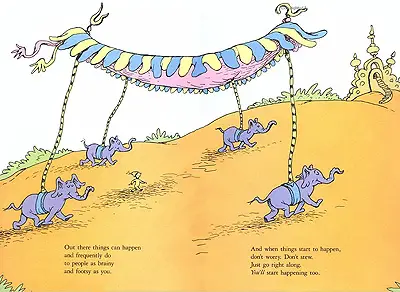
I also greatly enjoyed Dr Seuss's immortal Oh, the Places You'll Go, which has everything you need to know for a life on earth. See also: Vonnegut's Timequake.

***

Thanks for reading.