Showing posts with label theatre. Show all posts

Wednesday, 20 December 2017

Review of 2017: Part 2 – Live


I'm not blasé about how lucky I am to have the job I do, to live in London, and to have just enough money to go to some incredible events (provided I don't go on holiday, and shop at Aldi quite a bit). In 2017, I've strolled around the Royal Albert Hall auditorium laying out Santa hats as Chrissie Hynde sang '2,000 Miles', gone for an extended drink with the Pern team after a day of filming with Christopher Eccleston, Paul Whitehouse and Nigel Havers, met Billy Bragg (straight in at #1 on the Nicest Celebs spreadsheet) and been to a celebration of Joe Orton featuring his sister Leonie, Kenneth Cranham and John Lahr. I've seen Allison Anders talk about Gas, Food Lodging, Bruce Robinson and Richard E. Grant discuss Withnail & I, and Kazuo Ishiguro reveal a deep love of screwball comedy. And through jobligations and a fast finger on the F5 button, I've been fortunate enough to go to the BAFTAs, Oliviers, the London Film Festival and the athletics world championships, and to see John Grant interview Elizabeth Fraser. It's been a bit daft.

That's everything that doesn't fit into my rigorously regimented Part 2 of the Review of the Year, which is split into Gigs, Shows and Exhibitions:

Gigs


12. The Best of Elmer Bernstein (June, Royal Albert Hall) – A fantastic concert showcasing Bernstein's pioneering work in everything from epics to comedies, Westerns to romances, and nature documentaries to sweaty, cynical, claustrophobic fag-end noirs. It was cosy, conversational and emotionally overwhelming in turn. Bernstein’s rhapsodic homage to/pastiche of classic Hollywood music – evoking the very history of Hollywood and composed for a ‘60s TV show called Hollywood and the Stars – was a revelation, captivating me with its sweeping, Steiner-esque beauty. Full review.


11. Martha Wainwright and Ed Harcourt (February, The Roundhouse) – An often brilliant evening in the company of one of the 21st century’s most compelling performers. Her new record is patchy, but she is such a mesmerising performer that she can wring brilliance from almost anything, her hips rotating sensually, her foot coming off the floor and her knee up towards her chest again and again in a mannerism that seems both inexplicable and inevitable, as much a part of her act as her easy humour, constant between-songs swearing and that unapproachable voice, racing over the octaves, blasting the roof off the Roundhouse or staying husky, deep and disgruntled somewhere in her larynx. Leonard Cohen’s 'Chelsea Hotel #2' is the highlight: among the most remarkable things I’ve ever seen or heard, at a gig or anywhere else (even after a false start in which she leaps straight into the second verse). At one point she’s crouched on the floor, her voice somewhere in the rafters, her heart somewhere in Hell. There are versions of it on YouTube, one from 10 years ago, another when she started doing it again live in December – clutching a lyric sheet, skitting around the tune – but nothing will ever come close to the way she sang it that night in February. It was revelatory. Full review.


10. The National (September, Hammersmith Apollo) – The best band since Suede (it's true, check your paperwork), and one of the most viscerally exciting live acts around. After three solid years of touring Trouble Will Find Me, they seemed keen to get away from it, delving further back into their catalogue and playing nearly everything from their new record, Sleep Well Beast. Highlights were a blistering 'The System Only Dreams in Total Darkness', a hushed, harmonised 'Dark Side of the Gym' featuring support act This The Kit, and a brass-backed take on that stuttering, syncopated hymn to escapism in a hellhole, 'Fake Empire'. My only quibble is that Matt Berninger, one of the most gifted lyricists of his generation and a dynamic stage presence, can't sing in tune live. It's not that hard.


9. Jens Lekman (March, Oval Space) – Glorious. Imagine how good he is when he doesn't have the flu. Full review.


8. David Ford's Milk and Cookies (December, Bush Hall) – Every Christmas, the protest-singing multi-instrumentalist puts down the economics textbook and plays a covers show for charity. Milk and cookies are on sale from a table at the back. This was the first time I'd been (though I've seen Ford live twice before), and it was a total joy, Ford effortlessly judging the mood as kicked off with 'Free Fallin' ', put his heart into a Whitney cover ('Didn't We Almost Have It All'), and played a joshing bromantic duet with Tom McRae (John Waite's 'Missing You'), between self-penned classics and randomly generated 'requests'. At one point, he asked the audience to sing a succession of notes, then used them as the synths for an inspired take on 10cc's 'I'm Not in Love'. What a treat. See you next year. I've put up a setlist (from memory) here.


7. Mike Heron and Trembling Bells (August, Cafe Oto) – As I said in the books review, my summer was commandeered by a burgeoning infatuation with the Incredible String Band. Robin Williamson's show at a Putney pub was distinctive and enjoyable, but ISB-free and dragged down by his wife's tuneless vocals. That felt in keeping with his character, and so did Mike Heron's hits set, backed by Glasgow folk-rock outfit, Trembling Bells. After support by a bad poet and a good young folkie, they took the stage for eight Incredible String Band numbers, including mesmeric versions of 'Douglas Traherne Harding' and 'A Very Cellular Song', probably the best thing Heron ever wrote. Pushing 75, he couldn't take a lead on all the numbers, so a backing singer unconvincingly deputised on 'Maya', but his voice has held up pretty well, and there's no questioning the enduring, singular quality of the material, nor the talent of his polished but flexible ensemble. He ended the show by duetting on the ISB rarity, 'Bright Morning Stars', with his daughter. Immediate reaction.


6. Yasmine Hamdan (March, Scala) – Every time I see her live, Lebanese electro-grunge pioneer Yasmine Hamdan features in this list. She topped it in 2014. The crowd was full of people farting and petting, but the performance itself was packed full of Hamdan's easy sensuality, instinctive creativity and megawatt charisma. The aftermath was somewhat spoiled by Yasmine not remembering me (we once hung out for like three hours) and then proceeding to offer me a fist-bump, which I misjudged and shook hands with. I can hear you cringing from here. Full review.


5. Susanne Sundfør (October, Union Chapel) – For me, one of this year's happiest musical discoveries, along with my numbers 10, 7 and 1. I saw her at the Scott Walker Prom in July (more of which later), and quickly became besotted. Y'know, musically. This show at London's most tranquil, atmospheric and welcoming venue (though the pews aren't ideal if you're a handsome 33-year-old press executive with a bad back) leant heavily on her new record, Music for People in Trouble, and its stylistic siblings: songs like 'Walls' and 'The Brothel', introspective, teasingly extroverted synth-folk ballads a world away from the stomping electro-pop of 2015's irresistible Ten Love Songs. Occasionally the show dipped into plonky nothingness, but there were stand-out moments from 'Reincarnation' to Paul Simon's 'American Tune', and when Sundfor rips the lid off that extraordinary voice for 'Trust Me' (a heart-stopping version) and the year's best song, 'Undercover', there's simply no feeling comparable.


4. John Grant (May, Union Chapel) – My first ever visit to Union Chapel was to see Review-of-the-Year stalwart John Grant, staying true to his reputation as rock's nicest genius with a charity show (to fund a kidney transplant for his friend Oleg) full of rarely-aired fan favourites ('Global Warming', 'You Don't Have To') and definitive versions. His 'Glacier' was the greatest I've ever heard, and I've seen him duet on it with Kylie. Full review.


3. Seu Jorge (May, Royal Albert Hall) – I loved The Life Aquatic from first sight, and one of its great joys is the Seu Jorge soundtrack: Portuguese-language covers of Bowie songs that give it so much of its poignant, perfect atmosphere. This year he toured those songs for the first time, pitching up at My Office for an intimate, conversational show. It was uplifting, unique, but deeply moving too: speaking very personally to the sell-out crowd, many of them sporting those iconic red beanies. “I am glad to see so many members of Zissou Team here,” says Seu. (A Team Zissou member calling Team Zissou 'Zissou Team” is the most Team Zissou thing ever). When a hidden screen comes down and his backdrop is The Life Aquatic and you realise that though it’s only 13 years, it’s already 13 years, and that the passing of time set to music is a rhapsodically poignant thing. Full review.


2. Prom 15: The Songs of Scott Walker: 1967-70 (July, Royal Albert Hall) – Perhaps the best show I've ever seen at work, a stunning reinterpretation of Scott Walker's early solo work from four of the most distinctive musical voices of later generations. Backed by Jules Buckley's impeccable Heritage Orchestra, each brought something different to the show, representing a different facet of Walker's mercurial persona: John Grant power and eloquence, Richard Hawley an urgent, tuneful melancholy, Jarvis Cocker a stage presence in place of the voice required to do Walker's songs justice, and Susanne Sundfør the insolent sensuality and super soaraway top notes. I'd come for Walker and Grant, but left as a Sundfør superfan. I first saw her in the soundcheck, doing something strange to 'The Amorous Humphrey Plugg'. By the end of the song I couldn't wait to hear more, and when she stepped out to sing it in Bond-theme style that night, I was just a foot away. It damn near lifted me to the ceiling. You can watch it here.


1. Father John Misty (November, Hammersmith Apollo) – In which the psychically tortured confessional artist puts on the most joyous pop concert of the year. Full review.

Would you like some more? I've written about plenty of other shows, from Jackson Browne being pretty damn great to Angel Olsen being pretty damn poor, and Richard Thompson not really being arsed.

Extra bits: Here are the best three pieces I wrote for the Royal Albert Hall blog this year: - My best pun of the year headlines this piece about Elmer Bernstein's greatest hits - Go behind the scenes at the filming of Brian Pern: A Tribute - And, after the untimely passing of the great Tom Petty, I wrote about seeing him live in 2012

***

Theatre


Yes, I like this sort of thing, what exactly is your point.

7. The John Wilson Orchestra presents Oklahoma! (August, Royal Albert Hall) – This counts, right? A semi-staged performance of Rodgers and Hammerstein's morally incomprehensible 1943 musical, in which the hero decides that a mentally ill love rival who owns pornography doesn't deserve to exist, and tries to convince him to commit suicide. Helluva show, though, powered by John Wilson's tight, exuberant orchestra, as a first-rate ensemble conjured Oklahoma from thin air with the help of a washing line, a couple of chairs, and impeccable song-and-dance smarts. Robert Fairchild was unquestionably the stand-out, but a mention too for Marcus Brigstocke. When I heard he was in it, I thought that was funny. It wasn't, but he was. I'd forgotten too how much great music there is in Oklahoma! I'll always prefer Rodgers and Hart to Rodgers and Hammerstein, but I prefer Rodgers and Hart to most things.


6. An American in Paris (March, Dominion Theatre) – An explosive, intelligent stage version of MGM’s 1951 masterpiece, direct from Broadway, which sags now and then in its book, but offers unmissable entertainment of a type rarely seen in the West End. It was the first night too, so Leslie Caron turned up to take a bow. Full review.


5. Girl From the North Country (July, The Old Vic) – A jukebox musical of Bob Dylan album tracks, allied to a Depression-era melodrama, and nearly as good as that sounds. Its greatest virtue was Shirley Henderson's performance. I've never been that taken with her, seeing her in films, but she had such a presence and physicality, flitting between pitiful and sensual, rabid and comatose, that I was transfixed. Though I tend to have a problem with portraits of mental disintegration which are big and tic-laden (as the journalist Tim Lott once wrote, a realistic piece of fiction about mental illness would just be very boring), this one managed to be funny, intelligently allegorical, moving and somewhat unpleasant, without traversing into unbelievability or hysteria, while her moments of lucidity unveiled an unexpectedly beautiful voice, shot through a Scandi-Minnesotan lilt. It was her, the songs and the atmosphere of quiet desperation that stayed with me, but mostly her. Full review.


Pennycooke as the dandyish Francophile, Thomas Jefferson.

4. Hamilton (December, Victoria Palace Theatre) – The top four could be in any order, really: I've been incredibly lucky to see four shows so thrilling and affecting in a single year. Lin-Manuel Miranda's Broadway sensation makes it to the West End in considerable style, delivering for an audience so hyped that they were whooping with barely-contained delirium when the lights went down. The writing is magnificent – two small moments that just blow me away are Lafayette's appearance in 'Guns and Ships' and "... we dream in the dark for the most time", a wail of impotence in the stand-out number, 'The Room Where It Happens' – and the staging and playing aren't far off. Rachel John (as Angelica) and Giles Terera (as Aaron Burr) are both incredibly classy performers, and there's explosive, pint-sized support from Jason Pennycooke. The West End audience seemed to retain its comfortable fondness for warbly show tunes (the cheesy if unquestionably effective 'One Last Time') over lightning-paced wordplay, but the atmosphere was something special all the same.


3. Angels in America (July/Aug, National Theatre) – The first half, Millennium Approaches, was astonishing: a clear-headed, literate and ambitious piece of art, lit by the NT's masterly, expansive stagecraft and a stunning ensemble. Part two, Perestroika, wasn't quite in my sweet spot, its abstract and metaphysical elements sometimes more confusing than compelling, but taken as a whole it was a vivid presentation of an extraordinarily ambitious, eight-hour play, with a sprawling focus but an enduring, unblinkered humanity. The performances from Nathan Lane (as Trump's mentor, McCarthyite lawyer Roy Cohn), Denise Gough and the relatively unknown James McArdle were absolutely terrific.


2. The Ferryman (August, The Gielgud Theatre) – What I always imagined theatre might be, and yet rarely is: both political and personal, with a specificity that gives it its universality, and a crackling, super-charged atmosphere that here buzzes with desperation, danger and the particular energy of unspoken love. Written by Jez Butterworth and directed by Sam Mendes, it stars Paddy Considine as a former IRA heavy whose tranquil farm life remains in the shadow of his brother's unresolved disappearance, setting up your expectations only to subvert them or – in the case of a moment of lucidity amidst the fog of dementia – time and heighten cliche with such effortlessness that it works just the same, before a descent into inevitable, ironic violence. Everything about the play is first-rate, but especially Laura Donnelly as the missing brother's wife. The play was based on Donnelly's own experiences, and her knife-edge performance is warm, tortured and erotic – sometimes all three at once.


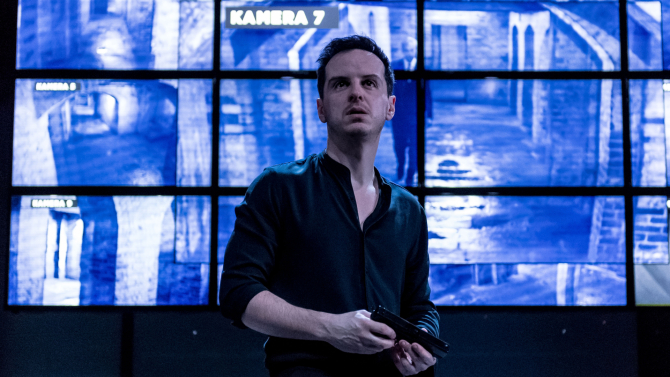
1. Hamlet (April, Almeida Theatre) – Andrew Scott's Hamlet is the best I've seen − probing, philosophical, introspective and bitterly witty − and this intimate, innovative, cleanly modern production rises to meet him, keeping your attention rapt and your emotions engaged. He's also the first to whom I've felt a natural and personal connection, and it runs deep. He's groping in the dark, beset with an impotence of action from which he's trying to rip himself free, questing for self-knowledge, while praying for a relief from it. He's an existential Hamlet: thoughtful, melancholy, feeling deeply, a decent, anguished, emotionally tender Prince with an adolescent's loathing of hypocrisy and duplicity, a child's guilelessness, and a self-loathing born of immobility in the face of dishonour. In pegged black trousers and a collarless shirt, barefoot or in shiny black shoes, stripped to a vest highlighting his voluminous biceps, or dressed in cream and white for the graveyard scene, the wiry, wild-eyed Scott commands the stage, and all of your attention. Full review.

***

Exhibitions


"The bees are getting suspicious." My favourite exhibition of the year is on until April: the V&A's wonderful Winnie the Pooh: Exploring a Classic, which approaches its topic from the angle of E. H. Shepard's perfect illustrations. That was presumably through necessity, as Shepard's drawings are part of the museum's collection whereas the smaller number of Milne items are borrowed, but it offers a fascinating new perspective on the works, examining Shepard's preparation (sketches from life in the rural locations), his subtle tricks (lengthening Piglet's snout to bury it in a balloon, showing his ears streaming back in the force of a gale) and his genius, while celebrating a creative marriage of two forceful, remarkable talents that extended to the artistic layout of the text, which echoed and so enhanced the stories they were telling. Don't miss the little side-room which takes that one step further! The rooms are full of life-size recreations of the drawings, including a Poohsticks bridge with an electronic river, and of remarkable insights and artefacts. The best are the alternate, unused Shepard sketches, among 270 drawings that he donated the museum in 1973. What I also found fascinating, looking at a gallery of later Pooh editions illustrated by Shepard, is that it was only in his dotage that his colour portraits began to work. His watercolour paintings, at least in these reproductions, seem blocky and charmless, but when he returned to the subject in his eighties, his eyesight failing, he opted instead for simple washes over his old ink drawings, and it's those indelible editions (making Pooh's jackets red, where sometimes they'd been blue) which have become definitive – and rightly so. There are a few references to the abhorrent D*sney bastardisation of the books in the opening room, but otherwise we're fine.


Grayson Perry's small-scale offering at the Serpentine Galleries, The Most Popular Art Exhibition Ever!, made me very happy: a sly, self-referential and extremely funny collection, from a vase decorated with delicately hideous cartoons of the Brexit mob to a tooled up motorbike for his teddy bear and (my favourite), a pastiche of miners' gala banners that contrasts the vilified 'archetypes' of the contemporary working class with the hazy image of their forefathers' macho monochrome nobility.


I saw two great exhibitions at the British Library, as well as their enjoyable Harry Potter one: a collection of Jane Austen's teenage writings in the Treasures gallery, and a fine study of the failed communist experiment – already in tatters by 1920 – in Russian Revolution: Hope, Tragedy, Myths. The Imperial War Museum's People Power exhibition was impressive, multi-faceted and a little unfortunate in having to follow the V&A's Disobedient Objects, which is one of the best exhibitions I've seen since moving to London, and dealt with a similar theme: public protest.

If you like the idea of going into a warm hut and trying not to stand on some butterflies, then I'd really recommend the Natural History Museum's ever-popular Sensational Butterflies (seriously, it's terrific).


My favourite of the art exhibitions was Tate Modern's Soul of A Nation: Art in the Age of Black Power, which had its philosophically impenetrable collections of twigs, but also works like Benny Andrews' provocative, 'Did the Bear Sit Under a Tree' – with its challenging, tactile 3D created partially by using an everyday zip for a mouth – and Betye Saar's 'Sambo's Banjo', its gaudy exterior covered in the infantilising, dehumanising racism of a blackface caricature, while its inside contains a black figure strung up for a lynching. Saar said, though, that the plight of the black man in America was not hopeless, destiny was in his hands, and so a sniper rifle lies within reach, waiting for him to free himself. I was less enamoured of the Rauschenberg exhibition, though it contained the greatest factual description of an artwork ever written, though American Dream at the British Museum got me thinking about the ways we see America, and the ways it sees itself.

***

Thanks for reading.

Wednesday, 12 July 2017

REVIEW: Angels in America − Part One: Millennium Approaches at the National Theatre

Wednesday 12 July, 2017
*A FEW SPOILERS*

You can see the play at the National Theatre (a limited number of day tickets are available for every performance, on sale at 9:30am beforehand), or via NT Live.


I only knew this play from one scene, the highlight of NT50, a decidedly patchy nationally-broadcast celebration of half a century of the National Theatre, which proceeded to confirm to half the country that they really don't care for theatre. In it, Andrew Scott's fey, muscular, aloof Prior teases his lover Louis (Dominic Cooper) about becoming the butch "Lou" when he's around his own family, before revealing that he's dying, via the sudden exposure of the lesion on his arm. The way the scene shifts from catty camp to stoical sincerity, via linguistics, Judaism, death, seeming to cast its net so wide across the gay experience, marked it as a piece of urgent, intelligent, human writing, and confirmed what has been readily apparently to those more knowledgeable than me for years: Andrew Scott is quite something.

Now Tony Kushner's play is back at the National Theatre, where it premiered to UK audiences in 1992 a year after its American debut, with Andrew Garfield in the Scott role and James McArdle in Cooper's, as part of an ensemble featuring Russell Tovey, Denise Gough, Nathan Lane and Nathan Stewart-Jarrett.

It's billed as 'A Gay Fantasia on National Themes', and that's about the size of it: a waspish, tender and abstract state-of-the-union address, full of hallucinations, flights of philosophy, self-reproach and humour − it's far funnier than I expected − but completely sure-footed, never spinning into self-indulgence or triviality, and with such a variety of ideas, jokes and language that it reminded me of Truman Capote at his best. Set beneath the neon striplights of an unforgiving New York, a sort of Hell, haunted by the spectre of the AIDS pandemic as the Millennium Approaches, it follows a vivid assemblage of damaged souls, from Gough's valium-addicted housewife, hiding from an abusive childhood, to her closeted, straight-backed husband (Tovey) and his father figure, Roy Cohn (Nathan Lane), a genuine figure in 20th century American politics, who trained under Joseph McCarthy and mentored one Donald J. Trump.


Cohn, as envisaged by Kushner, is a brilliant character, and this is a simply brilliant characterisation. On one level he is so clear and commanding, so assured, so rendered in coal-black and Vanish-white, an unshakable monolith rooted in an immovable Americanism, and yet there are layers within layers, so many of them grey, and each lit up by the scene, and by what Lane seems to play between the lines. We see him first as a sort of barking barrel on little legs, roaring into his phone like a wackily irascible '30s screwball character. That blustering fury is part of his persona, but the blistering, hollering rage that comes later is part of his personality. Cohn seems at first full of contradictions, but they're not contradictions, they're contentions as firmly held as his believe in robust, right-wing America. He loathes traitors, but sees his disavowal of his orientation not as a betrayal of a community to which he doesn't believe he belongs; for him, betrayal would be accepting the lowly, put-upon place of the 'homo' in American life. And so, as he explains to his doctor (Susan Brown): "Roy Cohn is a heterosexual man, Henry, who fucks around with guys." The awesome power and nimble timing that Lane brings to this role is extraordinary but, like every element of this production, it's regimented and restrained, part of a whole that moves sleekly and sublimely.

McArdle is excellent too as Louis, a verbose, liberal Jew whose idealism is tempered by a pragmatic discovery of his own limitations that saturates him with self-loathing, and unbearable guilt. His chemistry with Garfield is tender, his deftness with quickening streams of political consciousness is a feat of admirable, involving plate-spinning, and his emotional connection with the audience allows us into a character conspicuously lacking in heroism.


Garfield's role is more obviously showy, and his performance attracts superlatives, but he refuses to play Prior as a straightforward martyr. His Prior is effete, sensitive and even profound, with a natural grace and an affected gentility. He's also this first half's great victim, transfigured but more often disfigured by his disease, by mental torment and physical degradation; a character defined by his beauty, with an illness that's ugly and unforgiving. Stricken, with lesions on his skin; pouting, dressed as Norma Desmond; barking wordplay on a bench; reclining like a dying Greek God on a hospital bed, his homosexuality or his illness make him irresistibly otherworldly, touched as if by some secret spell. But in this first half, Prior is also slightly silly: a shrieking, bitchy, tart, vain queen (played without an ounce of vanity), and Garfield never loses sight of that dichotomy.

By contrast, Tovey's Joe is a model of Reagan-era repression, a clean-cut, ambitious forceful 'nice' guy struggling to reconcile his sexuality, his morality and the sphere in which he operates. I was a bit of a Tovey agnostic before this (I believe he exists, I just wasn't sure if I was a fan), but he struck just the right tone, and continued striking it with just the right variations. As his tortured wife, Harper, slipping from her pained existence into the welcoming embrace of fantasy, Denise Gough matches him: we want to protect her character from this self-destructiveness, we want her to be happy, or content, or free, but we also want her to stop lying.

But while Louis spouts democratic rhetoric, Joe voted Republican and Belize (Stewart-Jarrett) listens − boiling − to Louis' description of a post-race America, these characters are not conduits or manifestations of political positions. They're people who have ideas, not people who represent ideas. That's why they feel real. I also loved the way that Kushner's language is attuned to his themes, and that those themes are so wide-ranging and yet so specific. Millennium Approaches cast its view across a broad scope of American history, takes in all areas of American society, and then goes broader still. Without labouring his points, the playwright can evoke the ethnic cleansing of Native Americans, the rooting out of communism, the endemic racism against African-Americans, the self-satisfied, unthinking, privileged, hostile 'niceness' of Reaganite Washington, and the hole in the Ozone layer that no-one but the emotionally damaged gives a shit about, without having to ever compare any of these, explicitly, to the plight of gay men during the AIDS pandemic.


Cohn and Trump

This revival is valuable too in reading present-day America. The people Cohn worked for (and namechecks) characters were − like Reagan −both political and pop cultural, celebrities who became celebrities because of their political power, and whose celebrity caused that power to increase exponentially: gossip columnist and commentator Walter Winchell, FBI chief J. Edgar Hoover, and red-blooded, red-hunting senator, Joseph McCarthy. All fine Americans, celebrated in their time for their strength, their weeding out of hypocrisy, and their obsession with the morality of private lives or of private political beliefs. Trump, though he's thick as shit, is a tub-thumping populist whose Americanism is similarly uncomplicated, and whose major calling card has been a ubiquitous celebrity, though he doesn't have the same concerns Cohn does about state officials being under Russian control. Nor is Trump's malevolence coated in the unwavering 'niceness' of Reaganism − who made people feel good about themselves, then looked the other way − it is sheer, toxic nationalism, which makes him more the heir to McCarthy and Cohn than Ronnie ever was. As much as anything, this is a play about both the ruinous effects of privilege − in which even a gay Jewish man whose lover is dying of AIDS cannot attempt to comprehend the African-American experience − and the blinkered guilt-saturated selfishness of '80s America ("All of us... falling through the cracks that separate what we owe to ourselves and... and what we owe to love," as Louis puts it). President Trump is both the scion and the defender of unthinking, uninvestigating privilege, while Reagan's America was the self-serving economic playground in which he began to pave his path to the White House.

As it contemplates these characters and draws those from history into its realm, its sprawling tentacles make the play feel like something in a hidden American tradition, the way Todd Haynes' Far From Heaven reinserted the nation's censored stories into '50s melodrama. It looks forward, back and around: absorbing the past (Jewish mothers carrying their world on their backs to the New World), staring dumbstruck at the present, and forecasting − via Cohn −a dominant Republican future, anticipating today's horror show, but little-knowing that the play's pop-culture savvy (with nods to Rosemary's Baby and The Exorcist) is probably going to be more valuable in understanding it than any knowledge of Washington history.


The play's stagecraft impeccably mirrors its subject matter. At first it's compartmentalised in three small sets (left, right and centre), its characters boxed off from one another, trapped in lives that are about to upended. Later the characters shout across one another: as they open up, so does the set, setting into motion the "connectedness" of which Louis speaks. Finally, the scenery moves back to make the most of a vast stage, as Garfield's descendants (a hilarious, Very Yorkshire Tovey, offset by Lane as a preening, powdered fusspot) pay him an unwelcome, hallucinatory visit, Gough retreats from her kitchen floor to see the Ozone layer up close, and Moon River pipes up from somewhere giving us a hint of a Hollywood ending as false as those always are.

I can gaze perplexed at some gay culture − when it's gaudily sleazy, I tend to feel either disinterested or uncomfortable; at others times I find its reductionism baffling, seeming to define gay people only by their gayness − but I suppose this is like how those who are LGBT might enjoy the album Liege and Lief but hate Transformers, the defining criteria of the art isn't the sexuality underpinning it, but whether it's really good or rubbish. You'd have thought a Corbyn voter would have known that.

One line in particular ("You're old enough to understand that your father didn't love you without being ridiculous about it") makes a dizzying comic leap that brings understanding and recognition in lapping waves of laughter, having audaciously vaulted over the expected exposition or consolation to land effortlessly on its feet.

I was blown away by Angels in America: this clear-headed, literate and ambitious piece of art; by the precision and variety of its ideas, the breadth of its imagination, the variety of its expression (in language alone, it moves from absurdity to knowingly long-winded verbosity, to wit, to caustic one-liners, to an unexpected bluntness that really works in such small doses), and by how unexpectedly enjoyable and funny and entertaining it was. Only a month to wait till Part Two. (4)

***

Thanks for reading.

Friday, 19 May 2017

REVIEW: An evening down the culture wars

The Girls (Phoenix Theatre)
Thursday 18 May, 2017


This is so, so Brexit. Gary Barlow’s musical version of Calendar Girls is fine-tuned to within an inch of its life, evoking a world and espousing a worldview that’s both seductive and abhorrent. It’s a hymn to a vanishing Britain – rural and nostalgic, where everyone knows everyone, and everyone is white – but it lacks the poetry or radicalism of the pastoral: it’s cloying and self-involved and almost context-free, lacking in proper principles beyond the ones you might find in the Conservative Party manifesto, and with a sense of community where there used to be a sense of society (cast member James Gaddas was a Tory PPC in 2005, so he should know all about it). The Girls is like Brassed Off for Leave voters: a safe, convivial, reassuring evening’s entertainment for people who look like the characters and think alcoholism is funny, and an ode to the crushing mediocrity rapidly consuming British culture, in both its music and its broad, blunt, saucy-seaside-postcard sense of humour. These characters aren’t really interested in politics, but they’ll vote Tory because they always have, and because you know where you stand with the Tories, and they’ve always done alright by us, and didn’t Corbyn say something about the IRA and wasn't that was dreadful, because I was around then and I remember what it was like. It’s a show of girl jobs and boy jobs, where hospitals should be paid for by charity, and the score is written by a tax avoider.

And yet, after 20 minutes of hating it, I began to come around, at least a little. From the moment that Claire Machin disappeared into her skirt for an exceptional piece of clowning on the knockout number ‘Who Wants a Silent Night?’, I started to forget that we’re in the middle of a culture war, and remembered that I was allowed to have a nice time, and a break from a hectic week at work. Having said that, the part of the show that really works is the hard part. The heartbreaking part. Torn from real life. Annie (Joanna Riding) loses her husband, Clarkey (Steve Giles) to cancer, and the play makes you feel the weight and the sorrow and the injustice of it. The way it's realised is very middle England, the lyrics evoking a world of duvets, margarine and Tesco trips that’s more Daily Mail than Ray Davies, but it's also moving and genuine and wonderfully played, with the two actors effortlessly stealing the show. That sincerity and emotion should, in principle, juxtapose perfectly with the humorous sequences that rub up alongside it. But they don’t. There are a handful of very funny moments, largely from Machin and young cast members Ben Hunter and Josh Benson, but most of the humour is really loud: inane, broad-brush joshing – the kind of thing you see on Loose Women or in an above-par Carry On… film, or when a hen party is on your train.


Chloe May Jackson, Ben Hunter and Josh Benson, the latter two providing many of the funny bits.

As you may know, Annie – encouraged by her free-spirited friend Chris (Claire Moore) – decides to make a nude calendar with her friends in the Women’s Institute, to raise money for a new sofa at the hospital where her husband died (I presume it hadn’t been replaced for several years due to 18 years of chronic underfunding of the health service by successive Tory governments). Along the way, they fight, squabble, banter and heal, while facing a cartoon baddie (Marion McLaughlin), assorted familial troubles and the personal demons of their WI friends. And we get a succession of Gary Barlow tunes – with pleasant if uninspired melodies, and wildly variable Tim Firth lyrics – before plot threads are tied and the cast take their clothes off behind pianos, flowers and currant buns, and the audience whoops and hollers, and a standing ovation breaks out. And in the end I kind of enjoyed it, because I like the theatre, and there were just about enough hummable songs and incidental funny bits, and Riding was very good, and her scenes with Clarkey stick in my mind because they brought a lump to my throat, and the second half was much more entertaining than the last act of King Lear at The Old Vic last year, which troubles me immensely. And though it’s set in a Paul Dacre wet dream of a small-town idyll, and the characters are cartoon Yorkshire people, and they’re the kind of cartoon Yorkshire people who actually exist, because they find the stereotype so alluring, and I’m going to have the burn the book to this show once the culture war hots up, it was a hell of a lot more enjoyable than I expected after those first, joyless 20 minutes, when I’d begun to question many of the life choices that had brought me to this point.

Having said all that, think how many hospital wings we could build if Gary Barlow just paid his taxes. (2.5)

***

Thanks for reading.

Saturday, 15 April 2017

REVIEW: Hamlet at the Almeida Theatre

Saturday 15 April, 2017 (matinee)


Andrew Scott's Hamlet is the best I've seen − probing, philosophical, introspective and bitterly witty − and this intimate, innovative, cleanly modern production rises to meet him, keeping your attention rapt and your emotions engaged.

Scott's emotions are always just below the surface. He doesn't cry on command, as such, that suggests a gimmicky or insincerity. He cries easily, his performance here studded with tears, dripping down that taut, gaunt, pouting face as the veins stand out in his neck. Those tears of rage, self-loathing and simple sorrow are where you go when you've run out of words. For Bob Dylan, that place was always a harmonica blast, and Dylan's the only soundtrack we get here: One More Cup of Coffee commenting on mortality, Spirit on the Water signifying a party, Don't Think Twice… subtly mocking the prevaricating Prince, and Not Dark Yet striking up as the end approaches. Am I wrong in thinking that the coda slyly winks at another track from Dylan's Time Out of Mind, as Claudius tries to get to Heaven, before they close the door.

Where the Barbican's production with Cumberbatch in the lead was flaccid, distant and long-winded, the Almeida's takes place in your lap, feels pared down to its essentials − old and newly discovered − and in its music, projections and manners feels like a Hamlet for this cynical century, its protagonist pained, tired and wired, a gentle, melancholy man wrestling endlessly with his burden, every nuance intriguing and every line seeming to be thoughts that are just occurring to him now. For the first time, I felt I was watching a Hamlet who seemed to be discovering the story as we were, lessening the play's fatalistic foreboding and making it a personal human drama, not a grand, portentous charade.

At times, Cumberbatch tried buffoonish, crowd-pleasing comedy, prancing around in a toy soldier's hat. Scott's Hamlet is nimble, knowing and drily funny, his sarcastic barbs all the funnier because he's so thoughtful, and so thoughtfully self-critical. When he's consumed by anger, it's not theatrical grandstanding, it comes from deep within, from unease that's revealed as insight, and a faltering self-knowledge that explodes into epiphany. Here, what was literal in Shakespeare shadows the psychological forces buffeting the hero: Hamlet is cast on a boat towards England, as his soul is tossed on roiling waters; his father appears thrice as a spirit, as the looming spectre of betrayal stalks our hero. And he is a Hamlet systematically if not always wittingly betrayed: by his murderous step-father, by his incestuous mother (Juliet Stevenson), by the former schoolfriends of the Prince whom they effortlessly seduce to their side, by the chummily meddling, foolish Polonius, and by Ophelia (Jessica Brown-Findlay), who seeks to help her father resolve Hamlet's loss of mirth, and instead drives both of them towards insanity.


Jessica Brown-Findlay as an affecting Ophelia, with Peter Wight her foolish father, Polonius.

The stage is just three stubby, fat steps up from the stalls: we may as well be in a living-room. In fact, we are, or at least in Elsinore's coldly comfortable quarters, coolly-coloured IKEA-like furniture close to the faux-marble floor that doubles as a CCTV headquarters, a hall and a graveyard. The use of video screens (one large and temporary, a smaller one at either side) feels unusually seamless and natural: occasional footage from a sort of Danish Sky News updating us on funerals, battles and the like, and − when the cast sit with the audience to watch the pivotal play-within-a-play − showing Claudius's reaction to Hamlet's incendiary self-penned script. After the first interval, the screen is unpaused, then exquisitely 'malfunctions' as Claudius enters, spewing out close-ups of his guiltily contorting face.


The players scenes, mercilessly and mercifully pruned to perhaps three-dozen lines (and complete with Scott's parody of declamatory acting), are illustrative of a brilliant reshaping of the text. Robert Icke's production uses modern dress and is tooled specifically for modern tastes, zeroing in on the characters' emotions, their inner conflicts and their reasons for those conflicts, and junking everything that's long-winded, extraneous or a bit stupid. It retains enough of the players to accentuate some of Shakespeare's commentary on the truthful artifice of theatre − in Scott's hands, a pithy, meta thing − to energise its hesitant hero, and to cast light on those who surround him, and that's it. Here, Hamlet's 12 lines inserted into the action to gauge his stepfather's reaction are not a threat or a test of Claudius's temperament, but solely for the prince to ascertain the suspect's guilt, or to offer His Uncertainness a way out. I'm not sure if that's always the case. If it is, then I can only say that I typically find this sequence so boring that I've never been engaged enough to realise it. And while the idea of a ghost telling his son that someone poured poison in his ear is going to be ridiculous to me until the day I die, this production is so swift in dispensing with exposition that the play's other improbabilities become part of a credible, compelling whole.

That's certainly true of the final scene, which is showy, spontaneous, gripping, wryly funny and deeply moving, before passing into a rhapsodic fantasy, then snapping back to black and gutting tragedy. At the Barbican, it felt like a laughable orgy of improbable deaths. Here, the human cost is vast and epic and inevitable in the context of the action.


Scott's Hamlet is the first to whom I've felt a natural and personal connection, and it runs deep. He's groping in the dark, beset with an impotence of action from which he's trying to rip himself free, questing for self-knowledge, while praying for a relief from it. He's an existential Hamlet: thoughtful, melancholy, feeling deeply, a decent, anguished, emotionally tender Prince with an adolescent's loathing of hypocrisy and duplicity, a child's guilelessness, and a self-loathing born of immobility in the face of dishonour. In pegged black trousers and a collarless shirt, barefoot or in shiny black shoes, stripped to a vest highlighting his voluminous biceps, or dressed in cream and white for the graveyard scene, the wiry, wild-eyed Scott commands the stage, and all of your attention.

Occasionally he ventures forth with his finger and thumb in an 'O', reclaiming the gesture from Donald Trump, and putting it into the service of poetic precision as he wonders at what a piece of work a man is. He blasts his arms skywards, showering the stage with spit as he finally shakes off the shackles of inaction. And he toys slyly with Polonius, outfoxing him amiably as the darkness sets in around Hamlet's heart. Elsewhere he is fleet of foot, touchingly tentative and uncertain ("To be… or… not to be) or sardonic, turning the Dane's usual contemplation of mortality after the revelation of Yorick's skull into something more offhand, spiky and yet strangely affecting, the dust pouring from the eye-sockets as he at first calls with an amazed amusement: "Alas, poor Yorick...", then muses: "Here hung those lips that I have kissed I know not how oft. Where be your gibes now? Your gambols? Your songs? Your flashes of merriment, that were wont to set the table on a roar?" Its nostalgia for childhood for once outweighs its macabre portents, which chimes beautifully with this innocent Hamlet who seems not to know what awaits him. The spontaneity of the delivery, the lightness of touch, and the play's scope but specificity of humour seem to all play into it, and so do the other performances.


Juliet Stevenson as a lustful, protective Gertrude and Angus Wright a svelte, straightforward Claudius

Peter Wight's meddlesome Polonius is unusually likeable and doltish, Luke Thompson is a spirited, dangerous but noble Laertes, and Juliet Stevenson plays Gertrude as lustful, naïve and protective, and while a couple of her actorly tricks were a little synthetic for my taste at close quarters, she does a better job than anyone I've seen of resolving the character's apparent inconsistencies, of being vain and blinkered while still "living almost by [Hamlet's] looks", and taking a bullet for her son, for all the good it does him. Jessica Brown-Findlay is a fine Ophelia too: appealingly playful, sexy and normal in the opening scenes, her sense of fun not equating to triviality, and her growing vulnerability constrained within a real character. When Ophelia does fall to pieces, a transformation intelligently rendered in stagecraft and performance, she plays mental illness credibly and compellingly, without patronising ethereality or runaway artificiality, but seriously, properly, weightily, singing a Laura Marling melody, flaring into rage, then greeting Laertes with an erotic tenderness, before dissipating into despondency. When her death comes, it's without predetermination or fanfare: all keeping with a production that thinks you haven't seen this before, because it's never happened before. Polonius's violent death too is a sudden, bloody shock that hits you hard because of its ear-splitting ferocity and because a dull-witted but good-meaning father whom we were beginning to like is dead, and not simply because Hamlet has just incinerated every bridge in sight.

Hamlet is closing at the Almeida as I write this, but it's bound for the West End later this year, and I'd urge you to see it if you can afford to. It's 195 minutes long, but it's vivid and enthralling, and consistent too, not lagging when Hamlet is off stage, as other productions do. I'd recommend it to anyone who loves Shakespeare, but I'd recommend it even more strongly to those who don't, because it filters his work unerringly through a modern sensibility, stripping away the redundant and finding resonances with the world in 2017. Like Elsinore, it's a lonely place, ruled by murderous liars, but if thou can be true to thine own self, you're halfway there. The rest you try to fill with self-knowledge, personal philosophy, friends and art.

(4) ***

Thanks for reading.

Friday, 17 March 2017

REVIEW: An American in Paris at the Dominion Theatre

Wednesday 15 March, 2017


This explosive, intelligent stage version of MGM’s 1951 masterpiece, direct from Broadway, sags now and then in its book, but offers unmissable entertainment of a type rarely seen in the West End.

We began in the tumult of postwar Paris, less the escapist playground of the film and more a ravaged battleground where demobbed soldiers try to forget the war, women feel in perpetual danger and collaborators are being beaten and getting their heads shaved. Craig Lucas’s script offers a rejigged, re-ordered narrative that adds extra Gershwin songs (the film doesn’t have nearly enough), underscores the action with a battle fatigue that accentuates its more carefree moments, and leads to a putting-on-a-ballet climax that’s imaginatively conceived in narrative and artistic terms.


Its great masterstroke is turning the sardonic narrator from the grouchy, alienated middle-aged Adam played by Oscar Levant into David Seadon-Young’s war vet (above, left), an inspired innovation that lends a far greater heft to his sequences, if rather undermining the appeal of Jerry Mulligan (Robert Fairchild), one of three protagonists now in love with the same woman, the gamine ballerina, Lise (Leanne Cope, a worthy successor to Leslie Caron). Jerry is a painter who truly cares for Lise, but when you put this character into a more realistic, grounded world of Nazis, collaborators and the battle between duty and romance, his charming rom-com stalking comes off as a little thin, selfish and, y’know, sexist. The other romantic possibility for Lise is her fiancée, Henri Baurel (Hayden Oakley), a French aristocrat who dreams of being a musical-theatre star, and who here is a nervous, cautious man with a rather abrupt back story.


Fairchild and Cope (above) both originated their roles on Broadway, and they’re superb dancers, while transmitting the basic traits that make their characters appealing: Jerry’s ease in his skin, his irreverence and athleticism, Lise’s combination of the elfin and the erotic, a latent fire burning beneath an ethereality that – like Audrey Hepburn’s – seems dictated by the privations of war. Their characterisations can’t quite bridge the shortcomings of the script (Jerry’s quite selfish, Lise is something of a cipher), but their song-and-dance talents are unimpeachable. The moment that the climactic ballet explodes into sensual life is pure exhilaration, with shades of Bob Fosse’s revolutionary, finger-clicking goodness in Kiss Me Kate. In support, Zoe Rainey makes for a sparky, hugely appealing Milo (younger, and funnier, than Nina Foch), Oakley is pretty good balancing the inconsistencies of his character, and Seadon-Young is simply terrific as the lovelorn, limping war vet who channels his unhappiness and romantic impotence into his art.

The staging is similarly superb, making the most of the stage’s depth through some striking compositions, and mixing the irregular patterns and primary colours of ‘50s art with the more impressionistic style of the MGM film, and many of its most enchanting, striking and transportative effects achieved through brilliant projections and lighting. That sense of intelligent, contextualised innovation extends to the musical numbers, which are an absolute knockout. Beginner’s Luck is the epitome of vibrant, perfectly choreographed, 1950s-style showstopping magic, as Jerry crashes Lise’s workplace at the Galleries Lafayette perfume counter, turning the room into a riot of colour, extravagant hoofing and umbrellas.


When Henri makes his live debut, we get all the art deco razzmattaz of a ‘30s Warner musical, but framed in the realism of an awkward, halting first show that explodes into fantasy. It’s lovely too that its post-modern but idealistic escapism extends to Adam losing his limp and getting to share the spotlight (though it loses a fraction of a point for Oakley being unable to hit that climactic top note, instead going down an octave). I Got Rhythm too tinkers with the film’s formula, bringing all three love rivals together for the first time and incorporating an inspired, hushed, candlelit middle-eight with diegetic sound. Character-led, grounded numbers that still thump it out of the park are about the best thing that musicals can offer, and there are several here. And though we don’t get the breathtaking Seine-side dance to Our Love Is Here to Stay that’s one of the MGM movie’s great virtues, this stage version does incorporate several Gershwin songs from other shows, including his fondest, saddest, most romantic creation – Our Love Is Here to Stay – as well as The Man I Love and, erm, Fidgety Feet. The vocals are strong while retaining a fair amount of the subtlety and personality that can be lost in musical theatre, and the orchestra is fantastic: punchy and precise, like John Wilson at his considerable best.


The show climaxes with a ballet that’s still a hypnotic fantasy of love, but now coupled with a putting-on-a-ballet climax, as Lise makes her first public performance, but can only acquire the requisite passion by calling Jerry to mind. For a little while you wonder if they’ve botched it by junking the movie’s journey through different artistic styles – though Singin’ in the Rain is now the best-loved and most-respected of all MGM musicals, in the ‘50s it was An American in Paris, and particularly this sequence, that was regarded as the studio’s supreme achievement – but with Jerry’s entrance it becomes a powerful, extremely sexy and all together beguiling proposition: the bob-haired Cope draped across Fairchild, or swaggering, shoulders-back, towards us, as he pirouettes furiously, exuberantly around the perimeter of the stage.

It’s a stunning highlight of a show that’s less slick, seamless and smooth in the book than it needs to be – the jokes are patchy, and a laboured subplot about Henri’s parents isn’t helped by shallow sentimentality and broad playing – but knows its strengths, with some intelligent weighting towards the political context, fine acting, and musical moments that are everything they should be and more. And since I was lucky enough to land a ticket for the first night, I also got to see Leslie Caron come and take a bow. (3.5)


(Pic credit: Heidi Bohnenkamp)

***

Thanks for reading.

Monday, 12 September 2016

Basia Bulat, The Entertainer and a voice you could write a book about − Reviews #241

LIVE


The Entertainer (Garrick Theatre) − It makes sense that Kenneth Branagh would close his first season at the Garrick with this: a play synonymous with his hero, Laurence Olivier. Branagh is Archie Rice, the unhappy, dissolute and past-it music-hall star Archie Rice, whose fey, innuendo-laced stylings are playing to dwindling audiences in '50s Yorkshire.

John Osbourne's play is very much of its time, but director Rob Ashford does well to mine it for its modern relevancies: patriotism, racism and the pathos of an artform on its last legs, and plays Archie as a slight, sad figure, his bags of charisma obscuring a complete lack of moral character, or really any substance at all. He's fast, erudite and fills a room (if not a concert hall) with his bravado, and his rants are more lost than vitriolic. It's a reading of the character that convinces but doesn't always lend itself to emotional dynamism, and that's problematic in a play that has some serious longueurs. On a more prosaic note, I remember reading years ago that Branagh doesn't work himself up into a teary state, but aims for the same effect through simple acting shorthand, and that synthetic approach leaves me feeling rather detached and cheated.

After a stunningly modern opening that sees a silhouetted Branagh slowly tapdancing with his back to the audience, as he's joined by four young chorus girls, we're largely trapped in a room with his family. The first dialogue scene, with Branagh's daughter (Downton Abbey's Sophie McShera) and his father (Gawn Grainger) goes on forever and has little to offer but vast swathes of unpopulated space and an oppressive mundanity. As Greta Scacchi enters as Archie's wife, Phoebe, and the star breaks off for music hall routines pitched perfectly between the dated and the devilishly good, it does begin to work up some momentum, but the first half never really hits its stride until the final seconds.

Once that happens, it doesn't lose it: suddenly it seems to have a purpose and a theme, the characters crumbling like the edifices of the music halls, their viewpoints complex but apparent, and their relationships shifting like cogs in a rotting machine. I don't rate McShera as an actor, and she speaks increasingly throughout the play with that unbearably false intonation that convinces people they don't like theatre. The other principals are fine though: Grainger's comic timing, sentimentality and irascible detachment are a joy in themselves and lend the climax a real emotional heft, Scacchi is largely terrific as a woman drunk on her own hard-luck stories, and Jonah Hauer-King is tuneful and gently nuanced as Archie's lanky son, Frank.

It doesn't ever quite hit the heights I was anticipating − and one can only imagine what John Hurt might have made of Grainger's character if he hadn't been forced to drop out − but at its best it's a valuable, fascinating portrait of the Britain that was and perhaps still is, with a commanding, committed and often brilliant performance at its centre. (3)

***


Photos by me, can you tell?

Basia Bulat (Oslo Hackney) − Barnstorming power-pop princess Basia Bulat lit up London again last week, surely confirming her status as just about the best live act around. A knockout In the Name Of, a three-song autoharp solo spot comprising Heart of My Own, Gold Rush and In the Night, a heart-stopping, brokenhearted cover of Damaged by Primal Scream, and a dizzying version of her 2013 song The Wire that concluded with her screaming into a voice distorter, it often took the breath away. She never stands still; every time, every song sounds new, thanks to her restless imagination, a Sandy Denny-like gift for reworking melodies, and that notable fondness for odd gadgets. If you get the chance to see her, leap at it. (3.5)

See also: I've reviewed other Basia gigs, at the Slaughtered Lamb (my favourite show of 2015), Rough Trade East and − best of all − Hoxton Square Kitchen. ***

FILM


CINEMA: Born Yesterday (George Cukor, 1940) − I had a rough day on Thursday, then I went to the BFI to watch this, and my worries just floated away. It's a film I return to time and again, and it always has the same effect on me.

The movie is dominated by Judy Holliday's tour-de-force as ill-educated, complacent former chorine Billie Dawn, whose gangster fiancé (Broderick Crawford) decides that she needs her edges smoothing off, but doesn't bargain for what happens next. You could write a book about Holliday's voice alone: the working class accent, the seductive impediment, the cartoonishness that accentuates the comedy but is never broad or alienating as Billie transforms from an abused adornment to a self-possessed modern woman.

Garson Kanin's script pulls a punch or two to circumvent the censors (the rogue congressman who Crawford bribes is the exception, not a rule) and William Holden's columnist − the catalyst for Billie's change − comes off as a tad smug, but it's rare to find a mainstream movie that elides so succinctly with my own views: that anti-intellectualism is dangerous, that intellectual posturing is tiresome, and that a woman improving herself for her own sake is more beautiful than if she reforms for love.

Cukor's direction is curiously drab, but almost everything else about the film works, with Howard St. John superb as Crawford's refined, self-hating lawyer, two dozen big laughs, and some eloquent polemicising that's arguably more relevant in 2016 than it was in 1950, dealing as it does with crooked lobbyists, spineless legislators and rampant misogyny.

Its greatest strength, though, remains Holliday's astonishing characterisation: so hilarious, vital, heart-warming, nuanced and specific. She would give other truly great performances, but none as great as this. People who say women can't be funny should have their eyes stapled open and be made to this film. It'll improve their Thursday. (4)

See also: This movie is in my all-time top 100, which you can read about here.

***

Thanks for reading.

Sunday, 7 August 2016

REVIEW: Groundhog Day at The Old Vic

6 August 2016, matinee


It's incredibly rare that an actor takes a role indelibly associated with someone else and makes it completely, and perhaps irrevocably, their own. But that's what's happened with Groundhog Day's Phil Connors in this musical adaptation of Harold Ramis's 1993 film, from the creative team behind the West End's Matilda. As realised by Broadway star Andy Karl − lent to the production under a special deal with American Equity − Connors is a comic whirlwind, powering a jawdropping production that's both a technical and an artistic triumph, using a rotating stage and several travelators, a song style fusing Lorenz Hart with hip hop, and an inspired broadening of its focus to wring every laugh, gasp and tear from the source material, and from its audience.

The plot, an It's a Wonderful Life for the early '90s, concerns celebrity weatherman Phil Connors (originally played by Bill Murray), who's trapped in Punxsutawney, Philadelphia on the small town's folksy Groundhog Day, by a storm that he had failed to predict. He wakes up the next morning to find that it's Groundhog Day again, and again, and again, and again, and again...

I can't remember the last time I enjoyed any play − or gig, film, perhaps even book − as much as Groundhog Day, an endlessly inventive production that's simultaneously thrilling as a theatrical achievement and as an uplifting and daring story of redemption. It's handsome, exuberant and magical, escapism with an undercurrent of melancholy and malaise, at times as chilly as its environs, at others as seductive as its snowscapes. The play changes a few things from the film through necessity - Phil now shoots his groundhog adversary, rather than driving him off a cliff; the build-up is chopped so that he no longer makes a disastrous impression on his producer, Rita, the day before departure; the presumably expensive 'I Got You Babe' no longer signals his continuing presence in Groundhog Day - and others through choice, notably inserting a funny but unnecessary scene in which Connors seeks various solutions to his problem (including an enema, alternative remedies and a lecture from a priest), as well as fleshing out four minor characters who previously just existed in Phil's story.

Insurance salesman Ned Ryerson, one-night-stand Nancy and the two hicks with whom Phil goes joyriding were largely just plot catalysts in the film, but here they're treated seriously and given both a spotlight and a song with which to share their innermost thoughts, fears and insecurities. Phil can't escape his own situation due to a quirk of the universe or an act of God, but for these people that sense of stasis is simply their life, and this musical builds on a single throwaway gag in the film to inject a sense of tragedy and far-sighted humanity that I found really powerful, especially in the hands of Tim Minchin, a gobsmackingly-talented songwriter and slightly tiresome atheism activist whose compositions here are truly extraordinary: gentle, humanist, desperately funny and always balancing the need to both be about these characters and possess a universality that makes them transcend above and endure beyond their immediate context. They also mirror the play's preoccupation with time, in both form and content, and Minchin has a great habit of wrapping up his songs in intensely dense, rhyming wordplay, fostering a sense of delayed gratification that means by the time he breaks the spell we're gagging for both melodic resolution and unequivocal lyrical expression. He can't help himself including a couple of slightly incongruous, heavy-handed jabs at religion, but I think we can let it slide.


Another thing the play does brilliantly is interpreting Connors' shifts in mood and perspective − from confusion to depression to debauchery to frustrated calculation, heartfelt sensitivity and finally flowering self-worth − through the musical theatre medium. That means Karl's hilarious swagger as he realises his power (and his brilliant asides, like vindictively attacking a child with a snowball while simultaneously attempting to get inside Rita's pants), but also director Matthew Warchus's staging, in which the dancing, celebrating and guileless townfolk's performance, lighting and choreography reflects the character's worldview, appearing ominous, adorable or mere putty in his hands, depending entirely on Phil.

The rotating stage allows us to wake up again and again in his bed (sometimes contained in a tight set, sometimes spaced out, sometimes just alone on the vast expanse of the Old Vic stage), blackouts and quick set changes allow him to pursue Rita through trial and error, while − in one virtuosic scene rife with misdirection − he repeatedly kills himself, then pops up again at 6am, elsewhere on the stage.

Karl's physicality, amiability and superb comic timing are complemented by Carlyss Peer, a Holby City veteran who I was astonished to learn afterwards was making her musical theatre debut. Her intrinsic warmth and sensational voice, her fusion of sweetness and steel, and her articulation of the character's internal complexity − incorporating a subtle but radiant sensuality − sell you completely on Connors' desire to reform on her behalf, while the chemistry they create, ebbing and flowing as his character shuffles through the seven stages of responding to a perpetual Groundhog Day, is completely believable and utterly persuasive.

There are a couple of incidental shortcomings, I suppose − the song in which Phil considers both medical and spiritual solutions seems more like Minchin ticking off predictable enemies like the church and reiki practitioners than advancing the story or the characterisation, and there's one member of the ensemble I've seen before and am not a huge fan of (it seems unnecessary and churlish to name them) − but I found more to entertain and enrapture than in perhaps any production I've ever seen.

Before I moved to London in 2013, I'd never seen a West End play, and my knowledge and experience of theatre remains strictly limited, but this is comfortably in the top four productions I've ever been lucky enough to see (with The Book of Mormon, Skylight and A View from the Bridge), a creative triumph in which all those involved seem to be at the peak of their powers, and everything gels, an impression epitomised by a succession of remarkably intricate sequences utilising an arsenal of hardware, propelled by an apparently boundless sense of ambition, and realised in the most apparently effortless, exultant way.

The coup de grace is Karl's performance, a larger-than-life characterisation that distils Phil Connors' essence, and from that lifeblood creates a succession of unforgettable Phils, each flawlessly formed around a conspicuous imperfection, then given license to steal this incredible show, again and again and again.

***

Thanks for reading.