Showing posts with label Oscars. Show all posts

Wednesday, 22 March 2017

Rauschenberg, Moonlight and Simon Pegg's epiphany – Reviews #260

Cultural excursions, 11 March to date. I also have this stupid thing called Choose Your Own Twadventure, which you can take part in here.

FILMS


CINEMA: Moonlight (Barry Jenkins, 2016) – An intensely beautiful, compassionate film in three parts about a quiet, 'soft' African-American boy being battered by the inner-city experience as he tries to deal with his tortured sexual awakening.

Barry Jenkins' movie has something of Soderbergh's captivating coming-of-age film, King of the Hill, and the same poetic eye as Killer of Sheep and Half Nelson – a camera lapped by waves or jostled by a crowd of laughing boys, fingers spreading in the sand during orgasm – but it feels revelatory and revolutionary in its subject matter, its impeccable structural control and its innate sensitivity, which strips away the distancing, self-mythologising bravado of gang culture to find something vulnerable, human and humane.

Three generations of Chirons and Kevins lead a flawless cast, and from the breathless dash for the sanctuary of a junkie's den to that steadicam shot trailing Black as he heads to the climactic encounter, Moonlight is masterfully directed: an enveloping, once-in-a-lifetime film about the constancy, malleability and complexity of human nature, the pain and ecstasy of love, and the world's vicious but not quite unrelenting assault on the weak. (4)

***


CINEMA: Raising Arizona (Joel Coen, 1987) – This early Coens comedy is sometimes too cartoonish for my own dubious taste, but how do you criticise something that’s clearly exactly what the makers wanted it to be – and so damn good most of the time?

Simon Pegg presented Raising Arizona as part of the BFI’s Screen Epiphanies strand, explaining that it paved the way for Shaun of the Dead, opening his eyes to the fact that even cuts and camera angles could be comic, then took his seat in the auditorium, hooting with laughter throughout. The film has some of the best lines the Coens will ever write (“Do these balloons blow up into funny shapes?” “No... unless round is funny”), a lovely performance from Holly Hunter as a straight-shooting cop who wants a baby so badly that she crosses to the other side of the law, and a genuine sweetness too often absent from Joel and Ethan’s films, particularly in its beautiful closing sequence. It also has Trey Wilson as unpainted furniture tycoon, Nathan Arizona (catchphrase: "... or my name ain't Nathan Arizona").

But at times it’s too noisy, mannered and self-satisfied to get truly lost in, yelling its own subversiveness and invention in your face, or sometimes just yelling for no good reason. It’s possible to be madcap without just being annoying, as Carole Lombard can tell you, and there’s so much here that’s original, interesting and affecting that I wish the Coen Bros had wanted to make a slightly different film, one that I’d really like (I appreciate that this is a selfish, unrealistic proposition).

As a man immune to the self-mythologising post-modern joke that is Nicolas Cage, I’ve got to admit that at times he can be just great, and here (a year after his very worst performance, in Peggy Sue Got Married) he finds a truth in caricature, like Mike Leigh or the young Johnny Depp, that’s really impressive. There are great gags all over the place, showy shots – including that one over the car, up the ladder, through a window and into Florence Arizona’s mouth that the Coens put in as a challenge to Sam Raimi, who bettered it in Evil Dead 2 – and then there’s Holly Hunter singing Down in the Willow Garden. For that I can forgive, if not forget, John Goodman’s endless shouting or those moments when even the leads are asked to push it just a mite too far.

BONUS QUOTES:

“I tried to stand up and fly straight, but it wasn't easy with that sumbitch Reagan in the White House. I dunno. They say he's a decent man, so maybe his advisors are confused.”

"Need a beer, Glen?"
"Does the Pope wear a funny hat?"

(3)

***


Client 9: The Rise and Fall of Eliot Spitzer (Alex Gibney, 2010) – A standard Alex Gibney doc, this time about disgraced former New York governor Eliot Spitzer, with the usual questionable pacing and shambling structure, but also a typically fascinating subject and the filmmaker’s strong journalistic insights in his favoured areas of capitalism, corruption and moral capitulation.

Spitzer was a crusading DA known as ‘the sheriff of Wall Street’ who sought to curb the spectacular, immoral excesses of AIG, Merrill Lynch et al, only to be turfed out of office for using prostitutes. Starting, peculiarly, at the end of the story, and then sort of running in loads of different directions at once, Gibney examines who Spitzer was, what he stood for and why he threw it away, while underlining the hypocrisy and dubious practices of corporate America.

The subject, to give him credit, is fairly frank about his failings, and blames no-one else for his downfall, which feels like not just a betrayal of his family, but also a dereliction of duty with the sub-prime scandal set to blow. The flipside, of course, is that Spitzer bothered to go after these companies like no-one ever had before, so in political terms we're judging him by his own high standards.

There's the usual strong, confessional interview footage, full of Gibney's precise, probing questions, as well as some solid material, though the scuzzy direction doesn't always make for the most coherent storytelling, let alone alight on the most telling juxtapositions. There's a good story here, though, told without sensationalism or triviality, and with a gallery of interesting, colourful supporting characters, including giggly, morally bankrupt pimp, Cecil Suwal, and peroxided right-wing weirdo Roger Stone, who's a fantastic character and also a massive twat. (3)

See also: I wrote about Gibney's 2013 film, The Armstrong Lie, here.

BOOK


Anthem by Ayn Rand (1937)
– Rand’s short dystopian novel is a short, precise critique of totalitarianism, anticipating both 1984 and Fahrenheit 451, and climaxing with the heavy-handed ‘anthem’ of the title: a two-chapter crystallisation of the philosophy that she would late name ‘objectivism’, in which the ego is king. Here the style is substance, the story written in the first person plural at irregular intervals, as Equality 7-2521 – working by candlelight, underground – attempts to understand their flaws and sins, borne of a latent individuality in the age of the masses. There are allusions to the hypocrisy and anti-intellectualism of Soviet Russia (a Russia that robbed the Rand family of everything it had), but it’s not the box-ticking revenge porn you might fear, setting its sights higher and broader than just Bolshevism, with allusions to the torchlight regressiveness of Nazi Germany, and a firm grasp of an alternative ideology, even when pitting it against her usual straw man.

Rand hadn’t fully mastered English when she first wrote the novel, so she returned to it in 1946, after the success of The Fountainhead (1943), cleaning up passages while retaining – as she was clear to stress in her foreword – the meaning of the book. Though the allegory here is cleaner than in The Fountainhead, it’s primarily because Anthem is more simplistic and mannered, lacking the colour, depth and scope of character of that daring, problematic odyssey, and with a climax that seems more like over-the-top wish-fulfilment than an inspiring call-to-arms. For all that, it’s a distinctive and memorable work that does what it’s trying to, highlighting the ideological failings of populist extremism (while extending them to anyone exhibiting basic empathy), with flashes of stark, brutal poetry as Equality 7-2521 learns to love and question and create. (3)

Next up: Just Kids by Patti Smith. I'm nearly done.

***

EXHIBITION


Rauschenberg (Tate Modern)
– Another trip to the Tate Modern, where I stand forever suspended (or rather furiously oscillating) between the opposing schools of ‘This is extraordinary’ and ‘This is pretentious bollocks that means nothing’. I always like it if there’s a good painting somewhere, for the assurance that the other forms of expression are an artistic choice and not a necessity born of basic talentlessness. Rauschenberg’s tactile, 3D works in constant motion are really strong and alive (a bubbling pit; stainless steel machinery reassembled, water running through it forever) and some of his transfers and screen prints are a striking, even overpowering synthesis of ancient themes and modern style, multimedia news and disposable pop culture ripped free and fused to depict a time of drowned hope, desperate sorrow and impotent rage.

Often you see a burgeoning new style develop across a single series of works: his 34 modern illustrations for Dante’s Inferno begin as bitty, exploratory and hard-to-follow; by 32, the painting is tying together the disparate borrowed visuals (transferred from newspapers using lighter fluid and pressure from an empty ballpoint pen) into something cohesive, immersive and provocative. At other times, context makes us at least contemplate the dynamic he is attempting: a wooden box parodying similar holders of religious artefacts but filled with dirt could be a comment on the irrelevance of faith, but seems here to be about the miracle of nature, Picasso’s “found objects” given an earthy, pastoral grandeur. Elsewhere he utterly lost me, with ‘sculptures’ that were just a couple of cardboard boxes – one complete, one disassembled – and ballet routines (captured on video) rendered stale by crass camerawork, the performers’ dated stylistics and choreography that seems turgid, limited and graceless.

As an overview, this exhibition is sumptuously put together, and (as a newcomer to this work) seems close to definitive, but Rauschenberg didn’t move me like Malevich, Matisse or much of the Abstract Expressionism I saw at the Royal Academy last year. It did, however, include the greatest artwork description in the history of the world:


(2.5)

***

Thanks for reading.

Wednesday, 12 October 2016

London Film Festival: Part 1 − Rebecca Hall, La La Land and Finnish film

"Do you have any dreams...?"


What a massive treat this is: one of the world's greatest film festivals on our doorstep, glowing amidst the gloom of this lousy year, and bringing the likes of Michelle Williams, Ryan Gosling and Isabelle Huppert to the capital. It's the first time I've got properly involved since moving to London in 2014, and it's been a magical experience. I'm seeing 18 films across the two weeks, from a Finnish boxing drama to a documentary about Syria's answer to Jon Stewart. Here are the first four.

THURSDAY 6th


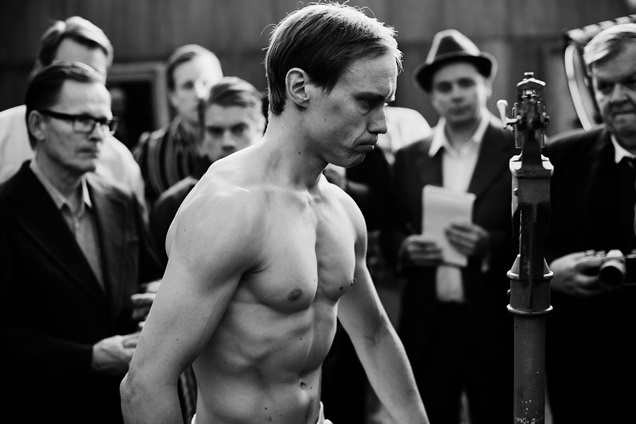
Film 1: The Happiest Day in the Life of Olli Mäki (Juho Kuosmanen, 2016) at Vue West End
– A completely charming, disarming Finnish film, based on a true story, about a boxer who falls in love whilst preparing for a world championship fight. Shot in grainy monochrome, it reminds me a little of Truffaut in its grace notes (lovely, self-contained sequences of children) and also of Half Nelson – with its eye for an arresting, unexpected image or sentiment – though its sensibility, and its sense of humour, are all its own.

Whatever their quality, boxing movies tend to be bruising noirs about proud patsies (Body and Soul, The Set-Up, Champion), shameless stories about underdogs (Rocky) or cynical, bruising portraits of disconnected losers (Raging Bull). Olli Maki, with its humble hero, quiet humanity and knockout ending, could scarcely be more different.

Occasionally it seems unfocused or long-winded, but the performances from stage star Jarkko Lahti (as Olli), newcomer Oona Airola (as his ordinarily beautiful new girlfriend) and Eero Milonoff (playing his ex-champ of a manager) are really fresh, credible and well-judged, the bits of off-kilter humour mesh nicely with the affecting central storyline, and the film’s blending of realism, sweetness and surprise makes it a richly enjoyable experience.

A cracking start to the festival from debuting feature director Juho Kuosmanen – who won ‘Un certain regard’ at Cannes for this one. (3)


Guest: Juho Kuosmanen (post-film Q&A)

***

FRIDAY 7th


Film 2: Christine (Antonio Campos, 2016) at Vue West End
– A stunning character study of a woman whose name is notorious if indeed it’s known at all: Christine Chubbuck (Rebecca Hall), a news reporter in early ‘70s Florida who’s indelibly associated with her final act: shooting herself on live TV.

This richly empathetic film goes beyond the sensationalist headlines to explore her psyche, her environment and her motivations (if something as irrational as suicide can have motivations at all), and though the script’s shorthand and inventions can seem too pat and glib, Hall is just staggeringly good, and the film feels just right.

First, though the script: its mixture of the tough and the tender is right, but at times it’s simply crude and rudimentary: allusions to Chubbuck’s breakdown in Boston are sledgehammer-subtle, the invention of a crush on network anchor Michael C. Hall is simply misleading, and the way the film sometimes presents depression as a series of bad responses to triggers seems simplistic. That kind of paraphrasing or superficiality feels OK in a movie like, for example, Dmytryk’s The Sniper, which also strips away its character’s safety net by episodes, but a real story deserves better than that.

The story does, however, get the performance it deserves: in actuality, one of the best performances in years. As Christine, Rebecca Hall is simply astonishing. Tightly-wound, highly-strung and unable to connect, she has moments of eye-popping neurosis, but there’s nothing here that’s false or overdone. She lashes out in moments of black comedy, embraces the awkward by overstepping the mark quite egregiously with her boss, and then acquires a fittingly unearthly calm once her mind is made: I’ve been with someone about to kill themselves, and I didn’t see it coming either.

The film’s artistry and humanity grows organically from her performance, which places its roots far below the script and nourishes everything else. Michael C. Hall is fine and Tracy Letts is good as her boss, but it’s Rebecca Hall who makes everything work: in moments of disintegration that risk seeming synthetic and smack of screenwriting-by-numbers, her conviction is complete and utterly overpowering.

She’s by no means the only thing about the film I admired. When I say that it ‘feels right’, I don’t just mean that its portrayal of mental illness is extremely realistic and nuanced (sadly I have more experience in this area than I would wish on anyone) in a way that no movie aside from von Trier’s Melancholia has approached, but also that the film replicates the textures of ‘70s Florida in both its look and its sound: its succession of apposite West Coast soft rock classics is some of the best use of music I can remember. And nor is the script a write-off: the final scene seems tacked-on and false, but its opening gambit is amusing, its ability to sometimes give us a good time while putting us through the wringer isn’t to be underestimated, and the shards of black comedy embedded in the tragedy twinkle darkly amidst the heartbreak.

She is, though, the thing about the film that lifts it way out of the ordinary, turning it into an experience to be cherished, as it turns a headline into a portrait that acts too as a plea for empathy. A lot of people are hurting. Try to connect. (3.5)


Guest: Michael C. Hall (post-film Q&A)


Film 3: Tower (Keith Maitland, 2016) at Vue West End A moving, utterly gripping documentary about the University of Texas shooting in 1966, which doesn’t – as the festival literature suggests – use the tragedy to understand subsequent massacres, but instead tells the stories of the victims in mesmerising fashion.

It’s a film about the ways we react in extreme circumstances, and afterwards: the way that life-defining events have an aftermath and, as Kurt Vonnegut wrote in Deadeye Dick (another work that’s superficially about a shooting), the way the story may be over, but the life has to continue.

Director Keith Maitland took five years to make the film: conducting dozens of hours of interviews, then interspersing the footage of talking heads with archive film and new sequences of rotoscopic animation, which enabled him to restage much of that fateful, fatal day at the real locations, without having to get permission to film there.

It’s a striking approach that lends the film an artistic distinctiveness without undercutting its realism, and imbues it with a nauseating tension while keeping its real human stories centre-stage. And the stories are incredible, the characters unforgettable: the reflective, forgiving Claire, the tower itself – since the shooter is unseen, it seems to be picking off innocents at random, like the truck in Duel – and resourceful off-duty cop Martinez.

Best of all is Rita, whose selflessness dominates this story and makes it a portrait of humanity at its best, rather than at its worst. (3.5)

Guest: Keith Maitland (post-film Q&A)

***

SATURDAY 8th


*MINOR SPOILERS*
Film 4: La La Land (Damien Chazelle, 2016) at Odeon Leicester Square
– I’ll be astonished if I see a better film than this at the London Film Festival: Whiplash director Damien Chazelle’s homage to MGM musicals is like Blue Valentine starring Fred and Ginger, with a first half of unparalleled joy and a second that’s almost unbearably poignant.

It’s a movie about people out of time: actress Emma Stone should be in the ‘40s, jazz musician Ryan Gosling should be in the ‘30s and they shouldn’t both be on the cusp of realising their dreams if this relationship is going to work.

Timing is central to people getting together (a fact rarely acknowledged in movies) and La La Land acknowledges the fact that these characters may want to have their time over again (or have it in an idealised realm) in the most spectacular way imaginable: a climax that’s both exhilarating and replaces your entire throat with a lump.

The exuberant opening sequence sets the tone (I wouldn’t dream of spoiling it) and from there on it’s great music, irresistible chemistry and a descent into heartbreaking Technicolor melodrama of which Jacques Demy would be proud.

From Stone’s hair lit like a neon sign (echoes of One From the Heart), to a Band Wagon-ish jaunt in a park, via nods to Gold Diggers (stylised montages! Chorus gals living together!), Broadway Melody of 1940 (challenge dancing!) and the climactic dream ballets of the ‘50s, it fits into the grand tradition without ever feeling like a novelty or a rip-off. And if I say that Mandy Moore’s choreography more than makes for A Walk to Remember, that is no small concession.

The problem with contemporary musicals is the undercurrent that says: “Isn’t this wacky, we’re doing a musical!” It was musicals’ everyday nature, their centrality to the national psyche that made them so magical. Somehow Chazelle has made that live again, and if his leads can’t dance quite like Fred and Ginger, they can sing comparably and act better. Gosling's comic timing is a thing of eternal beauty.

I expected to be charmed by this film, but I didn’t expect to be blown away like I was, or completely broken by the end. This is a wonderful, wonderful movie, and so far the undisputed highlight of a dizzyingly good festival. (4)


Guests: Pre-show Q&A with Ryan Gosling, Damien Chazelle, cinematographer Linus Sandgren and two producers.

***

Thanks for reading. Part 2 includes Bing Crosby, Casey Affleck and a bizarre Isle of Man-set comedy from Julian Barratt and Simon Farnaby of The Mighty Boosh.

Thursday, 5 May 2016

Mankiewicz, The Shadow Line and the original House of Cards - Reviews #235

FILMS


Somewhere in the Night (Joseph L. Mankiewicz, 1946) - This was unexpectedly terrific: a very, VERY underrated movie from the great writer-director, Joseph L. Mankiewicz. It’s a brilliantly-plotted mystery-noir, full of that classic Mankiewicz dialogue: wise, hard-boiled and exceedingly sarcastic.

John Hodiak plays an amnesiac war hero searching for a shadowy hoodlum by the name of Larry Cravat, his Third Man-ish investigations bringing him into the orbit of a wry, warm-hearted chanteuse (Nancy Guild), her nice guy suitor (Richard Conte) and a gently omniscient detective (played with great charm by Lloyd Nolan).

There are outstanding self-contained, character-led scenes, including an absolute gem featuring Josephine Hutchinson (a former Warner female lead who never quite made it), fine, unexpected examples of jocular post-modernism – in the shape of meta movie gags about Lugosi, lighting and how detectives behave – and a succession of quite magnificent surprises, right up to the finish.

From the film’s reputation, I was expecting something fairly shabby and perfunctory, but instead got a film that’s impressive, interesting and almost impossible to second-guess. The leads are strictly second-tier, but while Hodiak is fairly bland, the director takes Guild into strong territory (like Hutchinson before her, she was on the cusp of superstardom that never came) – the actress emerging as a sort of Ella Raines-Ronnie Lake hybrid, with a gift for a one-liner – as Nolan and Conte hoover up everything that’s left. (3.5)

See also: I wrote about Mankiewicz's masterpiece, All About Eve, here.

***


They're even giving great performances in the publicity stills.

Watch on the Rhine (Herman Shumlin and Hal Mohr, 1943) - A talky, grown-up and extremely powerful propaganda piece - from Lillian Hellman, via Dashiell Hammett – about German émigré Paul Lukas, his American wife (Bette Davis) and their three children moving to the States, where they face persecution from a dissolute, amoral Nazi sympathiser (George Coulouris). There’s a false note in the characterisation of the kids, who speak in that generic ‘foreign’ Old Hollywood way (all stilted full sentences), and Beulah Bondi is wasted in a weak part as a French maid, but much of the film is truly great, with perfect performances from Lukas and Davis, and mature, incisive writing that hammers its points across – even while showing the Nazis as cruel, sadistic thugs, rather than the genocidal ethnic cleansers they were soon confirmed to be. (3.5)

***


Darling (John Schlesinger, 1965) - A ‘60s time capsule with a European feel about the romantic adventures of capricious British model Julie Christie, who moves through relationships with a TV journalist (Dirk Bogarde), a louche, selfish playboy (Laurence Harvey) and an ageing Italian prince (José Luis de Vilallonga), on her way to partial self-discovery. It’s inconsistent and holds you at arms’ length, but Christie is very good in her Oscar-winning role, and there are some excellent insights and fine lines from Frederick Raphael – who went on to write one of the greatest things I’ve ever seen on TV, the BBC’s novelistic, challenging and brilliant adaptation of his book, The Glittering Prizes. Jim Clark’s editing is also extremely good, full of tricks inspired by the Nouvelle Vague, though the direction from John Schlesinger includes too much that simply feels like padding, particularly a party sequence as incoherent and unfulfilling as the one with which he almost sank Midnight Cowboy. The film’s bagginess and aloofness is compounded by a motivational murkiness and lack of clarity that’s not intentional: it strives to be adult and complex, but comes off as merely unclear, despite Christie’s best efforts. The idea that anybody would go after Harvey while they had Dirk Bogarde at home is also, of course, ridiculous. As you would expect, Harvey is as dreadful as ever. (2.5)

***


It is only as terrible as this half the time.

Excuse My Dust (Roy Rowland, 1951) - A broad, nostalgic musical-comedy about an aspiring inventor (Red Skelton) at the birth of the automobile revolution. Skelton is as funny as a hernia (and his various car crashes as funny as, well, a car crash), but the Arthur Schwartz-Dorothy Fields songs are good and Monica Lewis puts her numbers across with great gusto, sass and style. I like the hilariously incongruous ballet featuring female lead Sally Forrest too: it's very stylish and well choreographed and confusing. In support, Preston Sturges regulars William Demarest and Raymond Walburn are rather wasted, though Demarest does blow a sort of weird raspberry at one point. In addition, an uncredited Buster Keaton came up with a few of the gags and worked behind the camera (some of the Skelton business is a little better than normal, though he himself is dire), while the star's car was previously seen in Orson Welles' butchered 1942 masterwork, The Magnificent Ambersons, which is where the similarities between the two rather cease. (2)

***

BOOKS


The Pursuit of Love by Nancy Mitford (1945) – Nancy Mitford’s romantic comedy about the pretty, fickle, impulsive, small-eyed Linda Radlett is a playfully heightened, impeccably-written slice of escapism, laced with insight, understated emotion and dazzling wit, based upon her own life – and her experiences as a member of Britain’s most notorious family. It’s not especially ambitious in terms of scope, but it is magnificently realised, full of brilliantly-drawn characters, sublime running gags and effortlessly turned phrases. The chance to get a tour of Mitford's world and her brain is a rare sort of treat, and despite her rarefied upbringing, there’s a worldiness and a compassion here, allied to a rare intelligence and a matchless, piercing viewpoint, that can’t be missed. The foreword by her sister Decca is hilarious too. (4)

***


The Thin Man by Dashiell Hammett (1934) – Hammett’s celebrated crime novel is, well, a bit of a damp squib, really. I came to it as a fan of the movie (which came out later the same year, having been shot in just 12 days!), the defining mystery-comedy of its era, and the first time that a modern, happy and equal marriage (at least within the parameters of its period) had been depicted on screen, touched with the alchemic chemistry of stars William Powell and Myrna Loy. All I can say now is that screenwriters Albert Hackett and Frances Goodrich did an incredible job of adapting this book, which is less escapist, more cynical, more repetitive, less funny and conspicuously less fun than the film, consisting chiefly of second-gen Greek immigrant PI Nick Charles saying that he’s not sure who committed a murder, while various dislikeable supporting characters try to either stitch up or have sex with one another. The relationship between Nick and his wife Nora (based on that of Hammett and his long-term partner, Lillian Hellman) isn’t bad, and sometimes the book’s eruptions of violence, drunkenness and cutting sardonism draw you in, but there’s always a long lull just around the corner. A real disappointment. (2)

***

TV

The House of Cards trilogy:


House of Cards (1990)
- One of the most exquisite achievements in the history of British TV: a paraphrasing of Macbeth, with a repulsive psycho-sexual undercurrent, about Tory chief whip Francis Urquhart (Ian Richardson), who reacts very poorly to being overlooked in a cabinet reshuffle, and proceeds to destroy everyone in his path to power. Andrew Davies’s script – including those celebrated, conspiratorial fourth-wall-busting asides – the immersive direction, and a pair of sensational performances from Ian Richardson and Susannah Harker (as his mistress and most prized media contact, Mattie Storrin) make it simply unmissable: a dark, daring and delicious satire about an old soul poisoned by avarice, but with a twinkle in his eye. (4)

To Play the King (1993) - An interesting sequel to House of Cards, about Francis Urquhart (Ian Richardson) locking horns with the Prince of Wales (Michael Kitchen), resulting in a constitutional crisis. It’s less novel and more of-its-time than the original, but exceptionally well-written and acted, with an unforgettable climax containing more than a hint of The Godfather Part II. Kitty Aldridge’s performance as Urquhart’s new mistress, Sarah Harding, is emblematic of this sequel’s standing: better than almost any you’ll see on TV, but not in the same league as Susannah Harker’s last time out. Still, I can't help but think that this was a major influence on one of last year's most overrated plays, Charles III, which has an almost identical storyline (though was written in blank verse). (3.5)

The Final Cut (1995) - A very good but nonetheless slightly disappointing conclusion to the House of Cards trilogy, with prime minister Francis Urquhart (Ian Richardson) dealing with revolt and rebellion that threatens to push him out of Number 10. For the most part, it feels more like a cynical political drama than the black satire of House of Cards – while traversing some rather over-familiar ground – and the supporting cast isn’t in the same class as before (Isla Blair and Paul Freeman are simply lightweights compared to Richardson), but it’s still consistently entertaining, with confrontational storytelling, fine dialogue and a flamboyant if conventional pay-off. (3)

***


The Shadow Line (Hugo Blick, 2011) - The BBC at its best, a bleakly brilliant mini-series from writer-director-producer Hugo Blick that plunges you into an unexplained, nightmarish and narcotic netherworld, then begins to illuminate and tie up a few threads while leaving others dangling for the longest time. Chiwetel Ejiofor is a cop with a past, Christopher Eccleston a dealer with a heart, Rafe Spall an out-there gangster (whose tics are a thing of joy) and Stephen Rea a tall, quiet mystery man by the name of ‘Gatehouse’. It’s idiosyncratic and almost matchlessly imaginative, with more than an echo of Edge of Darkness (arguably the finest thing the Beeb did in the ‘80s) in its marriage of introspection and action, the latter showcased in a succession of creepy, eerie and ultimately breathtaking set pieces. (4)

***


State of Play (David Yates, 2003) - A dazzling drama from the pen of Paul Abbott, about a political scandal that begins to mount after the death of a political researcher, who was having an affair with her boss, up-and-coming MP David Morrissey. As reporters John Simm and Kelly MacDonald begin to investigate, further revelations follow thick and fast, impacting on the livelihoods – and lives – of them all, as well as editor Bill Nighy, a pale, sexy, floppy-haired, cool-as-flip freelancer (James McAvoy), a callow, irritating PR weasel (Marc Warren) and Morrissey’s unhappy, conflicted and opinionated wife (Polly Walker). The meshing of acting styles is simply exhilarating, the direction from future Harry Potter helmer David Yates is swift and immersive, and the writing is absolutely extraordinary: clever, funny, thematically complex but entirely accessible, and eloquently and pointedly personal while operating within a moral morass.

I always remember Abbott telling Charlie Brooker (in a personally inspiring special edition of Screenwipe about how to write) that he would throw in outrageous twists at will, then say to himself: “Write yourself out of that corner, you bastard”, and that gloriously abrasive, unconventional approach works absolute wonders here. It’s only Warren’s subplot that seems a little out-of-place, a cartoonish, relentlessly one-note storyline that occasionally stalls a mini-series of otherwise unstoppable momentum – and magnificence. (Also: Kelly Macdonald is bae, especially her voice.) (4)

***

Thanks for reading.

Monday, 25 February 2013

A Star Is Born revisited, Jennifer Lawrence and how to start an argument - Reviews #148

Hello, and welcome to a special Oscars-themed update, as the Oscars happened yesterday and it would be negligent of me not to piggy-back pointlessly on that kind of publicity. To celebrate, I've reviewed a film starring Jennifer Lawrence, who won Best Actress last night, and another starring the first winner of that award and featuring an Oscars ceremony of its own. That this was all just a coincidence shouldn't stop you reading on. JOIN ME.


A Star Is Born (William A. Wellman, 1937) - The initial incarnation of this Tinseltown tragedy is right up there with Judy's, and holds up superbly on second viewing, revealing - most rewardingly - additional layers to the stunning central characterisations. We first meet Norman Maine (Fredric March) as he's toppling off his mantle - and his chair - and it's largely downhill from there, via a sanitarium, a night court and three of the saddest and most uncomfortable scenes I've ever had the good fortune to dread coming round again. Esther Blodgett (Janet Gaynor) is introduced as a feisty fighter of a farm girl - not unlike Gaynor's character in Lucky Star - if one with a sensitive soul, but once she gets to Hollywood, with stars in her eyes, we see her as the naive, innocent dreamer she really is. What the film does next is magnificent, but so seamlessly, subtly done, that it's only when the credits roll that you appreciate the shifting, sliding, dynamic: Esther growing in confidence, authority and compassion - growing up, if you will - and Norman sinking, faster than you keep up, his chilling forecast that he has lived too much to have anything left being proved tragically true.

Evelyn Waugh said of Brideshead Revisited that he wanted to write a book about people brought low by nothing more than love and drink. Add a bit of masculine pride into the mix and you have A Star Is Born. The film is perhaps a test of empathy (as I feel something like The Kid with a Bike may be), as its success - or otherwise - is based on how much compassion you feel for a good-looking millionaire whose greatest problem, at least that he will acknowledge, is that his star is slipping. Really, though, he's a man being consumed - from the inside - by demons and disease, slipping into dissolution even as he appears to have it all, as would his contemporary John Barrymore, and their spiritual successor, Errol Flynn. March makes Maine - and his problems - seem utterly, desperately real, in a gutting characterisation that may well be the best thing he ever did. It's only in the final third that the human cost really becomes apparent, though, and up until then it's a lighter proposition, a revealing snapshot - in early Technicolor - of Hollywood in the '30s, and just as fun as that sounds (I'm aware that some people may not think that sounds very fun). I still think Adolphe Menjou's benevolent producer is too good to be true, and Edgar Kennedy's comic sequences seem incongruous, but Lionel Stander brings just the right mix of amusing irascibility and sadistic insensitivity as a kind of hybrid press agent/fixer, perhaps patterned after MGM's Howard Strickling and Eddie Mannix, and Andy Devine is just lovely as Gaynor's first friend in Hollywood. It's a superlative film, wonderfully conceived and scripted - with some of the best barbs coming unmistakably from Dorothy Parker's poisonous pen - and with an emotional clout like little else in '30s cinema. (4)

***


Laugh, Clown, Laugh (Herbert Brenon, 1928) - A gifted clown (Lon Chaney) finds a little girl in the rushes, makes her laugh with his cockerel-based shadow puppetry and takes her under his wing (pun intended), naming her Simonella. When she grows to adulthood, and reveals a bit of shoulder, he realises he loves her in a different way - but then so does the count and reformed cad with whom he shares a psychiatrist. This intensely moving melodrama sticks to the familiar Chaney formula, strikes a few questionable notes (having the count's deep unhappiness manifest itself in bursts of manic laughter seems an unnecessarily gothic touch), could do with a scene showing the children's connection to the comic that would give its final line even greater resonance, and fails to explain its characters' motivations at some key junctures. But who cares? Chaney is sensational, the 15-year-old Atilla the Nun, Loretta Young, is at her ethereal best as Simonella, and the film is stuffed to bursting with unforgettable images of love, longing and desolate desperation, many focusing on Chaney's matchlessly expressive face - painted or otherwise - and all showcasing legendary cinematographer James Wong Howe's unique eye for contrast and composition.

Some viewers may feel queasy about Chaney's sad clown trying to "do a Woody Allen" and cop off with his adopted daughter (legal disclaimer: in Woody's case, it was his long-term partner's adopted, of-age daughter), but these were different times, Young isn't playing a 15-year-old. and the film is so persuasively acted that you can't help but feel for the sad-eyed Chaney, and wish for him some modicum of happiness. It's a gutting, wonderful film and an important one too: in telling the story of a gifted mime who wins every heart except the one he wants, it must surely have influenced the ultimately incomparable Les enfants du paradis. It was Chaney's favourite of his pictures, and with good reason. The TCM release features a wonderful addition in H. Scott Salinan's beautiful new score, which recalls Howard Shore's classic work on The Lord of the Rings. (4)

See also: The other two films in TCM's Lon Chaney Collection are reviewed here.

***


Hard to Handle (Mervyn LeRoy, 1933) - An anarchic Cagney comedy, with Jimmy cast (once again) as an inveterate go-getter for whom the Depression is little more than a mild inconvenience. Having lost the takings from an epic dance marathon to an unscrupulous partner, his versatile promoter spents the rest of this fast-paced, sex-fuelled jolt of Pre-Code hilarity putting his quick wits and absent morals to good use by hoodwinking the ordinary folks of America into taking part in a phony treasure hunt, smearing meritricious gloop over their wobbly bodies or buying up acres of grapefruit groves (a nod to that notorious scene in The Public Enemy). Like Groundhog Day's Phil Connors, he subscribes to the somewhat damning notion that people are morons.

There's little of Warner Bros' famed social conscience at work here, but it's delightfully unpredictable and extremely funny with it - its laughs, unusually for the studio, coming more from the performances and the situations than the repartee - while providing a fascinating glimpse of how my favourite comedy of all-time might have panned out, reuniting sassy Mary Brian and sardonic Ruth Donnelly from the previous year's Blessed Event, originally set to star Cagney. His chemistry with Bryan is both appealing and electric, Donnelly proves a perfect(ly unscrupulous) foil and sometime ally. and Cagney is, of course, magnificent: a whirlwind of energy, playing every comic scenario to the absolute hilt. (3.5)

***


The Hunger Games (Gary Ross, 2012) - It's Winter's Bone meets Battle Royale meets The X-Factor in this tense futuristic thriller, as Jennifer Lawrence takes the place of her terrified little sister in a televised fight-to-the-death against 23 other kids and teens. The only other contestant from her district is dishy, slightly wood-prone Josh Hutcherson, whose character has so many contrasting facets that I stopped thinking he might be realistically complex and decided he wasn't particularly well-drawn. The plotting, which inserts breathless action sequences at regimented intervals, seems a bit too clinical, the lead-in goes on too long (check out The Wages of Fear for how to properly execute an hour-long prologue to your suspenser), and the gaudy world fashioned around the game is tacky and heavy-handed. But the film has a wild card like few others, allowing you to spend two hours in the exultant company of Jennifer Lawrence. The whole thing hinges on her performance, and she's simply mesmerising. I've seen her in four movies so far (including Winter's Bone - the best of the decade so far - and Silver Linings Playbook, my favourite film released last year), and she hasn't struck a false note in any of them. Here, the story takes the toughest decisions away from her character, Catnip Evergreen, but she's wondrous nonetheless, creating an affecting, kind-hearted, ass-kicking protagonist with an innate emotional intensity who keeps the film grounded and real, even when being interviewed by a man with a blue ponytail in front of the crowd from Take Me Out.

It isn't exactly original - it riffs on the superior Battle Royale, there are shards of Logan's Run in there, and it occupies a similar world to the hugely silly Equilibrium - but it is very entertaining, and has one particularly fine, powerful scene, rather dubiously utilising Holocaust imagery, in which Lawrence volunteers for those there Hunger Games. It's also a well-directed film, in a showy sort of way, employing warped images and aggressive jump cuts while Lawrence is tripping on wasp bites, and fantastic use of sound throughout. It's clearly aimed at a teenage audience rather than an adult one, and perhaps a film like this should do more with its subtext of anti-establishment rebellion and social degradation, but when it tries to it feels forced and shallow, and Ross doesn't really know how to handle crowd scenes (he seems to be taking pointers from tea-time dramas on ITV), so it may be for the best. For all its imperfections, I enjoyed it a great deal, and Lawrence's performance confirms her status as one of the three most exciting actresses around, along with Carey Mulligan and the mighty Michelle Williams (Emily Watson doubtless remains the finest, but can't seem to land too many strong roles nowadays). This has really whetted my appetite for a sequel. Though apparently the "book" is better, whatever "books" are. (3)

***


Undefeated (Dan Lindsay and T.J. Martin, 2011) is like Hoop Dreams remade by Disney. It's an Oscar-winning doc about a volunteer high school football coach (Martin Clunes) who whips his troubled African-American charges into a formidable team, as they cope with injury, anger issues and everything else that comes with growing up in black, inner city ghettos (see The Interrupters and The House I Live In for yet more chilling detail). Compared with the benchmark for all documentaries of its type, Steve James' unforgettable Hoop Dreams, it's too much a surface look at the issues it raises - and a calculating, sometimes staged one at that - to be a real contender, but it is slickly done, emotionally stirring when not opting for easy sentiment (Chavis's speech is a wonderful moment), and in entertainment value alone deserves its place in the play-offs. Also, "Why you gotta sit by me for bro? You gay" is my favourite ever way to start an argument. I've spotted a goof, though, they're not undefeated - they lost their first match. What's that you say? A metaphor? (3)

Thanks for reading.

Sunday, 7 March 2010

Why the Oscars are worthless


"And the award for the most stultifying, simplistic, unchallenging guff of the year goes to..."

What have Alfred Hitchcock, Stanley Kubrick, Robert Mitchum, Cary Grant and Judy Garland got in common? Here's another clue: it's the same thing that unites The Life and Death of Colonel Blimp, Double Indemnity, It's a Wonderful Life, The Searchers and Hoop Dreams. They've all played a crucial role in the evolution of movie-making. They've all brought joy and heartache to countless millions. And not one of them has grabbed a single competitive Oscar.

The Academy Awards is the annual ode to gaudity and mediocrity that chose Forrest Gump over Pulp Fiction, that decided Marty was a more important film than Rebel Without a Cause, that gave Bogart his Oscar for The African Queen and Scorsese a gong for The Departed.

As the gold dust settles on this year's ceremony, the results are being met with the usual cries of surprise and dismay. Why? The Oscars has been getting it so completely wrong since its inception, the only mystifying thing is that anyone takes it seriously at all.

But even aside from the subjective argument that the Oscars consistently fails to reward "great movies", their more troubling flaw is a refusal to recognise important, era-defining ones - an issue that goes to the very heart of its purpose. Its continual embracing of the bland is not by coincidence, it's by design.

Set up in 1928 with the express purpose of mollifying censors and right-wing critics who saw Hollywood as debauched and amoral, the Oscars has always returned to that offensively unchallenging remit. The Academy had been established the previous year by MGM head Louis B Mayer as an anti-union move. As early as the first ceremony, its awards overlooked King Vidor's progressive liberal drama The Crowd in favour of the dazzling but apolitical romance Sunrise. It's barely deviated since. If in doubt: play safe.

Social polemics, state-of-the-nation dramas and movies that with one fell swoop have created entire genres have been - and are - consistently ignored, in favour of unchallenging, box-ticking, hateful, award-ogling guff. That underwhelming, simplistic fare can be so easily dismissed as "awards fodder" is a damning indictment of what these events represent. This is the awards ceremony that heralded Rocky over both Taxi Driver and Network, that decided Kramer vs Kramer was not only better than Coppola's Vietnam opus Apocalypse Now, but also knocked the Tin Drum into a cocked hat. That has just overlooked In the Loop. That seems to think Gandhi isn't shit. (The film, not the man).

The awards are reactionary, even regressive, with pet fixations that members think compensate for their general blinkeredness. Disabled people are sort of alright, and gays can get up to what they want - so long as we don't have to really see it - but keep the dissidents and the self-possessed blacks away at all costs. The Oscars have always prized the worthy and the preachy above the challenging or the new, consistently celebrated the cautious, the mawkish and the dull. The awards are pointless and redundant, irrelevant and obscene. And did you see what Sandra Bullock was wearing?