Showing posts with label Simon Pegg. Show all posts

Wednesday, 22 March 2017

Rauschenberg, Moonlight and Simon Pegg's epiphany – Reviews #260

Cultural excursions, 11 March to date. I also have this stupid thing called Choose Your Own Twadventure, which you can take part in here.

FILMS


CINEMA: Moonlight (Barry Jenkins, 2016) – An intensely beautiful, compassionate film in three parts about a quiet, 'soft' African-American boy being battered by the inner-city experience as he tries to deal with his tortured sexual awakening.

Barry Jenkins' movie has something of Soderbergh's captivating coming-of-age film, King of the Hill, and the same poetic eye as Killer of Sheep and Half Nelson – a camera lapped by waves or jostled by a crowd of laughing boys, fingers spreading in the sand during orgasm – but it feels revelatory and revolutionary in its subject matter, its impeccable structural control and its innate sensitivity, which strips away the distancing, self-mythologising bravado of gang culture to find something vulnerable, human and humane.

Three generations of Chirons and Kevins lead a flawless cast, and from the breathless dash for the sanctuary of a junkie's den to that steadicam shot trailing Black as he heads to the climactic encounter, Moonlight is masterfully directed: an enveloping, once-in-a-lifetime film about the constancy, malleability and complexity of human nature, the pain and ecstasy of love, and the world's vicious but not quite unrelenting assault on the weak. (4)

***


CINEMA: Raising Arizona (Joel Coen, 1987) – This early Coens comedy is sometimes too cartoonish for my own dubious taste, but how do you criticise something that’s clearly exactly what the makers wanted it to be – and so damn good most of the time?

Simon Pegg presented Raising Arizona as part of the BFI’s Screen Epiphanies strand, explaining that it paved the way for Shaun of the Dead, opening his eyes to the fact that even cuts and camera angles could be comic, then took his seat in the auditorium, hooting with laughter throughout. The film has some of the best lines the Coens will ever write (“Do these balloons blow up into funny shapes?” “No... unless round is funny”), a lovely performance from Holly Hunter as a straight-shooting cop who wants a baby so badly that she crosses to the other side of the law, and a genuine sweetness too often absent from Joel and Ethan’s films, particularly in its beautiful closing sequence. It also has Trey Wilson as unpainted furniture tycoon, Nathan Arizona (catchphrase: "... or my name ain't Nathan Arizona").

But at times it’s too noisy, mannered and self-satisfied to get truly lost in, yelling its own subversiveness and invention in your face, or sometimes just yelling for no good reason. It’s possible to be madcap without just being annoying, as Carole Lombard can tell you, and there’s so much here that’s original, interesting and affecting that I wish the Coen Bros had wanted to make a slightly different film, one that I’d really like (I appreciate that this is a selfish, unrealistic proposition).

As a man immune to the self-mythologising post-modern joke that is Nicolas Cage, I’ve got to admit that at times he can be just great, and here (a year after his very worst performance, in Peggy Sue Got Married) he finds a truth in caricature, like Mike Leigh or the young Johnny Depp, that’s really impressive. There are great gags all over the place, showy shots – including that one over the car, up the ladder, through a window and into Florence Arizona’s mouth that the Coens put in as a challenge to Sam Raimi, who bettered it in Evil Dead 2 – and then there’s Holly Hunter singing Down in the Willow Garden. For that I can forgive, if not forget, John Goodman’s endless shouting or those moments when even the leads are asked to push it just a mite too far.

BONUS QUOTES:

“I tried to stand up and fly straight, but it wasn't easy with that sumbitch Reagan in the White House. I dunno. They say he's a decent man, so maybe his advisors are confused.”

"Need a beer, Glen?"
"Does the Pope wear a funny hat?"

(3)

***


Client 9: The Rise and Fall of Eliot Spitzer (Alex Gibney, 2010) – A standard Alex Gibney doc, this time about disgraced former New York governor Eliot Spitzer, with the usual questionable pacing and shambling structure, but also a typically fascinating subject and the filmmaker’s strong journalistic insights in his favoured areas of capitalism, corruption and moral capitulation.

Spitzer was a crusading DA known as ‘the sheriff of Wall Street’ who sought to curb the spectacular, immoral excesses of AIG, Merrill Lynch et al, only to be turfed out of office for using prostitutes. Starting, peculiarly, at the end of the story, and then sort of running in loads of different directions at once, Gibney examines who Spitzer was, what he stood for and why he threw it away, while underlining the hypocrisy and dubious practices of corporate America.

The subject, to give him credit, is fairly frank about his failings, and blames no-one else for his downfall, which feels like not just a betrayal of his family, but also a dereliction of duty with the sub-prime scandal set to blow. The flipside, of course, is that Spitzer bothered to go after these companies like no-one ever had before, so in political terms we're judging him by his own high standards.

There's the usual strong, confessional interview footage, full of Gibney's precise, probing questions, as well as some solid material, though the scuzzy direction doesn't always make for the most coherent storytelling, let alone alight on the most telling juxtapositions. There's a good story here, though, told without sensationalism or triviality, and with a gallery of interesting, colourful supporting characters, including giggly, morally bankrupt pimp, Cecil Suwal, and peroxided right-wing weirdo Roger Stone, who's a fantastic character and also a massive twat. (3)

See also: I wrote about Gibney's 2013 film, The Armstrong Lie, here.

BOOK


Anthem by Ayn Rand (1937)
– Rand’s short dystopian novel is a short, precise critique of totalitarianism, anticipating both 1984 and Fahrenheit 451, and climaxing with the heavy-handed ‘anthem’ of the title: a two-chapter crystallisation of the philosophy that she would late name ‘objectivism’, in which the ego is king. Here the style is substance, the story written in the first person plural at irregular intervals, as Equality 7-2521 – working by candlelight, underground – attempts to understand their flaws and sins, borne of a latent individuality in the age of the masses. There are allusions to the hypocrisy and anti-intellectualism of Soviet Russia (a Russia that robbed the Rand family of everything it had), but it’s not the box-ticking revenge porn you might fear, setting its sights higher and broader than just Bolshevism, with allusions to the torchlight regressiveness of Nazi Germany, and a firm grasp of an alternative ideology, even when pitting it against her usual straw man.

Rand hadn’t fully mastered English when she first wrote the novel, so she returned to it in 1946, after the success of The Fountainhead (1943), cleaning up passages while retaining – as she was clear to stress in her foreword – the meaning of the book. Though the allegory here is cleaner than in The Fountainhead, it’s primarily because Anthem is more simplistic and mannered, lacking the colour, depth and scope of character of that daring, problematic odyssey, and with a climax that seems more like over-the-top wish-fulfilment than an inspiring call-to-arms. For all that, it’s a distinctive and memorable work that does what it’s trying to, highlighting the ideological failings of populist extremism (while extending them to anyone exhibiting basic empathy), with flashes of stark, brutal poetry as Equality 7-2521 learns to love and question and create. (3)

Next up: Just Kids by Patti Smith. I'm nearly done.

***

EXHIBITION


Rauschenberg (Tate Modern)
– Another trip to the Tate Modern, where I stand forever suspended (or rather furiously oscillating) between the opposing schools of ‘This is extraordinary’ and ‘This is pretentious bollocks that means nothing’. I always like it if there’s a good painting somewhere, for the assurance that the other forms of expression are an artistic choice and not a necessity born of basic talentlessness. Rauschenberg’s tactile, 3D works in constant motion are really strong and alive (a bubbling pit; stainless steel machinery reassembled, water running through it forever) and some of his transfers and screen prints are a striking, even overpowering synthesis of ancient themes and modern style, multimedia news and disposable pop culture ripped free and fused to depict a time of drowned hope, desperate sorrow and impotent rage.

Often you see a burgeoning new style develop across a single series of works: his 34 modern illustrations for Dante’s Inferno begin as bitty, exploratory and hard-to-follow; by 32, the painting is tying together the disparate borrowed visuals (transferred from newspapers using lighter fluid and pressure from an empty ballpoint pen) into something cohesive, immersive and provocative. At other times, context makes us at least contemplate the dynamic he is attempting: a wooden box parodying similar holders of religious artefacts but filled with dirt could be a comment on the irrelevance of faith, but seems here to be about the miracle of nature, Picasso’s “found objects” given an earthy, pastoral grandeur. Elsewhere he utterly lost me, with ‘sculptures’ that were just a couple of cardboard boxes – one complete, one disassembled – and ballet routines (captured on video) rendered stale by crass camerawork, the performers’ dated stylistics and choreography that seems turgid, limited and graceless.

As an overview, this exhibition is sumptuously put together, and (as a newcomer to this work) seems close to definitive, but Rauschenberg didn’t move me like Malevich, Matisse or much of the Abstract Expressionism I saw at the Royal Academy last year. It did, however, include the greatest artwork description in the history of the world:


(2.5)

***

Thanks for reading.

Tuesday, 6 August 2013

The World's End, Charlie Chan and old men waving their arms around - Reviews #169

I've seen just 11 full-length films since last we met, as I was on my honeymoon for the rest of that time (yes, lovely thank you). Here they are:

FEATURES:


CINEMA: The World’s End (Edgar Wright, 2013)
- The high school hero unable to replicate their triumphs in an adult arena is a character that echoes through American popular culture. But whereas across the Atlantic the figure tends to be a former quarterback or lead cheerleader, the concluding part of Edgar Wright's Cornetto trilogy gives us a happily British variant (Simon Pegg): a chain-smoking, hard-drinking, trenchcoat-wearing bad boy whose greatest moment was having sex in a disabled toilet and who has degenerated - or perhaps followed along the same path - into an alcoholic mess.

Finding himself at his lowest ebb, this wonderful tragi-comic creation, Gary King, is inspired to tackle the pub crawl that beat him on that fateful, feted night, in the company of the same four friends, now each responsible adults in the shape of Nick Frost, Paddy Considine, Martin Freeman and Eddie Marsan. It's then that an army of replicants appear, threatening not just the future of humanity, but also Gary's drinking binge. Dispensing with the pitifully blunted humour of Pegg and Frost's Paul, with its weakly universal, US-centric references, The World's End uses the same recipe as the first two Cornetto films: fiercely British comedy, dead-eyed potshots at genre cliche, and moments of beautiful poignancy, shorn of the irony that dominates the rest.

The first half is a wonder: affecting, surprising - with a first scene just as clever as Wreck-It Ralph's similar opening salvo - and full of brilliant gags. The second, while very entertaining, can't quite maintain that momentum, with an over-reliance on merely competent action, some heavy but muddled exposition and a final 20 rife with iffy post-modernism and high-reaching, not altogether successful dystopianism. And yet despite being the weakest of the trilogy, it's a fitting wrap-up too: narratively the most inconsistent, with an unconvincing, barely escalating external threat - a legion of blue-blooded aliens - but also the most ambitious, and arguably successful of the three in terms of characterisation, emotional maturity and belly laughs. And also swearing. Its jokes are defiantly parochial (there's one about the Antiques Roadshow) and its soundtrack - drawn from the turn of the nineties - gives it a firm sense of both time and place. The World's End stutters a little in story terms, but like its predecessors it's still a must-see - particularly with an audience. And rarely if ever has British cinema produced films as funny, as loaded with deft, unashamed sentiment, or as skilled in using the C-word. (3.5)

***


CINEMA: Monsters University (Dan Scanlon, 2013) - Pixar has lost much of its ineffable magic in the three years since the Toy Story series concluded. La Luna was wonderful, but the studio's features - while fun - have been worryingly mediocre. This one's weirdly paced, riffs on overly familiar American campus cliches (not to mention The Goblet of Fire) and feels altogether too forced in its sentiment, its story and its strange broadness of humour. For all that, it's a fair watch: reasonably engrossing, with some fun action set pieces and a scattering of massive laughs, most of them coming from Art, the oddest new character to populate this erratic universe. It's a disappointment - an unfit prequel to one of the finest children's films of recent decades - but growing from a creative divot, perhaps it was always destined to be. Pixar have now fluffed a sequel, a prequel and a standalone film. Hopefully their next one will blow us all away. In the meantime, this one's not too bad - just functional, rather than magical. (2.5)

***


Amélie (Jean-Pierre Jeunet, 2001) - "No. I'm nobody's little weasel." On umpteenth viewing (and my second in a matter of weeks), Amélie is better than ever before: a wise, warm, whimsical piece of perfection, blessed with an unparalleled Parisian atmosphere and centred on a performance of uncommon brilliance. (4)

***


Vivacious Lady (George Stevens, 1938) - An emotionally heady, seriously sexy and often very funny fusion of romantic, screwball and social comedy, with associate professor Jimmy Stewart marrying nightclub singer Ginger Rogers on an impulse, but struggling to break the news to his conservative family. The leads are brilliant, with Stewart showcasing his singular schtick - awwing, umming and bumbling to his heart's content - the supporting cast is one of the finest ever assembled, and Stevens' handling is typically sublime, seamlessly blending slapstick, character comedy and some of the most richly romantic scenes in Hollywood history. The script is a little inconsistent, resulting in some short dry stretches, particularly towards the end, but there are numerous great moments, as well as stand-out supporting turns from Franklin Pangborn, as an officious apartment block clerk, and Beulah Bondi - playing Stewart's gentle, surprisingly mobile mother - whose dance scene with Rogers and the amusing James Ellison is an exuberant comic high-spot. It looks great, sounds great - with a lush score and one knock-out nightclub number - and, well, is great, an oft-overlooked triumph from Hollywood at its height. (3.5)

***


Peter Pan (Herbert Brenon, 1924) - The Boy Who Never Grew Up is played by A Woman Who Has Very Much Grown Up, Betty Bronson, in this sometimes spellbinding silent adaptation of Barrie's play, which highlights both the melancholia at the heart of the piece, and the subject of Wendy's sexual awakening. It kicks off with five minutes of stationery, medicine-based chat, but, once Peter skips in, the film springs to life, conjuring a vivid, purposefully artificial world of patently phony creatures, lion-catching "redskins" and sentimental, airborne urchins. Despite such fantastical elements, the strangest thing about the story remains the fact that an otherwise ordinary middle-class family has a nurse who is a dog. Or in this case a man in a dog costume. The mesmerising, fabulously uplifting flying scene remains the standout sequence, but - despite a fair amount of staginess and the odd intrusion of archaic filming or hammy acting (step forward, Ernest Torrence) - a rich vein of magic runs throughout the film, aided by Brenon's suitably fine use of shadow, very special effects from Roy Pomeroy (later Paramount's notorious transition-to sound honcho), Mary Brian's appealing Wendy, and Bronson's ebullient, balletic Peter: that curious piece of pantomimic casting imbuing the film with an ethereal majesty and intoxicating buoyancy it surely couldn't have got from anywhere - or anyone - else. She's clearly a woman, but somehow she's also inescapably and perfectly Pan. (3.5)

***


The Youngest Profession (Edward Buzzell, 1943) - Enchanting fluff about teenage autograph hunter Virginia Weidler and her bff Jean Porter encountering various MGM stars while trying to keep her parents together (they're not actually splitting up). It missteps a little with a diversion into drama - and away from signature-seeking - but it's a must-see for old movie nerds, with some ace walk-ons from the studio's finest, a fine George Oppenheimer/Charles Lederer/Leonard Spigelgass script that allows for several neat supporting parts, and a classic closing gag featuring the one and only William Powell. (3)

***


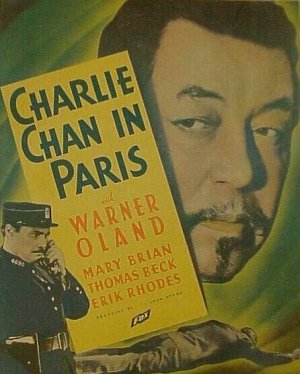
Charlie Chan in Paris (Lewis Seiler, 1935) - The best of Fox's many Charlie Chan films were the family affairs, those featuring one or more of the character's kids, and ideally those starring the original Chan, Warner Oland, opposite his "Number One Son" Lee, played by Keye Luke. This, Luke's first appearance in the series, is a fairly standard, rather low-budget B-mystery about bond forgery and murder that's lent remarkable warmth and humanity by the touching, completely credible relationship between the wise Chinese detective and his Americanised son. Their opening scene together, beginning with suspense, moving through the excitement of reunion, and ending with Luke vowing to protect his father from his would-be killer, is an absolute beauty. There's also a fairly strong supporting cast, led by Fred and Ginger alumnus Erik Rhodes, Blessed Event's Mary Brian (earlier Wendy in the silent Peter Pan - see above) and veteran character actor Henry Kolker - whose role is little more than a glorified cameo - along with a spectacular reprise of that rough-and-ready style of Gallic dance I last saw in Parisian Love. Fox had only thrown Luke into the series to snag a younger audience; it worked, but it did something greater, giving the films a human centre that the one-off mystery plots simply couldn't approach. Chan would have greater adventures, but this is the one that established the formula - winning in both senses of the word. (3)

***


Too Many Husbands (Wesley Ruggles, 1940) - Trivial but entertaining comedy about Jean Arthur being appalled - then delighted - to discover that her supposedly deceased husband (Fred MacMurray) is alive and well, is coming back to town, and plans to duke it out with her second spouse, and his best friend (Melvyn Douglas) for her fair hand. The material is spotty, especially in the final third, and MacMurray isn't in peak form, but Douglas is great and Arthur simply enchanting as the pair milk every scenario to the absolute limit. Douglas falls over a chair more funnily than any actor I've ever seen. (2.5)

***


Dreamboat (Claude Binyon, 1952) - A nicely-conceived comedy-drama about uptight educator and former silent screen heartthrob Clifton Webb trying to stop his former partner (Ginger Rogers) - both on screen and off - from presenting their old movies on TV. It's not actually that funny, or thematically coherent (teaching is pointless compared to being in movies?) and the barbs aimed at the small screen are as vituperative and desperate as usual for the period, but the script is intermittently interesting, Webb is brilliant and the spoofs of soundless cinema are great fun: agreeably accurate parodies of The Mark of Zorro, Wings, Beau Geste and The Three Musketeers, with Rogers' usual excessiveness tempered by her co-star's subtle, instinctively respectful type of take-off. Well, apart from that one very silly salute. Anne Francis and Jeffrey Hunter share an appealing but underdeveloped, incongruous romantic subplot designed to pull in the teens, while Elsa Lanchester does nice work as a horny spinster. It isn't a great film, but the promising premise does set up some very nice moments, with the aged, effete Webb shaping up amazingly well as a youthful, sexy swashbuckler. And the scene in which he takes tips from that younger self while embroiled in a bar fight is a little gem. (2.5)

***


Three Hearts for Julia (Richard Thorpe, 1943) - A daft, disjointed but unjustly maligned romantic comedy - Melvyn Douglas' last film as a leading man - that's burdened by a weak subplot about a female orchestra, a supporting character (played by Felix Bressart) who's employed to deal superficially with important issues, and an inability to cash in on promising set-ups, but lifted considerably and constantly by Douglas's distinctive brand of humour, delivered - as ever - in that effortless, effervescent manner. (2.5)

***


Two Guys from Texas (David Butler, 1946) - After directing the best of the Hope and Crosby "Road" movies, David Butler moved to Warner, who wanted to try a similar thing with comic Jack Carson and crooner Dennis Morgan. The results were a trio of variable efforts: Two Guys from Milwaukee, Two Guys from Texas and the Hollywood-on-film movie, It's a Great Feeling, a knockabout, post-modern, star-laden affair that's one of my favourite comedies of the '40s. If there's a weak link in the informal trilogy, it's this one, which recycles elements of the silent comedy Womanhandled in its thin, static story about a faux-Western ranch run for tourists, and features Dorothy Malone as a leading lady. She's nothing special compared to unmatched reactor Joan Leslie, or the multi-talented Doris Day, the pair who lit up the other two entries. There are a handful of good gags from Billy Wilder's future writing partner, I. A. L Diamond, though - including a clever closing twist borrowed and improved for Road to Bali - a slew of Jule Styne and Sammy Cahn songs which while unimaginatively staged are unusually memorable, and best of all, an animated dream sequence featuring Carson as a shepherd, Morgan as a wolf stealing his sheep, and Bugs Bunny as himself. It's that kind of freewheeling, try-anything, tongue-in-cheek approach - building on vivid archetypes - that made Butler's Road to Morocco really work, and which runs through It's a Great Feeling: the third and by far the finest movie starring this underrated pair. Their characters aren't from Texas, incidentally, they're just in Texas. While they sing a song with that name, it still makes this one of the most misleadingly-titled movies ever, along with Abbott and Costello Go to Mars (Venus) and Across the Pacific (part-way across the Atlantic). (2.5)

***

SHORTS:


CINEMA: The Blue Umbrella (Saschka Unseld, 2013)
- An uninspired Pixar effort about inanimate objects becoming animated, and an umbrella falling in love, that comes to life at two points: when the grates and ducts combine to save the hero's life, and when a strange red hue suddenly falls over him. Those moments just about make this derivative, lacklustre film worthwhile. (2)

***


One Week (Buster Keaton, 1920) - One of Buster's best shorts - and his first solo effort to be released - with the star and his new wife attempting to construct their first home, only to meet opposition in the shape of a bully, a hurricane and a train. It's inspired, ingenious and has one of the great endings: smart, cynical and sentimental. (4)

See also: There are reviews of some of Buster's other shorts here.

***


This is the bit you can't get on a t-shirt.

A Trip to the Moon (George Melies, 1902) - Its importance to the medium of cinema cannot be overestimated, and the shot of the moon with a rocket in his socket remains one of the screen's enduring images, but Meliès' signature film consists largely and inescapably of old men waving their arms around. (2.5)

***


One A.M. (Charles Chaplin, 1916) - A mildly amusing Chaplin comedy, from his time at Mutual, in which a hammered Charlie tries to go upstairs to bed. It's rather repetitive, and Buster not only did more with a stair carpet and a bed in My Wife's Relations, but surely would have found himself in the wrong house for the punchline. There are some nice gags, though, particularly the sequence with the climbing gear, and that fearsome adversary coming out of nowhere. (2.5)

***


The Non-Stop Kid (Gilbert Pratt, 1918) - An average Harold Lloyd short, with the star trying to seduce campus hottie Bebe Daniels, enlivened by the leading lady's expressiveness and an exuberant rhythmic and comic accompaniment from Fanfare Burlesque d'Intervention at this year's Avignon Festival. (2.5)

***


Get Out and Get Under (Hal Roach, 1920) - AKA the one where Harold Lloyd gives cocaine to his car. Get Out and Get Under is a fast, funny jolt of slapstick that doesn't do enough to endear its nominal hero to the audience, but is so full of energy - and comic invention - that you can't help but be swept along by it. There are a slew of clever, subversive sight gags, as the star's manic new motor smashes through a garage wall, is plonked onto a train and, yes, gets hopped up on coke, though the film is at its best when displaying a gleeful, innocent fondness for thrill comedy. I could watch Lloyd legging it after a runaway car all day long. (3)

Monday, 14 March 2011

Paul, D.W. Griffith and Hancock's 46 minutes of magic - Reviews #56


CINEMA: Paul (Greg Mottola, 2011) - As Simon Pegg and Nick Frost said on Radio 5 Live recently: if you're spending $50m of someone else's money, you've got to make a certain kind of film. So gone are the offbeat sensibility and obscure pop culture references of the show that made their name - Spaced - and the genre movies that followed, Shaun of the Dead and Hot Fuzz. The nods to E.T. and The X-Files here are more like headbutts. Gone too is the razor-sharp sense of humour. There are plenty of laughs, but the humour is so broad you could park a spaceship on it. This one's as straight-down-the-line as a movie about a foul-mouthed, chain-smoking alien is going to get. Pegg and Frost play a couple of nerds who plan to follow their visit to San Francisco's comic convention with a tour of the Deep South's UFO hotspots. They've barely gotten started before a car flips over in front of their camper van and - examining the wreckage - they come across Paul. He's an alien. A peaceful but rude alien. And he needs to get home. But before that the mismatched gang are going to have to do battle with an FBI agent (Jason Bateman), two childish cops, a couple of good ol' boys, a shadowy megalomaniac and a gun-totin' father. Yes, I think they probably have seen The Blues Brothers. One can lament the absence of Edgar Wright, the stylish director who co-wrote Shaun and Hot Fuzz with Pegg and was single-handedly responsible for their frenetic visual style. And it's easy to pick holes in a film that jettisons its creators' distinctiveness in search of a bigger audience - though there is at least one blessing: Pegg said he wanted to make more of the creationism subplot, the most smug and misguided bit of the film. But at the same time, it seems churlish to be too down on a film this solidly entertaining, with its likeable performances, strong supporting cast and a dozen genuine laughs. (2.5)

***


Sally of the Sawdust (D. W. Griffith, 1925)
is a nice film from the director of The Birth of a Nation, with nary a heroic Klansman in sight. The engrossing storyline, adapted from a hit stage musical, sees carnival barker W. C. Fields looking to restore orphaned waif Carol Dempster to her rightful place in society. The much-maligned Dempster is actually very good here (save for a bit of over-acting among the rushes as the police close in on her), backed by a couple of unimpeachable heavyweights: Fields and Effie Shannon. There are flaws. We could probably have done without the knockabout comedy for a start. The slapstick interludes aren't as jarring as in Way Down East, where the wrenchingly powerful narrative is offset by some of the most inscrutable alleged comic relief ever slapped onto the screen. For one thing, it's quite funny. But it does jar a little with the dramatic elements, particularly when we see Dempster striving desperately to avoid capture and ruin, intercut with Fields bouncing down a hill in an old banger. And there's also the sense of a missed opportunity. For a film that's not afraid to be melodramatic, the climactic reveal doesn't really carry an emotional punch at all, let alone the assault on the tear ducts I was anticipating. But I liked the film on the whole: interesting story, strong performances and - once you adapt to Griffith's style, revolutionary in 1915, a touch staid 10 years on - very watchable indeed. (3)

Trivia notes: Alfred Lunt, who plays Dempster's love interest, was Monty Clift's mentor and acting tutor. The film was remade as the talkie Poppy, also starring Fields, in 1936.

***


Hancock (Peter Berg, 2008) - If the credits had rolled after 46 minutes, I'd be raving about this as one of the best films I've seen in years. Hilarious, profane and bracingly original, with a killer performance from Will Smith and a deliciously dry one from Jason Bateman. Unfortunately it completely falls apart after that, morphing into a metaphysical love story of rare incoherence and tedium. Rarely have I come across a film - or a book, or a record, or a meal - with such a gaping gulf between the quality of its first half and its second. Gaah. The script was in development for 10 years, being fundamentally re-written with no input from the original author. Could that by any chance be something to do with it? (2.5)

***


Working Girl (Mike Nichols, 1988) is the second most '80s movie of all time (The Secret of My Success, obviously) - a hymn to business (urgh, business) with a sweet performance from Melanie Griffith, a fun one from Sigourney Weaver (boo, hiss) and a slightly lacklustre turn from Harrison Ford, making a then rare foray into romantic comedy. The story is formulaic in the extreme and there aren't many jokes, but it's entertaining and Griffith is an appealing presence. (2.5)

***


Out of Sight (Steven Soderbergh, 1998) is an enjoyable comic thriller, scripted by Scott Frank, though patently not one of the best films of its decade, as it's regularly described. The leads are good - I've never seen Clooney and Lopez as attractive or amusing as they are here - the labyrinthine, time-shifting script is mostly pretty neat and there are some strong scenes, including an opening bank robbery that's the ultimate in lo-fi insouciance. But the movie also drags in places, with an abundance of uninteresting subplots, and it's never quite as clever, smart or sexy as it seems to think. (3)

***


Anne of Green Gables (George Nichols, Jr., 1934) - This is a short, sentimental highlights package that turned out to be RKO's sleeper hit of 1934. Anne Shirley is Anne Shirley (she used her character's name for the rest of her screen career), the cheery, melodramatic, eternally appealing redhead created by L. M. Montgomery. Mistakenly placed with adoptive parents who were rather hoping for the boy they'd requested, her hot temper proceeds to get her into scrapes with friends, neighbours and that cheeky, good-looking boy in her class. There are production and pacing issues. The first hour is a little lacking in atmosphere, then - upon finding loads of the stuff - the film proceeds to race through the rest of the narrative at breakneck speed, with a succession of short scenes that cover five years in about five seconds. It also omits the most memorable bit of the book: Anne dyeing her hair green. For all that, this is a really gentle and rewarding movie, with absolutely charming performances, particularly from Shirley and O. P. Heggie, best-known for his turn as the blind hermit in Universal's seminal Bride of Frankenstein the following year. (3)

***


Bee Movie (Steve Hickner and Simon J. Smith, 2007) - The story doesn't always work, but the script's very funny and the animation's good. Not Pixar-good. But good. Apparently it got a bit of a kicking on release, which is a shame. Unless the critics were suggesting that a relationship between a bee and a woman constitutes quite an inappropriate romantic subplot, in which case they would be correct. (3)