CINEMA: I Am Not Your Negro (Raoul Peck, 2016) – A profoundly powerful polemic that forces you to view the African-American experience through the piercing gaze of writer, thinker and activist James Baldwin, who speaks with authority, insightfulness and a broiling anger about the way his people have been exploited, abandoned and killed by their own country.
The script is taken entirely from his unfinished book, Remember This House, which was to explore the history of black America through the murders of community leaders Medgar Evers, Malcolm X and Martin Luther King. Those passages, perfectly performed by Samuel L. Jackson, are mixed with footage of Baldwin in interview or debate (I love his voice), and a wealth of material showing everything from reviled character actors Stepin Fetchit and Willie Best – who epitomised the slurring, slow-witted black American in ‘30s comedies – to public information films, contemporary news reports of police shootings, and clips of Doris Day and Gary Cooper, the paragons of toxic white innocence whom Baldwin draws into his crosshairs.
At times that footage matches, showing the prescience – or more often the enduring relevance – of Baldwin’s words, but director Raoul Peck seems more interested in creating a collage of cumulative effect. In some ways, I do find it difficult that the film goes after RFK – who’s derided for his commitment to pragmatic realpolitik – and John Ford, one of the most thoughtful mainstream directors when it came to race, but that’s kind of Baldwin’s point: black people shouldn’t have to be grateful to the benevolent white man who nobly recognises their worth, they have as much right to their country as the white people who nicked it from the Native Americans.
As filmmaking, it may have rough edges or clumsy segues, but it’s wrenchingly powerful: an extraordinarily rich, humane and unsettling work, dominated by Baldwin’s unique moral and intellectual voice, which it brings to the masses. His polemicising is startlingly clear-sighted and incisive in a way that yanked the scales from my own eyes, and while it’s also wide-ranging and complex – bringing in such relevant but apparently disconnected concerns as the gulf between Americans’ private and public personas – perhaps its purest essence is contained in the speech that closes the film.
There, Baldwin rightly argues that since the grotesque caricature of black men (or of Jews in Nazi Germany or Muslims in Britain and the US today) bears such little relation to reality, it must have another purpose. “What white people have to do,” he says, “is try and find out in their own hearts why it was necessary to have a n***** in the first place, because I'm not a n*****, I'm a man, but if you think I'm a n*****, it means you need it.” (3.5)
***

Absolute Beginners (Julien Temple, 1986) – Julien Temple's notorious musical is one of the oddest and most perversely interesting British films of its era: a sort of West Side Story for '50s Soho, shot in the fantastical neon style of One From the Heart (or the 'Girl Hunt' ballet in The Band Wagon) and featuring arguably the most peculiar cast of all time. Ever wanted to see David Bowie and Patsy Kensit share the screen? Dying to find a movie where Lionel Blair, Profumo affair luminary Mandy Rice-Davies, and Sade all feature? Searched all your life for a film graced by the talents of Irene Handl, Sylvia Syms, Ray Davies, Edward Tudor Pole, Alan 'Fluff' Freeman, James Fox, and Steven Berkoff as an Oswald Mosley-like fascist hate preacher? Well step right up and enjoy the weirdness.
Kensit is Crepe Suzette, an annoyingly-voiced model and fashion designer whose romance with clean-cut dirty-picture-photographer Colin (Eddie O'Connell) is sacrificed on the altar of career advancement, as London gets ready to erupt into race riots in the boiling summer of 1958. No-one can act and the script is infuriating pretentious rubbish stuffed with shallow sub-and-pseudo beatnik proclamations, but the music's mostly excellent, the energy of the film is thrilling, and it's startlingly directed from start to finish, kicking off with a roaming five-minute tracking shot introducing us to a vividly-realised '50s Soho.
Self-contained scenes like Bowie's 'That's Motivation' and Ray Davies's 'The Quiet Life' aren't just like music videos, they are music videos, a stipulation made by the Americans financiers (who stepped in part-way through and insisted on adding famous names to the cast list). That might have corrupted Temple's original vision, but those set-pieces are a lot better than much of the narrative that surrounds them: while the film's themes of gentrification, racism, and art vs commerce (centring on the idea of 'selling out', an idea that obsessed my adolescent, music-loving mind) are more timely now than at any time since the film was made, the screenplay is enormously irritating, and the leads are risible, especially the squeaky, blank-faced Kensit. For her big number on the catwalk, Temple uses most of the Busby-Berkeley-meets-Baz-Luhrmann tricks in the book to keep it moving, and make it dynamic and convincing, but he can't quite mask her absolutely bloody awful dancing.
The screening at Regent Street Cinema included a Q&A with jazz club owner Chris Sullivan. He appears briefly in the film and supplied most of the extras, who largely wore their own clothes, the late-'50s look being fortuitously in vogue in the London of 1986. He remains keen for Temple to create a director's cut reinstating all the footage that was shot but then junked after the film was taken out of the director's hands following his original editor's death. It's only then, I suppose, that we can see whether Temple's vision was intended to be as divergent from the source novel, and if it would have made a more convincing film overall, with stronger characterisation and a greater consistency of tone than this compromised final cut.
Sullivan also shared some stories about production: the entire cast being off their face on beer, speed or coke, the climactic pitched battles exploding into genuine violence (since none of the non-professional actors were used to faking fight scenes), and a woman having 12 stitches in her bum because − while almost everyone was shagging behind the sets − she was the only one who decided to do it on top of an antique pinball machine with a flimsy glass top.
He didn't have too much to say about the film itself, which is − to pervert the Manics lyrics − "all surface and no feeling", a sumptuous stylistic delight with nothing to it, Temple's 'Carry on Punking' approach to everything rendering its characters and attempts at sincerity visceral, shallow and grotesque. It is a wonder of sound and vision, though, capped by Bowie's theme tune and 'That's Motivation', Sade's 'Killer Blow', the jazz club numbers and Davies's 'The Quiet Life', complete with a Finders Keepers-style cutaway house and unbearable cartoonish shenanigans, while unexpected explosions of movement and music pepper the half-finished, artistically bankrupt script. (2.5)
***

Mood Indigo (Michel Gondry, 2013) – When I heard that Michel Gondry was making a phantasmagorical romance starring perhaps my favourite three French stars of recent decades, I was excited, but bad reviews and an inability to find the full-length cut that played to home audiences sapped my appetite, so it took a while.
The film – adapted from a book by singular, surrealistic author Boris Vian – tells the story of rich layabout Colin (Romain Duris), who spends his time in a spectacular, stop-motion apartment, being cooked for by his perma-grinning lawyer, Nicolas (Omar Sy). When Nicolas and his other best friend begin romantic relationships, he realises just what is missing from his life, and begins to court Chloe (Audrey Tautou), a playful, post-modernly joshing young woman he seeks out at a party. On their wedding night, a water-lily begins to grow in her lung, puncturing their perfect existence and sending Colin out into a merciless, absurd and unforgiving world, as his cloistered home descends into rot and ruin.
It begins (at least in this 95-minute version) like a music video stretched well beyond breaking point, coming off as twee and shallow – if fitfully amusing – when its quirks should be shorn of some of their self-consciousness, and rooted in a world both transcendent and idealised. But then, as it slips into prolonged, joyless, existential anguish, its style becomes substance, which is a good job as there's precious little else to cling on to here.
It is Gondryan excess in the service of Vian, with mere silvers of story, and its stars left out in the cold, or deluged by an avalanche of whimsy. Here, Duris has neither the fascinating looks nor the commanding intensity that power his most compelling vehicles, Tautou is thoroughly underused – while the mountain diversion never gives you the epic money-shot of flowers wilting all around her – and Sy comes across as a mere comic adornment, with the script and effects doing all his heavy lifting.
It does draw you in, and by the second half you’re immersed and engaged in its characters’ plight, so arrestingly articulated by the restlessly innovative visuals, leading to a final scene that makes use of one of its calling cards – a mouse realised through in-camera effects and played by a man in a mouse suit – before breaking into a simple and simply beautiful animation.
It lacks the novelty of Eternal Sunshine, which first brought Gondry’s delirious DIY aesthetic to audiences, or the sublime comedy and off-balance emotional centre of The Science of Sleep – easily my favourite of his films – but it’s just about worth seeing if you’re receptive to his preoccupations, and the way he serves them through ostentatious stylistics. (2.5)
See also: Here's one film each that spotlights Gondry (The Science of Sleep), Sy (Chocolat), Tautou (Amélie) and Duris (The Beat That My Heart Skipped), and which I'd really recommend.
***

*SOME SPOILERS*
CINEMA: Fox and His Friends (Rainer Werner Fassbinder, 1975) – This resonant Fassbinder allegory tells the story of a virile, happy-go-lucky prole (the director) who wins the lottery, then loses his dignity, identity and all his money after falling for a calculating middle-class snob (Peter Chatel).
Its presentation of gay society can feel a little forced and it has moments of woodenness, but the film's combination of fatalistic poise and rough-and-ready spontaneity is pure Fassbinder, while his script blends excoriating satire with human drama and mordant humour.
Fox and His Friends also expands the director's familiar world to incorporate society drawing rooms, Marrakech and the kind of factory office you'd see in a Dardennes film, but doesn't skimp on the trappings you rightly expect from a Fassbinder film: moustaches, dingy bars, brown clothes, trashy '20s cabaret glamour, and squalid flats that stink of fags, booze and stifling urban desperation.
It's also interesting to Karlheinz Böhm, the star of Michael Powell's immortally creepy horror, Peeping Tom, in his more natural habitat. He's initially inscrutable – but unexpectedly suave and well-balanced in an Anthony Andrews vein – as an upper middle class antiques dealer who picks up Fassbender in a public toilet.
From the absurd, witty carnival intro to the pitiful dance of tragic greed that closes the picture, it's a hard-bitten but humane movie which suggests that the world is a terrible, cynical, rapacious place, but there are good people in it. What happens to those people, though, doesn't bear thinking about it, especially if they're from the proletariat and get ideas above their station. (3)
***

"No, I'm not gay!"
"Okay, alright, calm down. Look, this gay panic situation you're having right now, it's coming off a little homophobic."
"What, I'm homophobic because I don't want a penis in my mouth?"
"Exactly. That's exactly what homophobic means."
We're the Millers (Rawson Marshall Thurber, 2013) – An above-par comedy, with scuzzy weed dealer Jason Sudeikis moving into smuggling after losing loads of drugs, and recruiting a fake family (stripper neighbour Jennifer Aniston, homeless punk Emma Roberts, all-time dork Will Poulter) to help put the authorities off the scent. It's sensitive more often than sentimental, undercuts some occasional misogyny with clever pay-offs and Aniston's strong female character, and − while at times it's guilty of obviousness or signposting jokes or virulent misanthropy − when it's funny it is very funny. For that, you can forgive its lurches in tone, the clumsy recuts and post-synced dialogue synonymous with a film they thought was in trouble, and Ed Helms offering precisely nothing as Sudeikis's amoral boss. 'Very funny' covers a lot of sins (and how can you dislike a film in which the two main characters love Tom Waits? Shame he doesn't feature on the soundtrack). (2.5)
***
BOOKS

Big Sur by Jack Kerouac (1962) – Kerouac's follow-up to On the Road finds him retreating from the pressures and moral privations of fame to a lonely cabin in foggy, violent, howling, rocky Big Sur. Between there and the city, alone or with gentle, conspiratorial Cody, ailing George Baso − his slowness and Zen-ness corrupted by illness − with his eternal future bride Evelyn, with Ben Fagan, Monsanto, Dave Wain and the tortured, destructively depressed Billie, he finds only mounting madness, which comes at first in fleeting signs that interrupt his tranquil but restless, probingly creative diversion, then grows in the fertile ground of a wine-soaked mind, until chapters of exhausting, harrowing, unrelenting terror that evoke mental malaise as well as anything I've ever read.
It is a breathtaking work, written in Kerouac's roving, unstinting style, basking in naturalistic, colloquial language, in the juxtapositions of ideas and words, in the unvarnished, unprettified honesty of a man at the end of his tether, who despairs at his lack of 'human beingness' and yet in Big Sur shows the compassion, innate, clear-sighted judgement of character and ruthless, pitiless self-awareness that is being human. It is a book of wisdom, hope and relentless artistic accomplishment, a journal of illness and uncertain, incomplete redemption, haunted by the spectre of insanity and total self-destruction but blessed with the gentleness, empathy, childlike playfulness and richly-textured world of this unique poet: wine bottles, fireplace, old green t-shirt, singing bluejays, rolling mist, sacred burro and all. (4)
***
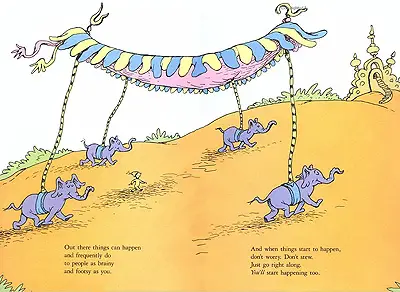
I also greatly enjoyed Dr Seuss's immortal Oh, the Places You'll Go, which has everything you need to know for a life on earth. See also: Vonnegut's Timequake.
***
Thanks for reading.