
Despite this special effect, Vertigo has been named the greatest film of all time.
This week, British film mag Sight and Sound published its list of the 50 greatest movies ever made, as voted for by critics. Having topped the list since 1962, Citizen Kane came second this time, with Alfred Hitchcock's Vertigo replacing it at number one. The changing of the guard has made headlines worldwide, with journalists confusedly declaring that Kane is "no longer the greatest film of all time".
For me, Kane remains as good a bet as any, its timeless screenplay and arresting performances allied to a matchless sense of innovation that changed the face of movie-making. Taking his lead from a pair of John Ford films, Stagecoach and The Long Voyage Home, Welles proceeded to comprehensively re-write the rules of cinema, employing jaw-dropping deep focus photography (developed with the legendary Gregg Toland), ceilinged sets that opened up the possibility of outlandish camera angles and an arsenal of frankly astounding visual tricks, all to serve a riveting, moving, aggressively non-linear narrative in which a man gains a fortune but loses his soul.
I like Vertigo - it's an interesting, masterfully-directed movie with a fine central performance from Jimmy Stewart, and a cut above much of Hitchcock's later work - but like rather too many films on the list, it engages the brain rather than the heart. And if I was sitting down to watch a Hitchcock film tonight, for entertainment rather than to write a thesis about it, I can think of a dozen I'd rather see. As Pauline Kael said about The Searchers (more of which later): "You can read a lot into it, but it isn't very enjoyable." In fact, that's how I feel about too many films on the list.
Jean-Luc Godard - everyone's favourite annoying, self-satisfied cinematic philosopher - has four entries on the list, including the disappointing Le Mépris, while Jacques Tati's interminable Play Time also makes an inexplicable appearance. The Bergman entry is the intriguing Persona, rather than the affecting Wild Strawberries, the Fellini movies are 8 1/2 and La Dolce Vita - rather than La Strada and Nights of Cabiria - both of which prize dazzling direction over human emotion, while the Renoir isn't La Grande illusion, but La Règle du jeu. Kubrick wasn't renowned for his weepies, but Paths of Glory can destroy a man; can the same be said of 2001? And between them, Man with a Movie Camera, Battleship Potemkin and Stalker don't offer a character you can engage with on any level, even if for fans of montage, double-exposure or having a three-hour nap (Stalker), there's lots to enjoy.
There are, of course, moving movies amongst the selection. Chaplin's exquisite City Lights is there, Truffaut's Les Quatre cents coups, and Dreyer's startling Passion of Joan of Arc, one of the most intense experiences that cinema has to offer. Sunrise is a perfect marriage of style, poignancy and entertainment; Bicycle Thieves makes me weep buckets. But it seems a list of slightly skewed priorities: over-familiar and celebrating the cerebral over the emotional.
***
My list
For reasons too obvious to document, I wasn't invited to vote in the poll (as you can see, I'm not bitter), so I thought I'd tack up my own top 10 here. All of which have made me cry, because I am a girl.
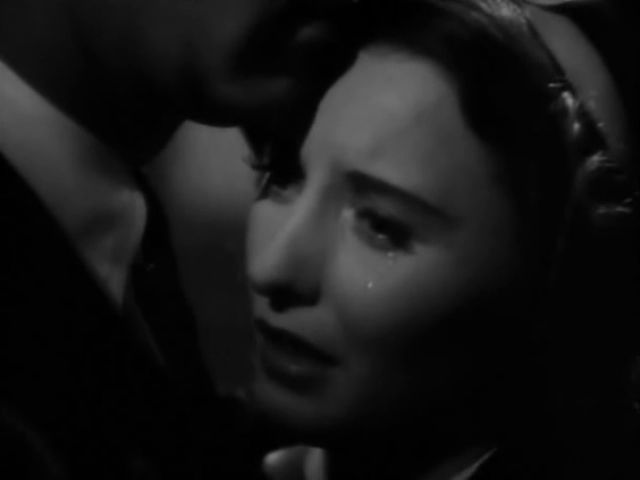
Remember the Night (Mitchell Leisen, 1940) - Written by comedy legend Preston Sturges and uniting the stars of Double Indemnity four years ahead of the fact, this holiday movie begins as a screwball comedy but morphs into a matchlessly moving romance, as prosecutor Fred MacMurray plays a dirty trick on shoplifter Barbara Stanwyck, then winds up spending Christmas and New Year with her. Spotlighting Leisen's startling visual sense and led by pitch-perfect performances - supporting players Beulah Bondi, Elizabeth Patterson and Sterling Holloway each given one scene in which to sparkle - it's a mesmerising, magical movie.

The Life and Death of Colonel Blimp (Michael Powell and Emeric Pressburger, 1943) - What does it mean to be British? Powell and Pressburger have a few ideas, serving up a mixture of character study, history lesson and state-of-the-nation address, as they chart the life of colonial-soldier-turned-Home-Guard instructor Clive Wynn-Candy (Roger Livesey, giving the performance of a lifetime). Churchill hated it, but what the hell did he know?

Hoop Dreams (Steve James, 1994) – You won't forget this documentary in a hurry: four years (and three hours) in the company of two teenage basketball players from inner-city Illinois who dream of the big-time, seeing the NBA as their ticket out of poverty. Shocking, exhilarating and heartbreaking, with astonishing twists of fate, it's a virtuosic, unforgettable film that has more to say about life itself than any other movie I've ever seen.

Ghost World (Terry Zwigoff, 2001) - A melancholy, bitingly hilarious crystallisation of teen ennui, which sees school leaver Thora Birch gravitate towards loner-with-lumbar-support Steve Buscemi. Beautifully written, superbly played and endlessly quotable. "It's America, dude, learn the rules."

Les enfants du paradis (Marcel Carne, 1945) - The towering achievement of French cinema: a portrait of a vanished world, a hymn to the art of acting and an allegory about Free France, boasting three of the finest performances ever committed to celluloid. Carné's handling is breathtaking, Prevert's script is clever, witty and worldly-wise and the timeless story seems to grow in strength and resonance with each passing year. Full review here.

The Searchers (John Ford, 1956) - Ford's dazzling odyssey of revenge and redemption has the greatest opening and closing sequences in all of cinema, and what's in between isn't bad either, dominated by John Wayne's towering characterisation. There are 4,000 words on it here.

Major Barbara (Gabriel Pascal, 1941) - There are some performances that bypass your critical faculties altogether, connecting not with your brain but with your soul. They are desperately few, those characterisations of such heightened sensitivity, such emotional resonance that the effect is both exalting and suffocating. I don't know why, or how, but every time Wendy Hiller utters a line or holds the frame in Major Barbara, I am on the verge of tears. It's just such a beautiful, enrapturing performance, the perfect, compassionate, warm and beating heart of a satirical, often cynical Bernard Shaw gabfest that cocks a snook at temperance, the Sally Army and those who see nobility in poverty. Full review here.

Cinema Paradiso: Director's Cut (Giuseppe Tornatore, 1988/2002) - In any form, Cinema Paradiso is a richly evocative movie that radiates a love of film and scales some unforgettable heights - the exam set-piece, the outdoor screening, the montage of kisses. This remarkable cut turns much of what you think you know on its head, twisting the film back from a crowd-pleaser to an upsetting, uncompromising artistic statement. And when Jacques Perrin's aged filmmaker puts his hands behind his head, it's hard to hold back the tears. Full review here.

Diary for Timothy (Humphrey Jennings, 1945) A summation of propagandist Jennings' wartime films: a portrait of Britain at war, made for a newborn child. Scripted by E.M. Forster and narrated by Michael Redgrave, it shows the country as you've never seen it: suffering and hardening, bogged down in a seemingly endless war of attrition as its people struggle to maintain business as usual for a fifth, ravaged year. As he would in his 1949 classic, The Dim Little Island, Jennings focuses on four diverse Britons: in this case a miner, a farmer, a train driver and a wounded pilot undergoing rehabilitation. Theoretically, anyway. In typical fashion, his scope encompasses not just conventional morale-boosting fodder, but also culture (Shakespeare, Beethoven), homelife and the contrast between the industrial heartlands and the tranquil countryside a stone's throw away. It's at once realistic and poetic. The fellow who edited the chaptering on the film's first DVD release said it was impossible to do it satisfactorily, because its themes are so interlocked. But while you could study it for weeks and still draw more from its immaculate construction, Diary for Timothy really works because it speaks not to the head but to the heart, and the part of all of us that will remain forever England.

A Tree Grows in Brooklyn (Elia Kazan, 1945) - Kazan's debut is impossible to fault, an utterly draining movie about teenager Peggy Ann Garner's coming-of-age in early-20th century New York, flawlessly-directed, with immense performances in which every detail, every gesture rings true. Dorothy McGuire excels as Garner's mother - hardened by poverty - Joan Blondell is superb in a rare dramatic role as the girl's oft-married aunt, and James Dunn delivers an indelible characterisation as Garner's dad, an alcoholic pipe dreamer oscillating between euphoria and desperation. His reading of the folk song Annie Laurie soundtracks one of the most wondrous sequences I've ever seen on film.


