Showing posts with label Jean-Luc Godard. Show all posts

Thursday, 2 August 2012

The greatest movies of all time - my Sight and Sound ballot


Despite this special effect, Vertigo has been named the greatest film of all time.

This week, British film mag Sight and Sound published its list of the 50 greatest movies ever made, as voted for by critics. Having topped the list since 1962, Citizen Kane came second this time, with Alfred Hitchcock's Vertigo replacing it at number one. The changing of the guard has made headlines worldwide, with journalists confusedly declaring that Kane is "no longer the greatest film of all time".

For me, Kane remains as good a bet as any, its timeless screenplay and arresting performances allied to a matchless sense of innovation that changed the face of movie-making. Taking his lead from a pair of John Ford films, Stagecoach and The Long Voyage Home, Welles proceeded to comprehensively re-write the rules of cinema, employing jaw-dropping deep focus photography (developed with the legendary Gregg Toland), ceilinged sets that opened up the possibility of outlandish camera angles and an arsenal of frankly astounding visual tricks, all to serve a riveting, moving, aggressively non-linear narrative in which a man gains a fortune but loses his soul.

I like Vertigo - it's an interesting, masterfully-directed movie with a fine central performance from Jimmy Stewart, and a cut above much of Hitchcock's later work - but like rather too many films on the list, it engages the brain rather than the heart. And if I was sitting down to watch a Hitchcock film tonight, for entertainment rather than to write a thesis about it, I can think of a dozen I'd rather see. As Pauline Kael said about The Searchers (more of which later): "You can read a lot into it, but it isn't very enjoyable." In fact, that's how I feel about too many films on the list.

Jean-Luc Godard - everyone's favourite annoying, self-satisfied cinematic philosopher - has four entries on the list, including the disappointing Le Mépris, while Jacques Tati's interminable Play Time also makes an inexplicable appearance. The Bergman entry is the intriguing Persona, rather than the affecting Wild Strawberries, the Fellini movies are 8 1/2 and La Dolce Vita - rather than La Strada and Nights of Cabiria - both of which prize dazzling direction over human emotion, while the Renoir isn't La Grande illusion, but La Règle du jeu. Kubrick wasn't renowned for his weepies, but Paths of Glory can destroy a man; can the same be said of 2001? And between them, Man with a Movie Camera, Battleship Potemkin and Stalker don't offer a character you can engage with on any level, even if for fans of montage, double-exposure or having a three-hour nap (Stalker), there's lots to enjoy.

There are, of course, moving movies amongst the selection. Chaplin's exquisite City Lights is there, Truffaut's Les Quatre cents coups, and Dreyer's startling Passion of Joan of Arc, one of the most intense experiences that cinema has to offer. Sunrise is a perfect marriage of style, poignancy and entertainment; Bicycle Thieves makes me weep buckets. But it seems a list of slightly skewed priorities: over-familiar and celebrating the cerebral over the emotional.

***

My list

For reasons too obvious to document, I wasn't invited to vote in the poll (as you can see, I'm not bitter), so I thought I'd tack up my own top 10 here. All of which have made me cry, because I am a girl.
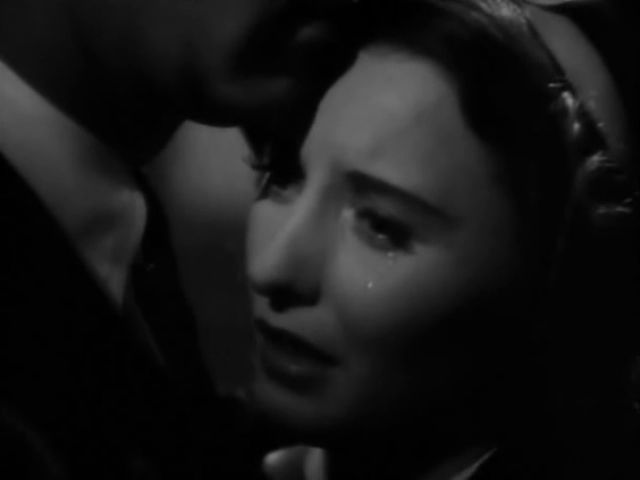


Remember the Night (Mitchell Leisen, 1940) - Written by comedy legend Preston Sturges and uniting the stars of Double Indemnity four years ahead of the fact, this holiday movie begins as a screwball comedy but morphs into a matchlessly moving romance, as prosecutor Fred MacMurray plays a dirty trick on shoplifter Barbara Stanwyck, then winds up spending Christmas and New Year with her. Spotlighting Leisen's startling visual sense and led by pitch-perfect performances - supporting players Beulah Bondi, Elizabeth Patterson and Sterling Holloway each given one scene in which to sparkle - it's a mesmerising, magical movie.


The Life and Death of Colonel Blimp (Michael Powell and Emeric Pressburger, 1943) - What does it mean to be British? Powell and Pressburger have a few ideas, serving up a mixture of character study, history lesson and state-of-the-nation address, as they chart the life of colonial-soldier-turned-Home-Guard instructor Clive Wynn-Candy (Roger Livesey, giving the performance of a lifetime). Churchill hated it, but what the hell did he know?


Hoop Dreams (Steve James, 1994) – You won't forget this documentary in a hurry: four years (and three hours) in the company of two teenage basketball players from inner-city Illinois who dream of the big-time, seeing the NBA as their ticket out of poverty. Shocking, exhilarating and heartbreaking, with astonishing twists of fate, it's a virtuosic, unforgettable film that has more to say about life itself than any other movie I've ever seen.


Ghost World (Terry Zwigoff, 2001) - A melancholy, bitingly hilarious crystallisation of teen ennui, which sees school leaver Thora Birch gravitate towards loner-with-lumbar-support Steve Buscemi. Beautifully written, superbly played and endlessly quotable. "It's America, dude, learn the rules."


Les enfants du paradis (Marcel Carne, 1945) - The towering achievement of French cinema: a portrait of a vanished world, a hymn to the art of acting and an allegory about Free France, boasting three of the finest performances ever committed to celluloid. Carné's handling is breathtaking, Prevert's script is clever, witty and worldly-wise and the timeless story seems to grow in strength and resonance with each passing year. Full review here.


The Searchers (John Ford, 1956) - Ford's dazzling odyssey of revenge and redemption has the greatest opening and closing sequences in all of cinema, and what's in between isn't bad either, dominated by John Wayne's towering characterisation. There are 4,000 words on it here.


Major Barbara (Gabriel Pascal, 1941) - There are some performances that bypass your critical faculties altogether, connecting not with your brain but with your soul. They are desperately few, those characterisations of such heightened sensitivity, such emotional resonance that the effect is both exalting and suffocating. I don't know why, or how, but every time Wendy Hiller utters a line or holds the frame in Major Barbara, I am on the verge of tears. It's just such a beautiful, enrapturing performance, the perfect, compassionate, warm and beating heart of a satirical, often cynical Bernard Shaw gabfest that cocks a snook at temperance, the Sally Army and those who see nobility in poverty. Full review here.


Cinema Paradiso: Director's Cut (Giuseppe Tornatore, 1988/2002) - In any form, Cinema Paradiso is a richly evocative movie that radiates a love of film and scales some unforgettable heights - the exam set-piece, the outdoor screening, the montage of kisses. This remarkable cut turns much of what you think you know on its head, twisting the film back from a crowd-pleaser to an upsetting, uncompromising artistic statement. And when Jacques Perrin's aged filmmaker puts his hands behind his head, it's hard to hold back the tears. Full review here.


Diary for Timothy (Humphrey Jennings, 1945) A summation of propagandist Jennings' wartime films: a portrait of Britain at war, made for a newborn child. Scripted by E.M. Forster and narrated by Michael Redgrave, it shows the country as you've never seen it: suffering and hardening, bogged down in a seemingly endless war of attrition as its people struggle to maintain business as usual for a fifth, ravaged year. As he would in his 1949 classic, The Dim Little Island, Jennings focuses on four diverse Britons: in this case a miner, a farmer, a train driver and a wounded pilot undergoing rehabilitation. Theoretically, anyway. In typical fashion, his scope encompasses not just conventional morale-boosting fodder, but also culture (Shakespeare, Beethoven), homelife and the contrast between the industrial heartlands and the tranquil countryside a stone's throw away. It's at once realistic and poetic. The fellow who edited the chaptering on the film's first DVD release said it was impossible to do it satisfactorily, because its themes are so interlocked. But while you could study it for weeks and still draw more from its immaculate construction, Diary for Timothy really works because it speaks not to the head but to the heart, and the part of all of us that will remain forever England.


A Tree Grows in Brooklyn (Elia Kazan, 1945) - Kazan's debut is impossible to fault, an utterly draining movie about teenager Peggy Ann Garner's coming-of-age in early-20th century New York, flawlessly-directed, with immense performances in which every detail, every gesture rings true. Dorothy McGuire excels as Garner's mother - hardened by poverty - Joan Blondell is superb in a rare dramatic role as the girl's oft-married aunt, and James Dunn delivers an indelible characterisation as Garner's dad, an alcoholic pipe dreamer oscillating between euphoria and desperation. His reading of the folk song Annie Laurie soundtracks one of the most wondrous sequences I've ever seen on film.

Monday, 26 April 2010

Kick-Ass, X2 and an unheralded screwball masterpiece - Reviews #32


CINEMA: Kick-Ass (Matthew Vaughn, 2010) is an original, entertaining fusion of teen comedy and superhero movie that stops firing on all cylinders when its guns start blazing. Dave Lizewski (Aaron Johnson) is an ordinary American teenager who decides to become a superhero. He has no powers, aside from “being invisible to girls”, but he does have a natty green costume, ordered online. After a spot of posing and some light training, the self-proclaimed Kick-Ass goes into action. Seeing two hoods trying to break into a car, he tackles them - and departs in an ambulance. Eventually, though, through a combination of resilience and dumb luck, our hero does attain local celebrity, along with the unwanted attentions of gangland kingpin Mark Strong, who thinks him responsible for a series of vigilante killings carried out by wronged ex-cop Big Daddy (Nicolas Cage) and his foul-mouthed daughter Hit Girl (Chloe Moretz, who is terrific). Meanwhile, Strong's neglected son (Christopher Mintz-Plasse) decides he wants to get involved, and reinvents himself as the bequiffed Red Mist.

The film starts in an appealingly whimsical vein, its superbly-observed passages about teen life punctuated with blasts of graphic, realistic violence: one minute Lizewski is wrestling with love interest’s Lyndsy Fonseca mistaken belief that he’s gay, the next he’s wrestling three armed men in the gutter. There’s a superb moment in which Kick-Ass decides to leap between tall buildings, then thinks better of it, such subversion of comic book lore jostling for space with simpler pleasures, like two geeky teen superheroes dancing goofily to Gnarls Barkley’s Crazy as they cruise the New York streets. But these more engaging elements are ultimately overtaken by cartoonish mayhem in a less imaginative, more gratuitous second half that - while fine in itself - largely abandons the excellent premise in favour of stylised gore. It’s still a very worthwhile film, with well-drawn characters, a glorious sense of the unexpected and a dozen huge laughs. (3)

***


*SPOILERS FOR THIS FILM AND CONFESSIONS OF BOSTON BLACKIE*
X2 (Bryan Singer, 2003) is a stunning sequel to X-Men that ups the ante in terms of action, mystery and character drama. The premise is perfectly formed, as the heroes from the first film are forced to enter an uneasy alliance with former adversary Ian McKellen and his amorphous henchwoman (Rebecca Romijn-Stamos). The danger this time is despotic military man Brian Cox, who’s harbouring at least two dark secrets as he plots the demise of the mutant race. All the key cast members return, while Alan Cumming is an excellent addition to the cast as Kurt Wagner, improbably channelling Nosferatu to create a lovely, sympathetic character. Utilising biblical reference and the actor’s effective underplaying, the film cleverly flips our initial impression of Wagner, introduced as a knife-wielding, teleporting psychopath in a bravura opening sequence.

This is an extremely well-plotted, satisfying action film that (presumably inadvertently) ends up borrowing the clever double-ending of Confessions of Boston Blackie (see #89), which also saw its heroes defeat the bad guys, only to face near-certain suffocation. Singer seamlessly balances the disparate story elements, which again mix story threads about friendship, love and loyalty with broad satire and disarmingly funny, well-integrated comic asides. Racism gets another battering here, while mutancy is also equated with homosexuality in a spoof of ‘coming out’ clichés that’s played solely for laughs. “Have you tried not being a mutant?” asks Ice Man’s mother, before adding: “This is all my fault.” Happily, Pyro is on hand to reassure her: “Actually, they discovered that males are the ones who carry the mutant gene and pass it on, so-” he points at Ice Man’s dad, “it’s his fault.” The film's heart is illustrated by the genuinely touching chat between Wolverine and Ice Man, which sees the latter use his powers to cool his friend's drink. X2 is littered with such likeable, knowing touches.

There are shortcomings, with a slight nastiness permeating several scenes and coming to a head in a sequence invoking a gruesome lobotomy. It’s also unnecessary for Singer to hit us over the head with flashbacks concerning Wolverine’s past, when that shot of the three scratch marks etched into a column in a grim cellar lab made the point so subtly and so well, while a lack of clarity about the dam site in the final set piece makes the ending a touch confusing. But this is a mightily impressive, immensely enjoyable blockbuster, with strong action sequences, a firm grasp of its source novels’ mythology and strong performances across the board. (4)

***


It's Love I'm After (Archie Mayo, 1937) is just a delight, an incredibly well-written screwball comedy that keeps the expertly-crafted witticisms flying thick and fast. Given the wrong material or the wrong direction, Leslie Howard could appear unbearably smug, but here he gets the role of a lifetime - and makes the most of it. He's a conceited ham, with two eyes for the ladies, who spends most of his time off-stage (and some of it on) warring with thespian girlfriend Bette Davis. Resolving one day to turn over not just a new leaf, but a whole book of them, he's forced to play the last word in unthinking bounders to disillusion the fiancee (Olivia de Havilland) of an old friend's son. It's a great set up: a reformed character having to appear even more reprehensible than before in order to do the decent thing, and it's developed in consistently surprising, imaginative ways.

And then there's the cast. Howard is flawless as the conceited, confused, compromised, increasingly desperate cad - who has more than a little of John Barrymore about him - with Davis giving her best comedic performance as his long-suffering lover, who packs an explosive temper. De Havilland is perfectly cast, both cloying and appealing as the starstruck girl who'll excuse anything her rambunctious idol does, while Eric Blore excels as Howard's valet and co-conspirator. Blore, one of the great supporting comics, is great in everything, but I've never seen him as funny as here. Displaying his customary lack of vanity and willingness to do anything for a laugh, he spends most of one scene making ridiculous bird noises and another displacing his silly toupee. Blore also gets the best line of the film, responding to Bonnie Granville's cry of "I know something you don't know" with one of the funniest, most petulant one-liners I've ever heard.

Drawing on Shakespeare to gets both its pathos and its laughs, in the vein of To Be or Not to Be and Withnail & I, It's Love I'm After is streets ahead of most other golden era comedies: intelligent, romantic and uproariously funny, eliciting the particular buzz that comes with watching something that's clearly very special. (4)

Note: This film is now available on Region 1 DVD, on demand from the Warner Bros Archive.

***


*MAJOR SPOILERS*
Daredevil (Mark Steven Johnson, 2003) - Speaking of Shakespeare, there’s something of Hamlet about Daredevil, the hero of Mark Steven Johnson’s grim, adult comic book tragedy on the subject of revenge. Ben Affleck is Matt Murdock, a lawyer by day, but a catsuited crimefighter by night. In between, he recharges his batteries by gobbling down prescription pills and sleeping in a coffin full of water at the back of a Catholic church. Whilst supposedly a protector of the public, Daredevil battles a burning desire for vengeance that threatens to consume him, as shadowy forces rob him of the only two people he loves.

The context is particularly interesting: in terms of the character’s background, his complexity and his moral ambiguity. Murdock, the son of a prizefighter, is blinded during a tough childhood in Hell’s Kitchen, but finds that his other senses acquire a superhuman sharpness. Exacting his own brand of justice, he comes into conflict with his priest and guardian (a character reminiscent of Pat O’Brien in Angels with Dirty Faces), who tells him: "A man without fear is a man without hope." But as the desperate Murdock tells a cowering child: “I’m not the bad guy.”

The bad guy is The Kingpin (Michael Clarke Duncan), ably assisted by flicky hitman (“flickman”, if you will) Bullseye (Colin Farrell), who’s like a satanic, Irish Oddjob. Hilariously, Farrell is introduced with a hip hop song boasting the central refrain: "Top o' the mornin' to ya/Top o' the mornin' to ya". Indeed, one of the film’s main failings is an overbearing song score stuffed with unmemorable tunes that are either unsuitable for the action or else offer blunt narration. Farrell’s superb, though, in his colourful characterisation, and there’s a cracking joke about the way he deals with security guards.

Johnson’s direction is quite good, repeatedly drawing on a neat “radar” gimmick, later half-inched by wise old Morgan Freeman in The Dark Knight, as Murdock constructs a picture of his surroundings via his supersensitive hearing. The scenes in which the hero “sees” via the rain are poorly realised, there’s too much CGI in the Affleck/Farrell showdown and the non-linear structure is quite confused, but there’s a great shot of Murdock on the rooftop before the final fight that recalls the classic image of coward Chester Morris keeping an eye out for the cops above his safehouse in the pictorially striking Alibi. The final fight itself, in the pouring rain, is also very good - recalling the main set piece in Jet Li’s passable Born to Defend – and the payoff is admirable and brave.

Affleck is fairly good in a well-written role, supported by Jon Favreau - offering strong comic relief and emotional backbone as Murdock’s law firm partner – and Jennifer Garner, who’s a nice romantic lead. Her courtship dance with Affleck, a kung fu battle in a park, is daft but novel. I was surprised to learn that Daredevil is widely regarded as one of the weaker comic book adaptations of recent years, as it’s vastly superior to Spider-Man and more coherent and nuanced than the messy, if sporadically extraordinary Dark Knight. There’s also a funny bit in the funeral scene where it starts to rain and Affleck’s impeccably gelled hair begins to look like an umbrella. (3)

***

The following review contains one instance of fully-justified swearing.


Le mépris (Jean-Luc Godard, 1963) sounds intriguing, but staggers under the weight of its own pretensions. The plot, according to almost anyone you ask, is this: screenwriter Michel Piccoli is torn between an artistic director (Fritz Lang, good fun playing himself) and a commercially-minded producer (Jack Palance), his artistic problems coinciding with home life troubles. Really, though, this is a 90-minute lovers' quarrel, with a soupcon about art and compromise occasionally nudged into the narrative. If that sounds fun, then go ahead. The film is at its best in the first hour, with fine use of the central musical theme (later borrowed by Scorsese for Casino), some spectacular Cinemascope photography and snippets of fairly involving characterisation, but the final third is almost unbearably tedious, dominated by marital squabbling that becomes hopelessly mannered and repetitive. It's interesting to see Bardot as the director's muse, but while she's really rather good, she's scuppered by the infuriatingly shallow scripting. In the disc's accompanying documentary, Bardot et Godard, the narrator says: "All Godard's films are portraits of the modern woman: illogical, disarming, capricious, exasperating, regal ... mysterious." Try: "All Godard's films are artificial, unilluminating portraits of the two women he seems to have met: illogical, capricious, naked and really fucking annoying."

Likewise, though Lang has some interesting - if rigidly Godardian - things to say about man's relationship with God and with film, the movie too often lapses into self-indulgent rubbish. Godard is clearly delighted at the points he's making, but they tend to be either obvious or confused. The dearth of insight is typified by including the character of an interpreter, who takes up about a fifth of the running time saying something someone else has just said, making a pretty crude point about the incompatibility of the archetypes in a very long-winded, tiresome manner. While the key cinematic homage in Godard's first film, À bout de souffle, was stylised and clever ("Ah, Bogie!"), here the namechecking of Rio Bravo and Bigger Than Life comes across as pointless and laboured. Lang's contention that Cinemascope is "good for snakes and coffins" rather than people is a nice moment, while the unsurprising revelation that he prefers his 1931 film M to the bloody dreadful Rancho Notorious has a clear implication: one is a clear; artistic statement, the other Hollywood studio product. But I'd still rather watch Lang's Fury, or The Big Heat, than Le mépris, which is self-satisfied, overly familiar and ultimately dull. (2)

***


It Happens Every Thursday (Joseph Pevney, 1953) – Loretta Young, the toothy, huge-eyed leading lady, was known in Hollywood as “Attila the Nun”, due to her evangelical Catholic faith (which extended to introducing a swear jar on set, something I’ll have to implement at work) and iron will. She may have been voted the Hollywood Women’s Press Club’s most cooperative actress of 1950 (Bob Mitchum scooped their least cooperative actor gong), but then she always was a sassy self-publicist. Still, despite all that, and the bad press she’s had in recent years for the whole Judy Lewis affair, she remains an attractive performer: ethereal and appealing in those early years, then a fitting screen mother as her fascinating looks ebbed away.

It Happens Every Thursday was her final film and it’s a charming piece of Americana: something like the gentle cousin of Fuller’s Park Row, with a showy role for Young as the archetypal supportive wife – stoic, resourceful and loyal. John Forsythe is a New York newspaperman who buys his own small-town ‘paper – the Eden Chronicle – and finds it’s going to need a bit of work. The relationship between Forsythe and screen wife Young is smartly written and delightfully played, and the difficulties they face are nicely realised. The familiar baddie in such movies, a hateful, sniping little gossip gleefully ruining lives, is usually a harridan, but here you get a fey wannabe adulterer, played by Willard Wateman. The rest of the supporting cast is pretty much terrific, featuring the greatest character comic of them all, Frank McHugh, alongside Preston Sturges regular Jimmy Conlin and round-faced Edgar Buchanan, who’s excellent in a surprisingly deep role. Best of all is the magnificent Gladys George (also appearing on the big screen for the final time), the most sympathetic brothel owner in ‘50s cinema. This blend of Johnny Come Lately and Mr Blandings could have seemed stale, but thanks to good scripting, pleasant plotting and lovely acting, it turns out just great. (3.5)