Showing posts with label Maggie Smith. Show all posts

Saturday, 1 October 2016

Maggie Smith, A. I. and a trip to see David Niven's suit − Reviews #244

Please excuse the relative sparsity and brevity (and indeed one of my most obvious opinions, about A. I.), I've been moving flats. A second update is on the way after this one.

FILMS


The Prime of Miss Jean Brodie (Ronald Neame, 1969) − As an adaptation of a quite brilliant novel, this doesn't hack it, but as a film in its own right, it's rather wonderful, hammering a deliriously modern and subversive book into a work of eccentric nostalgia, culminating in a histrionic battle of wills.

Maggie Smith is Miss Jean Brodie, an idiosyncratic, unmarried teacher in '30s Edinburgh who adores her charges, idolises Mussolini and won't shut up about being in her prime. Caught between two men − upstanding music teacher Gordon Jackson and rakish arts master Robert Stephens − she incurs the wrath of prim, moralistic headteacher Celia Johnson, as her relationship with self-possessed student Sandy (Pamela Franklin) begins to sour.

I find the film's synthetic, pastel-ish appearance simply unattractive and the book's wry wit and deliriously inventive flashes forward are much missed, but the music is wonderful, Smith is sensational and the film gains in momentum as it progresses, leading to a devastating monologue about Dante (invented for the stage production that preceded the film) and a climactic confrontation of sheer quivering fury.

It's a much more conventional work than Muriel Spark's source novel, but perhaps I'd rather find a film that does something different rather than emerging as a pale shadow of a beloved book. (3)

***


*SOME SPOILERS*
A. I. Artificial Intelligence (Steven Spielberg, 2001)
− Striking, heartwrenching sci-fi that for almost two hours hits the sweet spot between Kubrick's cold intellectualism and Spielberg's sodden soppiness, as robo-kid Haley Joel Osment is adopted, rejected and goes off in search of the 'Blue Fairy' who can turn him into a real boy. Dominated by Osment's wonderful performance and augmented by stunning visuals and John Williams' slowed-down-Raiders score, it's a film constantly in motion, never quite satisfying us until it reaches a point of poignant, terrifying clarity. Then Spielberg serves up the usual embarrassing half-hour coda saturated in treacle. (3)

See also: I decided to seek this one out after reading Mark Kermode's book, Hatchet Job, which discusses it at some length.

***


Love and Death (Woody Allen, 1975) − I'm a huge fan of Woody Allen movies, but his "early, funny films" − as he termed them in Stardust Memories − aren't really my thing. Pitching his familiar, bespectacled persona into some incongruous setting: the future (Sleeper), a South American revolution (Bananas) or Russian history (Love and Death) like an old Bob Hope or Marx Bros film, they're largely a barrage of gags, bereft of the warmth and deft introspection that typify that decade of classics he produced between Manhattan and Crimes and Misdemeanours.

Love and Death has its moments: a couple of inspired monologues to camera, some great one-liners ("Where did you go to finishing school, on a pirate ship?") and the inspired use of Prokofiev's music, but a lot of it consists of shameless mugging, self-satisfied nods to Russian novels and the kind of broad humour that veers awfully close to Mel Brooks territory − and I can't stand Mel Brooks. Even Diane Keaton can't make some of this work. (2)

See also: I'll be reviewing Woody's latest, Cafe Society, in the next reviews update. And here are 10 things I learned about him from an excellent 2012 documentary, as well as an address to the elephant in the room.

***

BOOK


Deadeye Dick by Kurt Vonnegut (1982)
– Vonnegut's 1982 novel is superficially about gun control, but as usual goes much wider, weirder and deeper than that, as narrator Rudy "Deadeye Dick" Waltz recalls his double-murder, his visit to Broadway and the neutron bomb that wiped out all life as we know it in Midland City, Ohio. It's partly about the death of innocence, partly about the sins of the father (in this case a former mate of Hitler's whose whole life, like his house, is a meaningless construct) and partly Vonnegut taking aim at the hypocrisy and muddled priorities of 20th century America, though it's about much else besides. And its narrator, meanwhile, is almost entirely dispassionate, lending the book a disorientating, otherworldly feel, strengthened by the flights of forced removal whereby he begins to write about stressful events in his life as if they were in a play.

Everything you would want from Vonnegut is ultimately here, from the stylistically childlike language (death is described as someone's "peephole closing") to the mischievous form (relevant recipes are sprinkled throughout) to the championing of art and community, even if it it's rather harder to get a handle on than most of his works. The passage about the way lives translate to stories ("If a person survives an ordinary span of sixty years or more, there is every chance that his or her life as a shapely story has ended, and all that remains to be experienced is epilogue. Life is not over, but the story is") typifies what I love about him as a writer: profundity distilled through a knowingly simplistic folksiness. Deadeye Dick is wry, dark, humane and wise, and it couldn't be mistaken for a book by anyone else. (3.5)

***

TV


Spiral (Season 3, 2010)
– A far-fetched but very entertaining third series of my new favourite programme, with Laure (Caroline Proust) and co hunting a serial killer, and Judge Roban (Philip Duclos) turning his steely blue eyes on political corruption. The grubby realism of Season 2 is exchanged for some improbable melodrama – would all of these things really happen to these people in just a few months?! – but the acting is excellent, stocky, taciturn cop Gilou (Thierry Godard) really comes into his own, and the final episode is a knockout, with a phenomenal conclusion that sheds new light on both Laure and ruthless lawyer Josephine Karlsson (Audrey Fleurot). (3.5)

***

EXHIBITION


Real to Reel (Imperial War Museum)
− This handsome exhibition looking at war movies and the real stories behind them is rather stronger on movie artefacts than those from genuine battles, but if that's what you're after, then the IWM's scholarly but accessible exhibition is essential viewing. As a proper film nerd, I was delighted and surprised by the scope and depth of the cinematic knowledge underpinning it, and by the chance to see David Niven's costume from A Matter of Life and Death, Dietrich's USO dress and the coat that Gable wore during WWII. More eerie, and yet arguably even more fascinating, is a rare opportunity to view a clip from a piece of shimmering Nazi escapism (a rare instance of interactivity), since almost every film made under the Third Reich is banned from distribution. My favourite of all the exhibits was in the final room, but I won't spoil the surprise (perhaps I'll publish a picture once the exhibition has closed): think '40s Warner Bros movies and prepare to get very excited. Incidentally, Real to Reel uses the 100 years since the drama-doc The Battle of the Somme as its hook, so there's no nod to the first, most influential and perhaps most troubling war movie of them all, Griffith's notorious Birth of a Nation. (3.5)

***

Thanks for reading.

Sunday, 20 January 2013

Jeff, jail and Judith Hearne - Reviews #144


*MINOR SPOILERS*
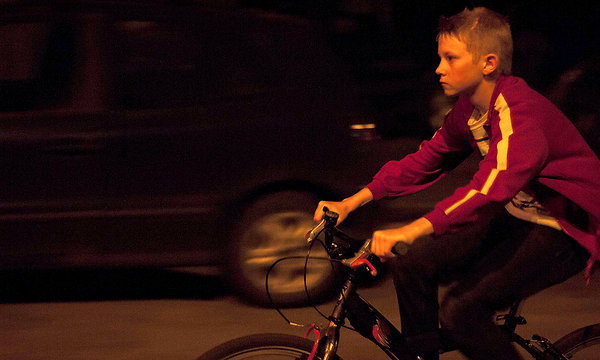
The Kid with a Bike (Dardenne brothers, 2011)
- A young boy (Thomas Doret) with behavioural issues tries to reconnect with his absent father (Jeremie Renier), is fostered by a selfless hairdresser (Cecile De France), then gets involved with a vicious, supercilious gangster (Egon Di Mateo), in this astonishing human drama. I've met quite a few people like the damaged, confused, painfully insular and sporadically aggressive hero of The Kid with a Bike, but I've never seen a movie about one before, and capturing real life on film in this way is to be applauded in itself.

The script and performances are note-perfect, and there's also an invigorating lack of extraneity in the storytelling: the linking scenes you'd find in most films are ruthlessly excised, so everything - even the scenes of the titular kid on his titular bike - serve the gutting, heartbreaking narrative, in which the viewer's response to almost every exchange is, "That's a shame", in which the aimless, lonely protagonist - devoid of masculine guidance - smashes two people with a baseball bat as an act of love for two male role models who throw the gesture back in his face, in which the only real point of comparison - in terms of bleakness, bicycles and the welcome shaft of light at the close - is De Sica's Bicycle Thieves.

The film has elements of fatalism without being pessimistic, tells a simple story that never looks for an easy way out, and eschews sentimentality while radiating a bold and uncompromising sense of humanity. It moved me very deeply.

***


Jeff, Who Lives at Home (Jay and Mark Duplass, 2011) – An emotionally articulate, unusual and deceptively wise film about fate, the universe and the frustrations and disappointments of adulthood, as full-time slacker Jason Segel ventures out from his mum’s basement and begins a tentative day of discovery, interacting with his uptight brother (Ed Helms) and trying to read some mysterious cosmic signs (following several viewings of the film Signs) that relate to the significance of the name Kevin. It’s funny, unpredictable and full of insights about love, loneliness and life, aided by Segel’s fine performance, though a subplot about mum Susan Sarandon’s romantic re-awakening seems a bit forced – and smugly progressive – in comparison. Despite that, and some concessions to conventionality, this consistently interesting indie is still likely to blindside you with the originality of its plotting, the strength of its dialogue and the courage of its convictions. Not that the film doesn’t have a couple of kindred spirits, recalling Matt Bissonette’s – which also concerned two brothers re-connecting during one long, strange day, and is even better – as well as The Tao of Steve, another movie with a philosophical stoner for a hero. (3.5)

***


The House I Live In (Eugene Jarecki, 2012) is a powerful polemic against the War on Drugs, which Jarecki argues is really a war on communities that began as an issue of race, and is now one of class. Assisted by scholars, addicts, dealers, law-enforcers, a judge, one of the creators of The Wire and a series of prisoners (500,000 US citizens are currently in jail for non-violent drugs-related offences), he forms a compelling and invigorating case filled with revealing and shocking detail. Like how the media storm around crack cocaine in the ‘80s (powder cocaine + baking soda + water + heat) saw the introduction of sentences 100 times more punitive than for the original form of the drug. That a “three strikes” policy advocated on film by Clinton has seen a drug addict who trafficked to feed his own habit jailed for life – without parole. And that while only 13 per cent of crack users in the US are African-American, 80 per cent of those behind bars for crack offences are. I didn’t think I could think less of how the US treats its African-American community after Steve James’s The Interrupters, but it turned out I could. As a film, it’s a little messy – curious, considering that Jarecki was responsible for that sleek, streamlined, immaculately-edited Reagan doc – while the decision to frame his investigation in the first person feels misguided, leading to some weak and irrelevant passages, but it’s an important and impassioned work that raises many crucial questions, all of which must be answered by American law-makers. (3.5)

***


*SPOILERS*
The Lonely Passion of Judith Hearne (Jack Clayton, 1987)
– A great performance in search of a great film, as meek, lonely, religious Irish spinster Maggie Smith loses her faith and her mind after being spurned by selfish would-be entrepreneur Bob Hoskins. Smith is absolutely extraordinary – fully immersed in a characterisation so real and true that the film feels almost intrusive – and her flashback sequences, reflecting on a her life spent caring for her addled aunt driven mad by a stroke, provide at least one truly great scene for the mighty Wendy Hiller. But the story is all over the shop, sometimes boring, often laughably overwrought, with supporting characters who’d seem more at home in either gothic melodrama or ‘70s sitcoms – especially ludicrous, slimy, be-moobed poet Ian McNeice – while Hopkins is oddly poor (and cursed with a lousy American accent), and the film expects us to be more disgusted by his character wanting Hearne for her money than the fact he’s a rapist. When Smith’s pitiful, self-pitying character is on screen it works and there are some incredibly powerful passages towards the end, particularly her drunken confrontation with parish priest Alan Devlin and subsequent explosion of emotion at the altar, railing furiously at God, before scratching desperately at the tabernacle and pleading to join him. It’s just a shame that such a remarkable performance, such a stunning study of mental illness, religious doubt and abject loneliness, isn’t housed in a more credible, coherent film, though it’s still worth it to see Smith at the peak of her considerable powers. (2.5)

***


I don't know what you're looking so smug about.

Orange County (Jake Kasdan, 2002) – When an aspiring writer (Colin Hanks) with a dysfunctional family sees his attempts to get into Stanford University scuppered by an incompetent school administrator (Lily Tomlin), he decides to drive there to talk them round, with his girlfriend (Schuyler Fisk) and stoner brother (Jack Black) in tow. Fisk is excellent, Kevin Kline has an unexpectedly effective bit near the close (the way he's incorporated is almost magical) and there are amusing cameos from Tomlin and Ben Stiller, but I found this an unimaginative, comedically lazy film, hampered by an emotional fraudulence that renders its stabs at poignancy completely hollow. It probably would have worked a bit better with Tom Hanks in the lead, mind. Even in 2002. (2)