Showing posts with label Dardenne Brothers. Show all posts

Tuesday, 2 April 2013

Crouching Tiger, Thora Birch in a hole, and still more from ClintFest '13 - Reviews #152

I watched a few movies over the Easter break. Now I'm going to tell you about them.

A couple of rewatches:


Crouching Tiger, Hidden Dragon (Ang Lee, 2000) - I hadn't seen Ang Lee's metaphysical, phantasmagorical epic kung fu love story since it blew me away at the cinema as a 16-year-old; remiss of me, I know. Twelve years on, and fuck me it looks good. Chow Yun-Fat and Michelle Yeoh play quiet, lovelorn warriors, kept apart by a shared sense of honour, whose tentative steps towards romance are interrupted most abruptly by highly-strung, arse-kicking governor's daughter Zhang Ziyi, and the high-pitched psychopath she calls master.

The script is blessed with a rare profundity, dealing with massive themes in a way that's elliptical yet grounded, and the methodically paced story - which includes a ludicrously ambitious half-hour flashback sequence dealing with Ziyi's formative romance - is offset by exuberant fights of fancy in which Yun-Fat or Yeoh zip skywards to pad speedily across rooftops in pursuit of the excitable, foul-mouthed little tyke, trading kicks and punches with her as they go. There are also more earthy - though no less remarkable - skirmishes that take place at ground level, including fight choreographer Yuen Woo-Ping's nod to his own work in The Matrix, as Ziyi firmly grasps her stolen sword, the Green Destiny, and Yeoh goes at her with everything she can find: a lance, a pole, a big ball on a stick (sorry to get all technical on you) and finally a dock-off sword of her own.

These fight scenes attain a breathless intensity, especially when the remarkable Yeoh is involved, fuelled by a pounding traditional score and their timeless context: if you feel inexorably tied to these characters, weighed down as they are by these emotions, then it matters more when they're fighting for their lives. There's also something truly fantastical about that first action sequence, as if Jet Li had suddenly turned up in A Short Film About Killing: 20 minutes of steady, timeless talkiness and then an explosion of wonder, as Ziyi's masked thief heads for the clouds. Having said all that, Crouching Tiger didn't reinvent screen action in the way that prissy critics claimed back in 2000. They'd just been too sniffy to watch a wired-up wuxia film - like Once Upon a Time in China or Iron Monkey - until the director of The Ice Storm deigned to make one.

What Lee does bring to the genre, though, is a serious-mindedness and a firm grasp of mythology that's too often missing from kung fu films. When the film wants to be funny, it is (well, apart from that completely incongruous gag in the middle of the frenzied Yeoh-Ziyi HQ battle), but it has little of the mugging and none of the weak comic interludes that drag down too many martial arts movies. Its characters are remarkable, their thoughts concerned with lofty ideals, but they are also recognisable human beings, played to a tee by proper actors.

When you cast Chow Yun-Fat in a kung fu film, you forego a certain skill and athleticism (I think he's doubled in some long shots exhibiting Li Bu Mai's technical prowess), but gain immeasurable weight and authority. Ziyi is a trained dancer, not a martial artist, but she has an acrobatic grace, and negotiates her character's dramatic complexities with admirable skill. And Yeoh, well, she's both a great actress and the definitive female action star of the last couple of decades, so she's alright. I've always held that Armando Ianucci was correct, and that a man has truly reached adulthood when he knows what a radiator bleed key is. Perhaps, though, it's the moment when he watches this film and thinks that while Zhang Ziyi's not bad looking, she's no Michelle Yeoh. (Last time, it was: "Wowsers, that Zhang Ziyi is gorgeous; who's that old woman?") In support, Chang Chen is good as "Dark Cloud", the bum-fluffed desert bandit who engages in a Bringing Up Baby/Ashes of Time hybrid of a burgeoning love story with Ziyi that fuses the battle-of-the-sexes, period romance and "I've-got-your-comb"/"Fuck off, give it back" genres.

Crouching Tiger is one of the great films of last decade, often claustrophobic in scale, but epic in its treatment of human emotion, and chock-full of magic, magnificence and good old-fashioned fucking mayhem. It looks beautiful, it sounds beautiful - hell, it is beautiful - and where it's going, we don't needs roads, or even floors. Goodness knows how it took me 12 years to rewatch it. See you in 2025, when I'll probably think Jade Fox is hotter than Michelle Yeoh and be begging her to stick her poisoned dart in me. (4)

***


Silver Linings Playbook (David O. Russell, 2012) - A film so great that even Chris Tucker is good in it. I loved Silver Linings to pieces when I saw it at the cinema - entranced by its originality, performances and rich sense of character - and it's even better second time around. I wondered if there might be padding somewhere, but there isn't: every scene serves the story and that dramatic spark lit in the opening scene never fades. Bipolar Bradley Cooper is released from a psychiatric hospital eight months after almost beating someone to death, and tries to get his life back on track, looking to overcome his illness by finding "silver linings" in the everyday. Meeting self-confessed "slut", Jennifer Lawrence, the two strike up a bargain: she'll get a letter to his estranged wife (thus sort-of-circumventing a restraining order), if he'll be her partner in a dance contest.

For all the praise heaped on Lawrence, an actress of almost supernatural talent, I think she was lucky to get the Oscar ahead of Wallis - I suspect it has something to do with the old "I fancy her" criterion. She's excellent, but not Hushpuppy-excellent, and really it's Cooper's film. He dominates the movie with a complex, layered and ultimately unforgettable characterisation that does everything you want it to, and then some, never crossing into melodrama or cliche; always ringing true. There aren't many such revelations in cinema: where apparently limited, one-note performers suddenly rip off the lid, and out pours this explosion of talent - Ben Stiller in Tenenbaums and Adam Sandler in Punch-Drunk Love are other rare examples - and so when it happens, it's invigorating to witness.

The supporting cast is also superb. De Niro is better than he has been in years and Jacki Weaver (looking a lot like Brigitte Mira) gives a superb performance as Cooper's mum - it's nice to see the Academy nominate such an unshowy performance - while Tucker, appearing as a nervy patient who's obsessed with a) The law, and b) His hair, confounds all those who thought he was a load of old rubbish. Like me. I suppose I better add him to that "revelations" list. Tentatively.

Silver Linings is a bold film and a brilliant one, expertly walking a tightrope, as it neither mythologises mental illness nor mines it for cheap humour. Yes, the gnawing unhappiness of Melancholia may be more akin to most people's experiences of depression (not the bit where the world ends or where she shags someone on a golf course, the other bit), but I find Silver Linings an inspirational and captivating film: funny, romantic and blissfully entertaining, yes, but with a point and a purpose that makes it truly great. That and the fact that Chris Tucker is good in it. (4)

***

ClintFest '13

Yeah, this is still going on. You can join in if you want. You just have to watch some Clint Eastwood films. That's it.


Two Mules for Sister Sara (Don Siegel, 1970) - A mercenary (Clint Eastwood) and a sweary, resourceful nun (Shirley MacLaine) - who he rather fancies - try to outwit lowlifes, Indians and the French, and so make his fortune, in this Mexican-set Western. The episodic story, by B-Western legend Budd Boetticher, is good but erratic, and the same goes for Ennio Morricone's score (which includes an earworm of a theme for MacLaine) and Siegel's direction - a sumptuous tracking shot one minute, a clumsy, uninteresting composition the next. It's good fun, though, with some nice moments of pathos and comedy, and excellent chemistry between the leads. Eastwood is excellent, gradually expanding his familiar, taciturn persona with flashes of vulnerability and even a nice little song, but MacLaine is even better, and I mean Apartment-good, tackling her character's intentional contradictions, and very real faith, with intelligence, imagination and great beauty of spirit. (3)


Tightrope (Clint Eastwood, 1984) - There's a sign on a nightclub door in this film that says: "If nudity offends you, don't come in", and it's good advice, what with all the clothesless women slinking around, getting into jacuzzis or oiling themselves up and wrestling on stage as a midget referee adjudicates and Clint watches. (Yes really.) He plays a cop, divorced and with two young kids, who's trying to track down a sex murderer, while accidentally getting really horny every time he has to go and interview anyone. All that changes when he strikes up a genuinely affecting friendship with tender, understanding anti-rape activist Genevieve Bujold. This creepy thriller is tawdry, sordid and often just plain old horrible, but it's also very well-acted - particularly by Eastwood and his real-life daughter Alison - features a distinctive jazzy score and offers some interesting insights into love, lust and "the darkness inside all of us". Like Sudden Impact, it shows that the mid-'80s Clint just couldn't keep away from fairground equipment at night. And like so many of the star's later movies, it studies and subverts the prejudices rife in his earlier work - in this case the way that films like Coogan's Bluff and High Plains Drifter took rape so alarmingly lightly. (2.5)

***

Other stuff:


Police Story 3: Supercop (Stanley Tong, 1992) - Hong Kong "supercop" Kevin Chan (Jackie Chan), who as you'll know alternates incredible feats of derring-do with getting whacked in the balls, takes on his most OTT assignment yet, battling drug traffickers with the help of high-kicking Chinese military official Michelle Yeoh. They go deep undercover, getting involved in a prison break and a hilariously excessive jungle shoot-out, and the result is one of the most purely enjoyable actioners of the '90s. In its shortened US cut (which contains incongruous hip-hop and dubbing, though at least the stars do their own voices), the film consists of a string of astonishing action set pieces, held together by the merest suggestion of plot, and interrupted only occasionally by some surprisingly bearable comedy. Jackie is great, being swung across the city by a helicopter at the climax - only to end up atop a moving train, like his hero Buster Keaton - but Yeoh completely steals the show, offering a series of staggering stunts and fight scenes. Like Jackie at the start of the original Police Story, she latches onto a lorry and refuses to be budged, but that's only the start of it: there are artful leaps through windows (another Keaton speciality), split-kicks at head height, and a gobsmacking piece of daredevilry near the close, as she lands a motorbike on that speeding train. I'm keen to see the authentic HK version of the movie, but this isn't bad for now: a popcorn movie of the highest order, and perhaps the only time Jackie's been bested on screen since he stopped working with Yuen Biao. (3.5)

***


The Hole (Nick Hamm, 2001) - Wooden teenagers play out Rashomon very badly in this risible horror-thriller, which is clunky and embarrassing in that special way that only British films can be. Thora Birch - speaking in a very Aussie "English" accent - emerges from a disused bunker covered in blood. She'd climbed in to try to snare the emo of her dreams, but her three companions - rounded out by long-headed rugger player Laurence Fox and the 16-year-old Keira Knightley, flashing her tits for no discernible reason - had put their lives in danger to avoid a geography field trip. What an extremely credible set-up; now let's find out who's telling the truth about what went on down there: Birch or a potentially malevolent nerd who sounds like Tony Blair. Birch - who gave such an extraordinary performance the same year in the decade's best film, Ghost World - is quite good, and there's a well sexy scene where a green-faced Knightley vomits profusely into a toilet, but The Hole is a thin, unrewarding and ultimately pointless exercise entirely lacking in thrills, scares and, in its second half, anything even resembling real human emotion. (1.5)

***


Oh look, it's the back of Olivier Gourmet's head again.

The Son (Dardenne brothers, 2002) - A fastidious, haunted carpenter (Olivier Gourmet), who helps young offenders, takes on his son's murderer as an apprentice in this draining, often stunning drama from the Dardenne brothers. That fascinating premise is given mature and unsentimental treatment that compares favourably with the similar In the Bedroom. While, in my limited experience, the Dardennes' films tend to end with a fraught confrontation in a wood, followed by a brief, understated moment of catharsis, it's never quite clear where this story is heading or what the protagonist's plans are - if indeed he knows. Their movies are so richly realistic as to sometimes appear humdrum, providing a meticulous presentation of everyday monotony. And here some of the photography choices are downright peculiar: I've certainly never been better-acquainted with the back of an actor's head. But they clearly believe that you can only understand a character by understanding their way of life and the rhythms within it, and that you can only observe such things properly by literally following them around.

They also clearly feel a great affinity with young offenders, unusual in today's world, repeatedly portraying them as victims of society, so it's interesting to see the story told from their victims' side. My only complaint is that the film, while startlingly original and beautifully acted, is ultimately too restrained for its own good - certainly its selfish, unrepentant teenager is harder to side with than Rosetta or The Kid with a Bike. The decision to have him lament only the time he spent behind bars is a curious one that fatally undercuts the denouement. There's a feeling that this should have been a truly great film, whereas it's only a very good one. Actually, that's not my only complaint. The idea that a table football champion would play without keeping one hand on the goalie is ridiculous. What do they take us for, idiots? (3.5)

***

Thanks for reading.

Friday, 8 March 2013

Prison, presidents and plains, as Clintfest continues - Reviews #150

Coming up in this very special* 150th reviews collection: all the latest from behind the scenes at Clintfest '13 - a private film festival held in my room during which I watch some Clint Eastwood films - which really kicked into gear this past week. Plus, as promised, a Dardennes brothers movie. I have another from LoveFilm to watch, The Son, so I'll be reviewing that next time, along with more Clint than you could shake a stick at. Or would care to.


In the Line of Fire (Wolfgang Petersen, 1993) - An ageing secret service agent (Clint Eastwood), still haunted by that day in Dallas in 1963, gets drawn into a deadly duel with elusive, lilting-voiced psychopath John Malkovich in this pulsating, nerve-shredding thriller. Jeff Maguire's script - based on research by producer Jeff Apple - sticks closely to rigid screenwriting rules: as well as the tragedy in the hero's past, both he and his nemesis have idiosyncratic hobbies; but it makes sense that a secret service agent who failed that day would never get over it, that this melancholic soul would find escape in tinkling the ivories, and that a metciulous DIY terrorist such as Malkovich's would delight in model-making. And crucially such traits augment, rather than replace, the human characteristics required to pull you into a story of this kind. The hero and the man who claims to be so very much like him are both believable, persuasive creations, heightened and unforgettable though they are. Just as their characters are perfectly matched, so are their performances. Malkovich's is a study in effete, silky-tongued malevolence, dripping with danger, Eastwood's is as craggy as you'd expect, but sensitive with it, and not without a gentle sense of humour - light years away from the macho sardonism he peddled in those '60s and '70s vehicles.

There are a couple of minor flaws in the story: there should really be a scene with Eastwood and the family of a fallen comrade - without it he seems a touch selfish - and I'm not sure the climactic reveal, as exciting as it is, quite makes sense, though that's perhaps because I could spot a Malkovich literally anywhere. Such quibbling aside, it's a sensational film, and along with The Fugitive - for which Tommy Lee Jones beat Malkovich to an Oscar - perhaps the best popcorn flick of the '90s. Its action scenes are clever, well-paced and have a sense of genuine peril and purpose, but the film is also bracingly intelligent and unexpectedly thoughtful, with some fascinating, off-beam polemicising from its villain about Kennedy, John Wilkes Booth and the legitimacy of self-sacrifice, and a collection of real characters who behave in believable ways, at least in the context of a summer crowd-pleaser. These virtues, within an American blockbuster of the period, shimmer like an oasis in the desert, and it all goes to show what can be done when you take an unimpeachable idea, build on it cleverly, cast it perfectly and then hand over the reins to someone like Das Boot director Wolfgang Petersen, a filmmaker who knows when to be patient, when to inject a breathless urgency into the narrative and when to linger on a close-up of an old man nodding appreciatively at Rene Russo's bum. An Ennio Morricone score always helps too, of course. (4)

***


High Plains Drifter (Clint Eastwood, 1973) - High Plains Drifter is like an evil melding of High Noon, Shane and The Magnificent Seven, as a nameless gunslinger arrives in a mining town, where he's hired to protect the self-serving residents from three vengeful outlaws, only to prove something of a problem himself. It's a claustrophobic, brutal, brilliantly-directed Western - amazingly Clint's first behind the camera - with a powerful plot that's dusted with supernatural overtones and laced with unexpected, extremely funny comic touches. The opening sequence is a classic of the genre, Eastwood instantly drawing us in to this convincing Western world and borrowing from his mentor, Sergio Leone, as he builds tension through the repetition and steady escalation of everyday sounds: his horse's whimpering and heavy footsteps building to a deafening crescendo. There's also a fantastic shot in the first bar scene in which Eastwood slowly lifts his head, the brim of his hat rising to reveal the townsfolk nervously waiting to see what happens next.

The star's performance is superb, playing a laconic, sardonic anti-hero who shoots deadly straight (but can't paint a sign to save his life), and there are strong supporting characterisations from little person Billy Curtis (a veteran of The Terror of Tiny Town) and Verna Bloom, who brings sensitivity and a quiet authority to a cliched part that reminded me - in both role and execution - of Wendy Hiller's heroics in Outcast of the Islands. And while perhaps the intriguing story shows its hand a little too early, my only real complaint is that a subplot featuring Marianna Hill takes rape so shockingly lightly - going as far as to suggest that her character is enjoying the experience. There's an unfortunate thread running through these testosterone-heavy '60s and '70s Eastwood vehicles, too many of which belittle sexual assault and mine the subject of rape for misguided attempts at wry humour. Aside from the more troubling moral implications of feeding that message to an audience, it simply makes it nigh on impossible to side with Eastwood's anti-hero, no matters how many jars of sweets he gives to cute Native American kids (it's two, in case you were wondering). That issue aside, it's a very interesting, extremely entertaining film, brought to the screen with no small sense of skill, imagination and style. (3.5)

***


Escape from Alcatraz (Don Siegel, 1979) - An everyman con and multiple prison escapee (Clint Eastwood) is sent to the supposedly impregnable island prison of Alcatraz, where he bonds with some well-realised inmates, before plotting to vamoose alongside his nervy next-door neighbour and a couple of interchangeable ciphers.

It's a low-key, meticulously-detailed, often unbearably tense telling of a true story that benefits from solid performances and some virtuoso direction in its second half. But it's also slightly cliched, lacks the brutality and realism of The Big House (made almost 50 years before) and Siegel's Riot in Cell Block 11, and is at times just too confusing to work as effectively as it should. In a cleverly-conceived opening, we see the levels of security surrounding the prison, but it isn't always clear during the finale where the characters are and what obstacles they still have to overcome. If such disorientation were intentional and well-utilised, it could add to the suspense, but as it isn't, it sometimes detracts.

Fittingly, the acting from the central inmates is as solid as a rock, even when the stark process of dehumanisation that begins so promisingly loses much of its momentum. Yes, the prison's fascist clampbown on news from the outside and the lifeline of creativity is chilling, but that sense of danger and despair ebbs away as the movie progresses, replacing such heightened sadism with some unconvincing symbolism about a flower head. Far more effective is the simple explosion of colour that we see just outside the prison walls, that lush green flourishing of nature lying merely metres away from the bleached concrete that dominates the inmates' unforgiving daily lives, though it's never seen nor sensed. Some of these poor, put-upon souls probably do deserve to be inside, though, going by the law of averages, which isn't something that the film regards as even worthy of discussion, painting a black-and-white portrait of institutional cruelty that is neither complex enough to act as social commentary nor convincing enough to load its climax with the requisite dramatic charge, beyond the nauseating, stomach-tightening tension that comes with someone simply being somewhere they shouldn't be, doing something they shouldn't (the best comparison I can offer is when I was 10 and I kept a copy of the Daily Sport in a biscuit tin).

Eastwood's character is more of a people person than his usual angry mavericks, allowing for some effective, offbeat and understated moments of pathos, particularly opposite Paul Benjamin, the character actor who bequeathed that broken-down old shack to Peter Dinklage in The Station Agent. The star's unshowy turn forms part of a cohesive, complementary unit that just about manages to avoid being overturned by Patrick McGoohan and Bruce M Fischer's one-dimensional villains: one of whom wants to break Clint's spirit and the other of whom wants to brea- well, wants to become better acquainted with him. And his bottom. Danny Glover also turns up briefly, in his first film, to call Clint the n-word. They're all rather overshadowed, though, by an awesome little spaghetti-eating mouse who hangs around with a personable old lag, acting as his messenger, shower companion and confidante. I like Melvyn Douglas as much as the next man - probably a whole lot more - but let's just say he was lucky to get the Best Supporting Actor gong that year.

While Siegel and his screenwriters could undoubtedly have made the escape attempt a little clearer, the director does hit a dizzying pitch for those scenes, aided by Bruce Surtees' flashy (and flashing) cinematography - saturated with rich red light - and a clanging, discordant score by Jerry Fielding that mirrors its characters' nervousness and desperation, while playing on the endless chipping, booting and shuffling necessary to facilitate their departure. There's also a fantastic, bravura moment in which a screw's hand stretches out for the dummy in Eastwood's bed, and time stands still, before the film provides the mother of all reveals.

Escape from Alcatraz is no classic - neglecting to contextualise its characters' plight beyond stock situations, failing to capture the unrelentingly grim, intensely inhumane atmosphere inside the prison, and jeopardising the success of its titular set-piece through a slight muddiness of method - but it's decent entertainment, with some nice touches in both the matter-of-fact performances and Siegel's increasingly frenetic handling. (3)

***


Rosetta (Jean-Pierre and Luc Dardenne, 1999) - This typically chucklesome romp from the Dardenne brothers concerns a cripplingly poor, emotionally combustible 16-year-old girl (Émilie Dequenne) striving to secure and then hold on to a permanent job, while looking out for her unspeaking, alcoholic, promiscuous mother. Rosetta makes friends with a waffle chef around her age, who sees past her fierce facade and allows a chink of light to shine into her life, only for her intense desperation to guttingly intervene. This largely plotless film may be excessively mundane, around half of it seemingly consisting of Dequenne taking her boots on and off, but it's blessed with an invigoratingly natural, unpretentious central performance - spotlighted by the Dardennes' fondness for handheld close-ups - has two absolutely unforgettable sequences set in and around a muddy lake, and ends in genuinely life-affirming fashion. Its emotional clarity and rich sense of character will endure in the heart and mind, long after the endless welly footage has faded from the memory. (3.5, as I like wellies)

See also: The Dardennes brothers' latest, The Kid with a Bike, is a masterpiece.

*may not be very special

Sunday, 20 January 2013

Jeff, jail and Judith Hearne - Reviews #144


*MINOR SPOILERS*
The Kid with a Bike (Dardenne brothers, 2011)
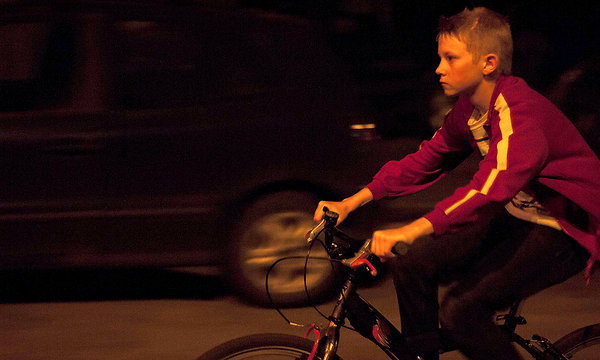
- A young boy (Thomas Doret) with behavioural issues tries to reconnect with his absent father (Jeremie Renier), is fostered by a selfless hairdresser (Cecile De France), then gets involved with a vicious, supercilious gangster (Egon Di Mateo), in this astonishing human drama. I've met quite a few people like the damaged, confused, painfully insular and sporadically aggressive hero of The Kid with a Bike, but I've never seen a movie about one before, and capturing real life on film in this way is to be applauded in itself.

The script and performances are note-perfect, and there's also an invigorating lack of extraneity in the storytelling: the linking scenes you'd find in most films are ruthlessly excised, so everything - even the scenes of the titular kid on his titular bike - serve the gutting, heartbreaking narrative, in which the viewer's response to almost every exchange is, "That's a shame", in which the aimless, lonely protagonist - devoid of masculine guidance - smashes two people with a baseball bat as an act of love for two male role models who throw the gesture back in his face, in which the only real point of comparison - in terms of bleakness, bicycles and the welcome shaft of light at the close - is De Sica's Bicycle Thieves.

The film has elements of fatalism without being pessimistic, tells a simple story that never looks for an easy way out, and eschews sentimentality while radiating a bold and uncompromising sense of humanity. It moved me very deeply.

***


Jeff, Who Lives at Home (Jay and Mark Duplass, 2011) – An emotionally articulate, unusual and deceptively wise film about fate, the universe and the frustrations and disappointments of adulthood, as full-time slacker Jason Segel ventures out from his mum’s basement and begins a tentative day of discovery, interacting with his uptight brother (Ed Helms) and trying to read some mysterious cosmic signs (following several viewings of the film Signs) that relate to the significance of the name Kevin. It’s funny, unpredictable and full of insights about love, loneliness and life, aided by Segel’s fine performance, though a subplot about mum Susan Sarandon’s romantic re-awakening seems a bit forced – and smugly progressive – in comparison. Despite that, and some concessions to conventionality, this consistently interesting indie is still likely to blindside you with the originality of its plotting, the strength of its dialogue and the courage of its convictions. Not that the film doesn’t have a couple of kindred spirits, recalling Matt Bissonette’s – which also concerned two brothers re-connecting during one long, strange day, and is even better – as well as The Tao of Steve, another movie with a philosophical stoner for a hero. (3.5)

***


The House I Live In (Eugene Jarecki, 2012) is a powerful polemic against the War on Drugs, which Jarecki argues is really a war on communities that began as an issue of race, and is now one of class. Assisted by scholars, addicts, dealers, law-enforcers, a judge, one of the creators of The Wire and a series of prisoners (500,000 US citizens are currently in jail for non-violent drugs-related offences), he forms a compelling and invigorating case filled with revealing and shocking detail. Like how the media storm around crack cocaine in the ‘80s (powder cocaine + baking soda + water + heat) saw the introduction of sentences 100 times more punitive than for the original form of the drug. That a “three strikes” policy advocated on film by Clinton has seen a drug addict who trafficked to feed his own habit jailed for life – without parole. And that while only 13 per cent of crack users in the US are African-American, 80 per cent of those behind bars for crack offences are. I didn’t think I could think less of how the US treats its African-American community after Steve James’s The Interrupters, but it turned out I could. As a film, it’s a little messy – curious, considering that Jarecki was responsible for that sleek, streamlined, immaculately-edited Reagan doc – while the decision to frame his investigation in the first person feels misguided, leading to some weak and irrelevant passages, but it’s an important and impassioned work that raises many crucial questions, all of which must be answered by American law-makers. (3.5)

***


*SPOILERS*
The Lonely Passion of Judith Hearne (Jack Clayton, 1987)
– A great performance in search of a great film, as meek, lonely, religious Irish spinster Maggie Smith loses her faith and her mind after being spurned by selfish would-be entrepreneur Bob Hoskins. Smith is absolutely extraordinary – fully immersed in a characterisation so real and true that the film feels almost intrusive – and her flashback sequences, reflecting on a her life spent caring for her addled aunt driven mad by a stroke, provide at least one truly great scene for the mighty Wendy Hiller. But the story is all over the shop, sometimes boring, often laughably overwrought, with supporting characters who’d seem more at home in either gothic melodrama or ‘70s sitcoms – especially ludicrous, slimy, be-moobed poet Ian McNeice – while Hopkins is oddly poor (and cursed with a lousy American accent), and the film expects us to be more disgusted by his character wanting Hearne for her money than the fact he’s a rapist. When Smith’s pitiful, self-pitying character is on screen it works and there are some incredibly powerful passages towards the end, particularly her drunken confrontation with parish priest Alan Devlin and subsequent explosion of emotion at the altar, railing furiously at God, before scratching desperately at the tabernacle and pleading to join him. It’s just a shame that such a remarkable performance, such a stunning study of mental illness, religious doubt and abject loneliness, isn’t housed in a more credible, coherent film, though it’s still worth it to see Smith at the peak of her considerable powers. (2.5)

***


I don't know what you're looking so smug about.

Orange County (Jake Kasdan, 2002) – When an aspiring writer (Colin Hanks) with a dysfunctional family sees his attempts to get into Stanford University scuppered by an incompetent school administrator (Lily Tomlin), he decides to drive there to talk them round, with his girlfriend (Schuyler Fisk) and stoner brother (Jack Black) in tow. Fisk is excellent, Kevin Kline has an unexpectedly effective bit near the close (the way he's incorporated is almost magical) and there are amusing cameos from Tomlin and Ben Stiller, but I found this an unimaginative, comedically lazy film, hampered by an emotional fraudulence that renders its stabs at poignancy completely hollow. It probably would have worked a bit better with Tom Hanks in the lead, mind. Even in 2002. (2)