Showing posts with label James Cameron. Show all posts

Monday, 7 November 2016

Sigourney Weaver, Creed and the strange story of Silibil N' Brains − Reviews #248

I have broadband in my flat for the first time ever, so I streamed some recent movies. Then I went to meet Sigourney Weaver.


A Most Violent Year (J. C. Chandor, 2014) − A superb, low-key crime film set in New York during its most violent year, 1981, as immigrant oil boss Abel Morales (Oscar Isaac) tries to protect his truck drivers, his family and his fortune, against attacks, bailing banks and a crusading D. A. (David Oyelowo).

The movie's unpredictability, grubby realism and tersely credible dialogue reminded me of two of my favourite movies, Cry Danger and The Friends of Eddie Coyle, and its moments of tension, violence and revelation are all gloriously understated and offbeat.

It's the polar opposite of something like De Palma's Scarface, made in the meticulous, slow-burn style of Sidney Lumet, and more interested in the minutiae of human relationships than in excess of any kind. Most impressive and rewarding is the way it presents the marriage between the pragmatic, persuasive, Pacino-esque Isaac, in his mustard coat, and his wily, wary wife (Jessica Chastain), the daughter of a Brooklyn gangster and usually two steps ahead of everyone else.

It's a movie about moral relativity, decisions made in a moment − and their arbitrary impact − and the American Dream, and probably more literate, mature and interesting than any crime film released in the past five years. (3.5)

See also: I have so much time for Isaac and his chameleonic stylings. I've reviewed quite a few of his others, including Ex Machina, Star Wars: The Force Awakens and the borderline-miraculous Inside Llewyn Davis.

***


The Great Hip Hop Hoax (Jeanie Finlay, 2013) − In 2004, Californian rap duo Silibil N' Brains looked set to be the next big thing. Signed to Sony and managed by industry heavyweight Jonathan Shalit, they opened for D12 at Brixton Academy and recorded a session for MTV, where they were interviewed by Dave Berry. There was just one problem: they were really Gavin Bain and Billy Boyd from Dundee.

It's a fantastic story, but Jeanie Finlay's documentary, which gets to the root of the matter, isn't the knockabout, throwaway fun you might expect. Gavin and Billy weren’t pranking the music business: after being dismissed by execs looking for the next Eminem as "the rapping Proclaimers", this ruse was the only way they could see of cracking the industry, and as they threw themselves wholeheartedly into the scheme, their immersion into their personas and their fear of getting found out began to drive a wedge between these best friends, and to drive them steadily insane.

This 2013 documentary, made for Storyville and inspired by Bain's memoir (released first as California Schemin', and then Straight Outta Scotland) is a film about the cruel collision between dreams and reality, an indictment of the music industy's obsession with image, and an exploration of two fascinating characters: Gavin, a shy, obsessively driven creative force whose perfectionism ultimately lays them low; and Billy: charismatic, fun-loving and yet ultimately devoted to his wife and children.

Those personas were blown up into Silibil N' Brains (Silly Bill and Brainy Bains, if we deconstruct them slightly), but it's the way these characters stagnate, intensify or transform over time that's most fascinating, reminding me a little of the protagonists of my all-time favourite documentary, Hoop Dreams.

At times the relentless, sub-Busted goofing of the American alter-egos, documented in innumerable proto-YouTube skits, becomes a little wearing, but that's kind of the point. When you see just how passionate, how lyrically inventive and how well-versed in their art these two performers were, it's depressingly illuminating to see the only way that the music industry would accept them was as baseball-cap wearing, crotch-grabbing pretend Americans, washing their faces with Bill's piss. I'm less certain about the animations, which seem at times to simply be filling in those sequences for which no other materials exist: I had a similar relationship with the stylised cartoon inserts in The Filth and the Fury and the recent Tickling Giants. But, taken as a whole, it's an exceptional film.

I was expecting something disposable and fun, but given the director (who also made last year's excellent documentary about another musical imposter, Orion) I should have known better: The Great Hip Hop Hoax is an immensely moving film, and its ruminations on fantasy, compromise, creativity and chance are universal. I also have quite a crush on Gavin, the broken-nosed raconteur whose mixture of talent, apparent sweetness and unreliable narration melds effectively with Billy's chubby ruddiness and down-to-earth honesty, recalling the ferocious chemistry that almost catapulted them to super-stardom, when they were pretending to be American. (3.5)

***


Creed (Ryan Coogler, 2015) − I was expecting a bruising, stylised, self-consciously credible African-American update of Rocky. Instead I got Rocky VII. But that's fine. Kind of nearer my comfort zone.

Michael B. Jordan is Adonis "Donnie" Creed, the illegitimate son of former heavyweight champ Apollo, who moves from L. A. to Philly (a 'reverse Fresh Prince') to train with restaurant owner Rocky Balboa, and − would you believe it − gets a shot at the world title.

Considering that I don't think the original Rocky movies are very good (my favourite is Rocky III, because at least it has few pretensions), I found both this movie and Rocky Balboa to be very affecting in their utilisation of the series' very definite mythos. And, by adding a further undercurrent of wistfulness and melancholia caused by Donnie's emotional displacement and need to connect with the father who died before he was born, Creed does make you care about its characters.

Without giving too much away, it also provides Rocky with a powerful, very well-imagined storyline, trades amiably enough on the fact he's entering his dotage, and fashions an agreeable romance between Creed and a musician named Bianca (Tessa Thompson), who as this is a Rocky film, is obviously going deaf. Add to that the series' usual mix of fight-night clichés, rousing training montages and persuasive villainy − in the shape of a Scouse boxer whose dialogue is well-researched enough not to make British people howl with incredulous laughter − and it's got everything you need for an entertaining but also agreeably substantial two hours.

It's not in the same league as something like Body and Soul, Fat City or Raging Bull, but it's a different kind of film. It's also unusually well-acted, without the somewhat trivial paraphrasing that blights other Rocky films, and has several moments that lift it well above the other movies in the series, particularly a When We Were Kings style run-around − but with the kids on bikes! − and a flashback sequence on the canvas with a denouement as overpowering as a punch to the temple.

It isn't for the most part a daring or dynamic film, and I find the critical bouquets flung in its direction somewhat confusing, but it's actually better than the movies it homages, taking a tried-and-trusted formula, amplifying its more successful elements and creating a crowdpleaser with a bit of heft to it. (3)

***


Foxcatcher (Bennett Miller, 2014) − I presume whoever produced this owns shares in prosthetics, as Mark Ruffalo's false hairline, Channing Tatum's cauliflower ear and Steve Carell's Dick-Tracy-villain nose are the most distracting appendages since Nicola Kidman's false schnozzola won an Oscar in The Hours.

It's the true(ish) story of Team Foxcatcher: essentially Behind the Candelabra with Matt Damon replaced by a wrestler, as eccentric multi-millionaire John Du Pont (Carell) brings Olympic gold medallist Mark Schultz (Tatum) to his isolated ranch with promises of glory, and things promptly start to get a bit weird. Ruffalo is Mark's older brother, Dave, a beloved, bearded star athlete who's initially suspicious but eventually acquiesces and takes his place on the farm.

The performances are excellent, and the paring down of the story to these three characters, in this shortened time-frame, makes it a disorientating and creepy ride, with echoes of Faust and wider resonances about the nature of greatness and America. At the same time, though, the film doesn't get to the heart of Du Pont's neuroses and madness, lessening the story's natural intensity and reducing its ultimate emotional impact. We see the tragic ending coming simply because 'why would they have made a movie of this story otherwise?' and not because there's a thread of fatalism running through it.

As with director Miller's over-praised Capote, its methodical pace will turn some people off, and its deliberate re-imagining of reality for its own ends is questionable, but Foxcatcher does unsettle and intrigue, thanks to a good performance by Tatum, an award-hungry portrayal of creeping oddness from Carell, and Ruffalo's excellent turn as the much-loved, decent Dave. (3)

... and then I watched this:


Team Foxcatcher (Jon Greenhalgh, 2016) − Solid documentary about the true story behind Bennett Miller's Foxcatcher, which distractingly omits Mark Schultz from the story, focusing instead on the relationship between increasingly eccentric multi-millionaire, John Du Pont, and a slew of other US wrestling stars, including their figurehead: Mark's brother, Dave.

This Netflix film, essentially presented through the eyes of Dave's wife, Nancy, does a good job of filling in all the context omitted from the movie, which is critical really to understanding what happened, as it charts Du Pont's mental breakdown, his increasing paranoia and his conspiracy theories about how Dave was living in his walls.

Much of the footage of the Foxcatcher Ranch used was shot on one day, eight years before the events it's often describing, which is somewhat disingenuous and distracting, but the usual mixture of archive clips and talking heads works fairly well, provided you can stomach the use of 911 calls from immediately after a murder.

I can't help but think that this film could have been a lot more arresting and memorable if it had started as a sports story and then changed tack, rather than foreshadowing its central tragedy, but it's convincing − fast-moving, yet sufficiently detailed − and its more creative moments, including a heartbreaking sequence in the ruins of Dave and his family's house, soundtracked by old video of their idyllic lives, are beautifully rendered.

Viewed here, the events of the film seem less abrupt and more inevitable, their obvious avoidability heightening the sense of tragedy and loss. The effect was to make Foxcatcher seem curiously false and unconvincing: more a Rothian meditation on the unknowability of man and the state of America than a chronicle of what actually happened on the ranch. (3)

***
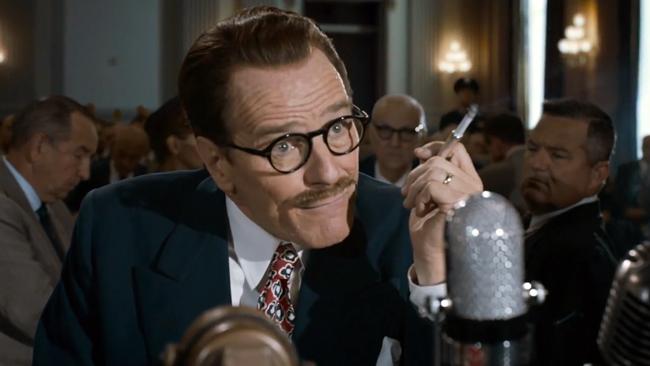

Give me strength.

Trumbo (Jay Roach, 2015) − The astonishing story of the Hollywood blacklist, which has fascinated me for decades, becomes an astonishingly bad film, telling its story through the life of Communist screenwriter Dalton Trumbo (Bryan Cranston) and playing like a Walk Hard-style parody of itself, as every character introduces themselves by reciting their name and profession.

It's plodding, monotonous and moronically irresponsible: a cartoon in which – contrary to the findings of Victor S. Navasky's searing moral audit, Naming Names, which indicted almost all of Hollywood – the people to blame were just J. Parnell Thomas, Hedda Hopper and Edward G. Robinson.

If you want a totemic figure, why not Ronald Reagan (glimpsed briefly in archive footage), the president of the Screen Actors' Guild, who secretly betrayed his own members to further his career? Or indeed director Edward Dmytryk, the member of the Hollywood Ten who turned on his friends – including Trumbo.

It's that kind of incomprehensible decision-making that prevents us from getting close to either the issue or the central character. There's one scene where we see him laid bare by the dehumanisation of prison that's all in the acting, but otherwise both he and the film are tedious and aloof.

We should blacklist whoever wrote this. (1.5)

***


I literally took this picture.

Aliens Live at the Royal Albert Hall (James Cameron, 1986) − A trip back to LV-426 in the company of the Royal Philharmonic Concert Orchestra, who brought James Horner’s ominous, throbbing, clanking, frenetic, discombobulating score to vivid, terrifying life at the Royal Albert Hall (disclaimer: that’s where I work).

It is, of course, a textbook action film, full of vivid archetypes, snappily quotable dialogue and pulsating, adrenalised suspense scenes, edited with jaw-dropping bravura. And in Sigourney Weaver’s Ripley, it has probably the greatest female action hero of all time, her DNA in everyone from Rey to Furiosa to Holtzmann.

The audience loved it, laughing at Hudson's doom-laden whining, whooping at the climax of those densely inventive action set-pieces and hollering at Weaver's insistence that the Alien Queen get away from little Newt, "you bitch".

Cameron, producer Gale Anne Hurd and the film’s star all came to London for this world premiere of Aliens Live, which meant that I got to hear Cameron talk about what "a Cameron film is” (he didn’t realise until someone pointed it out to him that his heroes are almost always reluctant ones) and to Sigourney about feminist actioners, Avatar and physiotherapy. My job is cool and weird. (4)

***

Thanks for reading.

Tuesday, 5 May 2015

Ten things I love about Titanic

Tuesday 28 April, 2015


Picture (c) Paul Sanders

I love Titanic.

Love it.

I never get tired of watching it, and last night I was lucky enough to see it at my office (the Royal Albert Hall), with an on-stage Q&A from James Horner and producer Jon Landau, a cameo from James Cameron, and the whole film accompanied by the Royal Philharmonic Concert Orchestra with Sissel Kyrkjebø. It was one of the best shows I’ve ever seen, and they even put my name in the credits at the end. I still haven’t come down from this, as you might be able to tell.

Because I love Titanic.

I’ve seen it a lot over the years. More times, in fact, than James Cameron’s wife (and Old Rose’s granddaughter) Suzy Amis, who’s only watched it three times all the way through (trivia bomb). As with my recent Star Wars reviews, here are 10 things I love about Titanic:


1. The pre-amble. What a strange, fascinating way to pitch us into an old-fashioned story: chiming with the cynicism of a modern audience, then chucking all of that out and asking us to join it, as an 101-year-old woman (Gloria Stuart) bewitches a bunch of mercenaries with her tale of forbidden love, and we fade into...


2. The dockside. On the surface, Jack’s card game and dash to the boat are pure Hollywood, but they’re underscored by the film’s fatalistic themes, giving that blast of euphoria a melancholy undertow.


3. Billy Zane. The finest performance by an eyebrow since Roger Moore was replaced as Bond. Yes it all goes a bit silly when he runs around with a gun and steals a child, but I enjoy his slimy malevolence far more than anyone else seems to, particularly the elitist nastiness he enjoys snidely dispensing in the film’s first half.


4. That chemistry. Perhaps the only time Kate Winslet’s love interest has been prettier than her. She and DiCaprio are just perfect: so sincere, each completing the shortcomings of the other, sparks flying through every spitting contest, soppy utterance or action sequence.


5. The music. Last night made it even more obvious - if such a thing is possible - just what a wonderful score this movie has, augmented by Sissel’s ethereal, wordless vocalising.


6. The dinner party. Jack is so dishy. *sigh*


7. Atmosphere. A $200m budget probably helps, but so does Cameron’s obsessively hands-on approach to every part of the production. The boat’s scale and its appointments seem scrupulously faithful and its evocation of life on the ship – while leaning a little on caricature – is entirely persuasive, bringing to life both vivid archetypes and genuine historical figures who boarded the 'berg-hitting vessel.


8. “I’m the king of the world”, “So, you wanna go to a real party?”, “Never let go”, and other one-liners. I used to find some of the dialogue a bit trite, I don’t anymore: the film is so sincere, so sure in its convictions that it just sweeps you away, like a big flood in an ocean liner.


9. Nearer My God to Thee. One of my favourite set-pieces in ‘90s cinema, and by far the most moving sequence in the movie, with spellbinding imagery and sound, and a devastating emotional wallop: this was real, and this was its human cost. Just sublime.

10. The final scene. Fuck yes.


Captain Birds Eye.

I also liked the way that it predated Avengers Assemble by including all my favourite superheroes, like Captain Birds Eye (Bernard Hill) and heroic Ed Miliband (Ioan Gruffudd).

Did I mention that I love Titanic.

Tuesday, 14 September 2010

Avatar, Viv Stanshall and Wendy Hiller being amazing (again) - Reviews #52

Hello there. I've been on holiday - a joyous break, and without a film in sight. Don't worry, though, I've been spending quite a bit of time in a darkened room since, and the results are transcribed for you below. Several of my most-recently-watched were shot on location in places I visited: Paris, Venice and Rome.


Forget Paris (Billy Crystal, 1995) is a rather chilly examination of how tricky it can be to forge a happy marriage, with a few cartoonish episodes chucked in alongside. Billy Crystal does his usual schtick as he romances Debra Winger, though the structure is pure Woody Allen - the whole film told by a group of friends at a party - and the foreign funeral set-up half-inched somewhat obviously from Billy Wilder's underrated Avanti!. The result is somewhat unsatisfactory. It's certainly no Moonstruck or Broadway Danny Rose, but it's not even When Harry Met Sally - and the Paris-set sections were disappointingly brief considering I'd just returned from my travels and was secretly hankering for a glossily-photographed sight-seeing tour. There are comic compensations, though. Playing a basketball referee, Crystal's meltdown on the court is the obvious highlight - along with his senile father-in-law's fondness for regurgitating ad slogans. "You asked for it... you got it. Toyota. You asked for it... you got it. Toyota. You asked for it... you got it. Toyota." (2.5)

***


Summertime (David Lean, 1955) has a thin plot and a dubious grasp of Venetian geography, but benefits from the glorious on-location filming and Katharine Hepburn's wonderful, nuanced performance. It seemed there was no leading lady stronger in the '30s, nor more frail thereafter. For Lean it's a transitional work between the small-scale, largely studio-bound films of his early career and the sprawling epics with which he became synonymous. Rossano Brazzi is effective as Hepburn's leading man, particularly when he chastises her for seeking perfection. (3)

***


PARIS... Gay... Alluring... Deadly!
The Man on the Eiffel Tower (Burgess Meredith, 1949) is really, really odd, perhaps due to the troubled production, with Irving Allen replaced by Meredith and future Night of the Hunter director Charles Laughton taking charge of the scenes featuring his co-star. The story is fragmented and the direction wildly erratic - sometimes vividly expressionistic, at other times consisting of the cast simply standing in a big line - but at least we've got a restored copy now. Previous touring prints had degraded to such an extent that they had turned sepia, except for Meredith's bright red hair. The plot sees manic depressive Franchot Tone - yes, apparently bipolar disorder is the same as megalomania if you've got it not only in your heart, but "also up here" (I have no idea) - repeatedly taunting useless detective Inspector Maigret (Laughton) en route to a climactic confrontation up Le Tour Eiffel. Laughton is lacklustre, Meredith peculiar and Tone looks about 108 - his grey hair dyed chestnut - though he's quite effective in a one-note role. English leading lady Patricia Roc is also among the bafflingly illustrious cast, but she's given virtually nothing to do. The real star is the Ansco Color photography (unsung MGM masterpieces Kiss Me Kate and Brigadoon were two one of the few other films shot in the short-lived process) shot at sites around Paris, from the banks of the Seine to Les Deux Magots (an old haunt of Hemingway's) and the eponymous monument. (2)

***


Zazie dans le métro (Louis Malle, 1960) is a joyous, freewheeling barrage of gags and cinematic tricks, several years ahead of its time. Perhaps surprisingly, the director is Louis Malle - better known for more contemplative fare like Ascenseur pour l'échafaud (aka A Trip to the Scaffold), with its classic Miles Davis score, and Au revoir les enfants. Nine-year-old Catherine Demongeot - now a historian, trivia fans - is the grinning, foul-mouthed protagonist, who goes to stay with her drag queen uncle (Philippe Noiret, later of Cinema Paradiso and Il Postino) in Paris and proceeds to cause absolute mayhem. Commencing with a delightful, jaunty credit sequence, the first half-hour is simply brilliant - subversive, hilarious and matchlessly energetic - with the next 30 just a notch below. The whole thing appears to run out of energy in the final third, with a weary, overlong slapstick sequence in a restaurant*, before a lovely final reel. (3)

*It's still better than the one in Tati's risible Play Time.

***


"Lilliput!"
Sir Henry at Rawlinson End (Steve Roberts, 1980) was the brainchild of writer, musician, comedian, drunkard and visionary Vivian Stanshall, growing out of his work on John Peel's radio show. And very English it is too, in the true spirit of the word: absurd, poetic and - on occasion - devastatingly satirical, underscored by a rich sense of history and a caustic sense of humour. Trevor Howard is typically commanding as the title figure, a colonial relic plagued by booze, indoor polo and the ghost of his adulterous brother, who's looking for his trousers. Then there are the cultured German PoWs he keeps in a cage at the bottom of the garden, who are intent on escaping, and the bodies of the hedonists he offed during a heady night of paganism climaxing with his appearance in a Viking hat, bellowing "Son of Raw!" The dialogue is sublime, the plotting generally more coherent than I'd heard - though it doesn't all work - and the snippets of music truly wonderful. Cracking sepia cinematography too. I just wish it were longer - the running time is a decidedly slender 71 minutes, not nearly long enough to investigate all the fascinating ideas Stanshall casts into the mix. (3.5)

***


Three Coins in the Fountain (Jean Negulesco, 1954) is a disappointingly artificial romantic drama about three women looking for love in Rome. The plotting seems synthetic, with the great Dorothy McGuire given nothing to work with, while almost all the colourful location work is second-unit material employed using process screens. It's rarely objectionable, and it passes the time, but if you're yet to see McGuire in A Tree Grows in Brooklyn or The Spiral Staircase, don't waste your time on this one. Incidentally, the titular water feature is "The Fountain of Trevi", or Trevi Fountain - as everyone else on planet Earth calls it. (2)

***


The House on 92nd Street (Henry Hathaway, 1945) is a neat little procedural that's hampered by an over-earnest, flag-waving voiceover that lauds the FBI and celebrates the dropping of the atom bomb (this was 1945, after all), but benefits from a new level of realism in American film, its exteriors all shot on location in New York. The story, about a college boy infiltrating a Nazi spy ring, is fitfully exciting, though personal favourite Lloyd Nolan has little to do of any note, despite his considerable screen-time playing an FBI operative. Hathaway continued to shoot crime movies on location for Fox, including the flawed-but-fascinating Kiss of Death - with Richard Widmark's unforgettable debut performance as a giggling killer - and Call Northside 777, which is the pick of the bunch. (2.5)

***


As a cheerleader for the possibilities of cinema, I thought I should probably check out CINEMA: Avatar: Special Edition (James Cameron, 2010), what with the original, unspecial edition being the Jazz Singer/Brothers in Arms/Matrix of the resurgent 3D medium, as well as the highest-grossing film of all-time. It's sort-of-alright, interest ebbing and flowing as an enjoyable first quarter - with some eye-popping live-action 3D work - gives way to an awful lot of silliness. The premise is predictable but diverting, as American soldiers attempt to colonise a land they make no effort to understand, with obvious echoes of the treatment of Native Americans, and solitary nods to Iraq (the country is rich in natural resources) and Vietnam (a soldier incinerates the vegetation). The dialogue is lousy - patronising, sloppy and full of pseudo-hip one-liners - but that's no surprise. It's the much-touted visuals that are the big letdown: sporadically impressive, but too often false and cartoonish, considering they're the film's main (only?) selling point. And though Cameron serves up a handful of good action sequences, they can't make up for a chilling absence of heart, his script playing like an exercise in formula screenwriting: calculating, unbelievable and empty.

On a more trivial note, I'd also caution against employing a villain who looks quite so much like Derek Acorah, though one can only admire Stephen Lang's adherence to the Cameron-baddie template, jettisoning all credibility by the 30-minute mark then becoming increasingly silly over the next two-and-a-half hours. There was some laughter in the theatre, much of it from me, when he shouted "Shut your pie-hole!", a word that's generally the preserve of jolly northerners, rather than psychotic American hawks. The only decent acting on show comes, predictably enough, from Giovanni Ribisi - good value as an eerily fresh-faced, bloodthirsty back-office bastard - and Michelle Rodriguez, who has a good five seconds of decent material to get her teeth into: a final scene for her character that's really nicely played. For the rest of it she's given little to do except say "bitch". And occasionally "shit". I wish people would let her act. Anyone who caught her arresting debut turn in Girlfight and is familiar with anything she's done since will want to take her agent to one side and shout at them. As regards Avatar; Titanic was the subject of one of the most vicious backlashes in living memory. Really unfair, given that it's one of the best blockbusters of the '90s. If any influential arbiters of taste are reading, you can do what you like to Avatar. Incidentally, the specialness of this re-release comprises several minutes of travelogue-ish padding and a sterile sex scene. (2)

***


SHORT: The Battle of Midway (John Ford, 1941) - John Ford's celebrated 19-minute documentary about America's first major victory of World War Two earned him a shrapnel wound, a Purple Heart and an Oscar. The first 10 is impressive without being that interesting - hard-won battle footage that largely consists of some stuff setting on fire, the camera shaking, the film cutting, then something else setting on fire - though the raising of the flag is a lovely moment, narrator Irving Pichel intoning: "Yes, this really happened". The second half is more obviously Fordian, the elegiac tone reinforced by hymns, slanting shadows and Jane Darwell's frenzied, corny, but effective narration. Audiences wept and fainted during the passage where she urges ambulance-men to rush injured soldiers to a hospital. Ford would make his definitive statement on the war, and the nature of heroism, with 1945's They Were Expendable, but this short is well worth a look. (3)

***


This movie is really good. Honestly.

"Where are you from, Bitchville?"
I Love Trouble (Charles Shyer, 1994) - Nick Nolte says this is the worst movie he's ever made. Julia Roberts says he's the poorest actor she's ever worked with. It scores 5.0 on IMDb and garnered 17 per cent of positive reviews on Rotten Tomatoes. Well, they're all wrong - it's actually really good. Of course this pastiche of '30s and '40s newspaper comedies comes up short compared to His Girl Friday, but that was like capturing lightning in a bottle. The best light comedian of all-time giving his greatest performance. The sassiest leading lady in Hollywood on top form. The sharpest, zingiest script from the finest writers of comedy-drama in cinematic history, helmed by the fastest, funniest comedy director we've ever seen. All that and a stellar supporting cast including such luminaries as John Qualen, Helen Mack and Roscoe Karns at their peak. But I'd say I Love Trouble would easily slot into the third tier of Golden Age comedies, with pleasant interplay between the likeable leads, fast-moving, stylish direction and a script that mixes intermittently sharp banter with genuine suspense. The action/exposition climax is slightly weak, but I enjoyed the gimmicky coda, like something from a Lee Tracy movie. The quote I've picked out above the review isn't indicative of the script, but its general witlessness made me chuckle. (3)

***


Separate Tables (Delbert Mann, 1958) is an acting masterclass, a stunning adaptation of Rattigan's two single-act plays set at a Bournemouth hotel. David Niven, Deborah Kerr and Wendy Hiller (my new favourite) are flawless in their sensitive, layered performances: he an army major with a dark secret, Kerr the meek, downtrodden girl who loves him, Hiller the hotel manager fighting disappointments of her own. Shooting on home soil, American stars Burt Lancaster and Rita Hayworth are very good in somewhat less interesting parts. Taking dead-aim at intolerance, as well as examining the disappointments and compromises of adulthood, this is a remarkable piece of humanist drama and one of the most intelligent films to come out of Hollywood in the '50s. Charles Lang's cinematography is a big plus; the only duff element is the wearisome theme song. (4)