Showing posts with label Casey Affleck. Show all posts

Saturday, 15 October 2016

London Film Festival: Part 2 − Isabelle Huppert, Manchester by the Sea and the most 1930 thing ever

My continuing adventures at the wonderful London Film Festival.

"I'm not done, right, I got more in me..." (I now see the LFF trailer, which plays before every screening, whenever I close my eyes. I hear it all the time.)

SATURDAY 8th (continued)


Film 5: King of Jazz (John Murray Anderson and Paul Fejos, 1930) at NFT 2 – This musical revue, complete with two-strip Technicolor, is a symphony in green and red, and while it's as hit-and-miss as any, it's a must for fans of old films.

Building on the success of Paramount on Parade and Warner's Show of Shows, which were designed to test the stars and the ground during the transition to the talkies, Universal's King of Jazz focuses on Paul Whiteman and His Orchestra - then the most popular jazz ensemble in the country - presenting a non-stop succession of eye-catching treats, all in that distinctive palette, and ranging from a comic cartoon about Whiteman fighting a lion, to skits, scatting (oh behave) trio the Rhythm Boys (featuring a cherubic Bing Crosby), ponderous ballads and a climactic celebration of America as a 'melting pot' that credits Germany, Spain and Scotland with creating jazz, but not any black people.

At its worst it's dated and dull (the 'bridal veil' and Monterey numbers are definite low points), but it's mostly good and occasionally great, with an astonishingly high success rate in its comic sketches (usually the worst part of a movie revue), as much camera trickery and surrealistic invention as Man with a Movie Camera and a handful of knock-out numbers, most notably So the Bluebirds - preceded by a glorious snatch of Missisippi Mud - stunning dance number Ragamuffin Romeo, and the infectious Happy Feet.

It's the weakest of the five Festival films I've seen so far, but still a lot of fun. It's like "How much more 1930 can you get?" and the answer is none. None more 1930. (3)

Guests: none, unless you count a slideshow of rare production photos (you don't)


Film 6: Manchester by the Sea (Kenneth Lonergan, 2016) at Odeon Leicester Square
European premiere


Kenneth Lonergan's third film is a familiar but extremely well-acted melodrama about haunted, introspective Casey Affleck pitching up in the chilly sea town of Manchester after his brother Kyle Chandler's death, and uncertainly reconnecting with his grieving, smartass teenage nephew (Lucas Hedges).

Affleck is absolutely terrific in a largely internalised role, there's one absolute knockout of a scene where he meets his ex-wife (an otherwise underused Michelle Williams) on the street, and Lonergan's dialogue is typically literate and funny, but the film lacks the originality and deceptive precision of Margaret (it's a sort of hybrid of You Can Count on Me and Tom McCarthy's Win-Win), and its narrative is rather too baggy and heavy-handed to overwhelm you in the same way. I also find the way that Lonergan uses stylised explosions of machismo violence as a shorthand for emotional turmoil a bizarrely shallow trait.

It's still a finer and more affecting film than most others you'll see this year. (3.5)


Guests: Kenneth Lonergan, Casey Affleck, Michelle Williams and members of the crew (pre-film Q&A)


Film 7: Elle (Paul Verhoeven, 2016) at Embankment Garden Cinema
UK premiere


Virtuosic but extremely suspect Verhoeven film, with Isabelle Huppert as a divorced careerwoman who's raped by an intruder, setting in motion a highly unpredictable chain of events. She's astonishing, the excoriating black comedy is jawdropping and there's one of the biggest jump scares ever, but the film leaves an absolutely repulsive taste in the mouth, and for that reason I can't really recommend it.

Verhoeven has quite a history of misogny: Peter Weller is killed in Robocop because Nancy Allen can't help but stare at a bad guy's penis during a shootout, and the director (allegedly) filmed Sharon Stone's vulva without permission in Basic Instinct before broadcasting it to the world. Elle is something else, though. During the post-film Q&A, audience members kept telling Verhoeven they 'loved' his film. How can you 'love' a rape comedy?

I'm still angry. (3)


Guests: Paul Verhoeven, Isabelle Huppert and Anne Consigny (post-film Q&A)

SUNDAY 9th


Film 8: Toni Erdmann (Marin Ade, 2016)


− This cult favourite, which wowed audiences at Cannes, is a genuinely unconventional German film about happiness, dealing with the relationship between a free spirit with a very specific sense of humour (Peter Simonischeck) and the estranged, work-obsessed daughter (Sandra Hüller) he visits in Bucharest after his dog dies.

Marin Ade's film is extremely funny - often in the most unexpected, imaginative ways, with a similar sense of the ridiculous to Le dîner du cons - but underpinning it is an understanding of life's contradictions, man's facility for melancholy and the shifting dynamics of relationships that I found very truthful and powerful. The leads are both wonderful.

There's no reason for it to be 162 minutes, though. (3.5)
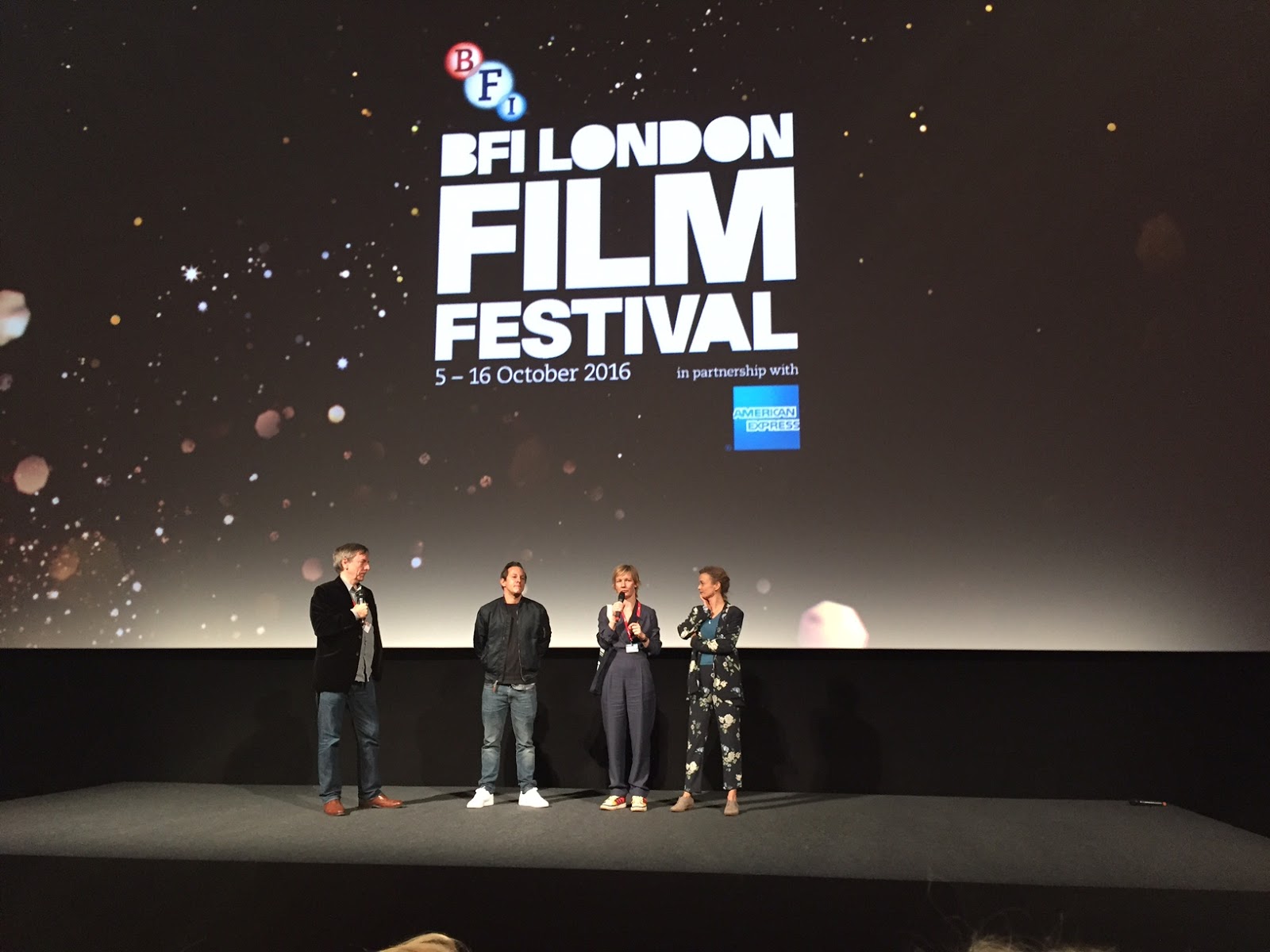


Guests: Stars Sandra Hüller and Trystan Pütter


Film 9: Mindhorn (Sean Foley, 2016) at Odeon Leicester Square
World premiere


This comedy from Boosh alumni Julian Barratt and Simon Farnaby is slight, and a little clichéd and formulaic in its premise and structure, though when it's funny it is very, very funny.

Barratt is a an arrogant, washed-up actor who once starred in a Bergerac-like crime series. When murder suspect Russell Tovey says he'll only speak to Mindhorn, it's time for him to strap on the electronic eye that is also a lie detector one more time - and return to the Isle of Man.

There are some brilliant jokes here about grudges and actorly pretension (including two absolute crackers during death scenes) and a pair of extremely funny supporting performances from Farnaby and Kenneth Branagh, though it feels like it's at least a draft away from being a great film. A lot of it feels kind of slapdash and convenient, clever ideas like the lie-detector eye are never properly exploited, and a few of the gags are tasteless in a way that they're not funny enough to justify.

It also gets the Manx flavour completely wrong, which is fine in an audience of self-satisfied Londoners, but is going to ring hollow to anyone who's spent some time there. You can shrug and say that it's not a shortcoming that matters, but a lot of humour works because of its specificity and clarity, and the oddities of the Manx character are funnier and wilder than these invented generalisations.

Having seen the best comedies than Germany, France and Iceland have to offer, this BFI-backed one feels rather minor, and suggests that perhaps we haven't really moved on that far from The Parole Officer. Speaking of which, this must be the most banal contribution Steve Coogan has made since adding nothing to The Other Guys (now that's a great comedy film - no, you shut up). (2.5)


Guests: Sean Foley, Julian Barratt, Simon Farnaby, Harriet Walter and other cast and crew (pre-film Q&A). I also bumped into Steve Oram from Sightseers outside. I love that movie.

***

Thanks for reading. Part 3 will feature the first real flop of the festival and my two wonderful midweek excursions.

Tuesday, 30 March 2010

Scouse noir, Lee Tracy and the coward Robert Ford - Reviews #26


Gumshoe (Stephen Frears, 1971) - or Scouser on the Third Floor, as I shall insist on calling it - is a skilled pastiche of classic film noir, with Albert Finney as a bingo caller and part-time comedian who fancies himself as a private eye. In his first day as a self-styled Sam Spade, he receives a mysterious phone call, plunging him into a superbly-realised world fusing the mundanity of Liverpool life with the Chandler-esque yarn going on inside Finney's head. It's deftly done, with a ready wit and the deep knowledge of crime flicks (and the odd Western) essential to such genre explorations, while the script fairly drips with zingers. The narrative seems to house elements of Chinatown, Charley Varrick, The Cheap Detective, Hammett and Brick, but this was released before a single one of them. Another similar work, Play, It Again Sam, had played on Broadway but would not reach the screen for another two years.

Finney is faultless in the lead, delivering his hard-boiled patter in a sliding hybrid of Bogart and Scouse, and keeping us guessing as to just how far gone his character is. The supporting cast includes Porridge favourite Fulton Mackay, making an ideal heavy as the Scottish hood on Finney's trail, Frank Finlay as our hero's menacing brother and Samuel Beckett alumnus Billie Whitelaw, playing a morally ambiguous woman caught between the siblings and sporting a hairstyle that would be impressively '80s were it not so resolutely '70s. Also cropping up in bit parts are Maureen Lipman as our bookshop floozy and Wendy Richards, speaking nineteen-to-the-dozen in a way that's very hard to decipher. Andrew Lloyd Webber's score - containing a rock 'n' roll parody written with Tim Rice - is also good fun, and if the eventual uncovering of the film's central conspiracy is a touch too small-scale to pack the requisite punch, that's a minor price to pay for 80 minutes of tense, superbly-scripted British noir. (4)

***


The Assassination of Jesse James by the Coward Robert Ford (Andrew Dominik, 2007) has the stamp of authenticity, but is let down by sloppy pacing and a lack of focus. Casey Affleck is nothing short of brilliant as the 19-year-old Robert Ford, who's drawn into outlaw Jesse James' (Brad Pitt) dwindling band of confidants, only for his awestruck subservience to morph into dreams of revenge, betrayal and greatness. It's a plausible premise: if one was craving approval and was met only with insensitivity, the snub would be intensified by the accompanying feelings of servility. Add to that the lure of fame and the opportunity for Ford to finally seize the mettle and become a man, and you can see why a shifty young kid might grab the revolver his idol gave him and stick a bullet right through his brain.

We start with the build-up to James' final heist, and that night-time train robbery itself is shot with impressionistic flair by cinematographer Roger Deakins. Indeed, there's plenty of great imagery in Dominik's film, as the work oscillates between painstaking realism (via impressively-detailed sets and a busy, factual voiceover) and a sort of heightened otherworldiness. But such sporadic artistry sponsors a narrative that gives the impression of being methodical, whilst leaping all over the place. The filmmaker's debt to Terrence Malick is obvious in the meticulously-composed wide shots, but the movie lacks the hypnotic rhythm of Badlands - and therefore its weighty cumulative impact. Apparently the film was taken out of Dominik's hands and recut into various versions, which might explain the rogue pacing, as well as a shapeless extended epilogue that seems to undermine the film's point of view, as its voiceover artist takes to providing an audio commentary.

That's not to say there isn't a lot to like in this ambitious, arthouse take on the James legend. Affleck and Sam Rockwell - as screen brother Charley - offer definitive portrayals of the Fords, compensating for Pitt's charismatic but empty lead turn, and there are passages of great insight and truth, even as the film takes to hurtling through history at the close. But despite the inevitable tension in its slow, stately presentation of the titular deed itself, the little gem to be found within the film's largely worthless coda - Ford's qualified success on the New York stage - and the fine Nick Cave/Warren Ellis score, it looks more like an interesting failure than a modern classic. It's still a lot better than the Tyrone Power version. (2.5)

***


More than enough teeth for two.

Tea for Two (David Butler, 1950) - I like Doris Day, but her cheery singing and cartoonish sensibility can't save this average musical, which is hamstrung by excessive comic relief, an unsuitable setting (the onset of the Great Depression - what an amusing scenario) and characters it's very difficult to root for. The set-up is this: Day dreams of being a Broadway star, and will get her big break if she can win a bet with uncle S. Z. Sakall to say "no" to every question she's asked for 36 hours. Not only do the writers fail to mine this promising premise to convincing dramatic ends, but they hardly wring any laughs out of it either. It's left instead for Billy "Oh no, not Billy De Wolfe" De Wolfe to provide the comic relief, which is not a situation I would like to revisit any time soon.

The lack of thought that went into the script is epitomised by the staggeringly artless way a gaggle of fun late-'20s songs are crowbarred into the narrative. Still, the film is lit by that good score, much of it performed by frequent co-stars Day and Gordon MacRae, and some impressive hoofing from Gene Nelson - with his staircase dance the obvious high spot. Terence Davies' favourite character actress, Eve Arden, snipes agreeably in support. Tea for Two is based on the stage musical No, No, Nanette (filmed in 1930 and 1940), which is the show-within-a-film here. (2)

***

... and a potboiler featuring your favourite actor* and mine**, Lee Tracy:


Barbara Read - never knowingly underaged.

The Spellbinder (Jack Hively, 1939) - For the first five minutes of this Lee Tracy vehicle it looks like we're in for The Nuisance Part II, which would be a thing of unquestionable greatness. Cast familiarly as a shifty lawyer, the great man is running rings around his rivals in the courtroom, with the aid of a bunch of actors posing as his client's desperate family. Then Patric Knowles (memorable as a would-be media mogul in Four's a Crowd) turns up in Tracy's office and the film suddenly shifts into soap opera. Telling us that he's about to snuff out his auditor, Knowles blackmails Tracy into fashioning his defence, then starts sniffing around the shyster's daughter. What a twat.

Tracy could make anything look good and while he’s some way off his irresistible peak here – occasionally looking uncomfortable spouting the kind of piousness his characters usually spent their time puncturing – he’s never less than compelling. Unfortunately the material is at once predictable and contrived, with a climactic shift into melodrama that seems to have been conceived by Jean-Jacques Rousseau's little brother. Agreeably, if not credibly, the uncertain narrative does allow for some lurches back into comedy which, while at odds with the main story, are generally much more entertaining. Tracy's scene with his "guardian" is very funny and Chester Clute offers amusing support as the world's worst prosecution witness.

The film is notable amongst Tracy's films in casting him as a father, just the second of 22 I've seen where he played a dad, and the first giving him a (possibly) grown-up kid. Barbara Read, who was one of the Three Smart Girls in the classic musical-comedy, is of indeterminate age as the daughter. In his desk photo she looks 25; at school she looks about 14, but since she then shacks up with Knowles, I'm guessing she's not. The actress herself was a fresh-faced, faintly cross-eyed 22. If you're a Tracy fan worried about his lesser performance here, rest assured: he was probably just cross to be back at work after his European honeymoon. The star returned to his whizz-bang comic showboating soon afterwards in the super crime comedy The Payoff. (2)

*probably not your favourite actor
**definitely my favourite actor