Showing posts with label West End. Show all posts

Saturday, 15 April 2017

REVIEW: Hamlet at the Almeida Theatre

Saturday 15 April, 2017 (matinee)


Andrew Scott's Hamlet is the best I've seen − probing, philosophical, introspective and bitterly witty − and this intimate, innovative, cleanly modern production rises to meet him, keeping your attention rapt and your emotions engaged.

Scott's emotions are always just below the surface. He doesn't cry on command, as such, that suggests a gimmicky or insincerity. He cries easily, his performance here studded with tears, dripping down that taut, gaunt, pouting face as the veins stand out in his neck. Those tears of rage, self-loathing and simple sorrow are where you go when you've run out of words. For Bob Dylan, that place was always a harmonica blast, and Dylan's the only soundtrack we get here: One More Cup of Coffee commenting on mortality, Spirit on the Water signifying a party, Don't Think Twice… subtly mocking the prevaricating Prince, and Not Dark Yet striking up as the end approaches. Am I wrong in thinking that the coda slyly winks at another track from Dylan's Time Out of Mind, as Claudius tries to get to Heaven, before they close the door.

Where the Barbican's production with Cumberbatch in the lead was flaccid, distant and long-winded, the Almeida's takes place in your lap, feels pared down to its essentials − old and newly discovered − and in its music, projections and manners feels like a Hamlet for this cynical century, its protagonist pained, tired and wired, a gentle, melancholy man wrestling endlessly with his burden, every nuance intriguing and every line seeming to be thoughts that are just occurring to him now. For the first time, I felt I was watching a Hamlet who seemed to be discovering the story as we were, lessening the play's fatalistic foreboding and making it a personal human drama, not a grand, portentous charade.

At times, Cumberbatch tried buffoonish, crowd-pleasing comedy, prancing around in a toy soldier's hat. Scott's Hamlet is nimble, knowing and drily funny, his sarcastic barbs all the funnier because he's so thoughtful, and so thoughtfully self-critical. When he's consumed by anger, it's not theatrical grandstanding, it comes from deep within, from unease that's revealed as insight, and a faltering self-knowledge that explodes into epiphany. Here, what was literal in Shakespeare shadows the psychological forces buffeting the hero: Hamlet is cast on a boat towards England, as his soul is tossed on roiling waters; his father appears thrice as a spirit, as the looming spectre of betrayal stalks our hero. And he is a Hamlet systematically if not always wittingly betrayed: by his murderous step-father, by his incestuous mother (Juliet Stevenson), by the former schoolfriends of the Prince whom they effortlessly seduce to their side, by the chummily meddling, foolish Polonius, and by Ophelia (Jessica Brown-Findlay), who seeks to help her father resolve Hamlet's loss of mirth, and instead drives both of them towards insanity.


Jessica Brown-Findlay as an affecting Ophelia, with Peter Wight her foolish father, Polonius.

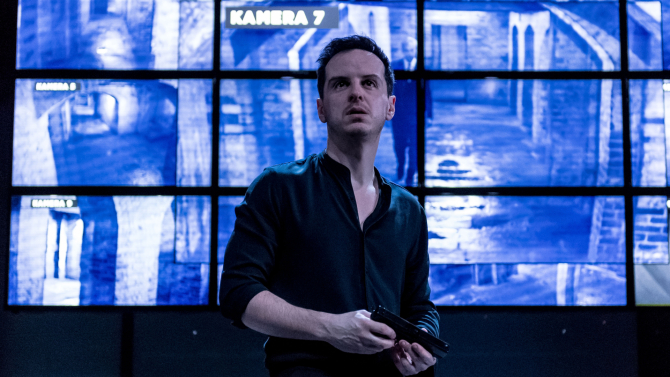
The stage is just three stubby, fat steps up from the stalls: we may as well be in a living-room. In fact, we are, or at least in Elsinore's coldly comfortable quarters, coolly-coloured IKEA-like furniture close to the faux-marble floor that doubles as a CCTV headquarters, a hall and a graveyard. The use of video screens (one large and temporary, a smaller one at either side) feels unusually seamless and natural: occasional footage from a sort of Danish Sky News updating us on funerals, battles and the like, and − when the cast sit with the audience to watch the pivotal play-within-a-play − showing Claudius's reaction to Hamlet's incendiary self-penned script. After the first interval, the screen is unpaused, then exquisitely 'malfunctions' as Claudius enters, spewing out close-ups of his guiltily contorting face.


The players scenes, mercilessly and mercifully pruned to perhaps three-dozen lines (and complete with Scott's parody of declamatory acting), are illustrative of a brilliant reshaping of the text. Robert Icke's production uses modern dress and is tooled specifically for modern tastes, zeroing in on the characters' emotions, their inner conflicts and their reasons for those conflicts, and junking everything that's long-winded, extraneous or a bit stupid. It retains enough of the players to accentuate some of Shakespeare's commentary on the truthful artifice of theatre − in Scott's hands, a pithy, meta thing − to energise its hesitant hero, and to cast light on those who surround him, and that's it. Here, Hamlet's 12 lines inserted into the action to gauge his stepfather's reaction are not a threat or a test of Claudius's temperament, but solely for the prince to ascertain the suspect's guilt, or to offer His Uncertainness a way out. I'm not sure if that's always the case. If it is, then I can only say that I typically find this sequence so boring that I've never been engaged enough to realise it. And while the idea of a ghost telling his son that someone poured poison in his ear is going to be ridiculous to me until the day I die, this production is so swift in dispensing with exposition that the play's other improbabilities become part of a credible, compelling whole.

That's certainly true of the final scene, which is showy, spontaneous, gripping, wryly funny and deeply moving, before passing into a rhapsodic fantasy, then snapping back to black and gutting tragedy. At the Barbican, it felt like a laughable orgy of improbable deaths. Here, the human cost is vast and epic and inevitable in the context of the action.


Scott's Hamlet is the first to whom I've felt a natural and personal connection, and it runs deep. He's groping in the dark, beset with an impotence of action from which he's trying to rip himself free, questing for self-knowledge, while praying for a relief from it. He's an existential Hamlet: thoughtful, melancholy, feeling deeply, a decent, anguished, emotionally tender Prince with an adolescent's loathing of hypocrisy and duplicity, a child's guilelessness, and a self-loathing born of immobility in the face of dishonour. In pegged black trousers and a collarless shirt, barefoot or in shiny black shoes, stripped to a vest highlighting his voluminous biceps, or dressed in cream and white for the graveyard scene, the wiry, wild-eyed Scott commands the stage, and all of your attention.

Occasionally he ventures forth with his finger and thumb in an 'O', reclaiming the gesture from Donald Trump, and putting it into the service of poetic precision as he wonders at what a piece of work a man is. He blasts his arms skywards, showering the stage with spit as he finally shakes off the shackles of inaction. And he toys slyly with Polonius, outfoxing him amiably as the darkness sets in around Hamlet's heart. Elsewhere he is fleet of foot, touchingly tentative and uncertain ("To be… or… not to be) or sardonic, turning the Dane's usual contemplation of mortality after the revelation of Yorick's skull into something more offhand, spiky and yet strangely affecting, the dust pouring from the eye-sockets as he at first calls with an amazed amusement: "Alas, poor Yorick...", then muses: "Here hung those lips that I have kissed I know not how oft. Where be your gibes now? Your gambols? Your songs? Your flashes of merriment, that were wont to set the table on a roar?" Its nostalgia for childhood for once outweighs its macabre portents, which chimes beautifully with this innocent Hamlet who seems not to know what awaits him. The spontaneity of the delivery, the lightness of touch, and the play's scope but specificity of humour seem to all play into it, and so do the other performances.


Juliet Stevenson as a lustful, protective Gertrude and Angus Wright a svelte, straightforward Claudius

Peter Wight's meddlesome Polonius is unusually likeable and doltish, Luke Thompson is a spirited, dangerous but noble Laertes, and Juliet Stevenson plays Gertrude as lustful, naïve and protective, and while a couple of her actorly tricks were a little synthetic for my taste at close quarters, she does a better job than anyone I've seen of resolving the character's apparent inconsistencies, of being vain and blinkered while still "living almost by [Hamlet's] looks", and taking a bullet for her son, for all the good it does him. Jessica Brown-Findlay is a fine Ophelia too: appealingly playful, sexy and normal in the opening scenes, her sense of fun not equating to triviality, and her growing vulnerability constrained within a real character. When Ophelia does fall to pieces, a transformation intelligently rendered in stagecraft and performance, she plays mental illness credibly and compellingly, without patronising ethereality or runaway artificiality, but seriously, properly, weightily, singing a Laura Marling melody, flaring into rage, then greeting Laertes with an erotic tenderness, before dissipating into despondency. When her death comes, it's without predetermination or fanfare: all keeping with a production that thinks you haven't seen this before, because it's never happened before. Polonius's violent death too is a sudden, bloody shock that hits you hard because of its ear-splitting ferocity and because a dull-witted but good-meaning father whom we were beginning to like is dead, and not simply because Hamlet has just incinerated every bridge in sight.

Hamlet is closing at the Almeida as I write this, but it's bound for the West End later this year, and I'd urge you to see it if you can afford to. It's 195 minutes long, but it's vivid and enthralling, and consistent too, not lagging when Hamlet is off stage, as other productions do. I'd recommend it to anyone who loves Shakespeare, but I'd recommend it even more strongly to those who don't, because it filters his work unerringly through a modern sensibility, stripping away the redundant and finding resonances with the world in 2017. Like Elsinore, it's a lonely place, ruled by murderous liars, but if thou can be true to thine own self, you're halfway there. The rest you try to fill with self-knowledge, personal philosophy, friends and art.

(4) ***

Thanks for reading.

Friday, 17 March 2017

REVIEW: An American in Paris at the Dominion Theatre

Wednesday 15 March, 2017


This explosive, intelligent stage version of MGM’s 1951 masterpiece, direct from Broadway, sags now and then in its book, but offers unmissable entertainment of a type rarely seen in the West End.

We began in the tumult of postwar Paris, less the escapist playground of the film and more a ravaged battleground where demobbed soldiers try to forget the war, women feel in perpetual danger and collaborators are being beaten and getting their heads shaved. Craig Lucas’s script offers a rejigged, re-ordered narrative that adds extra Gershwin songs (the film doesn’t have nearly enough), underscores the action with a battle fatigue that accentuates its more carefree moments, and leads to a putting-on-a-ballet climax that’s imaginatively conceived in narrative and artistic terms.


Its great masterstroke is turning the sardonic narrator from the grouchy, alienated middle-aged Adam played by Oscar Levant into David Seadon-Young’s war vet (above, left), an inspired innovation that lends a far greater heft to his sequences, if rather undermining the appeal of Jerry Mulligan (Robert Fairchild), one of three protagonists now in love with the same woman, the gamine ballerina, Lise (Leanne Cope, a worthy successor to Leslie Caron). Jerry is a painter who truly cares for Lise, but when you put this character into a more realistic, grounded world of Nazis, collaborators and the battle between duty and romance, his charming rom-com stalking comes off as a little thin, selfish and, y’know, sexist. The other romantic possibility for Lise is her fiancée, Henri Baurel (Hayden Oakley), a French aristocrat who dreams of being a musical-theatre star, and who here is a nervous, cautious man with a rather abrupt back story.


Fairchild and Cope (above) both originated their roles on Broadway, and they’re superb dancers, while transmitting the basic traits that make their characters appealing: Jerry’s ease in his skin, his irreverence and athleticism, Lise’s combination of the elfin and the erotic, a latent fire burning beneath an ethereality that – like Audrey Hepburn’s – seems dictated by the privations of war. Their characterisations can’t quite bridge the shortcomings of the script (Jerry’s quite selfish, Lise is something of a cipher), but their song-and-dance talents are unimpeachable. The moment that the climactic ballet explodes into sensual life is pure exhilaration, with shades of Bob Fosse’s revolutionary, finger-clicking goodness in Kiss Me Kate. In support, Zoe Rainey makes for a sparky, hugely appealing Milo (younger, and funnier, than Nina Foch), Oakley is pretty good balancing the inconsistencies of his character, and Seadon-Young is simply terrific as the lovelorn, limping war vet who channels his unhappiness and romantic impotence into his art.

The staging is similarly superb, making the most of the stage’s depth through some striking compositions, and mixing the irregular patterns and primary colours of ‘50s art with the more impressionistic style of the MGM film, and many of its most enchanting, striking and transportative effects achieved through brilliant projections and lighting. That sense of intelligent, contextualised innovation extends to the musical numbers, which are an absolute knockout. Beginner’s Luck is the epitome of vibrant, perfectly choreographed, 1950s-style showstopping magic, as Jerry crashes Lise’s workplace at the Galleries Lafayette perfume counter, turning the room into a riot of colour, extravagant hoofing and umbrellas.


When Henri makes his live debut, we get all the art deco razzmattaz of a ‘30s Warner musical, but framed in the realism of an awkward, halting first show that explodes into fantasy. It’s lovely too that its post-modern but idealistic escapism extends to Adam losing his limp and getting to share the spotlight (though it loses a fraction of a point for Oakley being unable to hit that climactic top note, instead going down an octave). I Got Rhythm too tinkers with the film’s formula, bringing all three love rivals together for the first time and incorporating an inspired, hushed, candlelit middle-eight with diegetic sound. Character-led, grounded numbers that still thump it out of the park are about the best thing that musicals can offer, and there are several here. And though we don’t get the breathtaking Seine-side dance to Our Love Is Here to Stay that’s one of the MGM movie’s great virtues, this stage version does incorporate several Gershwin songs from other shows, including his fondest, saddest, most romantic creation – Our Love Is Here to Stay – as well as The Man I Love and, erm, Fidgety Feet. The vocals are strong while retaining a fair amount of the subtlety and personality that can be lost in musical theatre, and the orchestra is fantastic: punchy and precise, like John Wilson at his considerable best.


The show climaxes with a ballet that’s still a hypnotic fantasy of love, but now coupled with a putting-on-a-ballet climax, as Lise makes her first public performance, but can only acquire the requisite passion by calling Jerry to mind. For a little while you wonder if they’ve botched it by junking the movie’s journey through different artistic styles – though Singin’ in the Rain is now the best-loved and most-respected of all MGM musicals, in the ‘50s it was An American in Paris, and particularly this sequence, that was regarded as the studio’s supreme achievement – but with Jerry’s entrance it becomes a powerful, extremely sexy and all together beguiling proposition: the bob-haired Cope draped across Fairchild, or swaggering, shoulders-back, towards us, as he pirouettes furiously, exuberantly around the perimeter of the stage.

It’s a stunning highlight of a show that’s less slick, seamless and smooth in the book than it needs to be – the jokes are patchy, and a laboured subplot about Henri’s parents isn’t helped by shallow sentimentality and broad playing – but knows its strengths, with some intelligent weighting towards the political context, fine acting, and musical moments that are everything they should be and more. And since I was lucky enough to land a ticket for the first night, I also got to see Leslie Caron come and take a bow. (3.5)


(Pic credit: Heidi Bohnenkamp)

***

Thanks for reading.

Saturday, 16 April 2016

Basia Bulat, Sunset Blvd: The Musical, and confessions of a completist - Reviews #233

I've been out of the flat a bit. See:

LIVE:


Photo by me, can you tell?


Basia Bulat (Hoxton Square Kitchen) - Since I last saw her properly a year ago, giving my favourite live performance of 2015, Polish-Canadian singer-songwriter Basia Bulat has undergone a quite startling transformation. There were hints of it in the Rough Trade mini-gig she did in February: a strident, rocky performance of songs from her new record, Good Advice, somewhat removed from that earlier folksy set played chiefly on the autoharp. Nothing prepared for me this, though: the whispery, wispy, baby-faced Bulat reincarnated as a power-pop diva in a gold cape, charisma bursting from her, as she belted out crowd-pleasers from behind a keyboard, like some improbable, magnificent union between Janis Joplin and Carly Simon.

Across the 90-minute show, and backed by her Canadian band (comprising support act The Weather Station and a bonus lead guitarist) she played six instruments on songs from the past 11 years, her voice everything from a sweet seduction to a tortured wail, including a stomping dance version of Let Me In (first heard as a Leonard Cohen-esque ballad last year), Fool - with its smooth falsetto replaced by a new arrangement that allows her to vocalise over a full band) - and, best of all, a Springsteen-like version of Five, Four, last heard as a faintly neurotic folk song. Between, there were autoharp versions of four beloved Bulat standards, including In the Night and Heart of My Own, the pop explosion that is Tall, Tall Shadow (title song of her 2013 record) and persuasive renderings of the hopeful Someday Soon and the furious, self-mocking La La Lie, two of the best songs from her current album.

The only track that didn't quite land was Good Advice, partly because of some sound problems at the venue, and partly because it's the least interesting song on her current LP. The encore - It Can't Be You played on a ukulele - was familiar, but little else about this show was, aside from its sheer mindblowing quality. With Yasmine Hamdan, she must be the best and friendliest live act around. (She also had an adorable smear of lipstick on her cheek for the entire show - marry me now, Basia.) (4)

SUPPORT: The Weather Station were happily in that 5% of support acts who are really good, particularly singer and guitarist Tamara Lindeman (who sang backing vocals for Basia). They sound like a compact Canadian Fairport, though the songs I liked best were the stripped-down ones using Linderman's ethereal voice to full effect. Their less conventional elements are, unusually, also the less successful. (3)

***


Sunset Blvd. (London Coliseum) - A good first half gives way to a sensational second in this headline-grabbing revival of Andrew Lloyd Webber's musical (based, of course, on Billy Wilder's seminal 1950 movie), which features Glenn Close in the role that won her a Tony and made her a musical star: Wilder's repulsive, tragic silent movie queen, Norma Desmond. Close is merely OK, struggling (literally) to hit the high notes or wring much of the implicit pathos from the role, but the 48-piece on-stage orchestra creates a sensational sound as it brings to life some of Lloyd Webber's most exquisite, affecting melodies, and both Michael Xavier (as Joe) and Siobhan Dillon (as Betty) are superb, Xavier articulating the character's inner conflict and broiling self-loathing in a way that I snobbishly thought might be beyond a West End musical star, while vocalising the numbers impeccably and looking terrific in a little pair of swimming shorts. There's a nice performance from Fred Johanson too, as Max, Desmond's imposing, unhappy butler.

Lonny Price's staging is imaginative, while relying on the imagination - consisting primarily of a metal gantry with two staircases and platforms - and I particularly liked both the use of archive LA footage (beamed onto a translucent screen) and, less obviously, the 'car chase' effect, which consisted of two people running down the steps in the semi-darkness, each holding torches in both hands (they never got around the second problem, though, which is that when they're 'parking' at the back of the stage, they just look like two men with their backs to the audience). A minor shortcoming of the musical adaptation is that Christopher Hampton's rhyming lyrics lack the bitter, sardonic poetry of Wilder's dialogue (some of which remains intact), while the recurring motif - while sumptuous - is perhaps ultimately overused. On the whole, though, I found the show hugely entertaining: a richly atmospheric evocation of Hollywood malaise, immersive, periodically exuberant and ultimately triumphant, if not quite for the reasons I expected. (3.5)

***


The Caretaker (The Old Vic) - I'm not a massive admirer of Harold Pinter's work: his way of writing (just start and you can figure out what it means later, or else not bother and just wait for critics to admiringly tell you) may have heralded a new type of theatre, but what if that type of theatre was a bit, you know, shit? Having said that, I can't watch The Servant - the 1962 Joseph Losey film written by Pinter - without being irredeemably sucked into its psycho-sexual confrontation of class politics, and much of that brilliance is to be found in the text, and between and underneath its abrasive lines.

I thought I'd see The Caretaker for my birthday though, as I like Timothy Spall, and his performance in Secrets & Lies (which I finally saw last year) has stayed with me like little else. Sadly this interminable production is one of the worst I've seen since I started regularly going to West End shows a couple of years ago. The second act provided its fair share of pathos and comic discomfort, thanks chiefly to George MacKay's barking, aggressive, leather-jacketed Pinter surrogate, though Daniel Mays' monologue at the close was extremely well received. Spall was dreadful, though, torpedoing the majority of the play with a single grating, borderline-unlistenable affectation of a line delivery that made me pray for the show to finish.

Three hours it lasts, including two intervals: that's a long time to be incredibly irritated. (1.5)

***

FILMS


What Ever Happened to Baby Jane? (Robert Aldrich, 1962) - Two of Hollywood's greatest actresses together at last: Bette Davis and Anna Lee. Joan Crawford's in it too.

Robert Aldrich's deliriously nasty Gothic thriller has Hollywood in its bones, and Hollywood stars in their element. As film historians have observed before, Davis's persona was as the great sadist, Crawford's the great masochist, and their roles here are tailored perfectly to their mismatched talents: Bette as ghost-faced former child star, Baby Jane Hudson, who has recently gone mad and taken to persecuting her sister, crippled Golden Age legend, Blanche (Crawford). Lee - who gave three of my favourite performances, in Ford's How Green Was My Valley, Lewton's Bedlam and Fuller's Crimson Kimono - is rather underutilised, though perfectly fine, as their solidly suburban neighbour, while big-boned Victor Buono plays Bette's new musical collaborator with an agreeably repellent, sickly charm, though also quite a bad English accent.

After a masterful prologue (magnificently utilising footage from Davis's most loathed studio potboiler, Parachute Jumper), Aldrich tips us into a rotting mansion, where Davis proceeds to isolate, starve and generally terrify her big-browed nemesis - and if that manifestation of the stars' mutual dislike is rather fanciful, the animosity itself was genuine. No two stars ever took bigger lumps out of another than these two (except perhaps for Tom Neal when he kicked Franchot Tone's head in), with the mercurial, sometimes monstrous Davis memorably dubbing her bed-hopping rival, "The original good time that was had by all."

I'm not sure that Aldrich's celebrated, trendsetting and meticulously well-directed film necessarily delivers on all of its early promise, as its story settles into a slightly repetitive rhythm, but it has many passages of nerve-shredding tension, some big dollops of pitch black comedy and two stars in fantastic form. I'm not generally a fan of Crawford, but there's no faulting her work here - she had, as the meme goes, one job, and did it very well - while Bette, that little black love heart on her blanched face, is in simply rampaging form, playing the last word in difficult siblings, though not one without an extremely latent sentimental side. (3.5)

***


La peau douce (François Truffaut, 1964) - Frustrated author Jean Desailly, bored with wife Nelly Benedetti, begins an affair with an air-hostess (Françoise Dorléac), and - worried about being unmasked - proceeds to make some foolish decisions.

It's Brief Encounter meets The Third Man, with nouvelle vague flourishes, fragments of Truffaut's own philosophy and some Hitchcockian suspense: note how the director immediately pitches us into a heart-stopping sequence that we really shouldn't care about, just as he'd envisaged when he spoke to Hitchcock about this very subject in 1962.

The film, Truffaut's fourth, was a critical and commercial failure upon release, with him lamenting that it had been too cold and unsentimental, with a protagonist no-one could care for, but it's full of great details (like Dorléac distractingly examining her reflection in a table knife), fine location flavour (a break-up on a Parisian rooftop!) and intuitive, intelligent female characters.

I'd class myself as a big fan of the director, but I don't think he actually made that many great films: acclaimed movies like Jules et Jim, Anne and Muriel, and The Last Metro leave me cold. This one, though, is mature, intriguing and quite brilliantly directed, if not exactly likeable.

Does the end fit the rest of it? I'm not sure. It's bloody good, though. (3)

***


Kiss and Make-Up (Harlan Thompson, 1934) - This plays almost like a parody of 1930s cinema, with white art deco sets, stylish wipes and an abundance of slightly stilted chorine types with fixed smiles, singsong voices and few clothes. Those bit parts are played by the entire roster of the 1934 WAMPAS Baby Stars, but unlike Clara Bow and Dorothy Mackaill (1924), Mary Astor, Mary Brian, Joan Crawford, Janet Gaynor and Fay Wray (1926), and Joan Blondell, Constance Cummings, Frances Dee, Rochelle Hudson and Karen Morley (1931), none of this bunch would go on to major stardom: 1934 was the most fallow crop, and the last.

Kiss and Make-Up is a bit sexist, a bit racist and a bit silly, concluding with an idiotic, pointless slapstick chase. But it's also surprisingly funny and full of novelties: slick, mobile direction, Edward Everett Horton and Helen Mack singing a duet about cabbage, and a neat POV opening where you get to be Cary Grant.

The story is that old chestnut - done best in Capra's Platinum Blonde - about a professional (beautician Grant) who loves a boring, shallow woman (his Galatea, Genevieve Tobin), not realising that he should be with his doting, lovelorn secretary. It would be a bit less disingenuous if Hollywood itself didn't routinely prize beauty over character, and the secretary was relatively unattractive, rather than a brunette Helen Mack.

Cary Grant only really became Cary Grant with Leo McCarey's hysterical 1937 film, The Awful Truth, one of the funniest movies ever made, but this is probably the closest he came before that, and it's definitely among his best early performances, with an easy charm, an aloof, offhand wryness even when the joke is very much on him, and even a couple of tuneful performances of the song, Love Divided by Two.

The best thing about the film, though, even acknowledging its attractive look and above-average dialogue, is Horton, who is at the peak of his powers: the scene between him and Grant in Tobin's room is genuinely hilarious. (3)

***


Sherlock Holmes (Albert Parker, 1922) - Here's a novelty: a Sherlock Holmes film without a mystery in it. It's based on a play by William Gillette - who popularised some of the iconography we associate with the character - but it's more true to the incidentals of the character than his essence, the detective portrayed as a romantic sentimentalist who'll go to the wall for the woman he loves.

An extraordinarily handsome John Barrymore - about to embark on his legendary stage triumph as Hamlet - is Holmes, who comes to the aid of a foreign prince and fellow Cambridge University student (Reginald Denny), bringing him into conflict with a nefarious, hairy Limehouse resident by the name of Moriarty - who seems to have been taking style tips from Barrymore's own Mr Hyde (unleashed on an unsuspecting public the previous year).

As a fan of film history, it's fun to see Barrymore as Holmes, to see a debuting Roland Young (as Watson) and William Powell (as a thief in the detective's employ), to see Moriarty introduced in the centre of a spider's web, and the likes of Denny, future gossip columnist Hedda Hopper and D. W. Griffith's mistress and leading lady, Carol Dempster, playing off one another. I'm glad the film was rediscovered in the '70s after being thought lost, and that Hugh Hefner stumped up the money for the restoration (!).

It's not actually very good, though. There are trick walls and secret passages (in my experience, a fail-safe indicator that I'm watching a shit film), the Holmes-Watson relationship - so integral to a successful adaptation - has but a single moment of genuine warmth, and the story is just really boring, because there's no mystery and not really any suspense: it's just people squabbling over some letters for 85 minutes. I think so, anyway: I'm not sure if there are frames missing from the existing print, but it all gets quite confusing towards the end, before a completely incomprehensible climax.

Barrymore was a truly great actor, but a lot of the time he couldn't really be arsed, and with Hamlet on the horizon, you get the feeling that his thoughts were over Elsinore rather than at 221b Baker Street. (2)

***


The Human Stain (Robert Benton, 2003) - Philip Roth's magnificent novel about a professor with a deep, dark secret, becomes an extravagantly bad film starring Anthony Hopkins, who does at least bother to do some acting, which I know he regards as something of a chore nowadays.

The scenes in the '40s about the professor's past are actually rather effective, but square-jawed, long-faced Wentworth Miller - though fine - looks and sounds nothing like Hopkins (who is orange and Welsh) and Nicole Kidman's irritatingly shallow performance sinks the rest, the portentous, overrated actress playing a one-dimensional stock character, rather than the fascinating one Roth wrote.

Compounding the misery is Sinise's Nathan Zuckerman (a recurring figure in the author's work), who must be about the most nondescript character I've ever seen in a film. The source novel may well be unfilmable, but it could be filmed quite a lot better than this. (1.5)

***

TV


The Kingfisher (James Cellan James, 1983)
- One of the loveliest things I've seen in ages: a magical, marvellously escapist made-for-TV drama with a cast of three and a tender score, as a lonely bachelor (Rex Harrison), living with his gay old butler (Cyril Cusack), who makes a move for the one that that got away a half-century ago (Wendy Hiller), following the death of her husband.

The material is good if imperfect - there's a touch of pointless slapstick and an ill-advised diversion about Harrison's fatal conquests that seems in rather bad taste given the actor's involvement in Carole Landis's suicide - while the direction is fairly standard and unimaginative, but the performances are an absolute joy, with Harrison and Hiller sparking as they had in Major Barbara (one of my favourite 10 films) 42 years earlier, and Cusack providing memorable though not exactly hilarious support.

Sexy Rexy plays the unrepentant but genuine, wistful old cove you'd expect, dialogue still like honey on his lips, while Hiller creates another of those impeccable, distinct characterisations she could turn out at will: a twinkly-eyed, joshing, witty, knowing and self-aware woman who's happy to get sloshed but blessed with tremendous emotional intelligence (a pensioned-off, very English version of Myrna Loy's character in Libeled Lady, perhaps).

The filmed legacy of this renowned stage actress is a strange and spotty thing: she made just 18 movies, along with 40-odd TV appearances, during a career that spanned from 1937 to 1992, but what remains is of inestimable value for anyone who admires the artistry of acting. Through the nuanced control of her incomparable face, a stage-honed understanding of gesture that she adapted for the all-seeing camera, and that deep, modulated and inimitable voice, she thought out loud, and what she thought was usually extraordinarily beautiful. I really do think she's the greatest sound actress of all time. And this TV drama that I supposed would be a mere footnote for this completist is a wonderful thing. (3.5)

***


All Passion Spent (Martyn Friend, 1986) - This three-part adaptation of Vita Sackville-West's most popular novel is quiet, contemplative and ultimately extremely rewarding: the story of an 85-year-old widow (Wendy Hiller) - previously wedded to the establishment - who finally gets to show her innate non-conformity.

It takes ages to get going (the first half of the mini-series is basically just her purchasing and redecorating a house), but the music's nice, the script is unusually classy and meditative, and the scenes between Hiller and her eccentric longtime admirer (Harry Andrews) are extraordinarily moving.

This portrait of a stoical, accepting and non-judgemental woman, blessed with a gentle power that comes from deep within, is among the great achievements of her incomparable career. What surrounds it isn't generally in the same league, but it's worth seeing for the central performance alone. (3)

***

BOOK


The Entertainer by Margaret Talbot (2012)
- The story of 20th century America, told through the prism of the author's father, Lyle Talbot, whose career mirrored the transition from localised to mass market entertainment, as he went from tent-show star, carny performer and stage actor to Pre-Code leading man, Ed Wood alumnus and TV sitcom favourite. His daughter Margaret is a New York staff writer, and the book does often feel more like an extended magazine feature than a weighty non-fiction tome - it's wide-ranging, thoughtful and interesting, whether documenting the early 20th century paradigm from character to personality, or dissecting the shortcomings that prevented Lyle from becoming the star that Warner Bros expected him to be - but sometimes rather slight (its anecdotes range from the memorable to the truly mundane), increasingly shows its working, and occasionally branches off into pretentious speculation (as in a simply dire passage imagining the later life of the actor's first girlfriend).

His biographer is broadly a good writer, though, her occasional weird, mannered, nature-themed metaphors compensated for by her ability to be witty, psychologically insightful and often subtly and deeply affecting (the final paragraph of her introduction is wonderfully realised). Sometimes she goes off on a mystifying tangent about a minor character in Lyle's life, and at times takes us into territory probably only interesting to her immediate family, but she writes movingly about both of her parents, knowledgeably about her father's minor Pre-Code triumphs, and perceptively -about everything from sexual attraction to Nebraska to the appeal of the sitcom Lyle appeared in, Ozzie and Harriet, and about the America it played to. Lyle himself had a remarkable life, rather than being a particularly interesting person, but in this ambitious, readable and slightly flawed book, he plays a new role: a man through whose long and diverse career we can better understand America, and the American century. The cover is absolutely beautiful too: a perfect pastiche of 1932 movie credits. (3.5)

***

Thanks for reading.

Tuesday, 23 February 2016

Basia Bulat, Sunny Afternoon and some fillums - Reviews #226

I've been out and about. Read some books too.

FILMS


The League of Gentlemen (Basil Dearden, 1960)
- A superior, extremely punchy British crime caper from the start of the ‘60s, with Jack Hawkins reacting to being kicked out of the army by recruiting a litany of dishonourable dischargees to rob a bank.

It’s weirdly – even poorly – paced, and only really achieves the desired air of fatalism in its final reel, but the cast is a who’s who of contemporary talent and the film is full of brilliant, stylised Bryan Forbes dialogue, including that famous, rather misogynistic gag about Hawkins’ wife (represented by a portrait of Deborah Kerr from The Life and Death of Colonel Blimp).

Some may struggle to get on board with a movie in which the heroes include a flasher who likes pretending to be a priest (Roger Livesey), but the film’s anti-everything cynicism is actually gloriously refreshing and it all builds to a wonderfully satisfying climax – from the atmospheric, beautifully-photographed heist (Smoke! Gasmasks! Impressive economy!) to a farewell party and beyond. Nigel Patrick is particularly good as Race, a refined former blackmarketeer enlisted for his transport nous. (3.5)

***


20 Feet from Stardom (Morgan Neville, 2013) - Full disclaimer: I was having a bit of a chat while this was on, so I’m even less equipped than usual to offer an opinion.

It’s a heartfelt documentary about African-American backing singers from the ‘60s to the present day, focusing on the likes of Darlene Love, Lisa Fischer and Merry Clayton – all of whom I’d heard, but none of whom I could’ve named, since they’re rather better known for their contributions to other people’s work than on their own terms.

It seemed to me like a worthwhile film – with some great moments – that suffered a little from a jumbled structure and story threads varying in interest. There are many arresting moments and telling anecdotes, though, alongside a neat gimmick isolating the backing tracks to underline their sheer power, resonance and quality, as well as a handful of tall tales that have since been rather comprehensively debunked. I don’t necessarily understand why it won the Oscar, but then I rarely do. (3)

***


The Story of Adele H (Francois Truffaut, 1975) - Francois Truffaut’s passion for making period dramas seems to have completely outstripped his aptitude for them, as this is another prettily-photographed borefest along the lines of Anne and Muriel, with the same uncomfortable bilingual presentation and complete monotony of tone.

Isabelle Adjani is quite good as the title character, the daughter of Victor Hugo, who is driven to distraction and then insanity by her unrequited love for a caddish soldier (the future writer-director of Withnail & I, Bruce Robinson).

It sounds promising and Néstor Almendros’s cinematography is once more sumptuous, but the (true life) story itself is interminable: just the same thing over and over, without wit, respite or even any great insight, not helped by Truffaut’s perverse dedication to the idea that Adele’s meltdown is the only thing worth investigating, not her seduction and not any potential last-act catharsis.

Like Les quatre cents coups, it ends with a monochrome freeze-frame (of a sort), but whereas that film buzzed with life and invention - and bristled with hurt - right up until its final frame, this one just sort of sits there.

***

LIVE


THEATRE: Sunny Afternoon (The Harold Pinter Theatre)
– An entertaining Kinks show that’s at its best when dealing with Ray Davies’ personal issues – artfully integrating his timeless songs into a nicely paraphrased story of sibling rivalry and crippling despondency – or giving us big, stompy musical numbers performed by on-stage musicians, at its worst when whining at length about greedy industry agents (they may have right on their side, but there’s little more tedious than rock stars moaning about money) or going for the purely cartoonish over the authentic or the intelligently heightened.

There’s some dialogue-writing-by-numbers (Ray's wife keeps saying "It's ahright") and musical-writing-by-numbers, as an outfitting results in the group singing Dedicated Follower of Fashion, but mostly it’s deftly done and the delightfully populist presentation of Sunny Afternoon – evoking the summer of ’66 – beautiful lead in to Waterloo Sunset (deftly mythologising its different, complementary, immaculately congealing parts) and crowd-pleasing encore are superbly handled.

The cast is mostly pretty good too, especially Danny Horn as the diffident, difficult but sympathetic Ray, and Oliver Hoare in a more obvious, showboating performance as the hellraising, whisky-swigging, cross-dressing Dave, and while the script sometimes gets lost in self-pity or trades lazily on jokes about events to come (Lennon ‘wouldn’t stay in bed for days’, McCartney ‘wouldn’t let his wife sing on his records’), the overall effect is rather lovely, lit by some conventional but exuberant staging and a frankly improbable number of brilliant songs: taking place chiefly from 1964-7, but integrating more obvious numbers from later on, we don’t even hear from the majestic but relatively idiosyncratic Village Green or Arthur eras. (3)

***


GIG: Basia Bulat (Rough Trade East) – An irresistible mini-gig from Canada’s best half-Polish folkie (and just about my favourite act of recent years), the mellifluous, extraordinarily distinctive Basia Bulat. Ditching her usual autoharp in favour of a guitar and a three-part backing band, she launched her new pop record, Good Advice, with a seven-song set comprising five new songs and two old ones (Heart of My Own and It Can’t Be You) – the oldies, as well as Someday Soon, performed solo. Highlights included an explosive version of the stunning Fool, her vocal modified into something harder from the trilling falsetto on the album due to the battle with the band, and two of the catchiest things Bulat has written – aside from which they could scarcely be more different – the knockabout, self-mocking La La Lie and the plaintive, exploratory In the Name Of. Her London show in September was the best show I saw last year; I’m back for another full-length concert in April, but until then this will do nicely. (4)

***

BOOKS


Lucky Jim by Kingsley Amis (1954) - Not a word is wasted in Kingsley Amis’s effortlessly brilliant debut novel, the pungent, uproarious and – for me – alarmingly relatable story of Jim Dixon, a lecturer at a red brick university who is caught between two very different women, and plagued by a litany of unspeakable men, as he attempts to hold on to his job and arrest a casual but definite decline brought on by booze, poor fortune, general confusion and a tragic inability to Play the Game. Barely a sentence goes by without Amis introducing some black, bleak or brilliant idea, revolving on some inspired turn of phrase, and the book’s blending of the cynical, romantic and inutterably, breathtakingly funny is just about perfect. A wonder. (4)

***


Election by Tom Perrotta (1998) – An absolutely exceptional story told from five vantage points, and prefaced with perfection by Irish novelist William Trevor's observation that "the world is the school gone mad". Mr M is a progressive, popular young teacher who becomes rather too involved in the election of the school president, a three-way fight between the high-achieving Tracy Flick, clever, warm-hearted Paul Warren and Mark’s sister: a sarcastic, malevolent, romantic lesbian whose campaign slogans include, “Vote for Tammy, she’s inexperienced and kind of lazy”. The story may be familiar from Alexander Payne’s excellent cinematic adaptation (with Reese Witherspoon a fitting Flick), but the book is rather different: not a vicious, misanthropic satire, but a sharp, dark, extremely and unexpectedly poignant work that cares for each of its characters, making you laugh out loud, rage and broil, then undercutting all of that with moments of desperate sadness. (4)

***

Thanks for reading.

Thursday, 8 October 2015

Review: Benedict Cumberbatch in Hamlet

Friday, 2 October 2015
at the Barbican Centre


Hamlet was fairly good, but no better than that: a curious, tonally awkward production that accentuated the absurdism of the character's descent into madness, drawing attention to the play’s odd lurches in mood, which doesn’t always play well to a modern mind.

Benedict Cumberbatch, of course, is the sweet prince who becomes markedly less sweet upon learning of his father’s murder: as the king was poisoned, now his son’s mind is poisoned: flitting from revenge fantasies to abusive rants to (in this adaptation) playing in a toy castle. The show begins with him listening to Nat ‘King’ Cole’s Nature Boy on a gramophone, before the curtain rises to reveal a stunning set depicting a castle hall and centring on a banqueting table set at an angle, guests descending a stately, statuesque staircase along one wall. It’s a magnificent moment, but it soon becomes clear that the film has traded a basic, thrilling intimacy for these fleeting instances of theatrical splendour, as everyone is just rather far away. And for some reason that one could probably imaginatively justify at a stretch, but which I’m not going to, the table is littered with the antlers of recently deceased deer. In another curious bit of staging, the set also goes way, way back. It’s a design pregnant with possibilities, but it’s not generally used as imaginatively or intelligently as it might be: mostly for chase sequences or to suggest the size of the building. Indeed, the only moment when it really comes into its own is during Ophelia’s touching departure from this planet.

That’s also the only part of the play in which Ophelia works as a character, since Sian Brooke has apparently never encountered a mentally ill person before, or, indeed, a person. Her wretched, inane twitching is like every stylised approximation of madness you’ve ever seen, but somehow worse. The rest of the supporting cast struggles too (though not quite so much), aside from Ciarán Hinds’ dangerous, repentant, rather bluff Claudius, Karl Johnson – an effective ghost, particularly when appearing within the players’ stage – and Matthew Steer, an amusingly apprehensive, confused Rosencrantz. I don’t know why Kobna Holdbrook-Smith was cast as Laertes: there does seem to be a tendency in London theatre to incongruously bestow black actors with traditionally non-black roles to which they’re not very well-suited; and unless I’m missing something, it’s not done for purely artistic reasons.

At times, though, this adaptation really does work. “What a piece of work is a man” remains one of the most remarkable speeches ever written, with a vast scope and an overpowering emotional pull, and Cumberbatch draws out much of its haunting power. He’s good, throughout, actually: less drenched in spit-flecked venom than Maxine Peake’s recent genderblind characterisation and lacking her manic, vituperative if one-note comic energy, but committed to the legendary role, finding flashes of anger and shards of sorrow that illuminate the stage, and drawing the eye even when the action is elsewhere on that rather cavernous stage. Having said that, I’m not sure that what he offers us is Hamlet: it’s more a fusion of the character and his stock persona, which can be a little too knowing and in control to suggest true pain, true passion and true madness.

He’s also undermined by an oddly silly, adolescent touch in which people act in slow motion while he delivers his solliloquys, an approach that distracts from several of the play’s most important moments. That kind of am-dram silliness is one reason that this production is unlikely to satisfy Shakespeare buffs, but then neither is what I’m about to say, which is that a lot of Hamlet is quite silly. I wouldn’t actually mind some judicious cutting of the text and not just for reasons of length: keep the killer dialogue, but dump the signet ring, the poisoned blade and the comic longeuers in which Hamlet turns into a kind of wankerish clown. Doubtless some pseud will tell me that Shakespeare is subverting the very nature of plotting (just like he’s a feminist and not an anti-Semite), but I really think that if someone made a TV drama that hinged on these self-same elements, everyone would say it was shit.

The play probably will appeal to Cumberbatch fans, though, as it’s as close to a star vehicle as a Shakespeare play is ever going to be, and because he gives them what they want: charm, charisma, effort and Sherlock-ish comedy, dressed informally or in mocking, post-modern military garb, striding around a stage on which no expense has been spared – would that similar effort had been spent finding a cast – and interspersed with a handful of knockout moments. The most notable of all is a magnificent pièce de théâtre at the end of the second act, which informs the impractical but intriguing staging of the rest of the play. It’s an effect that I won’t spoil for those likely to see it: a very exciting, engaging bit of theatre in a schizophrenic, ultimately disappointing production. (2.5)

Monday, 1 June 2015

The Elephant Man at Theatre Royal Haymarket

Wednesday 27 May


The Elephant Man (Theatre Royal Haymarket) - This adaptation of Bernard Pomerance's play (also the basis for the exceptional 1980 film) is fantastic as far as it goes, but it doesn't go quite far enough.

The production feels too short by a good 20 minutes and has no real dramatic climax, though it's illuminated by a superlative, all-American cast, particularly screen star Bradley Cooper, who made it big in that abhorrent, detestable slice of Fratwank, The Hangover, before revealing he could actually act the pants of most people in Hollywood, and makes for a simply sublime John Merrick. Eschewing prosthetics, he instead walks on stage as the pin-up he is, before responding to a doctor's coldly clinical analysis of his character's physique by contorting his award-winning body (People Magazine's Sexiest Man of 2011) into the curious curves of the Elephant Man, just as his voice then leans on gasps and gulps, and his personality bends to draw out Merrick's good humour, irony and inherent tortured melancholia.

In what is more of an ensemble piece than you may expect, veteran indie darling Patricia Clarkson goes for some big American moments, angling for the loudest kind of quiet pathos imaginable, as she wields the silence between words like a sledgehammer, but she's certainly commanding playing a world-weary diva shaken to sentiment by her encounter with true goodness. The other really notable performance here, though - indeed, the only person on the Theatre Royal stage who can live with Cooper in this kind of form, in this kind of scene-nabbing role - is Alessandro Nivola, absolutely excellent as doctor Frederick Treves, a character whose descent from arrogant, ambitious physician to largely broken man wielding a few choice observations about the human race is chilling, if not dramatically complete.

The acting is complemented by inventive though not groundbreaking stagecraft, into which so much thought has clearly gone that at times the production slightly undermines itself (the odd if arresting scene in which Cooper contrasts the standard human form with Merrick's distorted body requires that he act from behind a curtain prior to that). It's a hot ticket, though, and it deserves to be, not just for the big names from the big screen - which have brought a crackling excitement to Haymarket - but for the quality of the acting, Pomerance's familiar, erratic but sometimes beautifully modulated observations, and a basic story that retains its ability to appal, amuse, confound and move.

If it has a problem, it's that it never quite comes to the boil. The problem, perhaps is that Pomerance's thesis - that Merrick was as damaged by his embedment in high society as by his experiences as a ritually abused freakshow attraction - doesn't really seem to ring true, at least not in this version of the story.

There's a huge amount to be drawn from it, though, and even a bit of gratuitous nudity for us all to enjoy. No, not Patricia Clarkson's waps (though those are also on show), I'm talking about that glimpse we get of the real John Merrick's penis, which is perfectly in proportion. Cool. (3.5)

Wednesday, 21 January 2015

King Charles III at Wyndham's Theatre

Tuesday, 20 January 2015.


King Charles III has been festooned with garlands and approving royalty-based puns by a succession of national reviewers, who’ve heralded it with phrases like “the play of the year” and “a crowning achievement”. Watching it during the final fortnight of its run at the West End’s Wyndham’s Theatre, I found myself unable to reconcile these plaudits with the entertaining, sentimental, tabloidish drama I was seeing: something like Macbeth + Henry IV + Yes, Minister + The Sun. Perhaps I'd been hoodwinked and all the right-wing papers really want is a cosy, deferential pageant in which every satirical swipe comes from a sabre with its safety cover firmly in place.

The play's gimmick is that it takes the template of the historical, monarchical drama touched with populism – think those classics of the ‘60s, from Jean Anouilh’s incomparable Becket to Bolt’s A Man for All Seasons and the campy excesses of James Goldman’s The Lion in Winter – sets it in the present day, and then loads it with Shakespearean tropes and blank verse, as the newly-crowned King Charles (Tim Pigott-Smith) takes a principled stand when asked to sign off his first bill, William (Oliver Chris) is pushed into the limelight by the Lady Macbeth-like Kate (Lydia Wilson), and his other son – Prince Hal-ly, if you will – falls in love with a socialist art student (Tafline Steen).

Pigott-Smith, whose turn as the sadistic imperialist Charles Merrick in ITV’s near-mythic Jewel in the Crown remains a high-watermark of recent British acting, is well-cast and highly watchable as a recognisable, resolute, emphatic but nonetheless conflicted Charles, who has waited so long for the top prize that he now wants to make his mark, if only by refusing to make his mark. And while Chris is flat and increasingly unconvincing, and both Margot Leicester (as Camilla) and Steen unbalance moments of pathos and humour with grating actorly intonation, Wilson works well as the smart, clever Kate – calling him “husband” like her Shakespearean forebear – and Richard Goulding is absolutely exceptional as Harry. Writer Mike Bartlett took a gamble in presenting the younger prince as a hedonist whose muddled, lost soul is invigorated by love, but it really works, largely because in Goulding’s hands this bumbling, jumbled, inwardly honourable man is both admirable and adorable. Whether it gels with the central narrative is another question.

I wonder if the play has attracted such raves because it’s accessible and broadly entertaining whilst appearing highbrow, satirical and insightful. It is all of those things in turn, but it’s also confused, shallow, unfocused, overlong and somewhat smug, especially given its slender achievement. It also isn’t especially timely – it hangs some of its plot on the question of press freedom, but the role of the royal family, the restrictions on monarchical power and the balance to be struck between an elected chamber and an anointed ruler are hardly pressing questions in 2014. And wouldn’t have been in 2004, or 1994, or really any time since about 1651.

Like Becket and A Man for All Seasons, it's also - at least superficially - a play about conscience. The issue there, I think, is credibility. Whereas those works traded on history, where the stakes were real and provable, here the joke is that we are heightening Charles and Kate to the level of Shakespearean drama. A whimsical conceit, but the play can't then dislodge its tongue from its cheek sufficiently well to make us care about what we're seeing, especially when the wider plot developments quickly become so preposterous.

It paints reasonable portraits of its principal players, filtered effectively if not intelligently through Shakespeare, but even at its best, the characterisation leans towards caricature, which, while amusing, rather undermines any serious points it’s purporting to make.

It doesn’t help that those points – that Britain itself is vanishing, slice by slice, that there is a balance to be struck on press censorship, that there exists an insoluble bond between ruler and people, and that Charles probably shouldn’t meddle if he ever gets the big gig – are neither coherent nor original enough to merit these rhapsodies from the critics. Likewise, Rupert Goold’s staging, while clever, economical and swiftly adaptable, is fairly unexceptional, eliciting nary a gasp from the audience, except for one very smart bit of theatre at the end of Act II.

It’s a fairly good play, with a couple of strong performances and an agreeable first half, but it’s not deep, incisive or believable enough to ultimately take the crown. I suppose you could say that it’s a succession of near misses and a great big ‘king disappointment. (2.5)