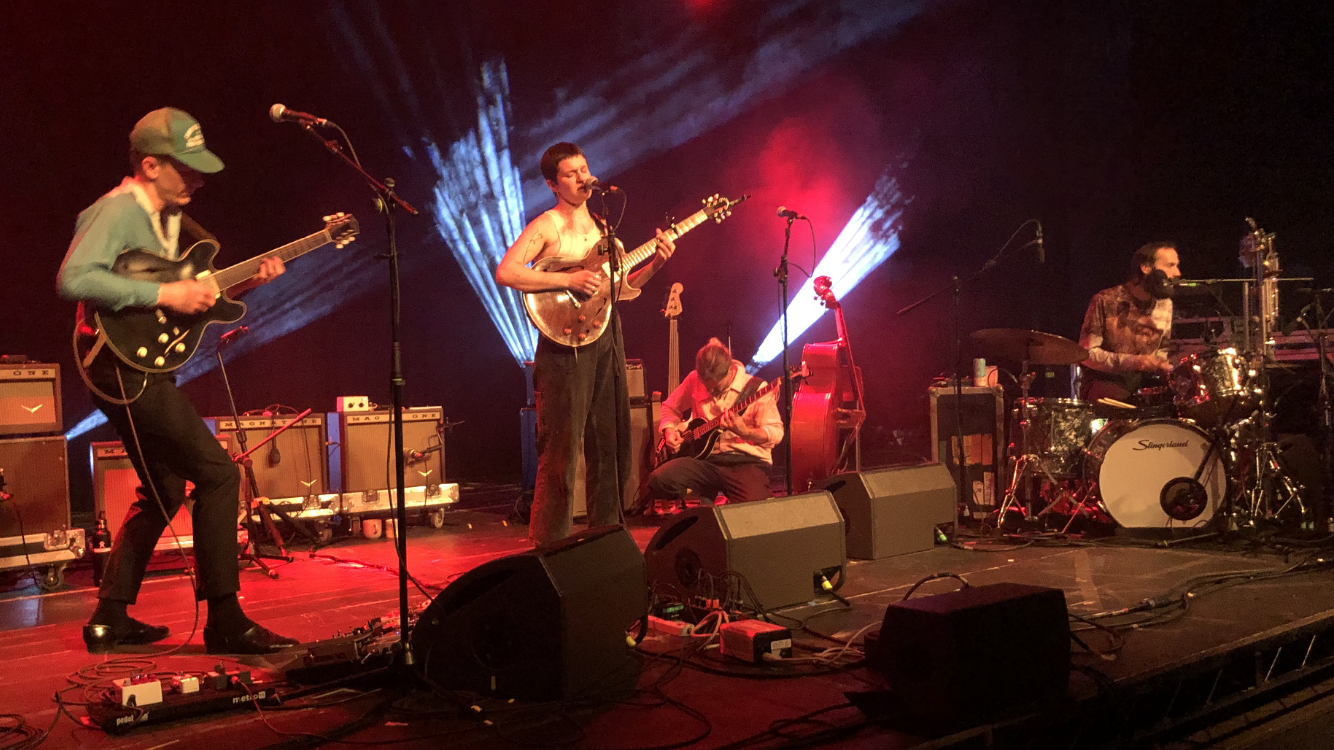
Black Box, Galway, Ireland – 19 April 2024
St Canice’s Cathedral, Kilkenny, Ireland – 20 April 2024
Vicar Street, Dublin, Ireland – 21 April 2024
The Old Fruitmarket, Glasgow, Scotland – 24 April 2024
The Hall @ Aviva Studios, Manchester, England – 25 April 2024
Barbican Centre, London, England – 27, 28 (matinee) and 28 (evening) April 2024
Bristol Beacon, England – 29 April 2024
She is a label PR's darkest nightmare, and we love her for it.
Four shows into Adrianne Lenker's 'Bright Future tour', promoting the biggest album of her career so far, our generation's greatest songwriter has got around to performing fewer than half the tracks on the record. In that time, she has played 30 other things instead, including a cover of a Chris Smither blues number, most of her previous album, and 'Oldest', which was cut from Bright Future, but which she appears to prefer to many of the songs on it. The opening, solo, portion of her climactic concert at the Barbican, arguably the most important date of her career so far, will consist, in its entirety, of the following: two tracks from 2014, one of which she has relearnt while on tour, and four unreleased songs, including a reworking of 'Evol' so new that it doesn't appear to have a name. "If love is simple, can you please explain this?", it begins. I can't explain much of this at all, if I'm honest, but I'll try.
A précis for the until-now-uninitiated: Lenker is a 32-year-old1 singer-songwriter from Indianapolis, via Minneapolis, Boston and Brooklyn, who for close to a decade has carried on a dual existence as a solo artist – playing what we can broadly term ‘alt. folk’ – and as the frontwoman and major creative force behind Big Thief, a band of Berklee music graduates whose approach to genre is largely summarised by the phrase “go on then”, and whose most recent shows have oscillated thrillingly between country and metal. While Lenker doesn’t do any Pantera covers on this latest tour, the country influence on her solo material is becoming ever more apparent: during an afternoon off, she pitches up at an open-mic in a Dublin pub and performs ‘I Don't Love You Much Do I’ by Guy Clark, off the cuff2; her new record has both a yearning fiddle and a cover photo of her in a cowboy hat. (The hat makes it onto the tour: she premieres it in Glasgow, never takes it off on the Sunday in London.) That she is wrangling with this supposedly reactionary genre while exploring the tender intricacies of queer experience does seem more interesting than whatever Beyonce is trying to do over there.
'Someday I'm gon' be a steamboat, baby'
Though Lenker played one date at EartH in London two years ago, she hadn’t toured solo in the UK since 2019. Back then, she seemed paralysingly shy and uncomfortably exposed – hiding behind a thatched fringe in front of the Union Chapel's organ – though that impression would evaporate every time she started to play. When she returned, to EartH, it was off the back of four sold-out nights with Big Thief at the Shepherd’s Bush Empire, and with her bleached buzz cut and swish jacket, she seemed to have segued into a rock star. Then she picked up her guitar, and began to cycle through songs, and it was like you’d dropped in on a mutual mate, only to find a genius in their front room.
That’s the feeling you get again in Dublin on this tour: that night is an extraordinarily intimate experience, Adrianne in cowboy boots on a fittingly carpeted stage, tossing off definitive versions as easily as falling off a log. But almost every show is special in its own way. The only exception is Galway, unspecial in its own way, with the crowd breaking various cardinal rules of gig-going, and seeming half-set on breaking the artist with it.3 After the show, I considered with a chill whether our musical hero might be passing into the realm of Mitski or Phoebe Bridgers, turned into a living meme by the most irritating people on earth, but no: it turns out that’s just Galway…
Because Kilkenny, the next night, is an incalculably special evening: Adrianne on a black platform within a startlingly beautiful 13th-century cathedral; fuchsia lights; the audience seated and hushed in reverence. “You’re so quiet and respectful,” she says at one point, and you think she’s referring bleakly – obliquely – to the previous rowdiness, but then you see how much fun she has in Dublin, and wonder if she just meant we’d been a little quiet. The atmosphere at those two shows fits each venue perfectly, though – and fits each set. They're the two stand-out dates of the tour. The St Canice concert ends with Lenker singing ‘Real House’, a song about her mum, with tears running down her face.
'I'm happy with you – why do I need to explain myself?'
She’s at her most transparently happy in Ireland’s capital (at ease before an audience who offer a saintly spin on Galway, their backing vocals swelling, apposite and perfectly-timed), save perhaps for the second night at the Barbican, when the joy of collaboration is followed by the scale of the send-off. Every seated show ends with the audience on its feet, but that clamour in London hits another level. Between those shows, Glasgow is an over-amplified but good-natured gig in the Dublin vein: an art student called Amy is sketching Adrianne on the front row, someone has brought a monkey on a stick, a requester shouts “my angel!”, followed a few seconds later by the clarification, “…the song”, while Manchester is St Canice’s revisited, just with a touch more joining in and a lot less stained glass. The swansong of this leg of the ‘Bright Future’ tour, in Bristol, features a cheery but less obviously obsessive crowd, mildly befuddled by the deep-cutting of the mammoth setlist (the number of unreleased songs tie with those off the new album, 4-4; in an early fit of whimsy, Lenker plays her two John Prine-iest songs, ‘Cactus Practice’ and ‘Once a Bunch’4 back to back).
By then, you feel like you’ve got to know her a little, not simply as an artist, but as a person. In Kilkenny, Lenker talks openly about her nerves, saying she’s just taken the longest break from touring of her life – which turns out to be just eight months – but she otherwise gives the impression of being quite uncannily relaxed. Now at ease in a way she never quite was before, she begins to open up…
'Please, cut my hair'
While the psychodrama of Adrianne's ever-changing hairstyle is a compelling subplot of any tour (the tousled 2014 shoulder-bob is back, baybee), here we get backstory. In Manchester, she punctures the delicate illusion of between-songs badinage by quipping, “It's good to be in Manchester, I always love coming through… I’m trying to small talk with you while I tune, so it's smooth.” But it's also true, she says: she used to use her friend Bernie's house here as a base, and it was in Manchester that a 24-year-old Lenker first lopped off her hair (me too – we have so much in common, we should hang out some time?). She shares one of her favourite semi-jokes – someone replying to “I’ve had a haircut” with “Which one?” – exhibiting the delight in wordplay and the guileless goofiness as crucial to the Lenker persona as her pained earnestness, before grinningly challenging the audience to identify various baffling chords. When she loses her thread during 'Sadness As a Gift, she spends five minutes telling us about her day (radio session, nap, dilemma over how quickly to eat chicken soup).
It is in Manchester too, and most memorably of all, that the ever-changing ‘Vampire Empire’ is welded to a snatch of Lucinda Williams’ ‘Like a Rose’. Lenker’s song, premiered on Colbert, exploding on TikTok, was essentially a recruiting tool that hoovered up young lesbians, but the first recording of the track (by Big Thief while on tour last year) was savaged online by entitled pricks. Perhaps as a result (though hopefully not), Adrianne re-recorded it for Bright Future, and she plays it six different ways during this tour, from a ‘Spud Infinity’-style5 parade of silliness in Dublin ("OK, freestyle solo,” she tells the audience near the end, "everyone do something different") to a blisteringly-paced honkytonk in Bristol. The great version, though, is Manchester’s, the medley rounding out the song, bringing together the various Lenker identities by spotlighting her open-hearted, open-armed sincerity. In London, she does something striking if less transcendent, adding an extra chorus, her voice plummeting through the octaves in tandem with the word ‘falling’, a vocal risk that replaces the physical jeopardy of last year’s performance in Hammersmith, during which she tipped over backwards, and dropped, laughing, to the floor.
In London, too, she tells us she could never be a stand-up comedian because she laughs at all her own jokes, and indeed she spends a lot of these shows laughing, the fragile music interspersed with sips of water, lengthy retuning and those dorky, squeaky giggles. Conspicuously, she doesn’t go near the two truly desolate songs on her recent heartbreak/heart-reclaiming record: ‘Evol’ and ‘Ruined’. She played one verse of ‘Evol’ as an encore back in March, and whether that was always the whole plan, she never went further: just sat stone still and silent, said brightly, “That’s all”, and went home.
'I see God here and there'
Instead, she plays a joyous ‘Born for Loving You’, which is introduced with a disarming simplicity: “Here’s a song I wrote for my girlfriend, it’s nice to sing it in a church.” When I interviewed Lenker’s Big Thief co-conspirator and ex-husband, Buck Meek, last year, he said that the one thing he admired about Lenker more than any other was her honesty. At greater ease between songs, that has manifested itself in her being utterly candid; with her latest writing, it has resulted in a startling new literalism. If you think ‘Real House’ is brutishly direct, wait until you hear ‘Before You’ (which is what we’re calling her as-yet-unnamed song, premiered in Galway). Here’s how she describes that marriage and its aftermath, her life folded into a standard folk-country frame:
New York City
‘fell in love with a man
He asked me to marry
and I gave him my hand
So simple
I’ve lived a whole life through
But I don’t remember nothin’
Before you
I ended my marriage
‘went back home
I needed to scatter
Those ashes alone
'A convulsion of honesty brought me to life'
“You know, honesty can be brutal,” Meek said to me, “but it’s always the right way.” ‘Before You’ is like In My Life if Lennon’s song had zoned in on the detail, before breaking both your heart and your legs. Seeing Lenker in love is quite something, though: ‘Born for Loving You’ (which I’ve written about here) is one of the great modern love songs, while ‘Baby, Honey, Sweetheart, Darlin'’, played for the second time ever at the first Barbican show, evokes McCartney’s ‘Here, There and Everywhere’, fitting Lenker’s crooked-hanging sentimentality into an ingenious pop-folk template. There is no feeling in modern music even remotely akin to the exhilaration of hearing Lenker unspool some new masterpiece for the first time, each line that she drops into the air somehow better than the one before. We felt it with the instantly immortal ‘Wait a While’ in Bristol in 2020, and with ‘Already Lost’ in Edinburgh last year. We’ve felt it more often than any audience would have any right to expect. Here, shaking her head, hair flicking, one eye on her left hand, she sings:
Honey
Whatcha smilin’ at, what’s funny?
Is it how I am with money?
Now my nose is gettin’ runny
You hold me when I cry
And make it sunny
When people smugly traduce pop lyrics committed to paper, what they miss are the intricacies: here, with Adrianne, it’s the effortless evocation of the fondness of her relationship, the specificity of her imperfection, the intentional lapse into quirky bathos, immediately spun on its head by the revelation of sorrow, and then the sun blasting through like in a ‘60s soul record. It is, too, the imploring quality of her voice, so affectionate and assured: comfortable in love. After she plays ‘I Don’t Love You Much Do I’ in a pub (and how I wish I’d been in The Cobblestone for those three minutes), she shares Guy Clark’s original on Instagram, together with a photo taken by her girlfriend.
'Men are baptized in their anger and fighting'
That song is one of many she’s been voraciously learning during an extended period of musical autodidacticism. In Kilkenny, after covering ‘Leave the Light On’ by Chris Smither, she says guilelessly: “I didn’t grow up learning songs, I just learned guitar by writing songs. So learning other people’s songs is this new thing I’m really into: it’s amazing. There are so many good songs in the world!” The Smither number showcases her extraordinary guitar-playing6 and is, as my friend Peter observed, closer to her own style of writing than anything else she’s ever covered, both cosmic and intimate in the vein of ‘Spud Infinity’. She plays slide guitar too on her own ‘half return’, a throwaway, faintly Gothic ditty enlivened by that flitting finger. At other times she is the consummate country artist, a cowgirl picking, Travis-style, with a hint of a swagger. A music writer once said of cult folkie Nic Jones that he had an orchestra in his right hand. Well, that’s Lenker too.
The only thing she struggles with is telling people off – or telling them to sing (well, that and the fact that she can’t quite whistle). In Dublin, she gently quietens the hum of chatter by saying, “You guys are missing the tuning… it’s the best part,” before pointedly adding, “‘kind of serious, though… it does help to hear when you’re tuning.” In Manchester, she tells the crowd that it’s “a rare treat to hear you sing”, before an encouraging, “Alright, last chance to sing, guys” as she embarks on the final stretch of her signature solo song, ‘anything’. During the matinee in London, when the phrase, “If anyone happens to know any words on any of these songs, you are invited to sing along... formally” fails to elicit the desired response, she ‘forgets’ the words to the song’s second verse, prompting the first communal crooning of the afternoon. The crowd in Glasgow is so good-humoured that she's able to risk one of her drier jokes, mock-apologetically responding to audience requests at the start of the encore by smiling a touch, and saying, “We have such a specific plan. I like these songs, so…” It's clear that Lenker is unusually – indeed, universally – beloved by her collaborators and crew, but it's also true that you don't scale the heights she has without being able to occasionally flash the steel on behalf of your art.
'Places you have been that I needed'
That’s the only night where she plays ‘Already Lost’, one of 17 numbers that receive just a single airing across these nine shows. In total, she plays 50 different songs. Two are covers. The other 48 are her own, and they break down something like this: great (42), good (six). Given that she doesn’t dip into most of the heavier Big Thief material (there’s no acoustic rendering on this tour of ‘Not’ or ‘Masterpiece’ or ‘Real Love’ or ‘Black Diamonds’ or 'Contact' or 'Flower of Blood', or even songs she's played solo at Big Thief shows, like 'Change', though she does do the gentler version of ‘Dragon New Warm Mountain’), it’s an astonishing testament to her micro-consistency, prolificity and, yes, now you happen to mention it, genius.
The finest of the one-shot wonders is a desperately affecting version of the 2019 Big Thief title track, ‘Two Hands’, at the first Barbican show. “You somehow let me down,” she softly wails, the enduring ambiguity of that opening shooting a chill down the spine, the song breaking you and then putting you back together again, as most of her greatest ones do, from “the more that we try … to deny, deny…” to a wild recalibration of how we might see hand-kissing, and finally the guileless reassurance of, “New friends: you can make some too/I know.” In Dublin, there’s a stunning, slowed-down ‘Cattails’. It’s been more commonly a lolloping, propulsive 12-string stomper, but suddenly now it’s a slip of a song, distinct from the mumblecore of ‘half return’ or ‘heavy focus’, instead delicate and bucolic: the perennials don’t dance anymore, they sway. There's also ‘Jonathan’ (from her 2014 EP, a-sides, in Galway), ‘From’ (in Bristol), and Bright Future highlight, ‘Donut Seam’ (the last night at the Barbican).
In terms of Lenker’s lyric-writing, it was the combination of the formative ‘Indiana’ (“…the talk that is told through the teeth of the mouth of the millions dyin’ to meet ya”) and ‘Mary’ (“your hands were making artefacts in the corner of my mind”) that first made me sit up and then slump back down again in amazement, and ‘Donut Seam’, from its pun title to its moth-Icarus motif, via climate dread and the confessional, is that talent seen a decade on. “Oh my heart has holes in it/And there you were exposing it” is the kind of rhyme that other artists spend a lifetime trying to find. ‘Candleflame’, meanwhile, is the current record’s secret weapon, and yet she doesn’t deploy it till the matinee in London. “I feel God here and there,” she murmurs, “people tell me he’s everywhere.” Well, he was definitely in the room during that song, so let's hope he doesn’t feel slighted. Hilariously, Adrianne also gives an airing to 'Bright Future', a song that gave its name to the album... but isn't on the album. And if it seems perverse that she repeatedly prioritises ‘No Machine’ over a song as remarkable as ‘Cell Phone Says’, the former does come to life in person. So does the woozy shoegaze of ‘heavy focus’, with its punchline of blissful release. So does ‘The Only Place’, its guitar part suddenly pulsating with purpose. I’ve said it before, but I’ll repeat it unto death – if you haven’t heard Lenker live, then you haven’t heard her at all.
'Wednesday in August, I was playing with my band'
Other new songs return time and again. ‘Sadness As a Gift’ might be the single best thing that Lenker has ever written, though like another masterwork, ‘Already Lost’, it works better as a solo number. The album versions may be lovely, but they’re not the equal of this ‘Sadness As a Gift’ or this ‘Already Lost’. What Adrianne does retain in the collaborative version of 'Sadness', though, even when it becomes a sing-along, is the stripped-back beauty of its seventh stanza. Her voice has never sounded lovelier, or more ethereal – strident then soft – than when it lands on “every second brimming with a majesty”, a time when time always stands still, and you are left immersed in that moment, wishing it wouldn’t ever pass.
My private theory has always been that the best version of any Adrianne Lenker song is done by her alone, as slowly as possible. However, the fleet-footed take on ‘Free Treasure’ that reaches its apogee in London – gorgeous three-part harmonies and an aching, climbing violin – makes me wonder if my take is watertight. She starts every show solo, but in Glasgow and Manchester is joined by the bear-like pianist (and support act) Nick Hakim, the developing threesome of ‘Bright Future’ alumni rounded out for the final four dates by be-fringed Swedish violinist Josefin Runsteen, whom Lenker met on a musical retreat in Italy.
I wrote after the 2022 shows that, like Dylan, Lenker’s songs are always in flux, and there are innumerable innovations on this tour. ‘Orange’ now has a gorgeous, a capella final verse, and, in Bristol, a busier picking style; ‘Simulation Swarm’ comes with a new staccato solo coda; and at the end of ‘symbol’, a hypnotic track from 2018’s abysskiss, Lenker dispenses a melodic, enormously satisfying ticking into her mic, her mouth sounding like a combination synth and Geiger counter. After a heartstopping version of ‘Born for Loving You’ at Hammersmith last year, she asked fans on Instagram if they could share their audio of the performance, so she could study how she’d done it; now she always sings it that way, save for an added country inflection in the chorus.
'I wanted so much for magic to be real'
‘Pretty Things’, meanwhile, the delicate opener from Big Thief’s Captivity (2017), has become a subtle sort of a monster, building to that devastating sting in its tail, and mounting in menace throughout the tour. ‘anything’, too, is a song that changes across eight shows, the frenzied intensity of the chorus in Galway junked in favour of a tenderness that escalates from each rendition to the next: in Glasgow and London, the people are around me in tears, though there’s a lighting-in-a-bottle feel to this version in Manchester, Lenker seguing straight from ‘Real House’ into a dazed and sibilant ecstasy.
If some people left the London matinee disappointed not to hear ‘anything’, and departed Bristol trying to work out what on earth they’d just heard, usually Lenker’s sweet eccentricity and her audience’s deepest desires collide. In Dublin, she gets off so much on the audience’s backing vocals that she throws an extra chorus into ‘not a lot just forever’. In Manchester, she takes things far further. After a moving piano-and-voice take on ‘zombie girl’, her guitar largely silent in her lap, Hakim on the keys, Lenker murmurs: “I just want to sing that one over and over: that one feels good.” Someone in the audience shouts out: “Play it again!” And so she does, the whole thing, just slower. In Bristol, when Runsteen nips off stage for a sneezing fit, Lenker picks up a guitar and plays ‘ingydar’ off the cuff. Her tours are full of such small, semi-improvised miracles.
Other songs are excavated from her past. The first time she plays ‘Steamboat’, a decade-old highlight from her first album proper, she's yet to relearn its intro (a fact she realises while on stage in Kilkenny), but it's slotted back into the song in time for London. In Galway, someone in the crowd asks atypically sweetly for a deep cut – 2014’s ‘Angels’, with that insane guitar part – and Lenker says she can’t remember how to play it anymore, but is the audience member going to any later shows? "Yes, Chicago." It's all agreed: Adrianne writes that in her songbook7. A week later, she plays the song at two Barbican shows, her fingers flying over the fretboard. Just magic.
And then there are her standards, like 'not a lot just forever' (from 2020's modestly-titled, songs), which trades in Lenker-ish imagery (a dog, a wolf, a rock, a sweater) before trading that imagery in for a vulnerability that remains truly rare and daring, her vocal imploring and her heart wide open, stealing your breath as you stand:
And your dearest fantasy
Is to grow a baby in me
I could be a good mother
And I wanna be your wife
'Both arms cradle you now'
Though her usual dexterity with words fails her between songs in Galway – language an amorphous thing crumbling amid discomfort – her sense of playfulness quickly returns. In Glasgow, she trails ‘forwards beckon rebound’ with the Wodehouse-ish words, “This has always been one of my favourite songs to play, since I wrote it”, before revelling in the dual meaning of ‘since’, and setting the date of composition as “December 34th”. In London, when she invites the audience to sing, she does so first “formally” and then “casually” and in a handful of other ways, rifling through synonyms and variations. The most enjoyable linguistic experimentation, though, is in ‘Free Treasure’, her ode to unconditional love, in which she toys endlessly with the behaviour of “the guy at the nape of my neck who hangs out there all day”: sometimes on this tour, he tells her not to play, sometimes what to play, and, finally, in Bristol, not, what and how to play, these night-to-night changes subtly tinkering with the feel of the verse.
On that final night, she forgets a stanza of ‘Once a Bunch’ (“I might just have to skip to the best verse at the end”); in Dublin, she had aborted the opener, ‘two reverse’, before coming back to it later, because her energy had been too “up”. Her shows are like an art piece about the preparation and performance of a gig, in which the frequent retuning is part of the experience, turning the songs into a suite. And if she fluffs a line – or decides to change the key, or to interrupt with a brief anecdote8 – she doesn't restart the number, she just picks back up from where she was. That charming and scuzzy scrappiness throws her shimmering talent into thrilling relief – and makes it all seem even less explicable. In crudest terms: you see how the sausage is made, and you still haven't got a fucking clue.
I began the 2020 Big Thief tour piece by rather pretentiously suggesting that “every time you see Adrianne Lenker, she’s three different people”. Certainly there are several different Adriannes crammed into the one woman9: the millennial goof; the cosmic balladeer; the unshakably confident Travis-picking, throwback king of country; and the untrammeled soul who writes and sings those pained songs of unwanted experience, searching through the rubble for the glint of solace.
***
NOTES
1In her song, ‘Simulation Swarm’, which is primarily about the brother she has never met, the 31-year-old Lenker describes herself as being “on the 31st floor of the simulation swarm”, if you wanted a cool way to refer to your age.
2That's the song listed on setlist.fm, perhaps because Adrianne shared Clark's recording on Instagram shortly afterwards... but isn't it more likely that she played his 'Dublin Blues'?
3It isn’t just the constant yelling of requests, but the tuneless chanting of the lyrics over her vocals, which smacks less of devotion than narcissism. "Such beautiful... singing," Adrianne says politely at one point, before immediately playing something (the new song, 'Before You') with which they can't join in. After she well-meaningly but unwisely refers to Galway as being “in the UK”, the crowd makes a distinctly ugly warning noise, and while Lenker clearly doesn’t quite grasp the nature of the gaffe, she refers endlessly back to her mistake in a kind of wounded panic, ruminating nervously and contradictorily on the pointlessness of borders and yet the importance of cultural pride. Some of the worst people on the internet had already taken to hectoring her online for being too pro-Israeli (Big Thief’s bassist is Israeli) or too pro-Palestinian (Lenker recently recorded a fundraising mini-album for Palestinian refugees), and in Galway, she is, for want of a better word (perhaps because this one is about right), bullied into addressing the conflict in Gaza by a between-songs cry of ‘Free Palestine!’ She immediately segues into a discussion of the charity record, to establish her bona fides, before, having not made a setlist, launching into a song off the mini-album, ‘fangs lungs ankles’. The earlier – standing – shows also feature an uncanny number of audience members halting the show by fainting, especially when caught in the secondary glow of the blazing blue stage lights. In Glasgow, this means we never do get the end of a Lenker story about her purchasing of a small antique chair.
4When Lenker was a child, she thought the words ‘Once upon a time…’ were ‘Once a buncha times’, which is how the song begins.
5‘Spud Infinity’ typically closes Big Thief shows and has become a cosmic country hoedown featuring improvised solos, including one by Adrianne’s brother Noah, on a jaw harp. He joins Adrianne on stage for an acoustic version at the Barbican’s matinee show, as well as shooting footage for a mini-documentary, which will focus mostly on the backstage experience of putting on a tour, with some bits of audience interaction and a few song clips.
6The best version is in Galway, but a decidedly more stop-start rendering, from Kilkenny, is up here. Apparently, the problems arose from the fact that Smither has, and here I defer to Lenker, “big hands”. After the performance breaks down, she says she’s going to play the song every night, and by the end it will be note-perfect. She plays it twice more. Both times it is.
7This is perhaps an innovation borrowed from one of her heroes, the folk songwriter, Tucker Zimmerman. There was one incredibly moving moment at Shepherd’s Bush in 2022, when the octogenarian Zimmerman, opening for Big Thief in front of 2,000 people, forgot to bring his cherished songbook out with him, and Lenker, who had walked him onto the stage, scooted off to fetch it.
8This sample from midway through the first chorus of ‘Steamboat’ at Kilkenny Cathedral: “I just realised I wrote this when I was 21, before I had ever gone overseas at all, or gone anywhere.” The post-song verdict: “Yeah, I still feel it. I still feel that sometimes.”
9You can even get a sense of this from her stage outfits, which sometimes inform the tenor of a show. The first night, she is sporting a green beanie, from which one of her ears obstinately peeks out. The next evening, in the cathedral, Lenker is a vision in white, resembling nothing so much as a heavenly painter-decorator, her hair tied back, and wearing make-up for the only time on the tour. In Dublin, she's the boy-next-door, in blue jeans and a tattered old motorcycle-shop sweater, but the next time we see her, she has gone Nashville, dressed in a plaid lumberjack shirt, a stetson and work boots. For London, she often seems to make a special effort (one of her few concessions to commercialism, along with exaggerating her mannerisms for show photographers, and thanking her manager from the stage), and though she's dressed for the opening night there in black jeans and boots, she's also wearing a see-through top, under a bralette embroidered with large red roses. She rolls up her sleeve, anyway, ready for action. "Gotta free the arm" for fingerpicking, she explains in Bristol, dressed down once more.
SUPPORT:
Queer Irish singer-songwriter Ellie O’Neill opens the first three dates, her voice racing around the octaves. She’s great, with killer melodies, and lyrics that slip between memoir and abstraction on standouts like ‘Song for Peter’ and ‘Anna with the Silver Arrow’. Nick Hakim, who’s known Adrianne since they were 17, and has often played on the same bill, is the support for the other six shows, singing slow, introspective indie ballads at the piano, including a touching cover of Chocolate Genius Incorporated's 'My Mom'.
SETLISTS:
Thanks to Peter, Fran, Paul, Sorrel, Jamie, Jordan and Jess for their company and friendship on the tour. And thanks to you for reading.
The abiding mental image from this tour is of Adrianne frowning with a kind of emotional concentration, head tilted to one side, eyes closed and lips pouting, words flowing out of the right side of her mouth.
Words and pictures by Rick Burin. Photos, in order, are: 'Real House' in Dublin; London (final night); 'Real House' in Kilkenny; Dublin; the main window at St Canice's, Kilkenny; Adrianne and Nick Hakim in Glasgow; Dublin; Glasgow; Adrianne and Josefin Runsteen at the Barbican (final night); Manchester; Galway; Ellie O'Neill in Dublin; Galway; Dublin (below).
Showing posts with label London. Show all posts
Wednesday, 1 May 2024
Saturday, 15 April 2023
Effortless audacity: Big Thief on tour
Sage Gateshead – 05/04/23
Usher Hall, Edinburgh – 06/04/23
Manchester Apollo – 07/04/23
The Great Hall, Cardiff – 08/04/23
Hammersmith Apollo, London – 11 and 12/04/23
Chalk Brighton – 13/04/23
There is a song that Big Thief have recently started playing called ‘Born for Loving You’.
If you want to understand it, there is a simple, biographical way. And then there is another way.
The simple way first: when the band’s frontwoman, Adrianne Lenker, was a student at Berklee, her music showcase betrayed the powerful influence of the husky, highway-fixated alt-country chanteuse, Lucinda Williams, right down to the very voice she was affecting. That influence hasn’t been as pronounced since (manifesting merely in the odd cover, with Lenker slipping back into Lucinda-voice), but as the band prepares to tour with Williams this summer, here’s a song – co-written with drummer James Krivchenia – that in its feel and its hook could be seamlessly snuck into Williams’ setlist. It may also be the straight-up sexiest thing that Lenker has ever sung (“Take me to the back of your pick-up truck,” she implores at one point, “show me a thing or two.”).
And now here’s the other way to think about ‘Born for Loving You’: no-one else on earth could have written this song.
‘After the dinos fell’: the world of Adrianne Lenker
In its first two lines, Lenker dispenses with the entire history of the universe up to her birth (“After the first stars formed, after the dinos fell/After the first light flickered out of this motel…”). That effortless audacity is characteristic. But the song’s conceit is not conceited: it is a way of understanding the magnitude of love. Everything that happened – to me, to us, to anyone – was just a prelude to this. From blood-soaked birth to teenage nightmare, via “waddling around, looking at birds”, well: “thank god we made it through.”
Dylan once said, “It isn’t me, it’s the songs. I’m just the postman, I deliver the songs.” And here is Lenker’s current online biography in full: “songs of all sorts from places unknown”.
The places are, admittedly, occasionally known. Across the seven shows on this UK tour, ‘Born for Loving You’ gets four airings: twice as a lush ‘70s California-style singalong, then as a plaintive solo ballad, and finally as a stripped-down full-band version with simple harmonies. For those last three, Lenker adds a coda: a falsetto snatch of ‘I Will Always Love You’ (Whitney version).
Yet even when the sources are, as she says, “unknown”, those songs come filtered through a unique sensibility: ideas are ingeniously inverted, images recur, motifs are endlessly shuffled. Her characters are gender-fluid, avian, feminist and quasi-biblical, traversing a world of blue skies, cluttered kitchens, bare plains and flat roads. Whether broken, fixed or flailing, they are loved.
And certainly she seems a conduit for whatever immortal music is floating in the ether right now, whether fragile or thundering. The most exhilarating part of following Big Thief on tour is the regularity with which miracles happen. “This is a new song,” Lenker will say, most nights, before playing the greatest fucking thing you’ve ever heard in your life. On the last tour, she composed ‘Wait a While’ on the ferry over from Dublin, performed it six times in concert, then retired it. It has never been released. Most musicians would kill to ever write a song just half as good.
But Lenker just keeps them coming. She begins the encore at Edinburgh with ‘Already Lost’, for which the word ‘timeless’ is barely sufficient (by the point she unspools the line, “How slow and how fast you are,” your soul has gone into spasm). She commences the second night at Hammersmith with ‘Sadness As a Gift’, which does for depression what ‘Change’ did for fear of death; turning your understanding inside out. She isn’t soothing you with song, she’s showing you another way of perceiving pain. While her between-songs badinage is regularly ridiculed by reviewers committed to the cheap shot, there’s something appealingly counter-intuitive about her worldview, about an artist who’ll tell a huge crowd that a mammoth show feels like a dream (so far, so banal), only to dazedly add: “I don’t really even mean career-wise, I just mean in general: it’s so bizarre to be a human being, and we all ended up here, right now.”
A live band who also make records
And here is where you want to be. You don’t know Big Thief if you haven’t seen them live. They are not a group you fall in love with at a distance: they are a live band who make records on the side; the intensity of their in-person performance rarely, if ever, transfers to your preferred streaming service.
Nor does its extremity. They continue to spread out in all directions, the quietest band on the circuit, and about the loudest. I saw them in Oslo last year during one of their particularly metal phases, an evening that did unspeakable things to my left ear. It is a decision I will never regret.
The live experience, gloriously, is never the same twice. That’s how I can justify seeing them seven times in nine days. Across those shows, they play 38 different songs, 14 of them just once. So if you want to hear their most popular song (‘Shark Smile’), a recent album track like ‘Blue Lightning’, or an unexpected cover of ‘Strangers’ by The Kinks, you’ll have to catch them in London, Manchester and Brighton. They start the second show of the tour, in Edinburgh, by playing four songs we haven’t heard the night before.
Every gig, too, has a different narrative, often built into the sweep of Krivchenia’s setlists. Edinburgh begins with that country-inflected singer-songwriter fare, before shifting into tortured rock, a sequence bookended by two absolute beasts: ‘Contact’ and ‘Dragon New Warm Mountain’. The former explodes into ugly metal screams; the latter continues to delight those who only know the gentle, balladic version that titled their last album.
That’s an emblematic number when talking about how their music continues to evolve, and how no Big Thief song is ever finished. At Gateshead – a curious, slightly muted show (presumably because it was largely seated) – ‘DNWM’ came galumphing out of the gate in a way that just made me think, “yeah OK, but we kind of did this last year”. The next night, it was reborn as a monster, and by Hammersmith, it had mutated into something unstoppable, the band adding more and more mad shit to it: a vocoder, a vocal-coda (Lenker’s drifting falsetto), and squalls of physically-induced feedback, Lenker turning her back on the crowd and throwing her torso at the amp. The song's opening line, "It's a little bit magic," is essentially now a public service announcement.
Not winning
Songs are in constant flux. While ‘Flower of Blood’ reaches its apogee on the first night – as if shoegaze died and went to Heaven, where the Shredding Festival was taking place – two of Lenker’s greatest songs don’t quite find their new place in the world until the final one.
‘Not’ often felt curiously tired, an incomparable song given oddly perfunctory treatment; and after glorious versions exhibiting the extroverted solo (2020) and the internalised one (2022), its climax here seemed technically impressive but hard to follow, either musically or emotionally. Manchester was an exception – Lenker beginning and ending the song on her knees, her guitar part suddenly pleading – while the first night in Hammersmith was an enjoyable anomaly in which she either forgot the words (not, ironically, for the first time) or just tried something new: a ‘Subterranean Homesick Blues’-style semi-rap on the verses. It’s Brighton, though, where the song comes to life again in exhilarating fashion. It’s longer, unerring, precise in meaning, Lenker drawing a defining message of futility from its endless negation, as she circles back for a last chorus, screaming the words “not winning” over and again, like some apocalyptic benediction.
She ended both the last UK tour and this one with ‘Change’ – her song about life gaining its very meaning from the existence of death – and while the deeply moving solo version that closed the Shepherd’s Bush run remains the indelible one, her message best delivered by a single voice, the four-part harmony and falsetto ending of this new reading also reaches its full flower by the seaside.
Other songs have been completely reworked. ‘Spud Infinity’ continues its transformation from a wispy, metaphysical ballad to a showcase for a band at its happiest and silliest, complete with Jew’s harp, stomping and a sing-along. While ostensibly a country song, it’s also a jazz number in as much as it allows for showy improv, including guitarist Buck Meek’s characteristically weird anti-solos. ‘Zombie Girl’, another song that Lenker played as a haunting solo song at Union Chapel in 2019, is performed in Edinburgh as a seven-minute prog number with two guitar solos.
At other times, the emotions are simply dialled up. Lenker’s guitar-play is further spotlighted in a newly funky, swaggeringly cocky ‘Simulation Swarm’ that contains two killer – and subtly different – solos, while the cult favourite, ‘Sparrow’ (whose accompanying t-shirt has become practically a uniform for teen girls paying pilgrimage), escalates into tormented fretwork. Simply ditching her acoustic 12-string is enough to conjure up a different world of ‘Cattails’, as if rural America finally got electrified. And in ‘Certainty’, she effectively improves upon perfection by dropping onto a blue note on the pivotal word ‘wild’, an innovation that makes the song more – not less – certain; and irrevocable, without end.
Real love: a horror show
Manchester, probably the best show of the tour, offers a first outing for ‘Real Love’ (Lenker memorably responded to audience cries for the song at Shepherd’s Bush by murmuring, “I know that one”, and mock-innocently singing a bit of the chorus). It’s a blistering rendition, with an extended solo, a huge riff and a similarly huge performance, Lenker grasping glorious, frenzied at the falsetto finale. It remains one of her greatest and most deceptively important love songs: a haunting and seductive marriage of adolescent goth imagery and childhood trauma. This is love as illness, incapacitation, sudden death; a life sentence; a horror show; a beating; a curse, endlessly repeating – and who doesn’t want love?
There are also the moments when Big Thief drag out a deep cut, and drag you around to their way of thinking. I didn’t get the fuss over ‘Change’ until the final moments of last year’s tour. Adrianne starts the first show here with a beautiful solo rendering of ‘UFOF’ – despite twice forgetting the words – a song I’d never cared about at all, before the band blasts out ‘Blurred View’ in a version that finally makes the song make sense: hypnotic and insistent. Other apparent filler from last year’s mammoth double-album grows in stature over the nine days, ‘Time Escaping’ in Cardiff emerging lopsidedly gorgeous from bizarre tuning and improvised wordless vocals; the yearning ’12,000 Lines’ rising to meet the majesty of its cosmic sentiments; a finger-picked ‘Dried Roses’ finally opening up in London, rather than repeatedly shutting its door in your face. In Brighton, the band turn the thin pastiche of ‘Red Moon’ into a total winner, the song racing past and carrying you with it.
And then there are those new songs. Alongside the ones already mentioned are ‘Horsepower’ – a groove-filled metaphor about fucking, via Top Gear Driving Classics, Vol. 5 – an amiable solo number called ‘Bright Future’, and a pair of instant classics. The sensual, longing ‘Ruined’ is one hell of a choice to kick off your biggest show in four years, while the raw and imploring ‘Free Treasure’ sounds like Springsteen’s more talented sister knocking about in the back yard. “Just when I thought I couldn’t feel more, I feel a little more,” Lenker sings, her voice breaking. Tell me about it.
Psycho-drama in Hammersmith
If the first Hammersmith show was, to me, the night she sang ‘Free Treasure’ solo (and the night I got to see my band with my best friend for the first time), then the second show felt more like a psycho-drama. In the 22 hours between, Adrianne had met up with her ex, and the band’s return to London had been damned with varying degrees of faint praise by the reviewers of two national papers. The armchair psychologist in me wonders whether that personal experience informed the quietly anguished elements of the show, while the professional brickbats inspired the setlist and the ferocious physicality. ‘Vampire Empire’ ended with Adrianne falling in tandem with the word itself, ending the song sprawled on her back; once up on her feet again, she took quite some time to compose herself for the repetitive, unrepentant, pseudo-cheery toxic ballad, ‘Happy with You’ (Krivchenia’s favourite Big Thief song). Incorporating ‘Masterpiece’ as recorded – rather than the conversational iteration performed the previous two nights – along with the only outings this tour of fan favourites ‘Shark Smile’ and ‘Mary’, this was the band’s version of a hits show, though they remain the only band whose hits show has four unreleased songs in it.
One of those is ‘Vampire Empire’, which – in typically offbeat fashion – Big Thief decided to showcase on prime-time TV, despite the fact it isn’t available to stream or buy. Whether that was 4D chess, agreeable iconoclasm or a mild form of commercial self-sabotage remains to be seen, but it’s looking increasingly like the former. Adopted as a Gen Z anthem, its spiky gender nonconformity (a preoccupation that found its most beautiful expression in Lenker’s 2016 song, ‘Paul’) might just boot them into the next level of rock stardom. Is it selfish to say that I hope not? I love this band, I don’t want to watch them in a large shipping container.
These spaces just feel right. In Cardiff, Lenker adapts her songs not just to her mood but to the acoustic peculiarities of the low-ceilinged Great Hall. After playing to 10,000 people across two nights at Hammersmith, the band could have treated the 800-capacity Chalk Brighton as a comedown; instead they embrace the intimacy.
Fashion rocks
When I wrote about the 2022 tour, I received two tweets that really stuck in my mind. One, from @roryisconfused, said: “I love that since I saw them 3 days ago, the bassist has dyed his hair pink.” Someone else, their name now sadly lost to history, wrote: “Each member looks like they’re in a different band.”
Last year, Lenker manfully continued with the solo to ‘Not’ despite the fact that what appeared to be a wedding dress was coming down around her. This time she has to negotiate the thrashing climax of ‘Contact’ with a green beenie having fallen down over her eyes. This band suffers for their art, but also occasionally for their fashion. In Gateshead, they are wearing: an untucked pink satin shirt and tall hair (Buck, guitar adornments); a silver jump suit and matching sandals (James, drums); a pale pink dress (Max, bass); a cut-off motorbike shop t-shirt, old black jeans and silver tooth (Adrianne).
Each has a stock expression on stage. Krivchenia’s mouth hangs open, as if in a drum-induced trance. Meek endlessly shakes his head, his front leg bent, a slim shoe pointing towards the crowd. Bassist Max Oleartchik greets regular deviations from formula by shrugging contentedly and giving it the big lower lip. And Lenker has three principal modes nowadays: eyes closed peacefully for a solo spot; eyes closed tormentedly for a howling guitar break; hopping from one foot to the other in a hoedown style when she feels the need to lighten up a little.
Her place on stage was always front right, but apparently a bad back has forced her inwards. Ironically, shifting to centre-stage makes her seem less like a solo act with some willing accomplices, and more like one of the band. She also seems younger on this tour, somehow. Maybe it’s the hair: a tomboyish tuft rather than the blonde buzzcut that made her look so otherworldly at Shepherd’s Bush. She was married to Meek, way back in the mists of 2015, and their dynamic remains hugely touching. For his part, he is possibly the most wholesome person on earth. In Edinburgh, he tells a story in his faltering southern twang about how as a child he stayed in a nearby castle where his grandfather – a dealer in antique coins – made the children a treasure hunt in which they had to find doubloons. Alright, Keith Moon.
Sadness as a gift
That gentleness extends to the whole band. Most nights, they spoil the big rock star reveal by shambling onto the stage an hour early to introduce the support act and ask the audience to be quiet and attentive. Lenker says in Hammersmith that it’s the part of the show that makes her most nervous. What I pretentiously took to be a delight in linguistic invention when she did it at EartH, may, instead, just be mere awkwardness.
But the vagueness that can beset that plea, or her chats between songs, vanishes when she sings, or writes, or plays. Her commitment to emotional truth habitually forces her to disrupt the band’s best laid plans by politely interpolating whatever song she suddenly feels like playing (you can think of their printed setlist as an interesting alternate reality). And it informs both the sincerity of her singing and the specificity of her songs. Even if the songs still come from ‘places unknown’.
In ‘Sadness as a Gift’, perhaps the most vivid example of Lenker’s ability to leap repeatedly between the everyday and the eternal, she addresses a lost lover. “You and I both know there is nothing more to say,” she begins, before saying it anyway, if only to herself. The song builds to a remembrance – or an offer? – of profound simplicity, as Lenker croons with a fractured strength: “You could hear the music inside my mind.”
I just feel privileged to live in a time when I can do the same.
***
With thanks to old friends and new on this tour: Paul, Jess, Jamie, Sorrel, Jordan, Chris and Orlando.
Setlists: My pieces on previous Big Thief tours: 2020, 2022
Usher Hall, Edinburgh – 06/04/23
Manchester Apollo – 07/04/23
The Great Hall, Cardiff – 08/04/23
Hammersmith Apollo, London – 11 and 12/04/23
Chalk Brighton – 13/04/23
There is a song that Big Thief have recently started playing called ‘Born for Loving You’.
If you want to understand it, there is a simple, biographical way. And then there is another way.
The simple way first: when the band’s frontwoman, Adrianne Lenker, was a student at Berklee, her music showcase betrayed the powerful influence of the husky, highway-fixated alt-country chanteuse, Lucinda Williams, right down to the very voice she was affecting. That influence hasn’t been as pronounced since (manifesting merely in the odd cover, with Lenker slipping back into Lucinda-voice), but as the band prepares to tour with Williams this summer, here’s a song – co-written with drummer James Krivchenia – that in its feel and its hook could be seamlessly snuck into Williams’ setlist. It may also be the straight-up sexiest thing that Lenker has ever sung (“Take me to the back of your pick-up truck,” she implores at one point, “show me a thing or two.”).
And now here’s the other way to think about ‘Born for Loving You’: no-one else on earth could have written this song.
‘After the dinos fell’: the world of Adrianne Lenker
In its first two lines, Lenker dispenses with the entire history of the universe up to her birth (“After the first stars formed, after the dinos fell/After the first light flickered out of this motel…”). That effortless audacity is characteristic. But the song’s conceit is not conceited: it is a way of understanding the magnitude of love. Everything that happened – to me, to us, to anyone – was just a prelude to this. From blood-soaked birth to teenage nightmare, via “waddling around, looking at birds”, well: “thank god we made it through.”
Dylan once said, “It isn’t me, it’s the songs. I’m just the postman, I deliver the songs.” And here is Lenker’s current online biography in full: “songs of all sorts from places unknown”.
The places are, admittedly, occasionally known. Across the seven shows on this UK tour, ‘Born for Loving You’ gets four airings: twice as a lush ‘70s California-style singalong, then as a plaintive solo ballad, and finally as a stripped-down full-band version with simple harmonies. For those last three, Lenker adds a coda: a falsetto snatch of ‘I Will Always Love You’ (Whitney version).
Yet even when the sources are, as she says, “unknown”, those songs come filtered through a unique sensibility: ideas are ingeniously inverted, images recur, motifs are endlessly shuffled. Her characters are gender-fluid, avian, feminist and quasi-biblical, traversing a world of blue skies, cluttered kitchens, bare plains and flat roads. Whether broken, fixed or flailing, they are loved.
And certainly she seems a conduit for whatever immortal music is floating in the ether right now, whether fragile or thundering. The most exhilarating part of following Big Thief on tour is the regularity with which miracles happen. “This is a new song,” Lenker will say, most nights, before playing the greatest fucking thing you’ve ever heard in your life. On the last tour, she composed ‘Wait a While’ on the ferry over from Dublin, performed it six times in concert, then retired it. It has never been released. Most musicians would kill to ever write a song just half as good.
But Lenker just keeps them coming. She begins the encore at Edinburgh with ‘Already Lost’, for which the word ‘timeless’ is barely sufficient (by the point she unspools the line, “How slow and how fast you are,” your soul has gone into spasm). She commences the second night at Hammersmith with ‘Sadness As a Gift’, which does for depression what ‘Change’ did for fear of death; turning your understanding inside out. She isn’t soothing you with song, she’s showing you another way of perceiving pain. While her between-songs badinage is regularly ridiculed by reviewers committed to the cheap shot, there’s something appealingly counter-intuitive about her worldview, about an artist who’ll tell a huge crowd that a mammoth show feels like a dream (so far, so banal), only to dazedly add: “I don’t really even mean career-wise, I just mean in general: it’s so bizarre to be a human being, and we all ended up here, right now.”
A live band who also make records
And here is where you want to be. You don’t know Big Thief if you haven’t seen them live. They are not a group you fall in love with at a distance: they are a live band who make records on the side; the intensity of their in-person performance rarely, if ever, transfers to your preferred streaming service.
Nor does its extremity. They continue to spread out in all directions, the quietest band on the circuit, and about the loudest. I saw them in Oslo last year during one of their particularly metal phases, an evening that did unspeakable things to my left ear. It is a decision I will never regret.
The live experience, gloriously, is never the same twice. That’s how I can justify seeing them seven times in nine days. Across those shows, they play 38 different songs, 14 of them just once. So if you want to hear their most popular song (‘Shark Smile’), a recent album track like ‘Blue Lightning’, or an unexpected cover of ‘Strangers’ by The Kinks, you’ll have to catch them in London, Manchester and Brighton. They start the second show of the tour, in Edinburgh, by playing four songs we haven’t heard the night before.
Every gig, too, has a different narrative, often built into the sweep of Krivchenia’s setlists. Edinburgh begins with that country-inflected singer-songwriter fare, before shifting into tortured rock, a sequence bookended by two absolute beasts: ‘Contact’ and ‘Dragon New Warm Mountain’. The former explodes into ugly metal screams; the latter continues to delight those who only know the gentle, balladic version that titled their last album.
That’s an emblematic number when talking about how their music continues to evolve, and how no Big Thief song is ever finished. At Gateshead – a curious, slightly muted show (presumably because it was largely seated) – ‘DNWM’ came galumphing out of the gate in a way that just made me think, “yeah OK, but we kind of did this last year”. The next night, it was reborn as a monster, and by Hammersmith, it had mutated into something unstoppable, the band adding more and more mad shit to it: a vocoder, a vocal-coda (Lenker’s drifting falsetto), and squalls of physically-induced feedback, Lenker turning her back on the crowd and throwing her torso at the amp. The song's opening line, "It's a little bit magic," is essentially now a public service announcement.
Not winning
Songs are in constant flux. While ‘Flower of Blood’ reaches its apogee on the first night – as if shoegaze died and went to Heaven, where the Shredding Festival was taking place – two of Lenker’s greatest songs don’t quite find their new place in the world until the final one.
‘Not’ often felt curiously tired, an incomparable song given oddly perfunctory treatment; and after glorious versions exhibiting the extroverted solo (2020) and the internalised one (2022), its climax here seemed technically impressive but hard to follow, either musically or emotionally. Manchester was an exception – Lenker beginning and ending the song on her knees, her guitar part suddenly pleading – while the first night in Hammersmith was an enjoyable anomaly in which she either forgot the words (not, ironically, for the first time) or just tried something new: a ‘Subterranean Homesick Blues’-style semi-rap on the verses. It’s Brighton, though, where the song comes to life again in exhilarating fashion. It’s longer, unerring, precise in meaning, Lenker drawing a defining message of futility from its endless negation, as she circles back for a last chorus, screaming the words “not winning” over and again, like some apocalyptic benediction.
She ended both the last UK tour and this one with ‘Change’ – her song about life gaining its very meaning from the existence of death – and while the deeply moving solo version that closed the Shepherd’s Bush run remains the indelible one, her message best delivered by a single voice, the four-part harmony and falsetto ending of this new reading also reaches its full flower by the seaside.
Other songs have been completely reworked. ‘Spud Infinity’ continues its transformation from a wispy, metaphysical ballad to a showcase for a band at its happiest and silliest, complete with Jew’s harp, stomping and a sing-along. While ostensibly a country song, it’s also a jazz number in as much as it allows for showy improv, including guitarist Buck Meek’s characteristically weird anti-solos. ‘Zombie Girl’, another song that Lenker played as a haunting solo song at Union Chapel in 2019, is performed in Edinburgh as a seven-minute prog number with two guitar solos.
At other times, the emotions are simply dialled up. Lenker’s guitar-play is further spotlighted in a newly funky, swaggeringly cocky ‘Simulation Swarm’ that contains two killer – and subtly different – solos, while the cult favourite, ‘Sparrow’ (whose accompanying t-shirt has become practically a uniform for teen girls paying pilgrimage), escalates into tormented fretwork. Simply ditching her acoustic 12-string is enough to conjure up a different world of ‘Cattails’, as if rural America finally got electrified. And in ‘Certainty’, she effectively improves upon perfection by dropping onto a blue note on the pivotal word ‘wild’, an innovation that makes the song more – not less – certain; and irrevocable, without end.
Real love: a horror show
Manchester, probably the best show of the tour, offers a first outing for ‘Real Love’ (Lenker memorably responded to audience cries for the song at Shepherd’s Bush by murmuring, “I know that one”, and mock-innocently singing a bit of the chorus). It’s a blistering rendition, with an extended solo, a huge riff and a similarly huge performance, Lenker grasping glorious, frenzied at the falsetto finale. It remains one of her greatest and most deceptively important love songs: a haunting and seductive marriage of adolescent goth imagery and childhood trauma. This is love as illness, incapacitation, sudden death; a life sentence; a horror show; a beating; a curse, endlessly repeating – and who doesn’t want love?
There are also the moments when Big Thief drag out a deep cut, and drag you around to their way of thinking. I didn’t get the fuss over ‘Change’ until the final moments of last year’s tour. Adrianne starts the first show here with a beautiful solo rendering of ‘UFOF’ – despite twice forgetting the words – a song I’d never cared about at all, before the band blasts out ‘Blurred View’ in a version that finally makes the song make sense: hypnotic and insistent. Other apparent filler from last year’s mammoth double-album grows in stature over the nine days, ‘Time Escaping’ in Cardiff emerging lopsidedly gorgeous from bizarre tuning and improvised wordless vocals; the yearning ’12,000 Lines’ rising to meet the majesty of its cosmic sentiments; a finger-picked ‘Dried Roses’ finally opening up in London, rather than repeatedly shutting its door in your face. In Brighton, the band turn the thin pastiche of ‘Red Moon’ into a total winner, the song racing past and carrying you with it.
And then there are those new songs. Alongside the ones already mentioned are ‘Horsepower’ – a groove-filled metaphor about fucking, via Top Gear Driving Classics, Vol. 5 – an amiable solo number called ‘Bright Future’, and a pair of instant classics. The sensual, longing ‘Ruined’ is one hell of a choice to kick off your biggest show in four years, while the raw and imploring ‘Free Treasure’ sounds like Springsteen’s more talented sister knocking about in the back yard. “Just when I thought I couldn’t feel more, I feel a little more,” Lenker sings, her voice breaking. Tell me about it.
Psycho-drama in Hammersmith
If the first Hammersmith show was, to me, the night she sang ‘Free Treasure’ solo (and the night I got to see my band with my best friend for the first time), then the second show felt more like a psycho-drama. In the 22 hours between, Adrianne had met up with her ex, and the band’s return to London had been damned with varying degrees of faint praise by the reviewers of two national papers. The armchair psychologist in me wonders whether that personal experience informed the quietly anguished elements of the show, while the professional brickbats inspired the setlist and the ferocious physicality. ‘Vampire Empire’ ended with Adrianne falling in tandem with the word itself, ending the song sprawled on her back; once up on her feet again, she took quite some time to compose herself for the repetitive, unrepentant, pseudo-cheery toxic ballad, ‘Happy with You’ (Krivchenia’s favourite Big Thief song). Incorporating ‘Masterpiece’ as recorded – rather than the conversational iteration performed the previous two nights – along with the only outings this tour of fan favourites ‘Shark Smile’ and ‘Mary’, this was the band’s version of a hits show, though they remain the only band whose hits show has four unreleased songs in it.
One of those is ‘Vampire Empire’, which – in typically offbeat fashion – Big Thief decided to showcase on prime-time TV, despite the fact it isn’t available to stream or buy. Whether that was 4D chess, agreeable iconoclasm or a mild form of commercial self-sabotage remains to be seen, but it’s looking increasingly like the former. Adopted as a Gen Z anthem, its spiky gender nonconformity (a preoccupation that found its most beautiful expression in Lenker’s 2016 song, ‘Paul’) might just boot them into the next level of rock stardom. Is it selfish to say that I hope not? I love this band, I don’t want to watch them in a large shipping container.
These spaces just feel right. In Cardiff, Lenker adapts her songs not just to her mood but to the acoustic peculiarities of the low-ceilinged Great Hall. After playing to 10,000 people across two nights at Hammersmith, the band could have treated the 800-capacity Chalk Brighton as a comedown; instead they embrace the intimacy.
Fashion rocks
When I wrote about the 2022 tour, I received two tweets that really stuck in my mind. One, from @roryisconfused, said: “I love that since I saw them 3 days ago, the bassist has dyed his hair pink.” Someone else, their name now sadly lost to history, wrote: “Each member looks like they’re in a different band.”
Last year, Lenker manfully continued with the solo to ‘Not’ despite the fact that what appeared to be a wedding dress was coming down around her. This time she has to negotiate the thrashing climax of ‘Contact’ with a green beenie having fallen down over her eyes. This band suffers for their art, but also occasionally for their fashion. In Gateshead, they are wearing: an untucked pink satin shirt and tall hair (Buck, guitar adornments); a silver jump suit and matching sandals (James, drums); a pale pink dress (Max, bass); a cut-off motorbike shop t-shirt, old black jeans and silver tooth (Adrianne).
Each has a stock expression on stage. Krivchenia’s mouth hangs open, as if in a drum-induced trance. Meek endlessly shakes his head, his front leg bent, a slim shoe pointing towards the crowd. Bassist Max Oleartchik greets regular deviations from formula by shrugging contentedly and giving it the big lower lip. And Lenker has three principal modes nowadays: eyes closed peacefully for a solo spot; eyes closed tormentedly for a howling guitar break; hopping from one foot to the other in a hoedown style when she feels the need to lighten up a little.
Her place on stage was always front right, but apparently a bad back has forced her inwards. Ironically, shifting to centre-stage makes her seem less like a solo act with some willing accomplices, and more like one of the band. She also seems younger on this tour, somehow. Maybe it’s the hair: a tomboyish tuft rather than the blonde buzzcut that made her look so otherworldly at Shepherd’s Bush. She was married to Meek, way back in the mists of 2015, and their dynamic remains hugely touching. For his part, he is possibly the most wholesome person on earth. In Edinburgh, he tells a story in his faltering southern twang about how as a child he stayed in a nearby castle where his grandfather – a dealer in antique coins – made the children a treasure hunt in which they had to find doubloons. Alright, Keith Moon.
Sadness as a gift
That gentleness extends to the whole band. Most nights, they spoil the big rock star reveal by shambling onto the stage an hour early to introduce the support act and ask the audience to be quiet and attentive. Lenker says in Hammersmith that it’s the part of the show that makes her most nervous. What I pretentiously took to be a delight in linguistic invention when she did it at EartH, may, instead, just be mere awkwardness.
But the vagueness that can beset that plea, or her chats between songs, vanishes when she sings, or writes, or plays. Her commitment to emotional truth habitually forces her to disrupt the band’s best laid plans by politely interpolating whatever song she suddenly feels like playing (you can think of their printed setlist as an interesting alternate reality). And it informs both the sincerity of her singing and the specificity of her songs. Even if the songs still come from ‘places unknown’.
In ‘Sadness as a Gift’, perhaps the most vivid example of Lenker’s ability to leap repeatedly between the everyday and the eternal, she addresses a lost lover. “You and I both know there is nothing more to say,” she begins, before saying it anyway, if only to herself. The song builds to a remembrance – or an offer? – of profound simplicity, as Lenker croons with a fractured strength: “You could hear the music inside my mind.”
I just feel privileged to live in a time when I can do the same.
***
With thanks to old friends and new on this tour: Paul, Jess, Jamie, Sorrel, Jordan, Chris and Orlando.
Setlists: My pieces on previous Big Thief tours: 2020, 2022
Labels:
Adrianne Lenker,
Apollo,
Big Thief,
Born for Loving You,
Brighton,
Buck Meek,
Cardiff,
Edinburgh,
Eventim,
Gateshead,
Hammersmith,
London,
Manchester,
review,
Sadness as a Gift,
setlist,
UK tour
Location:
London, UK
Monday, 7 March 2022
“When I say infinity, I mean NOW": Adrianne Lenker and Bob Dylan
Big Thief at Bristol Academy, 27/02/22
Big Thief at Shepherd’s Bush Empire, 02/03/22-05/03/22
Adrianne Lenker at EartH, 06/03/22
“The new album by @BigThiefMusic is a revelation,” tweeted Dwight from The Office this weekend. “Can I have permission to compare Adrianne Lenker to Bob Dylan?” Permission granted: the parallels are inescapable – and thickening.
When I followed Big Thief on tour in 2020 (not that I like to go on about it), I wrote:
Or listen to ‘Not’, included among Obama’s songs of 2019, and essentially the band’s anthem nowadays. Reviewing the following year’s tour, I called it “an explosion of cathartic anguish … a list song that exalts through endless negation”, but there was release there: a rush of respite in Lenker’s breakaway guitar solo. This tour, there is no release. The support band back then was ITHACA, a London thrash metal group, and a sign that Lenker’s interest in getting heavier was getting heavy. ‘Not’ ends now in an unforgiving squall that’s directed entirely inwards. The flurry of squealing, arrhythmic high notes whistling from Lenker’s guitar feel like clues to an emotion, not the emotion itself. In Bristol, the song becomes a 15-minute freakout. On the second London night, Lenker towers above the crowd during the solo, her face tortured beneath the lights, purging something. The next evening her dress starts coming down during the guitar break, like a stress dream for the ages. She doesn’t quite cut her losses, but let’s say that she doesn’t extend the communication with her muse.
I love this picture because you can hear it.
Another interesting comparison with Dylan is how Lenker’s persona appears to be ageing in reverse. Dylan wrote ‘Blowin’ in the Wind’ at 21, junked his political ideals in favour of creative ones with ‘My Back Pages’ at 23, and by 27 was writing throwaway country ditties. “Oh me oh my,” he sang that year. “Love that country pie.” By comparison, Lenker was a late starter: she didn’t put out ‘Indiana’, ‘I Still Hear You’ and ‘Steamboat’ until she was 22. But the three records (!) she released in 2014 feel like the crystallisation of late style: simple, pared-down, timeless. They are an old man’s songs. Perhaps her life has been back to front in a way: she married young, then caught up on her ‘freedom’ later.
Five years after that flurry of standards, Lenker would introduce a strange new tune called ‘Spud Infinity’, which mixes abstract cosmic imagery with twee nonsense poetry and sounds like what people who don’t like Big Thief think Big Thief sound like. Over time it has become a clarion call (and a merchandising opportunity: there is a long-sleeved ‘Spud Infinity’ t-shirt; I’m wearing it right now), and morphed from an ethereal poem into a wobbleboard-inflected album track and then a sing-along anthem. Appending an intro and outro centred around the words ‘lah-di-dah’, like an alt-folk Annie Hall, Lenker now takes a transparent on-stage delight in the song’s passages of trivial incoherence, as if Dylan had spliced bits of ‘Motorpsycho Nightmare’ into ‘Chimes of Freedom’.
That love of language for language’s sake is another parallel, surprisingly rare among songwriters. Think of the DA Pennebaker footage of Dylan in England in 1966, where he’s outside that cornershop, repeatedly re-arranging the words in his mouth, taking simple joy in the possibilities of a sentence. I was reminded of that before Lenker’s solo show at EartH last night, when she performed her customary, gentle duty of asking people who want to talk during the support act to do so outside. “If any of you have any social obligations that need to be… expressed verbally,” she said, “please do them in the… outer realm.” Aside from the humility, it felt like pure Dylan, right down to the mid-sentence giggle. But more importantly, it was pure Lenker: the perfect choice of words, inevitably straddling the mundane and the eternal. The similarities run deeper, though: it isn't just the elegant synonymising that draws these two artists together, it's the very sound of their syllables. Both his "majestic belts of bolts" and her "meteor show at the motel" are as much in love with the tongue as with the picture.
And yet sometimes words aren't enough. In 'Sad-Eyed Lady of the Lowlands', after close to 10 minutes of cryptic love verse, rock music's most important poet simply gives up on the idea that his lyrics could ever do justice to Sara Lowndes' spiritual and aesthetic beauty, and finally picks up his harp. It's among the most moving moments in the Dylan canon, and finds an echo in Lenker's guitar solos: with words, she builds a dam; with sound, she sweeps it away. Her 2020 colllection of improvised instrumentals hinted at an artist growing tired of chatter, and in the title track of her accompanying 'songs' (which, paradoxically, also provided the name of the new Big Thief record), she made the feeling overt: time to trade the metaphysical for the purely physical. "I don't wanna talk about anything," she sings. "I wanna kiss, kiss your eyes again/Wanna witness your eyes looking."
Perhaps the most prosaic point of comparison between the pair is how prolific they are. Dylan released the five albums spanning The Freewheelin’… to Highway 61 in just over two years, writing dozens of other masterpieces that have since turned up in the Bootleg series. Lenker put out two Big Thief albums in 2019, and two solo records (one comprising instrumental improvisations) in 2020, before penning a 20-song double-album released last month. My friend Jeff called it “her Blonde on Blonde”, and that’s spot on: it’s sprawling, unfocused, with whiplash turns of tone; incoherent, perhaps, but with incredible high points. During the first show that I saw on the official Dragon New Warm Mountain I Believe in You tour, two weeks after the record’s release, she performed three newer songs before playing anything from the album, including two absolute all-timers: a rambling, Neil Young-ish number about a river (‘Forgiver’) complete with shredding solos, and a quiet one, ‘Wait a While’, written mostly on the ferry across from the Dublin gig.
Introducing it, she said it was to comfort the heartbroken, and it seems that she has had her own heart broken. If these shows have seen her between-songs chatter become more natural – spotlighting a sense of comic timing that was always present in her lyrics but previously buried beneath sheer awkwardness – they have also suggested that she is Working Through Some Shit. The climax of ‘Flower of Blood’ sees her assaulting the bridge of her guitar, bending it to within a point of snapping as the track ascends into pure metal; ‘Not’ is purpled with rage, ‘Shoulders’ flecked with spit. It can’t just be down to entering the world of ITHACA, though one wonders how the ambient support act KMRU might influence Big Thief’s next moves: the Bristol show is dominated by strange and extended atonal intros. The next night it’s mostly the new album, then the one after that is as close to a greatest hits show as this band ever gets.
The recent country music influence is largely (and somewhat thankfully) absent. Dylan’s dalliances with the genre have usually been tinged with embarrassment, especially at first: the acknowledgement, perhaps, that this is a small Minnesotan boy playing dress-up. And that’s how Big Thief have tentatively approached country too. If there’s a cringier moment in their career so far than Adrianne’s cry of “That’s my grandma!” during the new album’s square dance number, ‘Red Moon’, then it must have escaped me. I really struggle to understand the point of pastiche in music: it feels like a dollop of self-satisfaction where the heart should be. The band’s other country tune, ‘Blue Lightning’ – a cousin of Evan Dando’s impeccable ‘Being Around’ – is also hampered by its affectations, though Lenker’s preference for playing the song as a lolloping, languid chronicle of offbeat admiration (rather than the country bop favoured by co-conspirator Buck Meek) helps a little.
On the second London night, when the band trips over ‘Little Things’, a song they’ve been struggling to render live, they ‘reset’ by watching Meek play a new number of his own, Lenker sitting down on the stage, bassist Max Oleachik lying on his back. It flows into the one of the most euphoric passages that I’ve ever witnessed at a gig: five full-band numbers of shimmering intensity – a rhapsodic, mounting ‘Mary’, ‘Black Diamonds’ reinvented in the Bunker Studio style – and, tossed in alongside, the sweet humanist sentiment of ‘Forgotten Eyes’ (the key refrain: “Everybody needs a home and deserves protection”). If the band’s essential duality – its capacity for quietness or ferocity – is another mid-‘60s Dylan trait (those being the two halves of his ’66 tour), it’s the spirit of the former, of the hiatus, that dominates Lenker’s heartstopping one-night-only show at EartH on Sunday night.
The first evening at Shepherd’s Bush, she makes her only concession to rock star ladder-climbing I’ve seen so far: playing the game for the three-songs-and-out photographers, striking a few poses, gently accentuating the facial mannerisms. There’s none of that at EartH, nor the breath-caught stillness of her full band solo spots. This is like she’s just picked up a guitar in a mutual mate’s flat and begun to cycle through new songs, cast-iron masterpieces (‘Indiana’, ‘cradle’) and deep cuts (‘Kerina’, an update of Dylan's 'Corrina, Corrina'), covering for flubs with self-deprecating quips, a genius in your front room.
She seems different there. But then she always does. Dylan once said, “I wake up in the morning and I'm one person, and when I go to sleep I know for certain I'm somebody else.” I’m certain that Lenker could relate. Her most popular song, ‘Paul’, is an ode to one of her alter-egos (“The last time I saw Paul, I was horrible and almost let him in,” she confides), and, most trivially, she always looks different. Last time she was rocking a Henry V pudding basin and then a long bob. This time she turns up shaven-headed, with a scar cut into one side. Across several nights, she’ll dye her hair blonde, and wear variously a vintage wedding dress, a Scarface t-shirt, a sweater that’s more holes than sweater, some sort of ornately-patterned kimono, and a see-through top (a bold choice, since there’s always the danger you’ll be upstaged by your own boobs). An enduringly enjoyable aspect of the Big Thief experience, too, is that the four members each look like they’re in different bands. Brian Epstein would shit.
Musically, though, they’re perfectly simpatico, their irregularities allowing them to effortlessly tessellate. For the most part, Meek plays a supporting role, sprinkling sounds into the mix, occasionally breaking out into an anti-solo dominated by the notes implied but not played. His cult status, or perhaps just the satisfying nature of his eight-letter Southern name, is defined by the fact that for every 10 fans shouting, “I love you, Adrianne,” there is one – always male – just yelling, “BUCK MEEK!” No pleasantries, just “BUCK MEEK!” That’s how you know you’re at a good show.
After playing a tormented new number, ‘Happy with You’ – halfway between an accusatory mantra and a Cranberries song, an impression not dispelled by Lenker’s hairdo – she says revealingly that you “don’t need to explain love”, before launching into ‘Certainty’, probably the best love song she has ever written. Like Dylan’s ‘I Want You’ or his late-period ‘Nettie Moore’, it’s built around a statement of perfect, direct economy (“My certainty is wild”), and there’s something so desperately affecting about seeing her perform it with Meek, when one knows their back story. They were married young, they broke up, they still write and play together, and they perform this almost as equals, both playing acoustics, voices entwined like brambles over a grave. They love each other. It’s complicated but it’s simple. Like the song.
Another guitar hero spotlighted at these shows is 80-year-old Tucker Zimmerman, a contemporary of Ralph McTell excavated from the footnotes of folk by an adoring Lenker, and summoned from his seclusion in the Belgian woods to open half of these shows. She takes the lead vocal on a version of his classic, ‘Slowin’ Down Love’, memorably describes his fingerpicking style as having “a danceband in his right hand”, and disappears at the start of his first show to find his songbook, which he’s left in the wings. He’s helped onto and off-stage each night by members of the main act. And that’s where there’s a key differences to Dylan: these people care about each other, their collaborators, their fans. You can accuse Dylan of many things but not of being a nice person.
There are marked disparities, too, when it comes to their limitations. “Geniuses steal”, of course (the ‘Nettie Moore’ chorus I mentioned was a direct lift), but Dylan has always stolen too much and too often. If Lenker has a shortcoming as a writer, it’s that her auteurism can lead to a repetition of imagery. I regard myself as one of the world’s premier Big Thief botherers: I turned up an hour before doors every night to get on the front row of six consecutive shows, and there are still a handful of their songs that I get mixed up because they essentially trade in the same pastoral imagery or Biblical allusion.
Yet there’s more to the reconfiguring of material than musical evolution. I wrote in a Guardian piece a couple of years back that it took seeing Big Thief live to reveal the secrets of some of their songs, as if they had meanings that could only be communicated in person. Hearing ‘Simulation Swarm’ live was a great musical experience, but hearing ‘Change’ was an emotional and intellectual one. That track had left me cold on record – another lilting trip to the bucolic well – but now that I understand it, I love it. As the perfect closer to the fifth and final show, it unfolded not as a retread but as a soothing antidote to the depressed stupor of ‘Terminal Paradise’, seeing the vastness of nature’s pattern, not the bitter poignancy of a single death. You know, like ‘Every Grain of Sand’.
Lenker has, in fact, only ever recorded one Dylan song, a version of ‘I Was Young When I Left Home’ for an obscure recording-studio project in 2015. It was among the first songs he ever wrote. Like him, she was so much older then. She’s younger than that now.
Big Thief at Shepherd’s Bush Empire, 02/03/22-05/03/22
Adrianne Lenker at EartH, 06/03/22
“The new album by @BigThiefMusic is a revelation,” tweeted Dwight from The Office this weekend. “Can I have permission to compare Adrianne Lenker to Bob Dylan?” Permission granted: the parallels are inescapable – and thickening.
When I followed Big Thief on tour in 2020 (not that I like to go on about it), I wrote:
I leave muttering something about Lenker being the only New Dylan since Dylan. You know in ‘Love Minus Zero’ when he sings, “My love, she speaks like silence”, or ‘Visions of Johanna – “The ghost of ‘lectricity howls in the bones of her face” – well no-one writes like that. But Lenker does. Not like Dylan, exactly – because what’s special about that? – but prolifically singular, with his perfect abstract specificity. “Your eyes were like machinery,” she sings in ‘Mary’. “Your hands were making artefacts in the corner of my mind.”Perhaps the most exhilarating aspect of seeing either artist live, though, is that their songs are never finished: they’re in a constant state of flux, developed organically through being played to an audience. How a song sounds on record is just how it happened to sound at the point it was recorded. Or in the words of Dylan at the Free Trade Hall, “It used to go like that, and now it goes like this…” Take the title track of Big Thief’s latest, for example. Lenker introduced it in a whispered, half-written version at an Islington church in 2019. Last month it debuted on record: a wispy rendering so delicate that you feel if you breathed on it, it might blow away. By the time the band takes to the stage at Bristol, it has become a chugging, unremitting post-punk song, with a jagged, slashing guitar riff.
Or listen to ‘Not’, included among Obama’s songs of 2019, and essentially the band’s anthem nowadays. Reviewing the following year’s tour, I called it “an explosion of cathartic anguish … a list song that exalts through endless negation”, but there was release there: a rush of respite in Lenker’s breakaway guitar solo. This tour, there is no release. The support band back then was ITHACA, a London thrash metal group, and a sign that Lenker’s interest in getting heavier was getting heavy. ‘Not’ ends now in an unforgiving squall that’s directed entirely inwards. The flurry of squealing, arrhythmic high notes whistling from Lenker’s guitar feel like clues to an emotion, not the emotion itself. In Bristol, the song becomes a 15-minute freakout. On the second London night, Lenker towers above the crowd during the solo, her face tortured beneath the lights, purging something. The next evening her dress starts coming down during the guitar break, like a stress dream for the ages. She doesn’t quite cut her losses, but let’s say that she doesn’t extend the communication with her muse.
I love this picture because you can hear it.
Another interesting comparison with Dylan is how Lenker’s persona appears to be ageing in reverse. Dylan wrote ‘Blowin’ in the Wind’ at 21, junked his political ideals in favour of creative ones with ‘My Back Pages’ at 23, and by 27 was writing throwaway country ditties. “Oh me oh my,” he sang that year. “Love that country pie.” By comparison, Lenker was a late starter: she didn’t put out ‘Indiana’, ‘I Still Hear You’ and ‘Steamboat’ until she was 22. But the three records (!) she released in 2014 feel like the crystallisation of late style: simple, pared-down, timeless. They are an old man’s songs. Perhaps her life has been back to front in a way: she married young, then caught up on her ‘freedom’ later.
Five years after that flurry of standards, Lenker would introduce a strange new tune called ‘Spud Infinity’, which mixes abstract cosmic imagery with twee nonsense poetry and sounds like what people who don’t like Big Thief think Big Thief sound like. Over time it has become a clarion call (and a merchandising opportunity: there is a long-sleeved ‘Spud Infinity’ t-shirt; I’m wearing it right now), and morphed from an ethereal poem into a wobbleboard-inflected album track and then a sing-along anthem. Appending an intro and outro centred around the words ‘lah-di-dah’, like an alt-folk Annie Hall, Lenker now takes a transparent on-stage delight in the song’s passages of trivial incoherence, as if Dylan had spliced bits of ‘Motorpsycho Nightmare’ into ‘Chimes of Freedom’.
That love of language for language’s sake is another parallel, surprisingly rare among songwriters. Think of the DA Pennebaker footage of Dylan in England in 1966, where he’s outside that cornershop, repeatedly re-arranging the words in his mouth, taking simple joy in the possibilities of a sentence. I was reminded of that before Lenker’s solo show at EartH last night, when she performed her customary, gentle duty of asking people who want to talk during the support act to do so outside. “If any of you have any social obligations that need to be… expressed verbally,” she said, “please do them in the… outer realm.” Aside from the humility, it felt like pure Dylan, right down to the mid-sentence giggle. But more importantly, it was pure Lenker: the perfect choice of words, inevitably straddling the mundane and the eternal. The similarities run deeper, though: it isn't just the elegant synonymising that draws these two artists together, it's the very sound of their syllables. Both his "majestic belts of bolts" and her "meteor show at the motel" are as much in love with the tongue as with the picture.
And yet sometimes words aren't enough. In 'Sad-Eyed Lady of the Lowlands', after close to 10 minutes of cryptic love verse, rock music's most important poet simply gives up on the idea that his lyrics could ever do justice to Sara Lowndes' spiritual and aesthetic beauty, and finally picks up his harp. It's among the most moving moments in the Dylan canon, and finds an echo in Lenker's guitar solos: with words, she builds a dam; with sound, she sweeps it away. Her 2020 colllection of improvised instrumentals hinted at an artist growing tired of chatter, and in the title track of her accompanying 'songs' (which, paradoxically, also provided the name of the new Big Thief record), she made the feeling overt: time to trade the metaphysical for the purely physical. "I don't wanna talk about anything," she sings. "I wanna kiss, kiss your eyes again/Wanna witness your eyes looking."
Perhaps the most prosaic point of comparison between the pair is how prolific they are. Dylan released the five albums spanning The Freewheelin’… to Highway 61 in just over two years, writing dozens of other masterpieces that have since turned up in the Bootleg series. Lenker put out two Big Thief albums in 2019, and two solo records (one comprising instrumental improvisations) in 2020, before penning a 20-song double-album released last month. My friend Jeff called it “her Blonde on Blonde”, and that’s spot on: it’s sprawling, unfocused, with whiplash turns of tone; incoherent, perhaps, but with incredible high points. During the first show that I saw on the official Dragon New Warm Mountain I Believe in You tour, two weeks after the record’s release, she performed three newer songs before playing anything from the album, including two absolute all-timers: a rambling, Neil Young-ish number about a river (‘Forgiver’) complete with shredding solos, and a quiet one, ‘Wait a While’, written mostly on the ferry across from the Dublin gig.
Introducing it, she said it was to comfort the heartbroken, and it seems that she has had her own heart broken. If these shows have seen her between-songs chatter become more natural – spotlighting a sense of comic timing that was always present in her lyrics but previously buried beneath sheer awkwardness – they have also suggested that she is Working Through Some Shit. The climax of ‘Flower of Blood’ sees her assaulting the bridge of her guitar, bending it to within a point of snapping as the track ascends into pure metal; ‘Not’ is purpled with rage, ‘Shoulders’ flecked with spit. It can’t just be down to entering the world of ITHACA, though one wonders how the ambient support act KMRU might influence Big Thief’s next moves: the Bristol show is dominated by strange and extended atonal intros. The next night it’s mostly the new album, then the one after that is as close to a greatest hits show as this band ever gets.
The recent country music influence is largely (and somewhat thankfully) absent. Dylan’s dalliances with the genre have usually been tinged with embarrassment, especially at first: the acknowledgement, perhaps, that this is a small Minnesotan boy playing dress-up. And that’s how Big Thief have tentatively approached country too. If there’s a cringier moment in their career so far than Adrianne’s cry of “That’s my grandma!” during the new album’s square dance number, ‘Red Moon’, then it must have escaped me. I really struggle to understand the point of pastiche in music: it feels like a dollop of self-satisfaction where the heart should be. The band’s other country tune, ‘Blue Lightning’ – a cousin of Evan Dando’s impeccable ‘Being Around’ – is also hampered by its affectations, though Lenker’s preference for playing the song as a lolloping, languid chronicle of offbeat admiration (rather than the country bop favoured by co-conspirator Buck Meek) helps a little.
On the second London night, when the band trips over ‘Little Things’, a song they’ve been struggling to render live, they ‘reset’ by watching Meek play a new number of his own, Lenker sitting down on the stage, bassist Max Oleachik lying on his back. It flows into the one of the most euphoric passages that I’ve ever witnessed at a gig: five full-band numbers of shimmering intensity – a rhapsodic, mounting ‘Mary’, ‘Black Diamonds’ reinvented in the Bunker Studio style – and, tossed in alongside, the sweet humanist sentiment of ‘Forgotten Eyes’ (the key refrain: “Everybody needs a home and deserves protection”). If the band’s essential duality – its capacity for quietness or ferocity – is another mid-‘60s Dylan trait (those being the two halves of his ’66 tour), it’s the spirit of the former, of the hiatus, that dominates Lenker’s heartstopping one-night-only show at EartH on Sunday night.
The first evening at Shepherd’s Bush, she makes her only concession to rock star ladder-climbing I’ve seen so far: playing the game for the three-songs-and-out photographers, striking a few poses, gently accentuating the facial mannerisms. There’s none of that at EartH, nor the breath-caught stillness of her full band solo spots. This is like she’s just picked up a guitar in a mutual mate’s flat and begun to cycle through new songs, cast-iron masterpieces (‘Indiana’, ‘cradle’) and deep cuts (‘Kerina’, an update of Dylan's 'Corrina, Corrina'), covering for flubs with self-deprecating quips, a genius in your front room.
She seems different there. But then she always does. Dylan once said, “I wake up in the morning and I'm one person, and when I go to sleep I know for certain I'm somebody else.” I’m certain that Lenker could relate. Her most popular song, ‘Paul’, is an ode to one of her alter-egos (“The last time I saw Paul, I was horrible and almost let him in,” she confides), and, most trivially, she always looks different. Last time she was rocking a Henry V pudding basin and then a long bob. This time she turns up shaven-headed, with a scar cut into one side. Across several nights, she’ll dye her hair blonde, and wear variously a vintage wedding dress, a Scarface t-shirt, a sweater that’s more holes than sweater, some sort of ornately-patterned kimono, and a see-through top (a bold choice, since there’s always the danger you’ll be upstaged by your own boobs). An enduringly enjoyable aspect of the Big Thief experience, too, is that the four members each look like they’re in different bands. Brian Epstein would shit.
Musically, though, they’re perfectly simpatico, their irregularities allowing them to effortlessly tessellate. For the most part, Meek plays a supporting role, sprinkling sounds into the mix, occasionally breaking out into an anti-solo dominated by the notes implied but not played. His cult status, or perhaps just the satisfying nature of his eight-letter Southern name, is defined by the fact that for every 10 fans shouting, “I love you, Adrianne,” there is one – always male – just yelling, “BUCK MEEK!” No pleasantries, just “BUCK MEEK!” That’s how you know you’re at a good show.
After playing a tormented new number, ‘Happy with You’ – halfway between an accusatory mantra and a Cranberries song, an impression not dispelled by Lenker’s hairdo – she says revealingly that you “don’t need to explain love”, before launching into ‘Certainty’, probably the best love song she has ever written. Like Dylan’s ‘I Want You’ or his late-period ‘Nettie Moore’, it’s built around a statement of perfect, direct economy (“My certainty is wild”), and there’s something so desperately affecting about seeing her perform it with Meek, when one knows their back story. They were married young, they broke up, they still write and play together, and they perform this almost as equals, both playing acoustics, voices entwined like brambles over a grave. They love each other. It’s complicated but it’s simple. Like the song.
Another guitar hero spotlighted at these shows is 80-year-old Tucker Zimmerman, a contemporary of Ralph McTell excavated from the footnotes of folk by an adoring Lenker, and summoned from his seclusion in the Belgian woods to open half of these shows. She takes the lead vocal on a version of his classic, ‘Slowin’ Down Love’, memorably describes his fingerpicking style as having “a danceband in his right hand”, and disappears at the start of his first show to find his songbook, which he’s left in the wings. He’s helped onto and off-stage each night by members of the main act. And that’s where there’s a key differences to Dylan: these people care about each other, their collaborators, their fans. You can accuse Dylan of many things but not of being a nice person.
There are marked disparities, too, when it comes to their limitations. “Geniuses steal”, of course (the ‘Nettie Moore’ chorus I mentioned was a direct lift), but Dylan has always stolen too much and too often. If Lenker has a shortcoming as a writer, it’s that her auteurism can lead to a repetition of imagery. I regard myself as one of the world’s premier Big Thief botherers: I turned up an hour before doors every night to get on the front row of six consecutive shows, and there are still a handful of their songs that I get mixed up because they essentially trade in the same pastoral imagery or Biblical allusion.
Yet there’s more to the reconfiguring of material than musical evolution. I wrote in a Guardian piece a couple of years back that it took seeing Big Thief live to reveal the secrets of some of their songs, as if they had meanings that could only be communicated in person. Hearing ‘Simulation Swarm’ live was a great musical experience, but hearing ‘Change’ was an emotional and intellectual one. That track had left me cold on record – another lilting trip to the bucolic well – but now that I understand it, I love it. As the perfect closer to the fifth and final show, it unfolded not as a retread but as a soothing antidote to the depressed stupor of ‘Terminal Paradise’, seeing the vastness of nature’s pattern, not the bitter poignancy of a single death. You know, like ‘Every Grain of Sand’.
Lenker has, in fact, only ever recorded one Dylan song, a version of ‘I Was Young When I Left Home’ for an obscure recording-studio project in 2015. It was among the first songs he ever wrote. Like him, she was so much older then. She’s younger than that now.
Saturday, 13 July 2019
Bob Dylan at Hyde Park, London
Friday 12 July, 2019

They came, they drank, they talked. And off in the distance, the other side of a 'Golden Circle' sparsely populated with affluent boomers, Bob Dylan delivered what must be the best performance I've seen him give in 10 years*. At a time when seeing Bob had begun to feel more like a duty than a treat, he came roaring back.
Dylan doesn't really do crowdpleasing shows: at least, not for the casual gig-goer ticking another legend off their bucket list. It may be that he simply won't − after all, such popular staples as 'saying hello to the audience' are relatively easy to execute − but I've begun to think that he simply doesn't know how.
Seeing Dylan is purely about the music, those songs are in permanent flux ("It used to go like that and now it goes like this," he barks on Live 1966, before launching into a paranoid, gasping 'I Don't Believe You'), and such personality as you can glean and harvest comes from his treatment of five decades of material, some increasingly peculiar physical posturing − is he a self-satisfied cowboy courting adulation or a man with a bad back? − and the intrusion of his crooked grin, which on bad nights is kept within the crusty exterior, but flashed across Hyde Park for half the damn show.
That approach has its virtues and its vices. His shows are erratic: I've seen great ones, weak ones, and everything in between. And there's something to be said for an artist who can turn up on time, display a certain basic level of gratitude towards their fans, and play what the masses want to hear. But there's also something cheering, and instinctively hilarious, about a performer who is ornery enough to neglect the pallid norms of stadium rock − be it punctuality, platitudes or sing-along set-pieces − and charged with the creative inspiration to make every night different, even if sometimes that appears to be merely because he's in a bad mood.
I'll tell you something, though. For those leaving the fields of South Kensington uttering those tritest of generalities, now worn so threadbare they're practically transparent − "His voice has gone", "You can't tell which song it is till halfway through", "He could at least speak to the crowd" − know this: Friday night was the closest to a straight hits show that I've ever seen Dylan play. Who knows why, I can offer only tinpot psychology: he wanted to best Neil Young, he wants to impress Neil Young, he was just in the right mood… whatever, he kicked off with three cast-iron '60s behemoths, and seemed almost eager to please, committed to every last song, though with that indelible caveat that he's Bob Dylan and if we're going to do this, we're still going to do it his way.
---
Before we get onto the main business, here's a quick word on the support:

A picture of Cat Power owned by a fairly non-litigious photographer.
I was most excited about seeing Cat Power, the scuzzily brilliant vocalist whose unhappy, often half-murmured laments seem almost singularly ill-suited to a big field in which people won't shut up. Time and again, she got the techs to turn up her mic, but despite throwing in a Dylan cover ('He Was a Friend of Mine', a fantastically if self-sabotagingly abstruse choice), it was only during a clutch of grungier numbers that her spellbinding set cut through to an audience waiting − for reasons unknown − for Neil Young. The songs from her current record, Wanderer, had a sensitive, beguiling if sometimes inaudible quality, coupled to a strutting stage style I hadn't anticipated, though the knock-out highlight was the title track from The Greatest, half-shorn of the anomalous shoo-wop style that defined that extraordinary record. It was weird, and oddly moving, to watch such life-stopping brilliance in a vacuum of complete disinterest.
Up next was Laura Marling, who has junked her treading-on-eggshells style for a more Carly Simon-ish approach (or was it just the wind buffeting her hair, like in that 'You're So Vain' video?). I have infinitesimal amounts of patience for British folkies who go all American, but Marling has some nice hooks and a flair for digging out a killingly sad line just when you think she's slipping into broad-brush mundanity.

Kermit the Frog's let himself go.
And then there was Neil Young. Imagine Neil Young being your favourite artist, it's like your favourite food being a packet of ham. There's a bit in Peep Show where Jez tells Mark that he loves Nancy, and Mark says: "You love her? What do you love about her?" That's me trying to understood people who love Neil Young. What do you love about him? His guitar? Still, the first CD we had in my house growing up was Live Rust and I seem to have absorbed most of his other stuff through cultural osmosis. Either way, I didn't expect to enjoy his set half as much as I did. A blistering 'Over and Over' was squeezed between the woozy 'Mansion on the Hill' and the appealingly corny 'Country Home' at the start of the set, and that was the perfect beginning, with what on record becomes an interminable jam session working just right in a live situation. And for an hour Young struck just the right balance, the set reaching its climax with a lovely 'Heart of Gold'.
Then his self-indulgence fuse blew, and every song started going on for four minutes too long, following the same format: song, jam, attempted audience ovation, Young fiddling frantically with the tremolo, drum solo, another jam, more tremolo... The apparent aim was to continue the song until everybody had stopped clapping. As a final insult, he then broke into 'Rockin' in the Free World', which is fun but also highly embarrassing, the Kissification of Neil Young. Is there anything more excruciating than saying 'rockin''? Except, that is, for the song's muscular Reaganism. Twice we thought the track was over, only for Young and co to burst into another chorus, which is a great idea for a comedy sketch, if not for a set of live guitar music.
I'd hoped for 'Like a Hurricane', but by the time it came along, I'd had about enough Neil Young for one year. This was partly due to him and partly due to me, as I'd been stood in one place for over four hours and was anxious to set off for my wee so I'd be back in time for Bob.
---
The screens were blank. And for a moment, it seemed like Dylan's recent but noted aversion to having anybody see his face close-up (at Hop Farm he was shown from a distance; his stage lights have been getting dimmer; in the recent Rolling Thunder Revue doc, he is painted a most curious shade of auburn) was going to result in the funniest audience-baiting of modern times**, but as he wandered on stage in a muted fit of anti-climax, the vast panels crackled into life. Young had shared screen-time with his band, but there was no such egality here: the camera fixed on Dylan's small, stooping frame for the next 105 minutes.

'Ballad of a Thin Man', 1966.
With a justifiably self-satisfied grin, Dylan launched into 'Ballad of a Thin Man', the 1965 track irrevocably associated with his reinvention as a braying individualist with great hair who was enthusiastically kicking apart his legacy as a protest singer, and sneering at anybody who asked him not to. It's an absolute monster of a song, with a fantastically snide and direct central refrain: "Something is happening here, but you don't know what it is/Do you, Mr Jones?", the name typically squawked amid a squall of noise as "Jooooahhhhhrrrrnnnns". It's a perfect choice to kick off this type of show, as at this point several members of the audience who've never seen Dylan before, and are confronted with a jowly, wire-haired, tactiturn little man in a rhinestone jacket jabbering 54-year-old words in a half-swallowed 80-a-day rasp as he happily plinky-plonks on his piano will indeed be wondering what is happening here. Perhaps you have to have Dylan in your blood to react to this with a rush of utter euphoria, but I don't know any other way. Dylan will spend the rest of the evening reshaping his songs in the most exhilarating manner, but with this one, it's enough to just deliver your statement of intent, and give it both fucking barrels.
'It Ain't Me, Babe' is up second, and one of the highlights of the night, its hero now not so much nobly apologetic as cheekily elusive, a quality one more associates with the fantastically unfaithful 20-something Bob. The word "babe" is intoned with such gleefully dismissive malevolence that you really do begin to suspect the protagonist is avoiding this lovesick woman more for his own sake than hers. James Taylor may appear to genuinely like his own audience, and Paul Simon's voice may be in better nick, but no-one but Dylan would excavate a song from 1964 and then warp it out of all recognition: not just its tune or its style, but its actual theme.
He follows that with an explosive 'Highway 61 Revisited', the closest you'll get to him acknowledging that now and then people would like to hear the hits, perhaps with one of them sounding similar to the record. This song's a great gauge, incidentally, for how good a Dylan show is going to be (though unfortunately by the time this litmus test can be performed, you have bought your ticket, train pass and accommodation, and are midway through the show): whenever I've seen Dylan at his best, he has spent it grooving, grinning and very occasionally (Sheffield 2009) genuinely dancing. And it's such a great song: the best organ-driven Biblical comedy record of psychedelic '60s rock. After that 'Simple Twist of Fate', from 1975's Blood on the Tracks, feels slightly bland: it's a wonderful song: small, sad, wry and lyrical, but it feels swallowed up in this space, the reading almost perfunctory.

1974.
I've written about Dylan before and said in 2013 that, while you rarely get unequivocally great Dylan shows any more, you can usually rely on a run of three or four songs where he's really cooking, where he cares enough to make it count. I did wonder, as 'Simple Twist of Fate' meandered meekly out from the vast speakers strapped around Hyde Park, whether perhaps we might have had our three-song run.
So sometimes you worry. And then sometimes you can only laugh, in slack-jawed amazement, at this maddening, occasionally ridiculous genius, who takes absurd risks with his material, even in front of 70,000 people. On record, 'Can't Wait' is a stinging, ominous, Tom Waits-ish lament, a hymn to utter isolation, a paean to pain near the close of Dylan's saddest album, Time Out of Mind, recorded as his health dwindled, en route to a brush with death. On Friday, it's not. On Friday, it's a fantastically funky James Brown number, with Dylan a white-suited ringmaster, holding the mic-stand at a jaunty angle as he defiantly raps the lyrics from out front, turning one of his most heartbreaking lyrics ("It doesn't matter where I go anymore, I just go") into nothing short of a punchline.
'When I Paint My Masterpiece', which follows, is fine, but the song's main virtue is how its rapturous but yearning melody lends harmony and power to some rather trite lyrics, so when you junk that tune in favour of something pleasant but basically unmemorable, you're neutering it. And then we're into a stompy, somewhat impenetrable 'Honest with Me', from 2001's Love and Theft, which I'm sure Dylan would be proud to learn (and I'm only mildly ashamed to confess) I didn't recognise until at least two minutes in, and I know that album back-to-front.

1997.
We get four from Time Out of Mind in total, and the second is the best of the lot. The album is, I think, and after everything, my favourite of all Dylan's records: a wintry, introspective retrospective. It sounds like the last testament of a dying man, and it nearly was. 'Trying to Get to Heaven' is probably the single greatest thing on it: essentially an update of 'Knockin' on Heaven's Door', his earlier defiance and desperation replaced by a wry and weary yearning pockmarked with pain ("You broke a heart that loved you/Now you can seal up the book and not write anymore"). Dylan is never content to trade on 22-year-old emotions, though, and last night the song became more like a whimsical quest, lines of alienation rendered playful, until the hammer-blow of its protagonist's essential pointlessness. "I been to Sugar Town, I shook the sugar down," he sighs, "now I'm trying to get to heaven before they close the door."
At the end of the song, as at the end of many of these songs, he stands up for the final few bars, then begins to wander off, as if he's remembered that the remote is in the other room, and the screens cut to black.
'Make You Feel My Love' is a song that was stolen from us by Adele, and some absolute roasters near us insisted on singing her version over the top of it, but just as Dylan never wrote sadder, starker words than on Time Out of My Mind, he never wrote a more direct love song than this one***. At Hyde Park, it's an effectively conventional reading, and while we'll never get a better reading of the unexpectedly and breathtakingly seductive line that closes the penultimate verse ("You ain’t seen nothing like me yet") than the one on the album, I suppose he can keep trying.
You can certainly never accuse Dylan of not backing himself, and he continues to display a vaguely misguided loyalty to 'Pay In Blood' and 'Early Roman Kings', two of the more didactic tracks from his last album of original songs, Tempest, Both are rather long-winded, both benefit from his full-blooded investment in their mixture of threats and fantasy, and both are barked in the same unflinching but essentially unchanging tone. Unfortunately, both are also heard in direct comparison to 'Like a Rolling Stone', which he stretches out languorously between them.

2012, the time of Tempest.
The first seven or eight times I saw Dylan, he played 'Like a Rolling Stone' fairly straight, usually as an encore with a familiarly cacophonous organ part. He's stopped doing that now. If you want to sing along, you really have to be on your toes. At first, it seemed like Bob was actively trying to prevent this, then you realised it was more like delayed gratification: a piano-led rap; a jazzy, dialled-down and almost painfully slow lead-in to the chorus; then this ferocious burst of rock; and finally the potential for a fists-in-the-air resolution with the beats of a football chant. By the final two choruses, he was almost egging the audience on, through some flamboyant embellishments to the words.
After 'Early Roman Kings' comes the best five minutes of the whole show: a heartstoppingly beautiful version of 'Girl from the North Country', with Bob singing: like, really singing, exposing himself not just through the emotional vulnerability of his performance, but the vulnerability of his voice. It's not what it was in 1963, it's not even what it was in 2005, and for the most part his live vocals are nowadays snapped out or throatily hollered. So a stripped-down country-folk ballad, accompanied only by a piano line and the aching strains of a pedal steel, is a hell of a thing to try. What results is simply one of the most moving experiences I've had at a concert. Incredibly, Dylan wrote the song at 21, but it is an old man's song: reflective, regretful, nostalgic in the most acutely painful way. He sings it here with his heart on display; the vocal wistful, even desolate, negotiating the loss of innocence, love and youth. He sings it like it has only just become true. And like telling someone may make it hurt a little less.
That he can mine such pathos from a simple old song, then continue hammering his most elegiac record, Time Out of Mind into baffling new shapes is the mark of a man for whom reinvention is everything. Isn't that better than a greatest hits show? The fourth and final track from his 1997 record is 'Love Sick', which Dylan famously leased to Victoria's Secret, due to his long and enduring commitment to underpants. It's an enduringly fascinating collision of dystopian imagery coupled to a doth-protest-too-much renunciation of love itself, all because some bird has apparently put him through the wringer. Live, it runs the gamut from unrepentant to vulnerable, needy and ultimately knowing.

Alicia Keys (more of whom below).
For the best part of 10 years, 'Thunder on the Mountain' was one of the two main blues jams in Dylan's set, along with 'Summer Days', which I don't like nearly as much, though it's more interesting live than listening to it in your front room. Both dropped out for a while, but now 'Thunder on the Mountain' is back. The album it opens − Modern Times, the final part of a loose career-revival trilogy − came out during a happy period of my life, and Dylan did it at the two best shows I've seen him play: in Sheffield in 2007 and 2009, so it means a lot to me for those reasons. Having said that, I think he mostly wrote it to try to get Alicia Keys to kiss him, an endeavour that I believe was unfortunately unsuccessful. He has recently changed the wording around her birthplace on the track, though whether this will do the trick, I'm not sure. It's a rumbling, suitably thundering blues adventure that runs appropriately up and down the scales as Dylan mixes the unapologetic doom-mongering of Time Out of Mind with the absurdism and cheery punning of Love and Theft, and while it lacks the emotional sensitivity, freewheelin' poetry or acidic, steel-shelled mythology-shredding that constitutes Dylan's most enduring work, it's a lot of fun.
'Soon After Midnight' is something else entirely: Dylan's stab at a Great American Songbook standard, before he decided to go and record a load of fucking terrible versions of other people's. It has a lovely, yearning feel to it, half-familiar, as if overheard from someone else's wood-fronted '30s radio unit, and it has some of those wonderful pay-offs that mark Dylan's best work post-Time Out of Mind: when he sings, "I'm in no great hurry/I'm not afraid of your fury", you doubt his resilience, then he nails your fucking feet to the floor with the saddest of clinchers: "I've faced stronger walls than yours." And you wonder whether fighting the expectations of the 1960s almost broke him in two, and doubt that anything else would be half as hard. With all due respect (which actually isn't all that much), if you think Neil Young doing 18 songs that sound broadly the same is as interesting as Dylan segueing from heartbroken country to epic blues and then what appears to be a depressive Bing Crosby record, I think it unlikely that we will ultimately get on.
The main set ends with 'Gotta Serve Somebody', one of the handful of great songs to come out of Dylan's dalliance with evangelical Christianity. I've been going to see Dylan as regularly as money and geography can permit since 2002, and this is the first time I've seen him play it. The lead single from his first Christian album, 1979's Slow Train Coming, it's essentially a strident list song about people who are, at some stage, gonna have to serve somebody. I'm going to stick my neck out and suggest that he means God. The studio version (a favourite of Sinéad O'Connor) is funky as hell − a bass-driven track that neatly mixes simple encouragement, finger-wagging and what sounds suspiciously like a series of threats − but since Dylan had already given us our serving of funk in the singularly improbably shape of 'Can't Wait', he does this as a simple rock number, one of the most confounding creative decisions of the night. I say 'one of', as at the end of the song he comes and stands at the front of the stage with his hand in one pocket, and just sort of lightly sways, in what I presume is his weird attempt at some straightforward rock-star posturing.

Would you trust this man with your revolution?
The encore begins in familiar fashion: 'Blowin' in the Wind' as it's generally played nowadays, its polemical power lost somewhere between now and then, presumably because its author doesn't seem to care about its questions, only the cynicism that greets them. He follows that in the only way a committed crowdpleasing people person can: with 1965 album track, 'It Takes a Lot to Laugh, It Takes a Train to Cry', an emblematic 'thin wild mercury sound'-era song, that period when genres seemed to be flowing through Dylan like water, and everything that came out of his pen and gob was effortlessly sublime. There are two moments in Dylan's career that will never be unsurpassed in terms of effortless cool. One is when Al Kooper rang Dylan (ultimately to resign from his touring band) and asked what he was up to. "I'm eating toast and listening to Smokey Robinson," replied Dylan. The other is in this song, when Bob's voice first casually joins the jaunty tune: "Well, I ride on a mail train, baby, can't buy a thrill," he offers, in a purposefully dismissive rejection of regressive folk norms. "Well, I been up all night, leanin' on the windowsill."
In Hyde Park, the song becomes the night's second legit blues jam, not as expansive (or lengthy) as 'Thunder on the Mountain', but with a relentless, lolloping beat that meshes astonishingly well with the song's hip, flip pronouncements: the mythos of Depression-era train-hopping filtered through the wired mind of a man busily shedding his hairshirt. In this bluesy guise, you could imagine it nestling between 'Workingman's Blues #2' and 'Beyond the Horizon' on Modern Times.
And that's your lot. It's the best I've seen Dylan for a decade. If you disagree, then I can only chastise you for your rank ingratitude.
Thanks for reading.
---
Footnotes:
* "I dread to think what the others must be like, then!" is not good banter.
** pun intended
*** I suppose a rival would be the (somewhat risible and madly popular) 'Lay Lady Lay', the hit single from 1969's Nashville Skyline
---

Setlist:
Ballad of a Thin Man
It Ain't Me, Babe
Highway 61 Revisited
Simple Twist of Fate
Can't Wait
When I Paint My Masterpiece
Honest With Me
Tryin' to Get to Heaven
Make You Feel My Love
Pay in Blood
Like a Rolling Stone
Early Roman Kings
Girl From the North Country
Love Sick
Thunder on the Mountain
Soon After Midnight
Gotta Serve Somebody
Encore:
Blowin' in the Wind
It Takes a Lot to Laugh, It Takes a Train to Cry

They came, they drank, they talked. And off in the distance, the other side of a 'Golden Circle' sparsely populated with affluent boomers, Bob Dylan delivered what must be the best performance I've seen him give in 10 years*. At a time when seeing Bob had begun to feel more like a duty than a treat, he came roaring back.
Dylan doesn't really do crowdpleasing shows: at least, not for the casual gig-goer ticking another legend off their bucket list. It may be that he simply won't − after all, such popular staples as 'saying hello to the audience' are relatively easy to execute − but I've begun to think that he simply doesn't know how.
Seeing Dylan is purely about the music, those songs are in permanent flux ("It used to go like that and now it goes like this," he barks on Live 1966, before launching into a paranoid, gasping 'I Don't Believe You'), and such personality as you can glean and harvest comes from his treatment of five decades of material, some increasingly peculiar physical posturing − is he a self-satisfied cowboy courting adulation or a man with a bad back? − and the intrusion of his crooked grin, which on bad nights is kept within the crusty exterior, but flashed across Hyde Park for half the damn show.
That approach has its virtues and its vices. His shows are erratic: I've seen great ones, weak ones, and everything in between. And there's something to be said for an artist who can turn up on time, display a certain basic level of gratitude towards their fans, and play what the masses want to hear. But there's also something cheering, and instinctively hilarious, about a performer who is ornery enough to neglect the pallid norms of stadium rock − be it punctuality, platitudes or sing-along set-pieces − and charged with the creative inspiration to make every night different, even if sometimes that appears to be merely because he's in a bad mood.
I'll tell you something, though. For those leaving the fields of South Kensington uttering those tritest of generalities, now worn so threadbare they're practically transparent − "His voice has gone", "You can't tell which song it is till halfway through", "He could at least speak to the crowd" − know this: Friday night was the closest to a straight hits show that I've ever seen Dylan play. Who knows why, I can offer only tinpot psychology: he wanted to best Neil Young, he wants to impress Neil Young, he was just in the right mood… whatever, he kicked off with three cast-iron '60s behemoths, and seemed almost eager to please, committed to every last song, though with that indelible caveat that he's Bob Dylan and if we're going to do this, we're still going to do it his way.
---
Before we get onto the main business, here's a quick word on the support:

A picture of Cat Power owned by a fairly non-litigious photographer.
I was most excited about seeing Cat Power, the scuzzily brilliant vocalist whose unhappy, often half-murmured laments seem almost singularly ill-suited to a big field in which people won't shut up. Time and again, she got the techs to turn up her mic, but despite throwing in a Dylan cover ('He Was a Friend of Mine', a fantastically if self-sabotagingly abstruse choice), it was only during a clutch of grungier numbers that her spellbinding set cut through to an audience waiting − for reasons unknown − for Neil Young. The songs from her current record, Wanderer, had a sensitive, beguiling if sometimes inaudible quality, coupled to a strutting stage style I hadn't anticipated, though the knock-out highlight was the title track from The Greatest, half-shorn of the anomalous shoo-wop style that defined that extraordinary record. It was weird, and oddly moving, to watch such life-stopping brilliance in a vacuum of complete disinterest.
Up next was Laura Marling, who has junked her treading-on-eggshells style for a more Carly Simon-ish approach (or was it just the wind buffeting her hair, like in that 'You're So Vain' video?). I have infinitesimal amounts of patience for British folkies who go all American, but Marling has some nice hooks and a flair for digging out a killingly sad line just when you think she's slipping into broad-brush mundanity.

Kermit the Frog's let himself go.
And then there was Neil Young. Imagine Neil Young being your favourite artist, it's like your favourite food being a packet of ham. There's a bit in Peep Show where Jez tells Mark that he loves Nancy, and Mark says: "You love her? What do you love about her?" That's me trying to understood people who love Neil Young. What do you love about him? His guitar? Still, the first CD we had in my house growing up was Live Rust and I seem to have absorbed most of his other stuff through cultural osmosis. Either way, I didn't expect to enjoy his set half as much as I did. A blistering 'Over and Over' was squeezed between the woozy 'Mansion on the Hill' and the appealingly corny 'Country Home' at the start of the set, and that was the perfect beginning, with what on record becomes an interminable jam session working just right in a live situation. And for an hour Young struck just the right balance, the set reaching its climax with a lovely 'Heart of Gold'.
Then his self-indulgence fuse blew, and every song started going on for four minutes too long, following the same format: song, jam, attempted audience ovation, Young fiddling frantically with the tremolo, drum solo, another jam, more tremolo... The apparent aim was to continue the song until everybody had stopped clapping. As a final insult, he then broke into 'Rockin' in the Free World', which is fun but also highly embarrassing, the Kissification of Neil Young. Is there anything more excruciating than saying 'rockin''? Except, that is, for the song's muscular Reaganism. Twice we thought the track was over, only for Young and co to burst into another chorus, which is a great idea for a comedy sketch, if not for a set of live guitar music.
I'd hoped for 'Like a Hurricane', but by the time it came along, I'd had about enough Neil Young for one year. This was partly due to him and partly due to me, as I'd been stood in one place for over four hours and was anxious to set off for my wee so I'd be back in time for Bob.
---
The screens were blank. And for a moment, it seemed like Dylan's recent but noted aversion to having anybody see his face close-up (at Hop Farm he was shown from a distance; his stage lights have been getting dimmer; in the recent Rolling Thunder Revue doc, he is painted a most curious shade of auburn) was going to result in the funniest audience-baiting of modern times**, but as he wandered on stage in a muted fit of anti-climax, the vast panels crackled into life. Young had shared screen-time with his band, but there was no such egality here: the camera fixed on Dylan's small, stooping frame for the next 105 minutes.

'Ballad of a Thin Man', 1966.
With a justifiably self-satisfied grin, Dylan launched into 'Ballad of a Thin Man', the 1965 track irrevocably associated with his reinvention as a braying individualist with great hair who was enthusiastically kicking apart his legacy as a protest singer, and sneering at anybody who asked him not to. It's an absolute monster of a song, with a fantastically snide and direct central refrain: "Something is happening here, but you don't know what it is/Do you, Mr Jones?", the name typically squawked amid a squall of noise as "Jooooahhhhhrrrrnnnns". It's a perfect choice to kick off this type of show, as at this point several members of the audience who've never seen Dylan before, and are confronted with a jowly, wire-haired, tactiturn little man in a rhinestone jacket jabbering 54-year-old words in a half-swallowed 80-a-day rasp as he happily plinky-plonks on his piano will indeed be wondering what is happening here. Perhaps you have to have Dylan in your blood to react to this with a rush of utter euphoria, but I don't know any other way. Dylan will spend the rest of the evening reshaping his songs in the most exhilarating manner, but with this one, it's enough to just deliver your statement of intent, and give it both fucking barrels.
'It Ain't Me, Babe' is up second, and one of the highlights of the night, its hero now not so much nobly apologetic as cheekily elusive, a quality one more associates with the fantastically unfaithful 20-something Bob. The word "babe" is intoned with such gleefully dismissive malevolence that you really do begin to suspect the protagonist is avoiding this lovesick woman more for his own sake than hers. James Taylor may appear to genuinely like his own audience, and Paul Simon's voice may be in better nick, but no-one but Dylan would excavate a song from 1964 and then warp it out of all recognition: not just its tune or its style, but its actual theme.
He follows that with an explosive 'Highway 61 Revisited', the closest you'll get to him acknowledging that now and then people would like to hear the hits, perhaps with one of them sounding similar to the record. This song's a great gauge, incidentally, for how good a Dylan show is going to be (though unfortunately by the time this litmus test can be performed, you have bought your ticket, train pass and accommodation, and are midway through the show): whenever I've seen Dylan at his best, he has spent it grooving, grinning and very occasionally (Sheffield 2009) genuinely dancing. And it's such a great song: the best organ-driven Biblical comedy record of psychedelic '60s rock. After that 'Simple Twist of Fate', from 1975's Blood on the Tracks, feels slightly bland: it's a wonderful song: small, sad, wry and lyrical, but it feels swallowed up in this space, the reading almost perfunctory.

1974.
I've written about Dylan before and said in 2013 that, while you rarely get unequivocally great Dylan shows any more, you can usually rely on a run of three or four songs where he's really cooking, where he cares enough to make it count. I did wonder, as 'Simple Twist of Fate' meandered meekly out from the vast speakers strapped around Hyde Park, whether perhaps we might have had our three-song run.
So sometimes you worry. And then sometimes you can only laugh, in slack-jawed amazement, at this maddening, occasionally ridiculous genius, who takes absurd risks with his material, even in front of 70,000 people. On record, 'Can't Wait' is a stinging, ominous, Tom Waits-ish lament, a hymn to utter isolation, a paean to pain near the close of Dylan's saddest album, Time Out of Mind, recorded as his health dwindled, en route to a brush with death. On Friday, it's not. On Friday, it's a fantastically funky James Brown number, with Dylan a white-suited ringmaster, holding the mic-stand at a jaunty angle as he defiantly raps the lyrics from out front, turning one of his most heartbreaking lyrics ("It doesn't matter where I go anymore, I just go") into nothing short of a punchline.
'When I Paint My Masterpiece', which follows, is fine, but the song's main virtue is how its rapturous but yearning melody lends harmony and power to some rather trite lyrics, so when you junk that tune in favour of something pleasant but basically unmemorable, you're neutering it. And then we're into a stompy, somewhat impenetrable 'Honest with Me', from 2001's Love and Theft, which I'm sure Dylan would be proud to learn (and I'm only mildly ashamed to confess) I didn't recognise until at least two minutes in, and I know that album back-to-front.

1997.
We get four from Time Out of Mind in total, and the second is the best of the lot. The album is, I think, and after everything, my favourite of all Dylan's records: a wintry, introspective retrospective. It sounds like the last testament of a dying man, and it nearly was. 'Trying to Get to Heaven' is probably the single greatest thing on it: essentially an update of 'Knockin' on Heaven's Door', his earlier defiance and desperation replaced by a wry and weary yearning pockmarked with pain ("You broke a heart that loved you/Now you can seal up the book and not write anymore"). Dylan is never content to trade on 22-year-old emotions, though, and last night the song became more like a whimsical quest, lines of alienation rendered playful, until the hammer-blow of its protagonist's essential pointlessness. "I been to Sugar Town, I shook the sugar down," he sighs, "now I'm trying to get to heaven before they close the door."
At the end of the song, as at the end of many of these songs, he stands up for the final few bars, then begins to wander off, as if he's remembered that the remote is in the other room, and the screens cut to black.
'Make You Feel My Love' is a song that was stolen from us by Adele, and some absolute roasters near us insisted on singing her version over the top of it, but just as Dylan never wrote sadder, starker words than on Time Out of My Mind, he never wrote a more direct love song than this one***. At Hyde Park, it's an effectively conventional reading, and while we'll never get a better reading of the unexpectedly and breathtakingly seductive line that closes the penultimate verse ("You ain’t seen nothing like me yet") than the one on the album, I suppose he can keep trying.
You can certainly never accuse Dylan of not backing himself, and he continues to display a vaguely misguided loyalty to 'Pay In Blood' and 'Early Roman Kings', two of the more didactic tracks from his last album of original songs, Tempest, Both are rather long-winded, both benefit from his full-blooded investment in their mixture of threats and fantasy, and both are barked in the same unflinching but essentially unchanging tone. Unfortunately, both are also heard in direct comparison to 'Like a Rolling Stone', which he stretches out languorously between them.

2012, the time of Tempest.
The first seven or eight times I saw Dylan, he played 'Like a Rolling Stone' fairly straight, usually as an encore with a familiarly cacophonous organ part. He's stopped doing that now. If you want to sing along, you really have to be on your toes. At first, it seemed like Bob was actively trying to prevent this, then you realised it was more like delayed gratification: a piano-led rap; a jazzy, dialled-down and almost painfully slow lead-in to the chorus; then this ferocious burst of rock; and finally the potential for a fists-in-the-air resolution with the beats of a football chant. By the final two choruses, he was almost egging the audience on, through some flamboyant embellishments to the words.
After 'Early Roman Kings' comes the best five minutes of the whole show: a heartstoppingly beautiful version of 'Girl from the North Country', with Bob singing: like, really singing, exposing himself not just through the emotional vulnerability of his performance, but the vulnerability of his voice. It's not what it was in 1963, it's not even what it was in 2005, and for the most part his live vocals are nowadays snapped out or throatily hollered. So a stripped-down country-folk ballad, accompanied only by a piano line and the aching strains of a pedal steel, is a hell of a thing to try. What results is simply one of the most moving experiences I've had at a concert. Incredibly, Dylan wrote the song at 21, but it is an old man's song: reflective, regretful, nostalgic in the most acutely painful way. He sings it here with his heart on display; the vocal wistful, even desolate, negotiating the loss of innocence, love and youth. He sings it like it has only just become true. And like telling someone may make it hurt a little less.
That he can mine such pathos from a simple old song, then continue hammering his most elegiac record, Time Out of Mind into baffling new shapes is the mark of a man for whom reinvention is everything. Isn't that better than a greatest hits show? The fourth and final track from his 1997 record is 'Love Sick', which Dylan famously leased to Victoria's Secret, due to his long and enduring commitment to underpants. It's an enduringly fascinating collision of dystopian imagery coupled to a doth-protest-too-much renunciation of love itself, all because some bird has apparently put him through the wringer. Live, it runs the gamut from unrepentant to vulnerable, needy and ultimately knowing.

Alicia Keys (more of whom below).
For the best part of 10 years, 'Thunder on the Mountain' was one of the two main blues jams in Dylan's set, along with 'Summer Days', which I don't like nearly as much, though it's more interesting live than listening to it in your front room. Both dropped out for a while, but now 'Thunder on the Mountain' is back. The album it opens − Modern Times, the final part of a loose career-revival trilogy − came out during a happy period of my life, and Dylan did it at the two best shows I've seen him play: in Sheffield in 2007 and 2009, so it means a lot to me for those reasons. Having said that, I think he mostly wrote it to try to get Alicia Keys to kiss him, an endeavour that I believe was unfortunately unsuccessful. He has recently changed the wording around her birthplace on the track, though whether this will do the trick, I'm not sure. It's a rumbling, suitably thundering blues adventure that runs appropriately up and down the scales as Dylan mixes the unapologetic doom-mongering of Time Out of Mind with the absurdism and cheery punning of Love and Theft, and while it lacks the emotional sensitivity, freewheelin' poetry or acidic, steel-shelled mythology-shredding that constitutes Dylan's most enduring work, it's a lot of fun.
'Soon After Midnight' is something else entirely: Dylan's stab at a Great American Songbook standard, before he decided to go and record a load of fucking terrible versions of other people's. It has a lovely, yearning feel to it, half-familiar, as if overheard from someone else's wood-fronted '30s radio unit, and it has some of those wonderful pay-offs that mark Dylan's best work post-Time Out of Mind: when he sings, "I'm in no great hurry/I'm not afraid of your fury", you doubt his resilience, then he nails your fucking feet to the floor with the saddest of clinchers: "I've faced stronger walls than yours." And you wonder whether fighting the expectations of the 1960s almost broke him in two, and doubt that anything else would be half as hard. With all due respect (which actually isn't all that much), if you think Neil Young doing 18 songs that sound broadly the same is as interesting as Dylan segueing from heartbroken country to epic blues and then what appears to be a depressive Bing Crosby record, I think it unlikely that we will ultimately get on.
The main set ends with 'Gotta Serve Somebody', one of the handful of great songs to come out of Dylan's dalliance with evangelical Christianity. I've been going to see Dylan as regularly as money and geography can permit since 2002, and this is the first time I've seen him play it. The lead single from his first Christian album, 1979's Slow Train Coming, it's essentially a strident list song about people who are, at some stage, gonna have to serve somebody. I'm going to stick my neck out and suggest that he means God. The studio version (a favourite of Sinéad O'Connor) is funky as hell − a bass-driven track that neatly mixes simple encouragement, finger-wagging and what sounds suspiciously like a series of threats − but since Dylan had already given us our serving of funk in the singularly improbably shape of 'Can't Wait', he does this as a simple rock number, one of the most confounding creative decisions of the night. I say 'one of', as at the end of the song he comes and stands at the front of the stage with his hand in one pocket, and just sort of lightly sways, in what I presume is his weird attempt at some straightforward rock-star posturing.

Would you trust this man with your revolution?
The encore begins in familiar fashion: 'Blowin' in the Wind' as it's generally played nowadays, its polemical power lost somewhere between now and then, presumably because its author doesn't seem to care about its questions, only the cynicism that greets them. He follows that in the only way a committed crowdpleasing people person can: with
In Hyde Park, the song becomes the night's second legit blues jam, not as expansive (or lengthy) as 'Thunder on the Mountain', but with a relentless, lolloping beat that meshes astonishingly well with the song's hip, flip pronouncements: the mythos of Depression-era train-hopping filtered through the wired mind of a man busily shedding his hairshirt. In this bluesy guise, you could imagine it nestling between 'Workingman's Blues #2' and 'Beyond the Horizon' on Modern Times.
And that's your lot. It's the best I've seen Dylan for a decade. If you disagree, then I can only chastise you for your rank ingratitude.
Thanks for reading.
---
Footnotes:
* "I dread to think what the others must be like, then!" is not good banter.
** pun intended
*** I suppose a rival would be the (somewhat risible and madly popular) 'Lay Lady Lay', the hit single from 1969's Nashville Skyline
---

Setlist:
Ballad of a Thin Man
It Ain't Me, Babe
Highway 61 Revisited
Simple Twist of Fate
Can't Wait
When I Paint My Masterpiece
Honest With Me
Tryin' to Get to Heaven
Make You Feel My Love
Pay in Blood
Like a Rolling Stone
Early Roman Kings
Girl From the North Country
Love Sick
Thunder on the Mountain
Soon After Midnight
Gotta Serve Somebody
Encore:
Blowin' in the Wind
It Takes a Lot to Laugh, It Takes a Train to Cry
Labels:
blog,
Blowin' in the Wind,
Bob Dylan,
British Summer Time,
BST,
concert,
England,
gig,
Girl From the North Country,
Hyde Park,
Like a Rolling Stone,
live,
London,
Modern Times,
photos,
review,
setlist,
tickets,
video
Location:
London, UK
Subscribe to:
Posts (Atom)