Showing posts with label gig. Show all posts

Friday, 2 June 2023

Susanne Sundfør at Røkeriet, USF Verflet, Bergen

Friday 29 and Saturday 30 May 2023

Among the things we were least expecting from Susanne Sundfør’s new live show, Rebirth of the Electro Diva must have been pretty high on the list.

First of all, she is touring a new album, blómi, and the last time she toured a new album, she played the-new-album-and-nothing-else, unless you counted the improvised, double-bass-led improvisations linking each song to the next.

Secondly, she has characterised herself as a folk artist whose flirtations with electro-pop were little more than a mathematical digression: the solving of a series of sonic puzzles ultimately pleasing to the human brain.

Increasingly, she has looked to distance herself from that record, 2015’s Ten Love Songs, in which the sorrow is swamped by triumphal dance hooks, and apparently from the life that created it: living in Dalston, smoking and drinking too much, wrecking her voice, close to breaking point.

When she has played songs from the album on recent tours, it has tended to be the eerie or spectral ones – ‘Silence’ and ‘Trust Me’ – rather than the shimmering art-pop of ‘Fade Away’, or her femme fatale monsterpiece, ‘Delirious’.

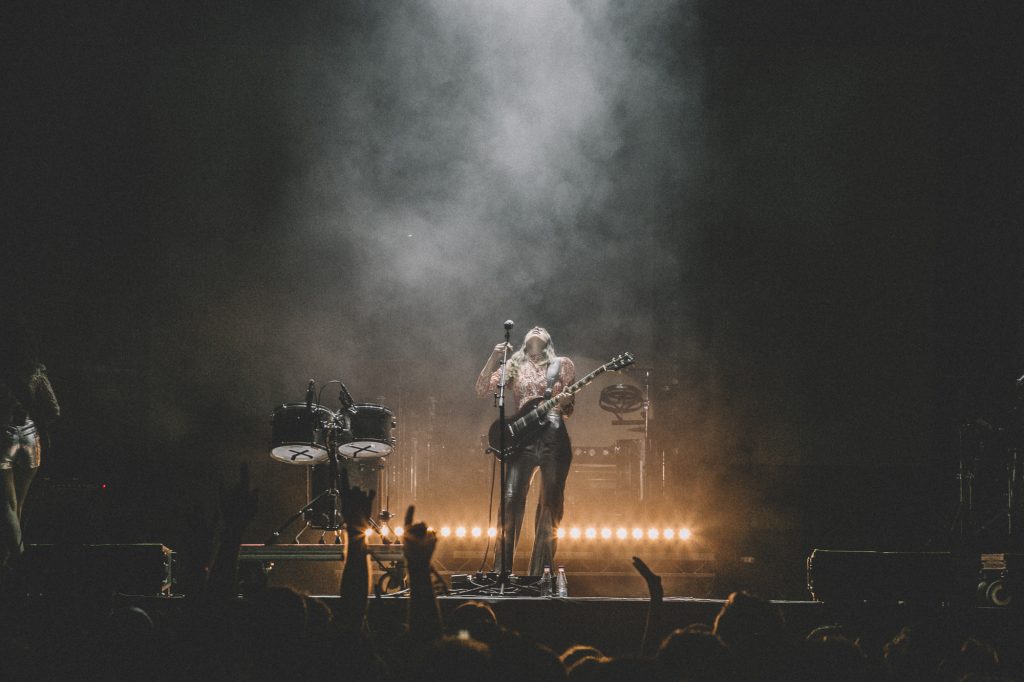
And yet here she is, on stage at USF Verflet in Bergen – a former sardine factory repurposed as the city’s coolest venue – dancing sensually to four of Ten Love Songs’s floor-filling bangers, as the synths climb a stairway to paradise.

Perhaps that’s what happens when you ask a born contrarian to headline a jazz festival.

This is the kind of love that never goes out of style

As I wrote in this recent interview piece: in spring 2018, Sundfør seemed on the cusp of a commercial breakthrough. Then she effectively disappeared. In the intervening years, she has found love, started a family, struggled with anxiety, gone back to high school, and become enormously interested in regenerative farming. Now, finally, she has returned to music. Her first album in six years, blómi was released at the end of April, and she is toying with the idea of a European tour in 2024.

In the meantime, she is playing across her native Norway all summer. The first two shows were in Bergen, headlining the city’s Natt Jazz season just metres from the riverside studio where she recorded her debut album in 2007.

When Sundfør last performed in the UK, she wore a hooded black cloak, and had apparently smeared soot around her eyes, like a Scandi druid, or an urchin Zorro. This time she has newly bleached her hair, and is clad entirely in white, down to the high-heeled PVC boots she kicks off off-stage at the midway point, so as to dance barefoot.

Her mesmerising 2017 show at Union Chapel was a spare affair, featuring just one introverted co-conspirator. For these extravagant, joyous Bergen shows, her on-stage ensemble has swelled to 15, including a pedal steel guitarist, two synth players, five backing singers, and a multi-instrumentalist husband on sax-solo-and-choral-conductor duties.

Open your eyes and begin again

The first night is an invigorating work-in-progress: the thrill of the new, and the old made new, and just the old uncovered and embraced after years in hiding. The second show, which adds a single song – a new opener; Sundfør at the centre of a crescent of 12 vocalists for the handclaps and harmonies of leikara ljóð – is the actualisation of ambition: the art, with most of the wrinkles ironed out.

In common with another legendary vocalist, Sandy Denny, what’s most exciting about Sundfør is the questing restlessness of her invention. Every version of every song she sings is given some new inflection, some new paraphrasing or twisting or variation of melody that changes its feeling and meaning. If neither rendering of ‘Turkish Delight’ here sweeps you up in the same way as the studio version – the blissful simplicity of its third act replaced by something that in its sheer jazziness sounds depressed – the trade-off is in the way that so many other songs are transfigured live. Performing the title track of ‘blómi’, Sundfør chucks in vocal trills, unexpected pauses and head-voice ad-libs that stop you in your tracks. With ‘alyosha’ – the lead single off the album – she knows what she’s got, a vehicle for the sheer scope and power of that God-given instrument, but even then she can’t resist a few experimental flourishes, while gazing across the stage, perhaps just at someone needing a musical cue, or perhaps at the guy who inspired this love song.

She does all three sitting behind her keyboard, along with ‘White Foxes’ (formerly her encore, now a first night statement-of-intent, with deafening percussion intro); a countrified version of ‘I Resign’ from her debut record; the deep cut, ‘Lilith’; and her gospel-inflected encore, ‘fare thee well’, with a glorious extra verse. For the rest, she’s at the main mic, a place she has barely ventured since 2016.

Do you believe in reincarnation?

And that’s where we find the electro-pop diva reborn. First up, she does ‘Kamikaze’, and if you’re wondering whether I’m overhyping the ‘she hasn’t done this for a while’ angle, well: she forgets the second line, consults a band mate, apologises with the words, ‘It’s been a while’, and then launches into the song again. It is one of those tracks that, to paraphrase John Peel talking about the Bluetones’ ‘Slight Return’, “as soon as you hear it, you feel you’ve known it all your life”, but now it comes with a gently wandering opening melody and added blue notes that give the song an emotional punch to go with its sonic one.

Later, she drops in ‘Fade Away’ – by far her most popular song, sporadically drowned out by the spirited singing of first-night die-hards – before returning to ‘Ten Love Songs’ for the final two tracks of the main set, ‘Slowly’ and ‘Delirious’. The latter now has a pleading pedal steel, and rap-adjacent vocals breaking off into clubby exhortations. The former is, simply, one of the best things I’ve ever heard live, especially in its second night iteration. It is notable on record for having at least four separate, irresistible hooks, each more exalting than the last (scroll to 3:08 to be lifted into the clouds). And now it has five. “It’s in the way. You. Hold. Me,” Sundfør sings, in a cascading, staccato arpeggio, as the song reaches its zenith. “Baby. I. Know. You’re. Lonely.”

The other songs she sings at centre stage are a playful ‘Reincarnation’, and ‘rūnā’, in which she seems to be conjuring the music through the contortions of her body, like Judy singing ‘The Man That Got Away’ in A Star Is Born. And between the notes she finds new ones, more beautiful than those on record, before riding the climactic harmonies, swaying, her arms spread wide.

A couple of times during the show, she leaves the stage, firstly for the synth transition between ‘Kamikaze’ and ‘rūnā’, and later to let the rest of the cast perform an a capella version of ‘ashera’s song’, reimagined as an old American spiritual, the original number spliced with fragments of atonal bluegrass, ‘Peace in the Valley’ and ‘Let Your People Go’. While both numbers are interesting, neither are quite what drew us to Bergen tonight.

Take me high to the depths of your soul

On the first night, I made a new friend called Thomas, and when we talked about what had drawn us to Sundfør’s music, we were of one mind: once that voice grabs you, there’s no going back.

These songs are beautifully written, the sprawling arrangements are often inspired, there’s space for limited musical improvisation, and the band are talented and charismatic, with the backing singers allowed to cut free and even encroach on some signature Sundfør lines.

But we are here, and will always be here, for That Voice. That it is now allied to the whole of her canon, even the emotionally tricky, musically mathematic bits, is a cause for dancing, in Bergen and far beyond.

***

SETLIST:

leikara ljóð [second night only]
White Foxes
Turkish Delight
Kamikaze
rūnā (with synth transition intro)
Reincarnation
I Resign
blómi
Fade Away
Lilith
alyosha
ashera's song (new version, choir only)
Slowly
Delirious

Encore:
fare thee well

***

Thanks for reading.

Saturday, 13 July 2019

Bob Dylan at Hyde Park, London

Friday 12 July, 2019


They came, they drank, they talked. And off in the distance, the other side of a 'Golden Circle' sparsely populated with affluent boomers, Bob Dylan delivered what must be the best performance I've seen him give in 10 years*. At a time when seeing Bob had begun to feel more like a duty than a treat, he came roaring back.

Dylan doesn't really do crowdpleasing shows: at least, not for the casual gig-goer ticking another legend off their bucket list. It may be that he simply won't − after all, such popular staples as 'saying hello to the audience' are relatively easy to execute − but I've begun to think that he simply doesn't know how.

Seeing Dylan is purely about the music, those songs are in permanent flux ("It used to go like that and now it goes like this," he barks on Live 1966, before launching into a paranoid, gasping 'I Don't Believe You'), and such personality as you can glean and harvest comes from his treatment of five decades of material, some increasingly peculiar physical posturing − is he a self-satisfied cowboy courting adulation or a man with a bad back? − and the intrusion of his crooked grin, which on bad nights is kept within the crusty exterior, but flashed across Hyde Park for half the damn show.

That approach has its virtues and its vices. His shows are erratic: I've seen great ones, weak ones, and everything in between. And there's something to be said for an artist who can turn up on time, display a certain basic level of gratitude towards their fans, and play what the masses want to hear. But there's also something cheering, and instinctively hilarious, about a performer who is ornery enough to neglect the pallid norms of stadium rock − be it punctuality, platitudes or sing-along set-pieces − and charged with the creative inspiration to make every night different, even if sometimes that appears to be merely because he's in a bad mood.

I'll tell you something, though. For those leaving the fields of South Kensington uttering those tritest of generalities, now worn so threadbare they're practically transparent − "His voice has gone", "You can't tell which song it is till halfway through", "He could at least speak to the crowd" − know this: Friday night was the closest to a straight hits show that I've ever seen Dylan play. Who knows why, I can offer only tinpot psychology: he wanted to best Neil Young, he wants to impress Neil Young, he was just in the right mood… whatever, he kicked off with three cast-iron '60s behemoths, and seemed almost eager to please, committed to every last song, though with that indelible caveat that he's Bob Dylan and if we're going to do this, we're still going to do it his way.

---

Before we get onto the main business, here's a quick word on the support:


A picture of Cat Power owned by a fairly non-litigious photographer.

I was most excited about seeing Cat Power, the scuzzily brilliant vocalist whose unhappy, often half-murmured laments seem almost singularly ill-suited to a big field in which people won't shut up. Time and again, she got the techs to turn up her mic, but despite throwing in a Dylan cover ('He Was a Friend of Mine', a fantastically if self-sabotagingly abstruse choice), it was only during a clutch of grungier numbers that her spellbinding set cut through to an audience waiting − for reasons unknown − for Neil Young. The songs from her current record, Wanderer, had a sensitive, beguiling if sometimes inaudible quality, coupled to a strutting stage style I hadn't anticipated, though the knock-out highlight was the title track from The Greatest, half-shorn of the anomalous shoo-wop style that defined that extraordinary record. It was weird, and oddly moving, to watch such life-stopping brilliance in a vacuum of complete disinterest.

Up next was Laura Marling, who has junked her treading-on-eggshells style for a more Carly Simon-ish approach (or was it just the wind buffeting her hair, like in that 'You're So Vain' video?). I have infinitesimal amounts of patience for British folkies who go all American, but Marling has some nice hooks and a flair for digging out a killingly sad line just when you think she's slipping into broad-brush mundanity.


Kermit the Frog's let himself go.

And then there was Neil Young. Imagine Neil Young being your favourite artist, it's like your favourite food being a packet of ham. There's a bit in Peep Show where Jez tells Mark that he loves Nancy, and Mark says: "You love her? What do you love about her?" That's me trying to understood people who love Neil Young. What do you love about him? His guitar? Still, the first CD we had in my house growing up was Live Rust and I seem to have absorbed most of his other stuff through cultural osmosis. Either way, I didn't expect to enjoy his set half as much as I did. A blistering 'Over and Over' was squeezed between the woozy 'Mansion on the Hill' and the appealingly corny 'Country Home' at the start of the set, and that was the perfect beginning, with what on record becomes an interminable jam session working just right in a live situation. And for an hour Young struck just the right balance, the set reaching its climax with a lovely 'Heart of Gold'.

Then his self-indulgence fuse blew, and every song started going on for four minutes too long, following the same format: song, jam, attempted audience ovation, Young fiddling frantically with the tremolo, drum solo, another jam, more tremolo... The apparent aim was to continue the song until everybody had stopped clapping. As a final insult, he then broke into 'Rockin' in the Free World', which is fun but also highly embarrassing, the Kissification of Neil Young. Is there anything more excruciating than saying 'rockin''? Except, that is, for the song's muscular Reaganism. Twice we thought the track was over, only for Young and co to burst into another chorus, which is a great idea for a comedy sketch, if not for a set of live guitar music.

I'd hoped for 'Like a Hurricane', but by the time it came along, I'd had about enough Neil Young for one year. This was partly due to him and partly due to me, as I'd been stood in one place for over four hours and was anxious to set off for my wee so I'd be back in time for Bob.

---

The screens were blank. And for a moment, it seemed like Dylan's recent but noted aversion to having anybody see his face close-up (at Hop Farm he was shown from a distance; his stage lights have been getting dimmer; in the recent Rolling Thunder Revue doc, he is painted a most curious shade of auburn) was going to result in the funniest audience-baiting of modern times**, but as he wandered on stage in a muted fit of anti-climax, the vast panels crackled into life. Young had shared screen-time with his band, but there was no such egality here: the camera fixed on Dylan's small, stooping frame for the next 105 minutes.


'Ballad of a Thin Man', 1966.

With a justifiably self-satisfied grin, Dylan launched into 'Ballad of a Thin Man', the 1965 track irrevocably associated with his reinvention as a braying individualist with great hair who was enthusiastically kicking apart his legacy as a protest singer, and sneering at anybody who asked him not to. It's an absolute monster of a song, with a fantastically snide and direct central refrain: "Something is happening here, but you don't know what it is/Do you, Mr Jones?", the name typically squawked amid a squall of noise as "Jooooahhhhhrrrrnnnns". It's a perfect choice to kick off this type of show, as at this point several members of the audience who've never seen Dylan before, and are confronted with a jowly, wire-haired, tactiturn little man in a rhinestone jacket jabbering 54-year-old words in a half-swallowed 80-a-day rasp as he happily plinky-plonks on his piano will indeed be wondering what is happening here. Perhaps you have to have Dylan in your blood to react to this with a rush of utter euphoria, but I don't know any other way. Dylan will spend the rest of the evening reshaping his songs in the most exhilarating manner, but with this one, it's enough to just deliver your statement of intent, and give it both fucking barrels.

'It Ain't Me, Babe' is up second, and one of the highlights of the night, its hero now not so much nobly apologetic as cheekily elusive, a quality one more associates with the fantastically unfaithful 20-something Bob. The word "babe" is intoned with such gleefully dismissive malevolence that you really do begin to suspect the protagonist is avoiding this lovesick woman more for his own sake than hers. James Taylor may appear to genuinely like his own audience, and Paul Simon's voice may be in better nick, but no-one but Dylan would excavate a song from 1964 and then warp it out of all recognition: not just its tune or its style, but its actual theme.

He follows that with an explosive 'Highway 61 Revisited', the closest you'll get to him acknowledging that now and then people would like to hear the hits, perhaps with one of them sounding similar to the record. This song's a great gauge, incidentally, for how good a Dylan show is going to be (though unfortunately by the time this litmus test can be performed, you have bought your ticket, train pass and accommodation, and are midway through the show): whenever I've seen Dylan at his best, he has spent it grooving, grinning and very occasionally (Sheffield 2009) genuinely dancing. And it's such a great song: the best organ-driven Biblical comedy record of psychedelic '60s rock. After that 'Simple Twist of Fate', from 1975's Blood on the Tracks, feels slightly bland: it's a wonderful song: small, sad, wry and lyrical, but it feels swallowed up in this space, the reading almost perfunctory.


1974.

I've written about Dylan before and said in 2013 that, while you rarely get unequivocally great Dylan shows any more, you can usually rely on a run of three or four songs where he's really cooking, where he cares enough to make it count. I did wonder, as 'Simple Twist of Fate' meandered meekly out from the vast speakers strapped around Hyde Park, whether perhaps we might have had our three-song run.

So sometimes you worry. And then sometimes you can only laugh, in slack-jawed amazement, at this maddening, occasionally ridiculous genius, who takes absurd risks with his material, even in front of 70,000 people. On record, 'Can't Wait' is a stinging, ominous, Tom Waits-ish lament, a hymn to utter isolation, a paean to pain near the close of Dylan's saddest album, Time Out of Mind, recorded as his health dwindled, en route to a brush with death. On Friday, it's not. On Friday, it's a fantastically funky James Brown number, with Dylan a white-suited ringmaster, holding the mic-stand at a jaunty angle as he defiantly raps the lyrics from out front, turning one of his most heartbreaking lyrics ("It doesn't matter where I go anymore, I just go") into nothing short of a punchline.

'When I Paint My Masterpiece', which follows, is fine, but the song's main virtue is how its rapturous but yearning melody lends harmony and power to some rather trite lyrics, so when you junk that tune in favour of something pleasant but basically unmemorable, you're neutering it. And then we're into a stompy, somewhat impenetrable 'Honest with Me', from 2001's Love and Theft, which I'm sure Dylan would be proud to learn (and I'm only mildly ashamed to confess) I didn't recognise until at least two minutes in, and I know that album back-to-front.


1997.

We get four from Time Out of Mind in total, and the second is the best of the lot. The album is, I think, and after everything, my favourite of all Dylan's records: a wintry, introspective retrospective. It sounds like the last testament of a dying man, and it nearly was. 'Trying to Get to Heaven' is probably the single greatest thing on it: essentially an update of 'Knockin' on Heaven's Door', his earlier defiance and desperation replaced by a wry and weary yearning pockmarked with pain ("You broke a heart that loved you/Now you can seal up the book and not write anymore"). Dylan is never content to trade on 22-year-old emotions, though, and last night the song became more like a whimsical quest, lines of alienation rendered playful, until the hammer-blow of its protagonist's essential pointlessness. "I been to Sugar Town, I shook the sugar down," he sighs, "now I'm trying to get to heaven before they close the door."

At the end of the song, as at the end of many of these songs, he stands up for the final few bars, then begins to wander off, as if he's remembered that the remote is in the other room, and the screens cut to black.

'Make You Feel My Love' is a song that was stolen from us by Adele, and some absolute roasters near us insisted on singing her version over the top of it, but just as Dylan never wrote sadder, starker words than on Time Out of My Mind, he never wrote a more direct love song than this one***. At Hyde Park, it's an effectively conventional reading, and while we'll never get a better reading of the unexpectedly and breathtakingly seductive line that closes the penultimate verse ("You ain’t seen nothing like me yet") than the one on the album, I suppose he can keep trying.

You can certainly never accuse Dylan of not backing himself, and he continues to display a vaguely misguided loyalty to 'Pay In Blood' and 'Early Roman Kings', two of the more didactic tracks from his last album of original songs, Tempest, Both are rather long-winded, both benefit from his full-blooded investment in their mixture of threats and fantasy, and both are barked in the same unflinching but essentially unchanging tone. Unfortunately, both are also heard in direct comparison to 'Like a Rolling Stone', which he stretches out languorously between them.


2012, the time of Tempest.

The first seven or eight times I saw Dylan, he played 'Like a Rolling Stone' fairly straight, usually as an encore with a familiarly cacophonous organ part. He's stopped doing that now. If you want to sing along, you really have to be on your toes. At first, it seemed like Bob was actively trying to prevent this, then you realised it was more like delayed gratification: a piano-led rap; a jazzy, dialled-down and almost painfully slow lead-in to the chorus; then this ferocious burst of rock; and finally the potential for a fists-in-the-air resolution with the beats of a football chant. By the final two choruses, he was almost egging the audience on, through some flamboyant embellishments to the words.

After 'Early Roman Kings' comes the best five minutes of the whole show: a heartstoppingly beautiful version of 'Girl from the North Country', with Bob singing: like, really singing, exposing himself not just through the emotional vulnerability of his performance, but the vulnerability of his voice. It's not what it was in 1963, it's not even what it was in 2005, and for the most part his live vocals are nowadays snapped out or throatily hollered. So a stripped-down country-folk ballad, accompanied only by a piano line and the aching strains of a pedal steel, is a hell of a thing to try. What results is simply one of the most moving experiences I've had at a concert. Incredibly, Dylan wrote the song at 21, but it is an old man's song: reflective, regretful, nostalgic in the most acutely painful way. He sings it here with his heart on display; the vocal wistful, even desolate, negotiating the loss of innocence, love and youth. He sings it like it has only just become true. And like telling someone may make it hurt a little less.

That he can mine such pathos from a simple old song, then continue hammering his most elegiac record, Time Out of Mind into baffling new shapes is the mark of a man for whom reinvention is everything. Isn't that better than a greatest hits show? The fourth and final track from his 1997 record is 'Love Sick', which Dylan famously leased to Victoria's Secret, due to his long and enduring commitment to underpants. It's an enduringly fascinating collision of dystopian imagery coupled to a doth-protest-too-much renunciation of love itself, all because some bird has apparently put him through the wringer. Live, it runs the gamut from unrepentant to vulnerable, needy and ultimately knowing.


Alicia Keys (more of whom below).

For the best part of 10 years, 'Thunder on the Mountain' was one of the two main blues jams in Dylan's set, along with 'Summer Days', which I don't like nearly as much, though it's more interesting live than listening to it in your front room. Both dropped out for a while, but now 'Thunder on the Mountain' is back. The album it opens − Modern Times, the final part of a loose career-revival trilogy − came out during a happy period of my life, and Dylan did it at the two best shows I've seen him play: in Sheffield in 2007 and 2009, so it means a lot to me for those reasons. Having said that, I think he mostly wrote it to try to get Alicia Keys to kiss him, an endeavour that I believe was unfortunately unsuccessful. He has recently changed the wording around her birthplace on the track, though whether this will do the trick, I'm not sure. It's a rumbling, suitably thundering blues adventure that runs appropriately up and down the scales as Dylan mixes the unapologetic doom-mongering of Time Out of Mind with the absurdism and cheery punning of Love and Theft, and while it lacks the emotional sensitivity, freewheelin' poetry or acidic, steel-shelled mythology-shredding that constitutes Dylan's most enduring work, it's a lot of fun.

'Soon After Midnight' is something else entirely: Dylan's stab at a Great American Songbook standard, before he decided to go and record a load of fucking terrible versions of other people's. It has a lovely, yearning feel to it, half-familiar, as if overheard from someone else's wood-fronted '30s radio unit, and it has some of those wonderful pay-offs that mark Dylan's best work post-Time Out of Mind: when he sings, "I'm in no great hurry/I'm not afraid of your fury", you doubt his resilience, then he nails your fucking feet to the floor with the saddest of clinchers: "I've faced stronger walls than yours." And you wonder whether fighting the expectations of the 1960s almost broke him in two, and doubt that anything else would be half as hard. With all due respect (which actually isn't all that much), if you think Neil Young doing 18 songs that sound broadly the same is as interesting as Dylan segueing from heartbroken country to epic blues and then what appears to be a depressive Bing Crosby record, I think it unlikely that we will ultimately get on.

The main set ends with 'Gotta Serve Somebody', one of the handful of great songs to come out of Dylan's dalliance with evangelical Christianity. I've been going to see Dylan as regularly as money and geography can permit since 2002, and this is the first time I've seen him play it. The lead single from his first Christian album, 1979's Slow Train Coming, it's essentially a strident list song about people who are, at some stage, gonna have to serve somebody. I'm going to stick my neck out and suggest that he means God. The studio version (a favourite of Sinéad O'Connor) is funky as hell − a bass-driven track that neatly mixes simple encouragement, finger-wagging and what sounds suspiciously like a series of threats − but since Dylan had already given us our serving of funk in the singularly improbably shape of 'Can't Wait', he does this as a simple rock number, one of the most confounding creative decisions of the night. I say 'one of', as at the end of the song he comes and stands at the front of the stage with his hand in one pocket, and just sort of lightly sways, in what I presume is his weird attempt at some straightforward rock-star posturing.


Would you trust this man with your revolution?

The encore begins in familiar fashion: 'Blowin' in the Wind' as it's generally played nowadays, its polemical power lost somewhere between now and then, presumably because its author doesn't seem to care about its questions, only the cynicism that greets them. He follows that in the only way a committed crowdpleasing people person can: with 1965 album track, 'It Takes a Lot to Laugh, It Takes a Train to Cry', an emblematic 'thin wild mercury sound'-era song, that period when genres seemed to be flowing through Dylan like water, and everything that came out of his pen and gob was effortlessly sublime. There are two moments in Dylan's career that will never be unsurpassed in terms of effortless cool. One is when Al Kooper rang Dylan (ultimately to resign from his touring band) and asked what he was up to. "I'm eating toast and listening to Smokey Robinson," replied Dylan. The other is in this song, when Bob's voice first casually joins the jaunty tune: "Well, I ride on a mail train, baby, can't buy a thrill," he offers, in a purposefully dismissive rejection of regressive folk norms. "Well, I been up all night, leanin' on the windowsill."

In Hyde Park, the song becomes the night's second legit blues jam, not as expansive (or lengthy) as 'Thunder on the Mountain', but with a relentless, lolloping beat that meshes astonishingly well with the song's hip, flip pronouncements: the mythos of Depression-era train-hopping filtered through the wired mind of a man busily shedding his hairshirt. In this bluesy guise, you could imagine it nestling between 'Workingman's Blues #2' and 'Beyond the Horizon' on Modern Times.

And that's your lot. It's the best I've seen Dylan for a decade. If you disagree, then I can only chastise you for your rank ingratitude.

Thanks for reading.

---

Footnotes:

* "I dread to think what the others must be like, then!" is not good banter.
** pun intended
*** I suppose a rival would be the (somewhat risible and madly popular) 'Lay Lady Lay', the hit single from 1969's Nashville Skyline

---


Setlist:

Ballad of a Thin Man
It Ain't Me, Babe
Highway 61 Revisited
Simple Twist of Fate
Can't Wait
When I Paint My Masterpiece
Honest With Me
Tryin' to Get to Heaven
Make You Feel My Love
Pay in Blood
Like a Rolling Stone
Early Roman Kings
Girl From the North Country
Love Sick
Thunder on the Mountain
Soon After Midnight
Gotta Serve Somebody

Encore:
Blowin' in the Wind
It Takes a Lot to Laugh, It Takes a Train to Cry

Sunday, 23 December 2018

Review of 2018: Part 2 – Live

This part focuses on LIVE things: mostly music and theatre. Part one (the best part) was about books, you can read that here. Without additional ado, here goes:


2018 had its challenges, but its artistic compensations too. If my seven-year-old self could have seen me in the staff box as Morrissey played 'Everyday Is Like Sunday', he would have first asked whether I'd already retired as a footballer, then asked me to explain exactly how my job was a job, and then felt curiously proud. It was a pinch-yourself moment, of which I've been lucky to have many. I may not see eye-to-eye with Mozza on Anne-Marie Waters, but we'll always have Viva Hate. Most of it, anyway. Not 'Bengali in Platforms'. I saw Lynne Ramsey talk about Morvern Callar (her reaction to seeing the movie for the first time since release, "What a weird fucking film"), Sally Rooney talk about Conversations with Friends, and Tom Courtenay get heckled by opponents of the 1960 Education Act during a seminar on Woodfall's kitchen sink cycle. The world seems to have moved on from stand-up Bridget Christie, judging by the words of friends and the empty seats, which is a shame, as she is better than ever and better than anyone else. I was invited to Edith Bowman's Soundtracking with Lenny Abrahamson, lured to the 2018 Panzini Lectures – blank space has never been so much fun – and dragged others to Elis James and John Robins' book tour. Is watching a man drunkenly planking while his friend recreates the whole of Freddie Mercury's Live Aid set in mime entertaining? I'm still not sure, but I think it is.

***

Gigs of the year:


This man was not in attendance.

10. A Celebration of John Williams/Star Wars: A New Hope in Concert (Royal Albert Hall) – Don't worry, they won't all be things that took place in my office and for which I was responsible for the PR. Just three of the first four, and then the #2. The Williams show was originally 'An Evening with John Williams' and then became 'An Evening without John Williams' as he was regrettably checked into hospital while preparing for the show in London. This created an awful lot of work for the Hall's handsome Press Manager, but we found enough Blitz Spirit that wasn't already being used for Brexit to rally round and win the day. I say 'we', it was mostly the London Symphony Orchestra and substitute conductor Dirk Brossé. It was a hell of a night: poignant, nostalgic, life-affirming, with one great piece of music after another: a triumphant Superman, a lilting, heartbreaking Schindler's List. No-one sounds quite like this orchestra. They were back the following month to accompany the original Star Wars (well, the '97 version) in full: as the two suns rose over Tatooine, the LSO rose to meet them.


9. HAIM (Alexandra Palace) – Being a HAIM fan is like being in a cool gang where everyone is really nice. Support came from Maggie Rogers, who rocked up on stage wearing a cape and got increasingly less interesting.


8. The Snowman (Royal Albert Hall) – I watch this every Christmas. For me it is Christmas, though it was only this year that I realised its ending is a metaphor for Christmas as a grown-up – or at least can be. I watched it with thousands of children, and the Royal Philharmonic playing the music live, and the moment when it becomes clear (after a little ingenious use of perspective) that The Snowman and Young David Bowie are flying was as exalting as ever. The kids loved the show, though despite the neat jokes (pineapple nose!), the bit they laughed at most was when the boy gets changed out of his pyjamas and you see his bum. (Technically this was the second half of a show, but it was on in the middle of the afternoon and I do have to do some work.)


This is actually from the 2016 performance, don't tell anyone.

7. Guy Barker's Big Band Christmas (Royal Albert Hall) – This is one of my favourite things we do, and now an indispensable part of my Christmas. Paloma Faith turned up in a Big Hat, but as ever the incomparable Vanessa Haynes stole the show. She is our Aretha and I still don't understand how she isn't the biggest star in the world.


Still not quite sure about this publicity shot tbh.

6. Paul Brady and Andy Irvine (Barbican Centre) – It's not every day you get to see one of your all-time favourite records played live, long after you thought any such opportunity must have passed. The first half was deep cuts and obscurities, the second half that immortal debut album, featuring Irvine's 'Bonny Woodhall' and Brady's immortal 'Arthur McBride', up there with the best seven minutes of my year.


Somewhere in there is Bjӧrk.

5. All Points East: Bjӧrk and Father John Misty (Victoria Park) – I returned to the fray of the 'outdoor gig' after six years, irresistibly tempted by the two headliners. Neither were as good as the last time I saw them (Bjӧrk in 2016, Misty last year), but those were some unscalable bars. Her absurd sets, magical soundscapes and conga of flautists, and his stripped-back singer-songwriter shtick made for a lovely night. Highlights: 'Isobel' and 'Holy Shit'. And the queues for the loos weren't too bad at all.


4. David Ford presents Milk and Cookies 2018 (Bush Hall) – With #s 8 and 7, think of this as the third part of an informal trilogy of Christmas musical traditions, in which Eastbourne's finest digs out the charity buckets, lays off the songs about dashed dreams and macro-economics, and cranks up his guitar for a succession of unmissable covers. This year's highlights included a heartbreaking piano-led take on Lionel Richie's 'Hello', a gorgeous 'God Only Knows' and an uproarious 'Go Your Own Way', before he made his peace with 'YMCA' (once his punchline in a muddled interview with Rolling Stone) in thrilling, climactic fashion. There was space for his own material too, including a metal-ish freakout to 'Requiem'.


3. Courtney Barnett (Brixton Academy) was blistering and brilliant: intense and heavy and heart-open, warts-and-all joyous. Go get her new record – her best yet – and I'll see you there next time.


2. Nine Inch Nails (Royal Albert Hall) – Fourteen years ago I came down from Manchester on the £1 Megabus to see my first gig in London: Nine Inch Nails at Brixton Academy. This time I got to promote the show. That's not a humblebrag, it's just a brag. I knew this would be great, but not how confrontational and brutal and majestic the new material would sound against the old. Amidst songs from The Downward Spiral and The Fragile, the absolute stand-out was a relentless, furious 'Copy of A'. Sensational light show too: snapping timers casting rhythmic, perverse and iconic shadows.


1. Susanne Sundfør: Music for People in Trouble AV (Barbican Centre) – She just gets better and better. A suite of 11 songs, staged with a deceptively tricksy, pixie-ish sense of fun (the whole band dressed alike in hooded black capes, behind a mesh of projections, so Sundfør will be apparently sat behind a guitar at stage left, then pop up at the piano on the far side), but with a greater emotional heft than any gig I have been to in years. The album, and the show, begin with the quiet naïve simplicity of 'Mantra' and build, via 'Undercover' (the song of the decade), to the towering, escalating wall of sound that is 'Mountaineers'. An utterly singular experience that for an hour takes you out of the world, and then allows you to live in it a little more happily.

***

Theatre of the year...

... is quite a grand title considering I've only seen a dozen things, but here are my six favourites.


6. Julius Caesar (Bridge Theatre) – My artistic appreciation of this production was hampered by having an overloaded kidney and a back spasm, meaning that Caesar was the only person who came out of this play worse than me... but through wincing eyes and a cloud of codeine I found much to love, especially the heartstopping 'Et tu, Brute?' set-piece, a sequence so profoundly moving that it has led me to stop using the phrase as a joke. The acting was variable and the Trumpian trappings a fairly unconvincing gimmick, but at its best it made Shakespeare new.


5. Witness for the Prosecution (County Hall) – As purely entertaining as anything I saw this year: a cleverly-staged production of the Agatha Christie story (memorably filmed by Billy Wilder in 1957): never profound or touched by genius, but remarkably enjoyable. It seems I can live without genius now and then.


4. Guys and Dolls in Concert (Royal Albert Hall) – I'm glad this was good, as I spent about a month working intensively on press for the show and we convinced lots of people to attend. Its abridged nature slightly undercut the play's emotional impact, but the numbers were astonishingly good. Clive Rowe's reprisal of his Olivier-winning role as Nicely Nicely meant that a show-stopping 'Sit Down, You're Rocking the Boat' was guaranteed, Adrian Lester's 'Luck Be a Lady' was great fun and director Stephen Mear's take on the 'Crapshooters' Ballet' was inspired, but it was Australian cabaret star Meow Meow who absolutely stole the show, shrinking the Hall's notably large stage with her mammoth talent, presence and charisma.


It's-a-me, Iago!

3. Othello (The Globe), in which Mark Rylance (as Iago), manages to play the first half of the play almost exclusively for laughs. Genuinely. Rather than wickedness, Iago's evasiveness commences (at least in appearance) as a kind of shameless, confounded innocence – and his plotting as a clever caper – somehow dragging us to his side. Then he starts to drip cruel and complex villainy, all the time looking like Super Mario. Sheila Atim, as a bullish, knowing Emelia, is excellent in support too. The best five quid I've spent since the Merlin Premier League 1993-4 sticker album.


2. The Sea Wall (The Old Vic) – Andrew Scott stands on an otherwise empty stage for half an hour and breaks our hearts. Theatre at its most primal, modern and moving.


1. The Writer (Almeida Theatre) – Oh to write like this. Ella Hickson's confounding, irresistible, meta-textual exploration of gender and sexuality begins with a two-hander between a misogynistic but superficially reasonable theatre director (Samuel West) and a feminist audience member (Lara Rossi), then snaps back to reveal that these are just characters, and that writer Romola Garai is going somewhere else: perhaps to a quasi-psychedelic lesbian rural idyll (complete with a subsequent, sarcastic post-modern deconstruction), perhaps to the brink of masculinity and beyond, attaining power and control at the expense of her identity. It is so entertaining, so funny, so clever and so packed with ideas that it's exhilarating, but it's also utterly haunting: a profoundly disquieting and disorientating piece of theatre. And it even acknowledges that preaching to a small, committed choir in an Islington theatre is a complete waste of time. Maybe I do need some genius now and again.

***


Exhibitions get just a brief mention this year, as I didn't go to many. My favourite was Ocean Liners: Speed and Style at the V&A, which included genuine bits of the Titanic, alongside a celebration of the Normandie's hilarious levels of excess (perhaps not so hilarious during the Depression), and a crash course in liner design. The Great British Seaside, at the National Maritime Museum, was also a lot of fun, bringing together the work of four very different photographers, each preoccupied with a vanishing culture, whether capturing its inherent quirkiness (Martin Parr), its poetry, offbeat dignity and key to national character (Tony Ray-Jones), or its scale if you put a camera a long way away (I wasn't as into Simon Roberts).

***

Thanks for reading. Part three will be about FILMS.

Wednesday, 8 November 2017

REVIEW: Father John Misty at the Hammersmith Apollo

Tuesday 7 November 2017

I’d listened to Father John Misty a little and dismissed him as “not really for me” (I reasoned that I didn't have room for a whiny, self-obsessed white man in my life aside from myself), but my brother and my friend Katie wanted to go, so I took the plunge. In revising for the gig, my Last FM (helloooo, 2003) tells me that I’ve listened to his songs 151 times in the past week, and by the end I was brainwashed. Sorry, ‘a fan’. And even his proselytising about the evils of religion, which seemed to be operating at the level of a GCSE textbook, began to make sense to me (a Catholic) when I read about his background, and understood the writing to be more about white-hot anger, lived experience, existential desperation and the repugnant hypocrisy of evangelist America than in-depth theological debate.

From interviews – and reputation – though, I was still expecting the morose, meandering, confessional Misty who turned up to a gig the day after Trump’s inauguration, did a rambling 15-minute speech, played a 13-minute song and then went home. Instead, we got a proper pop show: a sensational pop show – 24 songs across two hours, with confetti cannons, a band and a string and brass ensemble, a dazzling light display and Tillman’s full repertoire of struts, poses and guitar moves (and when I say ‘guitar moves’, I don’t mean his guitar-playing, I mean him taking his guitar off and flinging it halfway across the stage to a roadie, mid-song), but with enough room for the sincerity, the lamentations, the howls of protest and shards of bitter wit that make him one of the most distinctive voices in contemporary music.

There's almost no between-songs chat (a few 'thank you's and 'good to see yer's), it's just the music: the bearded Tillman, his hair slicked back, in a flowery shirt and black suit, his drainpipe trousers accentuating his slender legs, and the heeled boots just right for cutting a dashing silhouette as he's frequently backlit in a mist of pink or codeine white.

We kick off with 'Pure Comedy', climaxing with that explosive realisation that religion is "the kind of thing a madman would conceive!”, complete with panto-esque ‘loony’ gesture, 'Total Entertainment Forever' – an irresistible, rockabilly paean to just how fucked we are – and 'Things It Would Have Been Helpful to Know Before the Revolution', most people’s favourite on the album. I’m still wrestling with the song’s philosophy (is he foggily denouncing leftism or acerbically critiquing the comfort of capitalist conformity?), but it’s a definite Tune, and when the confetti cannon explodes on “Industry and commerce: toppled to their knees”, creating a red, mirrored supernova, everybody loses their shit. After a somewhat muted 'Ballad of the Dying Man' (and so the first four songs from the current record), we dip into the old stuff, including a plaintive, insistent, seductively reimagined 'Nancy From Now On', a lovestruck, crowdpleasing 'Chateau Lobby #4' (“You left a note in your perfect script/’Stay as long as you want’/And I haven’t left your bed since”) with Tillman striding around the stage like a Butlins redcoat, and a conversational 'When the God of Love Returns There’ll Be Hell to Pay', as he has a few choice words with his maker. The pay off, “Oh, my Lord/We just want light in the dark/Some warmth in the cold/And to make something out of nothing sounds like someone else I know” sounds like vintage Vonnegut in the land of Steinbeck, and I don’t have higher praise than that.


I didn't spend much of the gig taking pictures. Will this do?

There are Misty songs I don’t like much, and if a couple of them are banal live – ‘A Bigger Paper Bag’ and the interminable ‘So I’m Growing Old on Magic Mountain’ – others are given an individuality missing on record, and extraordinary life. ‘Only Son of the Ladiesman’ is chokingly broken amidst the country-rock sound, ‘This Is Sally Hatchet’ becomes a great lost Beatles song, ‘When You’re Smiling and Astride Me’ so fragilely self-mocking, and ‘Strange Encounter’ sensitive and vulnerable as it moves from Misty’s familiar boasting that he has sex with a lot of women to something like tentatively self-justifying self-realisation ("Yeah, I'm a decent person/Little aimless"), the perfect counterpoint to the disposable fun of, say, ‘I’m Writing a Novel’. 'Nothing Good Ever Happens at the Goddamn Thirsty Crow', by contrast, is an absolute bastard live: a sleazy love poem that turns increasingly belligerent and violent, with Tillman spitting its bitter denouement, "Why the long face, jerkoff? Your chance has been taken," into the crowd.

And then there are the songs I can never get enough of, like ‘The Night Josh Tillman Came to Our Apt’ – basically his ‘Idiot Wind’, a character assassination of a woman he’s just slept with, which would be completely indefensible if it wasn’t so beautifully, rhythmically sung, and so incredibly funny:
She says, like literally
Music is the air she breathes
And the malaprops make me want to fucking scream
I wonder if she even knows what that word means
Well, it's literally not that
And ‘Bored in the USA’, a chronicle of depression, a portrait of a wasteland of a homeland: America’s culture reimagined alternately as The Road, or as a tacky, narcotised, identikit, subprime, debt-ridden monument to nothing, guarded over by white president Jesus – the whole song springing from a profound pun for the ages. Tonight, though, the “white Jesus” that he pleads to becomes “honky-tonk Jesus’”, and the President Jesus just “President Anyone”. ‘The Memo’, one of the best songs on his current record, Pure Comedy, is mostly more pointed than despairing, and its targets are more specific and less existential, though its conclusion is similarly bleak, depicting a world in which people “won't just sell themselves into slavery/They'll get on their knees and pay you to believe”. Live, it comes with its wild card intact: a voice generator increasingly barking out mundanities and platitutdes: “This is totally the song of my summer,” “This guy just gets me” and “Music is my life”, as Tillman himself asks: “Just quickly, how would you rate yourself in terms of sex appeal and cultural significance?” “Do you usually listen to music like this?” and finally “Can we recommend some similar artists?” All three songs are just wonderful live – faithful but raw and immediate – though screening the video for ‘The Night…’ was kind of pointlessly distracting.

The main set ends with ‘Hollywood Forever Cemetery Sings’ and then a climactic ‘I Love You, Honeybear’, a rousing, glorious version that catapults it high into my favourite Misty songs, with Tillman making his second foray into the crowd, playing both the woodland indie messiah and the pop god, as the confetti flies and the singer performs the laying on of hands, as he pleads: “Don’t give into despair/Cause I love you, honeybear.”

What I loved – and what most surprised me – about the show was how much thought, effort and enthusiasm had clearly gone into it: into the choreographed stage moves (though never so choreographed that there's no room for him to extemporise as he's swept away by emotion), the lighting that creates an icon out of his silhouette, the reshapings of older songs. Tillman’s distaste for the entertainment industry doesn’t translate into a contempt for his fans, as it does with so many artists. As a mentally ill bloke myself, I can understand that sometimes his interviews are car-crashes, and that he has good gigs and bad gigs. I know too, of course, that it need not necessarily constitute an enormous challenge for a man to behave nicely towards a roomful of people who adore him and his art. But I’d thought of him as probably being a bit of a dick, and that didn’t come across at all. He even did an extended encore: ‘Real Love Baby’ – which is pleasant, but could have been written by anybody – and the tedious ‘Magic Mountain’ followed by something extraordinary: his shopping list of contemporary ills (some real, some imagined), ‘Holy Shit' incorporating a mid-song freak-out and seguing straight into an explosive, furious grunge version of the waspish, self-annihilating character study, ‘The Ideal Husband’, which ends with him lying on his back on the stage, writhing around on the floor as he screams: “Wouldn’t I make the ideal husband?” Yes, Josh, you probably would.

One of the gigs of the year. I’m a fan now. A convert. I left the Apollo moved and exhilarated. Speechless. I’m glad I took up that ticket offer.

SETLIST:

Pure Comedy
Total Entertainment Forever
Things It Would Have Been Helpful to Know Before the Revolution
Ballad of the Dying Man
Nancy From Now On
Chateau Lobby #4 (in C for Two Virgins)
Strange Encounter
Nothing Good Ever Happens at the Goddamn Thirsty Crow
Only Son of the Ladiesman
When the God of Love Returns There'll Be Hell to Pay
A Bigger Paper Bag
When You're Smiling and Astride Me
True Affection
This is Sally Hatchet
The Night Josh Tillman Came to Our Apt.
Bored in the USA
The Memo
I'm Writing a Novel
Hollywood Forever Cemetery Sings
I Love You, Honeybear

Encore:
Real Love Baby
So I'm Growing Old on Magic Mountain
Holy Shit
The Ideal Husband

(Source, as ever, setlist.fm)

***

I'm only really reviewing movies now (and only here), but last night had such an impact on me that I thought I'd write a little about it. Thanks for reading.

Wednesday, 7 June 2017

David Ford + Michele Stodart & JP Ruggieri at Islington Assembly Hall

Friday 2 June, 2017


(L-R) JP Ruggieri, David Ford and Michele Stodart.

It took seeing David Ford live to turn me into a fan. That was in 2015 when he played a one-man-band show at Soho’s underground Borderline club, looping his multi-instrumentalism in a sweaty, intense show that revealed the unusual potency of both his performance style and his protest-songwriting. Watching him is like witnessing Tom Waits’ soul trapped in the body of Dermot O’Leary. I haven’t seen Ford since, though I’ve listened to him a lot. His new thing is a three-hour, 30-song ‘roadshow’ tour featuring two support acts, a drummer and himself, accompanying one another throughout all three sets. I found JP Ruggieri’s the least compelling: he’s a fine guitarist whose technical prowess perfectly complemented the later two performances, but his own songs are a little pedestrian, and he’s a pleasant rather than dynamic vocalist. Dynamic, though, is the perfect word to describe Magic Numbers alumnus Michele Stodart, whose magnetic presence, arresting mid-Atlantic twang and slew of singular mannerisms – from singing out of the side of her mouth to marching on the spot like a turbo-charged Jona Lewie – lit up the place. There were real echoes of Janis Joplin in her performance, and comparing someone to perhaps the most mesmeric live performer of all time is not something I do lightly.

At around 9:30, Ford takes centre-stage to play “a lot of new songs and a few old ones”, kicking off with a thrilling take on the sub-Waitsian ‘Let It Burn’ and torturing his fretboard for the benefit of the photographers in the pit. The new songs, from ‘Animal Spirits’ – a forthcoming ‘concept album about macro-economics’ – are a mixed bag, with the sleazy, somewhat platitudinal funk-rock outweighing the thoughtful ballads, and the oldies aren’t all his best, but ‘Pour a Little Poison’ (containing perhaps his signature line, “I’m just a whiny little English boy singing the blues”) is raucous, ‘I Don’t Care What You Call Me’ desperately sad, and ‘Waiting for the Storm’ blessed with an eerie foreshadowing and a weary poignancy. The audience misunderstands his desire to ‘not do an encore’ (meaning that he’ll do the songs without pretending to go home), leading to a delightfully silly bit where we have to stay as quiet as possible while he’s off stage in order to coax another song. He does an exuberant 'My Sharona'* with a full band ("Playing this has been a dream of mine for years"), then comes out – unplanned – for another by himself, as a result of the cacophony, breaking his pledge not to play a song with swearing in it as he blasts out ‘Every Time’, his unexpected, unapologetic, counter-intuitive anthem, which seems conventional in its sound and language, but almost revolutionary in its theme and ideas: that fame isn’t for him, and he doesn’t want your pity, that in order to get it he’d ruin the present and break up his happy life. It gets faster and faster, Ford spitting out the vituperative, sincere, self-justifying words as he cranks up the atmosphere and the angst.


It’s what’s been missing during his enjoyable but faintly pallid set: the singer-songwriter having traded the taciturn mystery of 2015 for a languid, appealing but less explosive approach, which befits the roomy, high-ceilinged venue with its proscenium arch, but perhaps isn’t what David Ford is for. It does, though, mean that we get some of his insights on current affairs: I thought I was bored of people just calling Donald Trump names now, but he really is “a fucking toilet with hair”, so thank you to David for that. I imagine that this show will get better and it better as it progresses, since the band had had just a day and a half to rehearse, but this second date was good enough: occasionally slightly scrappy and rushed, but also affable, great fun and with some truly special moments, thanks to Ford and particularly Stodart. (3.5)

*'My Sharona' by The Knack was a post-punk single by The Knack that got a second wind from its inclusion in the glossy, Hollywoodised but near-iconic Gen X film, Reality Bites. Tarantino had been about to include it in Pulp Fiction, but frustratedly dropped the idea as it no longer seemed fresh.

***

Thanks for reading.

Wednesday, 31 May 2017

REVIEW: Seu Jorge at Royal Albert Hall

Tuesday 30 May, 2017

‘Intimate, conversational, just about perfect’ – Seu Jorge headlines the Royal Albert Hall with sensational Bowie tribute show


Brazilian guitarist Seu Jorge brought his Life Aquatic show to Europe for the first time last night, paying tribute to David Bowie, his father, and the victims of the Manchester attack during a moving and memorable evening.

2003. Seu Jorge was in his flat in Rio when the phone rang. “I was playing PlayStation, so I ignored it. It carried on ringing. My ex-wife said: ‘Aren’t you going to answer it, you lazy…’ – in the end she picked it up herself. She passed it to me: ‘Someone in America is making a movie and they want to know if you would play Pelé.’ I said: ‘I can’t play soccer.’ I’m Brazilian, but I was never any good, except on PlayStation.”

That ‘someone’ was Wes Anderson, and the ‘Pelé’ he wanted Seu to play was not the three-times World Cup-winner, but a maritime safety expert and guitarist in the indie filmmaker’s upcoming movie, The Life Aquatic with Steve Zissou. The catch: the character’s main role is as an on-screen troubadour, crooning David Bowie covers. “At the time I only knew two Bowie songs – I was a black kid from a favela, we didn’t hear rock and roll – but I fell in love with him.” The film became a cult favourite and Seu released an album of his solo, acoustic, Portuguese-language Bowie covers the following year – but he had never played them live in Europe until this month.


The compère introduces the show as “a concert from two artists: one in person and one in spirit” and then Seu strides on, dressed in the Team Zissou outfit of red beanie heat and ice-blue short-sleeved shirt and trousers, looking like he’s just got off the boat. The atmosphere is intimate and conversational: it’s just him and his guitar on a little square platform ringed with fairy lights that masquerade as candles, two small piles of seafaring paraphernalia either side, the songs alternating with stories about his life, his Life Aquatic and his relationship with Bowie’s music.

The highlights are legion, and there’s vast variety in Seu’s approach, which takes counter-intuition to a new level, his deep, soulful voice the only constant. ‘Changes’ is sadder than Bowie’s original, though with the same cathartic sense of release. The slutty glam-rock of ‘Suffragette City’ is subsumed by tenderness in a gentle, finger-picked version. ‘Five Years’ is transformed from a claustrophobic, piano-led indictment of groupthink into an insistent, anthemic lament, while ‘Space Oddity’ - which gets the biggest cheer of the night – would be a sing-along if we could only speak Portuguese.


Space Oddity

Other songs are introduced with reminiscences. The bossa nova take on ‘Rebel Rebel’ was improvised on the spot on the first day of filming (“There were two or three songs I hadn’t learned properly. Wes Anderson said to me: ‘We’d love to do one of your songs today, how about ‘Rebel Rebel’? And I was like ‘Haha, yes, of course… Holy s***!’ I looked up to the sky: ‘Please God, give me inspiration’, and what I came up with was this…”), ‘Lady Stardust’ – which emerges as a hymn to women – was inspired by watching Cate Blanchett working relentlessly on-board the set, four months pregnant. He dedicates a show-stopping ‘Life on Mars?’ to “you, the people of Manchester, Bowie and my father” – his dad, “who made me what I am”, having passed away just three days after the Thin White Duke.

It’s a beautiful evening. Uplifting, unique, but deeply moving too: speaking very personally to the sell-out crowd, many of them sporting those iconic red beanies. “I am glad to see so many members of Zissou Team here,” says Seu. (A Team Zissou member calling Team Zissou 'Zissou Team” is the most Team Zissou thing ever). As he leaves the stage, holding up his guitar like the spoils of battle – or as if it has done all the work – the audience rises to its feet. And then a hidden screen comes down and, when he returns for an encore, his backdrop is The Life Aquatic and you realise that though it’s only 13 years, it’s already 13 years, and that the passing of time set to music is a rhapsodically poignant thing (think of Johnny Cash’s ‘Hurt’ or Terence Davies).

Seu takes the word ‘encore’ delightfully literally, performing ‘Rebel Rebel’ and ‘Oh! You Pretty Things’ for a second time, then closes with a lengthy, mesmerising ‘Queen Bitch’ that prompts another standing ovation. He yells a final: “Thank you, London!” into the mic.

It’s been joyous and enrapturing, but with an undertow of poignancy that constantly tugs at Seu and at us. It’s been just about perfect. Thank goodness his wife picked up that phone. (4)


Setlist:

Ziggy Stardust
Changes
Oh! You Pretty Things
Rebel Rebel
Starman
Lady Stardust
Rock 'n' Roll Suicide
Suffragette City
Quicksand
Space Oddity
Five Years
Life on Mars?
When I Live My Dream

Encore:
Rebel Rebel
Oh! You Pretty Things
Queen Bitch

***

I wrote that for the Royal Albert Hall blog (it's accompanied by some shots from acclaimed rock-and-pop photographer, Christie Goodwin). I've added a few personal thoughts here, as I didn't want to bore the hell out of our visitors (but you are my people):

The 50th anniversary release of Sergeant Pepper is just landing on doorsteps as I write this, a cover sticker informing purchasers that this is “Sergeant Pepper as you’ve never heard it before”, as it is has been “remixed from the original tapes”. Excuse me while I take a seat. Remixed, you say? From the original tapes?! Now call me Philistine McGrumpy, but I fear we’re in danger of making “as you’ve never heard it before” lose its currency. But when you apply it to Seu’s Bowie covers, it’s utterly true, and in the finest possible sense of the phrase. The old adage with cover versions was always “either do it different or do it better”. By doing the first so committedly, he makes the second almost impossible to judge, but it’s these versions I’m more likely to pop on in the flat.

For me, Seu’s music is one of The Life Aquatic’s most apposite idiosyncracies, and one of its great virtues. What sounds hipsterish and gimmicky on paper becomes utterly genuine – and devastatingly, quietly effective – in the hands of Jorge and his director. The offbeat beauty and deceptive humanity present in this music, and the way it’s employed as an on-screen soundtrack, is the key to Wes Anderson’s films, which are often celebrated – or derided – for their micro-managed compositions and impeccable, much-parodied stylistisation. Critics rage at how mannered and self-satisfied his films feel, missing the point that many of us keep returning not for the outfits and tracking shots, but for the movies’ quiet, straightforward sincerity and unique sense of humour.


My relationship with the film is intensely personal, all tied up with my life and the relationship I was just starting when I saw it. The imperfect film you see, with those mundane, prosaic failings, isn’t the same as my Life Aquatic, which is a bigger, greater, more sprawling thing: a series of elements that transcend celluloid and have flooded into my own life, into my vernacular, my image-bank (the second death scene, the stop-motion sea dragon) and even my character. If I’d thought, as a 20-year-old discovering this film, that one day I’d be running the press office at the Royal Albert Hall, as Seu Jorge – in full costume – played these beautiful songs to 5,000 people, it would have blown my tiny undergraduate mind.

The handling of the film footage is a little mystifying – with irrelevant, ‘trippy’ effects, bad drawings of crabs and a decision to screen part of the credits through a mock porthole, so you can only read half of the words – but the weight of the footage, the 46-year-old Seu sitting in front of the 33-year-old one, snapshotted as a person who never existed, but feels a part of my life, is unconquerable.

***

Thanks for reading.

Thursday, 25 May 2017

REVIEW: Angel Olsen at the Roundhouse

Wednesday 24 May, 2017


I thought the communality and specificity of a gig, coupled with a visit from teary-voiced alt-troubadour Angel Olsen was what we needed to heal the pain, but it all felt amiss. She got the tone wrong from the start. There was no reference to the victims in Manchester, no acknowledgement of how people were feeling, no ‘thank you for still coming out’ – though a lot of ticket-holders hadn’t turned up due to unease or fear or a feeling that a gig wasn’t where they wanted to be. In fact, Angel’s only veiled nod to the tragic events of Monday was that the world’s scariness “makes me realise what I have”, which is a commendable attitude but seemed myopic and self-centred, just as her banter with her guitarist came off as irritatingly trivial and irrelevant.


I appreciate that it can be hard to gauge the atmosphere in a foreign country, that my self-righteousness can be unbearable, and that one might not know quite how to navigate the aftermath of a tragedy, but for me the omission started to sour the experience, coupled with some more prosaic failings. For an hour this much-anticipated gig was largely a slog: the sound was muddy and Angel looked bored, not to mention confused by the dazed audience, who didn’t appear to want to be here (as I said, I was having second thoughts myself). There was no gentle balladeering to soothe the soul, or an opening blast of sound to wash the pain away: instead she started with a plodding, 10-minute version of ‘Heart-Shaped Face’, which is the worst idea an Angel’s had since getting kicked out of Heaven.


Angel has a fair stab at her most popular track, ‘Shut Up, Kiss Me’, murmuring “Well that’s out of the way” as soon as it’s over (partly in jest), lashes out the stabbing, relentless climax of ‘Not Gonna Kill You’ with real anguish and intent, and ends with a scintillating, sexy version of ‘Total Control’ by The Motels, sitting on the drum platform with legs apart as she delivers the vocal in this fabulously offhand, conversational but compelling way, then breaks out into a joyous keyboard duet with her backing vocalist. But the rest of it’s mostly monotonous, and Angel largely inert: standing out front with a guitar, occasionally sinking to her knees behind the keyboard stand when lead guitarist Paulie takes over (he’s an exceptional musician, and the star of the light blue-suited, string-tied backing band, who are ultimately more like an ensemble). The audience emit embarrassed lone whoops fading to nothing and, perhaps as a result, the set is flat, a disappointment… and such small portions too, wrapping up in just 55 minutes.


But then she’s back, for a five-song encore that just about drags it out of the bag. Angel’s alone on stage for a long, heartbreaking ’Lonely Universe’, before the band join her – backing vocalist first, the others quickly materialising – midway through ‘Unfucktheworld’, her signature song sounding stark and acidic and arresting. ‘Fly’ is mediocre, but next she breaks out ‘Tiniest Seed’ – my absolute favourite, from her 2012 debut – refashioned from a plaintive folk lament into a hard-edged, Nashville-tinged thing with echoes of Emmylou Harris (or Lucinda Williams with less throatily objectionable vocals). I enjoy that more than many, but everyone loves the closer: a sultry, exuberant ‘The Waiting’, Olsen walking around, mic-in-hand, bellowing: “I want to be the one who knows the best way.” It doesn’t seem like she does, quite, but on another day in another city I suppose this might all have worked. At least she got halfway there in the end. (2.5)

***

Absolutely terrible photographs by me. Thanks for reading.