Wednesday, 3 May 2017

James Baldwin, Absolute Beginners, and Kerouac falling apart – Reviews #'264

Since you've been very good, I've written some reviews for you, taking a look at I Am Not Your Negro, Julien Temple's bizarre, fascinating 1986 musical, a Fassbinder film (he's the subject of a BFI season at the moment, so there are more on the way), and Jack Kerouac's phenomenal follow-up to On the Road, 1962's Big Sur.


CINEMA: I Am Not Your Negro (Raoul Peck, 2016) – A profoundly powerful polemic that forces you to view the African-American experience through the piercing gaze of writer, thinker and activist James Baldwin, who speaks with authority, insightfulness and a broiling anger about the way his people have been exploited, abandoned and killed by their own country.

The script is taken entirely from his unfinished book, Remember This House, which was to explore the history of black America through the murders of community leaders Medgar Evers, Malcolm X and Martin Luther King. Those passages, perfectly performed by Samuel L. Jackson, are mixed with footage of Baldwin in interview or debate (I love his voice), and a wealth of material showing everything from reviled character actors Stepin Fetchit and Willie Best – who epitomised the slurring, slow-witted black American in ‘30s comedies – to public information films, contemporary news reports of police shootings, and clips of Doris Day and Gary Cooper, the paragons of toxic white innocence whom Baldwin draws into his crosshairs.

At times that footage matches, showing the prescience – or more often the enduring relevance – of Baldwin’s words, but director Raoul Peck seems more interested in creating a collage of cumulative effect. In some ways, I do find it difficult that the film goes after RFK – who’s derided for his commitment to pragmatic realpolitik – and John Ford, one of the most thoughtful mainstream directors when it came to race, but that’s kind of Baldwin’s point: black people shouldn’t have to be grateful to the benevolent white man who nobly recognises their worth, they have as much right to their country as the white people who nicked it from the Native Americans.

As filmmaking, it may have rough edges or clumsy segues, but it’s wrenchingly powerful: an extraordinarily rich, humane and unsettling work, dominated by Baldwin’s unique moral and intellectual voice, which it brings to the masses. His polemicising is startlingly clear-sighted and incisive in a way that yanked the scales from my own eyes, and while it’s also wide-ranging and complex – bringing in such relevant but apparently disconnected concerns as the gulf between Americans’ private and public personas – perhaps its purest essence is contained in the speech that closes the film.

There, Baldwin rightly argues that since the grotesque caricature of black men (or of Jews in Nazi Germany or Muslims in Britain and the US today) bears such little relation to reality, it must have another purpose. “What white people have to do,” he says, “is try and find out in their own hearts why it was necessary to have a n***** in the first place, because I'm not a n*****, I'm a man, but if you think I'm a n*****, it means you need it.” (3.5)

***


Absolute Beginners (Julien Temple, 1986) – Julien Temple's notorious musical is one of the oddest and most perversely interesting British films of its era: a sort of West Side Story for '50s Soho, shot in the fantastical neon style of One From the Heart (or the 'Girl Hunt' ballet in The Band Wagon) and featuring arguably the most peculiar cast of all time. Ever wanted to see David Bowie and Patsy Kensit share the screen? Dying to find a movie where Lionel Blair, Profumo affair luminary Mandy Rice-Davies, and Sade all feature? Searched all your life for a film graced by the talents of Irene Handl, Sylvia Syms, Ray Davies, Edward Tudor Pole, Alan 'Fluff' Freeman, James Fox, and Steven Berkoff as an Oswald Mosley-like fascist hate preacher? Well step right up and enjoy the weirdness.

Kensit is Crepe Suzette, an annoyingly-voiced model and fashion designer whose romance with clean-cut dirty-picture-photographer Colin (Eddie O'Connell) is sacrificed on the altar of career advancement, as London gets ready to erupt into race riots in the boiling summer of 1958. No-one can act and the script is infuriating pretentious rubbish stuffed with shallow sub-and-pseudo beatnik proclamations, but the music's mostly excellent, the energy of the film is thrilling, and it's startlingly directed from start to finish, kicking off with a roaming five-minute tracking shot introducing us to a vividly-realised '50s Soho.

Self-contained scenes like Bowie's 'That's Motivation' and Ray Davies's 'The Quiet Life' aren't just like music videos, they are music videos, a stipulation made by the Americans financiers (who stepped in part-way through and insisted on adding famous names to the cast list). That might have corrupted Temple's original vision, but those set-pieces are a lot better than much of the narrative that surrounds them: while the film's themes of gentrification, racism, and art vs commerce (centring on the idea of 'selling out', an idea that obsessed my adolescent, music-loving mind) are more timely now than at any time since the film was made, the screenplay is enormously irritating, and the leads are risible, especially the squeaky, blank-faced Kensit. For her big number on the catwalk, Temple uses most of the Busby-Berkeley-meets-Baz-Luhrmann tricks in the book to keep it moving, and make it dynamic and convincing, but he can't quite mask her absolutely bloody awful dancing.

The screening at Regent Street Cinema included a Q&A with jazz club owner Chris Sullivan. He appears briefly in the film and supplied most of the extras, who largely wore their own clothes, the late-'50s look being fortuitously in vogue in the London of 1986. He remains keen for Temple to create a director's cut reinstating all the footage that was shot but then junked after the film was taken out of the director's hands following his original editor's death. It's only then, I suppose, that we can see whether Temple's vision was intended to be as divergent from the source novel, and if it would have made a more convincing film overall, with stronger characterisation and a greater consistency of tone than this compromised final cut.

Sullivan also shared some stories about production: the entire cast being off their face on beer, speed or coke, the climactic pitched battles exploding into genuine violence (since none of the non-professional actors were used to faking fight scenes), and a woman having 12 stitches in her bum because − while almost everyone was shagging behind the sets − she was the only one who decided to do it on top of an antique pinball machine with a flimsy glass top.

He didn't have too much to say about the film itself, which is − to pervert the Manics lyrics − "all surface and no feeling", a sumptuous stylistic delight with nothing to it, Temple's 'Carry on Punking' approach to everything rendering its characters and attempts at sincerity visceral, shallow and grotesque. It is a wonder of sound and vision, though, capped by Bowie's theme tune and 'That's Motivation', Sade's 'Killer Blow', the jazz club numbers and Davies's 'The Quiet Life', complete with a Finders Keepers-style cutaway house and unbearable cartoonish shenanigans, while unexpected explosions of movement and music pepper the half-finished, artistically bankrupt script. (2.5)

***


Mood Indigo (Michel Gondry, 2013) – When I heard that Michel Gondry was making a phantasmagorical romance starring perhaps my favourite three French stars of recent decades, I was excited, but bad reviews and an inability to find the full-length cut that played to home audiences sapped my appetite, so it took a while.

The film – adapted from a book by singular, surrealistic author Boris Vian – tells the story of rich layabout Colin (Romain Duris), who spends his time in a spectacular, stop-motion apartment, being cooked for by his perma-grinning lawyer, Nicolas (Omar Sy). When Nicolas and his other best friend begin romantic relationships, he realises just what is missing from his life, and begins to court Chloe (Audrey Tautou), a playful, post-modernly joshing young woman he seeks out at a party. On their wedding night, a water-lily begins to grow in her lung, puncturing their perfect existence and sending Colin out into a merciless, absurd and unforgiving world, as his cloistered home descends into rot and ruin.

It begins (at least in this 95-minute version) like a music video stretched well beyond breaking point, coming off as twee and shallow – if fitfully amusing – when its quirks should be shorn of some of their self-consciousness, and rooted in a world both transcendent and idealised. But then, as it slips into prolonged, joyless, existential anguish, its style becomes substance, which is a good job as there's precious little else to cling on to here.

It is Gondryan excess in the service of Vian, with mere silvers of story, and its stars left out in the cold, or deluged by an avalanche of whimsy. Here, Duris has neither the fascinating looks nor the commanding intensity that power his most compelling vehicles, Tautou is thoroughly underused – while the mountain diversion never gives you the epic money-shot of flowers wilting all around her – and Sy comes across as a mere comic adornment, with the script and effects doing all his heavy lifting.

It does draw you in, and by the second half you’re immersed and engaged in its characters’ plight, so arrestingly articulated by the restlessly innovative visuals, leading to a final scene that makes use of one of its calling cards – a mouse realised through in-camera effects and played by a man in a mouse suit – before breaking into a simple and simply beautiful animation.

It lacks the novelty of Eternal Sunshine, which first brought Gondry’s delirious DIY aesthetic to audiences, or the sublime comedy and off-balance emotional centre of The Science of Sleep – easily my favourite of his films – but it’s just about worth seeing if you’re receptive to his preoccupations, and the way he serves them through ostentatious stylistics. (2.5)

See also: Here's one film each that spotlights Gondry (The Science of Sleep), Sy (Chocolat), Tautou (Amélie) and Duris (The Beat That My Heart Skipped), and which I'd really recommend.

***


*SOME SPOILERS*
CINEMA: Fox and His Friends (Rainer Werner Fassbinder, 1975)
– This resonant Fassbinder allegory tells the story of a virile, happy-go-lucky prole (the director) who wins the lottery, then loses his dignity, identity and all his money after falling for a calculating middle-class snob (Peter Chatel).

Its presentation of gay society can feel a little forced and it has moments of woodenness, but the film's combination of fatalistic poise and rough-and-ready spontaneity is pure Fassbinder, while his script blends excoriating satire with human drama and mordant humour.

Fox and His Friends also expands the director's familiar world to incorporate society drawing rooms, Marrakech and the kind of factory office you'd see in a Dardennes film, but doesn't skimp on the trappings you rightly expect from a Fassbinder film: moustaches, dingy bars, brown clothes, trashy '20s cabaret glamour, and squalid flats that stink of fags, booze and stifling urban desperation.

It's also interesting to Karlheinz Böhm, the star of Michael Powell's immortally creepy horror, Peeping Tom, in his more natural habitat. He's initially inscrutable – but unexpectedly suave and well-balanced in an Anthony Andrews vein – as an upper middle class antiques dealer who picks up Fassbender in a public toilet.

From the absurd, witty carnival intro to the pitiful dance of tragic greed that closes the picture, it's a hard-bitten but humane movie which suggests that the world is a terrible, cynical, rapacious place, but there are good people in it. What happens to those people, though, doesn't bear thinking about it, especially if they're from the proletariat and get ideas above their station. (3)

***


"No, I'm not gay!"
"Okay, alright, calm down. Look, this gay panic situation you're having right now, it's coming off a little homophobic."
"What, I'm homophobic because I don't want a penis in my mouth?"
"Exactly. That's exactly what homophobic means."

We're the Millers (Rawson Marshall Thurber, 2013) – An above-par comedy, with scuzzy weed dealer Jason Sudeikis moving into smuggling after losing loads of drugs, and recruiting a fake family (stripper neighbour Jennifer Aniston, homeless punk Emma Roberts, all-time dork Will Poulter) to help put the authorities off the scent. It's sensitive more often than sentimental, undercuts some occasional misogyny with clever pay-offs and Aniston's strong female character, and − while at times it's guilty of obviousness or signposting jokes or virulent misanthropy − when it's funny it is very funny. For that, you can forgive its lurches in tone, the clumsy recuts and post-synced dialogue synonymous with a film they thought was in trouble, and Ed Helms offering precisely nothing as Sudeikis's amoral boss. 'Very funny' covers a lot of sins (and how can you dislike a film in which the two main characters love Tom Waits? Shame he doesn't feature on the soundtrack). (2.5)

***

BOOKS


Big Sur by Jack Kerouac (1962)
– Kerouac's follow-up to On the Road finds him retreating from the pressures and moral privations of fame to a lonely cabin in foggy, violent, howling, rocky Big Sur. Between there and the city, alone or with gentle, conspiratorial Cody, ailing George Baso − his slowness and Zen-ness corrupted by illness − with his eternal future bride Evelyn, with Ben Fagan, Monsanto, Dave Wain and the tortured, destructively depressed Billie, he finds only mounting madness, which comes at first in fleeting signs that interrupt his tranquil but restless, probingly creative diversion, then grows in the fertile ground of a wine-soaked mind, until chapters of exhausting, harrowing, unrelenting terror that evoke mental malaise as well as anything I've ever read.

It is a breathtaking work, written in Kerouac's roving, unstinting style, basking in naturalistic, colloquial language, in the juxtapositions of ideas and words, in the unvarnished, unprettified honesty of a man at the end of his tether, who despairs at his lack of 'human beingness' and yet in Big Sur shows the compassion, innate, clear-sighted judgement of character and ruthless, pitiless self-awareness that is being human. It is a book of wisdom, hope and relentless artistic accomplishment, a journal of illness and uncertain, incomplete redemption, haunted by the spectre of insanity and total self-destruction but blessed with the gentleness, empathy, childlike playfulness and richly-textured world of this unique poet: wine bottles, fireplace, old green t-shirt, singing bluejays, rolling mist, sacred burro and all. (4)

***

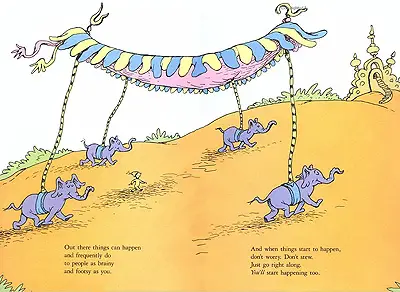
I also greatly enjoyed Dr Seuss's immortal Oh, the Places You'll Go, which has everything you need to know for a life on earth. See also: Vonnegut's Timequake.

***

Thanks for reading.

Wednesday, 26 April 2017

My 12 best reviews – official


Before I begin, please forgive me for the most appalling self-indulgence. But imagine a callow newcomer, around 1,500 reviews in, rooting through this blog trying to find The Good Stuff. No need! Since I publish the filmic elements on mildly successful social networking site Letterboxd, there's a very easy way to determine which of my witterings are the most defensible: those with the most up-votes from the small number of discerning film nerds who frequent that website. So here are, objectively, my 12 best reviews. Some are po-faced and endless, others just smug one-liners. 'Enjoy'.

12. The Empire Strikes Back (Irvin Kershner, 1980)


Reviewed April 2015
"Here are 10 things I love about The Empire Strikes Back, the best of the series, without any shadow of a hint of a suggestion of a doubt..." (5/5)

Full review: Letterboxd / This blog

***

11. The Little Foxes (William Wyler, 1941)


Reviewed August 2015
"We need to go beyond the canon. The established canon. The regimented canon ... Between the monoliths and the re-evaluated misfires lie films every bit as good: forgotten, neglected, still classic. This masterpiece is a caustic, troubling, profound examination of a Southern family brought low – or high and to prominence, depending on how you view it – by a sea of moral dissolution." (5/5)

Full review: Letterboxd / This blog

***

10. Far From Heaven (Tod Haynes, 2002)


Reviewed February 2012
"Haynes's florid recreation of the style of classic-era "women's pictures" is meticulous, the cast is uniformly fine and there's a terrific, backwards-looking score from Elmer Bernstein that captures the essence of the genre ... To get the full effect - and appreciate the dark humour of the opening reels - a crash-course in the work of '50s director Douglas Sirk would definitely help, but I think you can appreciate the film regardless, as a deliciously mannered portrait of an ideal crashing quietly to the floor." (4.5/5)

Full review: Letterboxd / This blog

***

9. The Invention of Lying (Ricky Gervais and Matthew Robinson, 2009)


Reviewed December 2012
"What begins as a mildly entertaining high-concept comedy (with Woody Allen-ish credits) turns into an incredibly heavy-handed atheist satire that operates at the heady intellectual and theological level of an 11-year-old skim-reading Philosophy for Beginners." (1/5)

Full review: Letterboxd / This blog

***

8. Napoleon (Abel Gance, 1928)


Reviewed December 2013
"Yesterday saw a rare screening of Kevin Brownlow's near-mythic five-and-a-half-hour reconstruction of Abel Gance's silent film Napoleon, a labour of love that has dominated more than 50 years of the historian's life ... It's the longest film I've ever seen and among the strangest, most restlessly innovative and technically astounding. It's as if Gance had never seen a film before, and no-one had told him that this simply isn't how it's done." (5/5)

Full review: Letterboxd / This blog

***

7. About Schmidt (Alexander Payne, 2002)


Reviewed July 2013

"Dear Ndugu,

How are you? I'm fine. Today I watched the film About Schmidt. I enjoyed it. At times I feared it was just a less inspired take on The Straight Story, with a score that went too jaunty too often, and a tendency to undercut its many truthful moments with smug comedy. But then the ending came along, one of the greatest endings I've ever seen, a heartbreaking voiceover followed by a heart-mending pay-off, and I realised that I'd seen something truly extraordinary, a film whose flaws are a small price to pay for a majestic, life-affirming whole. And then there was Nicholson's performance. It's so long since he bothered to act - I suppose One Flew Over must have been the last time - that I was willing him to succeed. And, yes, there were ticks and twitches there, and at times he hadn't quite submerged arrogant, shark-faced Jaaack within self-hating, sad-faced Warren (me), but in the end it was a triumph, just like the movie. Along with the usual cheque, I'm enclosing a little something extra to spend as you please.

Yours very truly,

Warren Schmidt"

(4.5/5)

Full review: Letterboxd / This blog

***

6. The Wolf of Wall Street (Martin Scorsese, 2013)


Reviewed February 2014
"So what's all this then? Basically Banks of New York, with Leonardo DiCaprio as hedonistic stockbroker Jordan Belfort, the kind of guy who caused the global recession.

Here he is having an awesome time. Look at his wife. Look at his car. Look at the size of his house. Here he is snorting cocaine off a hooker's boobs. Here he is doing it another eighteen times. Here he is making money. He has lots of money." (2.5/5)

Full review: Letterboxd / This blog

***

5. The Jazz Singer (Alan Crosland, 1927)


Reviewed October 2013

"On this evidence, I'm not sure talking pictures are a very good idea." (1.5/5)

Full review: Letterboxd / This blog

***

4. The Magnificent Ambersons (Orson Welles, 1942)


Reviewed August 2013
" 'Something had happened. A thing which years ago had been the eagerest hope of many, many good citizens of the town. And now it came at last: George Amberson Minafer had got his comeuppance. He got it three times filled and running over. But those who had so longed for it were not there to see it, they never knew it. Those who were still living had forgotten all about it and all about him.'

But when George Orson Welles, the infuriating, profligate wunderkind of American cinema got his comeuppance - three times full and running over - the whole world was watching." (5/5)

Full 2,278-word review: Letterboxd / This blog

***

3. The Outlaw (Howard Hawks, 1943)


Reviewed August 2013
"I'm not going to jugs this film too harshly. It has its knockers, and tit's certainly not the breast Western of the '40s - perbaps the casting of Jack Buetel is a bit of a boob - but it has a couple of really good points, which hold your interest as the cliches rack up." (2.5/5)

Full review: Letterboxd / It's not on this blog, I wrote the these all-new boob puns especially.

***

2. Sideways (Alexander Payne, 2004)


Reviewed October 2012
"Wine is probably the most boring subject on Earth, so how come Payne’s film about a lonely, bitter best man (Paul Giamatti) taking the soon-to-be-groom (Thomas Haden Church) on a week-long tour of vineyards is so bloody good? Perhaps because of Giamatti’s astonishing characterisation, which imbues an arrogant, self-destructive, self-hating pseud with a completely disarming humanity. Or perhaps because it’s not really about wine at all, but love and friendship and the choices that people make that end up deciding and defining their lives. It’s the antithesis of formula filmmaking: incredibly entertaining, but also about something, and featuring – quite unexpectedly – a handful of brilliant sight gags." (5/5)

Full review: Letterboxd / This blog

***

1. Ghost World (Terry Zwigoff, 2001)


Reviewed October 2012
"You can take your Juno, your Scott Pilgrim, even your Heathers, and chuck them in a skip, because Ghost World just does it all so much better. Well, all of it that's worth doing. I'm beginning to think this melancholy, bitingly hilarious crystallisation of teen ennui might be the only film I'll ever really need." (5/5)

Full review: Letterboxd / This blog

***

Of course, Letterboxd doesn't have that many people on it, so this will continue to be my main review platform, and we're now hitting 20K hits a month, which is lovely. The 10 most popular blogposts are viewable here, with 35K views between them:


Boast boast boast.

Here are three other reviews I was pleased with:

Gold Diggers of 1933 (Mervyn LeRoy, 1933)
Pat Garrett and Billy the Kid (Sam Peckinpah, 1973)
Gas, Food Lodging (Allison Anders, 1992)

***

Thanks for reading.

Friday, 21 April 2017

Bette Davis, Shaun the Sheep and the best pun I'll write this year – Reviews #263

Your are more than welcome.

FILMS


Shaun the Sheep Movie (Mark Burton and Richard Starzack, 2015)
– This is all rather lovely: a feature-length adventure for Shaun the Sheep that takes out hero to the medium-sized city and completes a trinity of really strong Aardman features, following Arthur Christmas and The Pirates. If it bucks the five-strong trend of every movie from the studio being better than the last, lacking the distinctive characters and clever dialogue of those two fine films (and featuring a thoroughly predictable, one-note villain), it emerges as something different: a spiritual successor to the silent comedies of Buster Keaton and Harold Lloyd, full of rich visual humour, imaginative thrill comedy and a little well-judged sentiment.

I find it disorientating to watch human characters who can’t speak except in vague noises (like The Sims, it makes me feel like I have dysprosody), the “oh you” mannerism utilised a full three times seems weirdly broad and old-fashioned for a movie this neat and sharp, and the film takes a good 20 minutes to get going, but once it does it’s a lot of fun, replete with clever sight gags, unexpected twists and deft swipes at everything from deux ex machinas to the shallowness of celebrity culture. It also has a breezy, summery theme tune from Ash’s Tim Wheeler.

My favourite jokes are the sheep who pretends to be human by attaching a sweeping brush to his face (I laughed out loud every time I saw him), and the psychotically-staring dog in the animal-control centre.

Having said all this, I'm not sure if being put in some poo is a serious enough punishment for attempted murder. (3)

***


Embrace of the Serpent (Ciro Guerra, 2015) – Apocalypse Now for hipsters.

This ethnographic arthouse film is enthralling at times, but disengaging at others, as two white men – decades apart – are taken up the river by Amazonian shaman, Karamakate, in search of the miraculous, health-giving plant, yakruna. This causes problems. Yakruna problems. "Yakruna matata”.

The mid-section is superb, its marriage of luscious monochrome cinematography (reminiscent of Louisiana Story and Jarmusch’s Dead Man) with colonial comment, deadpan humour and rich, deeply-rooted characterisation washing over you, saturating you with its quiet anger, shimmering beauty and resolute complexity. But Embrace of the Serpent’s trailer promised something greater than this film, which takes an age to navigate its slow, talky and boring opening stretches, and traverses into redundant hedonism after peaking in the instant that a boat cruises past the crumbling sign of a Catholic mission.

It's wonderful to see a film doing something new, and exposing us to a world and culture we've rarely encountered, but that doesn't just give it a free pass. Its fitful glories, including an obvious but nonetheless stunning and mindbending final act (A Field in England on Amazonian acid), aren’t enough to cover for a film that meanders endlessly or hits you at full force, when it should be following a steady course.

That bit where the young Karamakate is teasing Theo for crying made me laugh so hard, though. (2.5)

***


Enron: The Smartest Guys in the Room (Alex Gibney, 2005) – A delightful piece of anti-capitalist porn about the collapse of America’s seventh-biggest corporation, which made its name by using mark-to-market accounting (registering phenomenally large ‘expected profits’ to inflate its share price), and ended up with its traders getting Californian power plants to cut off electricity to homes and hospitals for days at a time to send stocks rocketing, ushering in a new governor of the state, Mr Arnold Schwarzenegger.

It’s an extraordinary story well-told through the use of previously secret documents and tapes, archive news footage and the usual talking heads, and though it suffers a little from triviality and gimmickry when leaning on found footage and music (Tom Waits, though!) and has no after-the-collapse interviews with the principal villains, the characterisation is superb, while it lays bare the moral bankruptcy of corporate America, and the dereliction of duty that is free market idolatry.

If I’d seen it at the time, I could have warned you about the recession. Sorry. (3)

***


SHORT: Hollywood Daffy (Friz Freleng, 1946) – Though there are a few fantastic Daffy Duck cartoons – like the legendary, post-modern Duck Amuck and the concurrent "Hunter's trilogy" – they're almost all made by Chuck Jones. And while the story here came from the same writer as those classics, Michael Maltese, and Hollywood Daffy was directed by influential animator Friz Freleng (himself famously the irascible inspiration for Yosemite Sam), it's sadly rubbish: an abrasive, unfunny and barely-drawn piece of nothing about Daffy attempting to become a Hollywood big-shot but being sidetracked by a rivalry with a studio security guard. Some of the references are faintly fun if you're interested in the period, but I didn't smile once, and the drawings of Bette Davis and Johnny Weissmuller are terrible. (1)

***


All This, and Heaven Too (Anatole Litvak, 1940) – An exceptionally classy melodrama, with Bette Davis giving one of her most extraordinary performances as a silhouette of a woman who enters the Duc de Praslin's tempestuous household in Paris of 1848 to act as the governess, falling in love with her master and becoming beloved of his children, before incurring the formidable wrath of his jealous, unstable wife.

It's a beautifully balanced and restrained performance, with the star often saying one thing and playing three more, her heroine having to keep her emotions in check, know her place in society and her household, and juggle the conflicting responsibilities to her employers, her charges and herself. She's a character rarely permitted to speak honestly, but yet at every instant we know what she's thinking. All the while, she's plagued by the circumstances of her early years − the script expertly drip-feeding information and motivation − while the framing device, with the older Davis justifying herself to a classroom of malicious teenage girls, tells us that it's unlikely to end cheerily.

As with many prestige pictures of the era set in foreign countries in previous centuries, a conceited, and at times complacent attitude prevails that undermines the film's aspirations to art: a distracting muddle of accents, the odd duff supporting performance (I'm quite fond of Harry Davenport, but he's pure am-dram here) and concessions to Hollywood hokum that that are superficially satisfying but detract from the wider film.

There are other elements, though, that would confound those who regard Hollywood studio product of the '30s and '40s as trite or silly or shallow, including Max Steiner's sweeping score, and artful cinematography from Ernest Haller, who began as assistant to D. W. Griffith's favoured cameraman, Billy Bitzer, and shot the likes of Gone with the Wind, Mildred Pierce and Rebel without a Cause, as well as several signature Davis vehicles.

The collision of art and artifice is rarely more profound than in the ballroom sequence, where he shoots twirling couples − complicit in the filthy hypocrisy of aristocratic life − in the mirrors behind three innocent children. That Ambersons-ish brilliance is in sharp contrast to the kids' conversation and characterisation: as much as I love Virginia Weidler et al, having modern American children enact these parts, spouting Hollywoodised exposition spoils the effect of the scene. Elsewhere, he brings a timeless freshness to his compositions (waves lapping upon the camera to slosh us into the flashback) while staying true to the glossy, idealised glamour of peak-era Hollywood.

Though I've catalogued its shortcomings, Casey Robinson's screenplay is mostly quite poetic and thoughtful, and if the film barely bothers to articulate the greater stakes beyond the compelling central story (which is only trivial if you believe that love and death are trivial when practised in a wealthy home), its slow-burning storyline is touching, immersive and intelligently handled. It's also broadly true, the source novel having been written by Rachel Field, the great-niece of Davis's Henriette Desportes.

Alongside Davis, Barbara O'Neil is an adequate if somewhat one-note villain, Charles Boyer does a fair job as the brooding Duke, and there are pleasant supporting turns from June Lockhart, Virginia Weidler and Ann E. Todd as the kids (they're joined by little Richard Nichols, who's too young to be able to act, but is really cute), within the restrictions of Hollywood convention.

But it's Bette's show: aside from All About Eve, this might be my favourite of her performances: another distinct, vivid and compelling character to add to a seemingly endless gallery. (3.5)

***


"I'm sorry, Miss Jackson."
April in Paris (David Butler, 1952) – An erratic piece of musical escapism, with bumbling State Department functionary Ray Bolger accidentally inviting chorus girl Dynamite Jackson (Doris Day) to perform at a highbrow arts festival in Paris, then falling in love with her on the boat over.

It's a weird mixture of elements that don't always gel, but still entrance, pall or apall. The surprisingly smutty script has gags about voyeurism and conjugal visits, but also lame right-wing barbs about taxation and government bureaucracy. Claude Dauphin seems to be playing Maurice Chevalier, rather than a character of his own. Bolger is a great dancer too often required to muggingly undermine his own talent, while approximating a mediocre, selfish man being unaccountably fought over by two feisty women. One of them, Day's character, is too prim and well-behaved for the story she's in, but yet she's sexy, brings a real sweetness to the central relationship, and injects the film with all the life it has, at this stage of her career simply brimming over with charisma and talent. Though the songs are variable (Sammy Cahn knows his way around a preposterously drawn-out lyric), her vocals are breathtakingly good, and the big set-piece in the boat's kitchen is fantastic fun: a showcase both for her and for Bolger, whose delirious 'drunk dancing' threatens to subvert his brilliance, only to emerge as a piece of virtuosic art: as big yet impeccably restrained as Jackie Chan's drunken mastery.

There's also a bit where she slags off the Eiffel Tower like a big loser, but it turns out this was a dramatic device intended to show how the city subsequently wins her over. Clever. But not actually. Much like this film. (2)

***

BOOK


The Ghost Writer by Philip Roth (1979)
– Roth’s first book narrated by his serious-minded, horny and human alter-ego, Nathan Zuckerman, is a vigorously and continuously brilliant story of three father figures and a barely acceptable reverie, as he arrives at the snowbound country home of cranky, regimented short story genius, E. I. Lonoff, indulging in reflection, self-exploration and methodical, metatextual flights of fancy on Roth’s chosen subjects of Jewishness, family, creativity and betrayal. It’s a profound, wistful, emotionally violent novel that takes one of the most almighty gambles and somehow pulls it off. (3.5)

***

Thanks for reading.

Next time: Fassbinder's Fox and His Friends, the Oscar-winning doc, I Am Not Your Negro, and Jack Kerouac's Big Sur.

Saturday, 15 April 2017

REVIEW: Hamlet at the Almeida Theatre

Saturday 15 April, 2017 (matinee)


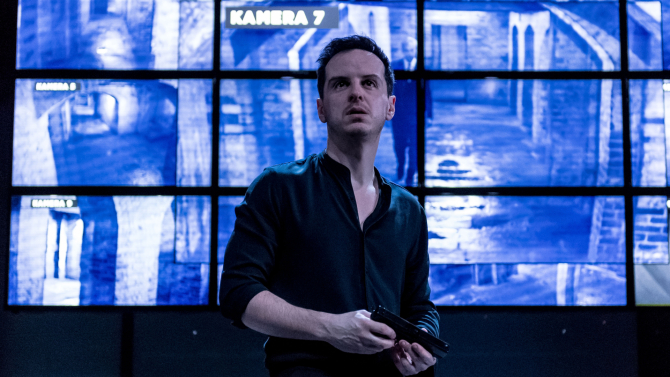
Andrew Scott's Hamlet is the best I've seen − probing, philosophical, introspective and bitterly witty − and this intimate, innovative, cleanly modern production rises to meet him, keeping your attention rapt and your emotions engaged.

Scott's emotions are always just below the surface. He doesn't cry on command, as such, that suggests a gimmicky or insincerity. He cries easily, his performance here studded with tears, dripping down that taut, gaunt, pouting face as the veins stand out in his neck. Those tears of rage, self-loathing and simple sorrow are where you go when you've run out of words. For Bob Dylan, that place was always a harmonica blast, and Dylan's the only soundtrack we get here: One More Cup of Coffee commenting on mortality, Spirit on the Water signifying a party, Don't Think Twice… subtly mocking the prevaricating Prince, and Not Dark Yet striking up as the end approaches. Am I wrong in thinking that the coda slyly winks at another track from Dylan's Time Out of Mind, as Claudius tries to get to Heaven, before they close the door.

Where the Barbican's production with Cumberbatch in the lead was flaccid, distant and long-winded, the Almeida's takes place in your lap, feels pared down to its essentials − old and newly discovered − and in its music, projections and manners feels like a Hamlet for this cynical century, its protagonist pained, tired and wired, a gentle, melancholy man wrestling endlessly with his burden, every nuance intriguing and every line seeming to be thoughts that are just occurring to him now. For the first time, I felt I was watching a Hamlet who seemed to be discovering the story as we were, lessening the play's fatalistic foreboding and making it a personal human drama, not a grand, portentous charade.

At times, Cumberbatch tried buffoonish, crowd-pleasing comedy, prancing around in a toy soldier's hat. Scott's Hamlet is nimble, knowing and drily funny, his sarcastic barbs all the funnier because he's so thoughtful, and so thoughtfully self-critical. When he's consumed by anger, it's not theatrical grandstanding, it comes from deep within, from unease that's revealed as insight, and a faltering self-knowledge that explodes into epiphany. Here, what was literal in Shakespeare shadows the psychological forces buffeting the hero: Hamlet is cast on a boat towards England, as his soul is tossed on roiling waters; his father appears thrice as a spirit, as the looming spectre of betrayal stalks our hero. And he is a Hamlet systematically if not always wittingly betrayed: by his murderous step-father, by his incestuous mother (Juliet Stevenson), by the former schoolfriends of the Prince whom they effortlessly seduce to their side, by the chummily meddling, foolish Polonius, and by Ophelia (Jessica Brown-Findlay), who seeks to help her father resolve Hamlet's loss of mirth, and instead drives both of them towards insanity.


Jessica Brown-Findlay as an affecting Ophelia, with Peter Wight her foolish father, Polonius.

The stage is just three stubby, fat steps up from the stalls: we may as well be in a living-room. In fact, we are, or at least in Elsinore's coldly comfortable quarters, coolly-coloured IKEA-like furniture close to the faux-marble floor that doubles as a CCTV headquarters, a hall and a graveyard. The use of video screens (one large and temporary, a smaller one at either side) feels unusually seamless and natural: occasional footage from a sort of Danish Sky News updating us on funerals, battles and the like, and − when the cast sit with the audience to watch the pivotal play-within-a-play − showing Claudius's reaction to Hamlet's incendiary self-penned script. After the first interval, the screen is unpaused, then exquisitely 'malfunctions' as Claudius enters, spewing out close-ups of his guiltily contorting face.


The players scenes, mercilessly and mercifully pruned to perhaps three-dozen lines (and complete with Scott's parody of declamatory acting), are illustrative of a brilliant reshaping of the text. Robert Icke's production uses modern dress and is tooled specifically for modern tastes, zeroing in on the characters' emotions, their inner conflicts and their reasons for those conflicts, and junking everything that's long-winded, extraneous or a bit stupid. It retains enough of the players to accentuate some of Shakespeare's commentary on the truthful artifice of theatre − in Scott's hands, a pithy, meta thing − to energise its hesitant hero, and to cast light on those who surround him, and that's it. Here, Hamlet's 12 lines inserted into the action to gauge his stepfather's reaction are not a threat or a test of Claudius's temperament, but solely for the prince to ascertain the suspect's guilt, or to offer His Uncertainness a way out. I'm not sure if that's always the case. If it is, then I can only say that I typically find this sequence so boring that I've never been engaged enough to realise it. And while the idea of a ghost telling his son that someone poured poison in his ear is going to be ridiculous to me until the day I die, this production is so swift in dispensing with exposition that the play's other improbabilities become part of a credible, compelling whole.

That's certainly true of the final scene, which is showy, spontaneous, gripping, wryly funny and deeply moving, before passing into a rhapsodic fantasy, then snapping back to black and gutting tragedy. At the Barbican, it felt like a laughable orgy of improbable deaths. Here, the human cost is vast and epic and inevitable in the context of the action.


Scott's Hamlet is the first to whom I've felt a natural and personal connection, and it runs deep. He's groping in the dark, beset with an impotence of action from which he's trying to rip himself free, questing for self-knowledge, while praying for a relief from it. He's an existential Hamlet: thoughtful, melancholy, feeling deeply, a decent, anguished, emotionally tender Prince with an adolescent's loathing of hypocrisy and duplicity, a child's guilelessness, and a self-loathing born of immobility in the face of dishonour. In pegged black trousers and a collarless shirt, barefoot or in shiny black shoes, stripped to a vest highlighting his voluminous biceps, or dressed in cream and white for the graveyard scene, the wiry, wild-eyed Scott commands the stage, and all of your attention.

Occasionally he ventures forth with his finger and thumb in an 'O', reclaiming the gesture from Donald Trump, and putting it into the service of poetic precision as he wonders at what a piece of work a man is. He blasts his arms skywards, showering the stage with spit as he finally shakes off the shackles of inaction. And he toys slyly with Polonius, outfoxing him amiably as the darkness sets in around Hamlet's heart. Elsewhere he is fleet of foot, touchingly tentative and uncertain ("To be… or… not to be) or sardonic, turning the Dane's usual contemplation of mortality after the revelation of Yorick's skull into something more offhand, spiky and yet strangely affecting, the dust pouring from the eye-sockets as he at first calls with an amazed amusement: "Alas, poor Yorick...", then muses: "Here hung those lips that I have kissed I know not how oft. Where be your gibes now? Your gambols? Your songs? Your flashes of merriment, that were wont to set the table on a roar?" Its nostalgia for childhood for once outweighs its macabre portents, which chimes beautifully with this innocent Hamlet who seems not to know what awaits him. The spontaneity of the delivery, the lightness of touch, and the play's scope but specificity of humour seem to all play into it, and so do the other performances.


Juliet Stevenson as a lustful, protective Gertrude and Angus Wright a svelte, straightforward Claudius

Peter Wight's meddlesome Polonius is unusually likeable and doltish, Luke Thompson is a spirited, dangerous but noble Laertes, and Juliet Stevenson plays Gertrude as lustful, naïve and protective, and while a couple of her actorly tricks were a little synthetic for my taste at close quarters, she does a better job than anyone I've seen of resolving the character's apparent inconsistencies, of being vain and blinkered while still "living almost by [Hamlet's] looks", and taking a bullet for her son, for all the good it does him. Jessica Brown-Findlay is a fine Ophelia too: appealingly playful, sexy and normal in the opening scenes, her sense of fun not equating to triviality, and her growing vulnerability constrained within a real character. When Ophelia does fall to pieces, a transformation intelligently rendered in stagecraft and performance, she plays mental illness credibly and compellingly, without patronising ethereality or runaway artificiality, but seriously, properly, weightily, singing a Laura Marling melody, flaring into rage, then greeting Laertes with an erotic tenderness, before dissipating into despondency. When her death comes, it's without predetermination or fanfare: all keeping with a production that thinks you haven't seen this before, because it's never happened before. Polonius's violent death too is a sudden, bloody shock that hits you hard because of its ear-splitting ferocity and because a dull-witted but good-meaning father whom we were beginning to like is dead, and not simply because Hamlet has just incinerated every bridge in sight.

Hamlet is closing at the Almeida as I write this, but it's bound for the West End later this year, and I'd urge you to see it if you can afford to. It's 195 minutes long, but it's vivid and enthralling, and consistent too, not lagging when Hamlet is off stage, as other productions do. I'd recommend it to anyone who loves Shakespeare, but I'd recommend it even more strongly to those who don't, because it filters his work unerringly through a modern sensibility, stripping away the redundant and finding resonances with the world in 2017. Like Elsinore, it's a lonely place, ruled by murderous liars, but if thou can be true to thine own self, you're halfway there. The rest you try to fill with self-knowledge, personal philosophy, friends and art.

(4) ***

Thanks for reading.

Friday, 14 April 2017

Ways of looking at America – Reviews #262


Stars and Stripes by Emma Amos (1992)

Yesterday it was my birthday. I went to the American Dream exhibition at the British Museum – which looks at modern America through screen printing, the consistency of the form illuminating the variations in theme – and to see Get Out, a horror movie that uses genre tropes to investigate the African-American experience. Several of these reviews touch on American identity, from Kurt Vonnegut's last 'novel' – which challenges the fear and intellectual bankruptcy of his country – to Evan Thomas's Robert Kennedy biography, a portrait of a decent, compromised man trying to stay true to his ideals, and sometimes merely to discover what they are, in the super-charged, dangerous and conflicted atmosphere of Cold War America. Vonnegut returns time and again to the subject of Native Americans, and they were one of Kennedy's causes too: on the last night of his life, he kept asking reporters, "Did you hear about the Indians?" Over 98% of Native American voters in California had cast their ballot for him.

Tunnel of Love, a supposedly inoffensive 1958 comedy that I watched for light relief, is fascinating in a variety of ways, eerily anticipating an American tragedy with links to the counterculture, and depicting a violently unequal, sexist US society both on-screen and off. Elsewhere, I've written about low culture trying to document high culture in '40s Hollywood, how Kurosawa took American pulp fiction and turned it into a study of Japanese society, and how one of America's finest imports, Billy Wilder, lost control of his talents after two decades at the top. By taking the action to Paris, he was aping his great hero – and fellow German emigre – Ernst Lubitsch, and yet his presentation was becoming crudely American, an unbecoming pastiche of Frank Tashlin, who a year before Tunnel of Love managed to smuggle the subversive masterpiece, Will Success Spoil Rock Hunter? past the censors, his characters' powerless, bawdy ogling of Jayne Mansfield a joke on the sexist, consumerist society that was '50s America. Mansfield, of course, was a Marilyn Monroe substitute, and Andy Warhol's famous screen prints of her hang in the first room of American Dream.

BOOKS:


Timequake by Kurt Vonnegut (1997) – Vonnegut’s last ‘novel’ isn’t quite a novel: it’s ‘choice cuts from the carcass’ of a book he was dissatisfied with (at least if the arch post-modernist isn’t having us on), mixed with reminiscences, reflections and bitter, hysterically funny wisdom earned in a life well but often painfully lived. The fictional portions deal with recurring character (and multi-eyed hack writer) Kilgore Trout, a mouthpiece for Vonnegut’s inspired short stories, and one of the luckless planetary citizens forced to endure a ‘rerun’ of the past decade following the ‘timequake’ of the title, in which they go through every moment of every day of every year in exactly the same way, the only novelty being that they are aware this is happening. The rest shoots off from this story at tangents, and just about every one is inspired. The book shakes with pain in its early passages, as Vonnegut details his crippling writer’s block and rails at the innate cruelty of the world, appearing almost defeated by it. After all, he says, “No-one asks to be born”. Soon, though, he’s brimming with brilliance both comic and humane, picking himself – and us – off the floor and arming us with compassion, insight and practical ideas for combating the societal plagues of poverty, loneliness and despair. It’s like a self-help book for sarcastic socialists. I thought I’d share a few favourite bits.

On socialism:


On his favourite movies and Kate Hepburn:


On wealth redistribution:


On humanism and religion:


While this is just one of the best passages I've ever read:


Me too, Kurt. Me too.

Not quite a novel, then, rather a handbook for life. Give copies to people you love. (4)

***


Robert Kennedy by Evan Thomas (2000) – This superb biography does a fine job of interrogating an extraordinary life, rejecting the lionisation and demonisation of RFK for something more complex and credible: a psychologically insightful portrait of a decent but deeply-flawed subject who felt deeply, erred frequently and grew through tragedy to become a great man. Thomas manages to explain how Kennedy could work for Joseph McCarthy, try to assassinate Castro, tap Martin Luther King's phone, and then emerge as a voice for the weak, the vulnerable and the forgotten − before being gunned down in his prime.

Across 400 pages (and acres of notes), Thomas shows us a man who was a hothead, a bully and a philosophical auto-didact, who loved children, his country and his doomed family, who hated his reputation for ruthlessness but frequently deserved it, and who wrote just one speech in his life, the greatest he ever gave, announcing the death of Martin Luther King to a black audience in inner-city Indianapolis, and speaking the words of his favourite poet, Aeschylus, to offer some shred of comfort.

The author doesn't bother with backstory, launching us into the book proper with Kennedy a teenager (and barely flashing back), and he has a tendency to be episodic − perhaps inevitable when you're dealing with a life dominated by set-pieces: the pursuit of Jimmy Hoffa, the Cuban Missile Crisis, the death of JFK − but he's also intuitive, even-handed and, though he sometimes deals with complexity of character by laying out a scattering of anecdotal, contradictory evidence − when he's dealing with complex matters of fact, he will always drill down in search of the truth.

If you go in expecting a hatchet job or a hagiography, you'll be disappointed. Thomas follows up the Indianapolis speech by having RFK mouthing off backstage about Dr King (and this time doesn't attribute it to wisecracking as a defence mechanism), while the famous story about Kennedy demanding the civil rights champion's release from jail is explained in terms of realpolitik, as well as principle, but appreciating the subject as a man forced to operate in the shady, pragmatic and morally murky world of politics makes his achievements and principled outspokenness all the more remarkable.

Kennedy was not the lily-white paragon of virtue of popular myth, his electoral hopes in 1968 − and he was by no means a cinch to win − had been raised by an unprecedented spending spree, and it's difficult to believe that he would have the same impact on the popular imagination without the tragic glamour bestowed by his brother's demise. His intense emotional connection with the downtrodden, though, was genuine, and while RFK was central in cementing the 'Camelot' myth of JFK's presidency, he was by far the more liberal, idealistic and ambitious of the two.

He was also a man of great bravery, not just in his obsession with proving his physical courage − a preoccupation forged as an effeminate young member of the Kennedy clan, sidelined by his older brothers − but in his resolute lack of fear towards the end of his short life. One of the great tragedies of a sudden death isn't just the violence and the unfulfilled promise, but the shock of it: the absence of warning, the inability of the person to prepare. This book made me realise just how fatalistic and undaunted Kennedy was: he suspected the end was coming, and he didn't care. He'd wave away his bodyguards, ignore their advice about not driving in convertibles, and even refused to draw his hotel curtains after seeing a gunman on a roof. After he was shot, he spoke just two lines. The second was a cry of pain. The first was: "Is everybody else all right." Now that is the mark of a man. (3.5)

I thought I'd share his speech upon the death of Martin Luther King with you: it's here. And this is the Great Lives episode that first made me aware of Kennedy's life and legacy, back in 2009. I remembered that Matthew Parris said the episode had done a rare thing in changing his mind about a subject, as he'd always thought RFK was a countercultural figure. I'd forgotten that it was Ken Livingstone who nominated Kennedy as his Great Life, before all he could talk about was Hitler.

***


CINEMA: Get Out (Jordan Peele, 2017) – I don't watch many modern horror movies: they're just not really for me. While I actively dislike slasher films − watching attractive women in their underwear being stabbed to death strikes me as a curious way to spend your spare time − my aversion to other horror sub-genres is less rooted in moral queasiness, it's more that I'm a big wuss. Mark Kermode once said that he loves being scared. I don't. Being scared is really bad. I like being calm and in control.

Every so often, though, a horror film will pique my interest and I'll trot dutifully along to my local cineplex and try bravely to appreciate it over the sound of dickheads talking and eating crisps. That's how I experienced Get Out, as a race relations horror about the African-American experience sounded like the kind of wanky liberal thing I'd enjoy.

Chris (Daniel Kaluuya) is a black college student who goes with his white girlfriend (Allison Williams) to visit her family in deep suburbia, where he's unquestioningly welcomed in a manner rife with complacent white guilt, but the spectre of African-American servitude still seems to linger, catching his eye in increasingly bizarre and jarring ways.

Writer-director Jordan Peele does a great job of balancing sardonic satire with social comment, while delivering a succession of knockout jump scares (aided by superb sound design) and passages of fantastical disorientation that keep you trapped in your seat. To an outsider, at least, he seems to articulate the immobility and impotence of self-determination that typified the African-American experience − and sometimes still do − by rendering them literal.

With very rare exceptions, black actors in the 1930s through the 1950s were only allowed to speak the words of white writers, and play characters acceptable to white audiences, as black citizens were forced to do the bidding of white masters. In juxtaposing a knowing, confident 21st century black man with these Uncle Toms and Mammys − twisted into eerie ciphers, dead behind the eyes − Peele shows how far we have come, but then how far we still have to travel. Today's racism may lurk beneath a respectable veneer, he appears to be arguing (presumably having written this before the ascent of Trump), but it's there all the same.

Whether he quite finishes that thought, or manages to properly punch it across, I'm not sure. Perhaps his point is that we'll only accept black people by controlling them in a new way − i.e. by forcing them to co-opt white norms − or it's an assault on liberal hypocrisy, but, if it's either, then the message is muddled and diluted in the telling.

Like another subversive comedy-horror that I really took to, Tucker & Dale vs Evil − the film falls down a little in the final act, becoming more horror-by-numbers, and failing to draw its thematic threads together, despite odd moments of brilliance. For the most part, though, it's a sharp and pointed and funny film, commandeering genre tropes to its own ends, while remembering to scare you shitless at the same time. And no-one was stabbed while wearing just a bra and pants. Though I wanted something even better, if they continue making horror movies this interesting, I may start watching more. (3)

***


Deception (Irving Rapper, 1946) – An absolutely awful Warner film about megalomaniac composer Claude Rains making life hell for his old flame (Bette Davis) and her new husband (Paul Henreid), who's just back from a PoW camp, and is like Victor Laszlo if he was a wife-beating twat.

The script and story are absolute shit, full of clunking, laboriously explained dialogue and bad characterisation, with Rains attempting to do his patented 'well-spoken psycho' bit using some of the least promising material in existence, and Henreid a sullen, jealous, domestic abuser whom we're supposed to root for.

Elsewhere it's all crunching plot gears, badly-mimed cello-playing and unearned sentiment − when even a committed Bette Davis and a Korngold score can't help, you know you're in trouble (though the way Erich Wolfgang holds that long note at a point of tragedy, damn). Of all the Golden Age melodramas about classical musicians, I think the only one that's halfway worthwhile is Humoresque. This one manages to be nasty, boring and stupid. (1.5)

***


The Tunnel of Love (Gene Kelly, 1958) – A very watchable '60s sitcom about the sexual peccadilloes of couple Richard Widmark and Doris Day, who are looking to adopt their first child. It's blandly shot and directed, but Gig Young is funny, Day has a couple of songs ('Run Away, Skidaddle, Skidoo' is great fun) and Scouse actress Gia Scala is stunningly attractive as the adoption board investigator who catches Widmark's eye, the cast making the most of material that's never inspired but rarely dull. There's also a bit where Young and Widmark both mugging wildly with the *exact* same face that Gene Kelly liked to pull on screen when being cheekily amorous. He directed this one.

In broader cinematic and social terms, though, there are four things that make the film troubling, some trivial and others less so:

1) Richard Widmark isn't good at playing normal characters. His great performances were all as villains or anti-heroes (even in Panic in the Streets, he's hardly straight-forwardly sympathetic). The Hollywood power structure dictated that when you became a big enough star, you played conventional leading men roles. That's why after a blistering beginning, his career tailed off so dramatically.

2) It's a fascinating snapshot of the period, but it's extremely sexist. Even when it tries to challenge its male characters' rampant, complacent misogyny, it only does so half-heartedly.

3) Martin Melcher's name is on the credits. Over the next 10 years, he would run his wife Doris Day's career into the ground, casting her in unsuitable projects and losing her fortune through bad investments.

4) There's a running joke about Gig Young's character being in therapy. In the 1970s, having been under the 'care' of Brian Wilson's psychologist, Eugene Landy, he killed himself and his young wife.

If you can put all that to one side, it's a diverting film, perfect for a lazy afternoon. Good luck. (2.5)

***


High and Low (Akira Kurosawa, 1963) – Or 'Heaven and Hell' in its original Japanese: the first half of Kurosawa's superb film a moral thriller set in the rarified atmosphere of businessman Toshiro Mifune's hilltop home − where he must decide whether to ruin himself by paying the ransom for his chauffeur's son − and the second a trawl through the depths, taking in a speeding train, police HQ and the sweaty, dirty, morally dissolute streets of Yokohama, through which a kidnapper with terrific sunglasses (Tsutomu Yamazaki) is pursued by the full force of the law.

Adapting from an Ed McBain novel, the director fashioned a story about contemporary Japan, indicting not just the rigid, unforgiving class structure that dictates the relationship between Mifune and his chauffeur, and the cops' preconceptions of both victim and criminal, but also the increasing shallowness of Japanese society. That's elucidated by the shoe company so central to the businessman's existence (shades of the leather gloves in Philip Roth's American Pastoral), caught between the durability and reliability of its dull products, and the cheap, flashy models now in vogue.

High and Low is a masterfully-made film, its claustrophobic first hour, rife with circular debate, that gives way to something else entirely: Kurosawa ripping the film open as it becomes a meticulous, credible and far-reaching procedural, without losing sight of its raison d'etre. The script isn't perfect, at times it spoonfeeds, at others it's long-winded or relies on coincidence, but as it evokes the collision of high and low society, as the cops search high and low for a kidnapper, it's taut, thrilling and yet substantial, with a final scene of virtuosic and pungent brilliance. (3.5)

***


Irma la Douce (Billy Wilder, 1963) – Wilder's worst film since The Emperor Waltz back in 1948, sunk by an approach that's more 'Frank Tashlin's crap brother' than Lubitsch in his prime, and sharply heralding a career decline where these shortcomings became more like old friends than the rude awakening they are here.

Jack Lemmon is a gendarme in the belly of Paris who falls in love with hooker Irma la Douce (Shirley MacLaine). He tries to reform her, but after finding himself reformed into her pimp, opts for Plan B, reinventing himself as a raffish English lord who becomes her sole client. The catch: he has to work every other hour in backbreaking manual labour in order to fund his scheme.

The first 30 is nice and the last half-hour isn't bad, but the 77 minutes in between are unbearable, with Lemmon off the leash and so at his most unbelievably irritating. There's no subtlety of specificity to his characterisation, it is just every moment in Wilder's sub-par script played as big and broad and loud as possible. He was an actor of some skill and sensitivity, but − like Mickey Rooney − he could only do comedy if he was reined in very tightly. Here Wilder is apparently aiming for cartoonish, and he certainly manages that, but to what end?

MacLaine, in green stockings, flashing her cleavage at every opportunity, strikes just the right note of casual, slightly worn sexiness, but her work is lost in this mess of a film. You could just watch The Apartment instead, and have 12 minutes free to spend how you like. (2)

***

Thanks for reading. Next time: Philip Roth's The Ghost Writer, Doris Day in April in Paris, and Bette Davis in All This and Heaven Too. Plus: other stuff to be determined.

Tuesday, 4 April 2017

Patti Smith, Music for Chameleons, and Ghibli being all weird again – #Reviews 261

Here's a blog I wrote about getting to go behind-the-scenes at Brian Pern: A Tribute, one of this year's televisual triumphs.

And here are reviews of the other cultural things I've ingested recently: three books, a movie and a couple of TV series.

BOOKS


Just Kids by Patti Smith (2010)
– At its best, Smith’s beautifully-titled memoir of her life with idiosyncratic, doomed artist Robert Mapplethorpe is uncommonly insightful, raw and moving, as a trio of fateful encounters blossom into romance, which in time becomes an epic love that endures even as their lives begin to diverge: Smith graduating from artist to poet to pioneering rock ‘n’ roll frontwoman, Mapplethorpe admitting his homosexuality to himself as he turns from a collagist and painter into one of the era’s defining photographers. The passages detailing his death and then flashing back to their early acquaintanceship and their construction and then abandonment of a self-contained world are extraordinarily powerful, shining a light into the corners of Smith’s soul and revealing the importance that her upbringing, her faith and her commitment to creativity and visionary artistry have played in dictating her life’s course.

And yet the book becomes decreasingly revelatory and compelling as it progresses, Smith traversing into pretension with increasing frequency and intensity, as well as boringly listing which thrift shops she visited, which trinkets people gave one another, which outfits she wore every day and what she had to eat. As a fashion icon, it seems obvious in retrospect that she must have spent time and energy crafting her visual identities, but it doesn’t make for great reading, that blissful middle-ground of relatability, frank emotion and economic but literate prose vacated entirely for long stretches, as we oscillate between posturing and pointlessness.

Even then, though, Smith has a way of snapping back to a truthfulness and precision that's immediately and startlingly effective, and while reading between the lines we can deduce that perhaps Robert wasn’t the saintly, selfless figure that his great defender contends, you would have to be a psychopath not to be moved by the pair’s deep, mutual and unstinting dependence, at times breathtakingly evoked by this flawed but distinctive and heartbreaking elegy – not just for an artist, but for a man, and for the heyday of the grungy, bohemian, dangerous, filthy, accepting, unforgiving and enrapturing New York City that was his. (3)

***


Scandals of Classic Hollywood by Anne Helen Peterson (2014) – I don’t want you to develop any preconceptions about this book’s contents, based on this image: if only there were a saying that succinctly crystallised this thought.

Anne Helen Petersen’s book isn’t the tawdry, sensationalist rehashing of age-old scandals it appears from the cover, rather it seems that this is the only way you can get a book like hers published. Instead, it’s a collection of blogs from this ‘doctor of gossip’ (she has a PhD in the history of the industry, from the University of Texas) which examines Hollywood scandals or tragedies, how they were managed (or not) by the studios, and what the events, their handling and the fall-out tell us about American society. Each chapter is around 13 pages long (a couple are much longer), beginning with Mary Pickford’s affair with Douglas Fairbanks, closing with the hysteria around James Dean’s death, and in between looking at everything from the tragic lives of screen sex sirens Clara Bow and Jean Harlow to Bogie and Bacall’s romance, and Montgomery Clift’s ‘long suicide’.

The quoted sources are almost all gossip and fan magazines, a fascinating prism through which to view this history, but also somewhat limiting, if the sections on Bow and Harlow are representative of the whole. Though Petersen alludes to David Stenn’s book on Harlow, she either misinterprets or deviates from his impeccably well-sourced, well-argued narratives of both lives, with an alternate vision that seems myopic and incomplete, with no understanding of (or even reference to) Bow’s tortured upbringing. The contrary assertions it does make aren’t attributed to any sources and so seem more like supposition. Though most of the other essays crackle with energy, as we get a witty, accessible and cleverly contextualised whistle-stop tour of a star’s life, usually zoning in on a controversial, widely-covered scandal (Fatty Arbuckle) or tragedy (Carole Lombard), or – more often than not – the ongoing ‘scandal’ that was their self-destruction (in the case of Judy Garland, Montgomery Clift, Marlon Brando), or their side-lining by censorship (Mae West) or racism (Dorothy Dandridge), as a result I began to question their veracity of completeness. Doubtless some elements are difficult to fact-check through the fog of time and the smoke and mirrors of Hollywood publicity, but her constant get-out of “the accuracy of this claim matters less than…” is frustrating, and there are quite a few typos and errors (Carole Lombard dies in 1941, then signs up to do war work in 1942). That’s a shame, as the Arbuckle section is spot on, the Clift one is a decent effort, and the chapters on West, Dandridge and heroin-addicted silent star Wallace Reid are – at least on the surface – gripping and eye-opening pieces about stars I’ve seen a bit of, but knew little about beyond the headlines.

There’s also certainly no doubt that Peterson is an expert on fan magazines and studio publicity, and it’s a fascinating angle from which to approach these stories. Now and then she'll even turn something you thought you knew about – like Kazan's On the Waterfront, one of the first films I ever loved – so you see it as if for the first time, appreciating how Eva Marie Saint's transformation in the film is fundamentally achieved through Brando's reactions to her. On the other hand, Petersen is writing for an audience with little to no knowledge of these stars and their work, which means that if you’ve read Patricia Bosworth’s book on Clift, Stenn’s definitive works on Bow and Harlow, or even seen – say – Paul Merton’s documentary on Arbuckle, you’re having to sit through an awful lot of familiar (but simplified) material in order to get a little more insight. She’s also somewhat curbed the waspish, sweary tone of her earlier Hairpin articles, which is understandable (I sometimes soften my own writing depending on the audience), but a little disappointing.

It's not that I didn’t enjoy the book. It’s a lot of fun, and I learned quite a bit, but it left me a little unsatisfied. Perhaps I’m just spoiled by Karina Longworth’s superb You Must Remember This podcast, which covers these sorts of stories with such skill, insight and journalistic rigour – and at such length – that she leaves most other film historians trailing in her wake. (2.5)

With enduring thanks (and sincere apologies for my usual ungratefulness) to my friend Soph for sending me this one.

***


Music for Chameleons by Truman Capote (1980) – A book of extraordinary grace, incisiveness and honesty which further bolsters my impression that Capote remains one of the most important, original and underestimated writers of his era. Fuck his artificial image as a catty, trivial, morbid starfucker, and study the work: dark, devastating, morally decent work shot through with his actual character, the shadows of an encroaching darkness creeping across the sun-dappled idyll of his New Orleans childhood. Even fans tend to lean on a popular narrative – pushed in last decade’s cinematic biopics – that sees him in terminal decline after the trial of In Cold Blood, but while it’s true that he degenerated into substance abuse (an affliction dealt with in breathtaking fashion in the last of these 14 pieces), and that with it his work-rate slowed, this book may well be his creative zenith.

In Bob Dylan’s Chronicles, he explains (entirely preposterously) that in the late ‘80s he found a new way to sing: a mathematical formula that has enabled his voice to endure his Never Ending Tour (please post your punchlines below). Here, Capote does much the same, denigrating his entire back catalogue as he seeks to articulate exactly why, and how, he’s developed the new style premiered in this book. Unlike Dylan, who is talking through his silly cowboy hat, Capote is sincere. His style here is so clean, precise and economical, yet to formally inventive, that it takes the breath away. Every decision he makes, from delayed gratification, to leading with dialogue, to drifting into remembrance and reminiscence, seems right, and his evocation of emotion, of nature, and of character is remarkably specific and so uniquely powerful.

There are six short stories and seven conversational portraits, alongside a non-fiction (?) centrepiece about a serial killer, and each is remarkable in one way or another. Perhaps my favourite piece is Dazzle, a multi-layered story with a time-shifting perspective that’s about love, fear and guilt, as Capote relives the story of his paternal grandfather, a fortune teller and two terrible secrets: one comic, the other tragic. It is flecked with wonder, touched by horror, and redolent with an unstudied compassion for his younger self, before a climactic sucker-punch that knocked me sideways. But it’s just one masterpiece among many. The other short stories are rich in irony, but unwaveringly sincere, as they deal with self-loathing, denial and the secrets (or unspoken truths) that dominate the book, while his egalitarian ‘portraits’ take in a weed-smoking cleaner, Marilyn Monroe, pastoral novelist Willa Cather and amoral Manson acolyte Bobby Beausoleil: though you could class the first of those as ‘hilarious’ and the last as ‘chilling’, that’s to reduce them from the multi-faceted, playful, probing, touching, humane and sad works that they are. The only piece that doesn't quite work for me, at least not unequivocally, is Handcarved Coffins, the lengthy true crime chapter at the book's centre. It has passages of great insight – on sexuality, obsession, delusion – but at times its language is oddly forced, and ultimately I'm not sure exactly what the point is that Capote is constantly circling and yet never quite landing upon.

It makes sense, perhaps, that when the book does malfunction, it's in both style and content, for it's the balancing of form, viewpoint and revelation, both overt and within the reader, that is the book's great strength. Music for Chameleons is beautifully-written, but even Capote’s admirers often stop right there, and it’s much more than that. His swaggering, elegant, stylistic brilliance – even as a supposed has-been, with a pickled liver and a nose stuffed with coke – is really a way of packing as much wit, pathos and meaning into each line as possible. His style is not an end in itself, it's the way he carries truth to the reader. (4)

See also: I wrote about In Cold Blood here, and some earlier Capote works here.

***

FILM


Spirited Away (Hayao Miyazaki, 2001)
– It only took me 16 years to see Spirited Away, and what a wondrous, spectacularly odd film it is: Ghibli on an epic yet intimate scale, as a little girl named Chihiro gets waylaid while moving house, and Hayao Miyazaki’s imagination goes into overdrive.

We meet Chihiro just minutes after an emotional farewell to her old friends: she’s sitting in the backseat of her parents’ car, as they trail a moving van to their new home. The family stop to investigate what seems to be an abandoned theme park, and soon the parents have been turned into pigs, Chihiro’s life has been saved by a boy who it turns out is a dragon and also a god, and she’s been forced to find employment in a fully-functioning bathhouse populated by ghosts, assisted by a multi-armed man who lives by a furnace with his friends – sentient bits of soot – and under the cosh of giant-headed Thatcher-a-like Yubaba, whose beloved germaphobe baby is bigger than she is. That’s the first 20 minutes. It carries on in a similar vein from there, as you can see from this short paragraph lifted from Wikipedia:
While visiting her parents' pigpen, Sen finds a goodbye card addressed to Chihiro and realizes that she has already forgotten her name. Haku warns her that Yubaba controls people by taking their names and that if she forgets hers like he has forgotten his, she will not be able to leave the spirit world. While working, Sen invites a silent masked creature named No-Face inside, believing him to be a customer. A 'stink spirit' arrives as Sen's first customer. She discovers he is the spirit of a polluted river. In gratitude for cleaning him, he gives Sen a magic emetic dumpling. Meanwhile, No-Face tempts a worker with gold, then swallows him. He demands food and begins tipping extensively. As the workers swarm him hoping to be tipped, he swallows yet another two greedy workers.
The film takes a little while to begin to weave its magic, but without warning you find yourself enraptured, lost in its peerlessly weird universe, spellbound by its animation – by turns serene, frenetic, opulent, disorientating, immersive and repulsive – and touched by its understated but profound emotional core. Its characters are notable for their complexity, duality and depth – often achieved with minimal exertion – as well as for their malleability. Whether by witchcraft or kindness, they can be corrupted or reformed – these are not the one-trait ciphers often fed to animation audiences – and yet there’s a simplicity in the emotional exchanges that’s completely beguiling, and surprising for a film with such a complicated story, and such a wealth of subtext. Miyazaki’s nostalgic vision acts as a commentary on a modern Japan that has lost its way, betraying its national identity and its environmental responsibility with a greed that’s evoked with both subtlety and a crude, in-your-face literalism. This, it says, it what happens when you only have a yen for yen. On a surface level, it's also great to have this coming-of-age tale led by such a brave, forthright, decent, ass-kicking girl. There should be one in every story.

The film isn’t perfect: while transfixed and impressed by its balls-out, apparently authentic weirdness, I found it initially distancing, and there were times when the movie’s proliferation of oddball supporting characters, the scenes necessary to accommodate them and its general noisiness (compared to my favourites thus far, Totoro and Porco Rosso) began to tire. It always, though, came back to itself: to Miyazaki’s singular if somewhat unregulated imagination, to the sincerity and simplicity of the Chihiro-Haku relationship, and to the aesthetic analogue that is Spirited Away’s exquisite animation. (3.5)

The music's lovely too.

***

TV


The Nazis: A Warning from History (1997)
– A topical rerun of this seminal series, 20 years on. It’s history as investigative journalism, shorn of all sensationalism and ghoulishness, which changes much of what you thought you knew about the Nazis, such as their bizarre, deeply dangerous power structure – competing, antagonistic department heads seeking to turn Hitler’s psychopathic monologues into policy – the role of voluntary, informal informants in making the Gestapo appear omniscient, and the self-justification of ‘ordinary’ Germans who enabled them to commit unprecedented horrors. From its striking credits to Samuel West’s crisp, authoritative voiceover, its unearthing (and understanding) of revelatory documents to its astonishing interviews with perpetrators and victims alike, it’s a class act, which manages to answer (or at least posit a compelling answer) to that eternal, chilling question: how could it happen? (4)

***


Spiral: Season 5 (2014) – For five episodes, this erratic but often exquisite French crime series appears to have given up the ghost. It’s tired, disjointed and – yes – even boring, as Laure Berthaud (Caroline Proust), Gilou (Thierry Godard) and the rest return to solve a slow-moving murder case, a series of ATM ram raids and the mystery of what the hell’s happened to Spiral. Then suddenly, and almost without warning, it explodes into brilliance, its stories dovetailing – and then artfully unfolding – its human subplots becoming uncommonly compelling, and Proust, Godard and Audrey Fleurot (as complex, flamehaired, bad-ass shyster Josephine Karlsson) hitting devastating peak form. It turns out that it’s all about mothers and daughters, and that neither we nor Laure are allowed to have anything nice happen to us ever. It’s back later this year, apparently. I’m going to record them all and then binge. (3)

***

Thanks for reading.