Showing posts with label Manchester. Show all posts

Wednesday, 1 May 2024

What a dream that was: Adrianne Lenker on tour

Black Box, Galway, Ireland – 19 April 2024
St Canice’s Cathedral, Kilkenny, Ireland – 20 April 2024
Vicar Street, Dublin, Ireland – 21 April 2024
The Old Fruitmarket, Glasgow, Scotland – 24 April 2024
The Hall @ Aviva Studios, Manchester, England – 25 April 2024
Barbican Centre, London, England – 27, 28 (matinee) and 28 (evening) April 2024
Bristol Beacon, England – 29 April 2024
She is a label PR's darkest nightmare, and we love her for it.

Four shows into Adrianne Lenker's 'Bright Future tour', promoting the biggest album of her career so far, our generation's greatest songwriter has got around to performing fewer than half the tracks on the record. In that time, she has played 30 other things instead, including a cover of a Chris Smither blues number, most of her previous album, and 'Oldest', which was cut from Bright Future, but which she appears to prefer to many of the songs on it. The opening, solo, portion of her climactic concert at the Barbican, arguably the most important date of her career so far, will consist, in its entirety, of the following: two tracks from 2014, one of which she has relearnt while on tour, and four unreleased songs, including a reworking of 'Evol' so new that it doesn't appear to have a name. "If love is simple, can you please explain this?", it begins. I can't explain much of this at all, if I'm honest, but I'll try.

A précis for the until-now-uninitiated: Lenker is a 32-year-old1 singer-songwriter from Indianapolis, via Minneapolis, Boston and Brooklyn, who for close to a decade has carried on a dual existence as a solo artist – playing what we can broadly term ‘alt. folk’ – and as the frontwoman and major creative force behind Big Thief, a band of Berklee music graduates whose approach to genre is largely summarised by the phrase “go on then”, and whose most recent shows have oscillated thrillingly between country and metal. While Lenker doesn’t do any Pantera covers on this latest tour, the country influence on her solo material is becoming ever more apparent: during an afternoon off, she pitches up at an open-mic in a Dublin pub and performs ‘I Don't Love You Much Do I’ by Guy Clark, off the cuff2; her new record has both a yearning fiddle and a cover photo of her in a cowboy hat. (The hat makes it onto the tour: she premieres it in Glasgow, never takes it off on the Sunday in London.) That she is wrangling with this supposedly reactionary genre while exploring the tender intricacies of queer experience does seem more interesting than whatever Beyonce is trying to do over there.
'Someday I'm gon' be a steamboat, baby'

Though Lenker played one date at EartH in London two years ago, she hadn’t toured solo in the UK since 2019. Back then, she seemed paralysingly shy and uncomfortably exposed – hiding behind a thatched fringe in front of the Union Chapel's organ – though that impression would evaporate every time she started to play. When she returned, to EartH, it was off the back of four sold-out nights with Big Thief at the Shepherd’s Bush Empire, and with her bleached buzz cut and swish jacket, she seemed to have segued into a rock star. Then she picked up her guitar, and began to cycle through songs, and it was like you’d dropped in on a mutual mate, only to find a genius in their front room.

That’s the feeling you get again in Dublin on this tour: that night is an extraordinarily intimate experience, Adrianne in cowboy boots on a fittingly carpeted stage, tossing off definitive versions as easily as falling off a log. But almost every show is special in its own way. The only exception is Galway, unspecial in its own way, with the crowd breaking various cardinal rules of gig-going, and seeming half-set on breaking the artist with it.3 After the show, I considered with a chill whether our musical hero might be passing into the realm of Mitski or Phoebe Bridgers, turned into a living meme by the most irritating people on earth, but no: it turns out that’s just Galway…

Because Kilkenny, the next night, is an incalculably special evening: Adrianne on a black platform within a startlingly beautiful 13th-century cathedral; fuchsia lights; the audience seated and hushed in reverence. “You’re so quiet and respectful,” she says at one point, and you think she’s referring bleakly – obliquely – to the previous rowdiness, but then you see how much fun she has in Dublin, and wonder if she just meant we’d been a little quiet. The atmosphere at those two shows fits each venue perfectly, though – and fits each set. They're the two stand-out dates of the tour. The St Canice concert ends with Lenker singing ‘Real House’, a song about her mum, with tears running down her face.
'I'm happy with you – why do I need to explain myself?'

She’s at her most transparently happy in Ireland’s capital (at ease before an audience who offer a saintly spin on Galway, their backing vocals swelling, apposite and perfectly-timed), save perhaps for the second night at the Barbican, when the joy of collaboration is followed by the scale of the send-off. Every seated show ends with the audience on its feet, but that clamour in London hits another level. Between those shows, Glasgow is an over-amplified but good-natured gig in the Dublin vein: an art student called Amy is sketching Adrianne on the front row, someone has brought a monkey on a stick, a requester shouts “my angel!”, followed a few seconds later by the clarification, “…the song”, while Manchester is St Canice’s revisited, just with a touch more joining in and a lot less stained glass. The swansong of this leg of the ‘Bright Future’ tour, in Bristol, features a cheery but less obviously obsessive crowd, mildly befuddled by the deep-cutting of the mammoth setlist (the number of unreleased songs tie with those off the new album, 4-4; in an early fit of whimsy, Lenker plays her two John Prine-iest songs, ‘Cactus Practice’ and ‘Once a Bunch’4 back to back).

By then, you feel like you’ve got to know her a little, not simply as an artist, but as a person. In Kilkenny, Lenker talks openly about her nerves, saying she’s just taken the longest break from touring of her life – which turns out to be just eight months – but she otherwise gives the impression of being quite uncannily relaxed. Now at ease in a way she never quite was before, she begins to open up…
'Please, cut my hair'

While the psychodrama of Adrianne's ever-changing hairstyle is a compelling subplot of any tour (the tousled 2014 shoulder-bob is back, baybee), here we get backstory. In Manchester, she punctures the delicate illusion of between-songs badinage by quipping, “It's good to be in Manchester, I always love coming through… I’m trying to small talk with you while I tune, so it's smooth.” But it's also true, she says: she used to use her friend Bernie's house here as a base, and it was in Manchester that a 24-year-old Lenker first lopped off her hair (me too – we have so much in common, we should hang out some time?). She shares one of her favourite semi-jokes – someone replying to “I’ve had a haircut” with “Which one?” – exhibiting the delight in wordplay and the guileless goofiness as crucial to the Lenker persona as her pained earnestness, before grinningly challenging the audience to identify various baffling chords. When she loses her thread during 'Sadness As a Gift, she spends five minutes telling us about her day (radio session, nap, dilemma over how quickly to eat chicken soup).

It is in Manchester too, and most memorably of all, that the ever-changing ‘Vampire Empire’ is welded to a snatch of Lucinda Williams’ ‘Like a Rose’. Lenker’s song, premiered on Colbert, exploding on TikTok, was essentially a recruiting tool that hoovered up young lesbians, but the first recording of the track (by Big Thief while on tour last year) was savaged online by entitled pricks. Perhaps as a result (though hopefully not), Adrianne re-recorded it for Bright Future, and she plays it six different ways during this tour, from a ‘Spud Infinity’-style5 parade of silliness in Dublin ("OK, freestyle solo,” she tells the audience near the end, "everyone do something different") to a blisteringly-paced honkytonk in Bristol. The great version, though, is Manchester’s, the medley rounding out the song, bringing together the various Lenker identities by spotlighting her open-hearted, open-armed sincerity. In London, she does something striking if less transcendent, adding an extra chorus, her voice plummeting through the octaves in tandem with the word ‘falling’, a vocal risk that replaces the physical jeopardy of last year’s performance in Hammersmith, during which she tipped over backwards, and dropped, laughing, to the floor.

In London, too, she tells us she could never be a stand-up comedian because she laughs at all her own jokes, and indeed she spends a lot of these shows laughing, the fragile music interspersed with sips of water, lengthy retuning and those dorky, squeaky giggles. Conspicuously, she doesn’t go near the two truly desolate songs on her recent heartbreak/heart-reclaiming record: ‘Evol’ and ‘Ruined’. She played one verse of ‘Evol’ as an encore back in March, and whether that was always the whole plan, she never went further: just sat stone still and silent, said brightly, “That’s all”, and went home.
'I see God here and there'

Instead, she plays a joyous ‘Born for Loving You’, which is introduced with a disarming simplicity: “Here’s a song I wrote for my girlfriend, it’s nice to sing it in a church.” When I interviewed Lenker’s Big Thief co-conspirator and ex-husband, Buck Meek, last year, he said that the one thing he admired about Lenker more than any other was her honesty. At greater ease between songs, that has manifested itself in her being utterly candid; with her latest writing, it has resulted in a startling new literalism. If you think ‘Real House’ is brutishly direct, wait until you hear ‘Before You’ (which is what we’re calling her as-yet-unnamed song, premiered in Galway). Here’s how she describes that marriage and its aftermath, her life folded into a standard folk-country frame:

New York City
‘fell in love with a man
He asked me to marry
and I gave him my hand

So simple
I’ve lived a whole life through
But I don’t remember nothin’
Before you

I ended my marriage
‘went back home
I needed to scatter
Those ashes alone
'A convulsion of honesty brought me to life'

“You know, honesty can be brutal,” Meek said to me, “but it’s always the right way.” ‘Before You’ is like In My Life if Lennon’s song had zoned in on the detail, before breaking both your heart and your legs. Seeing Lenker in love is quite something, though: ‘Born for Loving You’ (which I’ve written about here) is one of the great modern love songs, while ‘Baby, Honey, Sweetheart, Darlin'’, played for the second time ever at the first Barbican show, evokes McCartney’s ‘Here, There and Everywhere’, fitting Lenker’s crooked-hanging sentimentality into an ingenious pop-folk template. There is no feeling in modern music even remotely akin to the exhilaration of hearing Lenker unspool some new masterpiece for the first time, each line that she drops into the air somehow better than the one before. We felt it with the instantly immortal ‘Wait a While’ in Bristol in 2020, and with ‘Already Lost’ in Edinburgh last year. We’ve felt it more often than any audience would have any right to expect. Here, shaking her head, hair flicking, one eye on her left hand, she sings:

Honey
Whatcha smilin’ at, what’s funny?
Is it how I am with money?
Now my nose is gettin’ runny
You hold me when I cry
And make it sunny


When people smugly traduce pop lyrics committed to paper, what they miss are the intricacies: here, with Adrianne, it’s the effortless evocation of the fondness of her relationship, the specificity of her imperfection, the intentional lapse into quirky bathos, immediately spun on its head by the revelation of sorrow, and then the sun blasting through like in a ‘60s soul record. It is, too, the imploring quality of her voice, so affectionate and assured: comfortable in love. After she plays ‘I Don’t Love You Much Do I’ in a pub (and how I wish I’d been in The Cobblestone for those three minutes), she shares Guy Clark’s original on Instagram, together with a photo taken by her girlfriend.
'Men are baptized in their anger and fighting'

That song is one of many she’s been voraciously learning during an extended period of musical autodidacticism. In Kilkenny, after covering ‘Leave the Light On’ by Chris Smither, she says guilelessly: “I didn’t grow up learning songs, I just learned guitar by writing songs. So learning other people’s songs is this new thing I’m really into: it’s amazing. There are so many good songs in the world!” The Smither number showcases her extraordinary guitar-playing6 and is, as my friend Peter observed, closer to her own style of writing than anything else she’s ever covered, both cosmic and intimate in the vein of ‘Spud Infinity’. She plays slide guitar too on her own ‘half return’, a throwaway, faintly Gothic ditty enlivened by that flitting finger. At other times she is the consummate country artist, a cowgirl picking, Travis-style, with a hint of a swagger. A music writer once said of cult folkie Nic Jones that he had an orchestra in his right hand. Well, that’s Lenker too.

The only thing she struggles with is telling people off – or telling them to sing (well, that and the fact that she can’t quite whistle). In Dublin, she gently quietens the hum of chatter by saying, “You guys are missing the tuning… it’s the best part,” before pointedly adding, “‘kind of serious, though… it does help to hear when you’re tuning.” In Manchester, she tells the crowd that it’s “a rare treat to hear you sing”, before an encouraging, “Alright, last chance to sing, guys” as she embarks on the final stretch of her signature solo song, ‘anything’. During the matinee in London, when the phrase, “If anyone happens to know any words on any of these songs, you are invited to sing along... formally” fails to elicit the desired response, she ‘forgets’ the words to the song’s second verse, prompting the first communal crooning of the afternoon. The crowd in Glasgow is so good-humoured that she's able to risk one of her drier jokes, mock-apologetically responding to audience requests at the start of the encore by smiling a touch, and saying, “We have such a specific plan. I like these songs, so…” It's clear that Lenker is unusually – indeed, universally – beloved by her collaborators and crew, but it's also true that you don't scale the heights she has without being able to occasionally flash the steel on behalf of your art.
'Places you have been that I needed'

That’s the only night where she plays ‘Already Lost’, one of 17 numbers that receive just a single airing across these nine shows. In total, she plays 50 different songs. Two are covers. The other 48 are her own, and they break down something like this: great (42), good (six). Given that she doesn’t dip into most of the heavier Big Thief material (there’s no acoustic rendering on this tour of ‘Not’ or ‘Masterpiece’ or ‘Real Love’ or ‘Black Diamonds’ or 'Contact' or 'Flower of Blood', or even songs she's played solo at Big Thief shows, like 'Change', though she does do the gentler version of ‘Dragon New Warm Mountain’), it’s an astonishing testament to her micro-consistency, prolificity and, yes, now you happen to mention it, genius.

The finest of the one-shot wonders is a desperately affecting version of the 2019 Big Thief title track, ‘Two Hands’, at the first Barbican show. “You somehow let me down,” she softly wails, the enduring ambiguity of that opening shooting a chill down the spine, the song breaking you and then putting you back together again, as most of her greatest ones do, from “the more that we try … to deny, deny…” to a wild recalibration of how we might see hand-kissing, and finally the guileless reassurance of, “New friends: you can make some too/I know.” In Dublin, there’s a stunning, slowed-down ‘Cattails’. It’s been more commonly a lolloping, propulsive 12-string stomper, but suddenly now it’s a slip of a song, distinct from the mumblecore of ‘half return’ or ‘heavy focus’, instead delicate and bucolic: the perennials don’t dance anymore, they sway. There's also ‘Jonathan’ (from her 2014 EP, a-sides, in Galway), ‘From’ (in Bristol), and Bright Future highlight, ‘Donut Seam’ (the last night at the Barbican). In terms of Lenker’s lyric-writing, it was the combination of the formative ‘Indiana’ (“…the talk that is told through the teeth of the mouth of the millions dyin’ to meet ya”) and ‘Mary’ (“your hands were making artefacts in the corner of my mind”) that first made me sit up and then slump back down again in amazement, and ‘Donut Seam’, from its pun title to its moth-Icarus motif, via climate dread and the confessional, is that talent seen a decade on. “Oh my heart has holes in it/And there you were exposing it” is the kind of rhyme that other artists spend a lifetime trying to find. ‘Candleflame’, meanwhile, is the current record’s secret weapon, and yet she doesn’t deploy it till the matinee in London. “I feel God here and there,” she murmurs, “people tell me he’s everywhere.” Well, he was definitely in the room during that song, so let's hope he doesn’t feel slighted. Hilariously, Adrianne also gives an airing to 'Bright Future', a song that gave its name to the album... but isn't on the album. And if it seems perverse that she repeatedly prioritises ‘No Machine’ over a song as remarkable as ‘Cell Phone Says’, the former does come to life in person. So does the woozy shoegaze of ‘heavy focus’, with its punchline of blissful release. So does ‘The Only Place’, its guitar part suddenly pulsating with purpose. I’ve said it before, but I’ll repeat it unto death – if you haven’t heard Lenker live, then you haven’t heard her at all.
'Wednesday in August, I was playing with my band'

Other new songs return time and again. ‘Sadness As a Gift’ might be the single best thing that Lenker has ever written, though like another masterwork, ‘Already Lost’, it works better as a solo number. The album versions may be lovely, but they’re not the equal of this ‘Sadness As a Gift’ or this ‘Already Lost’. What Adrianne does retain in the collaborative version of 'Sadness', though, even when it becomes a sing-along, is the stripped-back beauty of its seventh stanza. Her voice has never sounded lovelier, or more ethereal – strident then soft – than when it lands on “every second brimming with a majesty”, a time when time always stands still, and you are left immersed in that moment, wishing it wouldn’t ever pass.

My private theory has always been that the best version of any Adrianne Lenker song is done by her alone, as slowly as possible. However, the fleet-footed take on ‘Free Treasure’ that reaches its apogee in London – gorgeous three-part harmonies and an aching, climbing violin – makes me wonder if my take is watertight. She starts every show solo, but in Glasgow and Manchester is joined by the bear-like pianist (and support act) Nick Hakim, the developing threesome of ‘Bright Future’ alumni rounded out for the final four dates by be-fringed Swedish violinist Josefin Runsteen, whom Lenker met on a musical retreat in Italy.

I wrote after the 2022 shows that, like Dylan, Lenker’s songs are always in flux, and there are innumerable innovations on this tour. ‘Orange’ now has a gorgeous, a capella final verse, and, in Bristol, a busier picking style; ‘Simulation Swarm’ comes with a new staccato solo coda; and at the end of ‘symbol’, a hypnotic track from 2018’s abysskiss, Lenker dispenses a melodic, enormously satisfying ticking into her mic, her mouth sounding like a combination synth and Geiger counter. After a heartstopping version of ‘Born for Loving You’ at Hammersmith last year, she asked fans on Instagram if they could share their audio of the performance, so she could study how she’d done it; now she always sings it that way, save for an added country inflection in the chorus.
'I wanted so much for magic to be real'

‘Pretty Things’, meanwhile, the delicate opener from Big Thief’s Captivity (2017), has become a subtle sort of a monster, building to that devastating sting in its tail, and mounting in menace throughout the tour. ‘anything’, too, is a song that changes across eight shows, the frenzied intensity of the chorus in Galway junked in favour of a tenderness that escalates from each rendition to the next: in Glasgow and London, the people are around me in tears, though there’s a lighting-in-a-bottle feel to this version in Manchester, Lenker seguing straight from ‘Real House’ into a dazed and sibilant ecstasy.

If some people left the London matinee disappointed not to hear ‘anything’, and departed Bristol trying to work out what on earth they’d just heard, usually Lenker’s sweet eccentricity and her audience’s deepest desires collide. In Dublin, she gets off so much on the audience’s backing vocals that she throws an extra chorus into ‘not a lot just forever’. In Manchester, she takes things far further. After a moving piano-and-voice take on ‘zombie girl’, her guitar largely silent in her lap, Hakim on the keys, Lenker murmurs: “I just want to sing that one over and over: that one feels good.” Someone in the audience shouts out: “Play it again!” And so she does, the whole thing, just slower. In Bristol, when Runsteen nips off stage for a sneezing fit, Lenker picks up a guitar and plays ‘ingydar’ off the cuff. Her tours are full of such small, semi-improvised miracles.

Other songs are excavated from her past. The first time she plays ‘Steamboat’, a decade-old highlight from her first album proper, she's yet to relearn its intro (a fact she realises while on stage in Kilkenny), but it's slotted back into the song in time for London. In Galway, someone in the crowd asks atypically sweetly for a deep cut – 2014’s ‘Angels’, with that insane guitar part – and Lenker says she can’t remember how to play it anymore, but is the audience member going to any later shows? "Yes, Chicago." It's all agreed: Adrianne writes that in her songbook7. A week later, she plays the song at two Barbican shows, her fingers flying over the fretboard. Just magic.

And then there are her standards, like 'not a lot just forever' (from 2020's modestly-titled, songs), which trades in Lenker-ish imagery (a dog, a wolf, a rock, a sweater) before trading that imagery in for a vulnerability that remains truly rare and daring, her vocal imploring and her heart wide open, stealing your breath as you stand:

And your dearest fantasy
Is to grow a baby in me
I could be a good mother
And I wanna be your wife
'Both arms cradle you now'

Though her usual dexterity with words fails her between songs in Galway – language an amorphous thing crumbling amid discomfort – her sense of playfulness quickly returns. In Glasgow, she trails ‘forwards beckon rebound’ with the Wodehouse-ish words, “This has always been one of my favourite songs to play, since I wrote it”, before revelling in the dual meaning of ‘since’, and setting the date of composition as “December 34th”. In London, when she invites the audience to sing, she does so first “formally” and then “casually” and in a handful of other ways, rifling through synonyms and variations. The most enjoyable linguistic experimentation, though, is in ‘Free Treasure’, her ode to unconditional love, in which she toys endlessly with the behaviour of “the guy at the nape of my neck who hangs out there all day”: sometimes on this tour, he tells her not to play, sometimes what to play, and, finally, in Bristol, not, what and how to play, these night-to-night changes subtly tinkering with the feel of the verse.

On that final night, she forgets a stanza of ‘Once a Bunch’ (“I might just have to skip to the best verse at the end”); in Dublin, she had aborted the opener, ‘two reverse’, before coming back to it later, because her energy had been too “up”. Her shows are like an art piece about the preparation and performance of a gig, in which the frequent retuning is part of the experience, turning the songs into a suite. And if she fluffs a line – or decides to change the key, or to interrupt with a brief anecdote8 – she doesn't restart the number, she just picks back up from where she was. That charming and scuzzy scrappiness throws her shimmering talent into thrilling relief – and makes it all seem even less explicable. In crudest terms: you see how the sausage is made, and you still haven't got a fucking clue.

I began the 2020 Big Thief tour piece by rather pretentiously suggesting that “every time you see Adrianne Lenker, she’s three different people”. Certainly there are several different Adriannes crammed into the one woman9: the millennial goof; the cosmic balladeer; the unshakably confident Travis-picking, throwback king of country; and the untrammeled soul who writes and sings those pained songs of unwanted experience, searching through the rubble for the glint of solace.

***
NOTES

1In her song, ‘Simulation Swarm’, which is primarily about the brother she has never met, the 31-year-old Lenker describes herself as being “on the 31st floor of the simulation swarm”, if you wanted a cool way to refer to your age.
2That's the song listed on setlist.fm, perhaps because Adrianne shared Clark's recording on Instagram shortly afterwards... but isn't it more likely that she played his 'Dublin Blues'?
3It isn’t just the constant yelling of requests, but the tuneless chanting of the lyrics over her vocals, which smacks less of devotion than narcissism. "Such beautiful... singing," Adrianne says politely at one point, before immediately playing something (the new song, 'Before You') with which they can't join in. After she well-meaningly but unwisely refers to Galway as being “in the UK”, the crowd makes a distinctly ugly warning noise, and while Lenker clearly doesn’t quite grasp the nature of the gaffe, she refers endlessly back to her mistake in a kind of wounded panic, ruminating nervously and contradictorily on the pointlessness of borders and yet the importance of cultural pride. Some of the worst people on the internet had already taken to hectoring her online for being too pro-Israeli (Big Thief’s bassist is Israeli) or too pro-Palestinian (Lenker recently recorded a fundraising mini-album for Palestinian refugees), and in Galway, she is, for want of a better word (perhaps because this one is about right), bullied into addressing the conflict in Gaza by a between-songs cry of ‘Free Palestine!’ She immediately segues into a discussion of the charity record, to establish her bona fides, before, having not made a setlist, launching into a song off the mini-album, ‘fangs lungs ankles’. The earlier – standing – shows also feature an uncanny number of audience members halting the show by fainting, especially when caught in the secondary glow of the blazing blue stage lights. In Glasgow, this means we never do get the end of a Lenker story about her purchasing of a small antique chair.
4When Lenker was a child, she thought the words ‘Once upon a time…’ were ‘Once a buncha times’, which is how the song begins.
5‘Spud Infinity’ typically closes Big Thief shows and has become a cosmic country hoedown featuring improvised solos, including one by Adrianne’s brother Noah, on a jaw harp. He joins Adrianne on stage for an acoustic version at the Barbican’s matinee show, as well as shooting footage for a mini-documentary, which will focus mostly on the backstage experience of putting on a tour, with some bits of audience interaction and a few song clips.
6The best version is in Galway, but a decidedly more stop-start rendering, from Kilkenny, is up here. Apparently, the problems arose from the fact that Smither has, and here I defer to Lenker, “big hands”. After the performance breaks down, she says she’s going to play the song every night, and by the end it will be note-perfect. She plays it twice more. Both times it is.
7This is perhaps an innovation borrowed from one of her heroes, the folk songwriter, Tucker Zimmerman. There was one incredibly moving moment at Shepherd’s Bush in 2022, when the octogenarian Zimmerman, opening for Big Thief in front of 2,000 people, forgot to bring his cherished songbook out with him, and Lenker, who had walked him onto the stage, scooted off to fetch it.
8This sample from midway through the first chorus of ‘Steamboat’ at Kilkenny Cathedral: “I just realised I wrote this when I was 21, before I had ever gone overseas at all, or gone anywhere.” The post-song verdict: “Yeah, I still feel it. I still feel that sometimes.”
9You can even get a sense of this from her stage outfits, which sometimes inform the tenor of a show. The first night, she is sporting a green beanie, from which one of her ears obstinately peeks out. The next evening, in the cathedral, Lenker is a vision in white, resembling nothing so much as a heavenly painter-decorator, her hair tied back, and wearing make-up for the only time on the tour. In Dublin, she's the boy-next-door, in blue jeans and a tattered old motorcycle-shop sweater, but the next time we see her, she has gone Nashville, dressed in a plaid lumberjack shirt, a stetson and work boots. For London, she often seems to make a special effort (one of her few concessions to commercialism, along with exaggerating her mannerisms for show photographers, and thanking her manager from the stage), and though she's dressed for the opening night there in black jeans and boots, she's also wearing a see-through top, under a bralette embroidered with large red roses. She rolls up her sleeve, anyway, ready for action. "Gotta free the arm" for fingerpicking, she explains in Bristol, dressed down once more.

SUPPORT:
Queer Irish singer-songwriter Ellie O’Neill opens the first three dates, her voice racing around the octaves. She’s great, with killer melodies, and lyrics that slip between memoir and abstraction on standouts like ‘Song for Peter’ and ‘Anna with the Silver Arrow’. Nick Hakim, who’s known Adrianne since they were 17, and has often played on the same bill, is the support for the other six shows, singing slow, introspective indie ballads at the piano, including a touching cover of Chocolate Genius Incorporated's 'My Mom'.

SETLISTS:
Thanks to Peter, Fran, Paul, Sorrel, Jamie, Jordan and Jess for their company and friendship on the tour. And thanks to you for reading.
The abiding mental image from this tour is of Adrianne frowning with a kind of emotional concentration, head tilted to one side, eyes closed and lips pouting, words flowing out of the right side of her mouth.

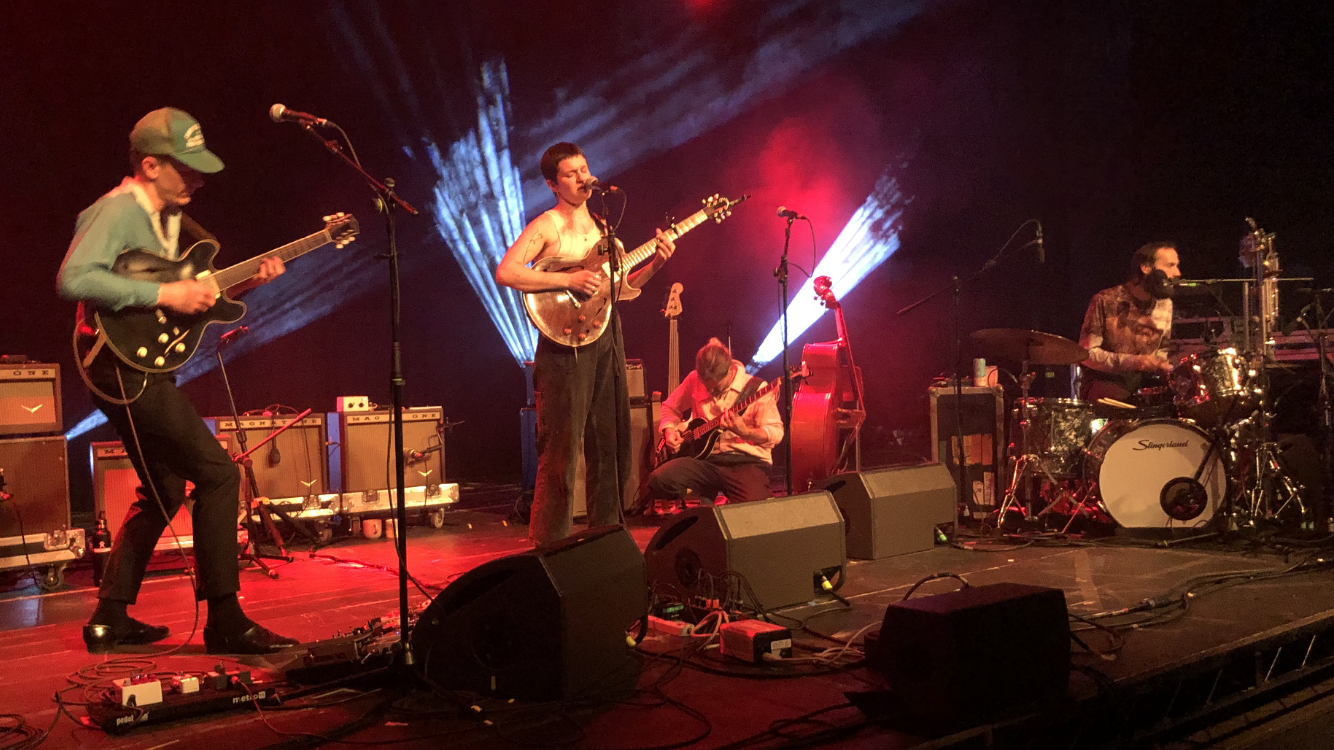
Words and pictures by Rick Burin. Photos, in order, are: 'Real House' in Dublin; London (final night); 'Real House' in Kilkenny; Dublin; the main window at St Canice's, Kilkenny; Adrianne and Nick Hakim in Glasgow; Dublin; Glasgow; Adrianne and Josefin Runsteen at the Barbican (final night); Manchester; Galway; Ellie O'Neill in Dublin; Galway; Dublin (below).

Saturday, 15 April 2023

Effortless audacity: Big Thief on tour

Sage Gateshead – 05/04/23
Usher Hall, Edinburgh – 06/04/23
Manchester Apollo – 07/04/23
The Great Hall, Cardiff – 08/04/23
Hammersmith Apollo, London – 11 and 12/04/23
Chalk Brighton – 13/04/23


There is a song that Big Thief have recently started playing called ‘Born for Loving You’.

If you want to understand it, there is a simple, biographical way. And then there is another way.

The simple way first: when the band’s frontwoman, Adrianne Lenker, was a student at Berklee, her music showcase betrayed the powerful influence of the husky, highway-fixated alt-country chanteuse, Lucinda Williams, right down to the very voice she was affecting. That influence hasn’t been as pronounced since (manifesting merely in the odd cover, with Lenker slipping back into Lucinda-voice), but as the band prepares to tour with Williams this summer, here’s a song – co-written with drummer James Krivchenia – that in its feel and its hook could be seamlessly snuck into Williams’ setlist. It may also be the straight-up sexiest thing that Lenker has ever sung (“Take me to the back of your pick-up truck,” she implores at one point, “show me a thing or two.”).

And now here’s the other way to think about ‘Born for Loving You’: no-one else on earth could have written this song.

‘After the dinos fell’: the world of Adrianne Lenker

In its first two lines, Lenker dispenses with the entire history of the universe up to her birth (“After the first stars formed, after the dinos fell/After the first light flickered out of this motel…”). That effortless audacity is characteristic. But the song’s conceit is not conceited: it is a way of understanding the magnitude of love. Everything that happened – to me, to us, to anyone – was just a prelude to this. From blood-soaked birth to teenage nightmare, via “waddling around, looking at birds”, well: “thank god we made it through.”

Dylan once said, “It isn’t me, it’s the songs. I’m just the postman, I deliver the songs.” And here is Lenker’s current online biography in full: “songs of all sorts from places unknown”.

The places are, admittedly, occasionally known. Across the seven shows on this UK tour, ‘Born for Loving You’ gets four airings: twice as a lush ‘70s California-style singalong, then as a plaintive solo ballad, and finally as a stripped-down full-band version with simple harmonies. For those last three, Lenker adds a coda: a falsetto snatch of ‘I Will Always Love You’ (Whitney version).

Yet even when the sources are, as she says, “unknown”, those songs come filtered through a unique sensibility: ideas are ingeniously inverted, images recur, motifs are endlessly shuffled. Her characters are gender-fluid, avian, feminist and quasi-biblical, traversing a world of blue skies, cluttered kitchens, bare plains and flat roads. Whether broken, fixed or flailing, they are loved.

And certainly she seems a conduit for whatever immortal music is floating in the ether right now, whether fragile or thundering. The most exhilarating part of following Big Thief on tour is the regularity with which miracles happen. “This is a new song,” Lenker will say, most nights, before playing the greatest fucking thing you’ve ever heard in your life. On the last tour, she composed ‘Wait a While’ on the ferry over from Dublin, performed it six times in concert, then retired it. It has never been released. Most musicians would kill to ever write a song just half as good.

But Lenker just keeps them coming. She begins the encore at Edinburgh with ‘Already Lost’, for which the word ‘timeless’ is barely sufficient (by the point she unspools the line, “How slow and how fast you are,” your soul has gone into spasm). She commences the second night at Hammersmith with ‘Sadness As a Gift’, which does for depression what ‘Change’ did for fear of death; turning your understanding inside out. She isn’t soothing you with song, she’s showing you another way of perceiving pain. While her between-songs badinage is regularly ridiculed by reviewers committed to the cheap shot, there’s something appealingly counter-intuitive about her worldview, about an artist who’ll tell a huge crowd that a mammoth show feels like a dream (so far, so banal), only to dazedly add: “I don’t really even mean career-wise, I just mean in general: it’s so bizarre to be a human being, and we all ended up here, right now.”

A live band who also make records

And here is where you want to be. You don’t know Big Thief if you haven’t seen them live. They are not a group you fall in love with at a distance: they are a live band who make records on the side; the intensity of their in-person performance rarely, if ever, transfers to your preferred streaming service.

Nor does its extremity. They continue to spread out in all directions, the quietest band on the circuit, and about the loudest. I saw them in Oslo last year during one of their particularly metal phases, an evening that did unspeakable things to my left ear. It is a decision I will never regret.

The live experience, gloriously, is never the same twice. That’s how I can justify seeing them seven times in nine days. Across those shows, they play 38 different songs, 14 of them just once. So if you want to hear their most popular song (‘Shark Smile’), a recent album track like ‘Blue Lightning’, or an unexpected cover of ‘Strangers’ by The Kinks, you’ll have to catch them in London, Manchester and Brighton. They start the second show of the tour, in Edinburgh, by playing four songs we haven’t heard the night before.

Every gig, too, has a different narrative, often built into the sweep of Krivchenia’s setlists. Edinburgh begins with that country-inflected singer-songwriter fare, before shifting into tortured rock, a sequence bookended by two absolute beasts: ‘Contact’ and ‘Dragon New Warm Mountain’. The former explodes into ugly metal screams; the latter continues to delight those who only know the gentle, balladic version that titled their last album.

That’s an emblematic number when talking about how their music continues to evolve, and how no Big Thief song is ever finished. At Gateshead – a curious, slightly muted show (presumably because it was largely seated) – ‘DNWM’ came galumphing out of the gate in a way that just made me think, “yeah OK, but we kind of did this last year”. The next night, it was reborn as a monster, and by Hammersmith, it had mutated into something unstoppable, the band adding more and more mad shit to it: a vocoder, a vocal-coda (Lenker’s drifting falsetto), and squalls of physically-induced feedback, Lenker turning her back on the crowd and throwing her torso at the amp. The song's opening line, "It's a little bit magic," is essentially now a public service announcement.

Not winning

Songs are in constant flux. While ‘Flower of Blood’ reaches its apogee on the first night – as if shoegaze died and went to Heaven, where the Shredding Festival was taking place – two of Lenker’s greatest songs don’t quite find their new place in the world until the final one.

‘Not’ often felt curiously tired, an incomparable song given oddly perfunctory treatment; and after glorious versions exhibiting the extroverted solo (2020) and the internalised one (2022), its climax here seemed technically impressive but hard to follow, either musically or emotionally. Manchester was an exception – Lenker beginning and ending the song on her knees, her guitar part suddenly pleading – while the first night in Hammersmith was an enjoyable anomaly in which she either forgot the words (not, ironically, for the first time) or just tried something new: a ‘Subterranean Homesick Blues’-style semi-rap on the verses. It’s Brighton, though, where the song comes to life again in exhilarating fashion. It’s longer, unerring, precise in meaning, Lenker drawing a defining message of futility from its endless negation, as she circles back for a last chorus, screaming the words “not winning” over and again, like some apocalyptic benediction.

She ended both the last UK tour and this one with ‘Change’ – her song about life gaining its very meaning from the existence of death – and while the deeply moving solo version that closed the Shepherd’s Bush run remains the indelible one, her message best delivered by a single voice, the four-part harmony and falsetto ending of this new reading also reaches its full flower by the seaside.

Other songs have been completely reworked. ‘Spud Infinity’ continues its transformation from a wispy, metaphysical ballad to a showcase for a band at its happiest and silliest, complete with Jew’s harp, stomping and a sing-along. While ostensibly a country song, it’s also a jazz number in as much as it allows for showy improv, including guitarist Buck Meek’s characteristically weird anti-solos. ‘Zombie Girl’, another song that Lenker played as a haunting solo song at Union Chapel in 2019, is performed in Edinburgh as a seven-minute prog number with two guitar solos.

At other times, the emotions are simply dialled up. Lenker’s guitar-play is further spotlighted in a newly funky, swaggeringly cocky ‘Simulation Swarm’ that contains two killer – and subtly different – solos, while the cult favourite, ‘Sparrow’ (whose accompanying t-shirt has become practically a uniform for teen girls paying pilgrimage), escalates into tormented fretwork. Simply ditching her acoustic 12-string is enough to conjure up a different world of ‘Cattails’, as if rural America finally got electrified. And in ‘Certainty’, she effectively improves upon perfection by dropping onto a blue note on the pivotal word ‘wild’, an innovation that makes the song more – not less – certain; and irrevocable, without end.

Real love: a horror show

Manchester, probably the best show of the tour, offers a first outing for ‘Real Love’ (Lenker memorably responded to audience cries for the song at Shepherd’s Bush by murmuring, “I know that one”, and mock-innocently singing a bit of the chorus). It’s a blistering rendition, with an extended solo, a huge riff and a similarly huge performance, Lenker grasping glorious, frenzied at the falsetto finale. It remains one of her greatest and most deceptively important love songs: a haunting and seductive marriage of adolescent goth imagery and childhood trauma. This is love as illness, incapacitation, sudden death; a life sentence; a horror show; a beating; a curse, endlessly repeating – and who doesn’t want love?

There are also the moments when Big Thief drag out a deep cut, and drag you around to their way of thinking. I didn’t get the fuss over ‘Change’ until the final moments of last year’s tour. Adrianne starts the first show here with a beautiful solo rendering of ‘UFOF’ – despite twice forgetting the words – a song I’d never cared about at all, before the band blasts out ‘Blurred View’ in a version that finally makes the song make sense: hypnotic and insistent. Other apparent filler from last year’s mammoth double-album grows in stature over the nine days, ‘Time Escaping’ in Cardiff emerging lopsidedly gorgeous from bizarre tuning and improvised wordless vocals; the yearning ’12,000 Lines’ rising to meet the majesty of its cosmic sentiments; a finger-picked ‘Dried Roses’ finally opening up in London, rather than repeatedly shutting its door in your face. In Brighton, the band turn the thin pastiche of ‘Red Moon’ into a total winner, the song racing past and carrying you with it.

And then there are those new songs. Alongside the ones already mentioned are ‘Horsepower’ – a groove-filled metaphor about fucking, via Top Gear Driving Classics, Vol. 5 – an amiable solo number called ‘Bright Future’, and a pair of instant classics. The sensual, longing ‘Ruined’ is one hell of a choice to kick off your biggest show in four years, while the raw and imploring ‘Free Treasure’ sounds like Springsteen’s more talented sister knocking about in the back yard. “Just when I thought I couldn’t feel more, I feel a little more,” Lenker sings, her voice breaking. Tell me about it.

Psycho-drama in Hammersmith

If the first Hammersmith show was, to me, the night she sang ‘Free Treasure’ solo (and the night I got to see my band with my best friend for the first time), then the second show felt more like a psycho-drama. In the 22 hours between, Adrianne had met up with her ex, and the band’s return to London had been damned with varying degrees of faint praise by the reviewers of two national papers. The armchair psychologist in me wonders whether that personal experience informed the quietly anguished elements of the show, while the professional brickbats inspired the setlist and the ferocious physicality. ‘Vampire Empire’ ended with Adrianne falling in tandem with the word itself, ending the song sprawled on her back; once up on her feet again, she took quite some time to compose herself for the repetitive, unrepentant, pseudo-cheery toxic ballad, ‘Happy with You’ (Krivchenia’s favourite Big Thief song). Incorporating ‘Masterpiece’ as recorded – rather than the conversational iteration performed the previous two nights – along with the only outings this tour of fan favourites ‘Shark Smile’ and ‘Mary’, this was the band’s version of a hits show, though they remain the only band whose hits show has four unreleased songs in it.

One of those is ‘Vampire Empire’, which – in typically offbeat fashion – Big Thief decided to showcase on prime-time TV, despite the fact it isn’t available to stream or buy. Whether that was 4D chess, agreeable iconoclasm or a mild form of commercial self-sabotage remains to be seen, but it’s looking increasingly like the former. Adopted as a Gen Z anthem, its spiky gender nonconformity (a preoccupation that found its most beautiful expression in Lenker’s 2016 song, ‘Paul’) might just boot them into the next level of rock stardom. Is it selfish to say that I hope not? I love this band, I don’t want to watch them in a large shipping container.

These spaces just feel right. In Cardiff, Lenker adapts her songs not just to her mood but to the acoustic peculiarities of the low-ceilinged Great Hall. After playing to 10,000 people across two nights at Hammersmith, the band could have treated the 800-capacity Chalk Brighton as a comedown; instead they embrace the intimacy.

Fashion rocks

When I wrote about the 2022 tour, I received two tweets that really stuck in my mind. One, from @roryisconfused, said: “I love that since I saw them 3 days ago, the bassist has dyed his hair pink.” Someone else, their name now sadly lost to history, wrote: “Each member looks like they’re in a different band.”

Last year, Lenker manfully continued with the solo to ‘Not’ despite the fact that what appeared to be a wedding dress was coming down around her. This time she has to negotiate the thrashing climax of ‘Contact’ with a green beenie having fallen down over her eyes. This band suffers for their art, but also occasionally for their fashion. In Gateshead, they are wearing: an untucked pink satin shirt and tall hair (Buck, guitar adornments); a silver jump suit and matching sandals (James, drums); a pale pink dress (Max, bass); a cut-off motorbike shop t-shirt, old black jeans and silver tooth (Adrianne).

Each has a stock expression on stage. Krivchenia’s mouth hangs open, as if in a drum-induced trance. Meek endlessly shakes his head, his front leg bent, a slim shoe pointing towards the crowd. Bassist Max Oleartchik greets regular deviations from formula by shrugging contentedly and giving it the big lower lip. And Lenker has three principal modes nowadays: eyes closed peacefully for a solo spot; eyes closed tormentedly for a howling guitar break; hopping from one foot to the other in a hoedown style when she feels the need to lighten up a little.

Her place on stage was always front right, but apparently a bad back has forced her inwards. Ironically, shifting to centre-stage makes her seem less like a solo act with some willing accomplices, and more like one of the band. She also seems younger on this tour, somehow. Maybe it’s the hair: a tomboyish tuft rather than the blonde buzzcut that made her look so otherworldly at Shepherd’s Bush. She was married to Meek, way back in the mists of 2015, and their dynamic remains hugely touching. For his part, he is possibly the most wholesome person on earth. In Edinburgh, he tells a story in his faltering southern twang about how as a child he stayed in a nearby castle where his grandfather – a dealer in antique coins – made the children a treasure hunt in which they had to find doubloons. Alright, Keith Moon.

Sadness as a gift

That gentleness extends to the whole band. Most nights, they spoil the big rock star reveal by shambling onto the stage an hour early to introduce the support act and ask the audience to be quiet and attentive. Lenker says in Hammersmith that it’s the part of the show that makes her most nervous. What I pretentiously took to be a delight in linguistic invention when she did it at EartH, may, instead, just be mere awkwardness.

But the vagueness that can beset that plea, or her chats between songs, vanishes when she sings, or writes, or plays. Her commitment to emotional truth habitually forces her to disrupt the band’s best laid plans by politely interpolating whatever song she suddenly feels like playing (you can think of their printed setlist as an interesting alternate reality). And it informs both the sincerity of her singing and the specificity of her songs. Even if the songs still come from ‘places unknown’.

In ‘Sadness as a Gift’, perhaps the most vivid example of Lenker’s ability to leap repeatedly between the everyday and the eternal, she addresses a lost lover. “You and I both know there is nothing more to say,” she begins, before saying it anyway, if only to herself. The song builds to a remembrance – or an offer? – of profound simplicity, as Lenker croons with a fractured strength: “You could hear the music inside my mind.”

I just feel privileged to live in a time when I can do the same.

***

With thanks to old friends and new on this tour: Paul, Jess, Jamie, Sorrel, Jordan, Chris and Orlando.

Setlists:
My pieces on previous Big Thief tours: 2020, 2022

Wednesday, 11 March 2020

Big Thief on tour


BIG THIEF at
Hammersmith Apollo, London (27 Feb)
Rock City, Nottingham (29 Feb)
Albert Hall, Manchester (1 Mar)
Ancienne Belgique, Brussels (5 Mar)
Paradiso, Amsterdam (6 Mar)


Every time you see Adrianne Lenker, she’s three different people. This month I’ve seen her five times.

It started like this. Last year I watched her enchant Union Chapel, picking at an outsized acoustic guitar, tooth missing, hiding behind a thatched fringe, whispering whimsical self-penned songs that seemed to be about potatoes but were suddenly about the cosmos. Four months later (two of which I’d spent in hospital), she played the Roundhouse with her band Big Thief, four disparate, perfectly and weirdly simpatico Brooklyn alt-folk scenesters.

She’d shaved her head and she was just screaming. Swaggering and screaming, guitar like a machine gun.

Later in 2019, her band played Bush Hall in one of those small miracles that London serves up now and again: announcement on Thursday, on sale Friday, gig on Monday, previewing their second album of the year, Two Hands, doing it in full for the-first-and-only-time, figuring out how to play these songs live, before our eyes, something between a workshop and a front seat to history. Since then they’ve been lauded by Pitchfork, the Guardian, and Barack Obama(‘s PR consultants), but it was how the shows made me feel. After Suede and the Manics gave way to The Strokes and The White Stripes, I thought I was through with bands – that really bands were the kind of thing you grow out of, like Ricicles or the Socialist Workers’ Party. Then The National came along and asked if that was in any way a tenable position. Big Thief set fire to it.

I had tickets to the London show, had the flyer magnet-pinned to my fringe for close to a year, but Big Thief aren’t a one-evening proposition. They’re mercurial and explosive, allergic to convention and setlists – to having a set list for more than one night in a row, even to sticking to the one drummer James Krivchenia has written – and seeing them just once suddenly seemed perverse. Like listening to Mahler’s Ninth once, enjoying it and then smashing the vinyl on the sideboard. Instead I could spend all my money going to Nottingham. And Manchester. And Brussels. And Amsterdam. Anywhere there were sympathetic Burins with fold-out sofas and an accepting attitude to turning up two hours early for gigs.

OK, I missed Glasgow and Paris somewhere in there, but the five shows were like a suite, or a Gus Van Sant film from back when he was great, and I’m left with this: a series of impressions, a juggling of snapshots, a succession of reinventions: the same but different, different but the same.


Hammersmith is first and it’s your erratic epic – their biggest gig ever, perhaps their longest. Big Thief are the only band whose singer’s hair is a continuing psychodrama of its own, and she turns up looking like Henry V. “He that outlives this day, and comes safe home/Will stand a tip-toe when the day is named/And rouse him at the name of Crispian,” says the grown Hal, and Lenker is a soul obsessed with home: the “good home” of ‘Parallels’, the home that everyone deserves in ‘Forgotten Eyes’, the home confused for a refuge in ‘Rock and Sing’. And this few, this happy few, this band of brothers so fierce in their gentle, sporadic, lolloping way: three men and this androgynous tour-de-force, Lenker unshaven and muscular and suited, spinning tortured love songs that are, upon inspection, not love songs at all but explorations of the male selves that at times flicker to her forefront. “Oh, the last time I saw Paul,” she breathes in one of their debut album’s heartstopping moments, “I was horrible and almost let him in.”


There are concessions to commercialism, or at least pragmatism, in London, but Big Thief are still just so irregular and counter-intuitive, and weird, and heavy, and fey. Which other band would kick off a landmark show with a new song called ‘Zombie Girl’, played acoustic and solo? Which band would meet every ovation with a wistfully abstruse deep cut? Or consent to an encore (by no means a given) from a pissed-up crowd of 5,000, do only a subdued ‘Rock and Sing’ and then leave. They quietly reinvent the Spotify Top Songs stuff – angular guitars, drum-and-vocal bridges, rolling rhythms – but at that stage I’m just getting attuned to it. I leave muttering something about Lenker being the only New Dylan since Dylan. You know in ‘Love Minus Zero’ when he sings, “My love, she speaks like silence”, or ‘Visions of Johanna – “The ghost of ‘lectricity howls in the bones of her face” – well no-one writes like that. But Lenker does. Not like Dylan, exactly – because what’s special about that? – but prolifically singular, with his perfect abstract specificity. “Your eyes were like machinery,” she sings in ‘Mary’. “Your hands were making artefacts in the corner of my mind.”


At Nottingham’s Rock City, bathed in blue, they manufacture atmosphere, then feed off it, swelling to twice their size (I’m on the front row now), pressing inexorably forward. “I love you, Adriana,” yells a male voice from the back of the room. Lenker scowls, says nothing. He says it once, twice, half-a-dozen times. She looks at her feet. It’s when two teenage girls begin to speak, freaking out at being in the same room with her that she engages. “I just love these songs so much,” says one, pushing her way forward, beginning to cry. Lenker, who’s crouching down over her guitar to fiddle with the amps, smiles, contorts her fingers into a thin and sturdy heart.

The show is intense, and in its intensity the tour’s themes start to reveal and congeal. You realise what a political record Two Hands is, with a directness that can only be communicated in person. ‘Not’ is an explosion of cathartic anguish, with something of Sleep Well Beast’s state-of-the-nation remit, a list song that exalts through endless negation, like Cole Porter just went fucking mental. Seen through the squall are Bible-old traumas and rampaging ills: climate emergency, consumerism, mortality, listlessness, loneliness. And at some point words are no longer enough, no matter how perfect the words, like when the harmonica comes in at the end of Dylan’s Sad-Eyed Lady of the Lowlands, and then ‘Not’ spirals into horror, madness, purposeful fury, and finally release; a howl, a blast of noise, a guitar solo that’s half-rehearsed, half-improvised, and by Amsterdam will be refined, Lenker no longer on her haunches, twiddling amp dials, but trading sonic perfection for picturesque rage, because the display, the physicality is part of the thing, if not the whole thing.


‘Forgotten Eyes’ is empathetic: a big hug, a socialist manifesto viewed through a hippy aesthetic. But ‘Shoulders’? That’s merely harrowing: domestic violence in primary colours, the sins of the father as anthem; at one point I turn half-around to see the whole crowd chanting in unison; it’s a definite moment, but it isn’t comfortable. In Manchester, Lenker will turn ‘The Toy’ into a stylised pantomime, her right hand a gun firing skywards as childhood play turns into misadventure, love transmogrifies into murder, and the horror of sudden, eyes-wide realisation twists America into an apocalyptic hellscape. But that’s not yet: here it’s just fraught and ugly. As these new songs flex their muscles, others are dragged into the present: the political present; the musical now – dragged upwards as the band degenerate into grunge. And then when it’s over, there’s just ‘Magic Dealer’, gentle as a sparrow in the dawn.

Manchester, though, is about those gestures. Lenker stretches out a hand towards the child by her side, before ‘Capacity’ turns introspective. She tracks a tear down her cheek. She fires the finger-gun. Birds fly away. And in ‘Masterpiece’s new, stompy segue, she clomps across the stage in black boots, facing away, the song as funky as it can ever get and still stab you in the heart. Because when she’s stopped playing at being the rockabilly George Clinton, she’s still got to go back to the mic, got to tell us that there’s only so much letting go you can ask someone to do.


She is avian. High cheekbones and a hooked nose. The wild, ethereal twitter of her head voice. And when she nods to a fast, burgeoning riff, ‘Shark Smile’ coming to life, her heads bobs and juts like a pigeon’s. Yes, she’s birdlike. Almost brittle. But her middle-range is powerful and her lower-range is brutal, and there’s such strength in this band. They’re pastoral and sensitive, but if you pollute that lake, they are going to fucking kill you. She handles her guitar like a feminist manifesto, and though it’s hard to find a new way of playing guitar live, rock clichés sit lightly on you when you’re a genius. Lenker moshes with a Beatle cut, backpedals as she thrashes out chords, delicately stamps her feet and shakes her head as ‘Forgotten Eyes’ takes shape, and screams as ‘Contact’ is made: the long, slow prelude, then skin touches skin, or metal touches brain, or a mind lurches awake, or somewhere in that vast empty blackness, something responds.


So often, her eyes are closed, and they flicker open to gaze into yours or just into the middle distance. She breaks sparingly but completely into a smile, into nervous laughter. There are thank yous, at times that feeling of being quietly overwhelmed that a band get when they’re suddenly big, but that comes only when they speak, and the spell of impetus slackens. In Brussels there’s a soliloquy about Europe. The cobbled streets… the beauty… wanting to go there, but feeling afraid. It’s not scary, though, it’s people, says Lenker – and stone. In Minnesota, everything was thin, but… no… there’s beauty there too, and she’s into ‘Cattails’, which rocks, but like a hand on a cradle, a part-cryptic bucolic lullaby, a deceptive 12-string dance track about the natural world, full-to-choking with beauty, in its imagery, its sounds, its meter. “And the clusters fell, like an empty bell,” sings Lenker, the rhythm so infectious that she’s proto-rapping. “Meteor shower at the motel.” It makes my throat swell.


She plays around with those rhythms, always. In ‘Mary’, her hypnotic, lulling fast-talking can either speed or drag, make the song lost and dreamlike, or else relentless and pretty; she injects urgency, uncertainty, certainty into ‘Not’. The freakout jams are different every night.

The setlist changes every night too, but there are runs of songs, and you get to know them. ‘Masterpiece’ into ‘Capacity’ – sad and sensual, spinning the heartbroken lover trope into bisexual erotica – then ‘Shark Smile’ and sometimes ‘Real Love’, that exquisitely painful smash-and-grab that takes one look at songs that glorify abusive relationships and decides that actually I’ll probably be alright, thanks – and suddenly you’re the kid watching his alcoholic mum get the shit beaten out of her by its dad. In Brussels, the poignancy almost drowns you, the “hummingbird” passage offbeat, strange and haunting, like it’s broken out of The Innocents: a quiet, haunting new song, the child’s song, suddenly growing out of this old one. In Amsterdam that’s gone forever, but the song is a monster, stretched out and violent. That show is the heaviest of the lot, ‘Shark Smile’ sped up, aggressive but still insouciant, its lust barely dampened by its auto-wreck tragedy.


Then there’s the acoustic stretch: for some of it the band take a back seat and, in bassist Max Oleartchik’s case, a literal one. ‘Orange’ is one of the loveliest, most straightforward songs Lenker has ever written – that’s played in London, then comes back for the Benelux gigs. There are new tracks: the conventionally attractive ‘Zombie Girl’; ‘Dried Roses’, premiered in Nottingham, which takes Lenker’s whimsical-metaphysical thing near to the point of parody but damn-near breaks you anyway; and ‘Time Escaping’, which eludes me still; I don’t remember it, nor how it goes. Maybe one day. She’s backed by the band for ‘Happiness’ – another list song, Lenker-style – for the rocky ‘Bruiser’, for the gorgeous ‘Two Rivers’, which meanders through familiar territory with an iridescent beauty. She picks a repetitive pattern over Krivchenia’s brushwork, voice scaling mountains of arpeggios, checking out the scenery, until finally she gets to the crux of it, words trembling: “Is it a crime to do what you ask me to?”

Krivchenia is a superb drummer, and his languorous expression – leaning forward, mouth lolling open – sets some sort of tone. He cracks one smile in five nights. Oleartchik – feet bare, clad in a pink onesie or a dress, often-times perched on a stack of amps – is unaffected, unobtrusive and unfussy, as if he’s scarcely realised he’s playing bass. And Buck Meek, extreme left of the stage, as Lenker is centre-right, has his knee eternally bent, slim shoes that feel like they should be winkle pickers, leaning towards her, towards Krivchenia, looming almost, lurching with those thin legs as he issues spare notes and shimmering soundscapes, but his talent sublimated to his group, with just the odd lead guitar part. And sometimes he’s scarcely playing at all, but fuck me those vocal harmonies, lifting ‘Mary’ and ‘Masterpiece’ still higher – and it’s only when he comes in, adding to Lenker’s voice, to Krivchenia’s, to Oleartchik’s, that you realise those sharply uptilted Texan vowels were what was missing. High forehead, hair like corn drifting back in a stack at the back of his head; guileless, polite, deceptively brilliant; when Lenker goes off, and yes she goes off, he instinctively complements her crackling invention, their chemistry absolute, and you think of that photo of them in front of the camper van on the front of ‘A Sides’, when they were a couple, perhaps halfway to getting married. In Amsterdam there’s even a rare concession to practicality, as he gets a solo spot, because he’s back later in the month as a solo supporting act, and he has tickets to sell.


So yes it’s a band, and if they ever split up, I will cry, but for all that it’s Lenker’s band. Walking on stage with wet hair, in high-waisted trousers, stripping off her suit jacket to unmask a sleeveless top – white or blue or khaki – after a frenetic guitar solo, an illegible tattoo snaking down her arm, she holds you for 90, 100 minutes in her thrall. She comes face-on to the audience just once, as ‘Masterpiece’ reaches its zenith; otherwise she’s off to one side, one of four points, but the driving force, content in her endless capacity. With three people, and three people herself.

***

Setlists:


Saturday, 30 June 2012

Review: The Stone Roses at Heaton Park, Manchester

Friday, June 29, 2012


As the 11pm curfew falls, fireworks explode across the Manchester sky and Bob Marley’s Redemption Song floats from the speakers around Heaton Park, it is something like a perfect moment.

It’s strange, perhaps, for the evening’s euphoria to congeal into this tranquil, whispered climax, 70,000 faces turning their backs on the stage to watch pretty patterns in the night sky. Strange for this pivotal moment to occur after the band has disappeared, the reverb of I Am the Resurrection replaced by the whizz-bang of lit gunpowder. But there was nothing ordinary or predictable about a night which most of those 70,000 – not least the four on stage – thought would never happen.

And the musical pay-off? Marley's song is appositely-named, to say the least.

Yes, there are greater wars to be fought on this earth than ones involving Mancunian bands, but this was still a night of redemption for an iconic group that threw it all away not once but twice: first by going missing at the peak of their powers (not all their fault, I'll grant you), and then by inexplicably imploding when they were perfectly poised to cash in commercially and artistically on the British indie guitar boom they did as much as anyone to inspire.

Strolling nonchalantly onto the stage at 9 o'clock sharp, basking in the adulation and then breaking into an atypically rocky I Wanna Be Adored, the Roses set about obliterating the brickbats of tiresome commentators, blowing away concerns that this was only about the money, that it was a pointless exercise, a hollow nostalgia trip or a spectacle unbecoming of a group of 40-year-olds.

Their remarkable two-hour set, before a convivial, woozy, boozy, largely stoned and endlessly pointing audience, included every song from their seminal, self-titled 1989 record, the best three songs from the hubris-tastic follow-up Second Coming – with lost anthem Ten Storey Love Song comprehensively reclaimed by a bellowing crowd – two stand-along singles of inestimable importance, and a trio of unforgettable flipsides. It always seems like a big, pretentious fib when someone claims their favourite song is a b-side, but aside from the first and last songs on their debut, Where Angels Play takes some beating. Tonight we get a glorious reading, segueing into Shoot You Down.

On a stage flanked and backed by big screens showing close-ups mixed with inventive, lemon-heavy visuals, there’s ample room for frontman Ian Brown to prowl, and easy access to a horizontal gangway where he periodically disappears to stroke the hands of the front row. His vocals always get a pounding from cynical critics, but – at least in terms of what you could hear above a perpetual crowd chorus – there was only one song in which he was flat out singing the wrong notes, and that was the closer, I Am the Resurrection. In totemic terms, he was faultless: everything was channelled through him and there was no false gesture (nor any false modesty) in his crowd-commanding performance.

The band had promised a modern spin on their classic sound and they delivered, the same three-piece group delivering a meatier, heavier, more muscular sound, complete with some inspired noodling from guitarist John Squire. If Brown signed up for the gigs on the basis that he could pay for his divorce, Squire presumably did so on the proviso that he be allowed to play a six-minute guitar solo during every song. The one during an exultant Fools Gold was a belter, and the sort of musical diversions that seemed like introspection or even self-indulgence on the second record worked ideally in a live setting, complementing a hit-heavy opening with artistry and originality. I’m not sure everyone was so enamoured by the periodic shifts from singalong to jam session, though. At times you could see feet shifting and slight boredom setting in as Squire settled into another complex fingers-of-fire routine.

There was a rant from Ian Brown about the Royal Family (to whom he dedicated murder fantasy Elizabeth, My Dear), a lot of boasting about the scale of the band's achievement in putting on these shows – self-aggrandisement tinged with self-deprecation – and also the singer’s attempt at a rap, in which the only audible words were “Stone Roses” and “Heaton Park”. But such things were mere trivialities besides a band who just did everything right as they reconnected with fans who had lived for this day, but never expected it to arrive.

The highlights? There were too many to choose from across an exhilarating show, but here’s for starters: a blissful Where Angels Play, versions of Sugar Spun Sister and Made of Stone that lifted you off the ground, and one of the loveliest moments I’ve ever had at a gig: our entire family unit hugging, leaping and singing as one to This Is the One, as all around everyone else did the self same thing.

These ‘80s indie-rock tunes aren’t the important “songs of freedom” to which Marley referred, nor are the audience in need of rescue or emancipation, but – to borrow from another great modern songwriter – the rain falls hard on this humdrum town, and this night of escapism, nostalgia and, yes, redemption, was one we’ll never forget.

***

Setlist:

I Wanna Be Adored
Mersey Paradise
(Song For My) Sugar Spun Sister
Sally Cinnamon
Where Angels Play/Shoot You Down
Bye Bye Badman
Ten Storey Love Song
Standing Here
Fools Gold
Something's Burning
Waterfall/Don't Stop
Love Spreads (inc unintelligible rap)
Made Of Stone
This Is the One
She Bangs the Drums
Elizabeth, My Dear
I Am The Resurrection

***

Support acts: I saw a smidgen of The Wailers, who were decent, while main support Primal Scream were excellent, playing a frenetic set lit by stunning versions of some of the best songs on Screamadelica (and unfortunately also doing Swastika Eyes).