Showing posts with label Antonio Banderas. Show all posts

Wednesday, 11 May 2011

Robert Rodriguez's Mexico Trilogy - Reviews #68


In 1992, Mexican director Robert Rodriguez burst onto the scene with a low-budget, Spanish-language thriller about a musician hiding out in a small town having been mistaken for a deadly criminal. El Mariachi was followed three years later by Desperado, a glossy Hollywood actioner where the title role was taken up by Antonio Banderas. A conclusion to the trilogy arrived in 2003, on which Rodriguez spanked $29m - more than 4,000 times what the first film cost - as he looked to emulate part three of Sergio Leone's slightly overrated Dollars Trilogy, The Good, the Bad and the Ugly. What I've done is, I've watched the films and then written reviews of them.


*SOME SPOILERS*
El Mariachi (Robert Rodriguez, 1992)
- Rodriguez's debut feature, shot in two weeks for $7,000, is a heady mix of grisliness, wry humour and charm, as a travelling guitarist (Carlos Gallardo) is mistaken for a ruthless killer, turning him from lightning-fingered balladeer to lightning-fingered desperado. It's an excitingly rough and ready mission statement, with bloody action scenes, a touching romance and a great use of voiceover, as our hero harks back to the mariachis of old, lending the film a timelessness and cultural relevance. Rodriguez allows some cheesiness to creep in when slimy '80s-style villain Peter Marquardt is on screen, but it's a minor shortcoming in this excellent little film, which milks the mistaken-identity plot for all its worth, aided by Gallardo's considerable charisma and likeability. There's even time in its 82 minutes for us all to stop and listen to a nice song. (3.5)


The first sequel, Desperado (Robert Rodriguez, 1995), kicks off in spectacular fashion, with Steve Buscemi regaling barman Cheech Marin and his pals with the story of a near-mythic gunman, "the biggest Mexican I have ever seen". His tall tale is intercut with exaggerated footage of El Mariachi (now played by Antonio Banderas) wiping out a bar-full of real lowlifes. "I think he's headed this way," Buscemi adds helpfully. For 50 minutes, the film maintains that momentum, setting up its Leone-ish story through a series of deft set-pieces as Banderas blasts up a second saloon, gets acquainted with leggy book-store owner Salma Hayek and encounters a knife-throwing mystery man (Danny Trejo). But then the story gets away from Rodriguez, becoming repetitive and uninteresting as it sets up a run of increasingly desperate action sequences. Banderas is good in the lead, but the film's concessions to conventional "cool" are pretty tiresome compared to the individuality, wisdom and bracing bleakness of the first instalment. (2.5)

Trivia note: That's the original El Mariachi, Carlos Gallardo, as Banderas' buddy Campa - the chap with the rocket-launcher guitar case.


Once Upon a Time in Mexico (Robert Rodriguez, 2003) - So this is how the trilogy ends. Not with a bang, but with a succession of massive bangs. The first sign that Rodriguez might be getting a little carried away is in the credits sequence, where Banderas strolls to the top of a cathedral and we pull away to an obscenely, self-consciously grandiose helicopter shot that must have cost more than his entire debut film, the music swelling in mock-Morricone style. Then our hero watches a blameless pensioner get shot for protecting his identity and you begin to think: 'Perhaps a little more time could have been spent on the story.' It's a confused, portentous film that weaves its many narrative strands with the casual grace of a dead rhino, as CIA agent Johnny Depp tries to engineer a revolution to his ends, Banderas hunts the man who killed his wife and daughter, and Eva Mendes wears a succession of very tight-fitting tops. There are individual sequences that work well, particularly another flashy opening that's rich in mythology and a flashback that sees Banderas and Hayek escape from a fifth-storey flat whilst handcuffed to one another, but the overall effect is deadening. Rodriguez certainly knows how to mess up the end of a trilogy, doesn't he? (2)

Friday, 6 May 2011

Spy Kids, baseball and the worst film I've seen in years - Reviews #66


Spy Kids (Robert Rodriguez, 2001) – This is a wonderful children's movie: intelligent, wildly imaginative and with plenty of heart. Daryl Sabara and Alexa Vega are appealing as the troubled kids whose tedious suburban life is turned upside down by the revelation that those bedtime stories were real, and their parents (Carla Gugino and the excellent Antonio Banderas) really are super-agents. Now all they have to do is travel to the remote island castle of an eccentric kids TV presenter (Alan Cumming) who's imprisoned their mum and dad, fight some henchman made of giant thumbs and defeat an army of robot children. Rodriguez, who also scripted, edited and co-scored, perfectly juggles the diverse elements, creating a movie that's as funny, entertaining and original as any live-action kids' film of the last 20 years. From the super-stylised pre-credits sequence - showing Gugino and Banderas gettin' it on - to the heartfelt post-action pay-off, this is something very special indeed. (4)

***


Spy Kids 2: The Island of Lost Dreams (Robert Rodriguez, 2002) is an absolutely exceptional sequel that takes all the best elements of the first film - humour, warmth and pencil-moustaches - and throws in some giant hybrid animals and Steve Buscemi as a mad scientist, with predictably awesome results. Sabara and Vega return, this time battling a shadowy power-crazed villain, while trying to out-do a pair of rival, showboating spy kids. As you might expect, their quest involves camping out on an island populated by oversized beasts, like a 20ft half-spider/half-gorilla. Not to mention several Harryhausen-homaging sword-fighting skellingtons. Rodriguez expands his scope, adding romance and another generation of super agents (Ricardo Montalban and Holland Taylor as Gugino's parents), without diluting the sense of wonder, excitement or emotional clarity. My favourite gag is the little toddler weighing into the fight at the awards dinner. In the spirit of full disclosure, I should add that the musical end-credits sequence is rubbish. (4)

***


Yes, it really is this rubbish.

*SPOILERS*
Spy Kids 3: Game Over (Robert Rodriguez, 2003)
is an inexplicably dire third outing that takes place largely in a virtual-reality universe, flinging things audience-wards in a way that apparently realises the full benefits of 3D, while ignoring all of cinema's other possibilities. Juni (Daryl Sabara), now an ex-super-agent, is forced to return to the fold after his sister is frozen in a video game by slurring megalomaniac Sylvester Stallone, cueing a series of terrible CGI set-pieces. There are a couple of laughs, including the appearance - and then swift demise - of The Guy (a surprise cameo), but the film is full of superficial sentimentality and entirely devoid of magic or invention, trading idly on the goodwill from the first two movies. Disappointingly, Sabara plays Juni as if he were a different character: self-consciously cool, and lacking in the nerdy appeal essential for the part, while the sequences with Stallone and his unfunny alter-egos are beyond parody. This is like watching someone else play a video game for 80 minutes. (1.5)

***


At no point does this, or anything like this, happen.

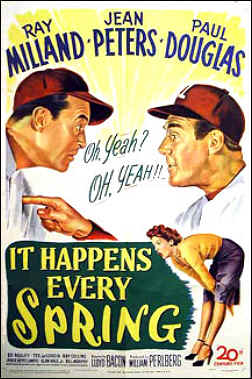
It Happens Every Spring (Lloyd Bacon, 1949) is a sporting comedy that takes a fun premise and knocks it out of the park. Ray Milland plays a professor who inadvertently discovers that his new solution can keep baseballs away from bats, launching him on a wildly successful pitching career. It's clever, atmospheric, amusing and sometimes very tense, with some thoughtful things to say about hero-worship and America’s obsession with its national game, an excellent supporting performance from Paul Douglas and a particularly satisfying ending. (4)

See also: To read about The Doctor Takes a Wife, a screwball comedy starring Ray Milland, go here.

***


Oh shut up. Your character makes no sense.

Mamma Mia! (Phyllida Lloyd, 2008) - This has put me off Abba. And Julie Walters. And possibly cinema itself. I couldn't stand anything about it, from Meryl Steep's grating singing and "look at me, I can be fun" characterisation to the teeth-achingly dreadful script - which crowbars the numbers in with staggering artlessness - witless staging and uniformly annoying performances. Except Colin Firth, he was kind of OK. Without hyperbole, the worst film I've seen for two years. (1)