I had a holiday the other week, and watched eight films. I've written about them here:
 Heaven's Gate (Michael Cimino, 1980)
 − I love the idea of
Heaven's Gate − a peerlessly ambitious artistic statement patronised and dismissed upon release but now rightly given its place among the all-time greats − but the reality is that while every shot is astonishingly and violently beautiful, it's also incredibly boring, Cimino much more interested in creating a world than telling a story. All there is, across 317 minutes on PAL DVD, is a tired love triangle against the backdrop of the Johnston County Wars.
Vilmos Zsigmond had shot three of the best-looking Westerns of all-time before this one: psychedelic experiments
The Argument and
The Hired Hand, and Altman's grubbily realistic
McCabe and Mrs. Miller, which had set the genre off in a new direction.
Heaven's Gate, now the most notorious flop in Hollywood history, began with Cimino going 10 days behind schedule two weeks into filming, and on course to spend 500% more than the original budget, due to his painstaking approach, while included demands for 70 takes of many scenes, and his view of each shot as a painting to be filled in by extras.
The resulting imagery is like nothing else in cinema: the shadow of a gunman on a drying sheet, then a dying man seen through the bullet hole ripped in it; rollerskating ranchers dancing in sync in the Heaven's Gate chapel; workers toiling in a spring field; mercenaries appearing over the brow of a hill; endless clouds of smoke and dust backlit by the broiling sun. And it's all accompanied by David Mansfield's magnificent score, which feels totally authentic and utterly fresh.
If this was a tone poem: fine, but it's not, as it spends an inordinate amount of time on its story, with every single scene outstaying its welcome. Cimino offers us nothing to get our teeth into: there's no emotional connection with any of these dislikeable, poorly-drawn characters, except perhaps for John Hurt's dissolute sell-out, and he isn't necessarily believable in this context, even though the actor himself is absolutely sensational. There's one scene between boring gruff Jim (Kris Kristofferson) and confusing, French Ella (Isabelle Huppert) near the end that I found quite affecting, but across three-and-a-half hours, two minutes of emotional interest is quite a poor ratio.
There are quotes all over the DVD case telling me that it's a neglected masterpiece, but it's simply not, and that does a disservice to all the genuinely great movies that can't find an audience because we're too busy pretending that this flaccid, tedious, miraculously-photographed bore is worthy of critical and popular rehabilitation. I don't doubt that Hollywood moneymen relished the opportunity to seize back artistic control from the directors who had briefly held the advantage, but Cimino didn't half give them a good excuse.
(2)
 Hubris central: Michael Cimino chuckles about going over the one-million-feet-of-film mark, little realising that he'll never be allowed to shoot a major movie again.
Final Cut: The Making and Unmaking of Heaven's Gate (Michael Epstein, 2004)
Hubris central: Michael Cimino chuckles about going over the one-million-feet-of-film mark, little realising that he'll never be allowed to shoot a major movie again.
Final Cut: The Making and Unmaking of Heaven's Gate (Michael Epstein, 2004) − It seems an easy, lazy jibe to say that this doc is more entertaining than Cimino's film, so I'll do that. It's a fun, fast-moving chronicle of What Went Wrong, with a mixture of talking heads (producers, the assistant editor, a few cast members, and archive interview footage of Cimino, who declined to be interviewed), contextualisation provided by narrator Willem Dafoe and some old news clips, and a handful of illustrative snippets from the movie itself, though it's slightly ridiculous that considering the director shot 250 hours of footage, and we spend so much of the movie talking about his method and the vastly differing takes he requested, that there isn't a single frame of unreleased film in this making-of documentary. You're only really getting the headlines here, but it's such a cracking story that anyone interested in movie history is going to love it.
(3)
***
 *SOME SPOILERS*
Dangerous (Alfred E. Green, 1935) − For 50 minutes, this is a quite brilliant drama of sexual obsession, with Franchot Tone as an architect falling for a boozy, washed-up actress (Bette Davis) who's 'jinxed' a half-dozen men, as well as half of Broadway. It's not dissimilar to
Of Human Bondage (it even trades on the likeness in the trailer), the film that made Davis's name the previous year and in which her filthy commoner drove Leslie Howard half-insane, though the tone – like its leading man – is a little lighter, while her character is smarter, more sentimental and much more likeable than the cruel, gobby waitress she played there.
It's interesting how much this movie's concerns foreshadow film noir, in which happily married men willingly jack in the American Dream when their dicks start making decisions for them, and Davis was never more fascinating or sexy than she is here - even if her opening two scenes may suggest otherwise! In fact, I've never seen her better than she is for two-thirds of this movie: slipping so casually and convincingly between modes and moods, crafting something timeless from shreds of script, that it's like watching real life, only much more exciting. She's aided by direction that catches her in a succession of Ernest Haller close-ups: harsh and overlit at first, then lush and lingering, lit like a heart-melting dream. Tone, for what it's worth, is giving one of the best performances of an often disappointingly mild and unambitious career, with Alison Skipworth offering solid support as his stoically loyal housekeeper.
Then the film takes a sharp left into melodrama and off a cliff.
Of Human Bondage was released three days before the strict imposition of the censorious Production Code, and while it also goes big at the close, it merely loses some momentum, rather than turning into a travesty. By Christmas Day 1935, when Dangerous came out, Hollywood still hadn't worked out how to incorporate the often absurd new rules – which determined that characters must be punished for any behaviour that transgressed its strict teachings on personal morality – without screwing up the endings of its movies. This one becomes so suddenly and violently unhappy at adulterous love that it turns its female protagonist into a psychopath and then forces her to cloyingly repent, a development that's both hideously conceived and incompetently executed.
That's a major disappointment, but it doesn't detract from the enrapturing, adult first 50. I'm glad that the DVD I ordered of '40s rom-com
Come Live with Me arrived with this printed on it instead.
***
 Margin for Error (Otto Preminger, 1943)
 − I only happened to see this because it's on a DVD with a film I really like:
A Royal Scandal, Tallulah Bankhead's best cinematic vehicle, which was started by rom-com master Ernst Lubitsch but completed − after his untimely demise − by stable-mate Otto Preminger, who also directed
Margin for Error. It's the first movie I've ever seen starring wise-cracking radio comic Milton Berle, and I was expecting dated gags and excessive mugging, like you'd get with a George Formby or Eddie Cantor vehicle. Actually, he slots quite effortlessly into this fascinating time capsule, playing a Jewish beat cop who's asked to guard the Nazi consulate in New York, locking horns with a hulking Teutonic sadist played, not unsurprisingly, by hulking Teutonic sadist Preminger.
Its propagandist elements are immediately apparent, but they're handled in a really great way, right from the framing sequence aboard a Naval ship, in which sailor Berle tells his mates to lay off the German-American in their midst (Carl Esmond), who it soon transpires was a Nazi functionary before something changed his mind: cue the flashback. That story ultimately gets a little bogged down towards the end, with a succession of developments more reminiscent of farce than thriller, but for the most part it's a very entertaining ride, with Berle a pleasant hero and Poldi Dur an absolute joy as his love interest: a sweet, cheery German maid just getting to grips with her first smattering of English phrases. Joan Bennett, meanwhile, is cast in the recurring 'attractive woman who naively married a Nazi' role − a key tenet of just about every WWII propaganda film made in Hollywood − though she isn't given a great to deal to do, leaving Preminger and Esmond to make the best of the rest.
You'd be unlikely to mistake it for great art, but it's surprisingly zippy and fun, and − from a historical standpoint − the treatment of anti-Semitism and democratic duty is really interesting throughout. I enjoyed it a lot.
(3)
***
 I'll let you know if you're being unbearable.
Nobody’s Fool (Robert Benton, 1994)
I'll let you know if you're being unbearable.
Nobody’s Fool (Robert Benton, 1994) − A gentle, sentimental comedy-drama from director Robert Benton, which is rather off-puttingly smug, perhaps because it stars two actors who are almost supernaturally pleased with themselves: Paul Newman (who I quite like) and Bruce Willis (who I don't really). Newman is Sully (not the blue guy from Monsters, Inc., a different chap), a construction worker dealing with a bum knee, a weird rivalry with his boss (Willis) and the reappearance of the son he abandoned as a baby (Dylan Walsh).
It's Americana of a sort, though it often feels like a TV movie, with a cheap look and a mawkish Howard Shore score, and every time it feels like it's finally getting going, with Newman offering some affecting bit of pathos or sparring pleasantly with Willis's wife (the perpetually excellent Melanie Griffith), its momentum ebbs away again thanks to some annoying line or unrealistic development − like the ridiculous sequence that leads to Sully's arrest.
There's something here: an acknowledgement of life's compromises, an understanding of the nature of redemption, and a small-town atmosphere that at times sparkles with life (Newman's encounter with nemesis Josef Sommer in a packed greasy spoon cafe is delightful), but it's obscured by self-satisfaction, strained comedy and a broadness of approach that's not worthy of Benton's undoubted talent, or indeed Jessica Tandy's persuasive supporting performance as a non-conformist pensioner who's Sully's only real defender.
(2.5)
***
 The Real Glory (Henry Hathaway, 1939)
 − Hollywood has always been happy to recycle its hits, and for a while it made a heap of money from clones of
Lives of a Bengal Lancer, the hugely successful 1935 movie that had the dubious distinction of being Adolf Hitler's favourite film. As late as 1951 studios were still sending three brothers-in-arms to the colonies for rambunctious, action-packed adventures with more than a little comedy, culminating in the absolutely delightful and almost unknown
Soldiers Three, but it was in the late '30s that this cottage industry really thrived, and in cinema's greatest year - 1939 - it made three: George Stevens' crowd-pleaser
Gunga Din (a classic in its own right), the sound remake of
Beau Geste (admittedly a shot-for-shot update of a silent Ronald Colman vehicle) and
The Real Glory, which reunited the star and director of
Bengal Lancer: Gary Cooper and Henry Hathaway.
It's the weakest of the three - too damn depressing to be escapism (hurray, cholera!) and too light on action - but there are some fine moments: renegade medic Cooper fighting off his pursuers on a bridge, Reginald Owen (one of my least favourite actors) acknowledging his debt to a hated junior, and the overdue but impressive battle set-piece that closes the picture. There's also a decent cast (if better on paper than in reality), typical of a Sam Goldwyn production in that it's a) thoughtfully assembled and b) includes David Niven, one of the few actors on permanent contract to the mogul.
Cooper is among the performers I hold most dear - a taciturn pretty-boy as popular with male audiences as female, who defined a certain sort of unintellectual all-American stoicism, and was often perfect within his clear limitations - and even when he's not quite in peak form (here he's a little too hesitant and shambling), he's fun to watch. Broderick Crawford and David Niven do what they can with rather one-dimensional roles, and Andrea Leeds − who gave one of the best performances of the decade in Gregory La Cava's
Stage Door − makes a rare, sweet appearance as the army brat for whom choosing between these three men is no choice at all. Reginald Owen spent most of his screen career bellowing witlessly in an English voice which seems particularly modulated to loosen the bowels, but here he effectively embodies the destructive obstinacy of commanders that had typified the early staged of the Great War.
Indeed, the story has resonances that stretch far beyond its setting in the Philippines at the turn of the century. Its story about how America must train an indigenous army to fight for itself, while avoiding conflicts in the jungle, is fascinating seen through the prism of 'Nam, while an enemy who take on suicidal missions to kill Westerners in order to reach paradise (including hacking uniformed servicemen to death in public) is extraordinarily timely. That also probably played into my experience of the film, which was fine if not necessarily much fun.
(2.5)
***
 The April Fools (Stuart Rosenberg, 1969)
 − A frequently insincere, disorientatingly cartoonish and very irritating rom-com, with investment banker (that's not rhyming slang) Jack Lemmon going to a swinging '60s party held by new boss Peter Lawford, and running off with the guy's wife (Catherine Deneuve).
There are some nice sentimental moments between Lemmon and Deneuve, a few interesting and unexpected jokes, and reasonable bit parts for
Myrna Loy and Charles Boyer − Golden Age legends making their first appearance together, as doting senior citizens − but Lawford is so odd, unappealing and otherworldly in his Rat Pack ieration (I know him better as a boy-next-door pin-up in '40s MGM movies), and the film is mostly concerned with lampooning a world so of its time that to modern eyes this satire is barely intelligible and certainly not entertaining.
The April Fools seems to think it's
A Thousand Clowns II, but the weirdly alienating effect it conjures is more like reading Fahrenheit 451. It also has the Lemmon Problem: like Mickey Rooney, Lemmon was a very gifted actor, with an unexpectedly affecting sensitivity, who quickly became absolutely unbearable if he was allowed to flex his 'comedic' muscles unrestrained. I spent at least half of this film wanting to flex my own muscles by punching him in the face.
(1.5)
See also: Lemmon's best film was
The Apartment, though his finest performance surely came in David Mamet's
Glengarry Glen Ross.
***
 Séraphine (Martin Provost, 2008)
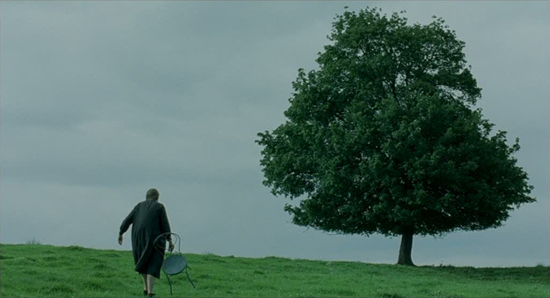
 − This is such a wonderful film: a movie about art, which is itself great art, taking the kind of real-life story that’s usually done in some hideous, schmaltzy way and ruthlessly rooting out every last bit of sentiment. Each choice it makes, from the delayed gratification of its opening (we don’t see a single painting for a good 40 minutes) to the marginal catharsis of the denouement is perfect, and the result is a French film in the traditions of Renoir, Bresson and the Dardenne brothers: humanist, intelligent and confrontational; about loneliness, connection and the sacrifices we make to create; a film that fights cruelty with an implacable, steely gentleness, a film that shakes you up and changes you.
Yolande Moreau is the titular figure, a cleaner in 1914 France who in the terminology of the period is “touched in the head”, her disability seeming to bring her closer to God. Scrabbling together enough money and materials – through menial work and digging on the riverbanks – to explore and indulge her passion for painting, she comes into contact with the German art dealer and expert (Ulrich Tukur) who launched Braque and Picasso on their careers. He is smitten by her work, while she is gratified, astonished and suspicious. As she begins to explore her talent, the touch paper of World War One is lit, making her patron persona non grata.
It’s such a different sort of movie: spiritually profound, quietly sincere, unusually yet perfectly-paced: not rushing to introduce its obscure, anti-social heroine, taking her faith seriously, and finding both humour and poignancy in her singularity and complete lack of interest in societal niceties or norms. Moreau is absolutely sensational – she won the Cesar for Best Actress, but by immersing herself in this character, not through twitches, short-cuts and glip paraphrasing – and so is everything that surrounds her, from the film’s interest in the details of everyday life in 1914, 1927, 1935, to its handsome but credible cinematography, and its contention that poverty, mental illness, a lack of education – none of these are a barrier to creating earth-shaking art.
(4)
See also: This film vaulted into my favourite 100 movies list,
which began over here.
***
Thanks for reading.