Tuesday, 27 August 2013

Janet Gaynor, The Whales of August and risible Hemingway - Reviews #170

I've been busy lately: house-hunting, eating my tea, going on holiday, but I also consumed this stuff:


FILMS:

*SPOILERS*
Lucky Star (Frank Borzage, 1929)
- An intoxicating romance from the incomparable Frank Borzage, starring the immortal Janet Gaynor and featuring the inconsistent Charlie Farrell, who gives arguably the best performance of his career. The director and his two leads made three films together between 1927 and '29 - silents made when that soon-to-be defunct genre was flourishing, then peaking, then almost dead.

The first two, 7th Heaven and Street Angel, helped win Gaynor the inaugural best actress Oscar, but this one - widely regarded as the least of the bunch, is in many ways my favourite; it's certainly the first I wanted to rewatch. Its metaphysical story is the simplest and sweetest, its characterisation sharply realised and unbearably poignant, and its presentation in both narrative and pictoral terms pitched between hopeless romanticism and the practicalities of real life, the former naturally winning out, as they had throughout this seminal triptych. The photography is nothing short of breathtaking. It is simply perfection, so crisp, clear and meticulously but warmly composed (check out the shot of the virginal, grubby, grinning Gaynor looking fondly back over her shoulder through the window she's just smashed); I've honestly never seen anything like it, though snow-bound films like Lady on a Train have aimed for a similiar look, as did Stanley Cortez with a couple of sequences in The Magnificent Ambersons - another film that stands head-and-shoulders above any competition it could conceivably have had. Here, the snow provides not only a climactic obstacle for Farrell, but also lends that mesmeric finale a lush, gobsmacking atmosphere, all leading to a heart-melting pay-off.

As these Borzage films invariably will, it does tend towards melodrama at the death, but it's nevertheless superbly put together, full of solid foreshadowing and scenes that build story but are more concerned with character, playing out at leisure but never outstaying their welcome, and evoking the heady, consuming feeling of a romantic dream. An incalculable amount of that is down to Gaynor, who was a strong sound actress but a sensational silent one: perhaps the most talented mute ever to parade before the cinema-going public, with a subtlety and an effortless transmission of complex emotion that gives the lie to every stupid spoof of early screen acting you've ever seen. Everything she does is remarkable on one level or another; it's also entirely true - one of those flawless, enrapturing, once-in-a-lifetime performances that she gave once or twice a year in those late silent days. If the film intoxicates - and it does - then that's because Gaynor does, thriving, blossoming in that unique arena that Borzage fashions solely for her. (4)

***


Attack the Block (Joe Cornish, 2011) - Or 'Hug a Hoodie: The Movie', which angered half the people who saw it by presenting inner-city muggers as human beings making disastrous decisions, rather than tabloid caricatures shorn of social context. I loved it, and my favourite film of 2011 still looks magnificent, any flaws it might have overpowered by the strength of its convictions and of its central storyline, following alien-killing, tower-dwelling hoodie Moses (John Boyega) on an unlikely journey of redemption. Boyega is little short of astonishing, and while a few of the young cast are a touch wooden and the balance between the various subplots and disparate elements isn't always spot-on, Attack the Block remains a heady cocktail of post-modern humour, crackling suspense and humanist social comment, flashily directed by Dr Sexy. Perhaps most significantly of all, this piece of exceptional, unusual entertainment shows a side of Britain usually ignored on film, namely disenfranchised kids betrayed by both their country and themselves. (4)

***


Moon (Duncan Jones, 2009) - Moon rocks. Rockwell moons. (4)

See also: There's a longer/better review here.

***


The French Lieutenant's Woman (Karel Reisz, 1981) - An exquisitely-sideburned scientist (Jeremy Irons) with a dishy but shallow fiancee falls under the spell of a melancholy "whore" (Meryl Streep) - their unclear relationship echoed in a dual narrative by the actors recreating their parts for a movie. Pinter's script is fascinating, the story frequently gripping and the parallels between the two worlds - the running time slanted massively towards the former - are mercifully free of over-egging (it probably wasn't necessary for Streep's modern day partner to be French, mind). Two scenes stand out: in the first Irons delivers some bad news to his fiancee (Lynsey Baxter), her performance exploding into life, her character's traditional reserve abandoned as she moves through self-pity, to desperation, and finally pure rage, her words ringing in the ears - and on the soundtrack - long after Irons has left the room, and we've left the scene. The second, the final sequence in what is technically a film-within-a-film (though I've never cared more about what happens in one), is a powerhouse from Irons, laying waste to the still fashionable idea that he is a commanding voice in search of some acting chops.

Streep's performance is obviously integral to the piece and by far the most showy in the picture, at times protruding like the most painful of thumbs. In simplest terms, she is half-great: far better than usual, and excellent when asked to emote solely with that pliable, hollow face - lending the film a haunting, haunted undercurrent - but still focusing too much of her energy on her accent (pure Thatcher) and her hands, rather than making the audience feel. You'll catch her acting a half-dozen times, while trying to keep yourself immersed in the story, and that's a problem. The scene in which her fallen woman first opens up to her saviour is pure choreography and mannerisms, with nothing behind it. The Oscars love that sort of stuff, and doubtless there's a textbook somewhere citing it as the apogee of thespianism, but it's not acting in any credible sense, because it constantly wrenches you out of the scene and into an objective analysis of what she's doing. Everything else about the film is first-rate, from Karel Reisz's handling to Carl Davis's majestic score, and Streep is more measured, less domineering and more nuanced - in emotion, rather than in superficial gesturing - than in many of her starring vehicles. Indeed, at her best and most restrained, perfectly utilised by a smart director, she lifts the film to a level it might not otherwise reach. And yet at other times she's a liability: with another actress in the part it would be a smoother, more immersive experience, and perhaps a masterpiece, rather than the merely excellent film it is. (3.5)

***


Emil und die Detektive (Gerhard Lamprechet, 1931) - This early talkie take on the classic kids' book, made in Germany from a script by Billy Wilder and Emeric Pressburger, is both remarkably accomplished and true to the spirit of its source. Stylish, airy and with some great location shooting, it's also a kiddie companion to the adolescent People on Sunday, that gobsmacking slice of summer escapism that had come a year earlier. The story sees mischievous, resourceful Emil (Rolf Wenkhaus) being put on the train to Berlin by his mum. In his pocket is the 140 marks he must give to his grandmother: a fortune to their impoverished family. Enter the most suspicious-looking man in the world (creepy Fritz Rasp), who drugs Emil with a poisoned sweet - cue a stunning Expressionist dream sequence - and makes off with the money. When our hero comes to, he chases the criminal across town, before falling in with a gang of young ruffians (the "detectives" of the title) with whom he hatches a plan to take back the dough. There's a wonderful sense of immediacy to the film - the novel was only two years old when it was shot - tied to an understanding of how children actually behave (their dogged determination, instant alliances and unselfconscious eccentricities) and, during parts of the picture, a semi-documentary atmosphere that allows these broadly realistic characters to flourish, while offering a vivid snapshot of pre-Nazi Berlin.

At the same time, and for all the film's intelligence, entertainment value and humour, there's an undeniable eeriness to it. That same poverty which drives the plot forward helped to usher in the Nazis, while blonde-haired, blue-eyed Wenkhaus went on to star in one of the Third Reich's first propaganda shorts - playing a member of the Hitler Youth - before perishing off the coast of Ireland in 1942, when his bomber was shot down. Those notorious events you've read about in history textbooks took place on these streets, down which pad the footsteps of these spirited young performers, who in the coming years will each be affected in their own way by Hitler's accession to power. Ignoring such inevitable intrusions, Emil is an excellent piece of work: often technically dazzling - though not without some stiltedness and a few rough edges - and superbly written, with Wilder inventing a bizarre, brilliant silent prologue centring on the taunting of a local lawman, and filling his script with funny set-pieces (special mention for the "Native American" messenger-boy visiting Emil's grandmother) and at least one unbearably tense set-piece. There's also considerable quote appeal in the shape of Emil's love interest, Pony Hutcheon: barely a minute goes by without someone imploringly or excitedly declaring: "Purny Hurrcheon!" Incidentally, the BFI disc includes a scene-for-scene British remake from 1935. Perhaps that was what Truffaut had in mind when he asked Hitchcock whether the words "British" and "cinema" were incompatible. (3.5)

***


The Big Steal (Don Siegel, 1949) - While His Kind of Woman and Beat the Devil would send up film noir itself, The Big Steal is content to reunite the stars of Out of the Past, slip them into a crime caper template, turn down the lights and inject a dry, healthy, and often uproarious dose of humour. The result is pure escapism, from that wilfully mysterious opening onwards, with the leads clearly having a ball - Greer was enjoying a rare break from blacklisting for refusing to sleep with studio head Howard Hughes, Mitchum embraces his screen image unilaterally - their relationship thawing out as they trade zingers across Mexico, in pursuit of Patric Knowles's utter spiv, while chased by scary, bulldogish Army heavy William Bendix, whose pupils are bigger than most people's heads. A running joke about the police chief learning English is long-winded, and the action ranges from superior to dorky, but it's a neat, cohesive and modest movie made before Hughes's obsessive tinkering caused the studio's films to simply fall apart. Jet Pilot, it's worth remembering, was in post-production for seven years. The Big Steal doesn't strive for the fatalism or bleak romanticism of Out of the Past: rather, it's that film's cheeky, irreverent, warm-hearted little brother - wanting little more than to have fun, and taking you along with it, whatever your mood. (3.5)

***


Slightly Dangerous (Wesley Ruggles, 1943) - A very enjoyable, affecting comedy-drama about soda squirt Lana Turner faking her death, getting a '40s makeover that makes her look 70% less attractive and posing as a lost heiress - much to the delight of her new 'father' (Walter Brennan), and the chagrin of her boss (Robert Young), who sets out to unmask her and so save his unjustly sullied reputation. The film sets itself a considerable challenge - our sympathies are hardly with the heroine at the start of her ruse - but comes out on top, handling the tricky material remarkably well. Turner is exceptional in a deceptively demanding part, the Lederer/Oppenheimer script is way above average and so is the slapstick - with Young playing it sillier than usual - while there's superb support from Dame Mae Whitty, Alan Mowbray and particularly Brennan, offering a deft take on his familiar persona: that irascible, soft-centred old duffer. My only real complaint is that it would have been nice to have had more scenes of Turner and Brennan, giving us a greater sense of their burgeoning relationship, perhaps at the expense of those amusing but relatively uninvolving sequences featuring Turner and Young. I also have a sneaking suspicion that Slightly Dangerous is both the best and the worst name ever for a film. Except perhaps for Half Past Dead. (3.5)

***


Good News (Charles Walters, 1947) - A slight but tuneful, utterly charming campus musical set in 1927 - and based on a 1930 film - in which football star Peter Lawford chucks over librarian June Allyson for a lousy snob, then belatedly realises he loves her. Allyson's as good as ever mixing husky-voiced vocalising with homespun sentiment, and Lawford does his usual suave bit - though he can't sing - but it's a long time since I've seen a supporting actor run off with a movie as completely as Joan McCracken does here, the bouncy, cartoonish and irrepressible Ellen Page-alike singing, hoofing and goofing with such boundless energy that it's like someone's set off a firework in the studio. Sadly she rather disappears in the second half, after tearing up the screen with Pass That Peace Pipe, the only one of scriptwriters Betty Comden and Adolph Green's new songs to make the final cut. As college musicals go, it's not quite The Affairs of Dobie Gillis - which had Bobby Van, a be-hatted Bob Fosse and a peak-form Debbie Reynolds on hand - but it's still a little gem, recovering after an uncertain opening reel thanks to the exuberant numbers, gentle period spoofery and evocation of a delightful, self-contained little world that are the unmistakable hallmarks of legendary producer Arthur Freed. (3)

***


Despicable Me (Pierre Coffin and Chris Renaud, 2010) - Top-heavy supervillain Gru (voiced by a Slavik-sounding Steve Carell) adopts three girls as part of a long-term plan to shrink the Moon, only to find the children a distinctly humanising influence. This lively, sentimental animated comedy isn't as strong on second viewing - despite a few neat gags I'd missed first time around (special mention for the Minion sexy-dancing, and Doctor Nefario barking "Who is this?") - as it sticks too rigidly to formula and pushes a little too hard in its quest for emotional high spots, but it's still a good film, striking a successful balance between comedy, drama and action, and offering a few choice Minion moments, my favourite being Kevin's impression of a water cooler. The sequel is a funnier movie, but less impressive overall, with a comparatively dull, contrived storyline that gives Gru fewer chances to shine. (3)

***


"The door's locked! McGinty, you clever dog!"
Mystery Team (Dan Eckman, 2009) - What happens when child detectives grow up? According to this endearingly stupid movie from the Derrick comedy troupe, they carry on solving kids' crimes, being treated with a mixture of irritation, concern and amusement by the teachers, drug dealers and strip club bouncers whom they encounter. There's the master of disguise (Community's Donald Glover) - who kits his team out in top hats and monocles to visit a gentleman's club, the "boy genius" (D. C. Pierson), who knows exactly 1,001 pieces of redundant trivia, and "the strongest kid in town" (Dominic Dierkes), who insists on tackling minor feats of strength that he can't accomplish. After being patronised for the umpteenth time - and now technically adults - the Mystery Team resolve to tackle their first grown-up case, a double murder, bringing them into contact with a couple of psychos, and the victims' deadpan daughter (Aubrey Plaza, naturally), to whom Glover is oddly drawn. "I think we had sex," he confides to his friends, after standing quite close to her in a closet.

It's a great concept, and the film works best - really rather brilliantly - when riffing on the improbabilities of detective fiction and its heroes' magnificent lack of wordliness, but flops when trying to offer further contrast with the adult world through bad taste (and mostly unfunny) jokes about child porn, cancer, suicide and anal intrusion. For a movie from a sketch troupe, it actually hangs together fairly well as a whole - perhaps due to the very safe formula it employs - and its thriller aspect, while slight, predictable and at times simply illogical, is also oddly suspenseful. Perhaps I'm just a sucker for those cliches. The reason to see it, though, is for the gags. I reckon I laughed 10 times and completely lost it a further three, which is a great strike rate. When it doesn't work, it really doesn't, but when it does, well... “Following your dreams is never stupid! Unless you dream about water and then you pee the bed last Thursday. For example.” (2.5)

***


One Touch of Venus (William A. Seiter, 1948) - This otherwise mediocre fantasy comedy - based on a Broadway smash, and concerning a nervy window-dresser (Robert Walker) who falls in love with a statue of Venus come to life - is given an almighty kick up the arse by Ava Gardner, delivering a performance of luminescent, feline sensuality that bursts out of the screen almost in 3D. Like Clara Bow, she was an actress with "flesh impact", to borrow a colourful phrase from Billy Wilder. Eve Arden also turns up to peddle one-liners in her usual tart fashion, the two actresses compensating for an unimpressive script, lacklustre numbers and Walker's acute discomfort as the male lead. The ending makes as little sense as the rest of it. (2.5)

***


*A FEW MINOR SPOILERS*
The Whales of August (Lindsay Anderson, 1987)
- The Whales of Snorefest, more like: a movie that moves at the same pace as its geriatric characters - living out their dotage on a Maine island - with a script that mistakes mundanity and mawkishness for profundity, given soporific, bland treatment from Lindsay Anderson (adjectives it seems bizarre to even consider in his presence) who pads the action with endless shots of nature and soundtracks it all with a trite, overproduced score. "I was afraid you would be bored," says Lillian Gish at one point, and her fears are well-founded, though her final screen performance - at age 93, some 75 years after her first - is the film's great virtue, a fittingly reflective, deceptively steely turn at once simple and deep, lending an inferior play a touch of the sublime, as Fonda and Hepburn had done for On Golden Pond. She also reminds me of my nanna, adding an extra poignancy to proceedings.

There are a handful of moments that are genuinely insightful, moving and special, and they all involve Gish: the years falling off her as she pretties herself in combing out her long, snowy hair, an exchange with Vincent Price about whether she has "lived too long", a conversation with her late husband on their wedding anniversary and the simple business of righting the room she has resolved to retain. These pieces of art, timeless and important, lie adrift - like the blocks of ice she clung to in her 1920 film Way Down East - in a sea of snail-paced, repetitive, often meaningless banality. The rest of the promising cast fails to register: Price and Ann Sothern are boring, Bette Davis weirdly and irritatingly motonotous and Harry Carey, Jr simply cliched. Perhaps revisiting it in my twilight will reveal layers of meaning invisible to me now. I waited 15 years to see this one, which I think is about how long the film lasted. (2.5)

***


This sort of thing is basically no good.

Zu Warriors from the Magic Mountain (Tsui Hark, 1983) - The first 10 minutes, in which supposed adversaries Yuen Biao and Sammo Hung team up to fight a smorgasbord of rampaging armies, is an utter joy in the old-school manner. The rest is plotless, deadening, effects-driven rubbish, director Tsui Hark having hired experts from Hollywood in a bid to spruce up that side of Hong Kong cinema. Pity. (1.5)

***


The Snows of Kilimanjaro (Henry King, 1952) - A boring, unconvincing and thematically incoherent version of the Hemingway novel, with a thoroughly dislikeable Gregory Peck bitterly recalling his relationship with Ava Gardner - though never once mentioning her terrible hairstyle. It's all rather ugly to look at, with the sloppy pasting together of location footage and studio shots giving the whole enterprise an insultingly slapdash feel. Bernard Herrmann's beautiful score is the film's only plus point. Just listen to that instead, while doing the washing up or something. (1.5)

***

BOOKS:


Orson Welles: The Road to Xanadu by Simon Callow
Orson Welles: Hello Americans by Simon Callow


The first two volumes of Callow's mammoth, as-yet-unfinished trilogy on the life of Orson Welles are required reading for anyone the least bit interested in one of the key cultural figures of the American Century. The Road to Xanadu (1995), climaxing with the release of Kane, does an extraordinary, unprecedented job of stripping away the thick layers of myth around Welles, at long last getting to something like the truth. It's arguably at its best in the early chapters, tracing the development of Welles from tormented, annoying child to tormented, annoying "boy genius" of the Irish stage, lying extravagantly at every stage to boost his public profile. If there's a complaint, it's that while Callow does a stunning job of recreating his subject's subsequent stage triumphs in America (the initial focus of his book), his fastidiousness does sometimes cause him to lose sight of Orson the man, while his observations about Welles' flaws as an actor and director (that he has no emotion, that he offers merely a "fireworks display") are a little repetitious. It's a masterful book all the same, exhaustively researched, superbly-written (an addiction to semi-colons and the actorly phrase "inner life" aside) and remarkably insightful, full of fact and mercifully free of the armchair psychology that seems to dog most writing on Welles. Hello Americans (2006), which begins with the heartbreaking tale of The Magnificent Ambersons - and an accompanying human tragedy in Brazil - and ends with Welles' departure from the US in 1947, shows him in flux: his stock as a filmmaker sharply declining, as his engagement in politics as a broadcaster, commentator and activist takes over his life. It's a brilliant story, remarkably told, with perhaps a few too many lengthy excerpts from the subject's newspaper columns, but an abundance of telling detail packed into a pacy, invigoratingly entertaining narrative. Across the two books, Callow delights in playing devil's advocate, or perhaps just offers a sense of balance - whether talking down flaws of the lost Ambersons, talking up various forgotten radio broadcasts or arguing that The War of the Worlds was essentially a fluke - and as the first looked to show that Welles' meteoric rise did include failings both personal and professional, so he argues that the director's fall from grace wasn't exactly clear-cut either. In tribute to Welles, I think the third volume should be taken out of Callow's hands, every second page removed and the ending changed so he doesn't die. (4)

See also: I've written my own epic treatise on Welles in the shape of a 2,700-word blog post about The Magnificent Ambersons. It should be up sometime next week. Actually, "should" is the wrong word... perhaps "probably will be".

***

Thanks for reading.

Tuesday, 6 August 2013

The World's End, Charlie Chan and old men waving their arms around - Reviews #169

I've seen just 11 full-length films since last we met, as I was on my honeymoon for the rest of that time (yes, lovely thank you). Here they are:

FEATURES:


CINEMA: The World’s End (Edgar Wright, 2013)
- The high school hero unable to replicate their triumphs in an adult arena is a character that echoes through American popular culture. But whereas across the Atlantic the figure tends to be a former quarterback or lead cheerleader, the concluding part of Edgar Wright's Cornetto trilogy gives us a happily British variant (Simon Pegg): a chain-smoking, hard-drinking, trenchcoat-wearing bad boy whose greatest moment was having sex in a disabled toilet and who has degenerated - or perhaps followed along the same path - into an alcoholic mess.

Finding himself at his lowest ebb, this wonderful tragi-comic creation, Gary King, is inspired to tackle the pub crawl that beat him on that fateful, feted night, in the company of the same four friends, now each responsible adults in the shape of Nick Frost, Paddy Considine, Martin Freeman and Eddie Marsan. It's then that an army of replicants appear, threatening not just the future of humanity, but also Gary's drinking binge. Dispensing with the pitifully blunted humour of Pegg and Frost's Paul, with its weakly universal, US-centric references, The World's End uses the same recipe as the first two Cornetto films: fiercely British comedy, dead-eyed potshots at genre cliche, and moments of beautiful poignancy, shorn of the irony that dominates the rest.

The first half is a wonder: affecting, surprising - with a first scene just as clever as Wreck-It Ralph's similar opening salvo - and full of brilliant gags. The second, while very entertaining, can't quite maintain that momentum, with an over-reliance on merely competent action, some heavy but muddled exposition and a final 20 rife with iffy post-modernism and high-reaching, not altogether successful dystopianism. And yet despite being the weakest of the trilogy, it's a fitting wrap-up too: narratively the most inconsistent, with an unconvincing, barely escalating external threat - a legion of blue-blooded aliens - but also the most ambitious, and arguably successful of the three in terms of characterisation, emotional maturity and belly laughs. And also swearing. Its jokes are defiantly parochial (there's one about the Antiques Roadshow) and its soundtrack - drawn from the turn of the nineties - gives it a firm sense of both time and place. The World's End stutters a little in story terms, but like its predecessors it's still a must-see - particularly with an audience. And rarely if ever has British cinema produced films as funny, as loaded with deft, unashamed sentiment, or as skilled in using the C-word. (3.5)

***


CINEMA: Monsters University (Dan Scanlon, 2013) - Pixar has lost much of its ineffable magic in the three years since the Toy Story series concluded. La Luna was wonderful, but the studio's features - while fun - have been worryingly mediocre. This one's weirdly paced, riffs on overly familiar American campus cliches (not to mention The Goblet of Fire) and feels altogether too forced in its sentiment, its story and its strange broadness of humour. For all that, it's a fair watch: reasonably engrossing, with some fun action set pieces and a scattering of massive laughs, most of them coming from Art, the oddest new character to populate this erratic universe. It's a disappointment - an unfit prequel to one of the finest children's films of recent decades - but growing from a creative divot, perhaps it was always destined to be. Pixar have now fluffed a sequel, a prequel and a standalone film. Hopefully their next one will blow us all away. In the meantime, this one's not too bad - just functional, rather than magical. (2.5)

***


Amélie (Jean-Pierre Jeunet, 2001) - "No. I'm nobody's little weasel." On umpteenth viewing (and my second in a matter of weeks), Amélie is better than ever before: a wise, warm, whimsical piece of perfection, blessed with an unparalleled Parisian atmosphere and centred on a performance of uncommon brilliance. (4)

***


Vivacious Lady (George Stevens, 1938) - An emotionally heady, seriously sexy and often very funny fusion of romantic, screwball and social comedy, with associate professor Jimmy Stewart marrying nightclub singer Ginger Rogers on an impulse, but struggling to break the news to his conservative family. The leads are brilliant, with Stewart showcasing his singular schtick - awwing, umming and bumbling to his heart's content - the supporting cast is one of the finest ever assembled, and Stevens' handling is typically sublime, seamlessly blending slapstick, character comedy and some of the most richly romantic scenes in Hollywood history. The script is a little inconsistent, resulting in some short dry stretches, particularly towards the end, but there are numerous great moments, as well as stand-out supporting turns from Franklin Pangborn, as an officious apartment block clerk, and Beulah Bondi - playing Stewart's gentle, surprisingly mobile mother - whose dance scene with Rogers and the amusing James Ellison is an exuberant comic high-spot. It looks great, sounds great - with a lush score and one knock-out nightclub number - and, well, is great, an oft-overlooked triumph from Hollywood at its height. (3.5)

***


Peter Pan (Herbert Brenon, 1924) - The Boy Who Never Grew Up is played by A Woman Who Has Very Much Grown Up, Betty Bronson, in this sometimes spellbinding silent adaptation of Barrie's play, which highlights both the melancholia at the heart of the piece, and the subject of Wendy's sexual awakening. It kicks off with five minutes of stationery, medicine-based chat, but, once Peter skips in, the film springs to life, conjuring a vivid, purposefully artificial world of patently phony creatures, lion-catching "redskins" and sentimental, airborne urchins. Despite such fantastical elements, the strangest thing about the story remains the fact that an otherwise ordinary middle-class family has a nurse who is a dog. Or in this case a man in a dog costume. The mesmerising, fabulously uplifting flying scene remains the standout sequence, but - despite a fair amount of staginess and the odd intrusion of archaic filming or hammy acting (step forward, Ernest Torrence) - a rich vein of magic runs throughout the film, aided by Brenon's suitably fine use of shadow, very special effects from Roy Pomeroy (later Paramount's notorious transition-to sound honcho), Mary Brian's appealing Wendy, and Bronson's ebullient, balletic Peter: that curious piece of pantomimic casting imbuing the film with an ethereal majesty and intoxicating buoyancy it surely couldn't have got from anywhere - or anyone - else. She's clearly a woman, but somehow she's also inescapably and perfectly Pan. (3.5)

***


The Youngest Profession (Edward Buzzell, 1943) - Enchanting fluff about teenage autograph hunter Virginia Weidler and her bff Jean Porter encountering various MGM stars while trying to keep her parents together (they're not actually splitting up). It missteps a little with a diversion into drama - and away from signature-seeking - but it's a must-see for old movie nerds, with some ace walk-ons from the studio's finest, a fine George Oppenheimer/Charles Lederer/Leonard Spigelgass script that allows for several neat supporting parts, and a classic closing gag featuring the one and only William Powell. (3)

***


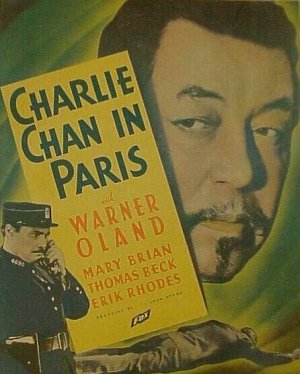
Charlie Chan in Paris (Lewis Seiler, 1935) - The best of Fox's many Charlie Chan films were the family affairs, those featuring one or more of the character's kids, and ideally those starring the original Chan, Warner Oland, opposite his "Number One Son" Lee, played by Keye Luke. This, Luke's first appearance in the series, is a fairly standard, rather low-budget B-mystery about bond forgery and murder that's lent remarkable warmth and humanity by the touching, completely credible relationship between the wise Chinese detective and his Americanised son. Their opening scene together, beginning with suspense, moving through the excitement of reunion, and ending with Luke vowing to protect his father from his would-be killer, is an absolute beauty. There's also a fairly strong supporting cast, led by Fred and Ginger alumnus Erik Rhodes, Blessed Event's Mary Brian (earlier Wendy in the silent Peter Pan - see above) and veteran character actor Henry Kolker - whose role is little more than a glorified cameo - along with a spectacular reprise of that rough-and-ready style of Gallic dance I last saw in Parisian Love. Fox had only thrown Luke into the series to snag a younger audience; it worked, but it did something greater, giving the films a human centre that the one-off mystery plots simply couldn't approach. Chan would have greater adventures, but this is the one that established the formula - winning in both senses of the word. (3)

***


Too Many Husbands (Wesley Ruggles, 1940) - Trivial but entertaining comedy about Jean Arthur being appalled - then delighted - to discover that her supposedly deceased husband (Fred MacMurray) is alive and well, is coming back to town, and plans to duke it out with her second spouse, and his best friend (Melvyn Douglas) for her fair hand. The material is spotty, especially in the final third, and MacMurray isn't in peak form, but Douglas is great and Arthur simply enchanting as the pair milk every scenario to the absolute limit. Douglas falls over a chair more funnily than any actor I've ever seen. (2.5)

***


Dreamboat (Claude Binyon, 1952) - A nicely-conceived comedy-drama about uptight educator and former silent screen heartthrob Clifton Webb trying to stop his former partner (Ginger Rogers) - both on screen and off - from presenting their old movies on TV. It's not actually that funny, or thematically coherent (teaching is pointless compared to being in movies?) and the barbs aimed at the small screen are as vituperative and desperate as usual for the period, but the script is intermittently interesting, Webb is brilliant and the spoofs of soundless cinema are great fun: agreeably accurate parodies of The Mark of Zorro, Wings, Beau Geste and The Three Musketeers, with Rogers' usual excessiveness tempered by her co-star's subtle, instinctively respectful type of take-off. Well, apart from that one very silly salute. Anne Francis and Jeffrey Hunter share an appealing but underdeveloped, incongruous romantic subplot designed to pull in the teens, while Elsa Lanchester does nice work as a horny spinster. It isn't a great film, but the promising premise does set up some very nice moments, with the aged, effete Webb shaping up amazingly well as a youthful, sexy swashbuckler. And the scene in which he takes tips from that younger self while embroiled in a bar fight is a little gem. (2.5)

***


Three Hearts for Julia (Richard Thorpe, 1943) - A daft, disjointed but unjustly maligned romantic comedy - Melvyn Douglas' last film as a leading man - that's burdened by a weak subplot about a female orchestra, a supporting character (played by Felix Bressart) who's employed to deal superficially with important issues, and an inability to cash in on promising set-ups, but lifted considerably and constantly by Douglas's distinctive brand of humour, delivered - as ever - in that effortless, effervescent manner. (2.5)

***


Two Guys from Texas (David Butler, 1946) - After directing the best of the Hope and Crosby "Road" movies, David Butler moved to Warner, who wanted to try a similar thing with comic Jack Carson and crooner Dennis Morgan. The results were a trio of variable efforts: Two Guys from Milwaukee, Two Guys from Texas and the Hollywood-on-film movie, It's a Great Feeling, a knockabout, post-modern, star-laden affair that's one of my favourite comedies of the '40s. If there's a weak link in the informal trilogy, it's this one, which recycles elements of the silent comedy Womanhandled in its thin, static story about a faux-Western ranch run for tourists, and features Dorothy Malone as a leading lady. She's nothing special compared to unmatched reactor Joan Leslie, or the multi-talented Doris Day, the pair who lit up the other two entries. There are a handful of good gags from Billy Wilder's future writing partner, I. A. L Diamond, though - including a clever closing twist borrowed and improved for Road to Bali - a slew of Jule Styne and Sammy Cahn songs which while unimaginatively staged are unusually memorable, and best of all, an animated dream sequence featuring Carson as a shepherd, Morgan as a wolf stealing his sheep, and Bugs Bunny as himself. It's that kind of freewheeling, try-anything, tongue-in-cheek approach - building on vivid archetypes - that made Butler's Road to Morocco really work, and which runs through It's a Great Feeling: the third and by far the finest movie starring this underrated pair. Their characters aren't from Texas, incidentally, they're just in Texas. While they sing a song with that name, it still makes this one of the most misleadingly-titled movies ever, along with Abbott and Costello Go to Mars (Venus) and Across the Pacific (part-way across the Atlantic). (2.5)

***

SHORTS:


CINEMA: The Blue Umbrella (Saschka Unseld, 2013)
- An uninspired Pixar effort about inanimate objects becoming animated, and an umbrella falling in love, that comes to life at two points: when the grates and ducts combine to save the hero's life, and when a strange red hue suddenly falls over him. Those moments just about make this derivative, lacklustre film worthwhile. (2)

***


One Week (Buster Keaton, 1920) - One of Buster's best shorts - and his first solo effort to be released - with the star and his new wife attempting to construct their first home, only to meet opposition in the shape of a bully, a hurricane and a train. It's inspired, ingenious and has one of the great endings: smart, cynical and sentimental. (4)

See also: There are reviews of some of Buster's other shorts here.

***


This is the bit you can't get on a t-shirt.

A Trip to the Moon (George Melies, 1902) - Its importance to the medium of cinema cannot be overestimated, and the shot of the moon with a rocket in his socket remains one of the screen's enduring images, but Meliès' signature film consists largely and inescapably of old men waving their arms around. (2.5)

***


One A.M. (Charles Chaplin, 1916) - A mildly amusing Chaplin comedy, from his time at Mutual, in which a hammered Charlie tries to go upstairs to bed. It's rather repetitive, and Buster not only did more with a stair carpet and a bed in My Wife's Relations, but surely would have found himself in the wrong house for the punchline. There are some nice gags, though, particularly the sequence with the climbing gear, and that fearsome adversary coming out of nowhere. (2.5)

***


The Non-Stop Kid (Gilbert Pratt, 1918) - An average Harold Lloyd short, with the star trying to seduce campus hottie Bebe Daniels, enlivened by the leading lady's expressiveness and an exuberant rhythmic and comic accompaniment from Fanfare Burlesque d'Intervention at this year's Avignon Festival. (2.5)

***


Get Out and Get Under (Hal Roach, 1920) - AKA the one where Harold Lloyd gives cocaine to his car. Get Out and Get Under is a fast, funny jolt of slapstick that doesn't do enough to endear its nominal hero to the audience, but is so full of energy - and comic invention - that you can't help but be swept along by it. There are a slew of clever, subversive sight gags, as the star's manic new motor smashes through a garage wall, is plonked onto a train and, yes, gets hopped up on coke, though the film is at its best when displaying a gleeful, innocent fondness for thrill comedy. I could watch Lloyd legging it after a runaway car all day long. (3)

Monday, 8 July 2013

A Field in England, Woody Allen, and my letter to Ndugu - Reviews #168

Plus: one of the best I've seen this year.


A Field in England (Ben Wheatley, 2013)

"You are confused, sir - it is I who am capturing you."

A strange, misty, monochrome film, heavy with hallucinations and bizarre twists, in which four Civil War deserters have an encounter with an Irish occultist, who turns the bucolic idyll of the title into a bloodbath - much as the conflict was doing all over the country.

This uncategorisable movie is instinctively directed, full of brilliant dialogue courtesy of Amy Jump ("He's not only kept you a stranger to the world, but to yourself, it seems"), and has three great performances: from Reece Shearsmith as an effete coward of an astrologer, Richard Glover as his idiotic friend - who has never looked upwards - and Michael Smiley playing their formidable adversary, with his Geoffrey Rush nose and penchant for shovel-based violence. But for all its strengths, including dizzying, mushroom-powered montages, a crisply atmospheric visual sense that seems to borrow from Humphrey Jennings, Michael Powell and Michael Reeves, and an abundance of dry wit, it's infuriatingly flawed. As Smiley's right-hand man, Ryan Pope seems to really struggle with the immaculately rendered inflections and nuances of the dialogue, the film's lack of story or purpose means it begins to bore before the end, and it all adds up to... what?

I liked it, and enjoyed the pervading sense that this was not only an event movie, but one prepared to break all the rules. But whether it attempted to do so while dressed partly in the Emperor's New Clothes is another question. (3)

See also: I didn't like Wheatley's Kill List much. Here's why.

***


The Intouchables (Olivier Nakache and Eric Toledano, 2011) - Ladies and gentleman, I think we have a new comfort movie. And what a beautiful film it is: one of the funniest I've ever seen, and among the sweetest too. Omar Sy is an uneducated Senegalese immigrant from the Projects who applies to become a full-time carer to unhappy, wealthy quadriplegic Francois Cluzet, so he can complete his benefit form. Instead, he gets the job. Cluzet doesn't care about his background, he wants a man without pity, and he gets one - Sy's contempt for modern art, hilarity at high culture, and exuberant dancing to Earth, Wind & Fire are a bonus. It's formulaic, perhaps, and concludes in a conventional (though perfect) way, but it's beautifully performed, hysterically funny - special mention for the opera sequence, the hardest I've laughed at a movie since Team America's vomit geyser - and navigates the pitfalls of this type of film with laughable ease. It's deft without being disposable, affecting without being mawkish, and takes on big issues (death, disability, poverty), without losing its sense of humour. Put simply, it's a classic. *strokes ears* (4)

***


*A FEW SPOILERS*
About Schmidt (Alexander Payne, 2002)


Dear Ndugu,

How are you? I'm fine. Today I watched the film About Schmidt. I enjoyed it. At times I feared it was just a less inspired take on The Straight Story, with a score that went too jaunty too often, and a tendency to undercut its many truthful moments with smug comedy. But then the ending came along, one of the greatest endings I've ever seen, a heartbreaking voiceover followed by a heart-mending pay-off, and I realised that I'd seen something truly extraordinary, a film whose flaws are a small price to pay for a majestic, life-affirming whole. And then there was Nicholson's performance. It's so long since he bothered to act - I suppose One Flew Over must have been the last time - that I was willing him to succeed. And, yes, there were ticks and twitches there, and at times he hadn't quite submerged arrogant, shark-faced Jaaack within self-hating, sad-faced Warren (me), but in the end it was a triumph, just like the movie. Along with the usual cheque, I'm enclosing a little something extra to spend as you please.

Yours very truly,

Warren Schmidt

(3.5)

***


Manhattan Murder Mystery (Woody Allen, 1993) - "Is that what you do when I forbid you?" Woody at his most playful: a largely effortless mystery-comedy in the Thin Man vein, with nervy book publisher (Allen) dragged into an amateur murder investigation by his bored wife (Diana Keaton) when their neighbour turns up dead. Also along for the ride are amorous Alan Alda - who still has his eye on Keaton - and saucy poker sharp Anjelica Huston, one of Allen's authors. Laid-back, charming and suspenseful in the old-fashioned way - with lots of scenes of people searching in places they shouldn't, and a finale that pays homage to The Lady from Shanghai - it comes with hundreds of those little gags Woody used to manufacture at will, along with plenty of wisdom amongst his wisecracks. For a little while in the second half the film becomes so high-pitched and frenetic that it risks being annoying, and that "father figure" line still seems a bit iffy given the events of the previous year, but for the most part it's a joy: a little gem from that period when Woody was still firing on most, if not all cylinders. The pay-off is just glorious. (3)

Tuesday, 2 July 2013

Dumbo, Django and Despicable Me 2 - Reviews #167

Just six movies in the past 10 days, as I keep being interrupted by life and the world and stuff.


I can't handle this. At all.

*SOME SPOILERS*
Dumbo (Ben Sharpsteen, 1941)
- I didn't watch many films as a kid, but Dumbo was my favourite. It was also the third DVD I ever bought (if memory serves), after Once Upon a Time in China II and Three Colours Blue. But I hadn't seen it for perhaps seven or eight years before this evening. And I'd forgotten how desperately sad it is, drawing a lump to the throat around the 20-minute mark and holding it there until its climax. Only Capra has ever made you work as hard, or go through so much, for your happy ending, as Dumbo - a pure innocent, like Bresson's Bathazar - is tormented, patronised and brutalised, on his way to a climactic act of almighty catharsis.

It takes a little while to get going, with some extraneous, somewhat ill-conceived material about the circus and its sentient, breathing train, but every scene featuring the impossibly cute, stunningly expressive title character - a big-eyed little elephant with gargantuan ears - is pure magic, whether pairing him with his protective mother (wonderfully voiced by Disney regular Verna Felton), or the smart-talking Timothy Q. Mouse (veteran character comic Edward Brophy), a self-appointed guardian who takes her place after fate intervenes - and sets the life-changing finale in motion with an extraordinarily powerful plea for compassion.

After the failure of the matchlessly ambitious Pinocchio and Fantasia, Dumbo was intended by Disney as a back-to-basics affair along the lines of Snow White, on that smaller scale and with that slighter running time. The tremendous amount of love, care and attention to detail poured into it, though, remains staggering, from the incomparable opening with its formation of storks delivering newborn babies to be excitedly unwrapped by their parents, past the adorable sequence with Dumbo in the bath, through that terrifying set-piece that sits him atop a burning edifice, via the gobsmacking "pink elephants" set-piece and showstopping When I See an Elephant Fly number to a punch-the-air finale of uncommon brilliance (with a little tacked-on wish-fulfilment).

The film is simply conceived and unashamedly episodic, but hand-drawn with a rich and vivid flair, and capable of moving me more deeply than just about any movie I've ever seen. For all the surrealistic brilliance of those pink elephants - the most trippy, out-there and perhaps original thing Disney has ever done - my favourite passage (perhaps in all of cinema) is the breathtakingly beautiful, utterly sincere scene of Dumbo and his mum set to Baby Mine, which begins with them touching trunks through a cage window and ends with a wrenching farewell. It's the first thing that comes to mind whenever I think of the film: if the pink elephants wow me, then Baby Mine destroys me, and I think it's what makes this Disney's greatest - just pipping Bambi to the crown.

George Lucas once batted away criticisms of his movies' cold aloofness by saying that it's easy to make an audience feel something: you just choke a kitten in front of them. Dumbo's formula isn't complex, and you could argue that it follows that Lucas template - take an obviously adorable hero, make fully sure your audience is in love with him, then make him suffer - but its method of manipulation is so sublime and its story of redemption so timeless that it's very difficult to fault. Well, except for the train being alive - that's stupid. (4)

***


Django Unchained (Quentin Tarantino, 2012)

"Sold!"

I thought I was destined to dislike Django Unchained - or at least leave disappointed. I still remember the visceral thrill of seeing Kill Bill: Vol 1 on the opening night, being knocked sideways by this full-frontal assault on the senses, gazing up at the mammoth screen in rapt enthralment, perched on the edge of the only spare seat in the house, right on the end of the front row. I saw the film again a couple of weeks later, and thought: "Well, that didn't hold up particularly well", but the energy and invention of it all made one thing clear: a Tarantino movie is an event movie, more than any summer blockbuster is ever going to be. And whatever he does, for however long he does it, I'm going to watch it.

But that brings me to the first problem: Kill Bill: Vol 1 is the only good film that Tarantino has made since Pulp Fiction, and it isn't even that good. Jackie Brown was a messy, "mature" movie that looked and sounded suspiciously like its writer was just flailing around, with nothing left to say after whacking out two instant classics in three years. Kill Bill: Vol 2 had its moments, but felt more like a collection of interesting deleted scenes than a film. InjUriOUWs Ba$turdz was just completely pedestrian, aside from Waltz's exceptional performance and that one nerve-shredding sequence in a bar. And then there is Death Proof. The reason I haven't seen Django until now is because I go to the cinema with Mrs Rick, and she has refused to watch any Tarantino films since we saw Death Proof. This seems entirely reasonable, since Death Proof is probably the worst movie of the last 10 years.

As if to further ensure my hostility, Tarantino then started laying into John Ford, my favourite movie director, and the inventor of the modern Western, in his idiotic publicity interviews for Django. "I hate John Ford", he said, before going on to imply that Ford and his films were racist. Sorry, Quentin, but I'm shutting your butt down. You made a film condemning racism. In 2012. For hipsters. Ford did it in 1960. At the peak of the Civil Rights struggle. For an audience half-comprised or rednecks and racists. His film took their prejudices, threw them up on screen and shot them to pieces. That movie was Sergeant Rutledge, and it's one of the bravest and most progressive movies ever made by a mainstream American filmmaker. Admittedly Ford cast the black star, Woody Strode, as a Chinaman five years later, but really we're nitpicking.

So I suppose I approached Django with my enthusiasm severely compromised: that long-held fantasy of a Tarantino film that would pick me up and sling me at the wall tempered by the reality of his last few, and a lingering resentment that his tiresome posturing now involves telling his legions of fans to ignore The Great American Director. The thing is, though, that Django’s good. Like, really good. Midnight in Paris good. It’s a film that sees an artist awakening, rising from a long creative slump. It’s a movie that stands on its own two feet, without the need for post-modern pastiche that colours his worst films. The insertion of that “mandingo” fight sequence (sadly not a man fighting a dingo, though there is something similar to that elsewhere) seems cribbed from Jules Dassin’s Night and the City, but otherwise this is (mostly) all his own work. And it all feels so effortless, just as Tarantino’s recent films seemed so mannered and forced.

As you’ll probably be aware, as you saw it ages ago, the story deals with Django Freeman (Jamie Foxx), a slave-turned-bounty-hunter who travels with his German mentor (Christoph Waltz) to a Southern plantation run by a flamboyant, eye-linered slave owner (Leonardo DiCaprio) - the only man who takes handshakes more seriously than Mark Hughes - in the hope of freeing his wife (Kerry Washington). Just as Inquisitive Batmen was a Jewish revenge movie, so this is an African-American one – made by a man who appears to be under the mistaken impression that he is actually black. It reminds me a little of that line about Life Is Beautiful: "Clowning does not merely seem an inappropriate response to the realities of a concentration camp, but the wrong response". Levity and gunplay may be the wrong response to the realities of slavery, but Django's a hell of a lot of fun.

Though the film isn’t explicitly split into chapters like the first Kill Bill, it still comprises three distinct sections. The first, dealing with Django’s transformation, is light-hearted, surprising and dizzyingly fun. The second, taking place in and around the rather wonderfully-named “Candyland”, is hysterically intense, a fusion of Tarantino and Tennessee Williams: incredibly and brilliantly talky, full of ingenious ideas and colourful dialogue, densely plotted, polemical and hideous, enveloping you in its sickening, seductive world. Its masterstroke is dipping into phrenology, the intriguing and appallingly offensive "medical" basis for racism. And the final passage – power-hosing the remnants of that moral swamp from your body, and lasting barely 35 minutes – is pure, cartoonish Blaxploitation, aside from containing a couple of those beautiful quiet moments that QT can do so well, when he’s so inclined. The clichéd shot of the slave smiling at the departing figure of Django is nevertheless rousing, while the last scene between Foxx and Waltz is the most affecting in a Tarantino movie since Mr Orange said he was sorry. The dynamic of the characters is also refreshing - yes Django needs an in with "civilised" society in the context of the times, but Tarantino avoids the old Cry Freedom trap by a mile; there's no way the hero of his film is going to be the white guy, or that the only way we'll be asked to empathise with the plight of black people is through the eyes of a Caucasian protagonist.

All of Tarantino’s films have the same three basic ingredients: talking, violence and suspense. Here, the "N-word"-heavy dialogue is largely sensational (a little mention for the rather lovely: "On the off chance there are any astronomy aficionados amongst you, the North Star is that one"), the bloodletting is superbly choreographed and much of the drama is so taut that is seems to be fraying before your eyes. Tarantino is helped by a superb ensemble: Foxx is a persuasive hero and DiCaprio is better and more intriguing than he has been in years – he never quite became the actor he seemed destined to in the mid-‘90s – though the standout is Waltz, one of the director’s greatest discoveries. As the charming, erudite and brilliant Dr Schultz, a former dentist now in the corpses-for-cash business, he’s laid-back and playful, but also enigmatic, until that sense of rage at the injustices of the world begins to broil beneath his avuncular façade. There’s something exalting, enthralling, even hypnotic about his performance – and indeed about the giant, quivering “tooth” he keeps on the top of his van.

As usual, Tarantino has assembled a bizarre supporting cast, which this time includes Samuel L. Jackson as a virulent “Uncle Tom” figure, Jonah Hill as a Klansman, Don Johnson as a racist, and the likes of James Russo, Russ Tamblyn and Bruce Dern! The director’s weak spot in terms of casting (and in terms of general filmmaking) is that he always feel compelled – perhaps through pity – to include roles for this hopeless Quentin Tarantino guy, who’s the worst actor I’ve ever seen. Here he pitches up looking like Randy Quaid and attempting an Australian accent. It isn’t pretty. Or good.

As ever, the film comes with the soundtrack to your next two months – the one thing Tarantino never gets wrong – and includes Jim Croce’s I Got a Name, a rather wonderful song which I first came across in the 2005 film Invincible, and which accompanies the unveiling of Django and Schultz’s two-man dream team. Their adventures out West actually get little screen-time, a fascinating decision that recalls the absent robbery in Reservoir Dogs, and reminded me of an interview with Tarantino from the early 1990s in which he explained that what you didn’t see was often crucial – a lesson he’d learned from The Life and Death of Colonel Blimp.

Tarantino’s direction has seemed to falter in recent years, being geared towards people with the world’s shortest attention span (Kill Bill: Vol 2), those with limitless patience who really like fire and blood (UpROARious P0th3ads), or sado-masochists (Death Proof). Here he’s absolutely on top form, delivering the requisite thrills through a fusion of pyrotechnics and restraint that he hasn’t had in check since Pulp Fiction. And this is, unquestionably, his best film since Pulp Fiction: a masterful, genre-bending movie that’s full of superb exchanges and exceptional individual scenes, but also works as a compelling and consummately confident whole. It loses half a star for some rare wrong moves (castration? Yawn, even if it leads to a fun Jackson monologue), Quentin's performance and the dancing horse. (3.5)

***


CINEMA: Despicable Me 2 3D (Pierre Coffin and Chris Renaud, 2013) - Retired supervillain Gru (voiced by Steve Carell) has settled down with his three adopted daughters and his legion of Minions, and is branching out into the exciting world of jams and jellies. Then, out of the blue, a secret organisation fighting the planet's greatest (and most ridiculous) criminals gets in touch - asking him to go deep undercover at a shopping mall, where he's joined by a feisty ginger agent (Kristen Wiig) who seems preferable to the women he's been trying not to date. This sequel to one of the best animated movies of the past few years - not in the same league as Up and Cloudy, but comfortably in that second tier - is one of those follow-ups that in dramatic terms has no real reason to exist, but in terms of entertainment is very welcome all the same. Perhaps as a result, the story is weaker and slighter - without the strong emotional hook we got last time around - the new characters are rather dull (well, except for that one absolute beauty of a scene in which the world's most macho villain rides a shark into a volcano) and there are a couple of fart gags that seem a little laboured. Thank goodness, then, that it's so uproariously, outrageously funny, thanks a little to Gru, but mostly to his Minions, whose exuberant silliness, blissful juvenility and endlessly inventive escapades - from magic shows to impressions of their mutant friends - lead to some of the funniest sight gags and sequences I've seen on screen in a long time. Despicable Me 2 doesn't compare to the first film, because its humour and action is serving a story that seems altogether more contrived within the boundaries of its preposterous universe, and the film does sag a little in the middle, but it made me laugh a lot - and that spirited comic imagination is something that shouldn't be underrated. (3)

***


*VERY MINOR SPOILERS*
Ghost Dog: The Way of the Samurai (Jim Jarmusch, 1999)
- All human life is here, in Jarmusch's existential hitman flick. At a prosaic level, this story of a lone, violent outsider (Forest Whitaker) turning the tables on his cartoonish mob bosses grew from Le Samourai and led to Drive. On a more timeless one, it's a movie about life itself, with a beautiful, humanistic hero who places common moral ground and an adherence to his rigid, rigorous samurai code over superficial ties like age, language and the constraints of late 20th century, inner-city America. Jarmusch's pet theme has always been the similarities that triumph over our differences - but has he ever done it more effectively or movingly than in the friendship between Whitaker and an ice-cream selling immigrant (Isaach De Bankole) who speaks only French? In a way, the movie seems almost unfinished - in need of one last script revision and a final cut - troubled as it is with a rough-and-ready visual and editing style, moments of disjointed storytelling, and some ironic villainy that at times just pushes too far (the Flavor Flav raps are weirdly broad and shallow by Jarmusch's standards). But it's also a startling and brilliant film: its belly laughs and bright, brief action sequences never serving to obscure an unforgettable undercurrent of wistful melancholia (those poor pigeons - I only just got over On the Waterfront), quiet humanism and tranquil nobility. And as the epitome of all three, the braided, sad-eyed Whitaker gives one of the finest performances of that or any other decade. (3.5)

***


Cube (Vincenzo Natali, 1998) - I don't watch many horror films, but Owen is a bit of a buff, so I asked him to recommend me four of the best - the only rule: no slasher movies. Cube was the first, and it's really good: a taut, tense fusion of horror, thriller and sci-fi that sees a cop, a doctor, a maths whizz, a cynic and a serial prison escapee trying to climb - and think - their way out of a series of cube-shaped rooms, many of them booby-trapped. The acting's pure B-movie standard, but that's part of its charm, while the originality of the concept, an atmosphere akin to Carpenter's Assault on Precinct 13 and a succession of stomach-churning, claustrophobic sequences - replete with nasty surprises - make it something of a minor classic. There's the odd lull, daft line or obvious revelation - and the maths whizz is pretty bad at maths - but also a heady combination of shifting sympathies, effective character drama and suspenseful action that makes it something of a spiritual successor to those chamber Westerns of the 1950s - just relocated from the sprawling outdoors to a series of dingy, dangerous cages, each 14ft by 14 by 14. (3)

***


Liar Liar (Tom Shadyac, 1997) - Well, it's not subtle... (2.5)

Sunday, 23 June 2013

Reese Witherspoon, Superman III and ice ballet - Reviews #166

Some shorter reviews this time, as you're busy and I don't want to be a nuisance.


Well, you can't accuse them of misrepresenting the movie, anyway.

*SPOILERS*
Superman III (Richard Lester, 1983)
- Every so often you'll come across a film that you've always heard is terrible, and find that it's actually an undiscovered gem, a little masterpiece, a bafflingly overlooked beauty fully undeserving of its terrible critical reputation. Superman III is not that film. Superman III is shit.

Let me ask you a question: would you like to see Superman strangled to death by Clark Kent? Let me ask you another: did you think the problem with Superman II was that it didn't have Richard Pryor in it? Now let me ask you a third: would you like to see Superman fight a computer? If the answer to all three questions is 'yes', then I have exciting news for you: you're a moron, and I've just found your new favourite film.

The first half-hour of the film is actually alright. The slapstick ballet, while completely incongruous, is quite cleverly conceived (I like the fiery penguin, anyway), the sequence in which Supes gets changed in a passport photo booth is neat, and the two scenes shot at Clark's high school reunion - despite some weak comedy and an attack of the smugs - are genuinely very persuasive. Is it a bird? Yes, it's Annette O'Toole as lonely single mum Lana Lang, and she's really rather affecting, dancing with Clark to Earth Angel, one of the songs used so memorably at the Enchantment Under the Sea dance.

These sequences are interspersed with some high-grade idiocy and poor writing, but even the baffling inclusion of Richard Pryor doesn't feel like too much of a problem at this stage. He's walked into the wrong film by mistake, but he's still being mildly amusing. Come the 30-minute mark, though, and things start to go very wrong. Watching Superman II and III, you'll believe a man can fuck up a promising film series - and that man is Dick Lester. In this outing, the director's visual gags work reasonably well at first, with a Tashlin-ish sense of invention tied to a nicely rhytmic editing style. But boy can his stuff get irritating fast, partly because he has no conception of moderation. And partly because lots of his ideas are atrocious.

He isn't helped by one of the worst scripts of the decade. Granted, there's the odd zinger in there - "I ask you to kill Superman, and you couldn't even do that one, simple thing" - but such concessions to class are overwhelmed by reams of clumsy voiceover, risible exposition ("Kryptonite - I remember reading about it in an interview with him") and boring story. While Pryor's get-rich-quick gimmick is a clever touch later borrowed by Office Space, the bulk of the plotting is oppressively tedious and seems to bear the unmistakable mark of having been made up the night before shooting.

Though Reeve has fun as "Bad Superman", straightening the Leaning Tower of Pisa, blowing out the Olympic flame and - best of all - trying to shag Lana instead of saving a lorry that's hanging off a bridge, very little of what he does in the film makes any sense at all. Why would he accept a gift that is quite clearly Kryptonite? Or think that his alter-ego could be destroyed in a trash compacter? Oh, I know: HE WOULDN'T.

On paper, the film sounds fun, despite possessing perhaps the most singularly unpromising poster of all time. There's Superman going rogue, Pamela Stephenson cropping up as a pneumatic, deceptively intelligent moll, and a script that promises frequent recourse to some very '80s Doomsday predictions about artificial intelligence. In practice, it's just one long, embarrassing exercise in tedium and mythos-trashing, ill-conceived in just about every way. It even has the gall to offer a rather charming final five minutes, an inexplicable "look what you could have won", with a modicum of respect for its hero, and everything. It's all too laughably little, too ludicrously late, clocking in a full hour-and-twenty after the bottom fell out of the movie. And no matter how sorry he was afterwards, Supes still ruined the Olympic opening ceremony, didn't he? Wanker. (1.5)

***


Self-proclaimed "US citizen" Reese Witherspoon, showing off her insolent, wither(spoon)ing glare, back when the various components of her head were more in proportion.

The Man in the Moon (Robert Mulligan, 1991) - A flawed, familar but very worthwhile coming-of-age story, set in the rural South during the '50s and focusing on a 14-year-old tomboy (Reese Witherspoon in her screen debut) who falls in love for the first time, only for her 17-year-old heartthrob to become smitten with her sister. This final film from To Kill a Mockingbird director Mulligan is overly melodramatic in story terms and overly schmaltzy in presentation: shot in soft, sunny, TV movie-ish hues by Freddie Francis and cursed with an overbearing musical score that only really works in one scene - when its young heroine is gazing forlornly through a cemetery fence. But it's blessed with sincerity and self-confidence, has some unforgettable moments amidst the corn, and is lifted far out of the ordinary by Witherspoon's imperfect but brilliant debut turn. While she's still learning how to transmit complex emotion, there's something very genuine and attractive about her performance, illuminated as it is by a rawness and honesty that's since been eroded by the Hollywood machine. The film's shortcomings are clear, but it casts a spell: one that lingers. (3)

***


Yes, it's the most disingenuous film poster of all time, featuring a tantalising comic tagline and Rosalind Russell's X-ray vision.

The Velvet Touch (Jack Gage, 1948) - An unusually erudite mix of noir, thriller and melodrama, with a predictable, poorly-paced plot but a credible theatrical atmosphere and a very strong cast. At its centre is one of Ros Russell's best dramatic performances, as a stage star who accidentally kills her despicable director (Leon Ames). Her character is making a transition from comedic roles to meatier ones, and so was she; despite the wealth of familiar faces on show, this is unmistakably a star vehicle, tailored to her talents. But while Russell makes a deep impression with her powerful, commanding performance, the film's greatest joy is Sydney Greenstreet, as wonderful as ever playing an omniscient, belly-laughing, theatre-loving cop. Incendiary noir icon Claire Trevor fairly devours the sets as his self-pitying chief suspect. (3)

***


Phwoarr, Baloo.

Melody Cruise (Mark Sandrich, 1933) - An imaginatively-directed, super-stylised musical comedy, made by Mark Sandrich a year before he started working on the Fred and Ginger films, with inventive sequences based on the rhythms of everyday life - the first of which is a gem - some shimmering photography and the snazziest wipes I've ever seen. The Pre-Code story, full of women in their underwear, risque dialogue and arse-slapping, sees Phil Harris (later the voice of Baloo the Bear) bizarrely cast as an irressistible lothario and "gay boy type" who chases dames on a big boat, as his pal Charlie Ruggles tries to dissuade him from settling down with any of them - including a bright-eyed schoolteacher (the ever-appealing Helen Mack). The story's much too slight, there are only a couple of laughs and the love interest thinks nothing of throwing litter in the sea (boooo!), but it's also musically innovative - with plenty of rhyming dialogue - possesses the blueprint for Born Yesterday's closing gag, and is just amazing to look at: get a load of that sheet music in the night sky, made out of shining stars. Due to the paucity of plotting, there's even time for Sandrich to crowbar in an ice ballet number, shot from above in a slightly imprecise tribute to Busby Berkeley. (2.5)

***

Thanks for reading.