Monday, 3 November 2014

A Separation, Bing Crosby and seductive vigilantes - Reviews #195

More tales of sitting in a darkened room, with your host, R iCk bURi

N please. proofread this someone thank$


A Separation (Asghar Farhadi, 2011) - An Iranian couple, refused a divorce by the local magistrate, instead begin a separation, setting in chain a series of tragic events that leaves no-one in their vicinity uninjured and untainted.

This bristling, brilliant drama is bleak as hell but simply one of the best movies of recent years, offering rich characterisation, a vivid portrait of Iran's religious, male-dominated society, and a gripping, revealing and constantly surprising narrative that throbs with anger and anguish as bitter recrimination consumes its protagonists, colouring them in the eyes of their children, fast shedding their innocence.

There's not a false line or gesture here, in a searing examination of contemporary morality that offers no easy answers and passes no shallow judgements on its damaged characters, instead giving us something akin to real life, albeit in a world that often seems so very far removed from our own. (4)

***


Kes (Ken Loach, 1969) - Ken Loach's second - and still best - feature is this stunning translation of the Barry Hines novel, with David Bradley perfect as malnourished Barnsley school leaver Billy Casper, who escapes the drudgery of pit village life through his friendship with a savage, graceful hawk.

The hawk represents hope, freedom, aspiration and poetry - none of which are allowed to survive in a Britain that kicks the shit out of its working classes, breeding only vicious alpha males peddling mundane brutality and sadistic teachers blinkeredly hurling their young charges onto the scrapheap.

Though it's lit by frequent flashes of wry humour, glorious music and cinematography, and moments of transcendent escape redolent with rare beauty, it's ultimately a chilling depiction of utter hopelessness; one that packs a devastating emotional wallop, tha knows. (4)

***

"You do swim?"
"Oh yes, almost as well as I dance."
"Then you'll drown."


Libeled Lady (Jack Conway, 1936) - This is my ultimate comfort movie: I must have seen it 50 times.

Aside from one broad slapstick set-piece, a dated Chinese valet and Tracy's competent but uninspired performance, everything works. Loy and Powell simply sparkle together - she at her most arch, warm and beautiful, he turning every line into a mellifluous wonder - while Harlow is in unmissable screwball overdrive, displaying what a truly superb comedian she'd become by this time.

Snappily, imaginatively directed by Jack Conway, it's highly quotable, richly romantic and intensely, intensely funny. In fact, it's just about as good as movies get. (4)

***

Bing Crosby triple-bill


Rhythm on the River (Victor Schertzinger, 1940) - It's lovely to find a gem like this, as sometimes I start to wonder if I've exhausted the '30s and '40s' supply of quality musicals.

Bing Crosby plays a composer who ghost-writes tunes for superficially charming songwriter Basil Rathbone. Due to some fun contrivances, he happens upon Rathbone's secret lyricist - Mary Martin - and the two fall in love. A clever premise, and when you learn that it came from Billy Wilder, that makes perfect sense.

The production is handsome - full of gleaming white sets - there are some fun cameos and in-jokes (like a lovably grouchy Oscar Levant slagging off his own book, and bits for Crosby cohorts John Scott Trotter and Ken Carpenter), while the story is pleasant and quite nicely developed, if cluing in its characters surprisingly early, but where this one really excels is in the music.

The songs by Johnny Burke and James V. Monaco are just brilliant, particularly the moving, timeless Only Forever - sung by Crosby at the piano - and the star clearly knows it, approaching each one with the emotional and artistic commitment it deserves, and investing it with a deep and enduring inner beauty, or a palpable excitement.

Though Bing's jazzy posturing and mannered jive-talk ("Oh make me realise it, Wingston!") during the title track is easy to mock - which is why I've just done it - his vocal and rhythmic, pre-synced drumming is first-rate; Dixieland jazz was the star's overriding musical passion, and it shows.

Martin, who was the lifelong partner of one of my most cherished actresses - Janet Gaynor, vintage gossip fans - also contributes one show-stopping number, a sensational version of Ain't It a Shame About Mame that's flirtatious, funny and quite outrageously enjoyable. (3.5)


Birth of the Blues (Victor Schertzinger, 1941) - Or Cultural Appropriation: The Movie, as Bing Crosby and Brian Donlevy - who's frankly incompetent at miming the playing of a cornet - get the Dixieland jazz bug from the African-American community, and proceed to take it to the (white) masses.

But whereas the ghastly New Orleans - which cast Billie Holiday as a maid - had a certain inherent nastiness about it, and could hardly wait to get to a posh hall where white folks could play jazz to other white folks, here the treatment is more respectful, if still hamstrung by Hollywood cliché and racist censorship, paying tribute to real-life musicians of both colours at its close, which is a nice touch. (For his part, it's worth mentioning that Crosby himself saw racial divisions as ridiculous, performing with black musicians as readily as white: for him it was just never an issue.)

The (fictional) story is unfortunately an unmitigated shambles, taking in a tedious love triangle (hello Mary Martin), incorporating an allegedly cute kid, and having the band terrorised by a gangster, played by the chameleonic J. Carrol Naish.

Where it scores, though, is in that score. The music here is just great, from hot jazz numbers to ballads, including an irresistible version of Melancholy Baby which an overly literal Bing sings to a sleepy child. There's also the immortal St James Infirmary, The Waiter and the Porter and the Upstairs Maid - a tuneful, jaunty effort about poor people having the most fun, featuring the mellifluous tones of Jack Teagarden - and Ruby Elzy's glorious St Louis Blues (provoked by one of the most arbitrary plot developments of all time), the camera rudely wandering away from the African-American vocalist, before deciding that, yes, that's actually amazing and we should go and listen to it.

As a historical piece about the birth of the blues, it's blinkered and racist and basically just a big fib, and as entertainment it's patchy, but it'd make one hell of a CD, and here you get to see Donlevy actively wishing that he'd been paying attention when they told him how to hold a cornet. (2.5)


Rhythm on the Range (Norman Taurog, 1936) - This is another of the '30s' endless It Happened One Night rehashes, with society girl Frances Farmer (of Nirvana namecheck notoriety) falling in love with rodeo bum Bing Crosby while riding a boxcar to the West.

It's a solid if familiar story then, there's one stunningly lit shot of a cigarette-shrouded Farmer pulling on a very '30s hat, and Crosby makes the utmost of a thin song score, but the dialogue and characterisation is trite and the frequent comedy interludes are desperately unfunny, making a promising supporting cast look positively idiotic.

At one point, Samuel Hinds says Martha Raye is the most annoying person he's ever met, which seems fair.

As for Farmer, she's a little better than most of these identikit blondes who made 15 or 20 appearances as leading ladies, but undeserving of the cult attention that has attached itself to her as a result of a troubled life, a fraudulent biopic and a superb Cobain lyric. (2)

***


"Why does he make us feel the questions if he's not gonna give us any answers?"
A Serious Man (Joel Coen, 2009) - The Coens' film about a good man looking for answers as his life falls apart has a superb prologue, two terrific early comic scenes featuring an angry Korean student, and sporadic insights (or non-insights) concerning the meaning of existence. It's also nicely shot by the great Roger Deakins, and accompanied by some nice Jefferson Airplane songs.

But the writer-directors' treatment of the material, for all the originality of its setting - an orthodox Jewish community in the late 1960s - suffers from the age-old Coen problems. Any semblance of sentiment is always just the set up to more nastiness and nihilism, which in this context is frankly baffling, and ultimately both wearing and eye-widening - the cynicism of the ending every bit as unnecessary as the heartless pay-off to their take on True Grit. On one level, I'm intrigued by that approach, but it makes the film dreadfully hard to like. The overall effect is as if Wes Anderson had left the last 10 minutes off The Royal Tenenbaums, and then announced that Royal's illness was real.

On a more prosaic level, it's also quite bitty, but my real problem with A Serious Man is that coldness, that aloofness, the sense that it's laughing at its protagonist, as his world is tipped unceremoniously and brutally upon its head. It's a sad, cynical film, one allergic to genuine catharsis.

***
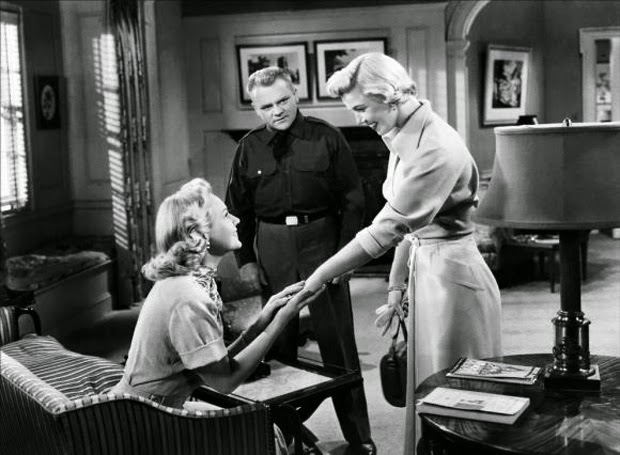


The West Point Story (Roy Del Ruth, 1950) - Jimmy Cagney reunites with his old comrade-in-arms Roy Del Ruth for this puttin'-on-a-show musical, but sadly the old magic just isn't there.

Cagney's a wisecracking former Broadway big-shot - working his way to the bottom of the ladder, betting on horses all the way - who gets a shot at redemption, in the shape of a revue at the army's West Point College. His covert mission, should he be blackmailed into accepting it, is also to put stars in the eyes of silver-tonsiled soldier Gordon MacRae.

It's a clumsy melange of star vehicle, cartoonish '50s comedy, sentimental drama and puff piece for the military, which reaches a particular nadir with a fascistic salute to the titular college - and the nation's armed forces - that would have made Leni Riefenstahl blush.

Doris Day and hoofer Gene Nelson both have their moments - the former bouncing around like a Duracell Bunny on benzedrine, the latter doing a neat routine with canes and hats - and it's fun to see Cagney sparring with his White Heat and Love Me or Leave Me leading ladies: Virginia Mayo and Day.

But the star seems all at sea with the spotty material, going too big too often, and as a film in itself, it's not nearly as great as it should have been, or as it promises to be in that opening reel.

See also: Lady Killer works in spots, while Del Ruth's Blessed Event - with Lee Tracy in the role originally intended for Cagney - might just be my favourite comedy film of all time.

***


The Saint’s Vacation (Leslie Fenton, 1941) - The bland but affable Hugh Sinclair takes over from George Sanders for this mediocre, visually threadbare series entry, co-written by creator Leslie Charteris.

It starts promisingly, and there are some ingenious touches and nice lines alongside a fair portion of convolution and silliness, but it all begins to drag a long while before its hour is up, with the (alleged) comic support from Arthur Macrae proving particularly irritating.

The first of the series remains by far the best: The Saint in New York, with a white-suited Louis Hayward playing Templar as a seductive vigilante killer. (2)

***


Against All Odds (Taylor Hackford, 1984) - The greatest film noir ever made becomes surely the worst neo-noir, in this staggeringly awful reworking of Out of the Past, with Jeff Bridges in the Mitchum role - reimagined as a beardy, leaden-witted American Football player.

The cast includes James Woods, Richard Widmark and Jane Greer - who played the femme fatale in the exalted original - but almost none of it works, due to the hideous '80s stylistics and one of the most abysmal scripts ever brought to the American screen.

In mild mitigation, Woods does his best, there's one neat (though completely incongruous) car chase and the theme song by Phil Collins is actually quite good, though I prefer the Mariah Carey version. Shut up. (1)

***

Thanks for

r
e
e
a
d
i
n
g
.

Tuesday, 28 October 2014

Boyhood, Carol Haney, and Kissimee in the Catskills - Reviews #194

Hello again. I haven't updated the blog since my summer holiday (the day job is heartily satisfying but all-consuming), so this'll be the first of a full four review anthologies unwantedly coming your way...


CINEMA: Boyhood (Richard Linklater, 2014) - Richard Linklater's staggeringly ambitious film about growing up is sprawling, shambling, and stunning in just about every way, beginning as a series of episodic, often comedic scenes, then mirroring its hero's increasing complexity and uncertainty, searching for itself across a dozen time-frames as this 11-year production morphs into an existential examination of not just one boy but all of humankind, in all its fuzzy, confusing, conflicted glory. Well, I said it was ambitious.

Ellar Coltrane plays Mason, a Texan kid whom we follow from age five to 18 - and across almost three hours - the film attaining some essential kind of truth as it alights upon real life (albeit with occasional recourse to cliché), through its measured, incisive, often improvised depiction of human relationships familial, platonic and romantic, and the way its unique production allows it to document the unfurling of a person and a personality, like a time-lapse camera showing a plant budding and blossoming, while getting rained on a lot.

It has few conventional dramatic peaks and little actual story to speak of, and yet I wasn't bored for an instant, pulled into the story, never able to second-guess where it was going, and sitting there slack-jawed in amazement when it was all over, knocked sideways by the cumulative impact of it all. And by the Hollywood Dean Gaffney (sorry, Ethan Hawke), who has never been this good on screen before. Not even when he flew around in Explorers.

There are individual scenes we've certainly seen before, and it has its moments of verbal pretension - a problem I'm always going to have with the director's Before Sunrise - but it's one of the most arresting and exciting films of the decade so far, and its USP is far more than a gimmick; rather, it's what enables Boyhood to create such an indelible impact: visually, viscerally and deep down in your soul. (4)

***


CINEMA: Two Days, One Night (Dardenne brothers, 2014) - The Dardennes hit a peak with their stunning Kid with a Bike in 2011, a soaring, polarising story about juvenile delinquency, thwarted promise and the loss of innocence.

This one doesn't hit quite so hard, doesn't break then mend you so completely, but it's reliably superb, up there with films like Rosetta and The Son, and boasting the writer-director's usual calling cards. That means the sort of damaged, nuanced characters you've met in real life yet who never grace the big screen, a brief, inspired and polemical premise that allows them to tackle a headline issue in subversive, socialist but universal style, and a confrontational bleakness giving way to marginal catharsis. If I wrote a book about the Dardennes' films, I think I would call it 'Marginal Catharsis'.

Marion Cotillard, sans make-up and vanity, is a factory worker who's laid off, just as she's well enough to return after months away with depression. It had gone to a vote amongst her colleagues: either they got a bonus or she got her job back. With the help of a bolshy friend, she lobbies the boss, who agrees to a compromise: a secret ballot in two days' time. And so, encouraged by her loving, patient husband, she begins to do the rounds, trying to talk them round, like a sad, shy, insecure Juror No. 8 fairly drowning in self-loathing.

It's repetitious at times - we get Cotillard's explanatory spiel numerous times - but while that's not necessarily the most invigorating thing to watch, it is part of the point, the desperation and casual dehumanisation of her character both reminiscent of Joan Bennett getting her soul kicked in during The Reckless Moment, and an allegory about the perils of the free market, which pits workers against one another and ends like this: with someone begging mundanely for clemency.

It's also one of the best and least sentimental, sensational depictions of depression I've seen on screen, right up there with Kirsten Dunst's mopey, ugly, real, stupefied lollop of a performance in Melancholia. Cotillard is a good person who can't even muster the energy to see the good in her that others do.

The film is perhaps minimally inventive in narrative terms, but it is forceful and original and even profound: beautifully played, and concluded in the sole way it really could be - though that's apparent only when it fades to black. (3)

***


The Pajama Game (Stanley Donen and George Abbott, 1957) - It's very nearly great, this adaptation of a smash-hit Broadway show, most recently brought to the Shaftesbury Theatre in London for a spectacular production, which met with rapturous reviews and too many empty seats.

It has the mellifluously-voiced Doris Day - before her weird, evil husband ruined her career - some devilishly good Bob Fosse choreography (the play had been his big break), and a slew of unforgettable songs, written by Jerry Ross and Richard Adler.

But it's not great. Not quite. The comedy seems too forced, male lead John Raitt doesn't have the charisma to put his part across (despite initiating the role on stage), and though some of the dancing is frankly stupendous, there just isn't enough of it.

That frustration is never felt more keenly than during Steam Heat, a showcase for the tragic, incomparable Carol Haney, who had done as much as anyone to reinvent screen dance - working as Gene Kelly's assistant choreographer, then ripping up the rulebook in tandem with Bob Fosse, through those 48 seconds of finger-clickin' goodness in Kiss Me Kate.

Steam Heat is so startling, so innovative, so gobsmackingly, jaw-droppingly perfect in all its scruffy, stylised, androgynous splendour, that it shows up the rest of the film for what it is: a merely competent translation of a hit play, conspicuously lacking in gold dust.

The Pajama Game is likeable, entertaining and unquestionably melodic, but it should have been better. It should have been great. (3.5)

Psst: you can watch Steam Heat here. That squashed, semi-panned-and-scanned version is genuinely the best I can find online. It's still worth it, a hundred times over. Watch it a hundred times. Now.

***


This Gun for Hire (Frank Tuttle, 1942) - Robert Preston and Ronnie Lake are top billed, but it's Alan Ladd - in his first real role - who dominates this stunningly nasty noir, as a new kind of screen anti-hero: a tortured loner of an assassin who punches a woman in his first scene, kills one in his second and pretty much goes on from there. Drawn from a Graham Greene novel, his DNA is in every character from Richard Widmark's giggling psycho in Kiss of Death and sweaty hood in Pickup on South Street to Alain Delon's Jef Costello.

The film isn't as polished or consistent as Ladd and Lake's follow-up, The Glass Key, and lacks that film's seductive verbal poetry, but the performances are mostly great - Laird Cregar as a man of hulking frame and feeble character, Lake putting that astonishing voice to good use - and much of the imagery is unforgettable, including fine LA location work and the mighty, admittedly tiny Ladd strolling into a rendezvous wearing a gas mask. (3)

***


Wedding Present (Richard Wallace, 1936) - A very nice little screwball comedy that starts uncertainly but ultimately delivers in terms of both laughs and heart, as a pair of mishievous, tight-knit newshounds (Cary Grant and Joan Bennett) begin to grow apart after he makes city editor and she makes him mad... only surely it can't end like that.

This is the first time Grant's dynamic fast-talking persona really made an appearance and there are some brilliant gags - including an extended practical joke worthy of Jim Halpert - to go with William Demarest's surprisingly effective bit as a friendly mobster, and the film's secret weapon: a moving, heartfelt depiction of two perfectly-matched lovers kept apart by nothing but pride.

Incidentally, the wedding present of the title manages to be both incredibly tasteless, dated and offensive, and also really quite funny. Well, apart from the pay-off. (3)

***


Two Weeks with Love (Roy Rowland, 1950) - Jane Powell undergoes some slightly tiresome growing pains in this overly glib comedy musical, which just about gets by thanks to her exceptional sincerity and an ebullient performance by the 18-year-old Debbie Reynolds. (I once met Debbie Reynolds, look!)

Powell plays a young woman who's still treated like a kid by her parents (teenagers hadn't been invented yet). The family goes off to the Catskills for a holiday, where she is overwhelmed by the desire to inspect-a-Montalban-o (boom!), but how is she ever going to get off with him if she isn't allowed to wear a corset?

The film's main problem is that the script keeps too much distance between itself and its protagonist, patronising Powell's character by depicting her problems as trivial (like I just did), and putting her through too many slapstick trials, before getting sidetracked by several deadly dull comic vignettes - including her screen father Walter Catlett trying vainly to have a sleep, a sequence which does at least climax with some delightfully primitive special effects.

Thankfully, Powell has a great voice and a winning presence, and the scene in which she breaks down in tears after a calamitous experience at a party is beautifully played, giving the film the heart that it needs and yet so often lacks.

The other real selling point is Reynolds' typically energetic turn, which hits a peak early on with the uproarious Aba Daba Honeymoon number - a paean to simian romance full of stupid dancing and glorious gibbering. The best of Powell's tunes is probably My Hero, a singularly incongruous dream sequence in which her teenager dances around in her underwear being ogled by fully clothed men, as she sings about getting married. (2)

***


Gold Diggers in Paris (Ray Enright, 1938) - Mediocre final entry in Warner's series of Gold Diggers musicals, with peerlessly annoying comic relief from the Schnickelfritz Band - discovered by star Rudy Vallee and now fondly remembered by nobody. There are a few flashes of choreographer Busby Berkeley's genius in the musical numbers, but it's not enough in a film saddled with a weak story, an often irritating cast (including a dislikeable Vallee and an unbearable Melville Cooper) and a dearth of quality songs. The first scene's quite funny, though. (1.5)

***

Old Perry Mason movies:


The Case of the Curious Bride (Michael Curtiz, 1935) - The second entry in Warner's Perry Mason series is a whole lot better than the boring, static opener, with a fair story, the brief American screen debut of Errol Flynn, and some seriously stylish direction from Michael Curtiz, who shoots the opening scene like a time-traveller from the mid-'40s, then slightly overdoes the fades between scenes, like a man who's just discovered what that button does. Admittedly the comic subplot about Mason (Warren William) becoming a gourmand is pretty pointless - indeed, for a comedy-mystery there aren't really any good gags - but there's still enough here to get your teeth into, and the relationship between the sleuth and his assistant Della Street (Claire Dodd) makes for a pleasant if undernourished diversion. (2.5)


The Case of the Lucky Legs (Archie Mayo, 1935) - Slightly irritating third outing at Warner for lawyer-turned-investigator Perry Mason (Warren William), with a rather obvious culprit and a lot of self-satisfied comedy. The main plus point is Genevieve Tobin's sparky, saucy Della Street; best remembered as the über-horny Mitzi in Lubitsch's One Hour with You, there's something of the Joan Blondell about her performance here - and compliments don't come much greater. I also like the scene where a distressed woman shouts "Lucky legs! Lucky legs!", which was the funniest bit of the film, albeit unwittingly. (2)


The Case of the Velvet Claws (William Clemens, 1936) - A short, strange and slightly stupid Perry Mason film - Warren William's last of the series: a series that never really got going; he would fare much better with the Lone Wolf films. The Perry-Della relationship is pushed to breaking point and the story is a rushed, compacted mess. Still, a couple of scenes play out quite well - like Mason slyly obliterating his nemesis' alibi - and it's accidentally very funny that everyone keeps saying "Spicy Bits" in an extremely serious voice. (1.5)

***

Thanks for reading.

Saturday, 26 July 2014

Mick Travis, How to Train Your Dragon 2, and English public school - Reviews #193

Assorted ruminations on recent film viewings. I'll try to update you on books read and plays seen when the sun isn't quite so shiny.


CINEMA: How to Train Your Dragon 2 3D (Dean DeBlois, 2014) - So, a sequel to an animated kids' film? Bigger? Check. Darker? Check. Roger Deakins hired as aesthetic consultant? Pardon.

That's just a little hint as to how high this one aims, upping the ante from the original with a story about a fascistic warlord who transfixes gentle but malleable creatures and turns them into a rampaging army (see 1930s Spain, Germany, Italy...), the film going blacker and more intensely sad than you could ever imagine, but also filling its vast frame with wonder and beauty and magic, including some of the most intoxicating flight footage ever created.

In a key part, Cate Blanchett's accent globetrots to a distracting degree - while the challenge of getting her character to make narrative sense requires some not entirely convincing plot developments - but for the most part it's a startlingly effective film, with excellent voicework by Jay Baruchel as our heroic Hiccup, a new faux-folk ballad penned by Shane MacGowan, and a beating heart as big as that weird alpha male ice dragon thing.

Does the film ever quite make up for the daringly dark, perilously tragic turn it takes in its second act? It's debatable, but I think just about: Hiccup's pleading, sincere, desperate face emerging from the fuzzy gloom as that magnificent score gets ready to soar.

Bizarrely, the lamentable Madagascar tried a similar thing and predictably died on its arse. This one has the clarity of vision and the sheer congregation of talent to sustain it through all manner of improbable challenges, the familiar fusion of action, comedy and family drama lent real weight by the sheer scale of its ambition - never more in evidence than when Hiccup sees a flamboyant dragon-rider dressed like The Statue of Liberty bearing down on him, apparently thirsty for blood... (3.5)

***


*SPOILERS*
if.... (Lindsay Anderson, 1968)
- Lindsay Anderson's bewildering, bewitching Marxist revenge fantasy is what '60s cinema should have been but so very rarely was: satirical, socially conscious and genuinely surreal, happily lacking in gimmickry and low comedy, with a variety of competing concerns but a sure focus on just who - and what - it wants to dispense with in a hail of bullets.

When I saw the film as a blazered teenager at a British public school, it seemed straightforward to me - after all, which right-thinking adolescent doesn't want to collage his walls, attract a pouty raven-haired girlfriend and then shoot everyone he doesn't like? My #1 film aged 16 looks no less radical to the 30-year-old me, but odder and wilder, throwing off the constraints of filmic form and function, just as its characters blast away the shackles of establishment oppression.

The story is slight but bracing: a trio of dissenters, led by the inestimable Mick Travis (Malcolm McDowell) - who's afforded one of the great screen entrances, dressed like a highwayman for reasons actually too uncool to recall - drink, scoff at authority and abscond from their increasingly bizarre public school, before a heartbreaking act of vindictive subjugation tips them over the edge into armed revolution.

Some have sensed a respect for tradition in Anderson's treatment of the David Sherwin script: I see little but a twitching contempt, the hymns, habits and institutions of the establishment merely monoliths and their entrenched but superficial trappings to be incinerated by the fire that burns within Travis and co.

There's none of Godard's stultifying posturing here, though: the drama is rooted in human feeling not philosophical semantics, and every sequence seems to serve some grander purpose, even if it's often left to us to determine what that might be. So the fencing fun sets up the triumvirate as musketeers defending some ancient right - and shifting from false to genuine blood-letting - the "tiger dance" presumably denotes a return to man's animal state, and the subsequent motorcycle jaunt is redolent with the smell of freedom: the antithesis of British public school life.

It's possible that the basement clear-out is just Anderson being confrontationally obscure (like Antonioni including the tennis-playing mimes in Blowup "for the critics"), but some tentative theorising can find symbolic value in everything they discover: the crocodile corpse is a relic of imperialism, tossed onto the fire, the gas mask represents Our Finest Hour, the foetus in the jar is an undeveloped human trapped under glass - much like Travis and his cohorts - and the weapons, well, they're the only answer to that.

Perhaps the only element of tradition that Anderson and Sherwin have any time for is the vernacular of public school, of "shag spots", "whips" and "scums", and that's weird enough to fit: a singular language for a singular film that flits between colour and black-and-white (initially through financial necessity, then later artistic choice), possesses a notably and joyfully unglamorous cast and chucks a grenade at the rule book.

For if there's one shot that sums up everything glorious about if...., it's that swooping, exhilarating close-up of Travis on the roof, about to take a shot of his own. (4)

***


*SOME SPOILERS*
O Lucky Man! 1973 (Lindsay Anderson, 1973)
- This unremittingly bleak, cynical meander through 1970s Britain is alternately visionary, flabby, bizarre, offensive, stupid, brilliant, scattershot, prescient and beautiful. It's also magnificently unpredictable.

Malcolm McDowell allegedly 'returns' as Mick Travis, the hero of Lindsay Anderson's if...., but if it's the same bloke, then he's certainly changed. Where once he was a Marxist insurgent, now he's an amoral coffee-salesmen-cum-arms-deal-facilitator who makes not a single reference to his glorious past (unless that abstract interrogation counts). But perhaps that's the point writer David Sherwin is making, inserting a deliciously sly line about moneyed warmongerers who once worshipped Karl Marx and Keynes within the walls of Oxford's left-leaning Balliol College.

The film as a whole is almost impossible to pin down, following Travis as it dumps him, and us, into a tragic guest house, a medical testing centre, a hippy hang-out, some smoke-filled rooms of unspeakable moral depravity, a rose-tinted jail that deliciously satirises prison's status as a place of reform, and the environs of a soup truck for the disenfranchised, the film ultimately revealing itself as the evil twin of George Bernard Shaw's Major Barbara, with not a crumb of comfort for its audience, aside from the solace of celebrity.

Laced with wicked black comedy, brilliantly soundtracked by Alan Price and his band - who often appear on-screen - and brought to life by a startlingly eclectic cast often playing several different roles (at one point Captain Mainwaring from Dad's Army turns up in blackface as an African president, and makes Rachel Roberts stroke his penis), it's an exhausting, astonishing work, as a patchy - even tedious - first half gives way to a frequently dazzling second.

In terms of coherence and visceral impact, it can't match its stunning predecessor, but it's a fascinating, remarkable film that's both a time capsule and a sign of things to come. Anderson, Sherwin and McDowell reunited nine years later for the conclusion of the trilogy, Britannia Hospital, but let's pretend they didn't. (3)

***


28 Days Later (Danny Boyle, 2004) - *swoon* Cillian Murphy.

Danny Boyle's zombie nightmare isn't as murky or bleak or intense as it really should be.

Sure, it has memorable ideas - newly awakened hospital outpatient Murphy walking the deserted London streets, shouting "Hellooooo" without much reply - but they're rarely executed as stridently as they might be, and the moments that do hit home are ultimately outweighed by a plethora of shortcomings: ugly digital cinematography, an excessive song score, some weak performances and a mawkish, often formless narrative. The admittedly bold third act diversion isn't an inspired left turn, it's the sight of the script wandering off into the wilderness.

Like all Boyle films, the movie does start well and it's not exactly unwatchable after that - with a pleasant philosophical undertow about what exactly there is to live for in this dystopia - but it's also not nearly the bristling homegrown Romero reboot that most critics would have you believe.

Take Naomi Harris's character as a case in point. She's a punchy, nihilistic one-woman pharmacy, warming up as the body count escalates - but she's just not that convincing, or interesting, or painted in bold enough colours. And neither's the film. (2)

***


Another Country (Marek Kanievska, 1984) - A sad, scintillating film - adapted by Julian Mitchell from his play - about the (semi-fictionalised) school days of the notorious dissolute Guy Burgess (Rupert Everett), who traded upper class respectability for a rollicking infamy born of alcohol, illicit sex and a double life as a Soviet spy.

Here we find him as a tortured young soul, his flamboyant queerness nothing but a mask to face down the stifling, pointless conformity of boarding school life, his dangerous sexuality as intrinsic to his being as the obsessive communism of his best friend (Colin Firth).

It's a strange, lolloping film - the missing link between the counter-culture public school rebellion of if.... and the repressed, restrained gay romance of Merchant Ivory's Maurice - unnaturally obsessed with the rules of its elite establishment not in themselves but as the strictures and structures of the establishment, in all its quivering hypocrisy.

Scored by an eerie synthesiser track, it wanders in and out of its various stories with the swaggering arrogance of Burgess himself, yet interrogates the characters - or archetypes - therein with the intellectual relish, sadness and wit also intrinsic to his being (at least as seen here).

Those myriad complexities - within us all, but within Burgess tenfold, if the film is to be believed - are brought to life with a dizzying virtuosity by Everett, before he apparently jacked in artistic ambition in favour of celebrity and playing various versions of himself in lousy American romcoms.

The scene in which he, lovestruck and drunk, hushedly croons Rodgers and Hart's 'Who?', laid out on a wooden library floor, is the kind of stunningly vulnerable, unselfconscious acting that people only seem to do when they're young and brilliant and seizing the world by its collar. Watch it next to him leading a chorus of 'I Say a Little Prayer for You' in My Best Friend's Wedding, and say a little prayer for the death of youth and its boundless creative endeavour.

Firth, too, is excellent, and their final scenes together are touched by a rare brilliance, the film's themes dovetailing perfectly into an incisive, razor-sharp examination of class, equality and Britishness. Their schoolmates naturally suffer in comparison (as Burgess's heartthrob, Harcourt, Cary Elwes has the cheekbones but not the requisite etherealism), though Michael Jenn is extremely good as a sympathetic house 'god' cracking under pressure - despite looking about 45, rather than 18.

Another Country works best with some prior knowledge of Burgess (or 'Bennett' as he is here), and isn't for all tastes - elliptical, self-contained and closeted as it is - but if you're interested in British history, class or sexual politics, it's completely fascinating, invigoratingly entertaining and extremely moving, with a hypnotically powerful, well-conceived pay-off. I loved it. (4)

***


Forbidden Games (René Clément, 1952) - Seeking perfection in art is a curse. "Why?" I hear you demand in suitably suppliant fashion. Because 'flaws' are often an irrelevance, and one that distracts viewers, reviewers and critics from embracing something truly special.

Take Forbidden Games, an Oscar-winner from 1952, which has more than its fair share of narrative and stylistic shortcomings. The subplots required to power its plot - including a rivalry between neighbours and an illicit romance between their offspring - are heavy-handed and a little dull, while the interiors shot around the lower level of a farmhouse are neither cinematic nor terribly credible.

Which makes it a flawed film, right? But it's also one of the greatest films ever made: an incredible, indelible movie about love, friendship and the destruction of innocence that builds to not one but two extraordinary gut-punches.

The movie details the intense and moving relationship between a little girl (Brigitte Fossey) orphaned in a bombing raid, and the older boy, Michel (Georges Poujouly), who appoints himself her protector. Together they try to confront the horror of war through a forbidden game: swiping ornamental crosses to decorate the cemetery they have created for fallen creatures.

While the action going on around them is middling, the children are both sensational, and the scenes concerning their obsessive friendship, their darkly comic quest and their wrestling with the biggest and most troubling questions in life are singularly and enduringly resonant, leading to a final scene that's as moving and powerful as cinema is ever going to get.

Its high points are so high, its view of childhood so arresting and deftly realised, that poorly-framed interiors and a handful of duff scenes seem a little beside the point. (4)

***

/a>

"P. S. Have you ever been teased? Can you help me?"
Mary and Max (Adam Elliot, 2009) - An animated Australian wonder about the idiosyncratic friendship between a lonely eight-year-old Antipodean girl and the obese, anxiety attack-prone middle-aged American man - magnificently voiced by Philip Seymour Hoffman - whom she selects for a penpal.

Told largely through their absurd, heartbreaking letters - which reach a definite peak of hilarity as Max recounts his employment history - and accompanied by distinctive visuals stuffed with brilliant, imaginative sight gags, it's a true original armed with an abundance of emotion, much of it deep and dark and sad.

The film arguably oversteps into poking fun at its characters a couple of times, and its plotting is best when not wandering off into diversions about manslaughter trials and lottery wins, but writer/director/designer Adam Elliot eschews easy sentimentality with admirable vigour, lending the mesmeric Que, Sera Sera sequence a haunting power, before a climactic scene that may even make Max weep big and salty tears. (3.5)

***


The Mayor of Hell (Archie Mayo, 1933) - Or Badass Boys Town: simply one of the best social dramas of the '30s, a crackling slice of humanist filmmaking, with Jimmy Cagney in electrifying form as a slum kid turned political boss who finds his conscience while running a reform school.

It's naïve in places and dramatically simplistic in others - with gangster-flavoured, comedic and romantic subplots we don't need - but it's also startlingly committed, intensely moving and often punchily exhilarating, with Cagney and juvenile delinquent extraordinaire, Frankie Darro, forming an irressistible team.

Darro would star in Warner Bros' revolutionary teen movie, Wild Boys of the Road, the same year. This one is almost as incendiary and provocative (in Wild Boys, Darro and his freight-jumping pals beat a rapist to death - and get away with it): a persuasive and progressive piece of entertainment, with a message about brutalised, demonised and abandoned youth that still rings utterly true, some beautiful direction and a Cagney performance that's up there with his very best. (3.5)

***


Sightseers (Ben Wheatley, 2012) - "I never thought of murdering an innocent person like that before." A rewatch not long after my first one, as my wife hadn't seen it. It's very funny, very British in an acute, specific way, and has some skull-crunching violence to set your teeth on edge. The lead performances could scarcely be better. I like it a lot. (3.5)

***


Goon (Michael Dowse, 2011) is like Dodgeball but with brains and heart, as former security guard Doug (Seann William Scott) is drafted into a struggling Canadian hockey team to protect its mercurial star from marauding opposition heavies, and becomes a cult hero.

Despite having its roots in truth, the plotting is rather by-the-numbers, but the script by Jay Baruchel and Evan Goldberg is funny, offbeat and sweet-natured, while providing Scott with a great part as the dim, guileless and fiercely loyal ice-borne thug with a little of Parks and Rec's Andy Dwyer about him.

Alison Pill is also extremely good as a most unusual love interest: a conflicted, horny young woman not too dissimilar to Jennifer Lawrence's celebrated character in Silver Linings Playbook, but a good couple of years before the fact.

The film occupies a strange hinterland between reality and absurdism, when leaning towards one or the other might have made it more emotionally resonant or outlandishly funny, but it is a fun place to hang out for a fast-moving hour and a half. (3)

***


Year One (Harold Ramis, 2009) - One of the more notorious flops of recent years: a comedy about cavemen Jack Black and Michael Cera, who get involved with Cain and Abel, Sodom and Gomorrah, and June Diane Raphael and Juno Temple.

It starts quite well, the leads are fun in small doses and every so often there's a really good, deceptively sharp gag, but, considering it was written by a couple of American Office staffers, it's mostly a big disappointment, with a stupid and unsatisfying story, a tendency to go for the insultingly lowbrow - and the alarmingly sexist - and a horrible performance by Oliver Platt as a high priest that sets back the gay rights debate to Year Zero. (2)

***


I didn't get to this bit. Thank fuck.

The Boat That Rocked (Richard Curtis, 2009) - Or Operation Yewtree: The Movie. This story of pirate DJs in the '60s is just complete garbage: awfully conceived, beset with mawkishness, and rife with Curtis's cringeworthy sex gags, including an astonishingly ill-judged 'comedy' attempted rape. You'll be rooting for Kenneth Branagh's ludicrous baddie to close down their stupid, boring, sex pest-y boat. Or just bailing early, as I did. (1)

***


The film is exactly this funny.

"Doctor, can you give the court your impression of Mr Striker?"
"I'm sorry, I don't do impressions, my training is in psychiatry."

Airplane II: The Sequel (Ken Finkleman, 1982) - There's no story here beyond Ted Striker (Robert Hays) trying to stop a lunar passenger flight from blowing up, simply an endless stream of jokes. Sorry, 'jokes'. The original film is pretty good if bafflingly overpraised; this repetitive sequel has precisely one-and-a-half laughs (the one is above, the half is that line about pre-flight nerves). The rest is just broad, nasty and sexist. Looks like I picked the wrong week to quit doing whatever would make it in some way bearable. (1)

***

Thanks for reading.

Thursday, 24 July 2014

The National, Lance Armstrong and A Perfume Ad: The Movie - Reviews #192

A quartet of documentaries in this belated round-up of stuff I watched in the small portion of free time not allocated to watching the World Cup.


CINEMA: Mistaken for Strangers (Tom Berninger, 2013) - This documentary about delightful indie mumblers The National is so meta that it almost swallows itself whole, but also sweet and tender and funny, tracing the relationship between their serious, sharp-suited frontman and the slacker brother he invites to be their roadie, but who spends all his time trying to make a film... this film. The gulf between the rockumentary he imagines himself to be making and the one he ends up with is bafflingly and brilliantly big.

There isn't a great deal of music, but you can get that on CD. It's more a shambling, insightful piece about brotherly bonds, with some (possibly staged) comic interludes that scale the heights of absurdity. (3)

***


The Spirit of '45 (Ken Loach, 2013) - Ken Loach's powerful, poignant polemic - about communal goals dreamt of, fought for, won and lost in the postwar period - is at once uplifting and soul-destroying, as the astonishing programme of reforms achieved by Attlee's administration are eroded, picked apart or junked by grasping free-marketeers.

The film also brought home to me how completely socialist ideas are kept out of the mainstream media: it felt bizarre to see people on my TV advocating the renationalisation of key public services - and yet YouGov says that's a majority view in this country.

Occasionally Loach loses the thread of his argument (and the RMT spokesman he chooses is poor), but the diverse selection of left-leaning contributors effectively mix the personal and the political - the best, and the one with the saddest story, is an 87-year-old Scouser supping beer in a pub - while the archive footage is simply stunning. There's some sizzling footage of NHS architect Nye Bevan railing against injustice, which nestles nicely beside interviews with my personal hero, the late Tony Benn.

The overall effect is of watching Terence Davies' Of Time and the City but injected with urgency and righteous, white-hot fury. Call it confirmation bias, but I wish everyone in the country was forced to watch this beautiful socialist propaganda. (3.5)

***


The Armstrong Lie (Alex Gibney, 2013) - Thank goodness Alex Gibney has found a use for all that footage he shot of Lance Armstrong in 2009 and then wasn't able to use.

I jest! (Slightly.)

This slightly messy, repetitive but nonetheless riveting documentary asks the question no-one else has: why did Armstrong return in 2009, and risk jeopardising his legacy. At first it appears that Gibney is only asking it so he has an excuse to roll out the wealth of access-most-areas film he shot whilst improbably constructing an Anderson hagiography five years back, but thankfully that's not the case. It turns out to be a very worthwhile question, and a worthwhile exercise.

For the uninitiated: Lance Armstrong was a young national cycling champion when he was struck down by cancer in 1996. After fighting his way back to health, he did the inconceivable, winning the sport's most gruelling worldwide competition - the epic Tour de France - a full seven times in succession, whilst becoming an inspiration to millions and amassing a personal fortune of $150m.

Perhaps unsurprisingly, given the sport's reputation and his improbable success, throughout he was dogged by accusations of doping, which he withstood thanks to the brassiest of brass necks and a policy of bullying, smearing and suing anyone who aired those allegations. Last year, he finally came clean to Oprah Winfrey, after the doping organisation USADA handed his arse to him on a plate, via an extraordinarily thorough and damning report.

His story, then, was The Armstrong Lie - and he tells it again and again here, in press conferences where he humiliates bolshy British journalists, in direct-to-camera addresses where he spins that impeccably-conceived tale of triumph over adversity and, in a new and modified version given to Gilbey five months after Oprah, where he admits that, yes, he doped, but it wasn't cheating, the facts once more moulded to fit a narrative of his making.

Armstrong is a fascinating subject - extraordinarily charismatic, with a will of iron and a habit of looking you dead in the eye and lying his face off - and though Gibney was taken in like so many others: willing to embrace the myth rather than question the man, the intervention of fate (or more specifically USADA) has led to a valuable film, if almost by accident.

You can see why Armstrong's defenders wanted to believe, and not just because of the story. The superbly-edited footage of him trouncing his rivals is genuinely exhilarating, at least until you hear him calling one detractor a "whore" on television, publicly belittling an opponent who dared speak out about Anderson's drug-pushing associate, and purposefully and repeatedly humiliating another accuser four years after an enforced legal wrangle.

That collision between the idyllic fantasy and the cold, heartless reality makes for chilling, compulsive viewing, as does the juxtaposition of heartwarming comeback footage with post fall-from-grace humility. While Gibney may not always be in control of his structure or his story, the compensations are vast. (3)

***


"Wanna meet Lars."
Mission to Lars (William Spicer and James Moore, 2012) - A Telegraph journalist takes her brother Tom - who suffers from Fragile X or "autism with bells on" - on a road trip through America. Her mission? To get him in a room with Lars Ulrich, the Metallica drummer with whom he has an almost unaccountable obsession.

I say "almost" because, as a Fragile X-pert informs us, Tom has few inhibiters halting his thought processes, leading to obsessive behavioural patterns. That only explains why he would have an obsession, though, not why he would have an obsession with Lars Ulrich.

This documentary is formulaic in the extreme, feels padded even at 76 minutes and forces you to spend quite a lot of company with a woman I frankly found quite annoying (Tom is the only person in the film who doesn't seem acutely aware of the cameras).

But as a film it has two major things going for it. Firstly, it's a valuable character study, offering insight not just into Fragile X, but into a single, singular sufferer, with his many individualistic idiosyncracies. And, secondly, the final 10 minutes left me with a huge grin plastered all over my stupid face. If it doesn't do the same to you then you're a horrible person and I hate you. (2.5)

***


Somebody Up There Likes Me (Robert Wise, 1956) - A young, Brando-ish Paul Newman is the inarticulate, brutalised inner-city middleweight Rocky Graziano - definitely - in this bruising boxing biopic.

While the star doesn't unfailingly convince as a thick, Italian-American New Yorker, he does bring a compulsive dynamism to the part, while anticipating a trio of his most indelible creations: Fast Eddie Felson, Hud and Cool Hand Luke.

The rest of the film is interesting too, its clichés and the disjointed coupling of its various elements offset by frequent Hitchcock screenwriter Ernest Lehman's smart decision to frame this as a story of poor immigrant communities trying (hopelessly?) to make something of themselves - without being stitched up by the establishment.

It lacks the myth-making cohesion of Body and Soul, the highlight of the '40s boxing movie cycle, but it's a solid film, with a good cast, some authentic location shooting and a few flourishes from Wise, including commentary of Graziano's title fight drifting out into a deserted street: everyone in his former community glued to their radio sets as he punches - and takes the punishment - for his pride and theirs. (3)

***


Bluebeard's Eighth Wife (Ernst Lubitsch, 1938) - A quick rewatch, as I was reviewing for MovieMail. The sanatorium coda is horribly dated, but overall it's an underrated Lubitsch outing, with a typically witty Wilder/Brackett script and good performances across the board. Cooper sometimes looks a little hesitant in one of his first comic roles, but he had a flair for humour, and that shows - especially during an irresistibly goofy song. David Niven remains the stand-out, though, as Colbert's hapless, idiotic suitor. (3)

***


*SPOILERS*
Johnny Eager (Mervyn LeRoy, 1941)
- Robert Taylor's cynical crimelord takes quite a while to reform for love in this crime melodrama, that flimsy central story augmented by a litany of incidental pleasures.

It's big-eyed, guileless Lana Turner who does it - her rather fortunate re-appearance in Taylor's life just one of a string of ridiculous if not unwelcome coincidences populating the film - loving him not wisely but too well, then going insane after he uses her to get his greyhound track approved (well, I said it was flimsy).

The film rather hobbles from one sporadic highlight to the next, the majority provided by a stellar supporting cast, from Van Heflin's poetically acerbic Oscar-winning rants, to Paul Stewart's brooding bits as a fickle gunman and - best of all - the mighty Glenda Farrell turning up to steal the film as Taylor's proud, desperate ex. Turner's good too, in a daft part, that excellent voice and instinctive emoting put to good use, though Taylor remains in fifth gear, which was his top gear.

While the plotting is slight, over-familiar and bears the hallmarks of being made up on the spot, those stand-out turns are supported by some fine dialogue - particularly for Heflin; shades of Thomas Mitchell in Angels Over Broadway - a decent shoot-out in an almost Western style, and a very LeRoy fondness for shots of people walking urgently through busy, exciting rooms, almost to the point of self-parody. I also like the way its hysterical early speechifying is completely (though subtly) subverted by what immediately follows, exhibiting a disregard for the spirit of the Hays Code that was very unusual in 1941.

Made as gangster pictures were giving way to that genre we later called "film noir", it's an uncertain picture but also a worthwhile one, if more for what comes with it than what it intended to be. (2.5)

***


The Girl on the Bridge (Patrice Leconte, 1999) - A stylised, monochrome French drama from the late '90s, with the look, feel and depth of a perfume ad. Vanessa Paradis is a suicidal young woman, forever waiting for something to happen, who's saved from a watery grave by knife-thrower Daniel Auteuil, and becomes a part of his act. The part he chucks knives at.

After a rather neat opening scene, this smug, sloppy film quickly unravels, hopping from a makeover scene to casino wins to infidelities, its thoughts on love and luck only half-developed, and a gaping chasm where its heart should be. In mitigation, I did kind of like the narrative device near the close, and the final exchange is quite good, though it's hardly earned by what precedes it. (1.5)

***

Thanks for reading.

Tuesday, 22 July 2014

Maurice Chevalier, 22 Jump Street and old boxing movies - Reviews #191

Hello dear reader. I am on my summer hols, so I finally have time to tack up all these reviews that have been hanging around on my computer for aeons. Lucky you. This is the first of three - yes, three - upcoming updates.


CINEMA: 22 Jump Street (Phil Lord and Chris Miller, 2014) - This sequel to one of the most cheering surprises of the past decade goes the Gremlins 2 route, sacrificing a bit of heart and any minor semblance of reality for a lot of jokes – the overwhelming majority of them extraordinarily good.

Picking up with a brief recap of the first film (with the addition of an Annie Hall reference that later pays off in considerable style), 22 Jump Street sends undercover cops Channing Tatum and Jonah Hill to college, and pitches them into a hyper-intelligent, deliriously stupid, homoerotically-mannered meta-textual subversion of/homage to the original movie, every bit as clever, idiotic, intensely gay and pop culturally astounding as that sounds.

The gags are simply legion and many surely soon to become legendary, from Hill’s beautiful contention that “it’s so refreshing to have a black victim” to the references to his advancing years, an insanely brilliant trip scene, Tatum losing it entirely outside Ice Cube’s new office (which is like “a big cube of ice”) and a post-credits sequence that’s frankly the last word in post-credits sequences.

It’s nothing new in plot terms, but it also keeps telling you it’s nothing new in plot terms, which is something new. And if the slightly repetitive, bleak and overzealous mirroring of marital breakup that forms its centrepoint is no substitute for the real human emotion at the core of the first film, the prison stuff is basically just revolting, and it has a fair few lulls to accompany its immense sense of invention, it is at least brilliantly, bracingly and blissfully funny.

“Are you going to strangle me with your liver-spotted hands?” (3)

... and I'd rewatched this to prepare myself:


"What kind of bullshit do they say about cov... coviolent bonds in this school?"
21 Jump Street (Phil Lord and Chris Miller, 2012) - One of the nicest surprises - and the funniest films - of the past few years, with the creators of Cloudy, and screenwriter Michael Bacall, sending cops and best buds Jonah Hill and Channing Tatum back to school to bust a drugs ring.

The results are imaginative, intensely funny and just the right side of laddish, mixing sentiment, comedy and action with a smart subversive streak that extends to both meta parodies of the action-comedy genre and a brilliant, incisive examination of changing youth culture.

The stars are sublime, that YouTube video incapacitates me, and while the first half is better than the second, which gets a little bogged down in peril, plot and cameo, the pay-off - starting with Hill having to front up and take the killer shot - is just extraordinarily good.

So obviously I'm excited about next week and 22 Jump Street, whilst praying that Lord, Miller and Bacall keep away from the fratboy bobbins with which they briefly flirt here. Praying to Korean Jesus, naturally. (3.5)

***


Love Me Tonight (Rouben Mamoulian, 1932) - Mamoulian's musical masterpiece was at least a decade ahead of its time in terms of imagination and innovation, and still looks sensational today. Poking fun at Lubitsch's films in which millionaires masquerade as paupers, Mamoulian casts Maurice Chevalier as a penniless tailor mistaken for a baron by princess Jeanette MacDonald.

From the ingenious opening number - which seems to have influenced everything from Once Upon a Time in the West to Dancer in the Dark - it's an unstinting barrage of joy and invention, full of dazzling shots, hummable tunes and classic Lorenz Hart lyrics, with a gorgeous Myrna Loy just about stealing the show in her breakout role as a witty, sex-hungry countess. (4)

***


Delicacy (David and Stéphane Foenkinos, 2011) - A few sitcomish elements sometimes intrude - not least the improbable event that commences the central relationship - but this romantic comedy still doubles as a deep and resonant study of grief, with several unforgettable scenes, some very well-drawn characters and a magnificent performance from Audrey Tautou.

It's a film in which the female lead's best friend cries in happiness at her emotional rebirth, then makes the boyfriend feel like dirt when he isn't the vicariously enjoyable heartthrob she'd envisaged, a film where people hold a loyalty to people and events long past - despite how it's tearing them to pieces - and a film in which being polite about some soup is a one-way ticket to Sexytown.

A very good film, in other words. (3.5)

See also: I wrote a longer review the first time I saw Delicacy. It's here.

***


Everyone Says I Love You (Woody Allen, 1996) - I finally got Woody's musical on DVD (my ancient pan-and-scan VHS was looking a bit peaky), so it seemed ripe for a rewatch not long after my last one. It was also a first viewing in widescreen, meaning that the choreography and visual composition of the dance scenes made a little more sense.

This time around, Allen's romance with Julia Roberts fell the wrong side of creepy and a few of the characters and numbers got on my nerves, but the film remains fine entertainment - and parts of it are just pure cinematic magic, particularly that climactic song and dance on the banks of the Seine. (3)

***


Gentleman Jim (Raoul Walsh, 1942) - Mark Kermode quite often reviews a movie with the rather vague phrase: "It's not a great film, but it has great things in it." Well, that's Gentleman Jim.

The great things, almost exclusively, are the intoxicating, invigorating fight sequences, strikingly conceived and stunningly executed, as the art of boxing graduates from two meatheads smacking each other on wasteground, to relative respectability, thanks in no small way to Gentleman Jim Corbett (Errol Flynn), a fleet-footed, working class bank clerk sponsored by an aristocratic club.

The pièce de resistance is an intense, brutal slugfest on a riverside platform, but every single scene in the ring is marked by stylish photography, credible choreography and no small amount of panache, whether in the extended set pieces or the flashes of freeze-framed, overlayed action in the various montages, which still look startlingly modern.

Taken as a whole, the film isn't quite a contender, let alone a champ. Flynn is fun but rather one note in his favourite role, the story has little dramatic tension outside the ring, and the film is full of extremely grating comic relief - which even intrudes on the fight scenes at times.

It all looks great, though, thanks to Walsh and cinematographer Sid Hickox's eye for detail, while Ward Bond gives surely his finest - and possibly his biggest - performance as legendary prizefighter John L. Sullivan. If his boxing style is perhaps a little cartoonish, he atones in the beautifully tender presentation sequence near the close, which is followed by Flynn and Alexis Smith's touching heart-to-heart as the film finally serves up two scenes away from the ring that can compare to those inside it. (3)

***


*MINOR SPOILERS*
Invisible Stripes (Lloyd Bacon, 1939)
- This is a surprisingly effective mix of social drama and crime film, not because it's from Warner Bros - who specialised in both - but because it starts off so unpromisingly, and stars George Raft.

Raft, a genuine hood spotted by a talent scout while the future star was scouting land for the mob, has always been among my least favourite classic actors, along with Joan Crawford and Charlton Heston. He's good in Scarface and cleverly used in Some Like It Hot, but elsewhere he's simply a plank of wood with an almost immobile face and an inability to generate any emotion beyond intense dislike.

I may have to make one of my periodic about-faces, though, as Raft is very persuasive here, playing a parolee who struggles to get a job once he's out of the big house, then becomes re-acquainted with his old mobster mate (Humphrey Bogart) as he strives to keep his callow brother (William Holden) on the right path, and out of the pen.

After a promising opening scene, the film becomes waylaid by some syrupy, over-written domestic drama, featuring another of Holden's characteristically terrible early performances. Was there ever an actor who improved so much - or so suddenly - as Holden, who some time in the late '40s got some cynicism, some stubble and some meaty roles, and became one of the key American screen actors of the 20th century.

But as Raft gets brutalised, patronised and ostracised by a succession of employers and co-workers, the film starts to grab a hold of you, and doesn't let up or let go, even when he starts robbing banks, and all realism goes out the window. Though the ending is essentially dictated by censorship restrictions of the period, in which all wrong-doing must be punished, its fatalistic air works largely in its favour, even going so far as to anticipate film noir.

In support, Flora Robson has some fine moments in a rather clichéd part as Raft and Holden's saintly mother ("When they were little I could always help them. I could pick them up when they fell down...", sob), and Bogart enjoys perhaps his best role of the '30s: an agreeably nuanced part bridging the gap between his straight out villains and the anti-heroes he would play from High Sierra onwards.

Invisible Stripes is predictable and preachy, with a rather hackneyed backdrop and some weak sequences, but it's also compelling for much of its length, with fine work from Bogart and Raft, and a few enduring things to say about how society breeds and treats its criminals. (3)

***


Kid Galahad (Michael Curtiz, 1937) - It's in the standard studio fodder, rather than the prestige pictures tailored to her talents, that you can truly see what a special performer Bette Davis was.

In Kid Galahad, a boxing film made about a decade before Hollywood learnt how to do them properly - exploring the fighter's psyche in classics like Body and Soul, The Set-Up, and Champion - she injects middling, even hokey material with both a wit and an enrapturing sincerity, as a conflicted, selfless moll knocked out by the hand of fate.

While everyone else is in a slightly superior gangster movie; Davis's film is timeless, an arresting, heart-wrenching tale of mutual reliance cast to the wind, crippling self-sacrifice and unrequited passion. The scene in which she packs her bags and attempts to leave Robinson contains some of the finest acting I've ever seen: remarkably modern and naturalistic. As in The Man Who Came to Dinner, another film where she played a supporting part, there are no histrionics and there's no grandstanding, she's just real - and really brilliant.

Director Michael Curtiz (or more likely his studio paymasters) must have known Davis was on the cusp of greatness - and of superstardom - as she's afforded the final shot here, despite playing essentially a supporting character who doubles as a plot catalyst.

Robinson is a fight promoter who builds and manipulates the career of a naive farm boy (Wayne Morris) with a good right hook. Fresh-faced Jane Bryan is Robinson's sister, for whom he has somewhat Scarface-ish protective tendencies, and Humphrey Bogart plays Robinson's gangland rival, the actor still stuck in villainous parts that largely required him to wince and bare his teeth. Rounding out the cast is Harry Carey, John Ford's first leading man, playing the now familiar role of the weather-beaten old trainer.

The plot is both predictable and rather corny, but the film as a whole is slick and entertaining, with good performances and a memorably nauseating pugilistic climax, fuelled by what I think we can safely call homoerotic sadism, with Robinson at his absolute best, shifting between panting malice and chubby-faced encouragement.

Kid Galahad is more a gangster picture with a ringside seat than a real boxing film, while its fight scenes, though commendable, pale alongside its '40s rivals (let alone Raging Bull). It's also rife with contrivances, right down the line. But if you're an old movie nerd looking for solid studio product, with a top-notch presentation and a cracking cast - including Bette Davis at her best - then you'll find yourself very much in luck. (3)

***


Seven Ways from Sundown (Harry Keller, 1960) - Audie Murphy's character in this film is called Seven. I wish I was called Seven. And Seven Days from Sundown is just a great name for a film, if not for a man.

The movie as a whole is one of a slew of interesting Audie Murphy Westerns made in the '50s and '60s, forming a loose, cool gang with those offbeat, complex and mature Joel McCrea and Randolph Scott starring vehicles shot around the same time. Seven Ways from Sundown starts poorly, but just gets better and better.

The baby-faced Murphy - in real life the most decorated American soldier of World War Two - plays a dogged, baby-faced Texas Ranger who tracks and then babysits a charming, loquacious killer (Barry Sullivan), little imagining that the toothy, reptilian bastard just murdered his brother. (Incidentally, what the film does with that information creates a stunningly astute counterpoint to the overtly, often overly personalised approach taken by so-called "revenge Westerns".)

The studio-shot footage here is seriously garish and ugly, and the acting has regular recourse to woodenness (Murphy's love interest is simply terrible), but Sullivan delivers a fine spin on a familiar character, and the sensational game of psychological cat-and-mouse between hunter and quarry - as mutual antipathy turns to homoerotic admiration - keeps it afloat during some spells of dodgy dialogue, aided by a few punchy, cleverly-conceived action interludes.

There's also one early, almost iconic shot of the star: his foot resting on the stone grave he's just made, his titular figure framed against the mountains and the grey-blue sky. It's actually just a set-up for some uninspiring gunplay, but in hindsight a sign that the film is about to burst into rather glorious life. (3)

***


Son of Rambow (Garth Jennings, 2007) - Two lonely, fatherless kids - one a troublemaker, the other a God-fearing mummy's boy - bond over a shared love of First Blood, and decide to remake it, but with the addition of an evil scarecrow.

Garth Jennings' hymn to friendship, film and the 1980s is best when rooted in the real - and articulating the upbeat - less effective when opting for (amusing but incongruous) comedy interludes concerning a cool French kid, or serving up a good half-hour of authentic but excessive human misery.

It is original, though, within the constraints of its formulaic structure, while exhibiting an invention, a humanism and a heightened sense of humour that reminded me of Danny Boyle's Millions, right down to the third act wobble.

From the sporadic flights of visual fantasy to Jessica Stevenson's heartfelt performance as a protective, conflicted mother, it's a movie studded with admirable attributes, if not ultimately an entirely successful film.

It's basically like Super 8 but English and good and with a flying plastic dog that attacks Adam Buxton instead of aliens. (3)

***


Catfish (Henry Joost and Ariel Schulman, 2010) - A shy, improbably handsome photographer in his 20s befriends an eight-year-old painter and then begins a passionate online affair with her beautiful, artistic older sister - a relationship that seems too good to be true. And is.

This documentary is unquestionably seminal - having added the term "catfished" to the lexicon - and is by turns entertaining, disingenuous, tacky, poignant, sensationalist, exploitative, intrusive, funny and weird (that chat on the cable car - shudder).

Because while it has something to say about the way we create online personas (after all, I'm really an eight-year-old girl), it's really a story of extremes: extreme naïvete, extreme self-delusion and ultimately extremely dubious investigative journalism that's fuelled by a search for answers but completely fails to engage with the rather serious questions it raises about mental illness.

It's sustained as far as it is by the novelty value of its story and the way that tale was tracked every step of the way, rather than being a particularly proficient piece of filmmaking, though it's ultimately worth seeing, if only to engage with the enduring debate about its themes, its potential fakery and its undeniable rubbernecking. (2.5)

***

Thanks for reading.