Showing posts with label William Powell. Show all posts

Monday, 3 November 2014

A Separation, Bing Crosby and seductive vigilantes - Reviews #195

More tales of sitting in a darkened room, with your host, R iCk bURi

N please. proofread this someone thank$


A Separation (Asghar Farhadi, 2011) - An Iranian couple, refused a divorce by the local magistrate, instead begin a separation, setting in chain a series of tragic events that leaves no-one in their vicinity uninjured and untainted.

This bristling, brilliant drama is bleak as hell but simply one of the best movies of recent years, offering rich characterisation, a vivid portrait of Iran's religious, male-dominated society, and a gripping, revealing and constantly surprising narrative that throbs with anger and anguish as bitter recrimination consumes its protagonists, colouring them in the eyes of their children, fast shedding their innocence.

There's not a false line or gesture here, in a searing examination of contemporary morality that offers no easy answers and passes no shallow judgements on its damaged characters, instead giving us something akin to real life, albeit in a world that often seems so very far removed from our own. (4)

***


Kes (Ken Loach, 1969) - Ken Loach's second - and still best - feature is this stunning translation of the Barry Hines novel, with David Bradley perfect as malnourished Barnsley school leaver Billy Casper, who escapes the drudgery of pit village life through his friendship with a savage, graceful hawk.

The hawk represents hope, freedom, aspiration and poetry - none of which are allowed to survive in a Britain that kicks the shit out of its working classes, breeding only vicious alpha males peddling mundane brutality and sadistic teachers blinkeredly hurling their young charges onto the scrapheap.

Though it's lit by frequent flashes of wry humour, glorious music and cinematography, and moments of transcendent escape redolent with rare beauty, it's ultimately a chilling depiction of utter hopelessness; one that packs a devastating emotional wallop, tha knows. (4)

***

"You do swim?"
"Oh yes, almost as well as I dance."
"Then you'll drown."


Libeled Lady (Jack Conway, 1936) - This is my ultimate comfort movie: I must have seen it 50 times.

Aside from one broad slapstick set-piece, a dated Chinese valet and Tracy's competent but uninspired performance, everything works. Loy and Powell simply sparkle together - she at her most arch, warm and beautiful, he turning every line into a mellifluous wonder - while Harlow is in unmissable screwball overdrive, displaying what a truly superb comedian she'd become by this time.

Snappily, imaginatively directed by Jack Conway, it's highly quotable, richly romantic and intensely, intensely funny. In fact, it's just about as good as movies get. (4)

***

Bing Crosby triple-bill


Rhythm on the River (Victor Schertzinger, 1940) - It's lovely to find a gem like this, as sometimes I start to wonder if I've exhausted the '30s and '40s' supply of quality musicals.

Bing Crosby plays a composer who ghost-writes tunes for superficially charming songwriter Basil Rathbone. Due to some fun contrivances, he happens upon Rathbone's secret lyricist - Mary Martin - and the two fall in love. A clever premise, and when you learn that it came from Billy Wilder, that makes perfect sense.

The production is handsome - full of gleaming white sets - there are some fun cameos and in-jokes (like a lovably grouchy Oscar Levant slagging off his own book, and bits for Crosby cohorts John Scott Trotter and Ken Carpenter), while the story is pleasant and quite nicely developed, if cluing in its characters surprisingly early, but where this one really excels is in the music.

The songs by Johnny Burke and James V. Monaco are just brilliant, particularly the moving, timeless Only Forever - sung by Crosby at the piano - and the star clearly knows it, approaching each one with the emotional and artistic commitment it deserves, and investing it with a deep and enduring inner beauty, or a palpable excitement.

Though Bing's jazzy posturing and mannered jive-talk ("Oh make me realise it, Wingston!") during the title track is easy to mock - which is why I've just done it - his vocal and rhythmic, pre-synced drumming is first-rate; Dixieland jazz was the star's overriding musical passion, and it shows.

Martin, who was the lifelong partner of one of my most cherished actresses - Janet Gaynor, vintage gossip fans - also contributes one show-stopping number, a sensational version of Ain't It a Shame About Mame that's flirtatious, funny and quite outrageously enjoyable. (3.5)


Birth of the Blues (Victor Schertzinger, 1941) - Or Cultural Appropriation: The Movie, as Bing Crosby and Brian Donlevy - who's frankly incompetent at miming the playing of a cornet - get the Dixieland jazz bug from the African-American community, and proceed to take it to the (white) masses.

But whereas the ghastly New Orleans - which cast Billie Holiday as a maid - had a certain inherent nastiness about it, and could hardly wait to get to a posh hall where white folks could play jazz to other white folks, here the treatment is more respectful, if still hamstrung by Hollywood cliché and racist censorship, paying tribute to real-life musicians of both colours at its close, which is a nice touch. (For his part, it's worth mentioning that Crosby himself saw racial divisions as ridiculous, performing with black musicians as readily as white: for him it was just never an issue.)

The (fictional) story is unfortunately an unmitigated shambles, taking in a tedious love triangle (hello Mary Martin), incorporating an allegedly cute kid, and having the band terrorised by a gangster, played by the chameleonic J. Carrol Naish.

Where it scores, though, is in that score. The music here is just great, from hot jazz numbers to ballads, including an irresistible version of Melancholy Baby which an overly literal Bing sings to a sleepy child. There's also the immortal St James Infirmary, The Waiter and the Porter and the Upstairs Maid - a tuneful, jaunty effort about poor people having the most fun, featuring the mellifluous tones of Jack Teagarden - and Ruby Elzy's glorious St Louis Blues (provoked by one of the most arbitrary plot developments of all time), the camera rudely wandering away from the African-American vocalist, before deciding that, yes, that's actually amazing and we should go and listen to it.

As a historical piece about the birth of the blues, it's blinkered and racist and basically just a big fib, and as entertainment it's patchy, but it'd make one hell of a CD, and here you get to see Donlevy actively wishing that he'd been paying attention when they told him how to hold a cornet. (2.5)


Rhythm on the Range (Norman Taurog, 1936) - This is another of the '30s' endless It Happened One Night rehashes, with society girl Frances Farmer (of Nirvana namecheck notoriety) falling in love with rodeo bum Bing Crosby while riding a boxcar to the West.

It's a solid if familiar story then, there's one stunningly lit shot of a cigarette-shrouded Farmer pulling on a very '30s hat, and Crosby makes the utmost of a thin song score, but the dialogue and characterisation is trite and the frequent comedy interludes are desperately unfunny, making a promising supporting cast look positively idiotic.

At one point, Samuel Hinds says Martha Raye is the most annoying person he's ever met, which seems fair.

As for Farmer, she's a little better than most of these identikit blondes who made 15 or 20 appearances as leading ladies, but undeserving of the cult attention that has attached itself to her as a result of a troubled life, a fraudulent biopic and a superb Cobain lyric. (2)

***


"Why does he make us feel the questions if he's not gonna give us any answers?"
A Serious Man (Joel Coen, 2009) - The Coens' film about a good man looking for answers as his life falls apart has a superb prologue, two terrific early comic scenes featuring an angry Korean student, and sporadic insights (or non-insights) concerning the meaning of existence. It's also nicely shot by the great Roger Deakins, and accompanied by some nice Jefferson Airplane songs.

But the writer-directors' treatment of the material, for all the originality of its setting - an orthodox Jewish community in the late 1960s - suffers from the age-old Coen problems. Any semblance of sentiment is always just the set up to more nastiness and nihilism, which in this context is frankly baffling, and ultimately both wearing and eye-widening - the cynicism of the ending every bit as unnecessary as the heartless pay-off to their take on True Grit. On one level, I'm intrigued by that approach, but it makes the film dreadfully hard to like. The overall effect is as if Wes Anderson had left the last 10 minutes off The Royal Tenenbaums, and then announced that Royal's illness was real.

On a more prosaic level, it's also quite bitty, but my real problem with A Serious Man is that coldness, that aloofness, the sense that it's laughing at its protagonist, as his world is tipped unceremoniously and brutally upon its head. It's a sad, cynical film, one allergic to genuine catharsis.

***
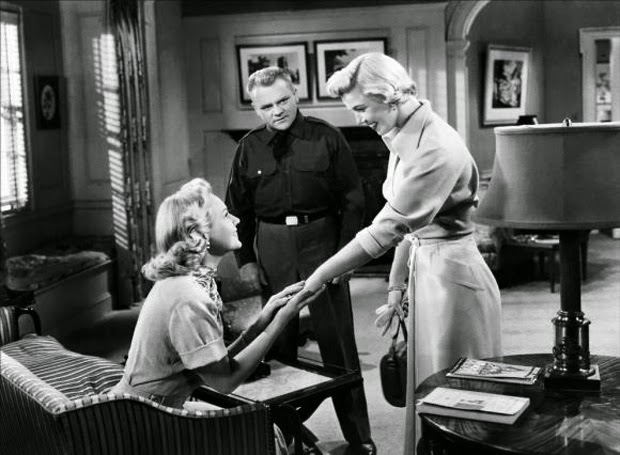


The West Point Story (Roy Del Ruth, 1950) - Jimmy Cagney reunites with his old comrade-in-arms Roy Del Ruth for this puttin'-on-a-show musical, but sadly the old magic just isn't there.

Cagney's a wisecracking former Broadway big-shot - working his way to the bottom of the ladder, betting on horses all the way - who gets a shot at redemption, in the shape of a revue at the army's West Point College. His covert mission, should he be blackmailed into accepting it, is also to put stars in the eyes of silver-tonsiled soldier Gordon MacRae.

It's a clumsy melange of star vehicle, cartoonish '50s comedy, sentimental drama and puff piece for the military, which reaches a particular nadir with a fascistic salute to the titular college - and the nation's armed forces - that would have made Leni Riefenstahl blush.

Doris Day and hoofer Gene Nelson both have their moments - the former bouncing around like a Duracell Bunny on benzedrine, the latter doing a neat routine with canes and hats - and it's fun to see Cagney sparring with his White Heat and Love Me or Leave Me leading ladies: Virginia Mayo and Day.

But the star seems all at sea with the spotty material, going too big too often, and as a film in itself, it's not nearly as great as it should have been, or as it promises to be in that opening reel.

See also: Lady Killer works in spots, while Del Ruth's Blessed Event - with Lee Tracy in the role originally intended for Cagney - might just be my favourite comedy film of all time.

***


The Saint’s Vacation (Leslie Fenton, 1941) - The bland but affable Hugh Sinclair takes over from George Sanders for this mediocre, visually threadbare series entry, co-written by creator Leslie Charteris.

It starts promisingly, and there are some ingenious touches and nice lines alongside a fair portion of convolution and silliness, but it all begins to drag a long while before its hour is up, with the (alleged) comic support from Arthur Macrae proving particularly irritating.

The first of the series remains by far the best: The Saint in New York, with a white-suited Louis Hayward playing Templar as a seductive vigilante killer. (2)

***


Against All Odds (Taylor Hackford, 1984) - The greatest film noir ever made becomes surely the worst neo-noir, in this staggeringly awful reworking of Out of the Past, with Jeff Bridges in the Mitchum role - reimagined as a beardy, leaden-witted American Football player.

The cast includes James Woods, Richard Widmark and Jane Greer - who played the femme fatale in the exalted original - but almost none of it works, due to the hideous '80s stylistics and one of the most abysmal scripts ever brought to the American screen.

In mild mitigation, Woods does his best, there's one neat (though completely incongruous) car chase and the theme song by Phil Collins is actually quite good, though I prefer the Mariah Carey version. Shut up. (1)

***

Thanks for

r
e
e
a
d
i
n
g
.

Tuesday, 19 January 2010

An introduction to... Lee Tracy (with a review of Criminal Lawyer)

This post contains one instance of strong language, employed in a comical sense. If that's likely to offend, please take a look at the Myrna Loy piece instead. No swearing there.

As you may have guessed from the blog name (borrowed from a 1933 Tracy vehicle), this razor-witted, motormouth leading man is my favourite actor. Here's a quick intro to the man.

An introduction to... Lee Tracy


After originating the role of Hildy Johnson in the original Broadway production of The Front Page, sparky, red-headed Lee Tracy went to Hollywood. He made a splash at Warner Bros, playing reporters, shysters and sharpsters in a run of gloriously snappy flicks like Blessed Event, The Half-Naked Truth and Washington Merry-Go-Round, something of a dry run for Capra's Mr Smith. Tracy signed for MGM in 1933 (William Powell made the same switch a year later), a move that did nothing to curb his ebullience or anti-authoritarianism, on screen or off. Just how highly the studio regarded him is evidenced by the number of movies they threw him into. In '33 alone he made no fewer than six movies at MGM, including forgotten classics Turn Back the Clock and The Nuisance, established greats Bombshell and Dinner at Eight and a peculiar Russia-set screwball comedy called Clear All Wires!, opposite Benita Hume and Una Merkel. Then he blew it.

There are potentially many fine ways to put the skids on a meteoric rise, but Tracy's takes some beating.

He pissed on the Mexican Army.

The story goes that Tracy was in Mexico shooting Viva Villa! for the studio when - blind drunk - he resolved to relieve himself off a balcony. The presence of a passing military parade below led to a diplomatic incident that saw him arrested, kicked off the film and then fired by MGM, after the Mexican papers called his actions "an insult to the nation". There is some debate over the authenticity of that story, though, superb as it is. Cameraman Charles G. Clarke says in his autobiography that Tracy was merely making obscene gestures to a guy outside his window. It's also worth questioning why Tracy had to go (from the studio, not to the toilet), since studios routinely hushed up sex scandals and hit-and-runs involving their stars. Perhaps the story was already too public, or perhaps his near-constant hellraising had left him on a last warning, but some have speculated that his type of wisecrack-driven film may have been losing favour with audiences (he only had a supporting role in Viva Villa!), with the scandal providing a suitable pretext on which to sack him. Whatever, they must have been mad. Tracy was something very special.

Charismatic and dynamic, the actor had one-of-a-kind delivery and a catalogue of recognisable mannerisms, like utilising his long, thin index finger to emphasise a point. Though there is such thing as a recognisable Tracy character - an incorrigible scalliwag playing everyone around him as he gets the scoop/wins the case, before displaying some skewed sense of morality in the final reel - he was no one-trick pony. Tracy's reporters in The Strange Love of Molly Louvain and I'll Tell the World (1934) are completely different, as are his promoters in Two-Fisted and Dinner at Eight. He also excelled in more obviously diverse roles: as a broken-hearted clown slipping into self-loathing in You Belong to Me, a Truman-esque President in his last film The Best Man and a disenchanted middle-aged man getting the chance to relive his life, and change history, in the devastatingly brilliant Depression-era fantasy Turn Back the Clock.

Following his sacking in '34, Tracy struck a three-picture deal with Columbia, before making a heap of low-budget star vehicles over at RKO, and a few for Poverty Row studios like PRC. Though the RKO movies vary in quality, they do acknowledge Tracy's standing as a uniquely gifted, fast-talking leading man near the peak of his powers, and are largely tailored to his talents.

One such RKO film is Criminal Lawyer (Christy Cabanne, 1937), which I watched last night. It's in many ways a standard Tracy film and, as such, an absolute riot. Taking the basic set-up of The Nuisance - Tracy is a shyster whose success in the courtroom is based more on theatrics and tricks than conventional legal practice - the writers also toss in the gangster subplots familiar from Blessed Event and Advice to the Lovelorn. The result is very similar to the William Powell movie Lawyer Man, though bizarrely that 1932 film chose not to show any of the courtroom sequences to which it frequently referred. The plot here has Tracy's barrister-come-showman becoming DA and trying to shake off his nefarious former sponsor. Hilariously, the tagline of the film gives away its entire storyline. What does the poster think it is - Halliwell's? Without telling you exactly what happens, I'll just say that as Tracy spars with hateful hood Eduardo Ciannelli, a woman (Margot Grahame) enters the picture, becoming Tracy's cook, secretary and confidante. That makes his sometime girlfriend (Betty Lawford) very jealous, setting up a slightly melodramatic final third that isn't as strong as the rest of the picture. Erik Rhodes provides plenty of comic support playing his patented amorous Italian (as seen in The Gay Divorcee, Top Hat and The Smartest Girl in the World), but as usual it's Tracy's show. Just seeing him on screen makes me happy, since he's never tired, or lacklustre, or sub-par. He's always just magnificently, spectacularly Tracy-ish. When the script is sharp, he's impossibly good, but he also elevates so-so sequences. His interrogation of a woman accused of murder recalls his pyrotechnics in Blessed Event, talking Allen Jenkins through a trip to the electric chair, and he imbues the climactic scene with an improbable credibility as well as a compulsive watchability. My 21st Tracy film is flawed, certainly, but yet another must for fans of the actor. (3)

Monday, 18 January 2010

Myrna Loy - Hollywood's forgotten star

I'm digging out a few articles from the archive that you might not have seen before. Here's the first - a piece I wrote about one of my favourite actresses, Myrna Loy.


Myrna Loy - Hollywood's forgotten star

In 1937, Myrna Loy was crowned Queen of Hollywood by 20 million moviegoers in the biggest survey of its kind ever conducted. The achievement, celebrated in front of press cameras as she promoted MGM's Parnell, was the result of Ed Sullivan's quest to find America’s favourite actor and actress. The King, of course, was Clark Gable, the smirking, macho charmer whose enduring place in popular culture would be cemented two years later by Gone with the Wind.

It seems remarkable today that Loy, now largely forgotten, once enjoyed a similar level of fame.

She may not have had a song named after her, like 1937’s ‘Dear Mr. Gable/You Made Me Love You (I Didn’t Want To Do It)’, but contemporaries converted the jazz standard ‘Moanin’ Low’ to serenade her, while E. B. White penned a poem in her honour – ‘Marvellous Myrna, Lovely Loy’. She was the subject of President Franklin Roosevelt’s most public crush, inspired a young Jimmy Stewart to declare, “I’m going to marry Myrna Loy!” and gave ‘30s plastic surgeons the most requested profile of the decade. When Dillinger was gunned down by police outside the Biograph Theatre, it was Loy he’d broken cover to see – in 1934’s Manhattan Melodrama. Even Gable himself was in thrall to Loy’s charms, being pushed off a porch into a hedge for his troubles.

Loy was also a trendsetter: the first actress to work for the UN, an unexpected rebel who went on strike from MGM for equal pay, and a fixture on Hitler’s blacklist, after speaking out against his treatment of Jews. She lobbied for black actors to be given more dignified roles, and was part of the Committee for the First Amendment that battled the Hollywood witch-hunt from 1947. Loy’s portrayals of patient, devoted spouses in some of the Golden Age’s best films saw her dubbed ‘The Perfect Wife’, while Henry Fonda considered her “the perfect movie star”. Even New Hollywood tipped its hat to Myrna, as Bonnie and Clyde’s C. W. Moss called her his “favourite picture star”. It's difficult to say why Loy is so little-known today. Perhaps it's because of her unshowy acting style - the way she complemented, rather than dominated, the other actors on show. Perhaps because she has no one transcendent film - a Wizard of Oz or Casablanca - frequently replayed on TV, lodging her in casual movie-watchers’ minds. Or perhaps the relative scarcity of her work is to blame. Of her 122 features, only 13 are available on DVD in Britain. Whatever, it's a situation that deserves to be rectified.

Loy, born Myrna Adele Williams in Montana in 1905, was a graceful, gracious, hugely appealing actress whose gift for sophisticated, banter-heavy comedy was complemented by an intuitive warmth, subtlety and sensitivity that helped her create maximum chemistry with a succession of legendary leading men. She had an engagingly unusual appearance: a nose that cast wicked shadows, ears that Selznick wanted stuck back to her head and legs that she kept under wraps at all costs, despite her training as a dancer. And after overcoming a severe uneasiness with sound cinema, she was able to project one of the movies' great voices, sympathetic and melodious, but with a funny edge to it.

Discovered by Rudolph Valentino, Loy had braved seven years of bit parts and bizarre typecasting before her career-changing role in the 1932 musical masterwork Love Me Tonight, directed by sometime beau Rouben Mamoulian. Her refreshing performance as a twinkly-eyed, man-hungry countess helped put pay to the ‘vamp’ tag that had seen her play exotic villainesses in films like The Black Watch and The Squall. From then on, her rise was meteoric. The following year was one of firsts. Night Flight was the first movie where Loy was billed above the title, while the superb comedy-thriller Penthouse had been her maiden collaboration with ‘One-Shot’ Woody Van Dyke, the director famed for his aversion to second takes. He took to yelling in the studio canteen about her bright future, before devising the first part written especially for her, in The Prizefighter and the Lady.

When MGM landed the rights to ‘The Thin Man’, Dashiell Hammett’s novel about two married, soused sleuths, Van Dyke fought for Loy to play the lead. He’d pushed her into his swimming pool, he said, and she’d passed the audition. Studio boss Louis B. Mayer eventually relented, giving Van Dyke three weeks to shoot the film. He made the deadline with ease.

If Loy had been good in Love Me Tonight, she was a revelation in The Thin Man. For the first time, audiences were presented with a modern take on marriage: a happily-wed couple with an endless tolerance for one another’s foibles, who matched each other drink for drink, while dabbling in detective work. Loy’s gift for comedy, so clearly on display in Love Me Tonight, had reached a whole new level, and was allied to an understated, often unspoken expression of heartfelt emotion that few performers could equal.

The film’s singular magic is epitomised by a spot of face-pulling. Amateur investigator Nick Charles (William Powell) is trying not to get involved in a murder case. Without warning, the chief suspect's daughter (Maureen O'Sullivan) turns up in his apartment. A Christmas party is in full swing, so he takes her into the bathroom. The young brunette falls into his arms... and in walks his wife (Loy). Cue the anticipated blow-up, with the rest of the film spent in recrimination and regret? Of course not. Powell pulls a face, Loy wrinkles her nose, and the danger's over. It's utterly joyous. The pair, who had acted together previously in Manhattan Melodrama, appeared in a further 12 films. Five of those were Thin Man sequels, while Libeled Lady and I Love You Again were peaks of the screwball genre. In The Great Ziegfeld, a simply enormous biopic, Myrna played the eponymous showman’s second wife. Though she doesn’t appear until the final third, her scenes with Powell are a delight.

But then Loy’s filmography is littered with wonder, from her wide-eyed love interest in Capra’s brilliant Broadway Bill, to her commanding dramatic performance in The Rains Came, a waterlogged disaster pic that’s slipped off the critical radar. She could do state-of-the-nation drama (William Wyler’s The Best Years of Our Lives) as effortlessly as family comedy (Cheaper by the Dozen) and continued to act well into her 70s, delivering a compelling, nuanced supporting turn in Sidney Lumet’s acidic satire, Just Tell Me What You Want. Hers is a body of work ripe for rediscovery and reevaluation. Whether she was paired with Powell, Gable, Cary Grant or Spencer Tracy, the sparks always flew and the relationships always rang true. Maybe Myrna couldn’t grandstand like Bette Davis, or suffer like Garbo, but given a quip and a cocktail dress, she was the greatest.

(c) MovieMail, March 2008