Showing posts with label Bing Crosby. Show all posts

Monday, 3 November 2014

A Separation, Bing Crosby and seductive vigilantes - Reviews #195

More tales of sitting in a darkened room, with your host, R iCk bURi

N please. proofread this someone thank$


A Separation (Asghar Farhadi, 2011) - An Iranian couple, refused a divorce by the local magistrate, instead begin a separation, setting in chain a series of tragic events that leaves no-one in their vicinity uninjured and untainted.

This bristling, brilliant drama is bleak as hell but simply one of the best movies of recent years, offering rich characterisation, a vivid portrait of Iran's religious, male-dominated society, and a gripping, revealing and constantly surprising narrative that throbs with anger and anguish as bitter recrimination consumes its protagonists, colouring them in the eyes of their children, fast shedding their innocence.

There's not a false line or gesture here, in a searing examination of contemporary morality that offers no easy answers and passes no shallow judgements on its damaged characters, instead giving us something akin to real life, albeit in a world that often seems so very far removed from our own. (4)

***


Kes (Ken Loach, 1969) - Ken Loach's second - and still best - feature is this stunning translation of the Barry Hines novel, with David Bradley perfect as malnourished Barnsley school leaver Billy Casper, who escapes the drudgery of pit village life through his friendship with a savage, graceful hawk.

The hawk represents hope, freedom, aspiration and poetry - none of which are allowed to survive in a Britain that kicks the shit out of its working classes, breeding only vicious alpha males peddling mundane brutality and sadistic teachers blinkeredly hurling their young charges onto the scrapheap.

Though it's lit by frequent flashes of wry humour, glorious music and cinematography, and moments of transcendent escape redolent with rare beauty, it's ultimately a chilling depiction of utter hopelessness; one that packs a devastating emotional wallop, tha knows. (4)

***

"You do swim?"
"Oh yes, almost as well as I dance."
"Then you'll drown."


Libeled Lady (Jack Conway, 1936) - This is my ultimate comfort movie: I must have seen it 50 times.

Aside from one broad slapstick set-piece, a dated Chinese valet and Tracy's competent but uninspired performance, everything works. Loy and Powell simply sparkle together - she at her most arch, warm and beautiful, he turning every line into a mellifluous wonder - while Harlow is in unmissable screwball overdrive, displaying what a truly superb comedian she'd become by this time.

Snappily, imaginatively directed by Jack Conway, it's highly quotable, richly romantic and intensely, intensely funny. In fact, it's just about as good as movies get. (4)

***

Bing Crosby triple-bill


Rhythm on the River (Victor Schertzinger, 1940) - It's lovely to find a gem like this, as sometimes I start to wonder if I've exhausted the '30s and '40s' supply of quality musicals.

Bing Crosby plays a composer who ghost-writes tunes for superficially charming songwriter Basil Rathbone. Due to some fun contrivances, he happens upon Rathbone's secret lyricist - Mary Martin - and the two fall in love. A clever premise, and when you learn that it came from Billy Wilder, that makes perfect sense.

The production is handsome - full of gleaming white sets - there are some fun cameos and in-jokes (like a lovably grouchy Oscar Levant slagging off his own book, and bits for Crosby cohorts John Scott Trotter and Ken Carpenter), while the story is pleasant and quite nicely developed, if cluing in its characters surprisingly early, but where this one really excels is in the music.

The songs by Johnny Burke and James V. Monaco are just brilliant, particularly the moving, timeless Only Forever - sung by Crosby at the piano - and the star clearly knows it, approaching each one with the emotional and artistic commitment it deserves, and investing it with a deep and enduring inner beauty, or a palpable excitement.

Though Bing's jazzy posturing and mannered jive-talk ("Oh make me realise it, Wingston!") during the title track is easy to mock - which is why I've just done it - his vocal and rhythmic, pre-synced drumming is first-rate; Dixieland jazz was the star's overriding musical passion, and it shows.

Martin, who was the lifelong partner of one of my most cherished actresses - Janet Gaynor, vintage gossip fans - also contributes one show-stopping number, a sensational version of Ain't It a Shame About Mame that's flirtatious, funny and quite outrageously enjoyable. (3.5)


Birth of the Blues (Victor Schertzinger, 1941) - Or Cultural Appropriation: The Movie, as Bing Crosby and Brian Donlevy - who's frankly incompetent at miming the playing of a cornet - get the Dixieland jazz bug from the African-American community, and proceed to take it to the (white) masses.

But whereas the ghastly New Orleans - which cast Billie Holiday as a maid - had a certain inherent nastiness about it, and could hardly wait to get to a posh hall where white folks could play jazz to other white folks, here the treatment is more respectful, if still hamstrung by Hollywood cliché and racist censorship, paying tribute to real-life musicians of both colours at its close, which is a nice touch. (For his part, it's worth mentioning that Crosby himself saw racial divisions as ridiculous, performing with black musicians as readily as white: for him it was just never an issue.)

The (fictional) story is unfortunately an unmitigated shambles, taking in a tedious love triangle (hello Mary Martin), incorporating an allegedly cute kid, and having the band terrorised by a gangster, played by the chameleonic J. Carrol Naish.

Where it scores, though, is in that score. The music here is just great, from hot jazz numbers to ballads, including an irresistible version of Melancholy Baby which an overly literal Bing sings to a sleepy child. There's also the immortal St James Infirmary, The Waiter and the Porter and the Upstairs Maid - a tuneful, jaunty effort about poor people having the most fun, featuring the mellifluous tones of Jack Teagarden - and Ruby Elzy's glorious St Louis Blues (provoked by one of the most arbitrary plot developments of all time), the camera rudely wandering away from the African-American vocalist, before deciding that, yes, that's actually amazing and we should go and listen to it.

As a historical piece about the birth of the blues, it's blinkered and racist and basically just a big fib, and as entertainment it's patchy, but it'd make one hell of a CD, and here you get to see Donlevy actively wishing that he'd been paying attention when they told him how to hold a cornet. (2.5)


Rhythm on the Range (Norman Taurog, 1936) - This is another of the '30s' endless It Happened One Night rehashes, with society girl Frances Farmer (of Nirvana namecheck notoriety) falling in love with rodeo bum Bing Crosby while riding a boxcar to the West.

It's a solid if familiar story then, there's one stunningly lit shot of a cigarette-shrouded Farmer pulling on a very '30s hat, and Crosby makes the utmost of a thin song score, but the dialogue and characterisation is trite and the frequent comedy interludes are desperately unfunny, making a promising supporting cast look positively idiotic.

At one point, Samuel Hinds says Martha Raye is the most annoying person he's ever met, which seems fair.

As for Farmer, she's a little better than most of these identikit blondes who made 15 or 20 appearances as leading ladies, but undeserving of the cult attention that has attached itself to her as a result of a troubled life, a fraudulent biopic and a superb Cobain lyric. (2)

***


"Why does he make us feel the questions if he's not gonna give us any answers?"
A Serious Man (Joel Coen, 2009) - The Coens' film about a good man looking for answers as his life falls apart has a superb prologue, two terrific early comic scenes featuring an angry Korean student, and sporadic insights (or non-insights) concerning the meaning of existence. It's also nicely shot by the great Roger Deakins, and accompanied by some nice Jefferson Airplane songs.

But the writer-directors' treatment of the material, for all the originality of its setting - an orthodox Jewish community in the late 1960s - suffers from the age-old Coen problems. Any semblance of sentiment is always just the set up to more nastiness and nihilism, which in this context is frankly baffling, and ultimately both wearing and eye-widening - the cynicism of the ending every bit as unnecessary as the heartless pay-off to their take on True Grit. On one level, I'm intrigued by that approach, but it makes the film dreadfully hard to like. The overall effect is as if Wes Anderson had left the last 10 minutes off The Royal Tenenbaums, and then announced that Royal's illness was real.

On a more prosaic level, it's also quite bitty, but my real problem with A Serious Man is that coldness, that aloofness, the sense that it's laughing at its protagonist, as his world is tipped unceremoniously and brutally upon its head. It's a sad, cynical film, one allergic to genuine catharsis.

***
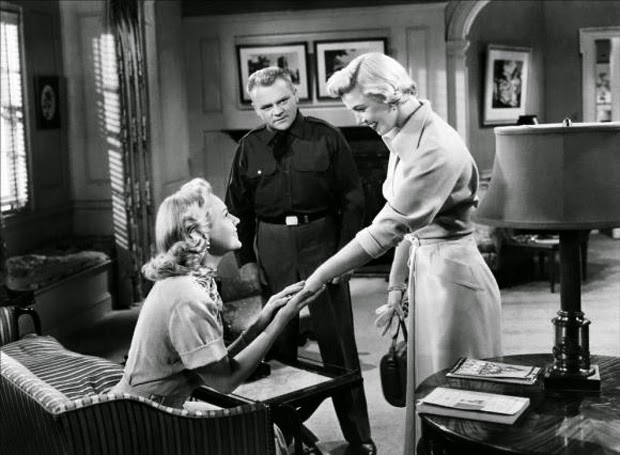


The West Point Story (Roy Del Ruth, 1950) - Jimmy Cagney reunites with his old comrade-in-arms Roy Del Ruth for this puttin'-on-a-show musical, but sadly the old magic just isn't there.

Cagney's a wisecracking former Broadway big-shot - working his way to the bottom of the ladder, betting on horses all the way - who gets a shot at redemption, in the shape of a revue at the army's West Point College. His covert mission, should he be blackmailed into accepting it, is also to put stars in the eyes of silver-tonsiled soldier Gordon MacRae.

It's a clumsy melange of star vehicle, cartoonish '50s comedy, sentimental drama and puff piece for the military, which reaches a particular nadir with a fascistic salute to the titular college - and the nation's armed forces - that would have made Leni Riefenstahl blush.

Doris Day and hoofer Gene Nelson both have their moments - the former bouncing around like a Duracell Bunny on benzedrine, the latter doing a neat routine with canes and hats - and it's fun to see Cagney sparring with his White Heat and Love Me or Leave Me leading ladies: Virginia Mayo and Day.

But the star seems all at sea with the spotty material, going too big too often, and as a film in itself, it's not nearly as great as it should have been, or as it promises to be in that opening reel.

See also: Lady Killer works in spots, while Del Ruth's Blessed Event - with Lee Tracy in the role originally intended for Cagney - might just be my favourite comedy film of all time.

***


The Saint’s Vacation (Leslie Fenton, 1941) - The bland but affable Hugh Sinclair takes over from George Sanders for this mediocre, visually threadbare series entry, co-written by creator Leslie Charteris.

It starts promisingly, and there are some ingenious touches and nice lines alongside a fair portion of convolution and silliness, but it all begins to drag a long while before its hour is up, with the (alleged) comic support from Arthur Macrae proving particularly irritating.

The first of the series remains by far the best: The Saint in New York, with a white-suited Louis Hayward playing Templar as a seductive vigilante killer. (2)

***


Against All Odds (Taylor Hackford, 1984) - The greatest film noir ever made becomes surely the worst neo-noir, in this staggeringly awful reworking of Out of the Past, with Jeff Bridges in the Mitchum role - reimagined as a beardy, leaden-witted American Football player.

The cast includes James Woods, Richard Widmark and Jane Greer - who played the femme fatale in the exalted original - but almost none of it works, due to the hideous '80s stylistics and one of the most abysmal scripts ever brought to the American screen.

In mild mitigation, Woods does his best, there's one neat (though completely incongruous) car chase and the theme song by Phil Collins is actually quite good, though I prefer the Mariah Carey version. Shut up. (1)

***

Thanks for

r
e
e
a
d
i
n
g
.

Wednesday, 7 April 2010

An interview with Bing Crosby's producer


Geoff (left) picks out a melody for Bing in the studio.

Bird noises, golf and teaching Bing to sing – producer Geoff Milne talks about working with the legendary entertainer on the 1976 album, Feels Good, Feels Right.

“It was almost through Bing Crosby that I came into the music business to start with,” says producer Geoff Milne.

“I started collecting his records in Germany in 1946. I was in the RAF and had been seconded into the entertainment division, where I ran a record library. People from other divisions would come in to borrow Bing records – even from the army divisions. He was very popular.”

After leaving the RAF, Geoff spent three years at British Airways, before deciding he’d be happier elsewhere. “I was brought up with music and films,” the 85-year-old says. “I can recall standing on a chair pretending I was conducting the afternoon broadcast from the Savoy Theatre.

“In 1950, only EMI and Decca were around, of any substance, so I made a nuisance of myself and Decca gave me a job to shut me up. I started in the accounts department, though my aim was to get to the artists department as soon as I got in – and I had determination.”

Special treatment

When Geoff joined Decca in 1950, Bing had been at the company for 20 years. “Crosby was a permanent artist on Decca and the company had been associated with his records since 1930,” he says. “Decca were interested in promoting him rather specially because of the longevity of his tenure.”

Ultimately Geoff rose to be the manager of Decca’s London American label, spending more than 30 years at the company. It took until 1976, though, for him to meet the man who’d inadvertently launched his career in the industry.

Bing had come to England to create a spoken word, three-LP box-set, The Adventures of Tom Sawyer, with Geoff working on the sound effects. While Crosby was there, Geoff had snapped up his latest record, Southern Memoir.

“He said nobody wanted it. He had run out of steam, as far as the record labels were concerned,” Geoff says. “I knew John Scott Trotter [Crosby’s regular accompanist and director], whom I’d met in America, and he told Bing I would be interested.”

New record

Having released the album, Geoff was given the chance to produce a new Crosby record: 1976’s Feels Good, Feels Right. “One can get very blasé about this sort of thing, but it was quite an event to meet him,” Geoff says. “It was very pleasant seeing him. I was always interested in Crosby – he was a bit of a legend, a little bit special.”

Geoff says being in the studio with the singer was a memorable experience: “It wasn’t just a job. It was exciting, in a way, listening to him. It’s hard to explain, but he was a man who had been singing since 1926 and he was still going strong – he had an incredible track record.

“He went through a period in the 1950s when he sounded a little bit tired and the records didn’t sound as good, but he seemed to recover from the early ‘70s onwards – there was a new timbre to his voice.”

Songs

The first step was to decide which songs Crosby would record, with Geoff driving up to the singer’s rented house at Holland Park to talk over possibilities. “We were going through all sorts of titles in the flat,” he says. “He knew most of them, having probably sung them on the radio at one time or another. But I remember having to sing one of them for him, and him saying: ‘That was very good – you ought to record it’, very much tongue-in-cheek.”

And Geoff did get a chance to croon in the studio, as Bing struggled with one particularly tricky melody line. “There was another song, either Rose in Her Hair or Old Fashioned Love, where he couldn’t get the melody quite right and had to reminded of how it went,” Geoff says.

“If you look on the back of the LP, there’s a photo of me singing to him, because he couldn’t get it right. Everybody found that very amusing. I suppose even the master professionals can have their weaknesses.”


'Easy'

Mostly, though, Geoff was taken aback by just how easy Crosby found the process. “The actual recording didn’t take very long,” he says. “Myself and the studio producer Kevin Daley suggested titles and Bing usually went along with what we had to say.

“He could nail a song in the first go. If you did it again, it was just a safety, just to be sure. I often heard the first take and thought: ‘How’s he going to improve on that?’”

The album was recorded in one three-day period in July, with a second session at the start of August where Bing recut four songs he was unhappy with, using a different style and tempo, including one that never made the record – That Old Black Magic.

Geoff’s favourite song from the record is the enchanting, dreamy closing number. “The song that stands out from those sessions is When I Leave the World Behind,” he says. “He liked that song; I remember when we talked about it. Al Jolson had made it famous and we thought: ‘Hmm, is it the right sort of material?’, but Bing was convinced it was, and he was right.”

Happy-go-lucky

Geoff says that while Bing was “practical” and “no mug”, he had much in common with the happy-go-lucky persona he cultivated in films and on records. “He wasn’t particularly interested in money,” Geoff says. “We signed contracts with him for a very nominal amount. He was just happy to be working.”

Still, it wasn’t always easy for the singer to fit in studio time along with his other commitments. “Golf was more important to him than singing,” Geoff says. “We were fixing duties for the studio and he would say: ‘I shall be at the golf that day’ – that always came first.”

The singer used his trip to the UK to pursue several hobbies, going grouse-shooting near Ripon in North Yorkshire, playing cricket with youngsters at the High Side playing fields in Kirkby Malzeard which he had helped build, and attending a golf championship in West Sussex.

Feeling at home

While Crosby was in the country, Geoff did his best to make the star feel at home. “Bing used to come in with all sorts of requests,” he recalls. “That included getting hold of some records of bird noises for his wife Kathryn.” Feels Good, Feels Right was released during a major upturn in Bing’s fortunes.

“It did quite well in sales,” Geoff says. “Bing was in the middle of a resurgence of interest – people were saying his voice was even better than in the ‘50s. He was more relaxed. He had done a concert – two or three nights at the London Palladium, and that had sparked this big interest. By general consensus he was singing very well indeed.”

Polite

Geoff remembers Crosby as “a very down-to-earth sort of man”, matter-of-fact and unfailingly polite. “I remember while we were in my office, a West Indian waitress brought some drinks in, and he was up there like a shot to take the tray from her and thank her,” he says.

“He was on his feet instantly, a man of his stature. I can think of many artists who wouldn’t have moved.” Though the company tried to keep Bing’s visit quiet, word inevitably leaked out, with vast numbers of fans visiting the studio. “There are some who hate signing autographs, but Bing would sign anything,” Geoff says.

“He said when people stopped asking for his autograph, that would be the time to worry. People were constantly knocking on the office doors, but he never refused them. That just shows what kind of a man he was.”


Death

Bing died on the golf course on October 14, 1977, meaning that a trio of planned albums with Geoff never saw the light of day. “When he died, we had already got a second LP all worked out,” Geoff says.

“He was going to sing an album of Noel Coward songs next. We had decided that two or three titles would just be with Keith Nichols’ piano accompaniment, which was a bit of a departure for that period. I had a complete itinerary worked out.”

The musicians had already been booked for the session when Bing passed away. “If you booked them, you had to pay a fee,” Geoff recalls. “Not a full fee, but a fee. The musicians came and said: ‘We’re not charging anything’, because they were so upset that they would not be doing the record. I think that’s the first time that had ever happened.”

Respect

Geoff says the action illustrated just how other musicians felt about Bing. “I thought that was one of the finest tributes given to Bing Crosby – that showed what esteem he was held in by other musicians,” he says.

“He was very much a musician’s man – he would be in the studio with the orchestra as they recorded. It was a wonderful gesture.” As well as the Coward record, Bing had planned to make a Dixieland album with brother Bob Crosby’s band and return to the studio with friend and sparring partner Bob Hope, with whom he’d appeared in the popular ‘Road’ movies.

“The titles were set out and we’d talked about it. He said: “Bob Hope? Leave that to me.” In the years since Bing’s passing, Geoff has had a chance to work on more Crosby records, releasing numerous compilations, complete with scrupulously-detailed liner notes.

Legacy

Since joining the Jasmine label around 12 years ago, the producer has embarked on the ambitious Going Hollywood series, with the aim of compiling every song Bing recorded for the movies.

“There was a collection of 15 LPs with the studio versions of his songs from films, starting in 1934,” he says. “I said: ‘I think we can go one better than that, starting earlier and using all the recordings from the films themselves.’

“With Going Hollywood, I aim to use the soundtrack version where it’s long enough or not interrupted by dialogue. Some of the songs are truncated, shortened or interfered with and I resort to the commercial recordings in those cases. But we bring out as many of the film tracks as we possibly can.

“The commercial ones have been around for so long and they’re so familiar, that it’s nice to hear these alternate versions.” The project has meant tracking down recordings from as far afield as Australia and remastering them – a process that takes up to three days for a single song – in Geoff’s home studio near Upton-on-Severn.

Stalled

Four double-CDs were released in the series between 1998 and 2003, but it has now stalled. “It would be worthwhile finishing it off, as there’s another material for two more releases,” Geoff says. “The records have been well-received and the fans are always pleased to see them, as you’re promoting the name, though the last two haven’t sold as well.”

But Geoff’s participation in the series doesn’t mean he can stand to watch many of Bing’s early features. “Some of the early films are abysmal to watch as storylines, though they’re redeemed to some degree by the female stars and the songs,” he says.
“I know that will be heresy to some Crosby fans. Going Hollywood is OK as a film, but some others, like Here Is My Heart, they just weren’t very good.”

Still, he retains a great enthusiasm for Bing’s music during the period. “If I had to pick a favourite song from his whole back catalogue, it would be I’ve Got to Sing a Torch Song, from 1933 or ’34,” he says. “I’ve always particularly liked that.”

***

Trivia notes: Geoff’s first record at Decca was released before he even began working in the artist department, when he helped compile an Ambrose & His Orchestra LP, followed by a record of eight British dance band tracks, in early 1951. “There was nobody else there who really knew about that stuff,” he says.

Since then, he has worked on hundreds of records, including a series of Deanna Durbin albums that sold 100,000 copies. His favourites are the compilations, particularly Dick Haymes – Broadway Melody From 1927 to 1957, with all the tracks sung by the original artists. “I don’t think anybody had done that before, so there was a sense of achievement getting hold of those recordings,” he says.