Showing posts with label silent. Show all posts

Thursday, 4 August 2016

Rick's 100 favourite movies: Part 1


I love movies. The film bug got me when I was 13. I was nursing a knee injury and looking for something to do that didn't involve playing football. I saw Star Wars, then not long afterwards On the Waterfront and Les 400 Coups, and that was that. Since then, my obsessions have moved from method-ish tough guys like Brando, John Garfield and Jean Gabin (and the juvenile delinquent poster boys such as Jean-Pierre Leaud), through the Empire, Leonard Maltin and Cahiers canons, to the current state of affairs, a heady, happy place where I can watch anything, enjoy the connections between everything, and mine whatever I like, lauding unheralded celluloid heroes like Lillian Gish and Jack Conway, trumpeting B-movie mystery-comedies from the 1940s (a constant and total favourite) and arguing the case for maligned or barely seen movies, whether it's MGM's "chocolate box" Little Women, Bernard Shaw's miraculous Major Barbara, or astounding arthouse movies such as The DreamLife of Angels and Seraphine.

As a massive nerd, I've always been an obsessive list-maker, as well as a journalist and writer, so I can tell you how many feature films I've seen (4,137), which ones I've seen on the big screen, and what the best movie I saw in 2011 was (Ghost World, again). Now and then I'll put together a list of my favourite movies. I have far more than a hundred favourites, but it's a fun game to play and hopefully representative of what I love about cinema: its ability to transport and transform, and its use as a crutch, a time machine and a tool for social change, in the best and worst senses of all those ideas. I created a new list this week (looking at the last top 100 I compiled, at the end of 2014, I've swapped out a quarter of the hundred), so I thought I'd share it with you here. Numbers 100-76 are below, with the others coming up soon. Did I mention that I love movies?

100. The Killer (John Woo, 1989)

Woo's A Better Tomorrow had as good a plot, and his Hard Boiled matched this one for action, but The Killer was by far the director's most effective marriage of the two, as noble hitman Chow Yun-Fat attempts to pay back the innocent woman caught in the crossfire, bringing him into conflict - and then partnership - with cop Danny Lee. It's full of breathtaking shoot-outs (yes of course with doves) and effective reflection, transcending its pulpy origins to become the definitive modern action film.

99. Little Women (Mervyn LeRoy, 1949)
A bewitching, exceptionally rewarding adaptation lit by Allyson's warm characterisation, O'Brien's lump-to-the-throat emoting and cinematography and music that - at least to me - seems perfectly pitched. Full review.

98. Inside Llewyn Davis (Joel Coen, 2013)
Unusually and arrestingly affecting. Perhaps my relationship with the Coens could yet blossom. Full review.

97. Forbidden Games (Rene Clement, 1952)
Its high points are so high, its view of childhood so arresting and deftly realised, that poorly-framed interiors and a handful of duff scenes seem a little beside the point. Full review.

96. Brigadoon (Vincente Minnelli, 1954)
Is it better than Singin' in the Rain? Well, no, but this is 'favourites', not 'best'. Enrapturing and deeply moving, with an ending that destroys and exalts me every time. Watch 'The Heather on the Hill' here.

95. Hail the Conquering Hero (Preston Sturges, 1944)

Perhaps the best of Sturges' immortal satires, though they're all pretty special. He coached star Eddie Bracken intensely on both this and The Miracle of Morgan's Creek, and the results are astonishing.

94. The Railway Children (Lionel Jeffries, 1970)
"Daddy! My daddy!"

93. Born Yesterday (George Cukor, 1950)
A dazzling film, containing one of the three or four best female performances in American cinema in the shape of Judy Holliday's endearing, eye-wateringly hilarious Billie Dawn. Born Yesterday is a flawless metaphor about the working classes and the emancipating power of knowledge posing as an utterly delightful romantic comedy. Full review.

92. The Iceman Cometh (John Frankenheimer, 1973)
One of the great casts brings to life one of the great plays. I love the 1960 TV version with Jason Robards (who did more than anyone to reinvigorate interest in the work), and he's a better Hickey than Lee Marvin, but screen titans Robert Ryan and Fredric March are in sensational form.

91. Once Upon a Time in America (Sergio Leone, 1984)
Appallingly and sickeningly misogynistic, but that opening 40 is like nothing else I've ever seen, an astounding meditation on the impermanence of memory and the fatal allure of the past. I was obsessed with watching the film as a teenager, and completely overwhelmed by it when I did.

90. My Life as a Dog (see below)

"This movie, directed and largely written by Lasse Hallström and released in 1985, when he was thirty-nine and I was sixty-three, made me like life and human beings much more than I had ever done before. Quite a favour!” - Kurt Vonnegut

89. A Place in the Sun (George Stevens, 1951)
Chaplin said this was the best movie ever made about America, and who am I to disagree? The pre-crash Monty Clift was surely the handsomest man ever to have lived.

88. Hannah and Her Sisters (Woody Allen, 1986)
Probably Woody's best movie, though I have another of his films higher up since I watch it the most. Review.

87.Chinatown (Roman Polanski, 1974)
It's a shame I can't watch this any more because I hate Polanski so much (though I can watch Woody Allen films, apparently). Still, I know the script off by heart, so perhaps I can just say it to myself. In some ways it's the ultimate '70s movie, a paranoid howl of despair that explodes genre convention, but it's also a gorgeous homage to the '40s, full of the most extraordinary Robert Towne dialogue.

86. The Lone Wolf Spy Hunt (Peter Godfrey, 1939)
Probably my favourite studio-era B-movie, though Confessions of Boston Blackie and The Saint in New York are up there too. A mixture of thriller tropes and screwball comedy, with Ida Lupino in incredible form as PI Warren William's dizzy new girlfriend, and Rita Hayworth as the femme fatale, just months from Only Angels Have Wings.

85. Séraphine (Martin Provost, 2008)

It’s such a different sort of movie: spiritually profound, quietly sincere, unusually yet perfectly-paced: not rushing to introduce its obscure, anti-social heroine, taking her faith seriously, and finding both humour and poignancy in her singularity and complete lack of interest in societal niceties or norms. Full review.

84. Frances Ha (Noah Baumbach, 2013)
A plotless ramble through the life of a 27-year-old dancer - who encounters assorted epiphanies and disappointments - shot like Woody's Manhattan or À bout de souffle, scripted with a nod to Whit Stillman and emanating its writer-director's usual good-natured angst, uncertainty about contemporary life and warm-hearted, off-kilter sentimentality. Full review.

83. Partie de campagne (Jean Renoir, 1936)
Renoir couldn't be bothered to finish this film because it kept raining. Review.

82. The Little Foxes (William Wyler, 1941)
Writer Lillian Hellman’s vision of America – imagined by Gregg Toland, enlivened by a killer ensemble, given order by the gifted Wyler – is far darker than anyone could have expected, the blanched Davis poisoned by greed, leaving goodness, humanity and virtue all gasping for breath. Full review.

81. Pulp Fiction (Quentin Tarantino, 1994)
This film is just so, so good. More than 20 years on, the freshness and effortlessness of it all is still astounding. Its vernacular. Its spiky, absurdist humour. Its moments of heart. Those long, wordless takes. The diner. The toaster. The watch up Walken’s ass. The legion of stylised lines that never feel mannered or forced. Actors like Samuel L. Jackson, Travolta and Uma Thurman producing performances from nowhere that continue to reward and astound. QT hasn’t done anything comparable since. Nowadays I will him to succeed – and with Django he did – but there was a brief time when all you could do was watch in slack-jawed amazement as he created dizzying, dazzling films that re-wrote the rules of genre cinema.

80. Another Country (Marek Kanievska, 1984)

"A sad, scintillating film." Full review.

79. A Thousand Clowns (Fred Coe, 1965)
85% of this film resulted in outright, prolonged laughter. 60% visibly moved me. 100% of Robards' performance is beyond brilliant.

78. The Friends of Eddie Coyle (Peter Yates, 1973)
"This is real life. But with better dialogue." Full review.

77. Groundhog Day (Harold Ramis, 1993)
I had this in my previous two lists too.

76. Sunrise: A Song of Two Humans (F. W. Murnau, 1927)
Perhaps the most famous silent film of all, and one of the best, equipped with an emotional tractor beam too often absent from Murnau’s eye-wideningly inventive works. Full review.

***

Thanks for reading. The other 75 are coming up soon, here's the list so far:

Tuesday, 8 March 2016

Beggars of Life - Reviews #229

CINEMA: Beggars of Live (William A. Wellman, 1928)
with live accompaniment from the Dodge Brothers; Elgar Room, Royal Albert Hall


A grim but intoxicating silent wonder from William Wellman, with a rough-and-ready storyline, Louise Brooks' best American performance and a first 45 minutes of almost perpetual motion, as our heroine kills an attempted rapist, dresses as a bloke and then hops freights with hobo Richard Arlen, trying to shake the "dicks" on their tail (stop sniggering).

Wellman made most of the best movies about trains and though Wild Boys of the Road remains one of the finest - and most violent - Pre-Code movies around, he never bettered the stunning, rolling, juddering, smoking, dangerous, desperate, hypnotic and free, wonderfully free evocation of the rails that he achieves here.

It's the backdrop to a timeless story of love and another of redemption, as sleazy, hulking, kind-of-cool hobo Oklahoma Red (Wallace Beery, giving the performance of his life) sees the lengths that the fugitives will go to for one another, and decides that maybe he should stop being a bastard. As 'the girl', Louise Brooks is modern, touching, beguiling, sexy, sweet, unaffected and quite outrageously steely.

There are grace notes aplenty, good gags, smooth but breathless tracking shots that take you to the heart of action, love scenes of refreshing originality - including a beaut in a haystack - and the bloodiest meet cute of all time, followed immediately by a frankly staggering murder montage that recalls (or anticipates) Abel Gance at his best.

I saw it, at long last, at my office, with astonishing, apposite accompaniment from Neil Brand and the Dodge Brothers that added immeasurably to every scene: a rollicking, raucous, nuanced soundtrack bursting with energy and emotion. If you ever get the chance to experience that: leap. Leap like a hobo going for the last freight to freedom. (4)

See also: I wrote about Louise Brooks' wonderful essays here: the book includes a superb, upsetting rumination on her experiences filming Beggars of Life. Richard Arlen also starred in Wellman's Wings, which I discussed here.

***

Thanks for reading.

Monday, 6 July 2015

Ten things I learned about Lillian Gish


She was not just the first great screen actor, but arguably the greatest screen actor of all, with a devastating emotional sensitivity and a thousand ways of differentiating between and delving beneath the layers of often superficially similar characters. Her name was Lillian Gish and her genius lives on in silent movies like The Wind, True Heart Susie and the enduringly controversial Ku Klux Klanfic, The Birth of a Nation (or just ‘The Birth’, as she called it), which invented the grammar of modern cinema whilst giving the formerly ailing KKK a second wind, inspiring thousands to join the white supremacist organisation, with chilling consequences.

Miss Gish, as she insisted on being called, returned to the stage in the early ‘30s after the advent of sound cinema – perhaps because she had little time for the new medium, perhaps because Hollywood no longer wanted a woman as assured of her worth and her myriad gifts as she was – playing Ophelia opposite Gielgud amongst other triumphs, but began to appear on screen again from 1942, and featured in irregular character parts until 1987, delivering memorable performances in the sex-Western, Duel in the Sun, Charles Laughton’s hypnotic Night of the Hunter, and – finally – Lindsay Anderson’s Whales of August, a suitable swansong despite its many deficiencies.


Her autobiography, The Movies, Mr Griffith and Me, is insightful in ways both intentional – as she discusses her art and the way in which she crafted characters – and not, since her lack of a personal life, any external interests or a good sense of humour mean that when she isn’t talking about film, the results are usually extraordinarily dull. She’s great on “Mr Griffith”, though: that’s Birth of a Nation director D. W. Griffith, for whom she was a muse, sounding board, actor, writer, story buyer, location scout, editor and even publicity brain. She met Griffith in 1912, working with him for a decade, and the passages about their short films at Biograph and the subsequent war epics and rural poems on which they collaborated are utterly fascinating, if emanating the definite sense of someone meticulously curating their own legacy. (Amongst other stories, she claims to have discovered Ronald Colman and Rudolph Valentino, predicted to a disbelieving King Vidor that The Big Parade would be a massive success, and launched Garbo on the path to success.)

Giving her the benefit of the doubt, here are 10 things I learned…


1. The only actress she was jealous of was fellow Griffith regular, Mae Marsh. “She had a quality of pathos in her acting that has never been equalled… Not only did she play the parts I thought I could play, but she was better in them than I could have been. And that hurt.”

2. She didn’t regard The Birth of a Nation as racist. She cites author Thomas Dixon’s (very racist) defence of the film as proof, as well as Griffith’s own argument: “Of whatever excesses or outrages the blacks may be guilty, these they commit as blind and misguided, if violent, pawns of their satanic new white masters from the North.” She adds: “Mr Griffith was incapable of prejudice against any group.”

3. She and Griffith subsequently planned ‘a film of affirmation about the Negro’. They talked about this shortly before Griffith’s death in 1948. “He believed that the Negro had made great strides since the end of slavery… that no other race in the history of mankind had advanced so far so quickly.”

4. The Birth of a Nation was shot on a relative shoestring. It cost just $61,000 to make, and grossed $3.75m in 1915 in New York alone. Though Griffith claimed to have employed up to 18,000 extras at a time, he actually never used more than 500, instead relying on his considerable ingenuity to achieve the film’s stunning sense of scope.


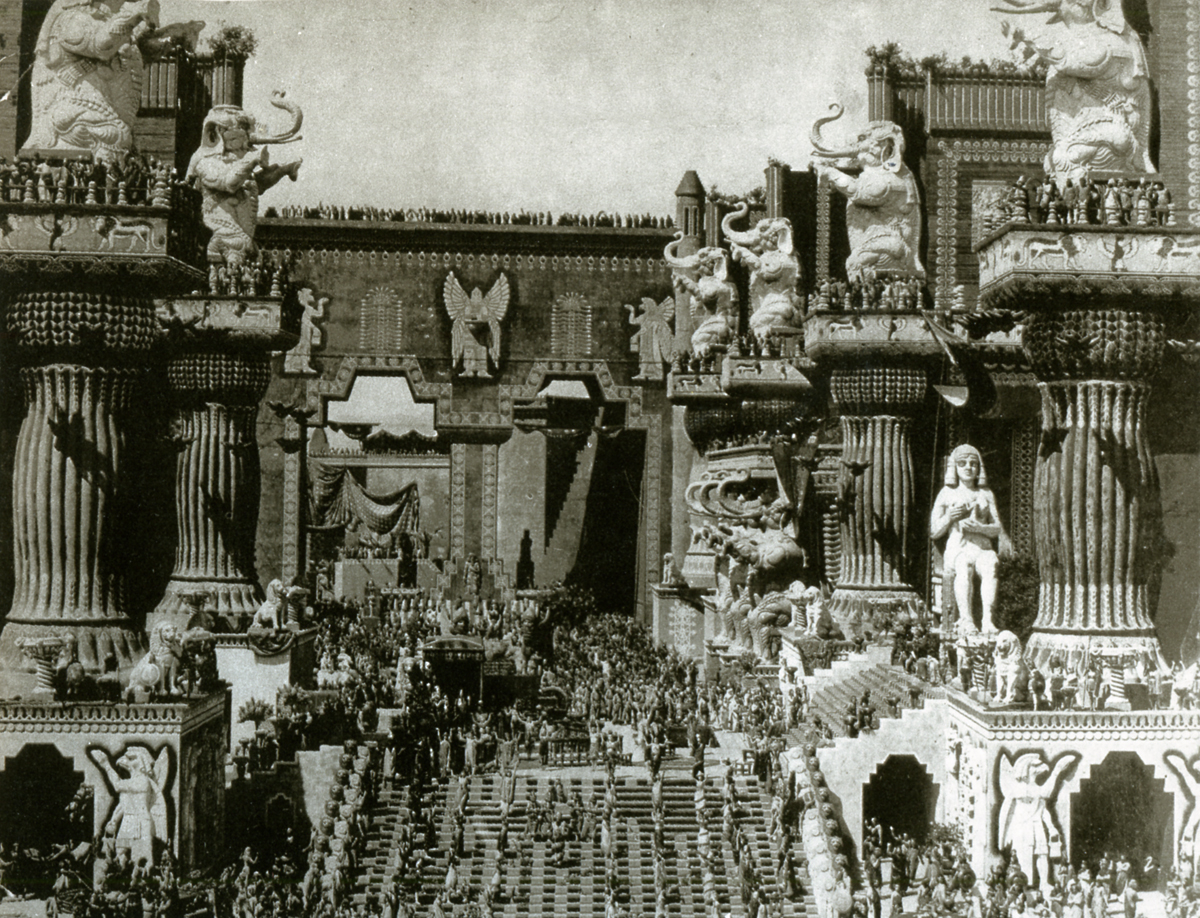
5. Intolerance was not. His subsequent film, Intolerance, required no such penny-pinching, and came in at $1.9m due in no small measure to its sets, which were up to 200ft high and more than a mile long. The film flopped upon release. Griffith’s initial cut ran eight hours long and was to be shown across two nights; it was later snipped to 210 minutes. Though her scenes in the film took just an hour to film, Gish felt “that there was more of me in this picture than in any other I had ever played in”. She talked over scenes with Griffith before he shot them, viewed all the rushes and suggested ways to improve them, and picked the best takes, before helping Jimmy Smith with the cutting. Though you get the sense that Griffith recognised Gish’s singular genius, this kind of partnership was only possible because of the egalitarian nature of moviemaking at the time.

6. Hearts of the World was filmed on location in a warzone. For this WWI propaganda piece, funded by the British and French governments, Gish, her sister Dorothy and Griffith filmed at the front. Their first location was a village that had been destroyed when the Germans were advancing on Paris. Later they were hit by a creeping barrage: two of their guides were killed, before the soldiers they had been hoping to film were obliterated by shellfire.

7. Lillian was ceaselessly melancholy; her sister wasn’t. In 1919, Gish and her younger sister Dorothy – also a major star – penned profiles of one another for Stage magazine. The pieces remain fascinating, not least for what they say about the writer. Lillian writes: “She is a criticism of all the things I am not. When I look at her, I always miss in myself the qualities that I was born without and that, I daresay, I should have been much happier with. She is laughter… nothing bothers her or saddens her or concerns her lastingly… I am not unhappy. I simply am not gay. It must have rained on the evening I was born, and it seems arbitrarily to have kept on raining in my heart ever since.” Dorothy says Lillian has a steeliness quite at odds with her popular image, like “a hat [that] lies upon the sidewalk; some person kicks it enthusiastically and finds to his astonishment and pain that there is hidden inside it a brick of flatiron”. She adds that “nothing really matters to her except her work and her career. She has little patience for anything or anybody unrelated to her work.”


8. She REALLY prepared – and did all her own stunts. Griffith would usually do just one take of a scene, but would rehearse his entire films from start to finish several times, his cast acting out the scenes on prop-free sets. He asked them to augment their characterisations through endless research. Gish took this to heart more than anyone, and continued her painstaking preparations even after her break from him. For The White Sister, she obsessively studied nuns whilst scouting 30 cloistered orders, watched taking-of-the-veil ceremonies before dawn and fostered a ‘spiritual’ atmosphere on set. Her devotion to her movies went further, though. The finale of Way Down East required her to lie on a slab of ice twenty times a day for three weeks. Her inspired idea that she should drag one hand ethereally in the freezing water permanently damaged her nerve endings. For The Wind, sand was blown at her by eight aeroplane propellers, while sulphur pots were used to simulate a sandstorm, burning her hair and almost blinding her.

9. Her first argument with Griffith was during the filming of Way Down East. After that legendary ‘ice floes’ climax, he told her to get ready. “I’m ready,” she said. “Yes, but the climax is over,” he told her. “The audience will want to see you look beautiful again. Go put on fresh make-up, and comb your hair.” Gish says it was the first time in her memory that Griffith had “settled for less than the truth… I obeyed. But in the scene it is evident to those who know me that I was awfully mad at someone.” In his defence, he was massively in debt, and in dire need of a hit. He got one.

10. She was great friends with F. Scott Fitzgerald. The author of The Great Gatsby gave her a copy of his novel, Tender Is the Night, inscribed: “For Lillian Gish, My Favourite Actress. On the occasion of her 1st visit to New York of which this book is a practical guide. From Her Chattel, F. Scott Fitzgerald.”


***

Thanks for reading.

My recent reviews of Griffith and Gish films - some of them screened at London's BFI Southbank - are right here.

You can read Louise Brooks' thoughts on Lillian Gish here.

Sunday, 1 December 2013

Review: Napoleon at the Royal Festival Hall

Saturday, November 30, 2013


Yesterday saw a rare screening of Kevin Brownlow's near-mythic five-and-a-half-hour reconstruction of Abel Gance's silent film Napoleon, a labour of love that has dominated more than 50 years of the historian's life, but has never been available on home video, and maybe never will be, due to ongoing and thorny contract wrangles with Francis Ford Coppola, who has his own version, which is incomplete, runs at the wrong speed and has a score written by his dad.

Brownlow's version, by contrast, is scored by arguably the greatest of all silent film composers, Carl Davis, his collaborator on the legendary Thames Silents project in the 1980s, and the man responsible for two of the all-time great soundtracks: The Student Prince in Old Heidelberg and The Kid Brother. And yesterday, at the Royal Festival Hall, that accompaniment came live, with Davis conducting the Philharmonia Orchestra in front of a packed house, to stunning effect.

Seen in this, its true form, Napoleon is a staggering achievement, a consistently dazzling mixture of innovation, spectacle and history writ-large, where insight into character and dramatic metaphor often come courtesy of a seemingly endless box of tricks, including octuple-exposure, montages stuffed with brain-scrambling cross-cutting, and a camera that's going to go wherever Gance wants it to, with no thought as to whether such things have ever been done on screen before.

The film kicks off with two of the most extraordinary sequences I've ever seen on celluloid. The first is a marriage of visual poetry and foreshadowing, saturated in its character's singular iconography, as the 10-year-old Napoleon wages war in the snowy environs of his school, Brienne, where such games are seen as a judge of character. Napoleon, an intense, unsmiling boy who lives in "wild isolation", is already a military mastermind, whose use of decoy, reflective vision and attack-as-defence wins him a victory against almost impossible odds. This passage climaxes with a barrage of unforgettable imagery, arresting pictures laid one on top of the other at frenetic speed, as our hero stands motionless in his battlefield, barking instructions until the glory is his. At one point, Gance even breaks out a handheld camera, at another shoots from a child's eyeline, capturing the weird dynamic of this deadly serious duel.

The next set-piece, which surely influenced Jean Vigo's surrealistic masterwork Zero de conduite, released in France just six years later, has Napoleon reacting to the setting free of his (highly symbolic) pet eagle by punching everybody in his dorm room, culminating in a pillow fight that covers every frame in feathers. The pay-off, with Napoleon alone, resting on a cannon, feathers in his hair and tears dripping down his face, only for the eagle to return and a rare smile to bless his angry little face, is an image I don't think I'll ever forget.

I didn't find the next two big sequences as successful, though there are superb things in both of them. The first is only tangentially related to Napoleon: a reconstruction of the first public performance of Le Marseillaise which has a few rousing moments, but only really comes to life with its introduction of the central figure (now played by Albert Dieudonné), leaning against a pillar, looking as cool as Belmondo in A bout de souffle, before turning to the camera in profile. Then the chap who wrote the anthem asks him his name - there's quite a lot of people asking other people what their names are in this film, so it can introduce both character and actor in a handy title-card. More consistent is an ingenious passage in which we see the growing dominance of mob rule, crystallised in one bloody night, as Napoleon saw it: snatches of cries, shadows and incomplete images, viewed through the grates of a run-down second floor apartment.

Despite its impressive credentials, including shooting on the genuine Corsican locales where the events transpired, the next major passage lacks dramatic engagement - with too much footage of people merely sitting around - until the film announces that Napoleon is about to embark on an "incredible adventure" and then all hell breaks loose: there's a stunning sequence in a bar, with Napoleon rising to counter his naysayers, then an escape on horseback, and then a simply staggering sequence in which he steals a French flag from the government headquarters and uses it as a sail to evade his pursuers as he heads off into a brewing sirocco, his battle against the elements juxtaposed with a gathering storm in parliament, shot by Gance - in one of those left-centre moves that suggests you're in the presence of genuine greatness - as if it were also being rocked by the tempestuous waves. There's just time for a neat, funny cameo for Horatio Nelson, then the intermission sign flashes up. End of part one.

Part two is much shorter and rather less revolutionary in both subject and style, dealing largely with the Siege of Toulon, in which Napoleon - now an artillery captain - stakes his reputation on a risky offensive against a far greater force (shadows of Brienne). There's stunning imagery to spare - rain-swept battlefields, a fleet on fire, Napoleon standing amidst the wreckage (a jawdropping image that forms the centre-piece of the event programme) - but it isn't as coherent or emotionally engaging as what precedes or what follows.

The third quarter is the most tonally outrageous, in a film that doesn't give a single damn about convention, as Napoleon and Josephine - still relative strangers - are each targeted by "the Terror", personified by Gance's ruthless, outwardly measured Saint-Just, before engaging in a hilariously awkward courtship that can genuinely be filed under "romantic comedy". In between, we get a vignette about a bureaucrat who saves lives by eating execution orders, and watch Napoleon zip to national prominence by quelling an uprising with devastating defensive tactics, then we're into the "Victims' Ball", a decadent, shimmeringly-photographed affair, in which our grim-faced hero, chin jutting out in that formidable fashion, proves he is the sort of man who would play chess at an orgy. And win.

But while the middle passages of the film are often touched with a rare brilliance, it's the first and fourth that I think give Napoleon its claims to greatness. The last is simply a tour-de-force, with two astonishing high points. As Napoleon heads to Italy to revive a tiring army, he stops at the deserted National Assembly hall. There, in the dead of night, the ghosts of the Revolution come to him, rising from the ether and next from their seats, calling on him to be the strong leader that his country needs, the dictator of an all-conquering France, then a united Europe. Allying the best of Eisenstein to the wizardry of Man with a Movie Camera and the seductive fascism of something like Gabriel Over the White House - in which liberal ends are achieved through totalitarian means - it's a piece of propaganda quite unlike anything else I've ever seen, either in form or content.

The other showstopper, as you may have heard, is that ending, in which the curtain pulls away to reveal... three screens, a vast panorama, a massive canvas on which Gance can paint, as Napoleon rouses his army, rides to victory, then reflects on it all from a mountain top: images from his life rushing breathlessly across the triptych: his successes, his calculations - scribbled across endless sheets - his beloved Josephine and his nose twin, that eagle who represents his power, his utter relentlessness and his fortitude.

It's the longest film I've ever seen and among the strangest, most restlessly innovative and technically astounding. There are shortcomings: the characters are generally very black and white - and sometimes too sketchily drawn or aloof to engage with - the film has a propensity for melodrama, and there are sequences that either confuse or drag. And while the acting is largely convincing, it's also - with the exception of Gance and the stony-faced Dieudonné (whose performance as the Christ-like central figure I found perhaps a little too underplayed) - done with rather broad strokes. But such things pale into gripy insignificance when put aside what it does achieve. There's a scope here, not just in terms of its epic logistics, but its destruction of cinematic barriers, that is unmatched not only in the context of silent film, but arguably within film as a whole. Gance attempts to explain Napoleon: his achievements, his character, his mind, not through dialogue, not even through performance, but via an arsenal of innovations that bring to life the man, the way he saw himself, his consuming obsessions.

When Napoleon encounters Josephine at the Victims' Ball, even before he shuns the boobs to go and play chess round the corner, Gance does something so perfect that I'm amazed no-one had ever tried it before - but so inspired that it's probably no surprise at all - he cuts together, in rapid-fire motion, every meaningful, fleeting moment they've shared, like a head rush of romance, every bit as affecting as Borzage's more reflective, more obviously effusive ruminations on the same subject. It's an act of narrative simplicity but technical genius that sums up this most staggering of motion pictures. It's as if Gance had never seen a film before, and no-one had told him that this simply isn't how it's done. (4 - out of 4, for newcomers)

Monday, 15 April 2013

Maurice Elvey, The Place Beyond the Pines, and Clint going to a girls' school - Reviews #154

Yo homeslice. Mo' reviews all up in yo' grill, starting with my birthday present from Mrs Rick.


The Life Story of David Lloyd George (Maurice Elvey, 1918) - Intended as a morale-booster in the wake of World War One, this staggeringly ambitious British epic simply disappeared when Elvey and his team were paid £20,000 by parties unknown to bury it just prior to release. Considered lost for decades, it was found in the house of Lloyd George's grandson more than 75 years later, and finally screened in 1996. Such is the film's scale of ambition and level of success that silent film scholars argue that if it had been released in 1918 as planned, it may have altered the course of British cinema forever.

Viewed almost a century on, it's a remarkable achievement: storytelling on a grand scale. The sequence depicting a riot at Birmingham Town Hall utilises 10,000 extras, intelligently orchestrated (well, once some of them stop grinning); there are victory parades, fog-shrouded war scenes and symbolic tableaus: France's Marianne raises her sword triumphantly upon a Great War battlefield, we flash back into American history, and receive a visit from the ghost of premiers past. There are rural scenes of breathtaking bucolic beauty, and tours of wartime factories which, even if they go on a bit, offer a valuable history lesson, and provide a glimpse of Elvey himself.

Made with the blessing of Lloyd George's family, and featuring a distinctly hagiographic tone, the film begins by showing his genuine birth certificate and snapshots of his parents, shoots extensively at genuine locations, and features numerous details and anecdotes from his career, shared by friends and confidantes, alongside his notable political triumphs. From a humble background, he becomes a solicitor, before his gift for oratory finds him a place in the House of Commons, then the cabinet, and then the hot-seat. He fights for the poor, runs away from the Suffragettes like a big girl's blouse, and then inspires his nation to triumph against the empire-builders of Germany - while lamenting the human cost of the conflict - in what may be a slightly fanciful retelling of the Great War. (I also can't help but notice that the French celebrate his uplifting wartime speech in Paris by waving white handkerchiefs in the air; typical French.)

Lloyd George is played, as an adult, by Norman Page, with Alma Reville - Hitchcock's wife and sometime collaborator - as his spouse, and Ernest Thesiger, the great Golden Age character actor, best-known for The Old Dark House and The Bride of Frankenstein, as Joseph Chamberlain. It's Page's show, though, he's rarely off-screen and proves a charismatic screen presence, with a perma-pointing finger.


Such is its antiquity that the flaws are obvious to the modern viewer: there's little dramatic tension throughout the narrative, the scenes of ordinary people's lives being transformed by the beneficent title figure are heavy-handed in the extreme, and where the writers don't have access to speeches from the late 19th century, they're resistant to speculation, and so simply show Lloyd George speaking with no intertitles. There's also a truly baffling scene in which the film breaks off from its story about social reform to let us know that Dave enjoyed a day off and scored a bogey on the first hole of the golf course, an impressive achievement that's then expressed pictorially. Sadly, no mention is made of Lloyd George's greatest attribute; greater even than his golfing prowess. In his diaries, Tony Benn recalls how he was showing a group of students around the Strangers' Gallery at the House of Commons when he happened to mention the former prime minister. At this point he was interrupted by a very old man, who rose to his feet and announced, "Lloyd George had a prick like a donkey".

As a director, Elvey shows extraordinary promise, but also comes up short compared to, say, Griffith, due to a marked lack of close-ups. The film is rousing and frequently compelling, with an eye for a crowd scene and an ear (or another eye?) for a great line of speech-making, but it's missing the human touch that comes from photographing the face. Elvey is a whizz with a long shot and a wonder with a montage, but a film is often too aloof if you can't read people's expressions. Having said that, on one of the rare occasions when we do get a medium close-up, it's in order to view what must be the most unconvincing false beard I've ever seen. Lloyd George's dad looks like someone has affixed a doormat to his face.

For all the film's highlights - which while strung together rather episodically are great in number - stretching from little Lloyd George shaking his fist at a grown-up buying off the family furniture, to refusing to say the catechism at Sunday school, through speeches in the Commons, a genuinely funny scene about a big liar, and that huge riot, my favourite is by far the short procession sequence, tinted in red, lit by night fires and accompanied by the loveliest portion of Neil Brand's beautiful score, in which Lloyd George's supporters celebrate his election with a sign that reads, "VICTORY FOR YOUNG WALES". Shot from high above, masterfully-composed and effortlessly moving, it's the highlight of an inevitably dated but extraordinarily confident and mightily impressive landmark in British silent cinema. (3.5)

See also: I was alerted to this wonderful movie by Elvey expert Lucie, who spoke about it on the Silent London podcast.

***


CINEMA: The Place Beyond the Pines (Derek Cianfrance, 2012) - People Magazine's two sexiest men of 2011, together at last.

It begins as Drive, turns into Prince of the City and then becomes a film all its own, and all the better for it: an epic tale of fathers and sons, heading inexorably for that place beyond the pines. Ryan Gosling stars as a stunt biker turned bank robber, with Eva Mendes as his ex-girlfriend - and the mother of his child - and Bradley Cooper a dedicated cop who turns up on his tail. Their actions, whether pre-planned or decided in a split-second, echo down the decades, informing the lives of their children, one a gentle loner stoner (Dane DeHaan), the other probably the most irritating character ever in a film (Emory Cohen).

Cianfrance's follow-up to the remarkable Blue Valentine is a vividly-directed movie full of invigorating action sequences, moments of pathos, and surprises in both plotting and characterisation. Yes, it strikes false notes on occasion and threatens to get bogged down in genre rehashing at others, but it's cerebral, emotional and visceral in the tradition of something like Cimino's Thunderbolt and Lightfoot, and has a sense of ambition that keeps it afloat - as well as some of the best performances we'll see this year. Gosling is extremely good, if doing something we've seen rather too many times, Mendes gives arguably her first showing of note, and Cooper builds on the goodwill he began stockpiling in Silver Linings with an extremely unusual, effective performance (and by wearing a nice shellsuit). There are also impressive supporting turns from the red-eyed Dane DeHaan, and particularly Ben Mendelsohn, as Gosling's confidante, while Middle-Aged Spread's Ray Liotta appears to have turned into Ed Balls.

Though the narrative is beset with a certain bittiness, there are a great many fine scenes, and the film acquires a considerable cumulative power as the emotions rise in the final third, culminating in that stunning scene at the titular spot. Having said that, I do have a problem with the film's message. As a teenager, I would have found Gosling's stylish, self-destructive hero an admirable and exciting alternative to his son's strait-laced adoptive father, but now I just think he's a bit of a prick. The idea that we should side with someone just because they look really fucking cool smoking a cigarette is one that I've largely dispensed with, and the suggestion that someone's bond with their biological father effortlessly and unquestionably overrides one with their loving, adoptive dad is hideously offensive. I do admire the film's sense of grandeur, though, its scope and scale, the energy of the action interludes, the artistry of much of the storytelling, and the intensity of the performances. And obviously the two really cute babies and the dancing dog. (3.5)

***


The Verdict (Don Siegel, 1946) - This superb Warner whodunit, set in Victorian London, stars Sydney Greenstreet as Scotland Yard's finest, who finds himself out of a job after sending an innocent man to the gallows. As he tries to get to the bottom of the mystery, another body is found and the investigators begin to drown in a sea of red herrings. Siegel's first film behind the camera sags slightly in the middle, but it's astmospheric, meticulously-plotted and boasts a pair of stunning performances from Greenstreet and Peter Lorre, stealing the show as usual as the hero's macabre best friend. (3.5)

***

ClintFest '13


The Beguiled (Don Siegel, 1971)
- The worst thing about the American Civil War was that nobody got to have any sex. Yankee soldier Clint Eastwood is picked up in the woods, dying, by a girl picking mushrooms (Pamelyn Ferdin, who voiced Lucy in the Charlie Brown cartoons). Though her father perished at the hands of the Union, she takes him back to her schoolhouse, where the brooding invalid becomes a target of love, lust or both for the lonely, sex-starved, all-female inhabitants, including an incestuous headmistress (Geraldine Page), her naive protégé (Elizabeth Hartman) and a transparently horny coquette (Jo Ann Harris). Siegel's film may not paint on the broadest canvas, but it has as good a feel for the Civil War as any film I've seen, from the sepia-toned credits to the vivid snippets of battle, and, most tellingly here, the realities of living with but not within the conflict: tying a ribbon to your gate as a code for passing soldiers, consuming rumour and counter-rumour of the latest shifts in dominance - a war shadowed in the schoolhouse - and trying to balance one's humanity, or selfish needs, with one's duty. This vividly-recreated world is a backdrop for mind games and power games heated by a bubbling cauldron of awakening sexuality, and heading who-knows-where. It's a highlight of ClintFest so far, and jostling with Dirty Harry as the best of the Siegel-Eastwood collaborations. (4)

See also: If you only became aware of ClintFest '13 mere seconds ago, you can catch up here, here, here and here. Or not. Your choice.

***


Entertaining Mr. Sloane (Douglas Hickox, 1970) - This perverse adaptation of Joe Orton's play takes complex, loaded material that should really be played as a black farce, with elements of satire, kitchen sink drama and offbeat chiller, and turns it into a blunt, garish sex comedy, full of wobbly women, lascivious, lip-smacking businessmen and aggressively bespectacled old men shouting: "Bollocks!" It's as if The Servant had been taken off Harold Pinter and turned into Confessions of a Servant, starring Robin Askwith. Peter McEnery - who played Boy Barrett in Victim, the groundbreaking social drama that led to the legalisation of homosexuality in Britain - is Mr Sloane, a toned, blonde-haired murderer who charms his way into the house of a flabby, sexually frustrated housewife (Beryl Reid, far too old for the part and being outrageously irritating), shags her, and then sets about seducing her wealthy, repressed older brother (Harry Andrews). There's enough of the censor-baiting play, its themes and its sardonic one-liners to make it just about tolerable, and Alan Webb is amusing as the ailing Dadda, but it's far too broad, simplistic and ugly-looking to really score, and the scenes where the three main players really click into gear - McEnery asking Andrews for guidance, or Reid staring at her withered reflection in a mirror - are far outnumbered by those consisting of nothing but hamming and repetition. The bowdlerised ending is just an embarrassment. (2)