
A Most Violent Year (J. C. Chandor, 2014) − A superb, low-key crime film set in New York during its most violent year, 1981, as immigrant oil boss Abel Morales (Oscar Isaac) tries to protect his truck drivers, his family and his fortune, against attacks, bailing banks and a crusading D. A. (David Oyelowo).
The movie's unpredictability, grubby realism and tersely credible dialogue reminded me of two of my favourite movies, Cry Danger and The Friends of Eddie Coyle, and its moments of tension, violence and revelation are all gloriously understated and offbeat.
It's the polar opposite of something like De Palma's Scarface, made in the meticulous, slow-burn style of Sidney Lumet, and more interested in the minutiae of human relationships than in excess of any kind. Most impressive and rewarding is the way it presents the marriage between the pragmatic, persuasive, Pacino-esque Isaac, in his mustard coat, and his wily, wary wife (Jessica Chastain), the daughter of a Brooklyn gangster and usually two steps ahead of everyone else.
It's a movie about moral relativity, decisions made in a moment − and their arbitrary impact − and the American Dream, and probably more literate, mature and interesting than any crime film released in the past five years. (3.5)
See also: I have so much time for Isaac and his chameleonic stylings. I've reviewed quite a few of his others, including Ex Machina, Star Wars: The Force Awakens and the borderline-miraculous Inside Llewyn Davis.
***

The Great Hip Hop Hoax (Jeanie Finlay, 2013) − In 2004, Californian rap duo Silibil N' Brains looked set to be the next big thing. Signed to Sony and managed by industry heavyweight Jonathan Shalit, they opened for D12 at Brixton Academy and recorded a session for MTV, where they were interviewed by Dave Berry. There was just one problem: they were really Gavin Bain and Billy Boyd from Dundee.
It's a fantastic story, but Jeanie Finlay's documentary, which gets to the root of the matter, isn't the knockabout, throwaway fun you might expect. Gavin and Billy weren’t pranking the music business: after being dismissed by execs looking for the next Eminem as "the rapping Proclaimers", this ruse was the only way they could see of cracking the industry, and as they threw themselves wholeheartedly into the scheme, their immersion into their personas and their fear of getting found out began to drive a wedge between these best friends, and to drive them steadily insane.
This 2013 documentary, made for Storyville and inspired by Bain's memoir (released first as California Schemin', and then Straight Outta Scotland) is a film about the cruel collision between dreams and reality, an indictment of the music industy's obsession with image, and an exploration of two fascinating characters: Gavin, a shy, obsessively driven creative force whose perfectionism ultimately lays them low; and Billy: charismatic, fun-loving and yet ultimately devoted to his wife and children.
Those personas were blown up into Silibil N' Brains (Silly Bill and Brainy Bains, if we deconstruct them slightly), but it's the way these characters stagnate, intensify or transform over time that's most fascinating, reminding me a little of the protagonists of my all-time favourite documentary, Hoop Dreams.
At times the relentless, sub-Busted goofing of the American alter-egos, documented in innumerable proto-YouTube skits, becomes a little wearing, but that's kind of the point. When you see just how passionate, how lyrically inventive and how well-versed in their art these two performers were, it's depressingly illuminating to see the only way that the music industry would accept them was as baseball-cap wearing, crotch-grabbing pretend Americans, washing their faces with Bill's piss. I'm less certain about the animations, which seem at times to simply be filling in those sequences for which no other materials exist: I had a similar relationship with the stylised cartoon inserts in The Filth and the Fury and the recent Tickling Giants. But, taken as a whole, it's an exceptional film.
I was expecting something disposable and fun, but given the director (who also made last year's excellent documentary about another musical imposter, Orion) I should have known better: The Great Hip Hop Hoax is an immensely moving film, and its ruminations on fantasy, compromise, creativity and chance are universal. I also have quite a crush on Gavin, the broken-nosed raconteur whose mixture of talent, apparent sweetness and unreliable narration melds effectively with Billy's chubby ruddiness and down-to-earth honesty, recalling the ferocious chemistry that almost catapulted them to super-stardom, when they were pretending to be American. (3.5)
***

Creed (Ryan Coogler, 2015) − I was expecting a bruising, stylised, self-consciously credible African-American update of Rocky. Instead I got Rocky VII. But that's fine. Kind of nearer my comfort zone.
Michael B. Jordan is Adonis "Donnie" Creed, the illegitimate son of former heavyweight champ Apollo, who moves from L. A. to Philly (a 'reverse Fresh Prince') to train with restaurant owner Rocky Balboa, and − would you believe it − gets a shot at the world title.
Considering that I don't think the original Rocky movies are very good (my favourite is Rocky III, because at least it has few pretensions), I found both this movie and Rocky Balboa to be very affecting in their utilisation of the series' very definite mythos. And, by adding a further undercurrent of wistfulness and melancholia caused by Donnie's emotional displacement and need to connect with the father who died before he was born, Creed does make you care about its characters.
Without giving too much away, it also provides Rocky with a powerful, very well-imagined storyline, trades amiably enough on the fact he's entering his dotage, and fashions an agreeable romance between Creed and a musician named Bianca (Tessa Thompson), who as this is a Rocky film, is obviously going deaf. Add to that the series' usual mix of fight-night clichés, rousing training montages and persuasive villainy − in the shape of a Scouse boxer whose dialogue is well-researched enough not to make British people howl with incredulous laughter − and it's got everything you need for an entertaining but also agreeably substantial two hours.
It's not in the same league as something like Body and Soul, Fat City or Raging Bull, but it's a different kind of film. It's also unusually well-acted, without the somewhat trivial paraphrasing that blights other Rocky films, and has several moments that lift it well above the other movies in the series, particularly a When We Were Kings style run-around − but with the kids on bikes! − and a flashback sequence on the canvas with a denouement as overpowering as a punch to the temple.
It isn't for the most part a daring or dynamic film, and I find the critical bouquets flung in its direction somewhat confusing, but it's actually better than the movies it homages, taking a tried-and-trusted formula, amplifying its more successful elements and creating a crowdpleaser with a bit of heft to it. (3)
***

Foxcatcher (Bennett Miller, 2014) − I presume whoever produced this owns shares in prosthetics, as Mark Ruffalo's false hairline, Channing Tatum's cauliflower ear and Steve Carell's Dick-Tracy-villain nose are the most distracting appendages since Nicola Kidman's false schnozzola won an Oscar in The Hours.
It's the true(ish) story of Team Foxcatcher: essentially Behind the Candelabra with Matt Damon replaced by a wrestler, as eccentric multi-millionaire John Du Pont (Carell) brings Olympic gold medallist Mark Schultz (Tatum) to his isolated ranch with promises of glory, and things promptly start to get a bit weird. Ruffalo is Mark's older brother, Dave, a beloved, bearded star athlete who's initially suspicious but eventually acquiesces and takes his place on the farm.
The performances are excellent, and the paring down of the story to these three characters, in this shortened time-frame, makes it a disorientating and creepy ride, with echoes of Faust and wider resonances about the nature of greatness and America. At the same time, though, the film doesn't get to the heart of Du Pont's neuroses and madness, lessening the story's natural intensity and reducing its ultimate emotional impact. We see the tragic ending coming simply because 'why would they have made a movie of this story otherwise?' and not because there's a thread of fatalism running through it.
As with director Miller's over-praised Capote, its methodical pace will turn some people off, and its deliberate re-imagining of reality for its own ends is questionable, but Foxcatcher does unsettle and intrigue, thanks to a good performance by Tatum, an award-hungry portrayal of creeping oddness from Carell, and Ruffalo's excellent turn as the much-loved, decent Dave. (3)
... and then I watched this:

Team Foxcatcher (Jon Greenhalgh, 2016) − Solid documentary about the true story behind Bennett Miller's Foxcatcher, which distractingly omits Mark Schultz from the story, focusing instead on the relationship between increasingly eccentric multi-millionaire, John Du Pont, and a slew of other US wrestling stars, including their figurehead: Mark's brother, Dave.
This Netflix film, essentially presented through the eyes of Dave's wife, Nancy, does a good job of filling in all the context omitted from the movie, which is critical really to understanding what happened, as it charts Du Pont's mental breakdown, his increasing paranoia and his conspiracy theories about how Dave was living in his walls.
Much of the footage of the Foxcatcher Ranch used was shot on one day, eight years before the events it's often describing, which is somewhat disingenuous and distracting, but the usual mixture of archive clips and talking heads works fairly well, provided you can stomach the use of 911 calls from immediately after a murder.
I can't help but think that this film could have been a lot more arresting and memorable if it had started as a sports story and then changed tack, rather than foreshadowing its central tragedy, but it's convincing − fast-moving, yet sufficiently detailed − and its more creative moments, including a heartbreaking sequence in the ruins of Dave and his family's house, soundtracked by old video of their idyllic lives, are beautifully rendered.
Viewed here, the events of the film seem less abrupt and more inevitable, their obvious avoidability heightening the sense of tragedy and loss. The effect was to make Foxcatcher seem curiously false and unconvincing: more a Rothian meditation on the unknowability of man and the state of America than a chronicle of what actually happened on the ranch. (3)
***
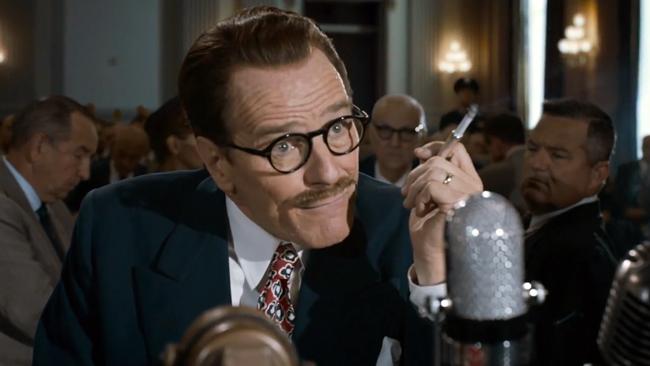
Give me strength.
Trumbo (Jay Roach, 2015) − The astonishing story of the Hollywood blacklist, which has fascinated me for decades, becomes an astonishingly bad film, telling its story through the life of Communist screenwriter Dalton Trumbo (Bryan Cranston) and playing like a Walk Hard-style parody of itself, as every character introduces themselves by reciting their name and profession.
It's plodding, monotonous and moronically irresponsible: a cartoon in which – contrary to the findings of Victor S. Navasky's searing moral audit, Naming Names, which indicted almost all of Hollywood – the people to blame were just J. Parnell Thomas, Hedda Hopper and Edward G. Robinson.
If you want a totemic figure, why not Ronald Reagan (glimpsed briefly in archive footage), the president of the Screen Actors' Guild, who secretly betrayed his own members to further his career? Or indeed director Edward Dmytryk, the member of the Hollywood Ten who turned on his friends – including Trumbo.
It's that kind of incomprehensible decision-making that prevents us from getting close to either the issue or the central character. There's one scene where we see him laid bare by the dehumanisation of prison that's all in the acting, but otherwise both he and the film are tedious and aloof.
We should blacklist whoever wrote this. (1.5)
***

I literally took this picture.
Aliens Live at the Royal Albert Hall (James Cameron, 1986) − A trip back to LV-426 in the company of the Royal Philharmonic Concert Orchestra, who brought James Horner’s ominous, throbbing, clanking, frenetic, discombobulating score to vivid, terrifying life at the Royal Albert Hall (disclaimer: that’s where I work).
It is, of course, a textbook action film, full of vivid archetypes, snappily quotable dialogue and pulsating, adrenalised suspense scenes, edited with jaw-dropping bravura. And in Sigourney Weaver’s Ripley, it has probably the greatest female action hero of all time, her DNA in everyone from Rey to Furiosa to Holtzmann.
The audience loved it, laughing at Hudson's doom-laden whining, whooping at the climax of those densely inventive action set-pieces and hollering at Weaver's insistence that the Alien Queen get away from little Newt, "you bitch".
Cameron, producer Gale Anne Hurd and the film’s star all came to London for this world premiere of Aliens Live, which meant that I got to hear Cameron talk about what "a Cameron film is” (he didn’t realise until someone pointed it out to him that his heroes are almost always reluctant ones) and to Sigourney about feminist actioners, Avatar and physiotherapy. My job is cool and weird. (4)
***
Thanks for reading.


