Tuesday, 19 December 2023

Review of 2023: Part 1 – Books

Dear friend,

I hope this blog finds you well. I traditionally like to kick off my review of the year by bragging about myself. So here's a selection of my best writing (and talking) from 2023, in the unlikely event that I haven't already beaten you about the head with it:
1. Film: On loving the movies, but hating the Oscars (for the i Paper)
2. Music: "There's something about feeling wonder": in conversation with Susanne Sundfør (for Line of Best Fit)
3. Film: On AI and the movies, including a chat with the great Larry Gross (for the i Paper)
4. Film: In praise of the sex scene (for the i Paper)
5. Music: Bonding with Big Thief's Buck Meek about how we muddled our way through divorces (for Line of Best Fit)
6. Film: 'I called him, but he gave me no answer' – the booklet essay for Indicator's Blu-ray of Song of Songs (Rouben Mamoulian, 1933)
7. Film: Speaking about On the Waterfront (pictured above) on Radio 3's The Sound of Cinema
8. Music: Effortless audacity – Big Thief on tour (just for this blog)

That done, let's proceed with the main business. This year's round-up of reading is likely to be an odd one, as so much of what I've ingested has been for research. By carefully studying this blog, you will be able to assemble, exactly, whatever it is that I'm so mysteriously working on, and, with a fair wind, get it to a publisher before me (I'm filing in June). But, beyond that possibility of untold riches, whether you want to read a blog discussing the minute differences between various oral histories of Hollywood and biographies of long-dead movie stars is entirely a matter for you. Here it is, anyway: everything I read in 2023, from Penelope Fitzgerald to P. G. Wodehouse, from dystopian fiction to the test cricket revolution, and from one book about the world of classic cinema to simply loads and loads of others.

FICTION

Every year I read one of Penelope Fitzgerald's novels – and just one, since she started late in life and her works must be rationed – and every December I look back to discover that no other fiction left me with quite the same feeling. This year, it was The Gate of Angels (1990), a strange and haunting book about a junior fellow at a cramped Cambridge college, and the beaten-down, poverty-scarred nurse whom he decides to idealise after they're both involved in a freak bicycling accident. In terms of its story and characterisation, it perhaps isn't Fitzgerald's most consistent novel, though it's surely her most eerie, its touch of the supernatural intensifying during an unforgettable, self-contained ghost story, before gently infusing that heartstopping ending. Whenever her research threatens to outstay its welcome – the detail beginning to obscure the point – she will suddenly snap to an instance of heartbreak or off-kilter sentiment that reminds you you're in the hands of a genius, reflecting the extremities of life as if in the fragments of a smashed mirror. Her pan is about the deadest in literature.

The Hollywood years of literature's second best Fitzgerald – F. Scott – have given me the greatest of joys and the deepest of chills. His legendary-notorious 1932 story, Crazy Sunday, recounted a disastrous party at Irving Thalberg's house, and mined his pain for art, while unhelpfully immortalising Scott's image as the drunken liability of Tinseltown. He returned to the theme for his cynical, rather thin Pat Hobby Stories (1940-41), dealing with the endless machinations of an amoral former silent film scenarist trying to stay one step ahead of the game. These short stories, written for Esquire, are transparently the work of an alcoholic, not only in their eternal preoccupation with going for a drink, but in their wild swings between despondency and mania. They do, however, contain one of the greatest lines ever shoved into the mouth of a bristling screenwriter: "I wouldn't sell you the story of the Three Bears for five grand."

Of course, these relatively trifling Hollywood diversions were just steps along the beach path to his last, aborted masterpiece, The Last Tycoon (1941). Its first-person approach is tortuous, with the perverse choice of narrator requiring Houdini-like feats of linguistic escapology; it's erratic; it isn't finished. But it is psychologically profound, deceptively complex and desperately moving, while suggesting an innate – though learnt – understanding of screenwriting and moviemaking that was generally considered to be beyond Scott when he was actually trying to write scripts (the jury, though, isn't so much 'out' as 'at war': much, much more of this in the 'non-fiction' section below). The Last Tycoon is full of magical passages, of romance that takes place on an elemental level far beneath the dialogue being exchanged, of Hollywood lore born of equal parts gold dust and pragmatism. What we were bequeathed, when Fitzgerald complained that he was feeling really quite unwell, before dropping dead of a heart attack at 44, was the first 60,000 words of a 50,000-word novel, covering around a half of the story. His outline of the remainder is in itself staggering, showing a literary mind that was still – or once again – firing, concerning itself with ideas of vast ambition, realised through mirroring, dramatic irony and startling clarity of character.

Of the other classic Hollywood novels, I found I Should Have Stayed Home (1938) rancidly irresistible. It's a nasty, brutal and short novel from the author of They Shoot Horses, Don't They, screenwriter Horace McCoy, in which losers meet other losers in Tinseltown, and everybody loses. It's existential and dialogue-heavy, studded with mere shards of action and atmosphere, and if its sourness comes close to self-parody, it leaves its mark. Budd Schulberg's notorious, million-selling What Makes Sammy Run? (1941) taps a similar vein but also fills in the surroundings. It is bristling, flavourful, compulsively readable and curiously one-note, fixated on all-time heel Sammy Glick as he beats a path to the top of Hollywood over the bodies of his contemporaries.

The contemporary books glancing back at the same subject have found an audience but didn't do much for me. Anthony Marra's Mercury Pictures Presents (2022) is clearly intended to be Kavalier & Clay in the world of Day of the Locust, but never feels authentic. While it's well-plotted and occasionally affecting, there's a smug glibness to its viewpoint – as if '40s cinema were just a thing to be mocked – and almost every joke (of which there are hundreds) seems laboriously reverse-engineered. Next to The Seven Husbands of Evelyn Hugo (2017) by Taylor Jenkins Reid, though, it begins to resemble The Last Tycoon. Jenkins Reid can plot, sure, but apparently neglected to indulge in any research beyond skimming Rita Hayworth's Wikipedia page. At the sentence level, the book is just dreadful, full of people "reaching out", perhaps to ensure that no clichéd phrase remains unmolested. Those shortcomings are compounded by a stifling and self-immobilising political correctness that in society is fine, and in art is death. The author is also endlessly preoccupied with clothes and food in a way that, as a reader, I am not.

Were there a competition to crown the Daddy of the Distinctive Sentence, it may come down to a straight fight between Truman Capote and P. G. Wodehouse. And when I need to remove myself from the worries of the world, I curl up with a Wodehouse. He did maybe collaborate with the Nazis a little bit that time, but aside from that it's an uncomplicated pursuit that whisks me off to a happier place. This year I read four (which perhaps offers a clue as to the state of my mental health during these past 12 months). The first two were Jeeves and Wooster. Joy in the Morning (1946) isn't as funny as the previous novel, The Code of the Woosters, but then what is? It comes up short only in the plotting, seeming slightly forced in comparison. By the mid-'40s, his style was pretty much flawless, Wodehouse wringing laughs from every scenario with some inspired turn – and pacing – of phrase. There are a dozen laugh-out-loud moments in the book, though surely the biggest (on p. 283 of the Everyman edition) has Uncle Percy spotting the central flaw in Bertie's plan to placate Aunt Agatha. 'Joy' is right. The Mating Season (1949) is even better: a trifle inelegant in the sweep of the thing, but full of brilliant moments, both in the devising of its set-pieces and the turns of its language; the introduction of Catsmeat is simply one of the funniest passages I have ever read. The only sour note comes from Wodehouse's egregious and unconvincing attacks on a couple of old friends who'd criticised him for (accidentally?) collaborating with those German chaps, if you're puzzled by how preoccupied the author is with having a go at A. A. Milne.

Since I'm keen not to read all the Jeeves books just yet, should the international news fail to improve, I headed off to Blandings. The first of that series, Something Fresh (1915), is early Wodehouse, so the prose isn't yet in full flight, and both the story and writing occasionally seem flat or laborious. It is, though, full of wonderful comic moments. That inadvertent duality is epitomised by the 'Wand of Death' sequence: an unbelievably funny situation which then involves its characters in the joke. Once they understand their interaction to be comic, thus revealing them as romantic juveniles rather than sympathetic laughing stocks, the gag is cosseted in warmth, and the humour evaporates. Leave It to Psmith (1923), which prior to 2018 was the most ambitious crossover event in history, finds Wodehouse's eccentric, garrulous, monocled socialist superhero invading the world of Blandings, the author's voice by now largely developed or discovered. It is like Something Fresh perfected: the story, about contrasting parties competing for a diamond necklace, is essentially the same, but it never drags or sags; it's as light as air.

Being an awful and adolescent snob, I imagined that Tomorrow and Tomorrow and Tomorrow (2022), being popular, would leave me cold. But being a book-lover and emotional sort who idealises the creative impulse, it knocked me sideways. It's a novel about work, love, friendship, computer games and chronic pain that creates a world as vividly as its characters do; those characters stayed with me for weeks afterwards. Some of its tangents feel a little too on-the-nose, but they're counterbalanced by timely thoughts – if couched in the acknowledgement of a certain reductivity – about how bastardised notions of 'appropriation' are the enemy of art – and of a shared humanity. Another book that got its claws into me was The Imposter (2024?), the work in progress by Rob Palk, a retrospective love story between two stand-up comics: one beset by guilt, the other dead. It's superb on mental illness, meat raffles and wild swimming, its characters stuck together by obsession, regret and the residue of oranges forever being peeled and eaten by its damaged and doomed hero. Presume it'll be coming out soonish, so that'll be nice.

I have really cool friends who buy me books for Christmas. Last year's windfall included Concerning My Daughter (2022) by Kim Hye-Jin, a spare, unsentimental book about old age and new worlds, told from the point of view of a care home worker who's terrified both of her impending obsolescence and the idea that her daughter is wasting her own life on futile protest and lesbianism. Its heroine is difficult, even dislikeable, Hye-Jin (and translator Jamie Chang) astutely relying on the reader's automatic identification with the narrator, before introducing changes that are either infinitesimal or imperfect. That transformation is beautifully judged, all the more affecting because it refuses to resort to simple answers or sweeping sentimentality, offering instead mere chinks of light and moments of partial catharsis.

The Christmas 2022 bonanza also included Emily St. John Mandel's Station Eleven (2014). “First we only want to be seen, but once we're seen, that's not enough anymore. After that, we want to be remembered.” This book raises up a world, in ruins, around you. And while its reveals, utilising a small cast of characters, sometimes feel more like coincidence than fatalism, it remains a dazzling feat of time-slip plotting. At the prose level, it’s uneven, hampered by some distracting tics and St. John Mandel’s tendency to overexplain small details, as if fighting the pedant in her head. But despite those issues, and an asexuality that feels almost perverse in a novel about the end of days, what lingers is the sheer feat of universe-building, the richness of her characterisation, and the deep love of civilisation – and particularly technology – that permeates her book. A post-apocalyptic vantage point proves the perfect one from which St. John Mandel can gaze with both wistfulness and an awestruck wonder at the mundane miracles of the 21st century.

I also read Daphne Du Maurier's Rebecca (1938) thanks to the intervention of a friend, as I'd forgotten my Kindle and didn't have anything for the train home. I quite liked it, though with reservations: is it ambivalent and ironic, or simply simplistic? Are its endless descriptions immersing or overwriting? Do we take its internalised excursions as deftly psychological or, in fact, slightly tedious? Perhaps if I'd gone in blind, rather than having seen Hitchcock's adaptation years ago, it would have tantalised me more, but then I knew the story of Jane Eyre (to which Du Maurier owes a vast and overdue debt) before I read that, and still felt the banging from the attic.

Corey Fah Does Social Mobility (2023) is another queer phantasmagoria from one of our most distinctive novelists, Isabel Waidner. It didn't give me quite the same feeling of euphoria and discovery as Sterling Karat Gold, but then subsequent novels rarely do (if I'd read Roth's other historical Newark novels before American Pastoral, would that still be the one I laud and fetishise?). This one features an insectoid Bambi, a psychotic Thumper, and a time-slipped Joe Orton, who escapes his violent death to host a furious, debunking talk show, all of that the riotous collage through which our working-class novelist hero wanders, trying to literally capture the trophy that will let them graduate to the book-tour circuit.


I was left beguiled, tormented and unsatisfied by Barry Unsworth's Losing Nelson (1999), in which an amateur historian loses his mind while trying to coming to terms with mounting evidence of Admiral Lord Nelson's duplicity and dishonour in the city of Naples. It's a triumph of voice, and of historical research, with a startling premise and moments of astonishing impact, but every other character is a caricature (which one suspects is not entirely intentional) and the climax feels both desperately forced and almost unkind in its nihilism. Another book I'd long wanted to read, and am now mildly sulky about, is Oranges Are Not the Only Fruit (1985) by Jeanette Winterson. For a while, it is dazzingly effective: glorious first-person narration, a vivid world, hilarious jokes, off-kilter romance... then suddenly it runs out of energy, its impact endlessly diluted by fantasy sequences that simply anticipate or repeat the central story in an alternate world of sledgehammer-light symbolism. There is something so special here, it just isn't sustained.

My forays into the world of Edith Wharton, meanwhile, smacked into Summer (1917). I'd struggled to imagine how a Wharton book wouldn't work, and with this, and The Custom of the Country, now I know. That one was glib and overly comic, this one is laborious and long-winded, appearing to go on forever, despite being a novella. She called it 'hot Ethan', regarding it as a companion piece to her immortal Ethan Frome, but it isn't in the same league. There are, at least, moments of beautiful brutality, and the exquisite pain of that climactic letter.

During previous explorations of middle-grade fiction, I became somewhat enamoured of Stuart Gibbs' Spy School books, and have taken to picking up the latest one whenever it comes out, a tradition I may now abandon, as Spy School: Project X (2022) was no good at all, a curiously mean-spirited book in which barely any of the (broad, overexplained) jokes landed. The series' strong suit used to be its recourse to genuine emotion, but, somewhere along the way, that too has turned phony. It is for 10 year olds, but they deserve good books too, and Gibbs has written several of them.

***

NON-FICTION

My favourite non-fiction book of the year was Anahit Behrooz's BFFs: The Radical Potential of Female Friendship (2023). It's the only thing I've read in the past 12 months that caused shifts in my thinking. Anahit has been about my favourite writer on film for a while, and here widens the scope and deepens the vision, seeing with such clarity, and writing with such originality and tactility. If I've got you a Christmas present this year, it may well be this. Not sure if I mentioned that I'm actually a feminist actually?

I'll break down the rest of the non-fic by theme...

Books about movies

There has rarely been a moment in 2023 when I have not had a Hollywood history in my hand. The following is everything I've read cover-to-cover, I'll spare you the other 80 books that have, in one way or another, so far assisted The Opus.

Perhaps the greatest of the lot was Tom Dardis's Some Time in the Sun (1975), an astonishing book essaying the Hollywood years of Fitzgerald, Faulkner, Huxley, Nathanael West and James Agee. It's revisionist history of the best sort, positing that Fitzgerald's drunken downfall amid the dream factories is largely a myth that obscures a period of financial security and ultimate creative rebirth. Dardis digs into the unpublished scripts to explain how Fitzgerald faultered when faced with the peculiar restrictions of screenwriting, and suggests that the notorious changes made to Scott's Three Comrades by Joe Mankiewicz ("Monkeybitch", in Fitzgerald's petulant term) were more like good sense. The other studies are every bit as fascinating, until a somewhat fawning section on Agee, who seems a limited figure in comparison with such literary bedfellows, though arguably had more success on screen. The view of Agee's scripts shows how Dardis is in some ways hamstrung by the received wisdom of the era in which he is writing: he piles praise upon The African Queen, which in 1975 was still regarded as a masterpiece, though thankfully its exalted reputation has been brought down a peg or two since. By contrast, the reputation of The Night of the Hunter, a flop on release, was still in the toilet; it is only in recent decades that Laughton's movie has been reappraised as one of the great pictures of its period. In keeping with mid-'70s conformity, Dardis is generally dismissive of genre fare (especially cheap B-movies), overlooking various no-budget Republic gems, while praising Huxley's dreadful script for Pride and Prejudice, perhaps the most incompetent bastardisation of a great novel perpetrated on the public during the Golden Age. His strong opinions, though, while conventional, are clearly sincere, and detract from neither the fun nor fascination of this superb study.

Aaron Latham's spectacular Crazy Sundays: Scott Fitzgerald in Hollywood (1971) is the perfect companion read, delving even deeper into Scott, while diverging significantly from Dardis's conclusions. It's an expanded dissertation but unbelievably readable, while exhibiting dizzying levels of scholarship. The book gets inside Fitzgerald's head and his talent, making a compelling case for his being a gifted – and ever-improving – screenwriter, explaining his complex approach to screen story, his developing understanding of the medium, and the transformation in his conception of female characters, from women of capricious passivity to people of practical action. Crazy Sundays is full of extraordinary insights, mining the subject's novels and stories for unguarded autobiography, and expanding the focus way beyond what you might expect. While discussion of Fitzgerald's 'Hollywood period' typically refers to the last four years of his life, Crazy Sundays goes way back: first to his days as a student dramatist, then through his lesser-known Hollywood flirtations – attempts to become a silent screen scenarist, leading man (!) and early-talkie dialogue writer – before exploring his fluctuating fortunes throughout his final stand.

Another unmissable book for fans of Hollywood screenwriting, and associated lore, is Scoundrels and Spitballers (1996, trans. 2020) by Philippe Garnier. Yes, he prioritises the hedonist, and the boozy, broken, self-pitying man – Rowland Brown, Charles Burnett, Buzz Bezzerides – but the results are vivid and quite outrageously entertaining, full of untold stories and revelatory details. The format is amusingly odd: a series of barely-connected profiles, mostly of writers, but also of a restaurant (the Brown Derby), a magazine (STORY) and a bookshop (Stanley Rose's). And Garnier has a vast knowledge of his subject: both the literary landscape (including the inevitable H. L. Mencken) and the films, supplemented by diligent research in the Warner archive. The only debits: no index, and the occasionally tortuous (or repetitious) translation.

There were two other good books about screenwriters. Backstory 1: Interviews with Screenwriters of Hollywood’s Golden Age (1986) by Patrick McGilligan offers tales from the frontline: interviews with 14 of the studio-era's best screenwriters, encompassing celebrated wits both urban (Julius Epstein) and refined (Donald Ogden Stewart), the greatest husband-and-wife team in pictures (Frances Goodrich and Albert Hackett) and a 'constructionist' (Richard Bennett), whose job was to map out the story, not prettify the language. There's a little vintage gossip, alongside some unwitting insights, from John Lee Mahin's lack of remorse about the communist witchhunt to Richard Maibaum's self-serving curation of his own chapter, though its greatest value is its simplest one, as a portrait of an underexamined class still variously proud of its achievements, chasing generation-old credits or smarting about the movie that might have been. Lizzie Francke's Script Girls: Women Screenwriters in Hollywood (1994) is also a collection of insightful, largely representational case studies, this time recounting the experiences of female screenwriters from 1910 to the period of publication, and analysing their output through a feminist lens. I found the later chapters particularly interesting, both because more of the material was new to me, and because many of Francke's most distinctive and intriguing subjects were available for interview. The book isn't intended as a comprehensive history, and it also somewhat overlooks '30s writers who did extraordinary work within rigid parameters, but it's thoughtful, righteously angry and full of valuable detail. It gave me a long list of films and scripts to explore; I'm especially intrigued by Clair Noto's The Tourist, a near-mythic, unproduced sci-fi screenplay from 1980. I'd be fascinated to know what Francke makes of the 30 years since she wrote the book.

The year's nichest and nerdiest reading (by anyone, not merely by me) was surely How to Write and Sell Film Stories (1938) by the legendary, vaguely over-praised screenwriter Frances Marion. If you are a freelance writer from 1938 looking to find out how to write and sell a film story, then boy do I have the book for you.

Of the various volumes I read about Fox, by far the finest was Memo from Darryl F. Zanuck: The Golden Years at Twentieth Century Fox (1993), in which editor Rudy Belhmer assembles a collection of inter-office studio memos dating from the early '30s to the mid-'60s, held in various archives around the world. Perhaps contrary to your expectations, this proves to be one of the most invigorating spectacles imaginable, taking you within the very walls of Twentieth at its zenith, and evoking the production side of life at the studio like little else. It's like a great novel told in postmodern style, a story of technological change, rampant ego and sporadic creative brilliance, with a cast of incidental characters so improbably eclectic that it verges on the surreal.

There are several more straightforward histories dealing with the same subject, of which the most compelling is George F. Custen's Twentieth Century's Fox: Darryl F. Zanuck and the Culture of Hollywood (1997). If it's somewhat messy in construction – dealing with Zanuck's career largely chronologically until the foundation of his major studio, before breaking into thematic chapters more concerned with socio-political meaning – and is based on rather over-familiar sources, Custen is a remarkably clear-eyed and fair-minded (Marxist) chronicler, whose astute analysis of where his subject dared to be different, and where he didn't, feels close to definitive. And while his argument that DFZ was the true author of John Ford films like The Grapes of Wrath and How Green Was My Valley feels like a stretch, it's also a useful corrective to the auteurist overreach that tends to dominate film discourse today. Zanuck's name is virtually forgotten in 2023, but he shaped – perhaps even dictated – how America saw itself, and how it dreamt, for four decades. In comparison, Peter Lev's Twentieth Century-Fox: The Zanuck-Skouras Years, 1935-65 (2013) is conspicuously dry, if at least having a USP by focusing so much on the (far less interesting) New York office/exhibition side of the studio. 20th Century-Fox: Darryl F. Zanuck and the Creation of the Modern Film Studio (2021) was another Scott Eyman book from the “will this do?” school of film history, a chronological, surface-level regurgitation of secondary sources, easy to read but lacking any panache, full of irrelevant asides, and in need of an editor who can spot the author’s tendency to repeat himself, sometimes within the same paragraph.

By contrast, Twentieth Century Fox: A Century of Entertainment (2016) by Michael Troyan, Stephen X. Sylvester and Jeffrey Thompson was absolutely invaluable for my barely-mysterious purposes, the next best thing to strolling around the Fox lot in 1937, and stuffed full of the most extraordinary insights. Its only shortcoming is one common to almost all corporate biographies: the necessity to lionise beancounters or bastards, in this case Rupert Murdoch.

I read six biographies of Fox stars. Certainly the most memorable, though only fitfully successful, was Fred Lawrence Guiles's Tyrone Power: The Last Idol (1979), detailing how the Irish-French-American Power, heir to a great acting dynasty, struggled to extricate himself from life as Hollywood's greatest pin-up. In its early chapters, it is deft, evocative and strikingly-structured, though despite instances of impressive access, including a wealth of insights from letters, Power's first wife (French actress Annabella) and best friend (cutter Watson Webb), it does ultimately degenerate into a disjointed and facile mess, hampered by erratic research and increasingly lazy writing. Often Guiles will suddenly inform you that (apparently contrary to everything you've just been reading), Power had been either bereft or delirious with happiness for quite some time. Taken in totality, the biog gives you a fair picture of its good-natured, weak-willed and fickle subject, while slightly skimping on the screen work, devoting vastly more time to his romances (three marriages; torrid affairs with Judy Garland and Lana Turner) and social obligations than to his films. Its great virtues are its periodic sucker punches. Near the close, Annabella's unposted letter to her ex-husband is employed at just the right moment, and I still haven't quite recovered.

Foxy Lady: The Authorised Biography of Lynn Bari (2010) by Jeff Gordon is a detailed biography of the Fox contract player, with a neat gimmick: its standard chronological narrative is studded with chunks of oral history from interviews conducted with the subject not long before her death. It's a familiar story of ambition, compromised success and alcoholism, though Bari tends to be more honest about her various flaws than her adoring and enthusiastically mitigating Boswell. In Alice Faye: A Life Beyond the Silver Screen (2002), author Jane Lenz Elder tackles the life of the actor and songstress who dared tell 20th Century-Fox to shove it, after they slashed her first true dramatic performance to ribbons. But either Faye's life beyond that moment of melodrama wasn't terribly interesting or (more likely) her passion for privacy makes her a hard figure to chronicle or know. There are a few insights from friends (as well as one revelation about hemmorhoids), but too much of this hagiography comes from old newspaper reports, and the author's desire to portray Faye's later life as just as interesting as her Hollywood years is a curious one, since she doesn't really seem to have done anything except for a mediocre radio sitcom and some presentations for Pfizer. Child Star: An Autobiography (1988) is Shirley Temple's rather tiresome memoir: the most extraordinary of lives rendered in rather a catty, superficial way, complete with broadly regressive politics and the endless idealising of her stage mother. The overriding impression is that she is not a particularly nice person, but not in an entertaining way. Gregory William Mank's Laird Cregar: A Hollywood Tragedy (2018) is well-researched and admirably impassioned but also amateurish and disjointed, with endless irrelevant tangents (at one point, a potted biography of Stephen Fry, who was born 13 years after Cregar died), and anecdotes from the author's own life possessed of dubious mystical overtones. Mank also sees everything through the prism of horror cinema and Hal Roach (just as I see everything through the competing filters of The Magnificent Ambersons, HUAC and Darryl F. Zanuck).

If you like the Ritz Brothers, you might feel a little short-changed that in The Ritz Brothers: The Films, Television Shows and Other Career Highlights of the Famous Comedy Trio (2021), author Roy Leibam rarely dwells in detail on the trio's routines. As I can’t fucking stand them, I found the book’s focus on script notes and production detail very welcome. Some Ritz fans (and these do, reportedly, still exist) have complained that the author dwells too much on the criticisms of contemporary viewers. My issue is slightly different: these bloggers are regularly quoted but never by name (always just ‘modern-day commentator’), which isn’t merely cheeky but kind of... inexplicable. Liebman's approach is also somewhat piecemeal and peculiar – one appendix deals with other cinematic versions of The Three Musketeers!? – an aspect that may further frustrate aficionados, but since these people enjoy watching the Ritz Brothers, who knows what they're thinking.

Two other books gave an insight into key creative personnel at Fox. Take Two (1980) are the memoirs of screenwriter Philip Dunne, who adapted How Green Was My Valley and The Ghost and Mrs. Muir, was involved in virtually every liberal cause of his day (which he would then sort-of-stand-up-for-but-not-really, invariably resulting in some kind of pissweak compromise), and here makes a solid bid for the Humblebragging Championship of the World. His book is occasionally funny, occasionablly admirable, and a good source of detail about life on the Fox lot. It is also unbearably smug, which coming from me is really saying something. Mamoulian: Life on Stage and Screen (2012) by David Luhrssen is a short but illuminating and highly-readable biog, focusing on the work of the great Russian-Armenian director, who debuted Porgy and Bess, and Oklahoma! on Broadway, revolutionised early-talkie cinema, and did The Mark of Zorro and Blood and Sand at Twentieth, before being fired from Laura and Cleopatra during a farcical final 20 years of his career that resulted in more sackings (three) than movies (two). There's much more about Mamoulian in my Song of Songs essay.

Widening the focus to Hollywood as a whole, Hollywood: The Movie Colony, the Movie Makers (1941) is the only sociological study of Tinseltown at its zenith. Author Leo C. Rosten's conceit is that these much-maligned arrivistes are rather benign, compared to captains of industry or the old-moneyed aristocracts of the East. If he somewhat labours that point, the statistical research remains an invaluable resource, and the surrounding report is written with a dash of panache and the odd piercingly perceptive point. His observation that happiness in Hollywood film consists of a woman arriving in an apartment, weighed down with packages, is perhaps the most dead-eyed takedown of Golden Age cinema ever committed to paper. In Gone Hollywood: The Movie Colony in the Golden Age (1979), Christopher Finch and Linda Rosenkrantz explicitly try to do something similar to Rosten: the sociology of the star system, but their efforts are culled largely from fan magazines, and grouped A-Z by nebulous theme. The results are only sporadically engaging, with many of the details appearing decidedly apocryphal.

I read a couple of oral histories dealing with the film industry. In the swaggeringly-titled Hollywood: The Oral History (2022), historians Jeanne Basinger and Sam Wasson splice and dice 10,000 hours of interviews conducted by the American Film Institute since 1969, as they chart Hollywood's evolution from a ramshackle start-up in an orange grove to the agent-dominated industry of today. More than half the book deals with the studio era, and those sections are easily the best, particularly when giving a voice to largely neglected figures, like staff writers, cameramen and make-up artists. The detail they share, mundane yet lightly magical, is fascinating. Even some of the bigger, more widely-interviewed names have new insights to share: director Frank Capra (who made Harry Langdon's biggest hits) provides a brilliantly incisive reading of the big four silent comics. There is, however, an obvious flaw in the authors' approach: the AFI's interviewees are – by definition – history's winners; as a result they are overwhelmingly complimentary about people such as the studio executives, whereas those who were trampled or ruined by Mayer et al remain voiceless. Elsewhere, a simpler issue afflicts the book: interest ebbs and flows. The silent film sections are fairly short and shallow (and somehow manage to spell Allan Dwan's name wrong throughout), but it's when we get onto New Hollywood, and beyond, that the book falls apart, in a blizzard of barely-connected anecdotes, followed by some stunningly dull material about deal-making. Perhaps that's the point: that a mighty beast was ripped to pieces, and the vultures moved in – that once it was at least partly about art – but this might have been brought to life in a less tedious way. Still, there's lots here to enjoy for Golden Age nerds, even if as a book it doesn't quite hang together. The Glamour Factory (1993) does the same thing markedly less well, perhaps because it's based on the oral history collection of the Southern Methodist University. The perplexing subtitle, 'Inside Hollywood's Big Studio System' (why 'big'?) betrays the fact that this history might be somewhat superficial, and though once more it's broken down by department, the material therein is dictated almost entirely by what happens to be contained in one fairly obscure archive. There's little that's new here, unless you're a novice.

Zoning in again, Behind the Screen: How Lesbians and Gays Shaped Hollywood, 1910-1969 (2001) is a groundbreaking, virtually definitive study of its subject from Tinseltown author, and Billy Haines biographer, William J. Mann. He deals with changes in cinematic and social culture, the phenomenon of 'queer work', and the key gay figures of an extraordinary era. While at times the resulting pen portraits descend into formula, Mann has the knowledge, instinct and incisiveness to find the through lines that make it atter.

Finally on the studio era, Camera Over Hollywood (1939) is an unforgettable photographic chronicle from John Swope, simultaneously deglamourising and mythologising its factory town.

And finally, on film, I managed to read a book that perversely didn't mention Barbara Stanwyck even once: Empire editor Nick de Semlyen's The Last Action Heroes (2023), a zippy, extremely funny chronicle of the '80s action boom. Highlights for me were the delightful vignette about how a Chuck Norris character seduces a date, and the recounting of Steven Seagal's still-notorious appearance on Saturday Night Live. I am always perplexed that anyone would like Sylvester Stallone, either on screen or off it, but the enthusiasm here for both the artform and its practitioners is contagious.

Books about history and politics

The pick this year was Doppelganger by Naomi Klein (2023), which is admittedly unfocused but also entertaining, original, provocative and incisively intelligent. In it, Klein uses her nemesis, conspiracy theorist Naomi Wolf, as the springboard to enter 'the mirror world', and investigate personal brands, the rise of fascism, and the justifications for Israeli violence (uh-oh). Along the way, she explains the ‘diagonalism’ that drew together Neo-Nazis and wellness influencers, and does a superb job of articulating and explaining the way that the far-right – and the literal elite – have co-opted the language and postures of the progressive left. Seeing that written down, so clearly and smartly, felt like sweet relief after years of being gaslit to oblivion.

I also enjoyed American Heiress: The Wild Saga of the Kidnapping, Crimes and Trial of Patty Hearst (2016), by noted lawyer and video-conference masturbator, Jeffrey Toobin (I'm sorry to mention that, Jeffrey, but if you hadn't done it, that would have solved that problem). It's fast-moving, balanced, clear and fairly clear-eyed, though given that its author's specialty is legal procedure, it deals with the trial altogether too briefly. Toobin's casual misogyny is also slightly off-putting, but not as off-putting as when he wanked on that Zoom call.

As regular readers of these reviews of years will know, I am an absolute pervert for a presidential biography. This year, that kink was sated by Bob Spitz's Reagan: An American Journey by Bob Spitz (2018). The main strength – and weakness – of the book is its disorientatingly intimate focus. We get a reasonable portrait of the human at its centre – patriotic, sentimental, limited, incurious and naive – but at times almost forget about the world he’s inhabiting, the scale of his influence, the importance of his every action on ordinary people’s lives. If you’re looking for a race through Reagan’s life, from poverty to Hollywood to General Electric to the governor’s chair and finally the presidency, it does the job. We get a sense of how his mind and his presidency worked – through snap emotive judgements based on short memos, letters from the public or things he’d read in the Reader’s Digest – a colourful tour of the high and low points, and a primer on his presidential advisers and their various rivalries. But the book is far more interested in things that are easy to write about – those internal wranglings, the Gorbachev summits and some whizzbang terrorist stories – than those that aren’t. The actual impact of Reaganism – the economic transformation of America caused by the largest upwards redistribution of wealth in history – is largely unexamined, and yet may be the most important element of all. There are also some fairly common shortcomings for the genre: a propensity to side with those he’s interviewed against those he hasn’t, a fondness for pretentious quotations at the start of chapters, some crashingly clumsy segues and a fair few avoidable errors (particularly in the Hollywood section).

I also read a book about people trying to blow up Reagan's best mate: Rory Carroll's Killing Thatcher (2023), which deals with the Brighton Bombing, and made the Times's list of the year's best history books. It's extremely well-researched, with an access to typically secretive sources at which one can only marvel, but that research is often showing, to the degree that you can trace the author's own journey as clearly as you can his actual narrative. And while it's strong on context, at times you just want it to focus on the story you paid for and deliver as the real-thriller we'd been promised, with the propulsion and explosiveness that implies. Its gallery of characters is certainly colourful, though a lot of writers of contemporary history appear to have caught Benmacintyreitis, in which humans are reduced to between one and three eccentric traits, hammered away at interminably.

Books about sport

After the intense excitement of this year's snooker world championship (you don't know, man, you weren't there), I scooted back to 1985-6 with Pocket Money (1986), Gordon Burn's journalistic chronicle of a season, which vividly captures a time and place during the sport's boom era. At first it's overly preoccupied with financials and merchandising, and thereafter still a little too fixated on Thatcherite entrepreneur Barry Hearn, but it's also erudite, atmospheric and full of deft portraits and telling details. As history, of a sort, unfolds: you're there.

And since so much of what I want to do in life involves either reading or being at the test match, Lawrence Booth and Nick Hoult's Bazball: The Inside Story of a Test Cricket Revolution (2023) seemed just right for me. Its curious structure, hopping about between this year's Ashes, a chronological narrative and a themed approach, leads to some repetition and the periodic fumbling of epic moments (particularly Bairstow's redemption at Trent Bridge) in a way that a simpler narrative might have avoided. But it offers amazing access, crisp writing, and the chance to relive two of the best – and most exhilarating – cricketing summers in living memory; even the dry stats just set the heart racing. That excitement is neatly counteracted by the melancholy contributions of Ben Foakes, one of the Bazball era's few losers due to his vaguely more pragmatic instincts, his undeserved pain leaving a mark.

This year's Ashes inspired plenty of talk about the 'spirit of cricket', so it was nice to read Simon Rae's It’s Not Cricket (2001), subtitled, "Skullduggery, Sharp Practice and Downright Cheating in the Noble Game", and be reassured that such a spirit does not, and has never, existed. The book is essentially a catalogue of appalling, immoral and dangerous behaviour on a cricket pitch, and just as enjoyable and ultimately shallow as that sounds. Ian Botham: The Power and the Glory (2011) by Simon Wilde, deals with one of the fabled Ashes heroes of decades past, but is never anything more than basically functional, failing to capture much of the excitement of his rise or the clumsiness of his fall.

Books about Dorothy Parker, Prince Harry or crypto

This section is always a popular one. Marion Meade's Dorothy Parker: What Fresh Hell Is This? (1987) is a fine biography of the funniest person who has ever lived. And if Parker, to misquote Oscar Wilde, put much of her genius into drunken quips at drunken parties, she also wrote good verse, great short stories and some of the best non-fiction of the 20th century. All of it was touched with her excoriating, innocent-eyed wit. In her first ever theatre review for Vanity Fair, she refused to name the creative team behind the production because she didn't "want to tell on them". Her tossed-off telegrams to Robert Benchley, whether about New Year or the public pronouncements of Herbert Hoover, are astonishingly clever. And even when the work was failing, the wit was not: during her ill-fated sojourn in Hollywood, she lent out of the window of a writers' building, yelling at passers-by, "Let me out of here, I'm as sane as the rest of you!" Meade's book is incredibly readable, if a little monotonous in its second half; but then so was Parker's life. The biographer certainly gets close to the heart of her difficult, brilliant subject. Damaged by grief, half-destroyed by drinking, Parker was capable of rare but extraordinary generosity of spirit: spending more than a year with friends as they cared for a child sick with TB; organising endless events to raise funds for refugees during the Spanish Civil War; leaving her estate to Martin Luther King and the NAACP. She was also almost pathologically ungrateful, caustic and unkind. If her humour came from the same place, she appeared unaware that you could still do that and be a good person on your own time. Her friendship with Benchley shows both sides of that character: it was astonishingly touching, and then it soured horribly. This book skimps a little in its treatment of the work, and remains curiously preoccupied with the nefariousness and deceit of Lillian Hellman (Parker's frenemy and will-executor), but as a portrait of the person, her sentimentality and savagery, it could scarcely be improved upon.

I had, somewhat unexpectedly, both the prurient desire to read Spare (2022) by Prince Harry, and then a large number of thoughts once I had done so. And what a strange, unhappy book it is: full of self-pity, lacking in self-awareness. Interest ebbs and flows, the collision between a man and his ghostwriter frequently more interesting than the events they are describing. And yet the tragedy at the book’s centre: that of a boy losing his mum, and simply being unable to deal with it, as his life is disfigured by tradition and a deeply unwell media, is genuinely upsetting, and a story eminently worth telling. The way that the death cast a shadow over his life, becoming its defining incident, will be relatable for anyone who lost a mother young – especially if it happened suddenly – and his terror that the same fate might befall his wife feels, if not necessarily accurate, at least utterly sincere and entirely understandable. More here, if that for some reason sounds appealing.

And, finally for this year, I read finance journalist Zeke Faux's book about the crypto implosion, Number Go Up (2023). It's a rather superficial read, in which a man jets around the world trying to find out information about the cryptocurrency Tether, fails, and then explains why he wasn't able to find out anything, as if you'd set him homework. Along the way, however, he does find out a few other things. Faux isn't quite as funny as he imagines (can't imagine what that's like, must be awful), though his explanations of crypto are handy for novices like myself, and he enjoys an improbable proximity to FTX founder (and now convicted fraudster), Sam Bankman-Fried, the book's most interesting character.

***

Thanks for reading. Part 2 will be about The Movies.

Friday, 2 June 2023

Susanne Sundfør at Røkeriet, USF Verflet, Bergen

Friday 29 and Saturday 30 May 2023

Among the things we were least expecting from Susanne Sundfør’s new live show, Rebirth of the Electro Diva must have been pretty high on the list.

First of all, she is touring a new album, blómi, and the last time she toured a new album, she played the-new-album-and-nothing-else, unless you counted the improvised, double-bass-led improvisations linking each song to the next.

Secondly, she has characterised herself as a folk artist whose flirtations with electro-pop were little more than a mathematical digression: the solving of a series of sonic puzzles ultimately pleasing to the human brain.

Increasingly, she has looked to distance herself from that record, 2015’s Ten Love Songs, in which the sorrow is swamped by triumphal dance hooks, and apparently from the life that created it: living in Dalston, smoking and drinking too much, wrecking her voice, close to breaking point.

When she has played songs from the album on recent tours, it has tended to be the eerie or spectral ones – ‘Silencer’ and ‘Trust Me’ – rather than the shimmering art-pop of ‘Fade Away’, or her femme fatale monsterpiece, ‘Delirious’.

And yet here she is, on stage at USF Verflet in Bergen – a former sardine factory repurposed as the city’s coolest venue – dancing sensually to four of Ten Love Songs’s floor-filling bangers, as the synths climb a stairway to paradise.

Perhaps that’s what happens when you ask a born contrarian to headline a jazz festival.

This is the kind of love that never goes out of style

As I wrote in this recent interview piece: in spring 2018, Sundfør seemed on the cusp of a commercial breakthrough. Then she effectively disappeared. In the intervening years, she has found love, started a family, struggled with anxiety, gone back to high school, and become enormously interested in regenerative farming. Now, finally, she has returned to music. Her first album in six years, blómi was released at the end of April, and she is toying with the idea of a European tour in 2024.

In the meantime, she is playing across her native Norway all summer. The first two shows were in Bergen, headlining the city’s Natt Jazz season just metres from the riverside studio where she recorded her debut album in 2007.

When Sundfør last performed in the UK, she wore a hooded black cloak, and had apparently smeared soot around her eyes, like a Scandi druid, or an urchin Zorro. This time she has newly bleached her hair, and is clad entirely in white, down to the high-heeled PVC boots she kicks off off-stage at the midway point, so as to dance barefoot.

Her mesmerising 2017 show at Union Chapel was a spare affair, featuring just one introverted co-conspirator. For these extravagant, joyous Bergen shows, her on-stage ensemble has swelled to 15, including a pedal steel guitarist, two synth players, five backing singers, and a multi-instrumentalist husband on sax-solo-and-choral-conductor duties.

Open your eyes and begin again

The first night is an invigorating work-in-progress: the thrill of the new, and the old made new, and just the old uncovered and embraced after years in hiding. The second show, which adds a single song – a new opener; Sundfør at the centre of a crescent of 12 vocalists for the handclaps and harmonies of leikara ljóð – is the actualisation of ambition: the art, with most of the wrinkles ironed out.

In common with another legendary vocalist, Sandy Denny, what’s most exciting about Sundfør is the questing restlessness of her invention. Every version of every song she sings is given some new inflection, some new paraphrasing or twisting or variation of melody that changes its feeling and meaning. If neither rendering of ‘Turkish Delight’ here sweeps you up in the same way as the studio version – the blissful simplicity of its third act replaced by something that in its sheer jazziness sounds depressed – the trade-off is in the way that so many other songs are transfigured live. Performing the title track of ‘blómi’, Sundfør chucks in vocal trills, unexpected pauses and head-voice ad-libs that stop you in your tracks. With ‘alyosha’ – the lead single off the album – she knows what she’s got, a vehicle for the sheer scope and power of that God-given instrument, but even then she can’t resist a few experimental flourishes, while gazing across the stage, perhaps just at someone needing a musical cue, or perhaps at the guy who inspired this love song.

She does all three sitting behind her keyboard, along with ‘White Foxes’ (formerly her encore, now a first night statement-of-intent, with deafening percussion intro); a countrified version of ‘I Resign’ from her debut record; the deep cut, ‘Lilith’; and her gospel-inflected encore, ‘fare thee well’, with a glorious extra verse. For the rest, she’s at the main mic, a place she has barely ventured since 2016.

Do you believe in reincarnation?

And that’s where we find the electro-pop diva reborn. First up, she does ‘Kamikaze’, and if you’re wondering whether I’m overhyping the ‘she hasn’t done this for a while’ angle, well: she forgets the second line, consults a band mate, apologises with the words, ‘It’s been a while’, and then launches into the song again. It is one of those tracks that, to paraphrase John Peel talking about the Bluetones’ ‘Slight Return’, “as soon as you hear it, you feel you’ve known it all your life”, but now it comes with a gently wandering opening melody and added blue notes that give the song an emotional punch to go with its sonic one.

Later, she drops in ‘Fade Away’ – by far her most popular song, sporadically drowned out by the spirited singing of first-night die-hards – before returning to Ten Love Songs for the final two tracks of the main set, ‘Slowly’ and ‘Delirious’. The latter now has a pleading pedal steel, and rap-adjacent vocals breaking off into clubby exhortations. The former is, simply, one of the best things I’ve ever heard live, especially in its second night iteration. It is notable on record for having at least four separate, irresistible hooks, each more exalting than the last (scroll to 3:08 to be lifted into the clouds). And now it has five. “It’s in the way. You. Hold. Me,” Sundfør sings, in a cascading, staccato arpeggio, as the song reaches its zenith. “Baby. I. Know. You’re. Lonely.”

The other songs she sings at centre stage are a playful ‘Reincarnation’, and ‘rūnā’, in which she seems to be conjuring the music through the contortions of her body, like Judy singing ‘The Man That Got Away’ in A Star Is Born. And between the notes she finds new ones, more beautiful than those on record, before riding the climactic harmonies, swaying, her arms spread wide.

A couple of times during the show, she leaves the stage, firstly for the synth transition between ‘Kamikaze’ and ‘rūnā’, and later to let the rest of the cast perform an a capella version of ‘ashera’s song’, reimagined as an old American spiritual, the original number spliced with fragments of atonal bluegrass, ‘Peace in the Valley’ and ‘Let Your People Go’. While both numbers are interesting, neither are quite what drew us to Bergen tonight.

Take me high to the depths of your soul

On the first night, I made a new friend called Thomas, and when we talked about what had drawn us to Sundfør’s music, we were of one mind: once that voice grabs you, there’s no going back.

These songs are beautifully written, the sprawling arrangements are often inspired, there’s space for limited musical improvisation, and the band are talented and charismatic, with the backing singers allowed to cut free and even encroach on some signature Sundfør lines.

But we are here, and will always be here, for That Voice. That it is now allied to the whole of her canon, even the emotionally tricky, musically mathematic bits, is a cause for dancing, in Bergen and far beyond.

***

SETLIST:

leikara ljóð [second night only]
White Foxes
Turkish Delight
Kamikaze
rūnā (with synth transition intro)
Reincarnation
I Resign
blómi
Fade Away
Lilith
alyosha
ashera's song (new version, choir only)
Slowly
Delirious

Encore:
fare thee well

***

Thanks for reading.

Saturday, 15 April 2023

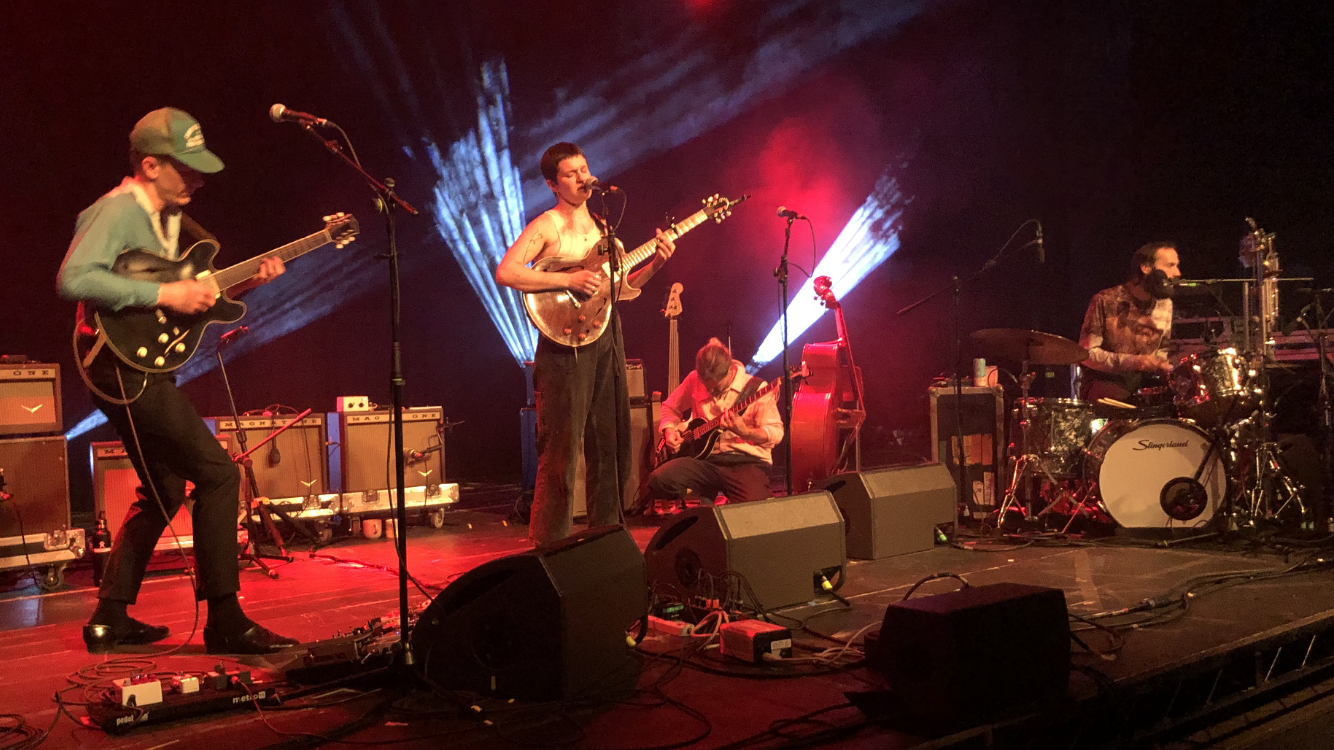
Effortless audacity: Big Thief on tour

Sage Gateshead – 05/04/23
Usher Hall, Edinburgh – 06/04/23
Manchester Apollo – 07/04/23
The Great Hall, Cardiff – 08/04/23
Hammersmith Apollo, London – 11 and 12/04/23
Chalk Brighton – 13/04/23


There is a song that Big Thief have recently started playing called ‘Born for Loving You’.

If you want to understand it, there is a simple, biographical way. And then there is another way.

The simple way first: when the band’s frontwoman, Adrianne Lenker, was a student at Berklee, her music showcase betrayed the powerful influence of the husky, highway-fixated alt-country chanteuse, Lucinda Williams, right down to the very voice she was affecting. That influence hasn’t been as pronounced since (manifesting merely in the odd cover, with Lenker slipping back into Lucinda-voice), but as the band prepares to tour with Williams this summer, here’s a song – co-written with drummer James Krivchenia – that in its feel and its hook could be seamlessly snuck into Williams’ setlist. It may also be the straight-up sexiest thing that Lenker has ever sung (“Take me to the back of your pick-up truck,” she implores at one point, “show me a thing or two.”).

And now here’s the other way to think about ‘Born for Loving You’: no-one else on earth could have written this song.

‘After the dinos fell’: the world of Adrianne Lenker

In its first two lines, Lenker dispenses with the entire history of the universe up to her birth (“After the first stars formed, after the dinos fell/After the first light flickered out of this motel…”). That effortless audacity is characteristic. But the song’s conceit is not conceited: it is a way of understanding the magnitude of love. Everything that happened – to me, to us, to anyone – was just a prelude to this. From blood-soaked birth to teenage nightmare, via “waddling around, looking at birds”, well: “thank god we made it through.”

Dylan once said, “It isn’t me, it’s the songs. I’m just the postman, I deliver the songs.” And here is Lenker’s current online biography in full: “songs of all sorts from places unknown”.

The places are, admittedly, occasionally known. Across the seven shows on this UK tour, ‘Born for Loving You’ gets four airings: twice as a lush ‘70s California-style singalong, then as a plaintive solo ballad, and finally as a stripped-down full-band version with simple harmonies. For those last three, Lenker adds a coda: a falsetto snatch of ‘I Will Always Love You’ (Whitney version).

Yet even when the sources are, as she says, “unknown”, those songs come filtered through a unique sensibility: ideas are ingeniously inverted, images recur, motifs are endlessly shuffled. Her characters are gender-fluid, avian, feminist and quasi-biblical, traversing a world of blue skies, cluttered kitchens, bare plains and flat roads. Whether broken, fixed or flailing, they are loved.

And certainly she seems a conduit for whatever immortal music is floating in the ether right now, whether fragile or thundering. The most exhilarating part of following Big Thief on tour is the regularity with which miracles happen. “This is a new song,” Lenker will say, most nights, before playing the greatest fucking thing you’ve ever heard in your life. On the last tour, she composed ‘Wait a While’ on the ferry over from Dublin, performed it six times in concert, then retired it. It has never been released. Most musicians would kill to ever write a song just half as good.

But Lenker just keeps them coming. She begins the encore at Edinburgh with ‘Already Lost’, for which the word ‘timeless’ is barely sufficient (by the point she unspools the line, “How slow and how fast you are,” your soul has gone into spasm). She commences the second night at Hammersmith with ‘Sadness As a Gift’, which does for depression what ‘Change’ did for fear of death; turning your understanding inside out. She isn’t soothing you with song, she’s showing you another way of perceiving pain. While her between-songs badinage is regularly ridiculed by reviewers committed to the cheap shot, there’s something appealingly counter-intuitive about her worldview, about an artist who’ll tell a huge crowd that a mammoth show feels like a dream (so far, so banal), only to dazedly add: “I don’t really even mean career-wise, I just mean in general: it’s so bizarre to be a human being, and we all ended up here, right now.”

A live band who also make records

And here is where you want to be. You don’t know Big Thief if you haven’t seen them live. They are not a group you fall in love with at a distance: they are a live band who make records on the side; the intensity of their in-person performance rarely, if ever, transfers to your preferred streaming service.

Nor does its extremity. They continue to spread out in all directions, the quietest band on the circuit, and about the loudest. I saw them in Oslo last year during one of their particularly metal phases, an evening that did unspeakable things to my left ear. It is a decision I will never regret.

The live experience, gloriously, is never the same twice. That’s how I can justify seeing them seven times in nine days. Across those shows, they play 38 different songs, 14 of them just once. So if you want to hear their most popular song (‘Shark Smile’), a recent album track like ‘Blue Lightning’, or an unexpected cover of ‘Strangers’ by The Kinks, you’ll have to catch them in London, Manchester and Brighton. They start the second show of the tour, in Edinburgh, by playing four songs we haven’t heard the night before.

Every gig, too, has a different narrative, often built into the sweep of Krivchenia’s setlists. Edinburgh begins with that country-inflected singer-songwriter fare, before shifting into tortured rock, a sequence bookended by two absolute beasts: ‘Contact’ and ‘Dragon New Warm Mountain’. The former explodes into ugly metal screams; the latter continues to delight those who only know the gentle, balladic version that titled their last album.

That’s an emblematic number when talking about how their music continues to evolve, and how no Big Thief song is ever finished. At Gateshead – a curious, slightly muted show (presumably because it was largely seated) – ‘DNWM’ came galumphing out of the gate in a way that just made me think, “yeah OK, but we kind of did this last year”. The next night, it was reborn as a monster, and by Hammersmith, it had mutated into something unstoppable, the band adding more and more mad shit to it: a vocoder, a vocal-coda (Lenker’s drifting falsetto), and squalls of physically-induced feedback, Lenker turning her back on the crowd and throwing her torso at the amp. The song's opening line, "It's a little bit magic," is essentially now a public service announcement.

Not winning

Songs are in constant flux. While ‘Flower of Blood’ reaches its apogee on the first night – as if shoegaze died and went to Heaven, where the Shredding Festival was taking place – two of Lenker’s greatest songs don’t quite find their new place in the world until the final one.

‘Not’ often felt curiously tired, an incomparable song given oddly perfunctory treatment; and after glorious versions exhibiting the extroverted solo (2020) and the internalised one (2022), its climax here seemed technically impressive but hard to follow, either musically or emotionally. Manchester was an exception – Lenker beginning and ending the song on her knees, her guitar part suddenly pleading – while the first night in Hammersmith was an enjoyable anomaly in which she either forgot the words (not, ironically, for the first time) or just tried something new: a ‘Subterranean Homesick Blues’-style semi-rap on the verses. It’s Brighton, though, where the song comes to life again in exhilarating fashion. It’s longer, unerring, precise in meaning, Lenker drawing a defining message of futility from its endless negation, as she circles back for a last chorus, screaming the words “not winning” over and again, like some apocalyptic benediction.

She ended both the last UK tour and this one with ‘Change’ – her song about life gaining its very meaning from the existence of death – and while the deeply moving solo version that closed the Shepherd’s Bush run remains the indelible one, her message best delivered by a single voice, the four-part harmony and falsetto ending of this new reading also reaches its full flower by the seaside.

Other songs have been completely reworked. ‘Spud Infinity’ continues its transformation from a wispy, metaphysical ballad to a showcase for a band at its happiest and silliest, complete with Jew’s harp, stomping and a sing-along. While ostensibly a country song, it’s also a jazz number in as much as it allows for showy improv, including guitarist Buck Meek’s characteristically weird anti-solos. ‘Zombie Girl’, another song that Lenker played as a haunting solo song at Union Chapel in 2019, is performed in Edinburgh as a seven-minute prog number with two guitar solos.

At other times, the emotions are simply dialled up. Lenker’s guitar-play is further spotlighted in a newly funky, swaggeringly cocky ‘Simulation Swarm’ that contains two killer – and subtly different – solos, while the cult favourite, ‘Sparrow’ (whose accompanying t-shirt has become practically a uniform for teen girls paying pilgrimage), escalates into tormented fretwork. Simply ditching her acoustic 12-string is enough to conjure up a different world of ‘Cattails’, as if rural America finally got electrified. And in ‘Certainty’, she effectively improves upon perfection by dropping onto a blue note on the pivotal word ‘wild’, an innovation that makes the song more – not less – certain; and irrevocable, without end.

Real love: a horror show

Manchester, probably the best show of the tour, offers a first outing for ‘Real Love’ (Lenker memorably responded to audience cries for the song at Shepherd’s Bush by murmuring, “I know that one”, and mock-innocently singing a bit of the chorus). It’s a blistering rendition, with an extended solo, a huge riff and a similarly huge performance, Lenker grasping glorious, frenzied at the falsetto finale. It remains one of her greatest and most deceptively important love songs: a haunting and seductive marriage of adolescent goth imagery and childhood trauma. This is love as illness, incapacitation, sudden death; a life sentence; a horror show; a beating; a curse, endlessly repeating – and who doesn’t want love?

There are also the moments when Big Thief drag out a deep cut, and drag you around to their way of thinking. I didn’t get the fuss over ‘Change’ until the final moments of last year’s tour. Adrianne starts the first show here with a beautiful solo rendering of ‘UFOF’ – despite twice forgetting the words – a song I’d never cared about at all, before the band blasts out ‘Blurred View’ in a version that finally makes the song make sense: hypnotic and insistent. Other apparent filler from last year’s mammoth double-album grows in stature over the nine days, ‘Time Escaping’ in Cardiff emerging lopsidedly gorgeous from bizarre tuning and improvised wordless vocals; the yearning ’12,000 Lines’ rising to meet the majesty of its cosmic sentiments; a finger-picked ‘Dried Roses’ finally opening up in London, rather than repeatedly shutting its door in your face. In Brighton, the band turn the thin pastiche of ‘Red Moon’ into a total winner, the song racing past and carrying you with it.

And then there are those new songs. Alongside the ones already mentioned are ‘Horsepower’ – a groove-filled metaphor about fucking, via Top Gear Driving Classics, Vol. 5 – an amiable solo number called ‘Bright Future’, and a pair of instant classics. The sensual, longing ‘Ruined’ is one hell of a choice to kick off your biggest show in four years, while the raw and imploring ‘Free Treasure’ sounds like Springsteen’s more talented sister knocking about in the back yard. “Just when I thought I couldn’t feel more, I feel a little more,” Lenker sings, her voice breaking. Tell me about it.

Psycho-drama in Hammersmith

If the first Hammersmith show was, to me, the night she sang ‘Free Treasure’ solo (and the night I got to see my band with my best friend for the first time), then the second show felt more like a psycho-drama. In the 22 hours between, Adrianne had met up with her ex, and the band’s return to London had been damned with varying degrees of faint praise by the reviewers of two national papers. The armchair psychologist in me wonders whether that personal experience informed the quietly anguished elements of the show, while the professional brickbats inspired the setlist and the ferocious physicality. ‘Vampire Empire’ ended with Adrianne falling in tandem with the word itself, ending the song sprawled on her back; once up on her feet again, she took quite some time to compose herself for the repetitive, unrepentant, pseudo-cheery toxic ballad, ‘Happy with You’ (Krivchenia’s favourite Big Thief song). Incorporating ‘Masterpiece’ as recorded – rather than the conversational iteration performed the previous two nights – along with the only outings this tour of fan favourites ‘Shark Smile’ and ‘Mary’, this was the band’s version of a hits show, though they remain the only band whose hits show has four unreleased songs in it.

One of those is ‘Vampire Empire’, which – in typically offbeat fashion – Big Thief decided to showcase on prime-time TV, despite the fact it isn’t available to stream or buy. Whether that was 4D chess, agreeable iconoclasm or a mild form of commercial self-sabotage remains to be seen, but it’s looking increasingly like the former. Adopted as a Gen Z anthem, its spiky gender nonconformity (a preoccupation that found its most beautiful expression in Lenker’s 2016 song, ‘Paul’) might just boot them into the next level of rock stardom. Is it selfish to say that I hope not? I love this band, I don’t want to watch them in a large shipping container.

These spaces just feel right. In Cardiff, Lenker adapts her songs not just to her mood but to the acoustic peculiarities of the low-ceilinged Great Hall. After playing to 10,000 people across two nights at Hammersmith, the band could have treated the 800-capacity Chalk Brighton as a comedown; instead they embrace the intimacy.

Fashion rocks

When I wrote about the 2022 tour, I received two tweets that really stuck in my mind. One, from @roryisconfused, said: “I love that since I saw them 3 days ago, the bassist has dyed his hair pink.” Someone else, their name now sadly lost to history, wrote: “Each member looks like they’re in a different band.”

Last year, Lenker manfully continued with the solo to ‘Not’ despite the fact that what appeared to be a wedding dress was coming down around her. This time she has to negotiate the thrashing climax of ‘Contact’ with a green beenie having fallen down over her eyes. This band suffers for their art, but also occasionally for their fashion. In Gateshead, they are wearing: an untucked pink satin shirt and tall hair (Buck, guitar adornments); a silver jump suit and matching sandals (James, drums); a pale pink dress (Max, bass); a cut-off motorbike shop t-shirt, old black jeans and silver tooth (Adrianne).

Each has a stock expression on stage. Krivchenia’s mouth hangs open, as if in a drum-induced trance. Meek endlessly shakes his head, his front leg bent, a slim shoe pointing towards the crowd. Bassist Max Oleartchik greets regular deviations from formula by shrugging contentedly and giving it the big lower lip. And Lenker has three principal modes nowadays: eyes closed peacefully for a solo spot; eyes closed tormentedly for a howling guitar break; hopping from one foot to the other in a hoedown style when she feels the need to lighten up a little.

Her place on stage was always front right, but apparently a bad back has forced her inwards. Ironically, shifting to centre-stage makes her seem less like a solo act with some willing accomplices, and more like one of the band. She also seems younger on this tour, somehow. Maybe it’s the hair: a tomboyish tuft rather than the blonde buzzcut that made her look so otherworldly at Shepherd’s Bush. She was married to Meek, way back in the mists of 2015, and their dynamic remains hugely touching. For his part, he is possibly the most wholesome person on earth. In Edinburgh, he tells a story in his faltering southern twang about how as a child he stayed in a nearby castle where his grandfather – a dealer in antique coins – made the children a treasure hunt in which they had to find doubloons. Alright, Keith Moon.

Sadness as a gift

That gentleness extends to the whole band. Most nights, they spoil the big rock star reveal by shambling onto the stage an hour early to introduce the support act and ask the audience to be quiet and attentive. Lenker says in Hammersmith that it’s the part of the show that makes her most nervous. What I pretentiously took to be a delight in linguistic invention when she did it at EartH, may, instead, just be mere awkwardness.

But the vagueness that can beset that plea, or her chats between songs, vanishes when she sings, or writes, or plays. Her commitment to emotional truth habitually forces her to disrupt the band’s best laid plans by politely interpolating whatever song she suddenly feels like playing (you can think of their printed setlist as an interesting alternate reality). And it informs both the sincerity of her singing and the specificity of her songs. Even if the songs still come from ‘places unknown’.

In ‘Sadness as a Gift’, perhaps the most vivid example of Lenker’s ability to leap repeatedly between the everyday and the eternal, she addresses a lost lover. “You and I both know there is nothing more to say,” she begins, before saying it anyway, if only to herself. The song builds to a remembrance – or an offer? – of profound simplicity, as Lenker croons with a fractured strength: “You could hear the music inside my mind.”

I just feel privileged to live in a time when I can do the same.

***

With thanks to old friends and new on this tour: Paul, Jess, Jamie, Sorrel, Jordan, Chris and Orlando.

Setlists:
My pieces on previous Big Thief tours: 2020, 2022