
*MINOR SPOILERS*
Blessed Event (Roy Del Ruth, 1932) is arguably the greatest comedy film of all time, with “that kid from advertising” Alvin Roberts (Lee Tracy) commandeering his newspaper’s society section, and turning it into the filthiest gossip column in America. But his take-no-prisoners journalism – and brilliantly abrasive persona – makes him a couple of powerful enemies: crooner Bunny Harmon (a hilariously peppy Dick Powell in his screen debut) and gangster Sam Gobel (Edwin Maxwell). Tracy was the crystallisation of everything great about Pre-Code movies – those fast-paced, scurrilous, say-anything films made before the censorship crackdown of 1934 – and this is his definitive vehicle. He’s just hysterically funny, spewing a constant stream of wisecracks and epithets, before a second half that demands every ounce of talent he had: Roberts throbbing with ebullience, self-loathing and finally righteous anger, as he tries to atone for the one time he took it too far. The script does everything right, circumventing a potential slip into melodrama with dismissive ease, and the supporting cast is truly spectacular, with each and every character – from Ruth Donnelly’s acerbic secretary to Ned Sparks’ pet correspondent and Frank McHugh’s ineffective press agent – given something memorable to do. Really it’s just one great scene after another, but there are several that are simply sensational.
The centrepiece is the terrifying, perilously dark set-piece in which Tracy talks mobster Allen Jenkins through a trip to the chair. He shoves a picture of Ruth Snyder in Jenkins’ face, before navigating the henchman through a florid, impossibly graphic description of state-sanctioned death, every part of his body seeming to contort as he dominates the screen. You would die with one finger twitching upwards, Tracy concludes with a shaking voice, “to where you’re… not… going”. It doesn’t sound like much fun, but somehow it’s exhilarating, because I’ve never seen anyone act like that before: it’s neither conventional, nor stagy, nor necessarily naturalistic, it’s just dynamic. There’s also Tracy being called a “nadir” – a shoo-in for any “top ten funniest scenes” list – his conversation with his mum about Bunny Harmon (she’s a big fan), a blistering showdown with Gobel in a café, and a bit in a hospital where a policeman keeps slapping a gunman in the face. Director Del Ruth has a cult following nowadays, on the strength of these breakneck early pictures he specialised in at Warner, and his handling couldn’t be better. But it’s Tracy’s show all the way, this 78-minute jolt of comic genius spotlighting his superb timing and singular style of acting – his high-pitched delivery, gesticulating fingers, monstrous self-confidence and gaggle of outrageous vocal trills combining to exalting effect. He's astonishing, and so is Blessed Event. (4)
See also: Here are my 100 favourite movies - Blessed Event is at #14.
***
*BIG SPOILERS*
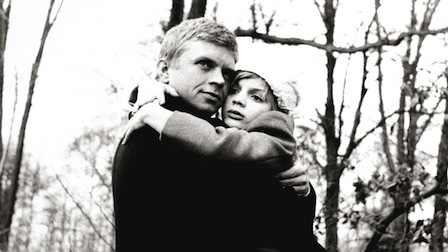
Sundays and Cybele (Serge Bourguignon, 1962) – A childlike amnesiac (Hardy Kruger), unable to repair his life after a wartime plane crash, befriends a 12-year-old (Patricia Gozzi) girl abandoned by her father. They enjoy blissful Sundays together, aside from his periodic attacks of irrationality, but outsiders begin to distrust the relationship, leading to tragedy. This intensely moving, truly original drama – with increasingly spare comic touches – confronts the cynicism, horror and alienation of the adult world, Bourguignon ingeniously shifting styles to contrast the stifling mundanity of Kruger’s apartment – and his unconnected life – with the tranquil idyll of the park where he and Cybele indulge in transcendent fantasy. It isn’t that Kruger doesn’t have love in his adult life, just that he wants to shrink from the world that forced him to gun down an innocent child. He, young Gozzi and Nicole Courcel – as the protagonist's conflicted girlfriend Madeleine – are terrific, while the film boasts some of the most striking black-and-white photography you’ll ever see: an endlessly creative variety of shots drawing you inexorably in to the heartbreaking story. (4)
***

*SOME SPOILERS*
The Young in Heart (Richard Wallace, 1938) – Magical comedy about a family of con artists who move into the house of a guileless, lonely old woman (Minnie Dupree), hoping to become her heirs, only to be transformed by her benign influence, and by love. It’s a promising premise, but where it really succeeds is in the cast – every role filled by the ideal late-‘30s actor, from Janet Gaynor as a flinty daughter discovering her humanity, to Roland Young and Billie Burke as her parents, displaying that old Topper spark – and a wonderful script. It's like little else I’ve seen from classic Hollywood, fusing the sentimentality of a typical Selznick production with a sense of irreverence and absurdity that’s like something from an ‘80s indie movie. Take the scene where Young is forced to go to work for the first time, cutting short his sightseeing trips of London. “There were so many things I never did,” he tells his son, in a perfect parody of mortality cliches, “I never even went to the aquarium.” The film is full of these bizarre, underplayed comic moments, which are refreshingly intelligent, while possessing a thoroughly modern sensibility. Coupled to an interesting subtext about the family loving the very idea of its harshness, it makes the film's climactic leap into heartfelt emotion – which builds on short passages of kindness and wisdom at crucial junctures – all the more affecting. Ben Hecht used a similar approach for his 1941 film Angels Over Broadway (which also starred Douglas Fairbanks, Jr.), while the plot presumably inspired the 1945 movie The Cheaters, which also cast Burke in her usual role as a wittering mother, while relocating the story to Christmas. The Young in Heart is a bracingly different kind of Hollywood movie, with a strikingly unusual feel and a superb cast that also includes Paulette Goddard, Henry Stephenson, Richard Carlson (doing a bad Scottish accent), a wobbly penguin and a cute puppy. Best of the bunch are Gaynor, who has some marvellous moments, Dupree and Young – in a perfect performance that requires him to be both loveably corrupt and touchingly repentant, without overegging either. The Fairbanks-Goddard chemistry is also first-rate. The only bit of the movie that doesn’t work is a slightly dull, unfunny scene of Young driving the car of the future, courtesy of some dodgy process screen work, but it’s only about 40 seconds long. The rest of it is amazing. (4)
See also: Gaynor had been perhaps the most important actress of the late silent era - her three films with director Frank Borzage are reviewed here (7th Heaven and Street Angel) and here (Lucky Star). She retired after The Young in Heart and made just one more film, a '50s movie about teenagers.
***

*MINOR SPOILERS*
Crazy, Stupid, Love (Glenn Ficarra and John Requa, 2011) – I enjoyed this a lot at the cinema and it’s just as good on DVD: a wise, touching, often very funny ensemble romantic comedy, dealing with the entanglements of divorcing couple Steve Carell and Julianne Moore, their son Jonah Bobo, and the incorrigible womanising slickster (Ryan Gosling) who’s teaching Carell to “be a man”. Carell – in one of those poignant parts he does well – Bobo and Emma Stone are all excellent, though it’s Gosling (*sigh*) who walks off with the film, exhibiting a masterful sense of timing and the ability to create irressistible chemistry with anybody who happens to be in the same room. (Can I be in a room with him? Oh please.) How he didn’t get a Best Supporting nomination is beyon- oh no, wait, I've just remembered the Oscars are rubbish. There are three very special comic scenes in the film, and Gosling is in all of them: the pep talk with Carell in a bar, his chat with Stone about a massage chair ("Who has one of those? Me, I do") and a classic bit of farce that brings together all the main characters in a surprising and clever way. On the downside, Julianne Moore isn’t very good at comedy and there’s the odd scene that drags, but I’m sticking by my oft-derided contention that this is the best mainstream romcom since Just Like Heaven. (3.5)
***

Three Colours White (Krzysztof Kieslowski, 1994) – The second of Kieslowki’s Three Colours trilogy is a black comedy on the subject of “equality”, as Czech immigrant Zbigniew Zamachowski reacts to life giving him lemons by making some horrible revenge. His target is heartless ex-wife Julie Delpy, who likes to mock him by being loudly pleasured down the phone. Visiting sadistic unpleasantness on its central duo, it's droll rather than funny, and the least impressive of the tricolore triumvirate, but well-constructed and engrossing, with a powerful pay-off. (3)
***

*MINOR SPOILERS*
Artists and Models (Frank Tashlin, 1955) – When artist Dean Martin needs inspiration for a violent new comic book, he takes it from the dreams of his best pal (Jerry Lewis). Unfortunately they also contain the secret code for a new space station. This is the first Martin and Lewis film I’ve seen, and it was OK. Lewis isn’t particularly funny, but you acclimatise to his relentless mugging after a few minutes, and he had a few good moments – particularly his encounter with the Bat Lady and the fat lady. I watched it because of Tashlin, a former animator who specialised in big, bright comedies satirising anything he felt like, including the marvellous Will Success Spoil Rock Hunter? But here his direction is overbearing to the point of being annoying, with sound effects at every juncture. The film’s best moments belong to Shirley MacLaine as Lewis’s girlfriend (it’s always amusing to see where stars ranked in the Hollywood Order of Attractiveness). This was her second film and she's so full of energy she's practically bouncing into your living room. Particularly good is her reprisal of the number Innamorata, where she leaps around a staircase, trying to kiss Lewis. In fact, the musical interludes are mostly surprisingly good; rather better than the comedy (the tone is set by the opening scene, which promises a man being flung through a billboard and then contents itself with dropping some paint on people’s heads). Martin’s Lucky Song, filmed in a similar way to I Got Rhythm from An American in Paris, is a joy, and the title tune is cleverly staged around an artist’s palette filled with various women. Did I mention that the film is quite sexist? All in all, I’m not in a rush to check out more Martin and Lewis movies, but if there’s one on TV, I might give it a go. (2.5)
See also: MacLaine is also in The Apartment. This piece is about how The Apartment is amazing.
***

Perrier’s Bounty (Ian Fitzgibbon, 2009) – When his plans to pay back a €1,000 debt go awry, scruffy criminal Cillian Murphy, the girl he loves (Jodie Whittaker) and his dying dad (Jim Broadbent) have to stay one step ahead of Brendan Gleeson’s goons, who want to lop off his willy and put it up his bottom. Given the cast, this crime-comedy is a big disappointment, with a poor, mannered script of the type currently entrancing the Irish Film Board: a torrent of swearing and a show-off’s vocabulary intending to compensate for a complete absence of anything to say. Man. Sorry, everyone in the film says “Man” all the time, like it’s 1967 (or Manchester in 1998). Films like Brick really did create their own vernacular; this isn't how you do that. The movie is also saturated in the kind of obvious post-modern irony of which The Guard was sometimes guilty. Gleeson gives an excellent performance and Murphy and Broadbent are both quite good, but it’s a smug and unsatisfying film, the agreeable invention of parts of the plotting and a handful of nice lines obliterated by a blizzard of bullshit and a climactic death scene that is a new kind of rubbish. Perrier's Bounty sounds like a two-for-one at WHSmith. That it's actually less inspiring than that is probably a criticism. (2)
***

Beautiful Lies (Pierre Salvadori, 2010) – When hairdresser Audrey Tautou receives a lyrical, unsigned love letter, she first throws it in the bin, then fishes it out and sends it to her mum, who’s in a four-year rut. Mumsy (Nathalie Baye) guesses who wrote it – over-educated handyman Jean (Sami Bouajila) – but not who it was intended for. After unwittingly waiting years for a love triangle featuring a mum and a daughter, I’ve seen two in two weeks (the other was It’s a Date), but this one’s no frothy confection; certainly not the Amelie-ish romcom promised by a disingenuous marketing campaign. It starts off cheerily, with an amusing opening 20, but gets lost, becoming a fraught, gloomy romantic drama desperately in need of a lighter touch. As an outwardly harsh businesswoman plagued by loneliness, fear and insecurity, Tautou is excellent, and Bouajila does a good job of articulating his character's predicament, but the film gives the distinct impression of having got out of hand somewhere along the line, with plot developments that simply don’t work. Jean is buffeted around by lies in a way that’s more bleak than funny. Beautiful Lies is neither enjoyable enough to work as entertainment, nor resonant or believable enough to have value as anything else. The French title actually translates as True Lies – I wonder why they changed that. (2)
***

What About Bob? (Frank Oz, 1991) - Multiphobic patient Bill Murray crashes psychiatrist Richard Dreyfuss's holiday, and manages to charm everyone except the doctor, in this desperate screwball comedy. Murray has a few good moments in the second half, but Dreyfuss is embarrassingly bad, giving a relentlessly shouty performance that sinks the movie. Well, that, the script and a hideously intrusive score. It's like Boudu Saved From Drowning, if Renoir's film wasn't satirical, funny or really any good. (1.5)
***

SHORT: Pirate Party on Catalina Isle (Charles "Buddy" Rogers, 1935) - There are loads of these musical-comedy two-reelers doing the rounds, with guest appearances from big stars who a) never interact with each other (they clearly all filmed their parts separately), b) never speak (it must be a payment thing), and c) generally just sit near a pool eating. I'm not sure how that was considered entertainment in the 1930s, though I suppose our generation had Big Brother. I watched this one because of Lee Tracy, but his appearance only lasts for four seconds - he grins, puts a knife between his teeth and throws his head back - which is about 0.33 per cent of the running time. The rest consists of the great Chester Morris struggling with some terrible dialogue as he introduces a few unfunny walk-ons and links various unexciting musical numbers, the best of which are the Busby Berkeley-esque We're in the Money - which steals shamelessly from Gold Diggers of 1933 - and a song-and-dance duo tapping on a ship. Which means the only real reason to check it out is if you want to see a few major players of the period in garish colour (I don't think Tracy ever made a colour feature, aside from the two-strip Doctor X) or are particularly interested in the Avalon, Catalina holiday resort. (2)


