Showing posts with label Daniel Craig. Show all posts

Monday, 2 November 2015

Me at the Spectre premiere


Yes thank you I will have my Pulitzer now

I went to the Spectre premiere last week, as it was at my office. It was amazing. The whole place was transformed, the red carpet was thick and plushy under my feet, I saw the stars of the film and then, after a speech from Sam Mendes, I saw the film.

My premiere experience:

I found out I had been successful in the staff ballot a couple of weeks before the event. There weren't too many to go round, so I was very excited. The ticket arrived in a fancy wallet with gold writing (not pictured).

In the morning, I saw a big mask arriving at Stage Door. It looked like this:


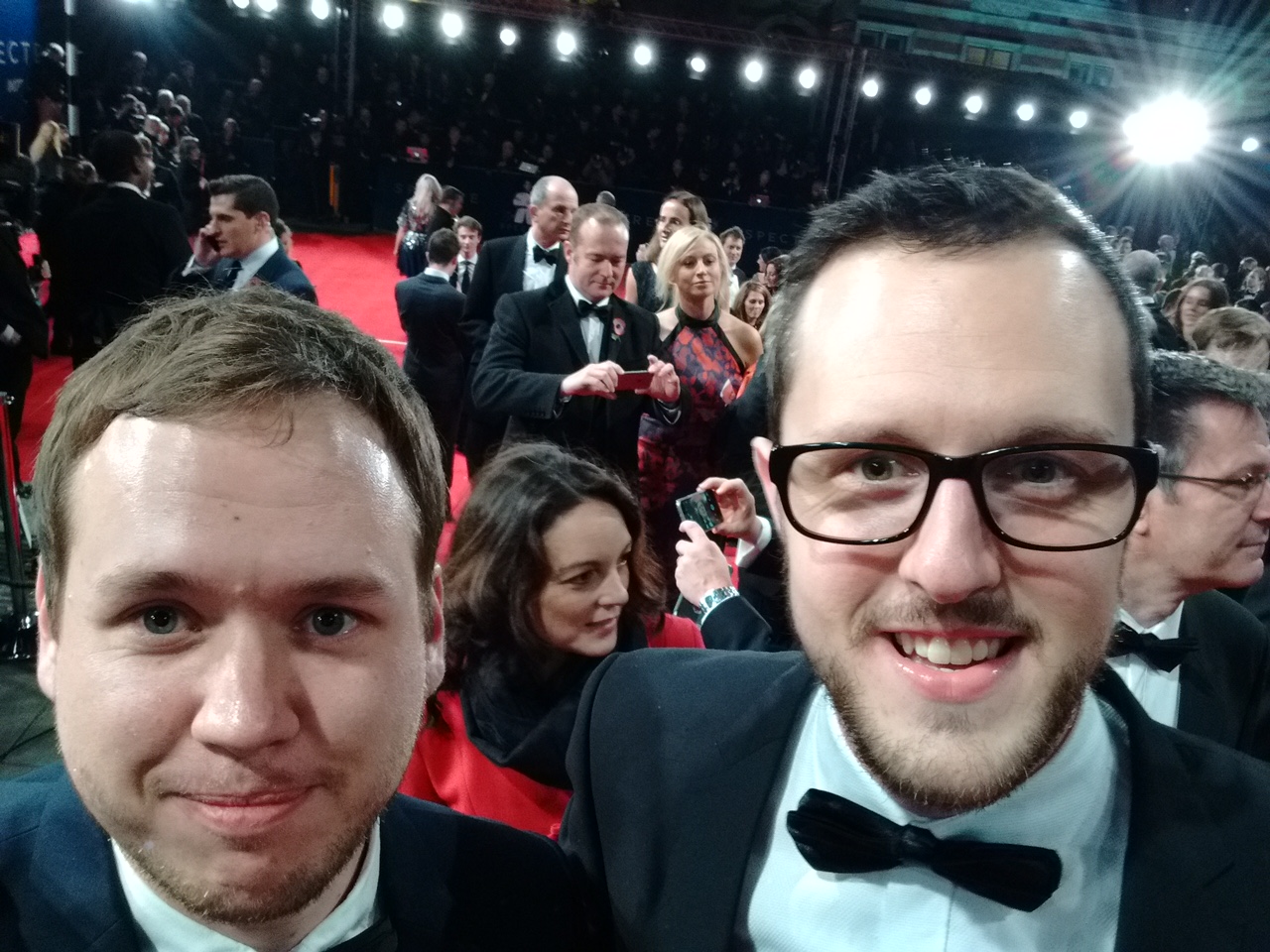
I got changed into my suit jacket from TK Maxx and my bow-tie that I got for £1.50 on eBay and went to join the red carpet. The red carpet looked like this. These are my feet.


I was joined by my friend-and-colleague Martin and my friend-and-boss Jessica. Here I am with Martin.


Here I am with Jess.


In both cases, I am the one with the bumfluff beard. I was pretty delighted about the whole thing. The premiere and the beard.


This is how the Hall looked as we approached:


Of all the people it was possible to see, I was most excited about seeing Ben Whishaw, as he's a wonderful actor. Here he is being wonderful:


He subsequently registered my excitement and gave me a smile that I like to think was sincere rather than frightened. I also saw Andrew Scott, and took this photo for my wife, who is a big fan. She said I can share it with you too, so that's cool:


After that, I went and stood in the middle of the carpet. Despite this, I have not become a social media sensation (I would suggest #HotBondPremiereGuy if you need a hashtag).


Security guards I'd never seen before kept telling me to hurry up, or else gave me very detailed instructions on how to get into the building where I work, but I managed to enjoy my moment by ignoring them. Eventually they got me to move. On the way past, I saw a car and David Walliams. Martin thought it was Sean Connery on the stage, but it wasn't.


Along the side of the stage, I tried to take an arty shot, but it looked a bit rubbish:


I had some water (shaken, not stirred! - I really hate myself) and met some 'friends' (work colleagues), then I went into the world's bestest auditorium, which was filling up:


They showed the rest of the red carpet stuff on the big screen:


Then Sam Mendes came on with the cast. We had a pretty good view:


But their heads are quite fuzzy irl.


Then the lights went down and the film began.

FILM:


Spectre (Sam Mendes, 2015) - Since when did Bond movies get good? Since Casino Royale really (with one boring, Quantum-shaped wobble), when they discovered emotional depth, quiet pathos and the joys of a knowing reference that isn’t just smugly parodic, and encouraged Bond to embrace his world-weariness, the grubbiness of his profession and a brutal, down-and-dirty fighting style, which is now all rabbit-punches and elbows to the face. I appreciate that this isn’t what everyone wants from Bond, but it is what I want.

Spectre isn’t as great as Skyfall, but that is such a high-watermark: a remarkably tricky act to follow. It is, however, a worthy successor. The scene with the rat is probably my favourite moment in a Bond film – giving him, perhaps for the first time, a sense of humour that’s warm and whimsical and self-mocking – there are wonderful supporting bits for Ralph Fiennes and Ben Whishaw, two of the best British actors working today, and the action sequences repeatedly deliver. My favourite is the opener, which is just a virtuosic piece of movie-making: a five-minute Wellesian tracking shot (a nod to Touch of Evil, perhaps, as we’re in Mexico), which follows two figures dressed as skeletons through the streets on the Day of the Dead, then launches us into a short, sharp assassination attempt ending with a fall to earth.

It’s a stunning start to an extremely entertaining, very likeable film that sometimes leans too heavily on flashy motors and callbacks to previous films at the expense of building a gripping story of its own – the plot is frankly a little scant for a film that runs 2hrs 30 – but delivers in just about every other way, with well-drawn supporting characters, good gags and, like, proper acting. While a craggy Craig doesn’t have as many moments to display dramatic range as he did in either Skyfall or Casino Royale, he’s asked to bear this film on his broad back, and he does it with ease. A mention, too, for Sherlock’s Moriarty, Andrew Scott, who does a lot with a slightly imprecise part, and chief villain Christoph Waltz, whose greying locks and hushed, faux-reasoned erudition calls to mind no-one so clearly as Jose Mourinho – though obviously Jose Mourinho is a lot more evil. By contrast, the Bond women (Lea Seydoux and Monica Bellucci) are fine, just... not that interesting, with the script and cinematography doing most of the heavy lifting. And even then, there's a moment where Seydoux orders Bond to leave her building "in the next 10 minutes" or she'll get security to eject him. That's rather a long time, and conspicuously slack screenwriting.

Spectre isn’t perfect, but it’s pretty damn great: riotously enjoyable, genuinely affecting and with a handling of Bond mythology that’s fresh yet respectful, the film pervaded by a swaggering self-confidence (and featuring additional dialogue by West End superstar Jez Butterworth!). If it is Mendes and Craig’s final Bond, it’s a good one to bow out with, but I really hope it’s not, since its balance of artistry, intelligence and blockbuster smarts lifts it way, way out of the ordinary. Not only did Bond films get good, but they’ve stayed good. (3)

***

Sorry if this was boring.

Tuesday, 30 April 2013

Michelle Yeoh, Skyfall and why philosophers love Thor - Reviews #156

A couple of these are in-depth, the rest are mostly jokes (you'll be the judge of that), as I had a busy weekend, without much time to scribble. This reviews update includes... Peter Lorre! James Bond! The return of ClintFest! But first, a Michelle Yeoh double-bill:


Reign of Assassins (Su Chao-pin and John Woo, 2010) - A reformed killer (Michelle Yeoh) with a new face gets a visit from her old gang, and must take up her flappy sword once more in this colourful wuxia film overseen by John Woo. It's Crouching Tiger-lite, but it's enjoyable, affecting and, at their best, the action scenes are a joy to watch. They all involve swords. Yeoh doesn't move with the same breathless speed that she once did, but, like Fred Astaire in the '50s, she's adapted to middle-age delightfully, and that peerless physical grace is still present and correct. Unlike Fred Astaire in the '50s, she could also still have you in a fight.

While the story, which sees various sword-wielding assassins vying to get their hands on the two halves of a corpse that will give them supreme martial arts abilities, is too confusing in places, it's agreeably personal in nature, with most of the characters getting a nice little sketch of a back story: one wants to open a noodle shop, another fears he isn't a real man, and newcomer Barbie Hsu is great fun as a promiscuous psychopath who's offed her fiance and his family, and now can't seem to keep her clothes on. As with The House of Flying Daggers, a third act twist that threatens to derail the whole movie instead provides a wholly unexpected but completely satisfying ending, which in this case should leave you with a tear in the eye and a stupid grin splashed across your face.

Of course, you don't just watch a martial arts movie for the plot, you watch it because you want to see people pretending to have a fight. At first, the action scenes here are infuriatingly mediocre, particularly in the imprecise way they're directed, so you can't quite see what's transpiring. But as the movie progresses, they improve exponentially.

Yeoh's scenes are typically superb - I could watch her just hopping up and down walls all day - and the scene in which she reveals her kung fu smarts is as superb as you'd expect, though perhaps the most memorable scrap has a chap called The Magician nattily employing a load of fire as he engages in a night-time duel. The scene, which sees no fewer than five assassins facing off (pun intended) in a courtyard, has a real whiff of Crouching Tiger about it, even if at that stage the human context hasn't been amped up as effectively nor are the characters as pure and well-defined for it to pack quite the same heavy emotional punch. But, really, what does? It's still an ace set-piece. And while there's scant evidence of Woo's fingerprints in this lively actioner, I do wonder if he suggested that tasty 3D-photo gimmick used to introduce the characters at the beginning.

Reign of Assassins is slightly too inconsistent in both its narrative and its fight sequences to approach the true classics of the genre, but it's entertaining, touching and has a fantastic pay-off. And without wanting to sound like a massive, creepy, lovestruck weirdo, it's just good fun hanging around with Yeoh for an hour-and-a-half - she's an excellent actress and the finest female action star on the planet by an almost insulting distance.

***


Magnificent Warriors (David Chung, 1987) - There's an action sequence here - in which Michelle Yeoh decides to "distract" the enemy - that's among the most extraordinary things I've ever seen on screen: five solid minutes of eye-popping combat, stuntwork and feats of outrageous derring-do that sees her evading, fighting and escaping from a slew of soldiers, and is akin to watching the very best of Jet Li, Yakima Canutt and Buster Keaton all at once. It's worth the £2.99 that I paid for the DVD at least 10 times over. The rest of this period, Indy-ish adventure movie is quite fun too, hampered by a bitty, rather uninvolving story, some tiresome comedy and an unfortunate predilection for slo-mo, but with many incidental pleasures and enjoyable individual scenes. Can't say I think much of Yeoh's hairdo, mind. (3)

***


Skyfall (Sam Mendes, 2012) - What the hell have they done to this Bond movie? It's got real characters, an interesting story, and even a good supporting cast. And wait, Bond can act? And his best gadget's a gun? It's almost like they made a proper film, and it only took them 50 years. Craig Not Bond (Daniel Craig) is James Bond, international man of misogny, who gets shot by a sexywoman (Naomie Harris), but survives to enjoy further encounters with sexywomen, and to do battle with a cyber-psycho (Javier Bardem), who's gunning for Bond's boss (Judi Dench). Chock-full of imagination and shot through with a Tinker Tailor-ish view of patriotism, it's exciting, amusing, even pleasantly sentimental at times, and though a smidgen of silliness remains and the offbeat final act goes on a bit, Mendes and his team still deserve great credit for trying something a bit different, particularly in the pay-off, while still retaining the requisite number of massive explosions. The whole piece is exalted by a great cast, with Harris, Ralph Fiennes and Ben Whishaw all wonderful additions, and both Craig and Dench making the most of the hidden depths revealed across this unusually elegiac, reflective and grown-up action movie (that still includes a bit where a man gets eaten by a Komodo dragon). The name's Bond, and for once my reaction isn't to yawn in his face. (3)

See also: Casino Royale was my previous favourite; it was alright.

***

ClintFest '13:


The Dead Pool (Buddy Van Horn, 1988) - Have you ever wanted to hear Clint call Liam Neeson "love"? Stupid question, of course you have. Received wisdom has it that the Dirty Barry movies follow the law of diminishing returns. I disagree. The Enforcer, a daft, gimmicky flick pairing Clint with a female sidekick, is far more entertaining than Magnum Force - which squanders a fine premise and has no concept of its own muddled worldview - while the widely-reviled swansong, The Dead Pool, for all its many and glaring faults, is a whole lot easier to take than the disgusting rape revenge movie that preceded it, Sudden Impact.

Yes, the story here about a serial killer is daft (even with its then-novel twist), the script has an unfortunate tendency to explain its own one-liners - along with easy-to-grasp phenomena like celeb deaths coming in threes - and the guy playing the hospital psychiatrist seems to have been fashioned from the same block of wood that once produced Charlton Heston. But look at what else we get: Jim Carrey miming to Guns N' Roses as a hopped-up rock star, Liam Neeson sporting a proto-Qui-Gon Jinn ponytail as an egomaniacal horror director, and future indie darling Patricia Clarkson cooking up some surprisingly strong chemistry with the greying Clint, in her role as a saucy TV journalist.

Most excitingly of all, the film features one of the best and most surreal car chases in movies (though I'll acknowledge that I find almost all car chases deathly dull), as Clint is forced to speed around the streets of San Francisco, pursued by a toy car. And, of course, there's the solid entertainment value that comes with each one of these films: their winning formula, strong sense of location and charismatic central performance, which carry them through even when the improbabilities begin to pile up, the stock situations start to tire or the unsuccessful catchphrases ("Marvellous", "Swell") get trotted out one more time. You'd be hard pushed to argue that it's a great film, or that it deserves to be mentioned in the same breath as that unassailable original, but - at least until it tips over into nastiness in the final reel - it's good, silly fun: a diverting little curio undeserving of its dreadful reputation. And Clint calls Liam Neeson "love". Nope, no idea why. (2.5)

Trivia note: Clint becomes the first person to take a harpoon to a gunfight since Sterling Hayden in Terror in a Texas Town. Almost certainly. ***


*SOME SPOILERS*
Mr. District Attorney (William Morgan, 1941)
- Hurray, it's the New York Times' least favourite film of 1941! And to be honest, you can see why: the dialogue is dire and the story's even worse. Dennis O'Keefe plays a wannabe lawyer from a powerful family who becomes attached to the DA's office, thanks to his uncle's connections, then attached to the pretty newspaper reporter he keeps accidentally walking into (Florence Rice). That's all very well, a suitable set-up for a screwball mystery, but, from then on in, the characters' actions make no sense: he overrides a colleague to purposefully botch a case (while supposedly observing), the central couple reconcile immediately after she tries to write in the paper that he's hounded someone to suicide, and they wrap up the case of mystery man Mr Hyde (Peter Lorre) through a heady fusion of dumb luck, incoherence and unfunniness. There's one laugh in the whole picture (the DA's exasperated retort to O'Keefe when sending him back to his office), which is half the number of hideously misjudged gags: one about a stroke, and the other Rice's baffling exclamation in the climactic scene: "Don't waste ammunition, hit something - if it's only an innocent bystander." Err, what?

So why the two stars? Well, for two of the stars. Rice is cute and appealing as our perky, sparky heroine, calling to mind her performance in the Thin Man rip-off par excellence, 1938's Fast Company. And Peter Lorre is just mesmerising. I'm a big Lorre fan - I'd have him in my five favourite actors of all time - but that fondness for his singular artistry isn't obscuring my judgement. His performance drips with menace and creeping malevolence, turning the movie from a stale programmer to something truly remarkable each time he appears. He has only three scenes, but those passages, shot in an Expressionistic style completely at odds with the rest of this bland movie, are visually superb and dramatically electrifying. We hear a lot about Hyde before he appears, but nothing prepares you for that ominous entrance - emerging from the shadows like Harry Lime - or his quiet, introductory spiel, the potentially banal dialogue lent a chilling air by Lorre's unapproachable delivery. And he even hides out after a murder by just inching up some stairs, as he had in the "first noir", Stranger on the Third Floor, the previous year.

O'Keefe, who would find a niche as a cynical, brutish leading man in Anthony Mann's superb noirs of the late 1940s, is simply miscast as our lolloping, effete lawyer, though there's a ridiculously strong supporting cast for a film from the cheapo Republic studio. Almost a dozen recognisable character actors appear in some form or another: camp southerner Grady Sutton, bespectacled Charles Halton, even gaunt, blonde-haired Billy Benedict, whose sole contribution is to walk down a corridor. Charles Arnt - who played a cheery banker memorably in I Love You Again - is neatly cast against type as, well, a banker again, but one driven to theft by pure animal lust. Joan Blair is also quite interesting as unrepentant bad girl Betty Valentine, overcoming some dodgy material thanks to a dose of unexpected charisma. She had a bit part in Citizen Kane, of all things, the same year.

Mr District Attorney is a patchy, brainless affair that begins with a crap "meet cute" and ends in a blizzard of incoherence and improbability, but it is worth it for Lorre's startling contribution, and Rice's best efforts to inject some sense of charm and realism into an almost wilfully scrappy hotchpotch of improbable plotting, inconsistent characterisation and deeply unamusing irascibility. O'Keefe returned six years later for a film with an identical name, based on the same successful radio series, though no longer playing for laughs. Not that he, or anyone else, get many here. (2)

***


Also, I found this great quote by Heidegger about how much he enjoyed the film Thor: "The less we just stare at the hammer-thing, and the more we seize hold of it and use it, the more primordial does our relationship to it become, and the more unveiledly is it encountered as that which it is." He's right, you know. He also likes it in Avengers when Hulk goes smash.

Friday, 25 March 2011

Bourne x 2, Bond 22 and two James Nesbitts - Reviews #58

Here are some more reviews. Irony fans will want to read on, as I've employed their favoured linguistic device twice. There's a couple of rude words in there too, so if that offends, steer clear. Unless you really like irony.


Seducing Doctor Lewis (Jean Francois Pouilot, 2003) - I saw this at the cinema when it came out. I liked it a lot then and I still do. It's a neat spin on the old city-slicker-is-won-over-by-small-town-life stock plot, which as we know is just about the best device going. Here, the little guys try every trick in the book to secure the services of coke-sniffing, foot-massaging, father-figure-seeking Doctor Lewis (David Boutin) and thus land the tupperware factory that will restore some dignity to their lives. There are lots of smart ideas and clever sequences (the cricket match, the big catch, the mass dash across town) along with some well-drawn characters who are both desperate and devious, while remaining likeable and engaging. Having seen how badly this sort of thing was done by Waking Ned only made me appreciate it more. It's not overly demanding and some will find it too gentle (I haven't mentioned yet how pleasant the scenery is), but to me it's the epitome of charm and there are some really great jokes. (3.5)

***


"Treadstone - tell me what it's all a-pout."

*SOME SPOILERS*
The Bourne Supremacy (Paul Greengrass, 2004)
- A tour of the world's finest modern train stations, directed by that beardy yokel off of Heartbeat, and just as good as that sounds. Amnesia victim Jason Bourne (Matt Damon) is back in this exhilarating, globetrotting game of cat-and-homicidal-mouse-and-cat, hunting the criminals that offed his girlfriend, as he tries to clear his name of a double murder. It's punchy, gripping and superbly shot and edited, with a suitably sombre turn from Damon to hang the whole thing on. Only the climactic car chase goes on a bit. This is what you hoped Bond would be, but never was. I'm projecting again. (3.5)


The Bourne Ultimatum (Paul Greengrass, 2007) - A dynamic conclusion to the trilogy, with Bourne (Matt Damon) striving to uncover his true identity, while being pursued by a succession of assassins. It's truly heart-pounding stuff: a series of extraordinary action sequences (some of them decidedly minimalist) interspersed with plot-heavy chatting and footage of Damon getting on and off trains and boats. The script is incredibly well-plotted and inventive, as Bourne battles guerilla-style against all-pervading surveillance, and the human drama is again agreeably understated, with Julia Stiles finally given something to do except get kidnapped, in a touching subplot. Again, the denouement isn't quite as strong as the rest, but that's my only gripe with this invigoratingly exciting movie. (3.5)

***


"He's got a gun and great big man-tits/He's got jug ears and tiny trunks/Dame Judi Dench is furious with him/He's gone completely out to lunch...” By far the best things about Quantum of Solace (Marc Forster, 2008) are its spoof theme tunes by Adam and Joe. Viewed in the light of the last two Bourne – and indeed, 2006's Casino Royale – the film itself seems a little lacklustre, tentative and rushed, as if it was written in about 15 minutes. That's not to say it isn't diverting. Daniel Craig's portrayal of Bond as a pocket-sized hothead remains impressive, Judi Dench is a fine M – stern but fiercely protective in the schoolmarm-ish manner – and there are some fairly effective action sequences, including Bond wiping out a lift-full of British secret servicemen in five seconds flat. It's just a pity the plot isn't really up to it, as underwhelming David Mitchell-Peter Lorre hybrid Mathieu Amalric schemes to overthrow the Bolivian Government and steal its precious resources, belying his reputation as a philanthropist and environmentalist. Fucking environmentalists, trying to stop me driving a 4x4, flying to London and burning tyres in my front garden; they're clearly the greatest danger to the modern world. Clarkson told me. Decent coda, though. (2.5)

***


Anchorman: The Legend of Ron Burgundy (Adam McKay, 2004) - "When in Rome...", "Veronica had a very funny joke today!", "60 per cent of the time it works every time", "You know how to cut to the core of me, Baxter", "Agree to disagree", "Milk was a bad choice"... There are plenty of great lines and funny ideas in Anchorman, but it's unquestionably erratic, with some seriously dry spells and a supporting performance from Steve Carell that's completely undercut by the crass, offensive line about him being "mentally retarded". For fuck's sake - is that still considered OK? The story sees self-assured local news anchorman Will Ferrell and his office full of chauvinists thrown off kilter by a talented new arrival, who just happens to be a woman. This is as funny as I've seen Ferrell and there's a strong supporting cast, including Paul Rudd (who's always good value), David Koechner and whoever that blonde chick with the nice arse was. Whammy. (3)

***


Boo-yah. This, I like.

Ride Clear of Diablo (Jesse Hibbs, 1954) - A solidly entertaining Audie Murphy Western, one of a string of superior B movies starring the most decorated US soldier of WWII. Dan Duryea perhaps overdoes it this time, cackling away in his familiar supporting role like a parody of Richard Widmark in Kiss of Death, but he's always fun to watch and the movie is largely well-played and well-mounted (the church social is wonderfully-directed), with a cracking action climax. At least until Murphy decides to stop blasting away and rugby-tackle the baddie. (3)

***


Cate Blanchett as Elizabeth I. I think. I can't be bothered to check.

Elizabeth (Shekhar Kapur, 1998) - Boring, confusing historical drama. Blanchett's quite good in the lead and there are a couple of moments that work (Edward Hardwicke's act of coat-y kindness, the final scene), but the script is poor and the eclectic cast (Eric Cantona, Angus Deayton, Lily Allen) offers very little. The tone is set by the opening exchanges, in which horrible spotty Queen Mary sits in her dark, airless attic, being all weird, while Elizabeth skips around in a field. (1.5)

***


TV: Jekyll (2007) - This is another super series from the pen of Steven Moffat, a fusion of human drama, conspiracy thriller and blood-soaked horror. James Nesbitt is research scientist Dr Jackman, whose very special problem sees him forced into battle with scallies, shadowy Americans and his own unhinged alter-ego, the redoubtable Mr Hyde. The plotting is consistently inventive - sometimes dizzyingly so - right down to a killer twist near the end, though I'm not convinced the disparate elements quite slot together. As usual, Moffat provides a heap of memorable set-pieces and nifty one-liners. One of the things I admire most about him is his ability to reveal something terrible to the viewer a fraction of a second before it dawns on a character. It's a really difficult thing to pull off, but he does it effortlessly, most notably in episode four, with the knocking on the door and the ice-cream van jingle. He's also effective at subverting the previously innocuous - like the old nursery rhyme Boys and Girls Come Out to Play - but in a way that's largely removed from gimmickry and reveals something of his hero or villain. Nesbitt is really good value in the lead, whether underplaying sympathetically or camping it up outrageously, and there's effective support from Michelle Ryan, though there are a few iffy American accents about and I don't trust Gina Bellman as a dramatic actress. All in all, great fun, and I'd be well up for watching a second series. The show's big reveal is the third scariest thing I've ever seen on telly, after 1) Grotbags (when I was four) and 2) The "Psirens" episode of Red Dwarf (when I was nine). (3.5)

Thursday, 11 March 2010

Our Friends in the North - TV review

I watched the whole series over four nights this week. Here's a write-up:


Our Friends in the North (Simon Cellan-Jones, 1996)

*MAJOR SPOILERS ALL THE WAY THROUGH*

Peter Flannery's journey through three decades of working class history is a passionate, astute and astonishingly sure-footed drama, tracing the contrasting fates of four Geordies in a vividly-realised world of police corruption, ill-conceived town planning and vice. The four stars roughly represent archetypes of the period - a Labour chameleon, a Thatcherite self-made man, a radical and an apathy factory - but they're much more interesting and well-rounded than that.

Nicky (Christopher Eccleston) is our radical. In 1964 he wants to change the world. By 1979 he's part of the militant tendency, having gun-run for the anarchists. Eight years later, he's all burnt out: a self-centred, unhappy academic jettisoning happiness for a cheap thrill and trying to connect with a father lost to Alzheimer's. Mary (Gina McKee) is the childhood sweetheart he let down back in '64, leaving her to the clutches of wannabe musician Tosker (Mark Strong). She grows up to be a Labour stalwart, while Tosker morphs into a wealthy developer thanks to Thatcher's tax breaks. The apolitical Geordie (Daniel Craig, in startling form) is a likeable likely lad who becomes immersed in a Performance-like world of strip clubs and Soho hoods (including Malcolm McDowell) and pays with his sanity.

Each of the nine episodes covers a specific year (from 1964 to 1995), containing apparently major events that crumble to dust and supposedly minor ones that grow in significance as they echo through the decades. The series is extraordinary in that it never goes where you expect it to and yet always rings completely true.

Fact and fiction

Mixing fact and fiction in a sur-Ellroy manner, the narrative encompasses the John Poulson public housing scandal rooted in the 1960s, successive investigations into police corruption and - in a bravura, largely self-contained episode - the miners' strike of 1984. There may be concessions to conventionality in the shape of three or four one-dimensional right-wing "baddies", but Flannery's glorious, deep writing creates an overwhelming number of compelling, multi-faceted characters, several of whom are among the greatest in television history.

Austin Donohue (a vivid characterisation from Alun Armstrong) is an arrogant, bribe-taking, bribe-paying councillor in bed with a property developer. And yet "Mr Newcastle" - based on the disgraced T. Dan Smith - is utterly human, with frailties that can't be papered over by an unmatched gift of the gab, and justifying arguments that are as practical as they are unpleasant. He gets a glorious send-off too, with a final line that's one of the high points of the series. "Oh no, not on the street, man, not on the street," he says, as the cops arrive to arrest him.

Nicky's father Felix (Peter Vaughan, Porridge's Grouty and one of Straw Dogs' more reprehensible villains), meanwhile, is haunted by the failure of the Jarrow March and incapable of showing love or respect for his son, whom he describes as "useless", as Alzheimer's later takes hold. Geordie is the story's Sebastian Flyte: attractive, sympathetic and laid low by drink, with his friends powerless to help.

Interestingly, Tosker follows a similar path to redemption as Soames, Eric Porter's enduringly controversial character in the 1966 Forsyte Saga. Admittedly the musician-cum-mogul doesn't rape his wife, but there is an extremely uncomfortable scene in which he accuses Mary of "ripping him off", and then has his way with her as she looks on boredly. By 1995 he is as successful in his homelife as in the business world, becoming a fully-fledged family man and possessing enough empathy to give his old pal Geordie not only a job, but also a place to stay.

Emotional wallops

This novelistic work, based on Flannery's 1982 play, is incredibly engrossing - try thinking about anything else between episodes and you'll see what I mean - and extremely moving. Donohue's exit is a killer, but there are numerous other wallops, like Nicky's photographing of a bearded vagrant in 1984, his hug with Geordie in the final episode, as Colin Towns employs his wonderful theme music within the action for the first time, and the pair's unforgettable talk about the love of Geordie's life. "When I was with her, everything made sense," he says. While the series is bleak and emotionally draining, it's also blackly funny, with an oft-hilarious 1979 episode that suggests the whole of Britain was engaged in some sick joke designed to destroy itself across 11 joyless years. Elsewhere, Flannery jazzes up the history lesson with thriller elements - check out the scene where Geordie returns to London after laying low: a masterclass in nausea-inducing dread.

Our Friends in the North is meticulously constructed, with elements that slot perfectly into place and a heavy sense of fatalism. But it's never forced or artificial, and boasts memorable, brilliantly-drawn characters elevated by some sensational acting. Craig, as the unconquerable Geordie, is the stand-out, retaining the character's essential spark, guilessness and penchant for silly jokes even when he's beaten down by life. The scene in which the booze-addled arsonist tells the cops he and a few other lads "set fire to a guy once" is superbly judged. "When was this, Geordie?" asks the officer. "Bonfire Night," he replies, exposing filthy teeth as he breaks into a delighted guffaw.

The series is, simply, magnificent - astonishingly ambitious, intelligent and impassioned, with inspired use of symbolism as it charts the fluctuating fortunes of Newcastle's working class since 1964 and, really, since the Jarrow Crusade of '36. Without ever labouring the point, it draws a parallel between Felix's dementia and the collective amnesia of the proletariat about its proud shared heritage. It's no coincidence that his character's condition is brought on by a crass, belittling thug and his Alsation - the alienated, unthinking '80s man lashing out in the only way he knows how, and savaging the spectre of working class resistance in the process. In his police interview, Geordie says the Labour Party told him to set fire to a mattress - "and that's why I don't vote for them, because they tell you to do daft things", suggesting that for vast swathes of the working class, the party's stance has proved to be unsuitable, wrong-headed and ultimately unintelligible.

Dazzling, heart-rending and uncompromising, with inspired use of music (including, of course, Don't Look Back in Anger by Oasis in the climactic scene), it's a landmark piece of work and one of the most profoundly affecting experiences of my life. It's also slightly dispiriting, as I'll never be able to write anything a tenth as good. (4)
----------------------------------------------------------------------------------
Our Friends in the North is currently unavailable on DVD and VHS. I'd advise you check your local library, rather than forking out £145 for a second-hand copy. Though it's certainly worth that, if you're loaded.